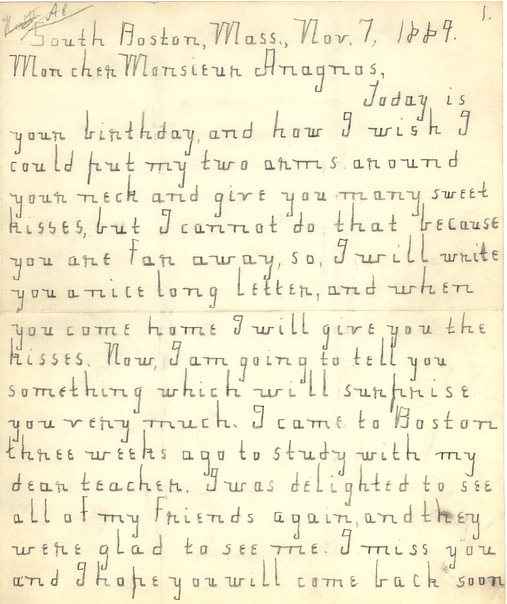
Image by Flickr, courtesy of Perkins School for the Blind
The inspirational blind and deaf activist and educator Helen Keller learned to speak aloud, but, to her great regret, never clearly.
Her careful penmanship, above, is another matter. Her impeccably rendered upright hand puts that of a great many sighted people—not all of them physicians—to shame.
Keller learned to write—and read—with the help of embossed books as a student at Perkins School for the Blind. The United States didn’t adopt Standard Braille as its official system for blind readers and writers until 1918, when Keller was in her late 30’s. Prior to that blind readers and writers were subjected to a number of competing systems, a situation she decried as “absurd.”
Some of these systems had their basis in the Roman alphabet, including Boston Line Type, the brainchild of Perkins’ Founding Director, Samuel Gridley Howe, an opponent of Braille. Students may have preferred dot-based systems for taking notes and writing letters, but Boston Line Type remained Perkins’ approved printing system until 1908.
There’s more than an echo of Boston Line Type in Keller’s blocky characters, as well as her spacing. Deviating from penmanship forms learned at school is a luxury exclusive to the sighted. Until formation became instinctual, Keller relied on a grooved board to help her size her characters correctly, an exhausting process. Small wonder that she ended many of her early letters with “I am too tired to write more.”
Perkins has published a Flickr album of letters Keller wrote between the ages of 8 and 11 to then-director Michael Anagnos, including 3 pages in French. Leafing through them, I marveled less at her ability and determination than my (sighted) 16-year-old son’s lack of interest in developing a respectable-looking hand.
Keller’s handwriting is so above reproach that it quickly fades to the background, upstaged by her charming manners and girlish preoccupations. A sample:
If you go to Roumania, please ask the good queen Elizabeth about her little invalid brother and tell her that I am very sorry that her darling little girl died. I should like to send a kiss to Vittorio, the little prince of Naples, but teacher says she is afraid you will not remember so many messages.
Ayun Halliday is an author, illustrator, theater maker and winemaker who played Annie Sullivan in her high school’s production of The Miracle Worker. Follow her @AyunHalliday.
Unless you’re a policy geek or an educator, you may never have heard of the “STEM vs. STEAM” debate. STEM, of course, stands for the formula of “science, technology, engineering, and mathematics” as a baseline for educational curriculum. STEAM argues for the necessity of the arts, which in primary and secondary education have waxed and waned depending on prevailing theory and, perhaps more importantly, political will. Andrew Carnegie may have donated handsomely to higher education, but he frowned on the study of “dead languages” and other useless pursuits. Industrialist Richard Teller Crane opined in 1911 that no one with “a taste for literature has the right to be happy” because “the only men entitled to happiness… are those who are useful.”
It’s a long way from thinking of poets as “the unacknowledged legislators of the world,” as Percy Shelley wrote in his “Defence of Poetry” 90 years earlier, but Shelley’s essay shows that even then the arts needed defending. By the time we get to STEM thinking, the arts have disappeared entirely from the conversation, become an afterthought, as venture capitalists, rather than wealthy industrialists, decide to trim them away from public policy and private investment. The situation may be improving, as more educators embrace STEAM, but “there’s tension,” as Neil DeGrasse Tyson says in the excerpt above from his StarTalk interview show on Nat Geo. In the kinds of funding crises most school districts find themselves in, “school boards are wondering, do we cut the art, do we keep the science?”
The choice is a false one, argues former Talking Heads frontman and sometimes Cassandra-like cultural theorist David Byrne. “In order to really succeed in whatever… math and the sciences and engineering and things like that,” Byrne tells Tyson above, “you have to be able to think outside the box, and do creative problem solving… the creative thinking is in the arts. A certain amount of arts education…” will help you “succeed more and bring more to the world… bringing different worlds together has definite tangible benefits. To kind of cut one, or separate them, is to injure them and cripple them.”
The idea goes back to Aristotle, and to the creation of universities, when medieval thinkers touted the Liberal Arts—the Trivium (grammar, rhetoric, and logic) and Quadrivium (arithmetic, geometry, music, and astronomy)—as models for a balanced education. Tyson agrees that the arts and sciences should not be severed: “Suppose they did that back in Renaissance Europe? What would Europe be without the support and interest in art?” He goes even further, saying, “We measure the success of a civilization by how well they treat their creative people.”
It’s a bold statement that emerges from a longer conversation Tyson has with Byrne, which you can hear in the StarTalk Radio podcast above. Tyson is joined by co-host Maeve Higgins and neuroscientist and concert pianist Dr. Mónica López-González—and later by Professor David Cope, who taught a computer to write music, and Bill Nye. Byrne makes his case for the equal value of the arts and sciences with personal examples from his early years in grade school and art college, and by building conceptual bridges between the two ways of thinking. One theme he returns to is the interrelationship between architecture and music as an example of how art and engineering co-evolve (a subject on which he previously delivered a fascinating TED talk).
You won’t find much debate here among the participants. Everyone seems to readily agree with each other, and I can’t say I’m surprised. Speaking anecdotally, all of the scientists I know affirm the value of the arts, and a high percentage have a creative avocation. Likewise, I’ve rarely met an artist who doesn’t value science and technology. We find example after example of scientist-artists—from Albert Einstein to astrophysicist Stephon Alexander, who sees physics in Coltrane. The central question may not be whether artists and scientists can mutually appreciate each other—they generally already do—but whether school boards, politicians, voters, and investors can see things their way.
Law school graduates always ask themselves the same question: after all this, what have I learned? The commencement speaker at University of California, Hastings College of Law’s class of 1983 told them exactly what they’d learned. “You’ve learned to hear at twice the speed of sound, listening to the criminal law lectures of Amy Wilson,” he said, to loud applause and laughter. And “who will ever forget professor Rudy Schlesinger? They say the man is a wonderful combination of Walter Brennan and Otto Preminger.” He then launches into not just an impression of the professor calling on one of his students, but the student as well.
Few commencement speakers can keep their audience in stitches, much less throw out a wide range of cultural references at the same time — and do all the voices. Robin Williams could, and while the students to whom he delivered the ten-minute talk above receive it as a tour de force, the rest of us can study it as an example of how to craft a speech with your audience in mind. Not only did the young San Franciscan comedian, then just out of his career-making role on Mork & Mindy, quickly establish his local credibility (at one point referring to the school as “UC Tenderloin”), he filled his remarks, swerving from high to low and dialect to dialect, with jokes only a Hastings student would get.
“ ‘He spent several days on campus preparing,’ remembers one alumna,” according to the video’s notes, “and offered up flawless, hilarious parodies of both students and faculty members as part of a message about the value of education and the importance of the legal system in society.” Hastings’ graduating classes get to choose their own commencement speakers, and 1983’s chose Williams with virtual unanimity. Knowing his comic persona from television, movies, and stand-up, they surely knew he’d turn up and make them laugh. But how many could have imagined that he would so handily demonstrate that knowledge is, indeed, power? All of them can now rest assured that Williams, who died two years ago today, has become the most in-demand speaker in that great San Francisco Civic Audtorium in the sky.
Malcolm Gladwell’s Revisionist History podcast kicked off this summer and in his very first episode, he took on the question of how women have broken into male-dominated fields, and the many reasons that so often hasn’t happened. Having set this tone, Gladwell asks in a more recent inquiry—a three-part series spanning Episodes 4 through 7—a similar question about what we might call meritocracy in education, a value fundamental to liberal democracy, however that’s interpreted. As Gladwell puts it in “Carlos Doesn’t Remember,” “This is what civilized societies are supposed to do: to provide opportunities for people to make the most of their ability. So that if you’re born poor, you can move up. If you work hard, you can improve your life.”
Over some sentimental, homespun orchestration, Gladwell points out that Americans have told ourselves that this is our birthright, “that every kid can become president.” We have seen ourselves this way despite the fact that at the country’s origin, higher offices were solely the property of propertied men, a small minority even then. Lest we forget, for all their good intentions, Ben Franklin’s Poor Richard’s Almanack and later collection, “The Way to Wealth,” were written as satires, “relentlessly scathing social and political commentary,” writes Jill Lepore, that mock wishful thinking and exaggerated ambition even as they offer helpful hints for organized, diligent living. Americans, the more cynical of us might think, have always believed impossible things, and the myth of meritocracy is one of them.
But Gladwell, skimming past the cultural history, wants to genuinely ask the question, “is it true? Is the system geared to serve the poor smart kid, or the rich smart kid?” Apart from our beliefs and political ideologies, what can we really say about what he calls, in economics terms, “the rate of capitalization” in the U.S.? This number, Gladwell explains, measures “the percentage of people in any group who are able to reach their potential.” Better than “its GDP, or its growth rate, or its per-capita income,” a society’s capitalization rate, he says, allows us to judge “how successful and just” a country is—and in the case of the U.S. in particular, how much it lives up to its ideals.
The first episode in the series (Episode 4 of the podcast, stream it above) introduces us to Gladwell’s first subject, Carlos, a very bright high school student in Los Angeles, and Eric Eisner, a retired entertainment lawyer who devotes his time to scouting out talented kids from low income families and helping them get into private schools. Eisner did exactly that for Carlos, finding him a place in an upscale private Brentwood school in the fifth grade. Early in Gladwell’s interview with Carlos, the question of what James Heckman at Boston Review identifies as the “non-cognitive characteristics” that inhibit social success comes up. These are as often “physical and mental health” and the soft skills of social interaction as they are access to something as seemingly mundane as a pair of tennis shoes that fit.
Carlos, a “really, really gifted kid,” Gladwell reiterates, cannot make it into and through the complicated social system of private school without Eisner, who bought him new tennis shoes, and who provides other material and social forms of support for the students he mentors. Students like Carlos, Gladwell argues, need not only mentors, but patrons in the mold of an ancient Roman patrician: “not just any advocate: a high-powered guy with lots of connections, who can get you in and watch over you.” The key to class mobility, in other words, lies with the arbitrary noblesse oblige of those who have already made it, generally with some considerable advantages of their own. The remainder of the episode explores the obvious and non-obvious problems with this modern-day patronage system.
In “Food Fight,” the next part of the mini-series on “capitalization,” Gladwell and his colleagues open the door on the world of prestigious liberal arts colleges’ dining services, starting at Bowdoin College in Maine, a place where the food services are “in a whole different class.” Bowdoin’s excellent food, Gladwell argues, represents a “moral problem.” To help us understand, he makes a direct comparison with Bowdoin’s elite competitor, Vassar College, whose student dining is more in line with what most of us experienced at college; in one student’s understated phrase, there’s “room for improvement.” What the food comparison illustrates is this: when many elite institutions doubled their financial aid budgets a decade or so ago to increase enrollment of low-income students, other budget lines, so Vassar’s president claims, took such a hit that food, facilities, and other services suffered.
Vassar’s current president transformed the student body from primarily full-tuition-paying students to primarily students “who pay very little.” The egalitarian move means the college must lean too heavily on its endowment and on the paying students. Gladwell doesn’t delve into what we’ve also been hearing about for at least the last decade: as institutions like Vassar accept and fund increasing numbers of low-income students, other schools charged legally with providing for the public good, like the University of California system, have raised tuition to levels unaffordable to thousands of prospective students.
Colleges across the country may have raised tuition rates to their current astronomical levels in part to better fund poorer applicants, but they have also faced stiff criticism for spending huge amounts on athletics, building projects, and exorbitant administrative salaries. The food comparison presents us with an either/or scenario, but the moral problem inhabits a much grayer reality than Gladwell acknowledges. Likewise, in the story of Carlos, we come to understand why smart kids from poor neighborhoods face so many impediments once they arrive at elite institutions. But we don’t hear about why so many poor kids fail to achieve at all due to what what Heckman calls “the principle source of inequality today”—children born into poverty begin life at a severe disadvantage from the very start, leading to social divisions of the “skilled and unskilled” even in early childhood.
We do get a broader picture in the final episode in the series, “My Little Hundred Millions,” in which Gladwell looks into another moral problem: In the story of Henry Rowan, who in the early ‘90s donated $100 million to a tiny university in New Jersey, we see a stark contrast to the way most philanthropists operate, almost as a rule making their generous gifts to elite, already wealthy schools like Harvard, Stanford, and Yale. This system of philanthropy perpetuates inequality in higher education and keeps elite institutions elite, even as—in places like Vassar—it gives them the reserve capital they need to fund lower-income students. Like any complex institutional system with a long, tangled history of exclusion and privilege, higher education in the U.S. offers us a very good model for studying inequality.
To hear Gladwell’s full assessment of meritocracy or “capitalization,” you’ll need to listen to the full series as it builds on each example to make its larger point. Each episode’s webpage also includes links to reference documents and featured books so that you can continue the investigation on your own, correcting for the podcast’s blind spots and biases. What Gladwell’s series does well, as do many of his pop sociological bestsellers, is give us concrete examples that run up against many of our abstract preconceptions. It’s an interesting approach—structuring an extended look at exceptionalism and its problems around three exceptional cases. But it is these cases, with all their complications and complexity, that often get lost in over-generalized discussions about higher education and the myths and realities of social mobility.
In 1970, when conceptual artist John Baldessari was teaching studio art at the experimental CalArts campus near Valencia, CA, the assignments he handed out to his class were art in themselves. Humorous, confounding, sometimes very specific but often like zen koans, the assignments must have come as a shock, especially to those students with a more traditional sense of what constitutes art.
They probably didn’t know that Baldessari was questioning art itself and in the middle of a crisis. That year he had taken all his previous painted work from 1953 — 1966 and cremated it at a San Diego mortuary. He turned from painting to photography. And he expected his students to rethink everything they thought they knew.
Looking back at his class assignments, which you can see here, here, and here, it’s like seeing the seeds of ideas that were to be turned into whole careers by the likes of Cindy Sherman, Wayne White, Komar & Melamid, and others.
Here’s a selection of favorites:
One person copies or makes up random captions. Another person takes photos. Match photos to captions.
Defenestrate objects. Photo them in mid-air.
Photograph backs of things, underneaths of things, extreme foreshortenings, uncharacteristic views. Or trace them.
Repaired or patched art. Recycled. Find something broken and discarded. Perhaps in a thrift store. Mend it.
Imitate Baldessari in actions and speech.
Punishment: Write “I will not make any more art” / “I will not make any more boring art” / “I will make good art” (or something similar) 1000 times on wall. (Apparently, Baldessari punished himself.)
Some of these assignments are intentionally silly. Some could produce good work. But all are meant to wake the artist up to the possibilities of the form.
Ted Mills is a freelance writer on the arts who currently hosts the artist interview-based FunkZone Podcast. You can also follow him on Twitter at @tedmills, read his other arts writing at tedmills.com and/or watch his films here.
Zombies, alien overlords, sharks, a mad dictator…math is a dangerous proposition in the hands of TED Ed script writer Alex Gendler.
The recreational mathematics puzzles he retrofits for TED’s educational initiative have been around for hundreds, even thousands of years. In the past, storylines tended to rely on biases 21st-century puzzle solvers would find objectionable. As mathematician David Singmaster told Science News:
One must be a little careful with some of these problems, as past cultures were often blatantly sexist or racist. But such problems also show what the culture was like.… The river crossing problem of the jealous husbands is quite sexist and transforms into masters and servants, which is classist, then into missionaries and cannibals, which is racist. With such problems, you can offend everybody!
Gendler’s updates, animated by Artrake studio, derive their narrative urgency from the sort of crowd pleasing sci fi predicaments that fuel summer blockbusters.
And fortunately for those of us whose brains are permanently stuck in beach mode, he never fails to explain how the characters prevail, outwitting or outrunning the aforementioned zombies, aliens, sharks, and mad dictator.
(No worries if you’re determined to find the solution on your own. Gendler gives plenty of fair warning before each reveal.)
Put your brain in gear, pull the skull-embossed lever, and remember, teamwork — and inductive logic — carry the day!
The prisoner hat riddle, above, hinges on a hierarchy of beliefs and the alien overlord’s willingness to give its nine captives a few minutes to come up with a game plan.
Go deeper into this age old puzzle by viewing the full lesson.
Gendler’s spin on the green-eyed logic puzzle, above, contains two brain teasers, one for the hive mind, and one for an individual acting alone, with a strategy culled from philosopher David Lewis’ Common Knowledge playbook. Here’s the full lesson.
Raring for more? You’ll find a playlist of TED-Ed puzzles by Gendler and others here. The full lesson for the bridge problem at the top of the post is here.
Ayun Halliday, author, illustrator, and Chief Primatologist of the East Village Inky zine, will be leading a free collaborative zine workshop at the Gluestick Fest in Indianapolis Saturday, July 9. Follow her @AyunHalliday
Despite the intensive focus on STEM (as opposed to STEAM—a debate for another day), Americans still find themselves falling far behind in science education. According to the National Math and Science Initiative, U.S. students placed 20th in science in a recent ranking of 34 countries. “The way the U.S. teaches science,” argues Popular Science, “simply doesn’t work…. Since scientists don’t just stand around memorizing stuff, students shouldn’t either.” The approach isn’t only counter to the scientific method; it’s tedious and doesn’t engage that most important of intellectual faculties: curiosity.
The problems are beyond pedagogy, as we know from polls that show upwards of 42% of Americans subscribing to literalist interpretations of their religious texts, and actively rejecting scientific thinking. These cultural roadblocks were very familiar to Carl Sagan, who spent a good part of his career attempting to coax the public out of its belief in a “demon-haunted world.” As a science educator, Sagan not only knew how to draw out the childlike awe in grown-ups, but also how to engage the natural curiosity of children, who—as every parent knows—long to know the why of everything.
Sagan’s first talk “explores the diversity of life on our own planet,” writes the Royal Institution, “and the building blocks behind it.” Then, he moves on to “questioning whether the same organic chemistry is occurring on planets in the outer solar system” in his second lecture, above. In the following three talks, below, Sagan takes us to Mars, a planet he helped explore without ever leaving the ground with his theories in the late 60s about the nature of the planet’s surface—theories later confirmed several years later by the Viking Project. Sagan’s talks below—“The History of Mars,” “Mars Before Viking,” and “Mars After Viking”—share the latest research with his young audience. With models of the planet and the Viking spacecraft, Sagan demonstrates in detail how NASA obtained its data.
The History of Mars
Mars Before Viking
Mars After Viking”>Mars After Viking
In his final Royal Institution Christmas Lecture, below, “Planetary Systems Beyond the Sun,” Sagan ventures far beyond the reach of NASA’s instruments (at the time) to speculate on what might lie beyond the Solar System. But first, he orients us—again using models and space photography—by explaining what a solar system is, and why other systems likely resemble ours. In his own scientific career, Sagan was instrumental in promoting the SETI Institute—which now has a center named after him. He believed unflaggingly in the possibility of extraterrestrial life, which he hypothesized based on many of the observations he shares below.
When Sagan delivered these lectures, the Royal Institution points out, “NASA had only just begun its Voyager program to the furthest planets in our solar system and no extra-solar planets were known to exist. Now, over three decades later, astronomers are looking at planets that lie beyond our solar system to ask the very same question we pondered over Mars: is there life out there?” As you may have heard, NASA’s Kepler mission has discovered a “habitable zone” of planets in another solar system with two suns—a find sure to pique the curiosity of kids of all ages, and one that would have excited Sagan to no end.
See Sagan’s Christmas lectures with better video and audio quality at the Royal Institution’s website, and please—whether you’re a parent, teacher, older sibling, etc.—share these with the kids in your life.
For me, nothing captures those occasional feelings of post-graduate yearning like “I Wish I Could Go Back to College,” a N‑quite-SFW track from the Broadway musical, Avenue Q.
With all due respect, it feels like the five members of Harvard University’s just-graduated Class of 2016 sharing their recollections in the interactive 360° video project, Harvard Students Say Farewell, left a few crucial details out. (Note: Youtube 360 videos only work in Chrome, Firefox, Internet Explorer, or Opera browsers.)
It’s completely safe for prospective parents, not a keg or condom wrapper in sight. (The project is hosted on Harvard’s official Youtube channel.)
Unsurprisingly, Harvard appears to have been the participants’ universal first choice of college. Hasty Pudding performer, Joshuah Campbell, above, a self-described “Black kid from the country,” confides that it was the only place he applied to.
He may have arrived wondering how he would fit in, but four years later, his grubby dorm room is one of the “iconic” Harvard locations viewers can explore digitally as he briefly reflects upon his experience.
That’s about as down and dirty as this series gets. The human subjects seem to have been selected with an eye toward diversity and humility, rather than the clenched Boston Brahmin jaw that once defined the institution.
Meanwhile, the libraries, quads, and theaters through which this new breed of Harvard men and women wander attest to the place’s ongoing exclusivity.
Sreeja Kalapurakkel, above, a member of the Harvard South Asian Dance Company, knew what she was getting into, as a student at a respected Boston secondary school. Shortly after graduation, she sung Harvard’s praises somewhat more frankly on her Facebook page:
Each day of my time at Harvard was filled with everything that makes life beautiful: darkness, struggle, despair, loneliness, friendship, hope, perseverance, light. Every experience, every lesson, every friend transformed me into someone more human and gave me something new to fight for.
On to the locker room! Hockey captain Kyle Criscuolo joins the Detroit Red Wings, reflecting that Harvard student athletes enjoy no special treatment. In future, the university may want to require them to listen to Will Stephen’s lecture, “How to Sound Smart in a TED Talk.” Criscuolo sounds sincere, but also stiff, as if reading from a sheet of paper, or the digital equivalent thereof.
Harvard Art Museums Student Board member Rachel Thompson paints herself so meekly, I’m tempted to check with her freshman year roommate. Was she really so filled with self doubt? I’ve always assumed Harvard acceptance letters would puff the recipient up. Good lord, imagine the effect the rejection letters must have!
Use a mouse to explore the immersive environment on your computer, or the YouTube app to navigate on a mobile device. Use a virtual reality headset and the Harvard Crimson staff’s vocabulary list to enhance the experience even more.
Ayun Halliday is an author, illustrator, Chief Primatologist of the East Village Inky zine, and a Northwestern University grad. Follow her @AyunHalliday
We're hoping to rely on loyal readers, rather than erratic ads. Please click the Donate button and support Open Culture. You can use Paypal, Venmo, Patreon, even Crypto! We thank you!
Open Culture scours the web for the best educational media. We find the free courses and audio books you need, the language lessons & educational videos you want, and plenty of enlightenment in between.