Yesterday, the news broke that the Trump administration will apparently be slashing federal spending, to the tune of $10.5 trillion over 10 years. According to The Hill, the “departments of Commerce and Energy would see major reductions in funding.” And “the Corporation for Public Broadcasting [aka PBS] would be privatized, while the National Endowment for the Arts and National Endowment for the Humanities would be eliminated entirely.”
Attempts to cut funding for the arts is nothing new. Above, we take you back to 1969, when Richard Nixon planned to reduce PBS’ funding from $20 million to $10 million. That is, until Fred Rogers, the gentle creator of Mister Rogers’ Neighborhood, spent six short minutes before Senator John Pastore, the chairman of the Subcommittee on Communications, and made his pitch for publicly-funded educational television. In those 360 seconds, Rogers gets the gruff senator to do a complete 180 – to end up saying “It looks like you just earned the 20 million dollars.”
It’s unlikely that Mr. Rogers could get the same traction today. Quite the contrary, his sweetness and sincerity would likely be mocked quite mercilessly, a sign of how coarse our society has become these days.
If you would like to support the mission of Open Culture, consider making a donation to our site. It’s hard to rely 100% on ads, and your contributions will help us continue providing the best free cultural and educational materials to learners everywhere. You can contribute through PayPal, Patreon, and Venmo (@openculture). Thanks!
“Survival of the fittest, this still exists even today. If you’re weak, people pick on you, they take advantage. And if you don’t respond to what they do, they will continually pick on you. You have to frighten them and attack first.”
Those strong words come from Ralph Whims, a teacher who, one night back in 1973, agreed to chaperone a school dance in a church basement. It was a pretty ordinary affair, until a 20-member biker gang barged in, uninvited, and started harassing the kids. What to do? Retreat? Or step forward and restore order? That’s the story, apparently all true, told by the short animation, The Chaperone, created by Fraser Munden. (His own father once had Ralph Whims as an elementary school teacher in Montreal.) This empowering short film has been screened at 70 film festivals and won 25 awards. You can get more backstory on the film by reading an interview with the director here.
If you would like to support the mission of Open Culture, consider making a donation to our site. It’s hard to rely 100% on ads, and your contributions will help us continue providing the best free cultural and educational materials to learners everywhere. You can contribute through PayPal, Patreon, and Venmo (@openculture). Thanks!
By now, most people are familiar with the term “school-to-prison pipeline,” the description of a system that funnels troubled students through disciplinary program after program. Detentions, suspensions, and often expulsions further aggravate many students’ already difficult lives, and send them “back to the origin of their angst and unhappiness—their home environments or their neighborhoods,” writes Carla Amurao for PBS’ Tavis Smiley Reports. Harsh disciplinary policies don’t actually change behavior, and “statistics reflect that these policies disproportionately target students of color and those with a history of abuse, neglect, poverty or learning disabilities.”
In short, students come to school with significant stresses and setbacks, and are themselves treated as problems to be quarantined or forced out. But why not instead teach those students—why not teach all students—effective means of coping with stress and setbacks? I can think of almost no more useful a set of skills to carry into adulthood, or into a troubled home or neighborhood situation. As the CBS This Morning segment above reports, one school in Baltimore is attempting to so equip their students, with a yoga and meditation program during and after school that takes the place of detention and other punishments.
The Robert W. Coleman Elementary School adopted a twice-a-day yoga and mindfulness practice during school hours for all students, called “Mindful Moments”; and an after-school program called Holistic Me, which “hosts 120 male and female students,” writes Newsweek, “and involves yoga, breathing exercises and meditative activities. Disruptive students are brought to the Mindful Moment Room for breathing practices and discussion with a counselor and are instructed on how to manage their emotions.” As we’ve previously noted on this site, these kinds of activities have been shown in research studies to significantly reduce stress, anxiety, and depression and to improve concentration and memory.
In the Holistic Me program at Coleman, “which focuses on prekindergarden through fifth-grade students,” administrators already noticed a difference in the first year. “Instead of the students fighting or lashing out,” says principal Carlillian Thompson in the video above, they started to use words to solve their problems.” None of the students in the program have received suspensions or detentions, and many have become leaders and high achievers. The program was founded in 2001 by brothers Atman and Ali Smith and their friend Andres Gonzalez, all Baltimore locals. In the past 15 years, their Holistic Life Foundation and its partners have offered a variety of enrichment activities but focused primarily on yoga and mindfulness practices.
Using these techniques, students learn to resolve conflicts peacefully and to reduce the amount of emotional turmoil in their lives. Rather than further alienating or traumatizing already stressed-out kids, this kind of intervention prepares them for academic and social resilience. The foundation has rapidly expanded since 2015, receiving federal funding and delivering programs to Charlottesville, Minneapolis, Madison, and abroad. It may not have changed the course of “school-to-prison pipeline” policies just yet, but it has shown a constructive way forward for other schools like Baltimore’s Patterson High, which has adopted a 15-minute yoga and mindfulness practice at the beginning and end of each day for every one of its students.
Looking for free, professionally-read audio books from Audible.com? Here’s a great, no-strings-attached deal. If you start a 30 day free trial with Audible.com, you can download two free audio books of your choice. Get more details on the offer here.
Several friends and relatives of mine teach philosophy, writing, and critical thinking to undergraduate college students. And many of those people have confessed their dismay in recent months. Threats and McCarthyite attacks on higher educators have increased (and in places like Turkey escalated to full-on war against academics). Many educators are also filled with doubt about the meaning of their profession. How can they stand in the pulpits of higher learning, many wonder, extolling the virtues of clear expression, logic, reason and evidence, ethics, etc., when the world outside the classroom seems to be telling their students none of these things matter?
But then there are some with a more optimistic bent, who see more reason than ever to extol said virtues, with even more rigor and urgency. Philosophy improves our mental and emotional lives in every possible situation. While millions of people in supposedly democratic countries have decided to put their trust in autocratic, authoritarian leaders, millions more have determined to resist the curtailing of civil liberties, democratic rights, and social progress. Educators see the tools of language and critical thinking as integral to those of political action and civil disobedience. And not only do college students need these tools, argue the executives of UK’s Philosophy Foundation, but children do as well, and for many of the same reasons.
Created in 2007 to conduct “philosophical enquiry in schools, communities, and workplaces,” the Foundation works with both children and adults. In the Aeon Magazine video above, COO and CEO Emma and Peter Worley explain the special appeal of philosophy for kids, making the case for teaching “thinking well” at a young age. Rather than lecturing on the history of ideas or presenting a thesis, their approach involves getting children “thinking about things together, working together collaboratively, coming up with counter-examples… really doing philosophy in the true sense.” Young students see problems for themselves and apply their own philosophical solutions, using the nascent reasoning faculties most of us can access as soon as we’ve reached school age.
The Foundation has shown that the teaching of philosophy to children “has an impact on affective skills and also on cognitive skills.” In other words, kids become more emotionally intelligent as they become better thinkers, developing what Socrates called “the silent dialogue” with themselves. These benefits are goods in their own right, argues Emma Worley, and as valuable as the arts in our lives. “We need philosophy because it’s a human thing to do,” she says, “to think, to reason, to reflect.” But there is a decided social utility as well. Philosophy can “safeguard against the ways in which education might sometimes be used to control people,” says Peter Worley: “If we have something like philosophy within the system, something that steps outside that system and asks questions about it, then we have something to protect us” against authoritarian means of thought and language control.
When the future looks dim, we can attend to the present with furious agency, spinning from task to task, forgetting for days on end to practice forethought. How much of this comes from tech-addled information overload and how much from physiological responses to real impending danger is anyone’s guess. But both sources of anxiety drive away thoughts of what Stewart Brand— futurist, founder of the Whole Earth Catalog, and one of Ken Kesey’s band of Merry Pranksters—calls the “Long Now,” also the name of his foundation advocating “the long view and the taking of long-term responsibility.”
But, you may object, we think of our children, and maybe of our grandchildren, too. Yet when Brand says long, he doesn’t mean 25, 50, or 100 years in the future. Inspired by an imagined clock that ticks away years, centuries, and millennia (and which Long Now is actually building) the foundation aims to create a version of Isaac Asimov’s “library of the deep future.” Long Now—whose board includes Brian Eno, Wired founder Kevin Kelly, and digital map maven David Rumsey—refers to their library as the “Manual for Civilization,” a somewhat grandiose title for a very ambitious project: an archive to help rebuild civilization in case of decimation or catastrophic collapse.
Many of the board members—like Kelly and Eno—have submitted their own lists of recommendations for titles to add to the collection of 3,500 books. (We’ve featured Eno’s list in a previous post.) The sampling of contributors so far is hardly a diverse group, and readers have pointed out that the sampling of authors (it’s overwhelmingly male) isn’t either. That perfectly legitimate criticism aside, these lists do provide us with ways of thinking about the kinds of books some possible future might need to rebuild. Would ancient Greek epics like The Iliad and The Odyssey have much relevance if the world lost its cultural wealth, along with the millions of references to Homer?
These epics, and those of Gilgamesh and Beowulf, have much more to contribute than just historical value. What about the science fiction of Ian Banks? Stoic philosophy of Marcus Aurelius and Lucretius? Edward Gibbon’s The History of the Decline and Fall of the Roman Empire (all six volumes)? All of these appear on Stewart Brand’s list, but so do practical and entertaining surveys like Peter Barber’s The Map Book, and scientific texts like Paul G. Hewitt’s Conceptual Physics and Theodore Gray’s The Elements: A Visual Exploration of Every Known Atom in the Universe.
Whether we can reasonably expect these books to survive hundreds or thousands of years from now is maybe beside the point. It’s an exercise in futurology. Long Now represents both “a mechanism and a myth,” Brand has written. His heavy emphasis on illustrated nonfiction suggests some critical acknowledgement that future readers may not be fluent and may have few memories of what things once looked like (especially through microscopes and telescopes). His heavy emphasis on classical literature and almost exclusively European history shows a particular cultural bias that may have little justification.
See a selected list of 20 titles from Brand’s list below, and see the full list of 76 books at the Long Now Foundation site here. Find his list myopic or missing some key areas of knowledge? Suggest your own additions in the comments.
Brand is not so modest as to exclude his own work, listing his How Buildings Learn: What Happens After They’re Built as a candidate for a declining or post-apocalyptic world. That book is also a six-part BBC series, with music by Brian Eno. You can watch the first episode at the top of the post and find all six parts at our previous post on Brand here.
How does censorship come about in advanced, ostensibly democratic societies? In some cases, through institutions colluding in ways that go unnoticed by the general public. As Noam Chomsky has argued for decades, state agencies often collude with the press to spread certain narratives and suppress others. And as we see during Banned Books Week, legislatures, courts, and educational institutions often collude with publishers, teachers, and parents to suppress literature they view as threatening. One such case remains particularly ironic given the book in question: Ray Bradbury’s Fahrenheit 451, the story of a dystopian society in which all books are banned, and fire departments burn contraband copies.
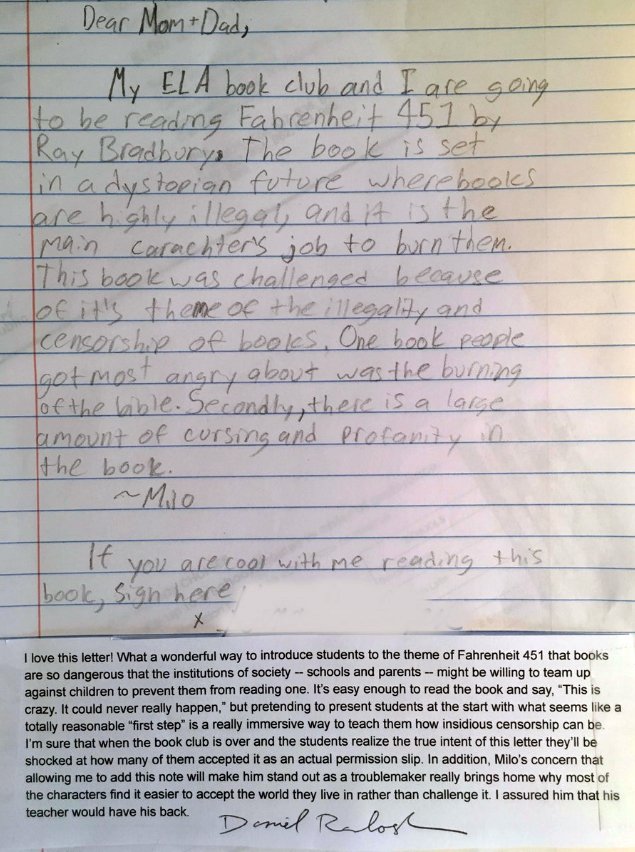
Between the years 1967 and 1979, Ballantine published an expurgated version of the novel for use in high schools, removing content deemed objectionable. Bradbury was completely unaware. For six of those years, the bowdlerized version was the only one sold by the publisher. We can remember this case when we read the response of writer Daniel Radosh to a permission slip his son Milo brought home from his 8th grade teacher for a book club reading of Fahrenheit 451. Written in Milo’s own hand, the initial note, at the top, informs Mr. Radosh that the novel “was challenged because of it’s [sic] theme of the illegality and censorship of books. One book people got most angry about was the burning of the bible. Secondly, there is a large amount of cursing and profanity in the book.”
After this confession, Milo’s note asks for a parental signature in a postscript. Addressing the letter’s true writer, Milo’s teacher, Daniel Radosh responded thus, in the typed note attached to his son’s letter.
I love this letter! What a wonderful way to introduce students to the theme of Fahrenheit 451 that books are so dangerous that the institutions of society – schools and parents – might be willing to team up against children to prevent them from reading one.
It’s easy enough to read the book and say, ‘This is crazy. It could never really happen,’ but pretending to present students at the start with what seems like a totally reasonable ‘first step’ is a really immersive way to teach them how insidious censorship can be.
I’m sure that when the book club is over and the students realise the true intent of this letter they’ll be shocked at how many of them accepted it as an actual permission slip.
In addition, Milo’s concern that allowing me to add to this note will make him stand out as a troublemaker really brings home why most of the characters find it easier to accept the world they live in rather than challenge it.
I assured him that his teacher would have his back.
Radosh’s insinuation that the letter his son was induced to write is not an “actual permission slip” underscores his claim that the exercise is really a means of controlling children by means of collusion, even though, he jests, such a thing must be part of the lesson itself. Should he be allowed to read the novel, the signing and delivery of the permission slip, Radosh devastatingly suggests, completes Milo’s humiliation, bringing home to him “why most of the characters” in the book remain passive, and “find it easier to accept the world they live in rather than challenge it.”
In short, Radosh’s response, for all its pithy irony, digs deeply into the mechanisms that suppress speech deemed so “dangerous that the institutions of society—schools and parents—might be willing to team up against children to prevent them” from reading it.
Vonnegut fans long for this level of access, which is why we are doubly grateful to writer Suzanne McConnell, who took Vonnegut’s “Form of Fiction” (aka “Surface Criticism” aka “How to Talk out of the Corner of Your Mouth Like a Real Tough Pro”) course at the Iowa Writers’ Workshop in the mid-60s.
The goal was to examine fiction from a writer’s perspective and McConnell (who is soon to publish a book about Vonnegut’s advice to writers) preserved one of her old teacher’s term paper assignments—again in letter form. She later had an epiphany that his assignments were “designed to teach something much more than whatever I thought then… He was teaching us to do our own thinking, to find out who we were, what we loved, abhorred, what set off our tripwires, what tripped up our hearts.”
(A decade and a half later, Vonnegut would subject his own novels to the same treatment.)
A noted humanist, Vonnegut instructed the class to read these stories not in an overly analytical mindset, but rather as if they had just consumed “two ounces of very good booze.”
The ensuing letter grades were meant to be “childishly selfish and impudent measures” of how much—or little—joy the stories inspired in the reader.
Next, students were instructed to choose their three favorite and three least favorite stories, then disguise themselves as “minor but useful” lit mag editors in order to advise their “wise, respected, witty and world-weary superior” as to whether or not the selected stories merited publication.
Here’s the full assignment, which was published in Kurt Vonnegut: Letters(Delacorte Press, 2012). And also again in Slate.
Beloved:
This course began as Form and Theory of Fiction, became Form of Fiction, then Form and Texture of Fiction, then Surface Criticism, or How to Talk out of the Corner of Your Mouth Like a Real Tough Pro. It will probably be Animal Husbandry 108 by the time Black February rolls around. As was said to me years ago by a dear, dear friend, “Keep your hat on. We may end up miles from here.”
As for your term papers, I should like them to be both cynical and religious. I want you to adore the Universe, to be easily delighted, but to be prompt as well with impatience with those artists who offend your own deep notions of what the Universe is or should be. “This above all …”
I invite you to read the fifteen tales in Masters of the Modern Short Story (W. Havighurst, editor, 1955, Harcourt, Brace, $14.95 in paperback). Read them for pleasure and satisfaction, beginning each as though, only seven minutes before, you had swallowed two ounces of very good booze. “Except ye be as little children …”
Then reproduce on a single sheet of clean, white paper the table of contents of the book, omitting the page numbers, and substituting for each number a grade from A to F. The grades should be childishly selfish and impudent measures of your own joy or lack of it. I don’t care what grades you give. I do insist that you like some stories better than others.
Proceed next to the hallucination that you are a minor but useful editor on a good literary magazine not connected with a university. Take three stories that please you most and three that please you least, six in all, and pretend that they have been offered for publication. Write a report on each to be submitted to a wise, respected, witty and world-weary superior.
Do not do so as an academic critic, nor as a person drunk on art, nor as a barbarian in the literary market place. Do so as a sensitive person who has a few practical hunches about how stories can succeed or fail. Praise or damn as you please, but do so rather flatly, pragmatically, with cunning attention to annoying or gratifying details. Be yourself. Be unique. Be a good editor. The Universe needs more good editors, God knows.
Since there are eighty of you, and since I do not wish to go blind or kill somebody, about twenty pages from each of you should do neatly. Do not bubble. Do not spin your wheels. Use words I know.
poloniøus
McConnell supplied further details on the extraordinary experience of being Vonnegut’s student in an essay forthe Brooklyn Rail:
Kurt taught a Chekhov story. I can’t remember the name of it. I didn’t quite understand the point, since nothing much happened. An adolescent girl is in love with this boy and that boy and another; she points at a little dog, as I recall, or maybe something else, and laughs. That’s all. There’s no conflict, no dramatic turning point or change. Kurt pointed out that she has no words for the sheer joy of being young, ripe with life, her own juiciness, and the promise of romance. Her inarticulate feelings spill into laughter at something innocuous. That’s what happened in the story. His absolute delight in that girl’s joy of feeling herself so alive was so encouraging of delight. Kurt’s enchantment taught me that such moments are nothing to sneeze at. They’re worth a story.
Ayun Halliday is an author, illustrator, theater maker and Chief Primatologist of the East Village Inky zine. Her play Zamboni Godot is opening in New York City in March 2017. Follow her @AyunHalliday.
Knowing the transformative effect an inspired teacher can have on an “unreachable” student, one can only hope that geography and luck will conspire to bring the two together at an early point in the child’s development.
Helen Keller, author, activist, and poster girl for surmounting near-impossible odds, certainly lucked out in the teacher department. Rendered deaf and blind by a fever contracted at 19 months, Keller earned a reputation as a holy terror in a family ill-equipped to understand what her wild rages might signify.
Within a few short months of her arrival at the Keller family home, Sullivan led the nearly-seven-year-old Keller to her famous breakthrough at the water pump.
In a more conventional arrangement, the student would eventually leave her teacher for further educational pursuits, but Keller depended on Sullivan to translate other teachers’ lectures and classroom interactions. Sullivan accompanied her to Perkins School for the Blind, the Wright-Humason School for the Deaf, the Cambridge School for Young Ladies, and finally Radcliffe College, where Keller earned her BA.
The unusual boundaries of their teacher-student bond meant Keller lived with Sullivan and her husband in their Forest Hills home, a move that hastened the marriage’s unofficial but permanent end, according to Sullivan’s biographer, Kim Nielsen. It likely thwarted Keller’s single attempt at romance, with her temporary secretary, writer Peter Fagan, too.
For better and worse, their lives were forever entwined, each made more extraordinary by the presence of the other.
Their appearance in the 1930 Vitaphone newsreel, above, highlights the mandatory physical closeness they shared, as they demonstrate the process by which Keller learned to speak. Having learned to communicate via letters Sullivan finger spelled into her palm, Keller placed her fingers against Sullivan’s lips, throat and nose, to feeling the vibrations made when these familiar letters were spoken aloud.
Sullivan died six years after the newsreel was filmed, at which point, Polly Thomson, originally engaged as the ladies’ housekeeper, took over, serving as Keller’s interpreter and traveling companion for the next twenty years.
Ayun Halliday is an author, illustrator, theater maker and Chief Primatologist of the East Village Inky zine. Her play Zamboni Godot is opening in New York City in March 2017. Follow her @AyunHalliday.
We're hoping to rely on loyal readers, rather than erratic ads. Please click the Donate button and support Open Culture. You can use Paypal, Venmo, Patreon, even Crypto! We thank you!
Open Culture scours the web for the best educational media. We find the free courses and audio books you need, the language lessons & educational videos you want, and plenty of enlightenment in between.