A Quick Introduction to Literary Theory: Watch Animated Videos from the Open University

Just what is an author? It might seem like a sil­ly ques­tion, and an aca­d­e­m­ic dis­sec­tion of the term may seem like a need­less­ly pedan­tic exer­cise. But the very vari­abil­i­ty of the con­cept means it isn’t a sta­ble, fixed idea at all, but a shift­ing set of asso­ci­a­tions we have with notions about cre­ativ­i­ty, the social role of art, and that elu­sive qual­i­ty known as “genius.” Ques­tions raised in the Open Uni­ver­si­ty video above—part of a series of very short ani­mat­ed entrées into lit­er­ary crit­i­cism called “Out­side the Book”—make it hard to ignore the prob­lems we encounter when we try to define author­ship in sim­ple, straight­for­ward ways. Most of the ques­tions relate to the work of French post­struc­tural­ist Michel Fou­cault, whose crit­i­cal essay “What is an Author?”—along with struc­tural­ist thinker Roland Barthes’ “The Death of the Author”—dis­turbed many a lit­er­ary critic’s com­fort­able assump­tions about the cre­ative locus behind any giv­en work.

In the 18th cen­tu­ry, at least in Europe, the author was a high­ly cel­e­brat­ed cul­tur­al fig­ure, a sta­tus epit­o­mized by Samuel Johnson’s rev­er­en­tial biog­ra­phy of John Dry­den and edi­tion of Shake­speare—and in turn Johnson’s own biog­ra­phy by his amanu­en­sis Boswell. The 19th cen­tu­ry began to see the author as a celebri­ty, with the hype and some­times tawdry spec­u­la­tion that accom­pa­nies that des­ig­na­tion. In the mid-twen­ti­eth cen­tu­ry, even as the idea of the film direc­tor as auteur—a sin­gu­lar cre­ative genius—gained ascen­dance, the inflat­ed role of the lit­er­ary author came in for a bruis­ing. With Fou­cault, Barthes, and oth­ers like W.K. Wim­satt and Mon­roe Beardsley—whose essay “The Inten­tion­al Fal­la­cy” more or less ruled out biog­ra­phy as a tool of the critic—the author reced­ed and the “text” gained pri­ma­cy as, in Foucault’s words, a “dis­cur­sive unit.”

This means that ques­tions of author­ship became insep­a­ra­ble from ques­tions of read­er­ship, inter­pre­ta­tion, and influ­ence; from ques­tions of his­tor­i­cal clas­si­fi­ca­tion and social con­struc­tion (i.e. how do we know any­thing about “Byron” except through biogra­phies, doc­u­men­taries, etc., them­selves cul­tur­al pro­duc­tions?); from ques­tions of trans­la­tion, pseude­pig­ra­phy, and pen names. Put in much plain­er terms, we once came to think of the author not sim­ply as the writer—a role pre­vi­ous­ly del­e­gat­ed to low­ly, usu­al­ly anony­mous “scribes” who sim­ply copied the words of gods, heroes, and prophets. Instead, the author became a god, a hero, and a prophet, a god­like cre­ator with a “lit­er­ary stamp of approval” that grants his or her every utter­ance on the page a spe­cial sta­tus; “that makes even the note on Shakespeare’s fridge a work of pro­found genius.” But that idea is any­thing but sim­ple, and the crit­i­cal dis­cus­sion around it any­thing but triv­ial.

Dit­to much of the above when it comes to that oth­er seem­ing­ly indi­vis­i­ble unit of lit­er­a­ture, the book. In the even short­er video guide above, Open Uni­ver­si­ty rapid­ly chal­lenges our com­mon­place ideas about book-hood and rais­es the now-com­mon­place ques­tion about the future of this “read­ing giz­mo.” For more “Out­side the Book,” see the remain­ing videos in the series: “Com­e­dy,” “Tragedy,” and “Two Styles of Love.” And for a much more sus­tained and seri­ous study of the art of lit­er­ary crit­i­cism, delve into Pro­fes­sor Paul Fry’s Yale course below. It’s part of Open Cul­ture’s col­lec­tion, 1,700 Free Online Cours­es from Top Uni­ver­si­ties.

Intro­duc­tion to The­o­ry of Lit­er­a­ture – Free Online Video – Free iTunes Audio – Free iTunes Video – Course Mate­ri­als – Paul H. Fry, Yale

h/t Cather­ine

Relat­ed Con­tent:

Down­load 55 Free Online Lit­er­a­ture Cours­es: From Dante and Mil­ton to Ker­ouac and Tolkien

Crash Course on Lit­er­a­ture: Watch John Green’s Fun Intro­duc­tions to Gats­by, Catch­er in the Rye & Oth­er Clas­sics

An Intro­duc­tion to World Lit­er­a­ture by a Cast Of Lit­er­ary & Aca­d­e­m­ic Stars (Free Course)

Michel Fou­cault: Free Lec­tures on Truth, Dis­course & The Self

Josh Jones is a writer and musi­cian based in Durham, NC. Fol­low him at @jdmagness

New Animated Web Series Makes the Theory of Evolution Easy to Understand

When it comes to mat­ters of broad sci­en­tif­ic con­sen­sus, I’m gen­er­al­ly inclined to offer pro­vi­sion­al assent. Like every­one else, I have to rely on the exper­tise of oth­ers in mat­ters out­side my ken, and in many cas­es, this ratio­nal appeal to author­i­ty is the best one can do with­out acquir­ing the rel­e­vant qual­i­fi­ca­tions and years of expe­ri­ence in high­ly spe­cial­ized sci­en­tif­ic fields. In the case of evo­lu­tion, I hap­pen to find the evi­dence and expla­na­tions near­ly all biol­o­gists prof­fer much more per­sua­sive than the claims—and accusations—of their most­ly unsci­en­tif­ic crit­ics. But as we know from recent sur­vey data, a very large per­cent­age of Amer­i­cans reject the the­o­ry of evo­lu­tion, at least when it comes to humans, though it’s like­ly a great many of them—like myself—do not know very much about it.

But as a layper­son with an admit­ted­ly rudi­men­ta­ry sci­ence edu­ca­tion, I’m always grate­ful for clear, sim­ple expla­na­tions of com­plex ideas. This is pre­cise­ly what we get in the video series Stat­ed Clear­ly, which har­ness­es the pow­er of web ani­ma­tion as an instruc­tion­al tool to define what the the­o­ry of evo­lu­tion is, and why it explains the observ­able facts bet­ter than any­thing else. Stat­ed Clear­ly’s tagline is “sci­ence is for every­one,” and indeed, their mis­sion “is sim­ple”: “to pro­mote the art of crit­i­cal think­ing by expos­ing peo­ple from all walks of life, to the sim­ple beau­ty of sci­ence.” The video at the top gives us a broad overview of the the­o­ry of evo­lu­tion. The ani­ma­tion just above presents the evi­dence for evo­lu­tion, or some of it any­way, in clear, com­pelling terms, draw­ing from at least two of the many inde­pen­dent lines of evi­dence. And below, we have a Stat­ed Clear­ly take on nat­ur­al selec­tion, an absolute­ly key con­cept of evo­lu­tion­ary biol­o­gy, and one reg­u­lar­ly mis­un­der­stood.

After watch­ing these three shorts, you might agree that what is “often con­sid­ered a com­plex and con­tro­ver­sial top­ic” is “actu­al­ly a very sim­ple con­cept to under­stand.” In layman’s terms, at least. In fact, artist, nar­ra­tor, and cre­ator of the series, Jon Per­ry, admits that he him­self has no for­mal sci­en­tif­ic train­ing. “He believed,” his bio states, “that if he could cre­ate just one good ani­ma­tion on his own, sci­en­tists and edu­ca­tors would real­ize the poten­tial of this project and help him cre­ate more.” And indeed they have. Stat­ed Clear­ly has a dis­tin­guished pan­el of sci­ence advis­ers and part­ners that include the Cen­ter for Chem­i­cal Evo­lu­tion, Emory Uni­ver­si­ty, Geor­gia Tech, NASA, and the Nation­al Sci­ence Foun­da­tion. Learn much more about Stat­ed Clearly’s goals and affil­i­a­tions, or lack there­of, at their web­site. And below, see the fourth video of the series, “Does the The­o­ry of Evo­lu­tion Real­ly Mat­ter?,” which address­es the prac­ti­cal, real world impli­ca­tions of evo­lu­tion­ary the­o­ry, and sci­en­tif­ic lit­er­a­cy.

Relat­ed Con­tent:

Carl Sagan Explains Evo­lu­tion in an Eight-Minute Ani­ma­tion

Watch Episode #2 of Neil deGrasse Tyson’s Cos­mos: Explains the Real­i­ty of Evo­lu­tion (US View­ers)

Richard Dawkins Makes the Case for Evo­lu­tion in the 1987 Doc­u­men­tary, The Blind Watch­mak­er

Josh Jones is a writer and musi­cian based in Durham, NC. Fol­low him at @jdmagness

Lynda Barry, Cartoonist Turned Professor, Gives Her Old Fashioned Take on the Future of Education

With col­lege tuitions bal­loon­ing to the point of implo­sion, and free edu­ca­tion­al con­tent pro­lif­er­at­ing online, the future of edu­ca­tion is a scorch­ing hot top­ic.

So where are we head­ing?

Cours­era and Khan Acad­e­myVideo game-based cur­ric­u­la? Expe­ri­ence-dri­ven microlearn­ing?

Or school build­ings that moon­light as can­dy?

So sug­gest­ed one of the younger par­tic­i­pants in a work­shop led by the Uni­ver­si­ty of Wisconsin’s Assis­tant Pro­fes­sor of Inter­dis­ci­pli­nary Cre­ativ­i­ty, car­toon­ist and author Lyn­da Bar­ry (aka Pro­fes­sor Long-Title).

Barry’s mes­sian­ic embrace of the arts has proved pop­u­lar with stu­dents of all ages. When the university’s Coun­ter­fac­tu­al Draw­ing Board Project invit­ed fac­ul­ty, staff, and oth­ers to con­sid­er what the “appear­ance, pur­pose, atmos­phere and com­mu­ni­ty of the cam­pus” would be like in 100 years time, Bar­ry delib­er­ate­ly widened the pool to include chil­dren.

Yes, their inno­va­tions tend­ed toward vol­cano schools that erupt at dis­missal, but pre­sum­ably some of those same chil­dren will be in the van­guard when it’s time for ini­tia­tives that seem unimag­in­able now to be imple­ment­ed. Rome wasn’t built in a day, and all that.

Or as one gim­let-eyed youth put it, in a hun­dred years “the teach­ers will all be dead.”

No won­der few adult par­tic­i­pants can see past a but­ton-dri­ven, her­met­i­cal­ly sealed, dig­i­tal future where­in every stu­dent has a chip implant­ed in his or her head.

Bar­ry, no stranger to depres­sion, man­ages to laugh such gloomy fore­casts off, despite what they por­tend for the tac­tile, hand­made ephemera she reveres. A sense of humor—and humanity—is at the core of every edu­ca­tion­al reform she prac­tices.

Rather than rip each other’s writ­ing to shreds dur­ing in-class cri­tiques, her stu­dents call each oth­er by out­landish pseu­do­nyms and draw med­i­ta­tive spi­rals as each oth­ers’ work is read aloud. Every read­er is assured of a hearty “good!” from the teacher. She wants them to keep going, you see.

Sure­ly there are insti­tu­tions where this approach might not fly, but why poo-poo it? Isn’t fuel­ing the cre­ative spir­it a prac­ti­cal invest­ment in the future?

“It’s there in every­body,” Bar­ry believes. “You have to give peo­ple an expe­ri­ence of it, a repeat­ed expe­ri­ence of it that they gen­er­ate them­selves.”

Maybe some­day, some kid who hasn’t had the love of learn­ing squelched out of him or her will apply all that cre­ativ­i­ty toward cur­ing can­cer. That’d be great, huh? At worst, that care­ful­ly tend­ed spark can give solace in the dark days ahead. As fans of Barry’s work well know, art exists to car­ry us through times of “sor­row and grief and trou­ble.”

Relat­ed Con­tent:

Car­toon­ist Lyn­da Bar­ry Reveals the Best Way to Mem­o­rize Poet­ry

Join Car­toon­ist Lyn­da Bar­ry for a Uni­ver­si­ty-Lev­el Course on Doo­dling and Neu­ro­science

The 430 Books in Marilyn Monroe’s Library: How Many Have You Read?

marilyn reading

If you’re a read­er and user of social media, you’ve like­ly test­ed your life­time read­ing list against the BBC Book Quiz.

Or per­haps you’ve allowed your worth as a read­er to be deter­mined by the num­ber of Pulitzer Prize win­ners you’ve made it through.

The Nation­al Endow­ment for the Arts’ Big Read, any­one?

The 142 Books that Every Stu­dent of Eng­lish Lit­er­a­ture Should Read?

The 50 Best Dystopi­an Nov­els?

Being young is no excuse! Not when the Amer­i­can Library Asso­ci­a­tion pub­lish­es an annu­al list of Out­stand­ing Books for the Col­lege Bound and Life­long Learn­ers.

So… how’d you do? Or should I say how’d you do in com­par­i­son to Mar­i­lyn Mon­roe? The online Mon­roe fan club Ever­last­ing Star used pho­tographs, inter­views, and a Christie’s auc­tion cat­a­logue to come up with a list of more than 400 books in her pos­ses­sion.

Did she read them all? I don’t know. Have you read every sin­gle title on your shelves? (There’s a Japan­ese word for those books. It’s Tsun­doku.)

Fem­i­nist biog­ra­ph­er Oline Eaton has a great rant on her Find­ing Jack­ie blog about the phrase “Mar­i­lyn Mon­roe read­ing,” and the 5,610,000 search engine results it yields when typed into Google:

There is, with­in Monroe’s image, a deeply root­ed assump­tion that she was an idiot, a vul­ner­a­ble and kind and lov­ing and ter­ri­bly sweet idiot, but an idiot nonethe­less. That is the assump­tion in which ‘Mar­i­lyn Mon­roe read­ing’ is entan­gled.

The pow­er of the phrase Mar­i­lyn Mon­roe read­ing’ lies in its appli­ca­tion to Mon­roe and in our assump­tion that she wouldn’t know how.

Would that every­one search­ing that phrase did so in the belief that her pas­sion for the print­ed word rivaled their own. Imag­ine legions of geeks lov­ing her for her brain, bypass­ing Sam Shaw’s icon­ic sub­way grate pho­to in favor of home print­ed pin ups depict­ing her with book in hand.

Com­mem­o­ra­tive postage stamps are nice, but per­haps a more fit­ting trib­ute would be an ALA poster. Like Eaton, when I look at that image of Mar­i­lyn hunched over James Joyce’s Ulysses (or kick­ing back read­ing Walt Whit­man’s Leaves of Grass), I don’t see some­one try­ing to pass her­self off as some­thing she’s not. I see a high school dropout caught in the act of edu­cat­ing her­self. If I saw it taped to a library shelf embla­zoned with the word “READ,” I might just sum­mon the resolve to take a stab at Ulysses myself. (I know how it ends, but that’s about it.)

See below, dear read­ers. Apolo­gies that we’re not set up to keep track of your score for you, but please let us know in the com­ments sec­tion if you’d hearti­ly sec­ond any of Mar­i­lyn’s titles, par­tic­u­lar­ly those that are less­er known or have fad­ed from the pub­lic view.

Mar­i­lyn Monroe’s Read­ing Chal­lenge

(Thanks to Book Tryst for com­pil­ing Ever­last­ing Star’s find­ings)

1) Let’s Make Love by Matthew Andrews (nov­el­iza­tion of the movie)

2) How To Trav­el Incog­ni­to by Lud­wig Bemel­mans

3) To The One I Love Best by Lud­wig Bemel­mans

4) Thurber Coun­try by James Thurber

5) The Fall by Albert Camus

6) Mar­i­lyn Mon­roe by George Car­pozi

7) Camille by Alexan­der Dumas

8) Invis­i­ble Man by Ralph Elli­son

9) The Boston Cook­ing-School Cook Book by Fan­nie Mer­ritt-Farmer

10) The Great Gats­by by F Scott Fitzger­ald

11) From Rus­sia With Love by Ian Flem­ing

12) The Art Of Lov­ing by Erich Fromm

13) The Prophet by Kahlil Gilbran

14) Ulysses by James Joyce

15) Stoned Like A Stat­ue: A Com­plete Sur­vey Of Drink­ing Clich­es, Prim­i­tive, Clas­si­cal & Mod­ern by Howard Kan­del & Don Safran, with an intro by Dean Mar­tin (a man who knew how to drink!)

16) The Last Temp­ta­tion Of Christ by Nikos Kazantza­kis

17) On The Road by Jack Ker­ouac

18) Select­ed Poems by DH Lawrence

19 and 20) Sons And Lovers by DH Lawrence (2 edi­tions)

21) The Portable DH Lawrence (more…)

Flannery O’Connor Explains the Limited Value of MFA Programs: “Competence By Itself Is Deadly”

flannery-reading-e1366303327545

Flan­nery O’Connor once wrote, “because fine writ­ing rarely pays, fine writ­ers usu­al­ly end up teach­ing, and the [MFA] degree, how­ev­er worth­less to the spir­it, can be expect­ed to add some­thing to the flesh.” That phrase “worth­less to the spir­it” con­tains a great deal of the neg­a­tive atti­tude O’Connor expressed toward the insti­tu­tion­al­iza­tion of cre­ative writ­ing in MFA pro­grams like the one she helped make famous at the Uni­ver­si­ty of Iowa. The ver­biage comes from an essay she wrote for the alum­ni mag­a­zine of the Geor­gia Col­lege for Women after com­plet­ing her degree in 1947, quot­ed in the Chad Har­bach-edit­ed col­lec­tion of essays MFA vs. NYC. Although fresh from the pro­gram, O’Connor was already on her way to lit­er­ary suc­cess, hav­ing pub­lished her first sto­ry, “The Gera­ni­um,” the year pre­vi­ous and begun work on her first nov­el, Wise Blood. Nev­er­the­less, her insights on the MFA are not par­tic­u­lar­ly san­guine.

On the one hand, she writes with char­ac­ter­is­tic dark humor, writ­ing pro­grams can serve as alter­na­tives to “the poor house and the mad house.” In grad­u­ate school, “the writer is encour­aged or at least tol­er­at­ed in his odd ways.” An MFA pro­gram may offer some small respite from the lone­li­ness and hard­ship of the writ­ing life, and ulti­mate­ly pro­vide a cre­den­tial to be “pro­nounced upon by his future employ­ers should they chance to be of the acad­e­my.” But the time and effort (not to men­tion the expense, unless one is ful­ly fund­ed) may not be worth the cost, O’Connor sug­gests. Her own pro­gram at Iowa was “designed to cov­er the writer’s tech­ni­cal needs […], and to pro­vide him with a lit­er­ary atmos­phere which he would not be able to find else­where. The writer can expect very lit­tle else.”

Lat­er, in her col­lec­tion of essays Mys­tery and Man­ners, O’Connor expressed sim­i­lar sen­ti­ments. Con­clud­ing a lengthy dis­cus­sion on the very lim­it­ed role of the teacher of cre­ative writ­ing, she con­cludes that “the teacher’s work is large­ly neg­a­tive […] a mat­ter of say­ing ‘This doesn’t work because…’ or ‘This does work because….’” Remark­ing on the com­mon obser­va­tion that uni­ver­si­ties sti­fle writ­ers, O’Con­nor writes, “My opin­ion is that they don’t sti­fle enough of them. There’s many a best-sell­er that could have been pre­vent­ed by a good teacher.” Cre­ative writ­ing teach­ers may nod their heads in agree­ment, and shake them in frus­tra­tion. But we should return to that phrase “worth­less to the spir­it,” for while MFA pro­grams may turn out “com­pe­tent” writ­ers of fic­tion, O’Con­nor admits, they can­not pro­duce “fine writ­ing”:

In the last twen­ty years the col­leges have been empha­siz­ing cre­ative writ­ing to such an extent that you almost feel that any idiot with a nick­el’s worth of tal­ent can emerge from a writ­ing class able to write a com­pe­tent sto­ry. In fact, so many peo­ple can now write com­pe­tent sto­ries that the short sto­ry as a medi­um is in dan­ger of dying of com­pe­tence. We want com­pe­tence, but com­pe­tence by itself is dead­ly. What is need­ed is the vision to go with it, and you do not get this from a writ­ing class.

O’Connor prob­a­bly over­es­ti­mates the degree to which “any idiot” can learn to write with com­pe­tence, but her point is clear. She wrote these words in the mid-fifties, in an essay titled “The Nature and Aim of Fic­tion.” As Harbach’s new essay col­lec­tion demon­strates, the debate about the val­ue of MFA programs—which have expand­ed expo­nen­tial­ly since O’Connor’s day—has not by any means been set­tled. And while there are cer­tain­ly those writ­ers, she notes wry­ly, who can “learn to write bad­ly enough” and “make a great deal of mon­ey,” the true artist may be in the same posi­tion after the MFA as they were before it, com­pelled to “chop a path in the wilder­ness of his own soul; a dis­heart­en­ing process, life­long and lone­some.”

via Every­thing That Ris­es

Relat­ed Con­tent:

William S. Bur­roughs Teach­es a Free Course on Cre­ative Read­ing and Writ­ing (1979)

Toni Mor­ri­son, Nora Ephron, and Dozens More Offer Advice in Free Cre­ative Writ­ing “Mas­ter Class”

Flan­nery O’Connor: Friends Don’t Let Friends Read Ayn Rand (1960)

Flan­nery O’Connor Reads ‘Some Aspects of the Grotesque in South­ern Fic­tion’ (c. 1960)

Flan­nery O’Connor’s Satir­i­cal Car­toons: 1942–1945

Josh Jones is a writer and musi­cian based in Durham, NC. Fol­low him at @jdmagness

Tap Into Timeless Wisdom: Download 36 Free Courses in Ancient History, Literature & Philosophy

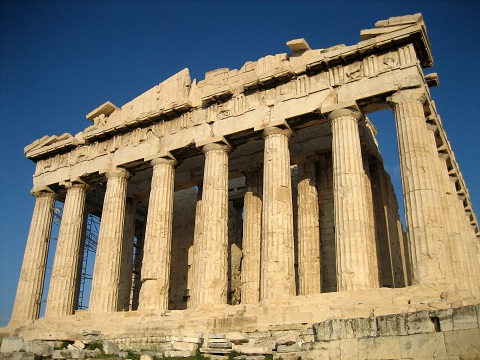
Parthenon_from_westsmall

I know, it’s a dat­ed ref­er­ence now, but since I still watch the remade Bat­tlestar Galac­ti­ca series on Net­flix, the mys­ti­cal refrain—“All of this has hap­pened before and will hap­pen again”–still seems fresh to me. At any rate, it’s fresh­er than the clichéd “his­to­ry repeats itself.” How­ev­er you phrase it, the tru­ism looks more and more like a gen­uine truth the more one stud­ies ancient his­to­ry, lit­er­a­ture, and phi­los­o­phy. The con­flicts and con­cerns that feel so of the moment also occu­pied the minds and lives of peo­ple liv­ing hun­dreds, and thou­sands, of years ago, and what­ev­er you make of that, it cer­tain­ly helps put the present into per­spec­tive. Can we ben­e­fit from study­ing the wis­dom, and the fol­ly, of the ancients? To this ques­tion, I like to turn to an intro­duc­to­ry essay C.S. Lewis penned to the work of a cer­tain church father:

Every age has its own out­look. It is spe­cial­ly good at see­ing cer­tain truths and spe­cial­ly liable to make cer­tain mis­takes. We all, there­fore, need the books that will cor­rect the char­ac­ter­is­tic mis­takes of our own peri­od. And that means the old books. […] If we read only mod­ern books […] where they are true they will give us truths which we half knew already. Where they are false they will aggra­vate the error with which we are already dan­ger­ous­ly ill. The only pal­lia­tive is to keep the clean sea breeze of the cen­turies blow­ing through our minds, and this can be done only by read­ing old books.

I may dis­agree with Lewis about many things, includ­ing that “clean sea breeze” of his­to­ry, but I take to heart his point about read­ing the ancients to mit­i­gate our mod­ern bias­es and shine light on our blind spots. To that end, we present links to sev­er­al excel­lent online cours­es on the ancients from insti­tu­tions like Yale, NYU, and Stan­ford, free to peruse or take in full. See our mas­ter list—Free Cours­es in Ancient His­to­ry, Lit­er­a­ture & Phi­los­o­phy—for 36 qual­i­ty offer­ings. As always, cer­tain cours­es pro­vide more resources than oth­ers, and a few only offer their lec­tures through iTunes. These are deci­sions course admin­is­tra­tors have made, not us! Even so, these free resources are invalu­able to those wish­ing to acquaint, or reac­quaint, them­selves with the study of ancient human­i­ties.

You can, for exam­ple, take a course on Ancient Israel from NYU’s Daniel Flem­ing (Free Online Video & Course Info — Free Online Video), study Plato’s Laws with the renowned Leo Strauss from the Uni­ver­si­ty of Chica­go (Free Online Audio) or Socrates ( Free Online Audio) with that university’s equal­ly renowned Alan Bloom. Take a course called “Ancient Wis­dom and Mod­ern Love” (Syl­labus - Free iTunes Video — Free Online Video) with Notre Dame’s David O’Connor or study Virgil’s AeneidFree iTunes Audio) with Susan­na Braund, whose lec­tures were record­ed at Stan­ford Con­tin­u­ing Stud­ies. You’ll find many more ancient his­to­ry, lit, and phi­los­o­phy classes—36 in all, includ­ing five more Leo Strauss Pla­to seminars—on our meta list: Free Cours­es in Ancient His­to­ry, Lit­er­a­ture & Phi­los­o­phy. Read, study, repeat.

Relat­ed Con­tent:

Down­load 55 Free Online Lit­er­a­ture Cours­es: From Dante and Mil­ton to Ker­ouac and Tolkien

Learn 47 Lan­guages Online for Free: Span­ish, Chi­nese, Eng­lish & More

Ita­lo Calvi­no Offers 14 Rea­sons We Should Read the Clas­sics

Josh Jones is a writer and musi­cian based in Durham, NC. Fol­low him at @jdmagness

Director Robert Rodriguez Teaches The Basics of Filmmaking in Under 10 Minutes

Orson Welles once claimed that Gregg Toland, cin­e­matog­ra­ph­er for Cit­i­zen Kane, taught him every­thing he need­ed to know about shoot­ing movies in a half hour. Direc­tor Robert Rodriguez — who start­ed off as the poster boy for ‘90s indie cin­e­ma and is cur­rent­ly mak­ing a healthy liv­ing turn­ing out movies like Sin City: A Dame to Kill For – claims that he can reduce that time by a third. In 10 Minute Film School, which you can watch above, Rodriguez quick­ly hits on some of the key points of movie mak­ing while espous­ing the same rebel DIY spir­it that made him a suc­cess. Remem­ber, this is a guy who made a fea­ture film, El Mari­achi, for $7000.

Rodriguez’s basic phi­los­o­phy doesn’t dwell on learn­ing the fine points of Aris­totelian act struc­ture or the tech­ni­cal nuances of the Red cam­era. He just wants you to start shoot­ing stuff. “Don’t dream about being a film­mak­er,” he pro­claims in the video, which looks like it was shot some time dur­ing the Clin­ton admin­is­tra­tion. “You are a film­mak­er. Now let’s get down to busi­ness.”

He tells aspir­ing film­mak­ers to become tech­ni­cal — learn the tools of the trade. If you don’t, you might become over­ly reliant on the techies who may or may not be inter­est­ed in real­iz­ing your vision. He also doesn’t put too much stock in screen­writ­ing books like Save the Cat. “Any­one know how to write?” he asks the audi­ence. “No? Good. Every­one else writes the same way. Start writ­ing your way. That makes you unique.”

He also advis­es against sto­ry­boards. “Make a blank screen for your­self and sit there and watch your movie. Imag­ine your movie, shot for shot, cut for cut…Write down the shots you see and then go get those shots.”

The video shows its age when Rodriguez starts to talk about equip­ment. No aspir­ing film­mak­er aside from a cel­lu­loid fetishist is going to shoot a first fea­ture on 16mm when cheap­er, eas­i­er dig­i­tal cam­eras are avail­able. Yet the core of his mes­sage is still valid. “You don’t want any­thing too fan­cy,” he states over and over. Fan­cy equip­ment makes for life­less, dull films, lack­ing in that reck­less, adven­tur­ous spir­it of the new­bie moviemak­er.

Essen­tial­ly, Rodriguez wants to keep the “inde­pen­dent” in inde­pen­dent film­mak­ing. Just as he tells his charges to get tech­ni­cal, Rodriguez also tells them to keep their bud­gets low. The more mon­ey a stu­dio sinks into a pro­duc­tion, the more they can dic­tate how that mon­ey is spent. Rodriguez had a gui­tar case, a tur­tle and a small Tex­an town at his dis­pos­al when he was start­ing out, and, with that, he strung togeth­er the sto­ry of El Mari­achi. In the 20 plus years since, Rodriguez has main­tained cre­ative con­trol over just about all of his movies.

One final note. “Don’t both­er going to film school,” he says. As some­one with an over­priced MFA in film, I have to say that he’s prob­a­bly right.

via Film­mak­er IQ

Relat­ed Con­tent: 

Tarkovsky’s Advice to Young Film­mak­ers: Sac­ri­fice Your­self for Cin­e­ma

Film­mak­ing Advice from Quentin Taran­ti­no and Sam Rai­mi (NSFW)

Jonathan Crow is a Los Ange­les-based writer and film­mak­er whose work has appeared in Yahoo!, The Hol­ly­wood Reporter, and oth­er pub­li­ca­tions. You can fol­low him at @jonccrow. And check out his blog Veep­to­pus, fea­tur­ing one new pic­ture of a vice pres­i­dent with an octo­pus on his head dai­ly. 

Greek Myth Comix Presents Homer’s Iliad & Odyssey Using Stick-Man Drawings

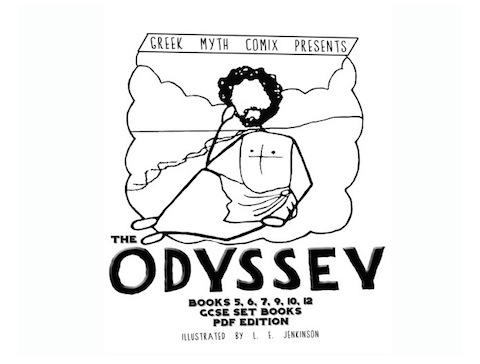
OdysseyComixmain2

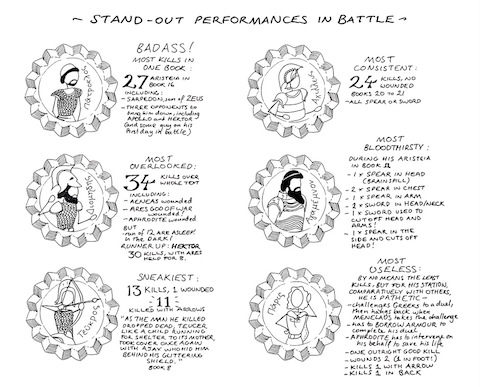
The next time some know-it-all moral­ist blames any num­ber of social ills on vio­lent video games or action films, ask them if they’d rather kids stick to the clas­sics. When they invari­ably reply in the affir­ma­tive, you can smug­ly direct their atten­tion to Greek Myth Comix’s aston­ish­ing info­graph­ic detail­ing the mul­ti­tude of grue­some killings in the Ili­ad. Homer’s epic unflinch­ing­ly describes, for exam­ple, in graph­ic detail, the death of Lycon, who in Book 16 has a sword thrust through his neck: “noth­ing held but a piece of skin, and from that, Lycon’s head dan­gled down.” And if you’ve held on to your lunch, you may be inter­est­ed to know the gris­ly cir­cum­stances of the oth­er two can­di­dates for “grimmest death.” Just below, see a sec­tion of the com­ic cel­e­brat­ing “stand out per­for­mances in bat­tle.” Can Zack Snyder’s King Leonidas match kills with Homer’s Achilles? Only one way to find out….

IliadStandouts

The Ili­ad graph­ic is great fun—as well as a suc­cinct way to ren­der mod­ern scolds speechless—but Greek Myth Comix doesn’t stop there… Oh no! Fans of Homer’s Odyssey will not be dis­ap­point­ed; Books 5–7, and much of 9, 10, and 12 also get the “comix” treat­ment. The art­work is admit­ted­ly crude, but the text comes from a much more author­i­ta­tive source than 300, no dis­re­spect to Frank Miller. Lau­ren Jenk­in­son is a “Clas­si­cal Civil­i­sa­tion and Lit­er­a­ture teacher, writer and, appar­ent­ly, artist,” and her online adap­ta­tions are intend­ed pri­mar­i­ly to help stu­dents pass their GCSE (OCR), the British sec­ondary exams whose near­est equiv­a­lent in the States might per­haps be the SATs.

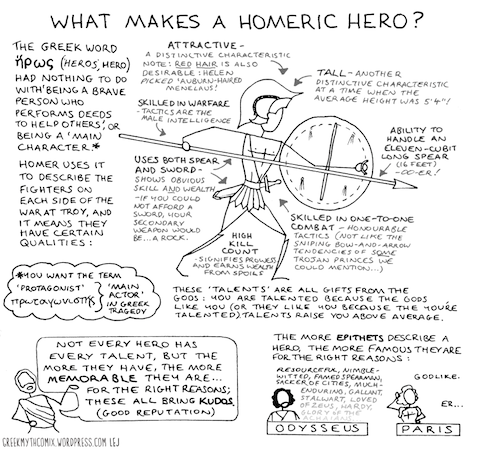
homeric-hero-1

But Greek Myth Comix won’t only appeal to strug­gling stu­dents in the British Isles. Edu­ca­tors will find much to love here, as will lovers of mythol­o­gy in gen­er­al. Online access to the site is free, and you can pur­chase copies of the comix in PDF—either indi­vid­u­al­ly, in bulk, or in poster-size res­o­lu­tion. The site’s full archive has oth­er good­ies like the above, “What Makes a Home­r­ic Hero?” And with such recent updates, no doubt Greek Myth Comix has much more in store for those strug­gling to enjoy or under­stand Homer’s bloody-mind­ed epics, and those who sim­ply love their myths in com­ic form as well as ancient lyric.

via HolyKaw

Relat­ed Con­tent:

The His­to­ry of Eco­nom­ics & Eco­nom­ic The­o­ry Explained with Comics, Start­ing with Adam Smith

What’s Next for the Large Hadron Col­lid­er? PhD Comics Intro­duces the Search for Extra Dimen­sions

A Short His­to­ry of Amer­i­ca, Accord­ing to the Irrev­er­ent Com­ic Satirist Robert Crumb

Josh Jones is a writer and musi­cian based in Durham, NC. Fol­low him at @jdmagness

« Go BackMore in this category... »
Quantcast