As if we needed the competition—am I right, parents?—of some very excellent children’s books read by some beloved stars of stage and screen, and even a former vice president. With Storyline Online, the SAG Foundation, charitable arm of the Screen Actor’s Guild, has brought together top talent for enthusiastic readings of books like William Steig’s Brave Irene, read by Al Gore, Satoshi Kitamura’s Me and My Cat, read by Elijah Wood, and Patricia Polacco’s Thank You, Mr. Falker, read by the fantastic Jane Kaczmarek. There are so many readings (28 total), I could go on… so I will. How about Betty White’s irresistible reading of Harry the Dirty Dog, just above? Or Rita Moreno reading of I Need My Monster, below, a lighthearted story about our need for darkness? Or James Earl Jones, who touchingly discusses his own childhood struggles with reading aloud, and tells the story of To Be a Drum, further down?
I won’t be able to resist showing these to my three-year-old, and if she prefers the readings of highly acclaimed actors over mine, well, I can’t say I blame her. Each video features not only the faces and voices of the actors, but also some fine animation of each storybook’s art. The purpose of the project, writes the SAG Foundation, is to “strengthen comprehension and verbal and written skills for English-language learners worldwide.” To that end, “Storyline Online is available online 24 hours a day for children, parents, and educators” with “supplemental curriculum developed by a literacy specialist.” The phrase “English-language learners” should not make you think this program is only geared toward non-native speakers. Young children in English speaking countries are still only learning the language, and there’s no better way for them than to read and be read to.
As a matter of fact, we’re all still learning—as James Earl Jones says, we need to practice, no matter how old we are: practice tuning our ears to the sounds of well-turned phrases and appreciating the delight of a story—about a dirty dog, a monster, cat, cow, or lion—unfolding. So go on, don’t worry if you don’t have children, or if they happen to be elsewhere at the moment. Don’t deny yourself the pleasure of hearing Robert Guillaume read Chih-Yuan Chen’s Guji Guji, or Annette Bening read Avi Slodovnick’s The Tooth, or… alright, just go see the full list of books and readers here… or see Storytime Online’s Youtube page for access to the full archive of videos.
Image by Università Reggio Calabria, released under a C BY-SA 3.0 license.
In general, the how-to book—whether on beekeeping, piano-playing, or wilderness survival—is a dubious object, always running the risk of boring readers into despairing apathy or hopelessly perplexing them with complexity. Instructional books abound, but few succeed in their mission of imparting theoretical wisdom or keen, practical skill. The best few I’ve encountered in my various roles have mostly done the former. In my days as an educator, I found abstract, discursive books like Robert Scholes’ Textual Power or poet and teacher Marie Ponsot’s lyrical Beat Not the Poor Desk infinitely more salutary than more down-to-earth books on the art of teaching. As a sometime writer of fiction, I’ve found Milan Kundera’s idiosyncratic The Art of the Novel—a book that might have been titled The Art of Kundera—a great deal more inspiring than any number of other well-meaning MFA-lite publications. And as a self-taught audio engineer, I’ve found a book called Zen and the Art of Mixing—a classic of the genre, even shorter on technical specifications than its namesake is on motorcycle maintenance—better than any other dense, diagram-filled manual.
How I wish, then, that as a onetime (longtime) grad student, I had had access to the English translation, just published this month, of Umberto Eco’s How to Write a Thesis, a guide to the production of scholarly work worth the name by the highly celebrated Italian novelist and intellectual. Written originally in Italian in 1977, before Eco’s name was well-known for such works of fiction as The Name of the Rose and Foucault’s Pendulum, How to Write Thesis is appropriately described by MIT Press as reading: “like a novel”: “opinionated… frequently irreverent, sometimes polemical, and often hilarious.”
For example, in the second part of his introduction, after a rather dry definition of the academic “thesis,” Eco dissuades a certain type of possible reader from his book, those students “who are forced to write a thesis so that they may graduate quickly and obtain the career advancement that originally motivated their university enrollment.” These students, he writes, some of whom “may be as old as 40” (gasp), “will ask for instructions on how to write a thesis in a month.” To them, he recommends two pieces of advice, in full knowledge that both are clearly “illegal”:
(a) Invest a reasonable amount of money in having a thesis written by a second party. (b) Copy a thesis that was written a few years prior for another institution. (It is better not to copy a book currently in print, even if it was written in a foreign language. If the professor is even minimally informed on the topic, he will be aware of the book’s existence.
Eco goes on to say that “even plagiarizing a thesis requires an intelligent research effort,” a caveat, I suppose, for those too thoughtless or lazy even to put the required effort into academic dishonesty.
Instead, he writes for “students who want to do rigorous work” and “want to write a thesis that will provide a certain intellectual satisfaction.” Eco doesn’t allow for the fact that these groups may not be mutually exclusive, but no matter. His style is loose and conversational, and the unseriousness of his dogmatic assertions belies the liberating tenor of his advice. For all of the fun Eco has discussing the whys and wherefores of academic writing, he also dispenses a wealth of practical hows, making his book a rarity among the small pool of readable How-tos. For example, Eco offers us “Four Obvious Rules for Choosing a Thesis Topic,” the very bedrock of a doctoral (or masters) project, on which said project truly stands or falls:
1. The topic should reflect your previous studies and experience. It should be related to your completed courses; your other research; and your political, cultural, or religious experience.
2. The necessary sources should be materially accessible. You should be near enough to the sources for convenient access, and you should have the permission you need to access them.
3. The necessary sources should be manageable. In other words, you should have the ability, experience, and background knowledge needed to understand the sources.
4. You should have some experience with the methodological framework that you will use in the thesis. For example, if your thesis topic requires you to analyze a Bach violin sonata, you should be versed in music theory and analysis.
Having suffered the throes of proposing, then actually writing, an academic thesis, I can say without reservation that, unlike Eco’s encouragement to plagiarism, these four rules are not only helpful, but necessary, and not nearly as obvious as they appear. Eco goes on in the following chapter, “Choosing the Topic,” to present many examples, general and specific, of how this is so.
Much of the remainder of Eco’s book—though written in as lively a style and shot through with witticisms and profundity—is gravely outdated in its minute descriptions of research methods and formatting and style guides. This is pre-internet, and technology has—sadly in many cases—made redundant much of the footwork he discusses. That said, his startling takes on such topics as “Must You Read Books?,” “Academic Humility,” “The Audience,” and “How to Write” again offer indispensable ways of thinking about scholarly work that one generally arrives at only, if at all, at the completion of a long, painful, and mostly bewildering course of writing and research.
FYI: You can download Eco’s book, How to Write a Thesis, as a free audiobook if you want to try out Audible.com’s no-risk, 30-day free trial program. Find details here.
Woe to the famous actor who dares to write a novel or start a band or design a line of clothing. The public can be awfully snobby about such extracurricular pursuits. We reward our children for cultivating a wide range of interests, but heaven forfend a celebrity who wanders away from the accepted script.
If there’s a formula to be gleaned from these examples, it’s likely a synthesis of iconic role, number of years spent on the pastime of choice, and a rabid curiosity of the sort that drives ordinary mortals to become educators. Once a public figure is in possession of that formula, the public he or she serves will grant a pass to pursue a side interest.
I’m not sure that science could be called a side interest of Alan Alda’s.
By now, he’s probably met more scientists than M*A*S*H fans—enough to suggest a troubling gap between the scientific message and the manner in which it’s delivered. To put it another way, if you think science is boring, perhaps the trouble is with the scientist.
The solution? Improv training.
Uh oh. Is there a danger this knife could cut both ways? Will some eminent biologist or astronomer be pilloried for playing freeze tag a bit too zestfully or joining a level 1 team at the Annoyance or UCB East? Like, how dare Stephen Hawking think he can make a machine?
It’s worth the risk (technically, Alda espouses Viola Spolin’s exploratory improvisation form over the kind with a strictly comedic goal, but c’mon. I know a gateway drug when I see one…)
His belief is that scientists who study improv are better equipped to communicate the complicated nature of their work to public officials, the media, and former theater majors such as myself. The level of engagement, flexibility, and awareness that improvisation requires of its practitioners are also the stuff of good TED talks.
Watch the “before and after” presentations of participants in his improv workshop at the Alan Alda Center for Communicating Science at Stony Brook University, above. His thesis holds water, it would seem. Improv hones the senses and helps one to clarify what is essential in any scene. Even the solo scene wherein one explains wave particle duality or specialized leaf forms to one’s fellow adults.
I’ll bet those same improv-based skills could help a TV star to persuade his students that he’s just as approachable and supportive as any old teacher. (Maybe even more so, to judge by his handling of an invisible jar of jellyfish that slips through one scientist’s fingers.)
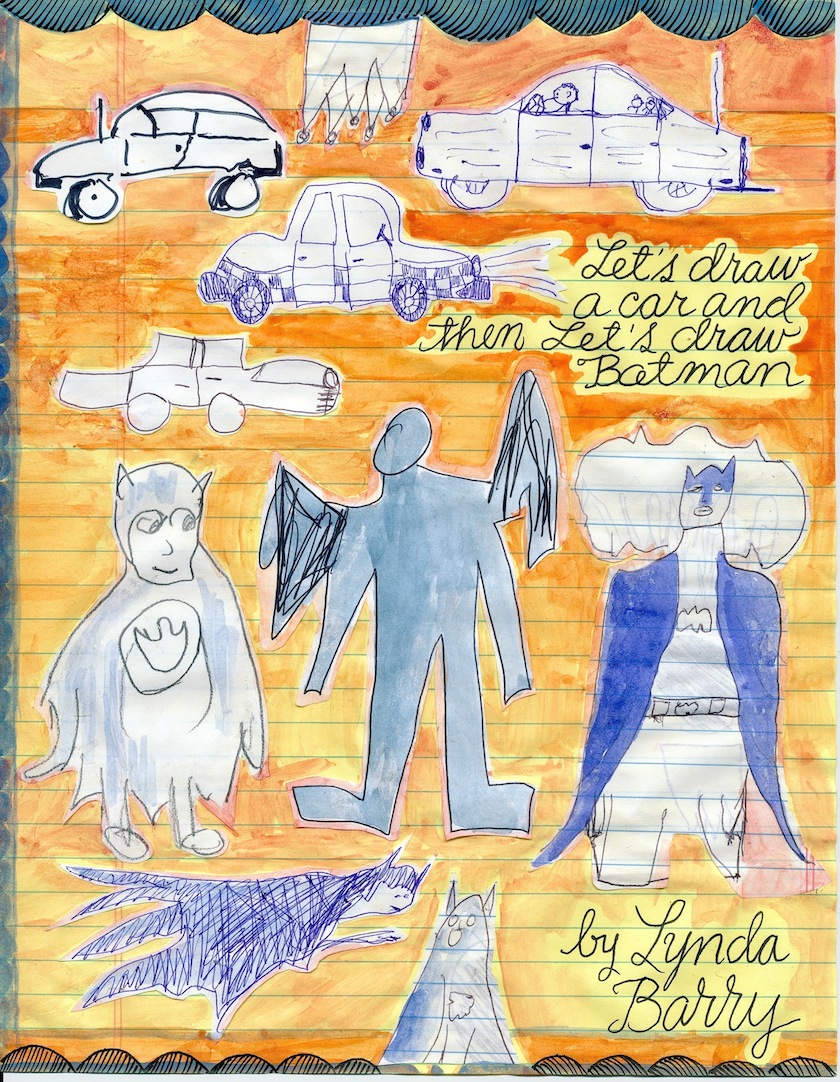
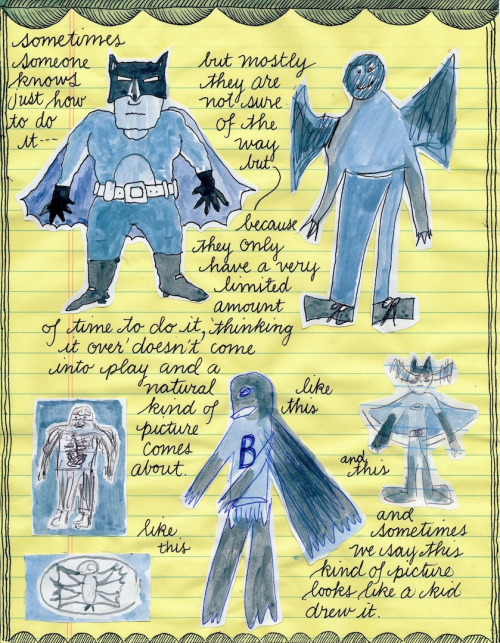
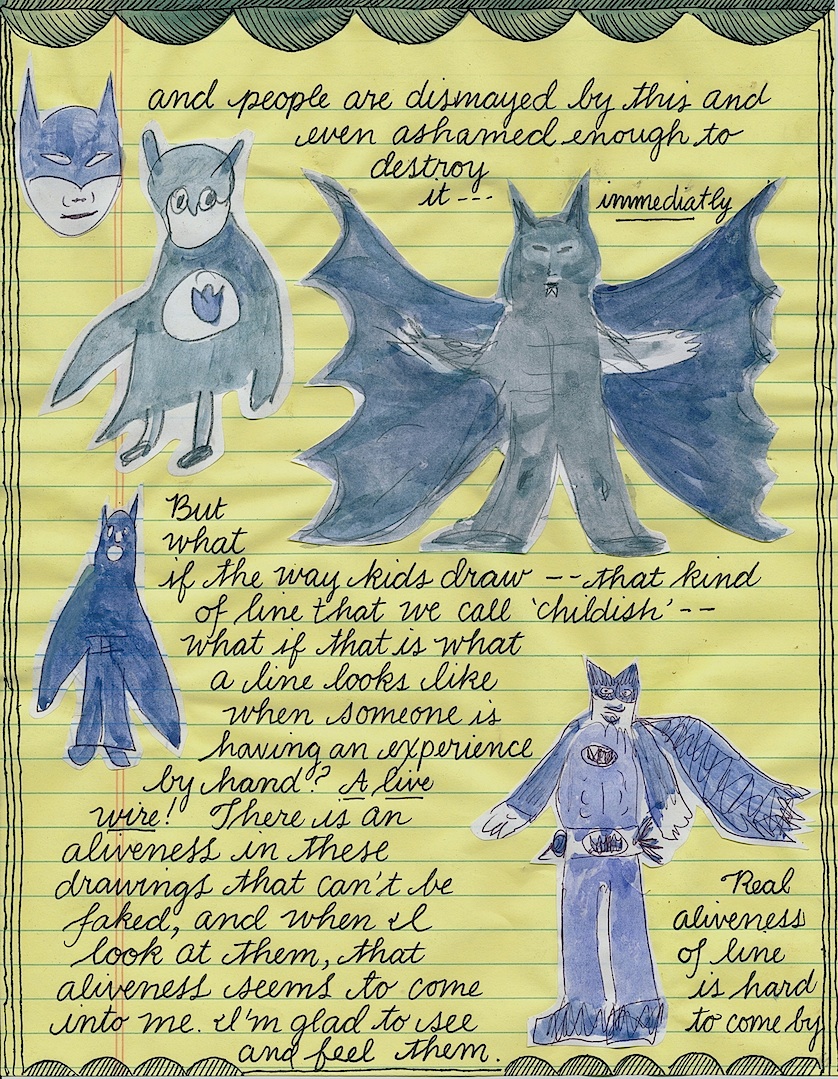
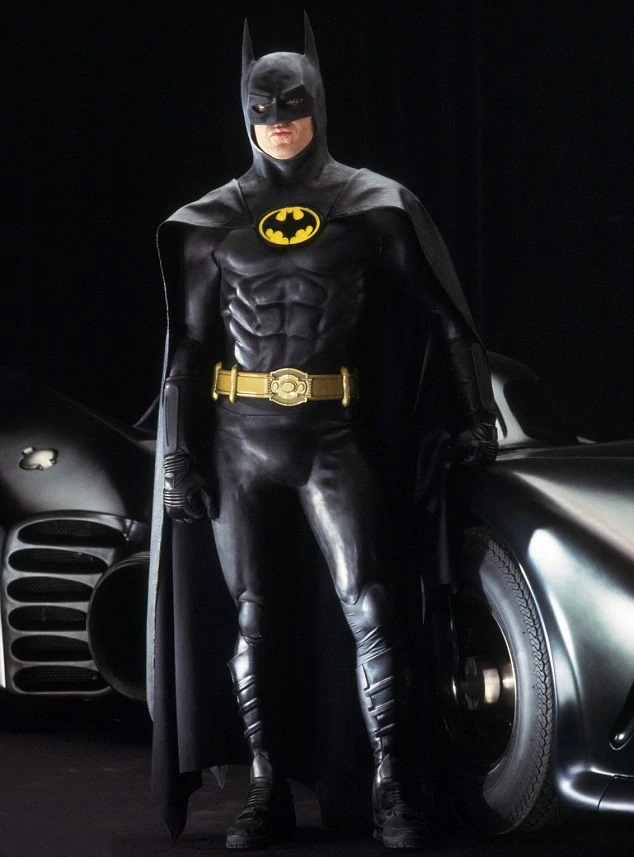
Don’t say you don’t, or that you can’t. According to cartoonist and educator Lynda Barry, we’re all capable of getting Batman down on paper in one form or another.
You have the ability to create a recognizable Batman because Batman’s basic shape is universally agreed upon, much like that of a car or a cat. Whether you know it or not, you have internalized that basic shape. This alone confers a degree of proficiency.
As proof of that, Barry would ask you to draw him in 15 seconds. A time constraint of that order has no room for fretting and self doubt. Only frenzied scribbling.
It also levels the playing field a bit. At 15 seconds, a novice’s Batman can hold his own against that of a skilled draftsperson.
Try it. Did you get pointy ears? A cape? A mask of some sort? Legs?
I’ll bet you did.
Once you’ve proved to yourself that you can draw Batman, you’re ready to tackle a more complex assignment: perhaps a four panel strip in which Batman throws up and screams.
This is probably a lot easier than drawing him scaling the side of a building or battling the Joker. Why? Personal experience. Anybody who’s ever lost his or her lunch can draw on the cellular memory of that event.
Fold a piece of paper into quarters and give it a whirl.
Then reward yourself with the video up top, a collection of student-created work from the Making Comics class Barry taught last fall at the great University of Wisconsin.
With everyone’s Batman rocking a Charlie Brown-sized noggin and simple rubber hose style limbs, there’s less temptation to get bogged down in comparisons.
Okay, so maybe some people are better than others when it comes to drawing toilets. No biggie. Keep at it. We improve through practice, and you can’t practice if you don’t start.
Once you’ve drawn Batman throwing up and screaming, there’s no end to the possibilities. Barry has an even bigger collection of student work (second video above), in which you’ll find the Caped Crusader doing laundry, using a laptop, calling in sick to work, reading Understanding Comics, eating Saltines… all the stuff one would expect given that part of the original assignment was to envision oneself as Batman.
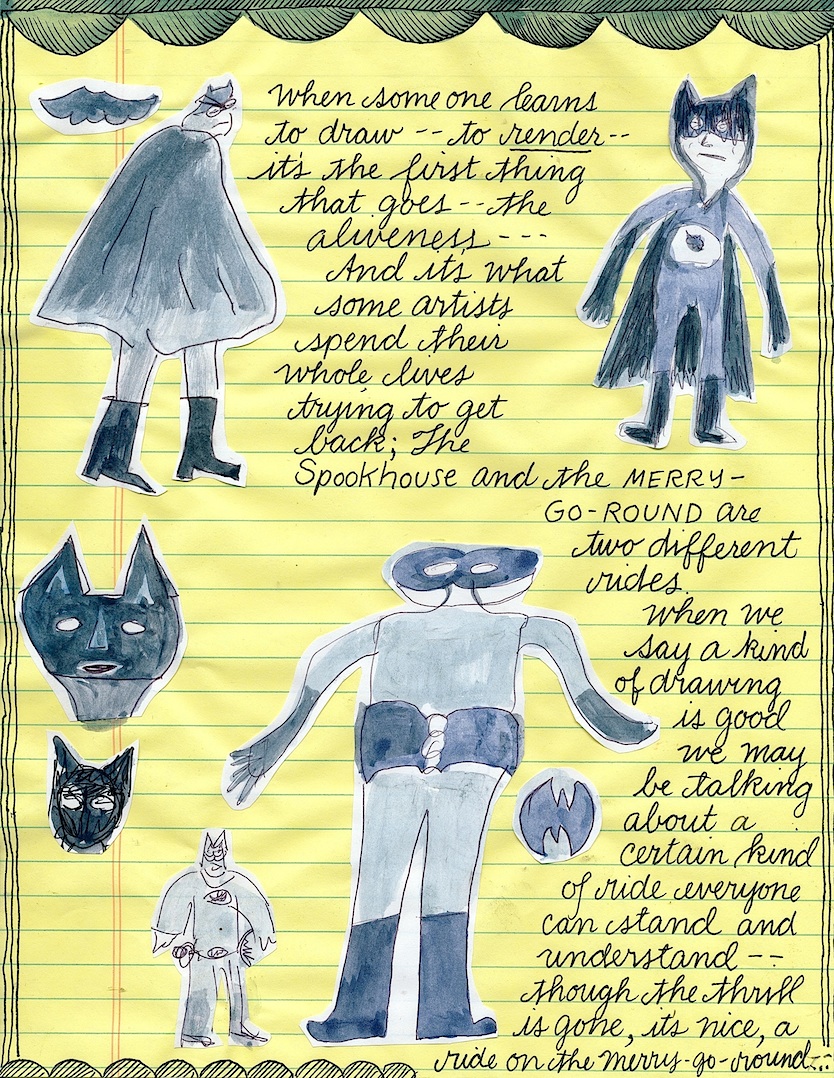
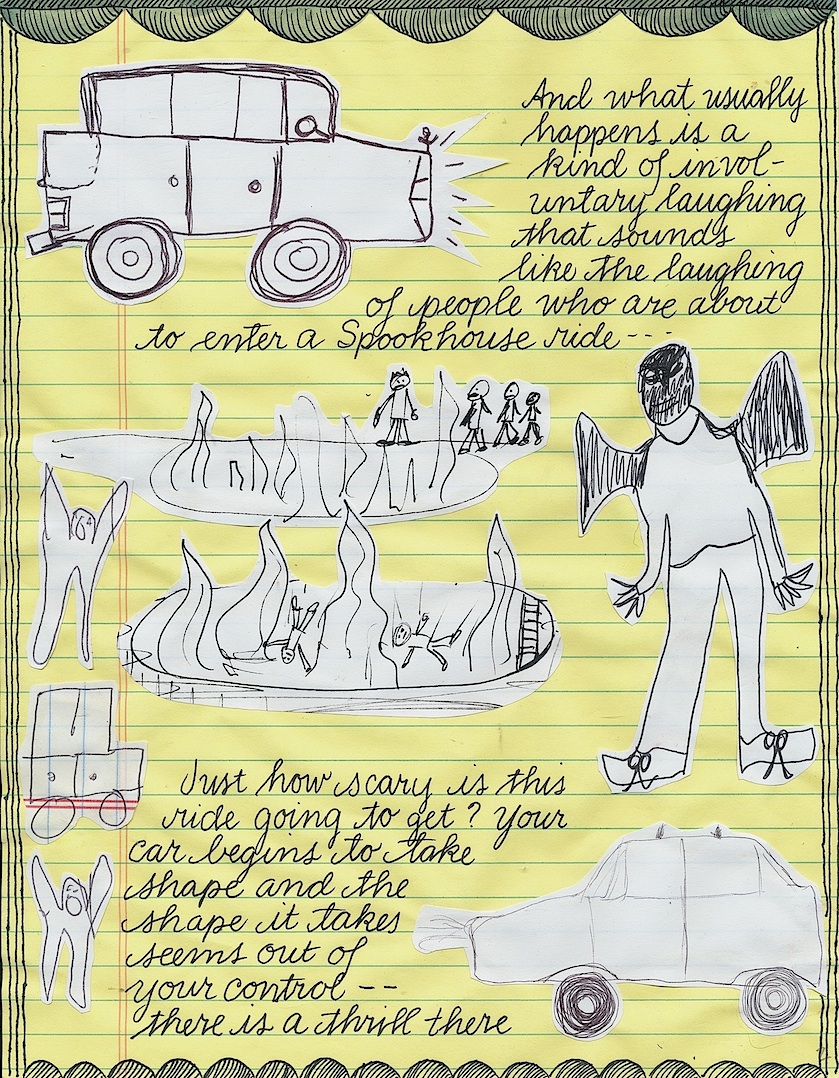
More of Lynda Barry’s Batman-related drawing philosophy from Syllabus can be found above and down below:
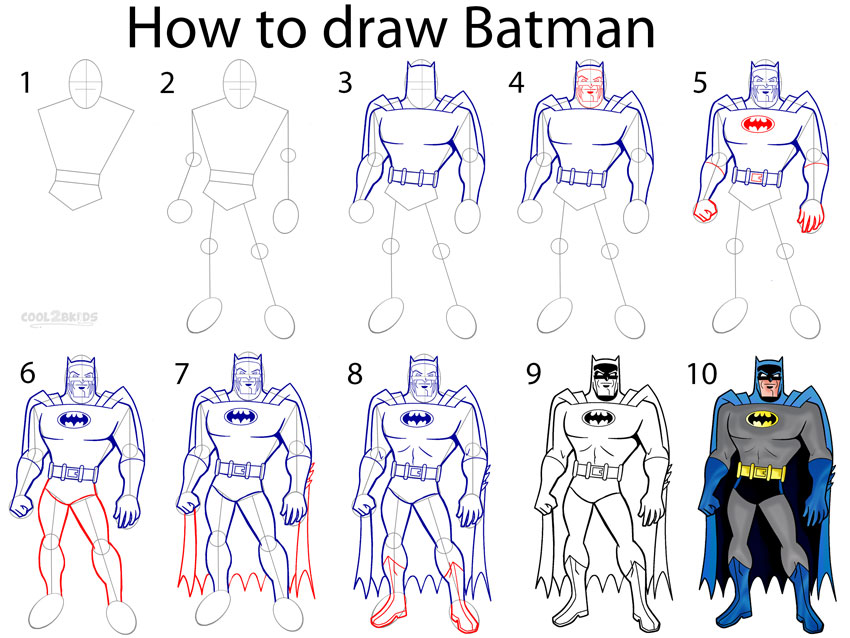
No matter what anyone tells you (see below), there’s no right way to draw Batman!
We can probably all agree that it’s a little premature, but all the same, the BBC has barreled ahead with its list of “The 21st Century’s 12 greatest novels.” Topping the list of excellent, if not especially surprising, picks is The Brief Wondrous Life of Oscar Wao, Junot Díaz’s Pulitzer Prize-winning debut novel about, as he puts it in the interview above, “a closeted nerd writing about an absolutely out nerd, and using their shared mutual language to tell the story.” The book has connected with such a wide swath of readers for more than its appeal to fellow nerds, though that’s no small thing. A great many readers have seen their own lives reflected in Díaz’s characters—Dominican immigrants growing up in New Jersey—or have found their experiences illuminating. And even though Yunior and Oscar’s very male point of view might have alienated female readers in the hands of a lesser author, Díaz has the sensitivity and self-awareness to—as Joe Fassler argues in The Atlantic—write sexist characters, but not sexist books. As the author himself says above, “if it wasn’t for women readers, I wouldn’t have a career.”
Díaz’s ear for dialogue and idiom and his facility for constructing completely believable characters with completely distinctive voices are matched by his commitment to representing the experiences of people who still get routinely left out of the contemporary canon. Despite the attention given to such stellar non-white, non-male writers as Toni Morrison, Maxine Hong-Kingston, Arundhati Roy, and Jamaica Kincaid, most MFA programs, Diaz argued in a recent essay for The New Yorker, are still “too white,” reproducing “exactly the dominant culture’s blind spots and assumptions around race and racism (and sexism and heteronormativity, etc).” In his own MFA workshop experiences at Cornell, he found that “the default subject position of reading and writing—of Literature with a capital L—was white, straight and male.”
The problem is more than just personal, though he certainly found the experience personally alienating, and it isn’t a matter of redressing historical wrongs or enforcing an abstract PC notion of diversity. Instead, as Díaz told Salon, it’s a problem of accurately representing reality. “If race or gender (or any other important social force) are not part of your interpretive logic—if they’re not part of what you consider the real—then you’re leaving out most of what has made our world our world.” In his own role at a professor at MIT, teaching undergraduate writing courses for the Comparative Media Studies/Writing Department, Díaz is very thoughtful about his approach, emphasizing, “it’s not the books you teach, but how you teach them.” In addition to novels by authors like Haitian-born Edwidge Danticat and Zimbabwean author NoViolet Bulawayo, he has his students read “classic Gothic texts which are themselves not very diverse by our standards,” but, he says, “the critical lens I deploy helps my students understand how issues of race, gender, coloniality etc. are never far.”
Salon tracked down the syllabi and reading lists for two of Díaz’s MIT courses, “World-Building” and “Advanced Fiction.” We do find one classic Gothic text—Bram Stoker’s Dracula—and also much of what we might expect from the self-confessed nerd, including work from such well-regarded comic writers as Frank Miller and Alan Moore and classic sci-fi from Tarzan creator Edgar Rice Burroughs. In addition to these white, male writers, we have fiction from African-American sci-fi authors Octavia Butler and N.K. Jemisin. Díaz’s “Advanced Fiction” list is even more wide-ranging, inclusive of writers from Chile, Zimbabwe, China, and Haiti, as well as the U.S. See both lists below.
World-Building:
Description: “This class concerns the design and analysis of imaginary (or constructed) worlds for narrative media such as roleplaying games, films, comics, videogames and literary texts. … The class’ primary goal is to help participants create better imaginary worlds – ultimately all our efforts should serve that higher purpose.”
Prerequisites: “You will need to have seen Star Wars (episode four: A New Hope) and read The Lord of the Rings by JRR Tolkien.”
Reading List:
“A Princess of Mars” by ER Burroughs
“Dracula” by Bram Stoker
“Batman: The Dark Knight Returns” by Frank Miller
“Sunshine” by Robin McKinley
“V for Vendetta” by Alan Moore
“The Hunger Games” by Suzanne Collins
“The Hundred Thousand Kingdoms” by NK Jemisin
“Lilith’s Brood” by Octavia Butler
“Perdido Street Station” by China Miéville
“Snow Crash” by Neal Stephenson (Recommended)
Some things to consider always when taking on a new world: What are its primary features—spatial, cultural, biological, fantastic, cosmological? What is the world’s ethos (the guiding beliefs or ideals that characterize the world)? What are the precise strategies that are used by its creator to convey the world to us and us to the world? How are our characters connected to the world? And how are we the viewer or reader or player connected to the world?
Advanced Fiction
Description: “An advanced workshop on the writing and critiquing of prose.”
Reading List:
“Clara” by Roberto Bolaño
“Hitting Budapest” by NoViolet Bulawayo
“Whites” by Julie Otsuka
“Ghosts” by Edwidge Danticat
“My Good Man” by Eric Gansworth
“Gold Boy, Emerald Girl” by Yiyun Li
“Bounty” by George Saunders
What is “Philosophy”? Yes, we know, the word comes from the Greek philosophia, which means “the love of wisdom.” This rote etymological definition does little, I think, to enhance our understanding of the subject, though it may describe the motivation of many a student. Like certain diseases, maybe philosophy is a spectrum, a collection of loosely related behaviors. Maybe a better question would be, “what are all the symptoms of this thing we call philosophy?” The medical metaphor is timely. We live in an age when the discipline of philosophy, like many of the humanities, gets treated like a pathology, in universities and in the wider culture. See, for example, popular articles on whether science has rendered philosophy (and religion) obsolete. There seems to be an underlying assumption in our society that philosophy is something to be eradicated, like smallpox.
Perhaps this sort of thing is just an empty provocation; after all, many logical positivists of the early 20th century also claimed to have invalidated large areas of philosophical inquiry by banishing every unclear concept to the dustbin. And yet, philosophy persists, infecting us with its relentless drive to define, inquire, critique, systematize, problematize, and deconstruct.
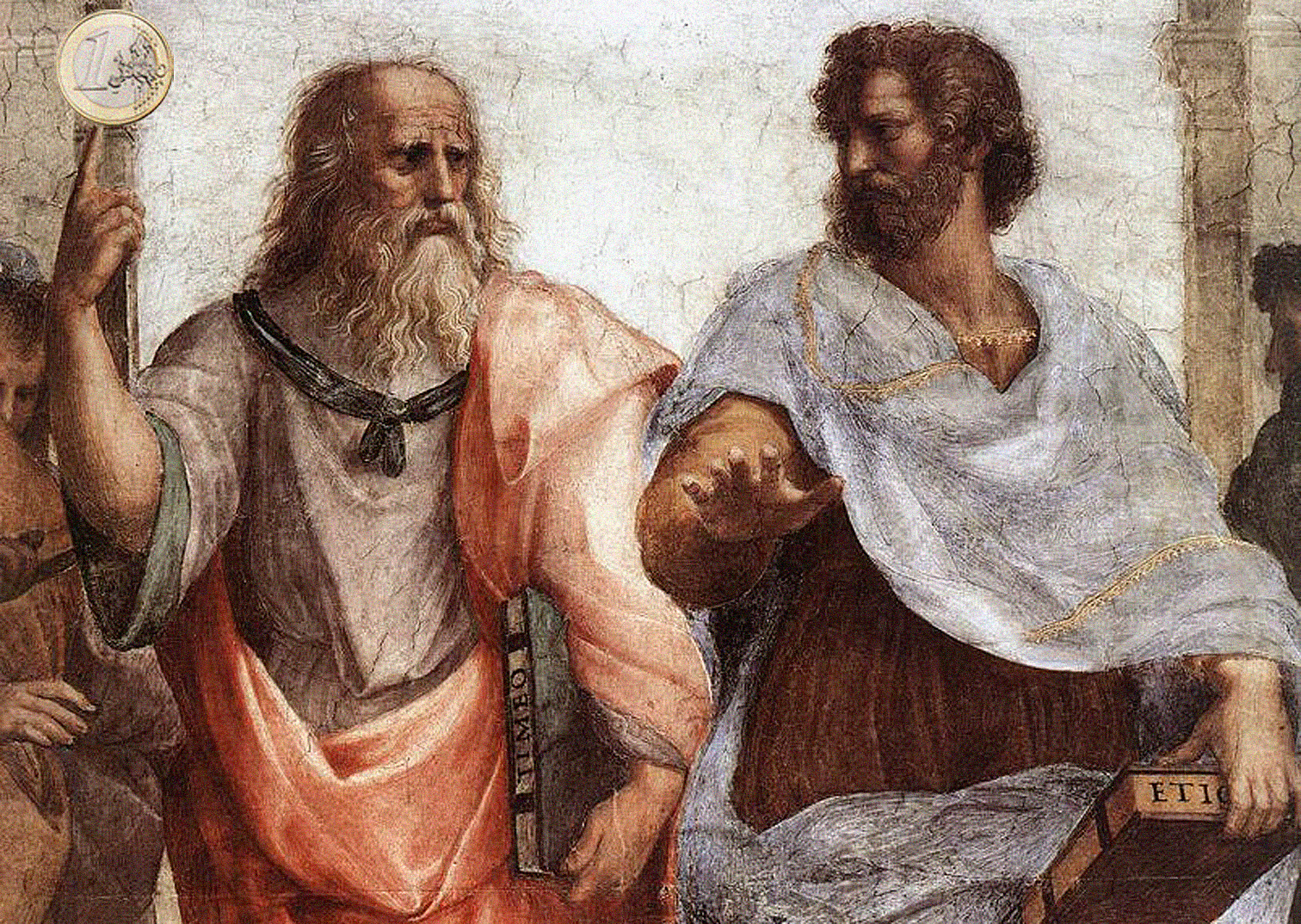
And of course, in a less technical sense, philosophy infects us with the drive to wonder. Without its tools, I maintain, we would not only lack the basis for understanding the world we live in, but we would also lack important means of imagining, and creating, a better one. If this sounds grandiose, wait till you encounter the thought of Plato, Spinoza, Hegel, Kant, Nietzsche, Kierkegaard, and jazz-futurist Sun Ra—all unaccustomed to thinking small and staying in their lane.
Some philosophers are more circumspect, some more precise, some more literary and imaginative, some more practical and technologically inclined. Like I said, many symptoms, one disease.
We at Open Culture have compiled a list of 140 free philosophy courses from as much of the wide spectrum as we could, spanning such diverse ways of thinking as University of Chicago’s Leo Strauss on Aristotle’s Ethics (Free Online Audio) and Plato’s Laws (Free Online Audio), to Columbia University Buddhist scholar Robert Thurman (Uma’s dad) on “The Central Philosophy of Tibet” (Free Online Audio). We have specific courses on Medical Ethics, taught by Notre Dame’s David Solomon (Free Online Audio) and the University of New Orlean’s Frank Schalow (Free iTunes Audio). We have hugely general courses like “The History of Philosophy Without Any Gaps,” from King’s College’s Peter Adamson (Free Course in Multiple Formats). We have philosophy courses on death, love, religion, film, law, the self, the ancients and the moderns…. See what I mean about the spectrum?
Perhaps philosophy incurs resentment because it roams at large and won’t be packaged into neatly salable—or jailable—units. Perhaps its amorphous nature, its tolerance of uncertainty and doubt, makes some kinds of people uncomfortable. Or perhaps some think it’s too abstruse and difficult to make sense of, or to matter. Not so! Visit our list of 140 philosophy courses and you will surely find a point of entry somewhere. One class will lead to another, and another, and before you know it, you’ll be asking questions all the time, of everything, and thinking rigorously and critically about the answers, and… well, by then it may be too late for a cure.
Remember when television was the big gorilla poised to put an end to all reading?
Then along came the miracle of the Internet. Blogs begat blogs, and thusly did the people start to read again!
Of course, many a great newspaper and magazine fell before its mighty engine. So it goes.
So did television in the old fashioned sense. So it goes.
Funny to think that these fast-moving developments weren’t even part of the landscape in 1991, when author Kurt Vonnegut swung by his hometown of Indianapolis to appear on the local program, Across Indiana.
Host Michael Atwood pointed out the irony of a television interviewer asking a writer if television was to blame for the decline in reading and writing. After which he listened politely while his guest answered at length, comparing reading to an acquired skill on par with “ice skating or playing the French horn.”
Gee… irony elicits a more frenetic approach in the age of BuzzFeed, Twitter, and YouTube. (Nailed it!)
Irony and humanity run neck and neck in Vonnegut’s work, but his appreciation for his Hoosier upbringing was never less than sincere:
When I was born in 1922, barely a hundred years after Indiana became the 19th state in the Union, the Middle West already boasted a constellation of cities with symphony orchestras and museums and libraries, and institutions of higher learning, and schools of music and art, reminiscent of the Austro-Hungarian Empire before the First World War. One could almost say that Chicago was our Vienna, Indianapolis our Prague, Cincinnati our Budapest and Cleveland our Bucharest.
To grow up in such a city, as I did, was to find cultural institutions as ordinary as police stations or fire houses. So it was reasonable for a young person to daydream of becoming some sort of artist or intellectual, if not a policeman or fireman. So I did. So did many like me.
Such provincial capitals, which is what they would have been called in Europe, were charmingly self-sufficient with respect to the fine arts. We sometimes had the director of the Indianapolis Symphony Orchestra to supper, or writers and painters, and architects like my father, of local renown.
I studied clarinet under the first chair clarinetist of our orchestra. I remember the orchestra’s performance of Tchaikovsky’s 1812 Overture, in which the cannons’ roars were supplied by a policeman firing blank cartridges into an empty garbage can. I knew the policeman. He sometimes guarded street crossings used by students on their way to or from School 43, my school, the James Whitcomb Riley School.
Vonnegut’s views were shaped at Shortridge High School, where he numbered among the many not-yet-renowned writers honing their craft on The Daily Echo. Thought he didn’t bring it up in the video above, the Echo also yielded his nickname: Snarf.
Vonnegut agreed with interviewer Atwood that the daily practice of keeping a journal is an excellent discipline for beginning writers. He also considered journalistic assignments a great training ground. He made a point of mentioning that Mark Twain and Ring Lardner got their starts as newspaper reporters. It may be harder for aspiring writers to find paying work these days, but the Internet is replete with opportunities for those who crave a daily assignment.
It’s also overflowing with bullet pointed lists on how to become a writer, but if you’re like me, you’ll prefer to receive this advice from Vonnegut, himself, on a set festooned with farming implements, quilts, and dipped candles.
The interview continues in the remaining parts:
Ayun Halliday is an author, homeschooler, and Chief Primatologist of the East Village Inky zine. Like Vonnegut, she’s a native of Indianapolis, and her mother was the editor of the Short Ridge Daily Echo. Follow her @AyunHalliday
Once upon a time, questions about the use-value of art were the height of philistinism. “All art is quite useless,” wrote the aesthete Oscar Wilde, presaging the attitudes of modernists to come. Explaining this statement in a letter to a perplexed fan, Wilde opined that art “is not meant to instruct, or to influence action in any way.” But if you ask Alain de Botton, founder of “cultural enterprise” The School of Life, art—or literature specifically—does indeed have a practical purpose. Four to be precise.
In a pitch that might appeal to Dale Carnegie, de Botton argues that literature: 1) Saves you time, 2) Makes you nicer, 3) Cures loneliness, and 4) Prepares you for failure. The format of his video above—“What is Literature For?”—may be formulaic, but the argument may not be so contrary to modernist dicta after all. Indeed, as William Carlos Williams famously wrote, “men die miserably every day / for lack / of what is found” in poetry. How many people perish slowly over wasted time, meanness, loneliness, and broken dreams?
Like de Botton’s short video introductions to philosophers, which we featured in a previous post, “What is Literature For?” comes to us with Monty Python-like animation and pithy narration that makes quick work of a lot of complex ideas. Whether you find this inspiring or insipid will depend largely on how you view de Botton’s broad-brush, populist approach to the humanities in general. In any case, it’s true that people crave, and deserve, more accessible introductions to weighty subjects like literature and philosophy, subjects that—as de Botton says above in “What is Philosophy For?”—can seem “weird, irrelevant, boring.…”
Here, contra Ludwig Wittgenstein’s claims that all philosophy is nothing more than confusion about language, de Botton expounds a very classical idea of the discipline: “Philosophers are people devoted to wisdom,” he says. And what is wisdom for? Its application, unsurprisingly, is also eminently practical. “Being wise,” we’re told, “means attempting to live and die well.” As someone once indoctrinated into the Byzantine cult of academic humanities, I have to say this definition seems to me especially reductive, but it does accord perfectly with The School of Life’s promise of “a variety of programmes and services concerned with how to live wisely and well.”
Lastly, we have de Botton’s explanation above, “What Is History For?” Most people, he claims, find the subject “boring.” Given the enormous popularity of historical drama, documentary film, novels, and popular non-fiction, I’m not sure I follow him here. The problem, it seems, is not so much that we don’t like history, but that we can never reach consensus on what exactly happened and what those happenings mean. This kind of uncertainty tends to make people very uncomfortable.
Unbothered by this problem, de Botton presses on, arguing that history, at its best, provides us with “solutions to the problems of the present.” It does so, he claims, by correcting our “bias toward the present.” He cites the obsessive jackhammering of 24-hour news, which shouts at us from multiple screens at all times. I have to admit, he’s got a point. Without a sense of history, it’s easy to become completely overwhelmed by the incessant chatter of the now. Perhaps more controversially, de Botton goes on to say that history is full of “good ideas.” Watch the video above and see if you find his examples persuasive.
All three of de Botton’s videos are brisk, upbeat, and very optimistic about our capacity to make good use of the humanities to better ourselves. Perhaps some of the more skeptical among us won’t be easily won over by his arguments, but they’re certainly worthy of debate and offer some very positive ways to approach the liberal arts. If you are persuaded, then dive into our collections of free literature, history and philosophy courses highlighted in the section below.
We're hoping to rely on loyal readers, rather than erratic ads. Please click the Donate button and support Open Culture. You can use Paypal, Venmo, Patreon, even Crypto! We thank you!
Open Culture scours the web for the best educational media. We find the free courses and audio books you need, the language lessons & educational videos you want, and plenty of enlightenment in between.