Do Rappers Have a Bigger Vocabulary Than Shakespeare?: A Data Scientist Maps Out the Answer

UniqueWordsinRap

Each year brings us a new list of words that, once hip or sub­cul­tur­al, sig­nal their admis­sion into the main­stream by enter­ing the pages—print or online—of the Oxford Eng­lish Dic­tio­nary or Mer­ri­am Web­ster’s. Many of those come from the world of hip hop. The form is a ver­i­ta­ble lab­o­ra­to­ry of lin­guis­tic inno­va­tion, spawn­ing dozens of region-spe­cif­ic argots that mutate and evolve beyond the capac­i­ty of hip lex­i­cog­ra­phers to doc­u­ment. One data sci­en­tist, Matt Daniels, has made an inter­est­ing attempt, how­ev­er, in a project he calls “The Largest Vocab­u­lary in Hip Hop.” Pro­ceed­ing from the premise that cer­tain rap­pers might match or best Shake­speare for the title of “largest vocab­u­lary ever,” Daniels used a method­ol­o­gy called “token analy­sis” to ana­lyze the lyri­cal con­tent of “the most famous artists in hip hop.” He relied on Rap Genius tran­scrip­tions, which are only cur­rent to 2012, to pro­duce a sam­ple size of 35,000 words (the equiv­a­lent of 3–5 stu­dio albums).

Top­ping the list by far with a total of 7,392 unique words used is rap­per Aesop Rock, whom, Daniels admits, is some­what obscure by com­par­i­son with Jay Z or Snoop Dog. More well-known artists like Wu Tang Clan, The Roots, and Out­kast also rank high­ly, but what Daniels dis­cov­ered is that many of the rap­pers near the top of the scale are under­ground or obscure artists who don’t sell mil­lions of records. And occu­py­ing the low­er end are some top-sell­ing artists and house­hold names like Lil Wayne, Kanye West, and Snoop Dog (DMX is dead last at #85). King of the hill Jay‑Z, whose 2013 album Magna Carta…Holy Grail sold half a mil­lion copies in its first week, ranks some­where in the mid­dle, and Daniels quotes from the mega-sell­ing rapper’s “Moment of Clar­i­ty” from his Black Album in which he plain­ly admits that he’ll write mid­dle­brow lyrics for mil­lion dol­lar sales fig­ures, say­ing “I dumb­ed down for my audi­ence to dou­ble my dol­lars” (one won­ders how many lis­ten­ers per­ceived the slight).

Daniels admits in an NPR inter­view that this is “not a seri­ous aca­d­e­m­ic study” but a project he under­took for the fun of it. And a great many of the “unique words” count­ed in each rapper’s totals are slang coinages or vari­ants like “pimps, pimp, pimp­ing, and pimpin,” each of which counts sep­a­rate­ly. Even so, writes Daniels on the project’s site, “it’s still direc­tion­al­ly inter­est­ing,” as well as soci­o­log­i­cal­ly. And of course, lit­er­ary writ­ers have been con­tribut­ing made-up words to the gen­er­al lex­i­con for cen­turies. See Daniels’ site for an inter­ac­tive visu­al­iza­tion (screen shot above) of the rank­ings of all 85 rap­pers sur­veyed.

If you’re won­der­ing who has a big­ger vocab­u­lary — Shake­speare or rap­pers — here’s the quick answer in pure­ly numer­i­cal terms. In his sam­ple size of 35,000 words per artist, Daniels deter­mined that Aesop Rock used 7,392 unique words (and Wu-Tang Clan, 5,895) against Shake­speare’s 5,000 unique words. And there you have it.

Relat­ed Con­tent:

Jay‑Z: The Evo­lu­tion of My Style

The Great­ness of Charles Dar­win Explained with Rap Music

The Art of Data Visu­al­iza­tion: How to Tell Com­plex Sto­ries Through Smart Design

Josh Jones is a writer and musi­cian based in Durham, NC. Fol­low him at @jdmagness.

A Brief Tour of British & Irish Accents: 14 Ways to Speak English in 84 Seconds

Amer­i­cans, com­ing from the enor­mous and rel­a­tive­ly recent­ly set­tled place we do, tend to have a hard time with accents, strug­gling to grasp the extent of the vari­ety of region­al ways of speech in small­er, old­er coun­tries, let alone to use them our­selves. Study­ing the Kore­an lan­guage, I’ve found that under­stand­ing a native speak­er from one city does­n’t mean I’ll under­stand any­thing said by anoth­er native speak­er from a city fifty miles away. (Though that holds true even for Kore­ans them­selves; hence the preva­lence of sub­ti­tles on their tele­vi­sion shows.) Vis­it­ing Lon­don a few months ago, eas­i­ly as I could make sense of every­body speak­ing my native tongue, I pre-emp­tive­ly gave up hope of pick­ing up on the nuances of all the accents peo­ple had brought to the city from their home­towns — much less the numer­ous and sub­tle dialects native of Lon­don itself. Every­one I met insist­ed that a Briton’s accent says more about their ori­gin, class, sta­tion in life, and degree of self-regard than any oth­er qual­i­ty, but not know­ing New­cas­tle from Southamp­ton when I first set foot on Eng­lish soil, I had to take them at their word (how­ev­er they hap­pened to pro­nounce it).

The video above, in which pro­fes­sion­al dialect coach Andrew Jack demon­strates four­teen British accents in 84 sec­onds, might help sort things out for my fel­low con­fused coun­try­men. “Received com­mu­ni­ca­tion is the great com­mu­ni­ca­tor,” Jack says, using the accent I assume he grew up with. “As soon as you devi­ate from that and you go into Lon­don speech, for exam­ple, you lose a lit­tle bit of the com­mu­ni­ca­tion.” By that point, Jack has seam­less­ly tran­si­tioned into Cock­ney, from which he then shifts into the accents of East Anglia, the West Coun­try, York­shire, Lan­cashire, Liv­er­pool, North­ern Ire­land, Dublin, the Scot­tish high­lands, Glas­gow, North Wales, and South Wales. The Youtube com­ment box below has, pre­dictably, filled with com­plains about all the accents — the com­menters’ own, dare I imag­ine? — that did­n’t make it into this brief lin­guis­tic tour. Though far from com­pre­hen­sive, the video does in any case put the lie to the notion so many non-Brits seem to have that they can “do a British accent.” If you encounter one of them, don’t ask them to demon­strate it; ask them which British accent they mean. Then you’ll real­ly hear how poor­ly they fare.

via Kot­tke

Relat­ed Con­tent:

Peter Sell­ers Gives a Quick Demon­stra­tion of British Accents

Peter Sell­ers Reads The Bea­t­les’ “She Loves You” in Four Dif­fer­ent Accents

Sir Patrick Stew­art Demon­strates How Cows Moo in Dif­fer­ent Eng­lish Accents

What Shake­speare Sound­ed Like to Shake­speare: Recon­struct­ing the Bard’s Orig­i­nal Pro­nun­ci­a­tion

Col­in Mar­shall hosts and pro­duces Note­book on Cities and Cul­ture and writes essays on cities, lan­guage, Asia, and men’s style. He’s at work on a book about Los Ange­les, A Los Ange­les Primer. Fol­low him on Twit­ter at @colinmarshall or on Face­book.

Opening Sentences From Great Novels, Diagrammed: Lolita, 1984 & More

Lolitadiagrammed

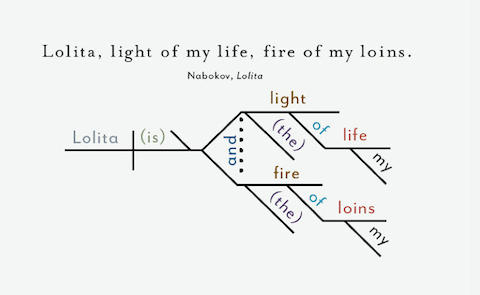
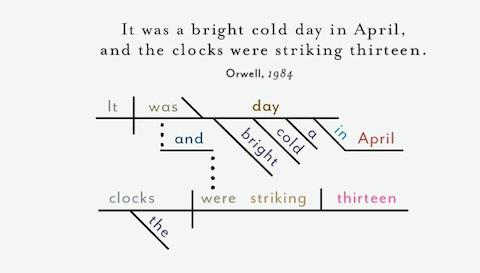
I admit it: I still don’t under­stand sen­tence dia­gram­ming. Though as a mid­dle school­er I duti­ful­ly, if grudg­ing­ly, sub­mit­ted to that clas­sic Eng­lish class­room exer­cise, the prac­tice did­n’t stick, nor did what­ev­er habit of com­po­si­tion it meant to con­vey. Some of my teach­ers tried to make sen­tence dia­gram­ming inter­est­ing, but they could only do so much. They could only do so much, that is, with­out Pop Chart Lab’s “A Dia­gram­mat­i­cal Dis­ser­ta­tion on Open­ing Lines of Notable Nov­els,” a poster that “dia­grams 25 famous open­ing lines from revered works of fic­tion accord­ing to the dic­tates of the clas­sic Reed-Kel­logg sys­tem,” with each and every graph­ic “pars­ing clas­si­cal prose by parts of speech and offer­ing a par­ti­tioned, col­or-cod­ed pic­to-gram­mat­i­cal rep­re­sen­ta­tion of some of the most famous first words in lit­er­ary his­to­ry.”

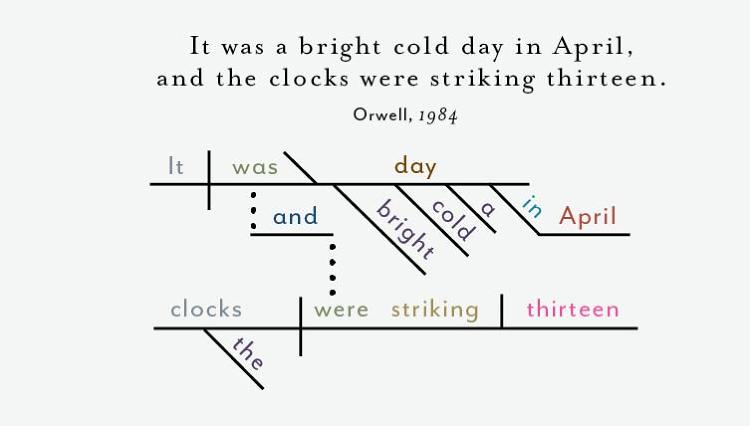
Orwelldiagrammed

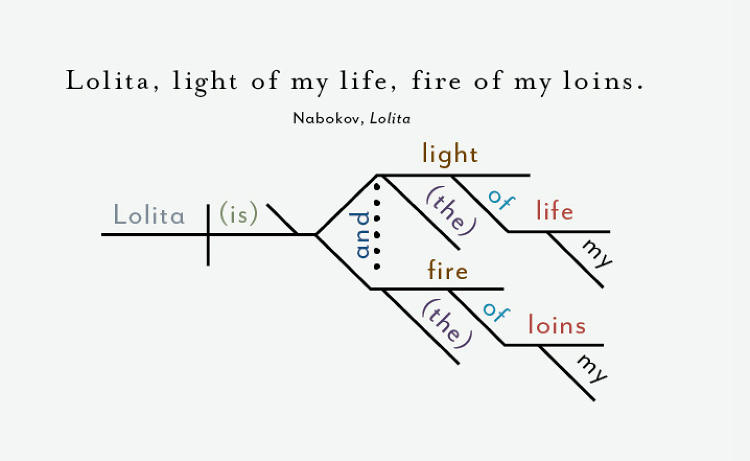
At the top of the post, we have the poster’s dia­gram of Hum­bert Hum­bert’s famous first words, by way of Vladimir Nabokov, in Loli­ta: “Loli­ta, light of my life, fire of my loins.” That immor­tal sen­tence may always have struck you as incom­plete — does­n’t it need a verb? — but hey, it dia­grams, at least with the addi­tion of the implic­it (is) and a cou­ple implic­it (the)s. Fol­low the branch­es and you find the words’ con­cealed com­plex­i­ty visu­al­ly revealed. Just above, you’ll see dia­grammed a more tra­di­tion­al open­ing sen­tence from George Orwell, a much more plain­spo­ken writer. “It was a bright cold day in April,” goes the first line of 1984, “and the clocks were strik­ing thir­teen” — a more lin­guis­ti­cal­ly involved descrip­tion, as you can see, than it may at first seem. Fif­teen years after the specter of Reed-Kel­logg dark­ened my desk — in which time I’ve made writ­ing my career — I still can’t claim the abil­i­ty to pro­duce prop­er­ly dia­grammed sen­tences for myself. But I like to think that I can appre­ci­ate them, espe­cial­ly when they show me the work­ings of a suf­fi­cient­ly great sen­tence.

See more famous open­ing sen­tences from Pop Chart Lab’s poster (and pur­chase your own copy) here.

Relat­ed Con­tent:

George Orwell’s 1984: Free eBook, Audio Book & Study Resources

The His­to­ry of the Eng­lish Lan­guage in Ten Ani­mat­ed Min­utes

Learn Lan­guages for Free: Span­ish, Eng­lish, Chi­nese & 37 Oth­er Lan­guages

David Fos­ter Wal­lace Breaks Down Five Com­mon Word Usage Mis­takes in Eng­lish

Nabokov Reads Loli­ta, Names the Great Books of the 20th Cen­tu­ry

Col­in Mar­shall hosts and pro­duces Note­book on Cities and Cul­ture and writes essays on cities, aes­thet­ics, Asia, and men’s style. He’s at work on a book about Los Ange­les, A Los Ange­les Primer. Fol­low him on Twit­ter at @colinmarshall or on Face­book.

New “Hemingway” App Promises to Make Your Writing “Strong and Clear”

hemingway writing app

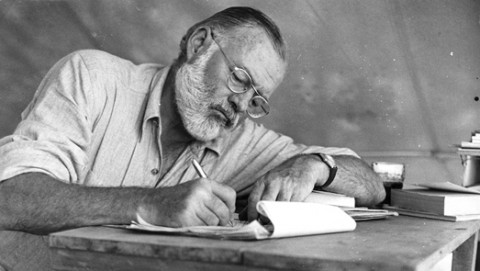
I con­fess, I pre­fer Faulkn­er to Hem­ing­way and see noth­ing wrong with long, com­plex sen­tences when they are well-con­struct­ed. But in most non-Faulkn­er writ­ing, they are not. Stream of con­scious­ness is a delib­er­ate effect of care­ful­ly edit­ed prose, not the unre­vised slop of a first draft. In my days as a writ­ing teacher, I’ve read my share of the lat­ter. The Eng­lish teacher’s guide for par­ing down unruly writ­ing resem­bles a new online app called “Hem­ing­way,” which exam­ines writ­ing and grades it on a col­or-cod­ed dif­fi­cul­ty scale. “Hem­ing­way” sug­gests using sim­pler dic­tion, edit­ing out adverbs in favor of stronger verbs, and elim­i­nat­ing pas­sive voice. It promis­es to make your writ­ing like that of the famous Amer­i­can min­i­mal­ist, “strong and clear.”

Of course I couldn’t resist run­ning the above para­graph through Hem­ing­way. It received a score of 11—merely “O.K.” It sug­gest­ed that I change the pas­sive in sen­tence one and remove “care­ful­ly” from the fourth sen­tence (I declined), and it iden­ti­fied “unruly” as an adverb (it is not). Like all forms of advice, it pays to use your own judg­ment before apply­ing whole­sale. Nev­er­the­less, the sug­ges­tion to stream­line and sim­pli­fy for clarity’s sake is a gen­er­al rule worth heed­ing more often than not. Broth­ers Adam and Ben Long, cre­ators of the app, real­ized that their “sen­tences often grow long to the point that they became dif­fi­cult to read.” It hap­pens to every­one, ama­teur and pro­fes­sion­al alike. The app sug­gests writ­ing that scores a Grade 10 or below is “bold and clear.” Writ­ing above this mea­sure is “hard” or “very hard” to read. Which prompts the inevitable ques­tion: How does Hem­ing­way him­self score in the Hem­ing­way app?

In a blog post yes­ter­day for The New York­er, Ian Crouch ran a few of the master’s pas­sages through the online edit­ing tool (a con­cept akin to John Malkovich enter­ing John Malkovich’s head). The open­ing para­graph of “A Clean, Well-Light­ed Place” received a score of 15. Hemingway’s descrip­tion of Romero the bull­fight­er from The Sun Also Ris­es also “breaks sev­er­al of the Hem­ing­way rules” with its use of pas­sive voice and extra­ne­ous adverbs. Does this mean even Hem­ing­way falls short of the ide­al? Or only that writ­ing rules exist to be bro­ken? Both, per­haps, and nei­ther. Style is as elu­sive as gram­mar is con­strict­ing, and both are mas­tered only through end­less prac­tice. Will “Hem­ing­way” turn you into Hem­ing­way? No. Will it make you a bet­ter writer? Maybe. But only, I’d sug­gest, inas­much as you learn when to accept and when to ignore its advice.

Relat­ed Con­tent:

Sev­en Tips From Ernest Hem­ing­way on How to Write Fic­tion

Jack Ker­ouac Lists 9 Essen­tials for Writ­ing Spon­ta­neous Prose

Crime Writer Elmore Leonard Pro­vides 13 Writ­ing Tips for Aspir­ing Writ­ers

Josh Jones is a writer and musi­cian based in Durham, NC. Fol­low him at @jdmagness

David Foster Wallace Creates Lists of His Favorite Words: “Maugre,” “Tarantism,” “Ruck,” “Primapara” & More

WallaceLexicon1

Every­one I know has a list of least-favorite words. For var­i­ous rea­sons, “moist” always seems to make the top three. But per­haps it takes a writer—someone who savors the sounds, tex­tures, and his­to­ries of pecu­liar words—to com­pile a list of their most-favorites. A few I’ve placed in keep­sake box­es over the years—little cor­ru­gat­ed min­er­als that remind me of what words can do: “palaver,” “obdu­rate,” “crevasse,” “super­fe­cund”….

I could go on, but it’s cer­tain­ly not my list you’ve come for. You’re read­ing, I sus­pect, because you well know the con­sum­mate care and atten­tion David Fos­ter Wal­lace lav­ished on his prose—his rep­u­ta­tion as a smith of end­less cre­ativ­i­ty who, Alex Ross wrote in a series of McSweeney’s trib­utes, spent his time “keen­ly observ­ing, forg­ing acronyms, rean­i­mat­ing life­less OED entries, and cre­at­ing sen­tences that make us spit out our beer.”

Ross’s men­tion of the Oxford Eng­lish Dic­tio­nary, that ven­er­a­ble repos­i­to­ry of the vast breadth and depth of writ­ten Eng­lish (sad­ly kept behind a pay­wall), helps us appre­ci­ate Wallace’s list, which fea­tures such archa­ic adverbs as “mau­gre” (“in spite of, notwith­stand­ing”) and obscure adjec­tives as “lacinate” (“fringed”). Who has read, much less writ­ten, the Anglo-Sax­on “ruck” (“a mul­ti­tude of peo­ple mixed togeth­er”)? And while the equal­ly rock-hard, mono­syl­lab­ic “wrack” is famil­iar, I have not before encoun­tered the love­ly “prima­para” (“woman who’s preg­nant for the first time”).

WallaceList2

Anoth­er page of Wallace’s list (above—click images to enlarge) includes such trea­sures as “taran­tism,” a “dis­or­der where you have an uncon­trol­lable need to dance,” and “sci­olism,” a “pre­ten­tious air of schol­ar­ship; super­fi­cial knowl­edga­bil­i­ty.” While it is true that Wal­lace has been accused of the lat­ter, I do not think this is a com­pe­tent judg­ment. Instead, I would describe him with anoth­er of my favorite words—“amateur”—not at all, of course, in the sense of an unpaid or unskilled begin­ner, but rather, as it meant in French, a “devot­ed lover” of the Eng­lish lan­guage.

These pages come to us from Lists of Note (and the Har­ry Ran­som Cen­ter at UT-Austin), who writes that they are “just two pages from the hun­dreds of word lists he amassed over the years.” Per­haps one day we’ll see a pub­lished edi­tion of David Fos­ter Wallace’s favorite words. For the nonce, head on over to Lists of Note to see this min­im of his lex­i­con tran­scribed.

Relat­ed Con­tent:

David Fos­ter Wallace’s Love of Lan­guage Revealed by the Books in His Per­son­al Library

David Fos­ter Wal­lace Breaks Down Five Com­mon Word Usage Mis­takes in Eng­lish

David Fos­ter Wallace’s 1994 Syl­labus: How to Teach Seri­ous Lit­er­a­ture with Light­weight Books

30 Free Essays & Sto­ries by David Fos­ter Wal­lace on the Web

Josh Jones is a writer and musi­cian based in Durham, NC. Fol­low him at @jdmagness

The International Children’s Digital Library Offers Free eBooks for Kids in Over 40 Languages

For all of the free lit­er­a­ture and essays avail­able online, a sur­pris­ing­ly small amount is geared toward chil­dren. Even less is aimed at chil­dren who speak for­eign lan­guages.

The Inter­na­tion­al Children’s Dig­i­tal Library offers chil­dren ages 3–13 free access to the best avail­able children’s lit­er­a­ture in more than 40 lan­guages. Librar­i­ans find and dig­i­tize books pub­lished around the world and present them in their orig­i­nal lan­guages.

The site acts as a meta learn­ing tool. It is designed to be easy for chil­dren to use by themselves—by sim­ply click­ing “Read Books,” a list of favorite titles pops up—but kids can learn how to search too, by their own age, types of char­ac­ters, genre, book length, lan­guage and geo­graph­i­cal region.

The home­page fea­tures rec­om­mend­ed and pop­u­lar titles, like Tyrone the Hor­ri­ble, writ­ten in Span­ish. Where trans­la­tion rights exist, the library works with vol­un­teer trans­la­tors to pro­vide addi­tion­al lan­guage ver­sions.

The library is a project of the Uni­ver­si­ty of Maryland’s Human-Com­put­er Inter­ac­tion Lab and there is a research com­po­nent to the project. Work­ing with chil­dren in New Zealand, Hon­duras, Ger­many, and the Unit­ed States, researchers are look­ing at how chil­dren per­ceive oth­er cul­tures out­side their own.

The library’s broad­er mis­sion is to make it pos­si­ble for chil­dren all over the world to learn to use a library sys­tem and read a range of qual­i­ty lit­er­a­ture. The inter­face aims as much at inter­na­tion­al chil­dren as it does immi­grant chil­dren in Amer­i­can cities and rur­al areas.

Books are avail­able for free and with­out an account. An account, how­ev­er, allows a child to cre­ate their own book­shelf of favorites that can be shared with oth­er users. A guide for teach­ers includes a train­ing man­u­al and tips for how to use the library to teach cre­ative writ­ing, library search skills and for­eign lan­guages.

You will find the Inter­na­tion­al Children’s Dig­i­tal Library in our col­lec­tion 200 Free Kids Edu­ca­tion­al Resources: Video Lessons, Apps, Books, Web­sites & More.

More dig­i­tized chil­dren’s books can be found at the Library of Con­gress.

Adults, don’t miss our oth­er col­lec­tion, 800 Free eBooks for iPad, Kin­dle & Oth­er Devices.

Relat­ed Con­tent:

Hear the Clas­sic Win­nie-the-Pooh Read by Author A.A. Milne in 1929

Watch Ani­ma­tions of Oscar Wilde’s Children’s Sto­ries “The Hap­py Prince” and “The Self­ish Giant”

The Clas­sic 1956 Oscar-Win­ning Children’s Film, The Red Bal­loon


Read 100 Entries From America’s Most Unique Dictionary, Now Available Online For The First Time

Ear­li­er this year, we wrote about the region­al dif­fer­ences in how Amer­i­cans refer to soft drinks. An explo­ration of the var­i­ous geo­graph­i­cal names for a car­bon­at­ed bev­er­age is all well and good, but it’s impor­tant to remem­ber that America’s lex­i­cal vari­a­tions are sig­nif­i­cant­ly more col­or­ful than “soda,” (East and West coasts), “coke,” (South), and “pop” (Mid­west and North­west).

For those inter­est­ed in expe­ri­enc­ing the full range of ver­bal Amer­i­cana, the Dic­tio­nary of Amer­i­can Region­al Eng­lish (DARE) has final­ly become avail­able online after 47 years of work. Unlike any oth­er dic­tio­nary, DARE attempts to doc­u­ment the region­al aspects of Amer­i­can Eng­lish, and sys­tem­atize the wide array of  geo­graph­i­cal­ly unique terms and expres­sions. As John McWhort­er notes in The New Repub­lic, this labor of lin­guis­tic love con­tains some 60,000 entries from 1,002 com­mu­ni­ties, col­lect­ed between 1965 and 1970. Of course, as McWhort­er points out, some of the terms indexed in DARE are dat­ed, hav­ing suc­cumbed to mass-media’s democ­ra­tiz­ing effects on lan­guage over the course of DARE’s lengthy prepa­ra­tion. Still, with entries like “rich rel­a­tives” (dust bun­nies) and “Cana­di­an per­jun­kety” (pim­ples), the dic­tio­nary pro­vides a fas­ci­nat­ing glimpse of the ver­bal curios, both old and new, that have sprung up around the coun­try.

Although DARE is a sub­scrip­tion-based ser­vice, its web­site pro­vides vis­i­tors with a list of 100 free and brows­able terms. We’ve includ­ed a selec­tion below:

  • “To acknowl­edge the corn – to admit to being drunk; by exten­sion, to admit to any mis­take, fault, or impro­pri­ety (for­mer­ly wide­spread, now chiefly Mid­land).”
  • Flan­nel cake – pan­cake (chiefly Appalachi­an)”
  • Flea in one’s ear – A hint, warn­ing, dis­qui­et­ing dis­clo­sure; a rebuke (chiefly North­east)”
  • Lucy Bowles – loose bow­els, diar­rhea (scat­tered, but esp. Penn­syl­va­nia, New Jer­sey, south­east­ern New York)”
  • Slick and a promise – A hasty or super­fi­cial per­for­mance of a task (chiefly New Jer­sey)”

Addi­tion­al­ly, a sam­ple of audio record­ings demon­strat­ing the breadth of accents and vocab­u­lar­ies in var­i­ous gen­er­a­tions, cities, and class­es dur­ing the ‘60s may be found on the Uni­ver­si­ty of Wis­con­sin-Madi­son DARE web­site.

Ilia Blin­d­er­man is a Mon­tre­al-based cul­ture and sci­ence writer. Fol­low him at @iliablinderman.

“Soda/Pop/Coke,” A Creative Visual Remix of Harvard’s Famous 2003 Survey of American Dialects

Tomor­row, friends and rel­a­tives from far-flung cor­ners of the coun­try will gath­er as they do this time each year—stuff them­selves sil­ly, trim Christ­mas trees, watch foot­ball, online shop, etc. And depend­ing on how far-flung those assem­bled are, there may be in cer­tain homes some clan­des­tine chuck­ling over a cer­tain guest’s request for “pop” instead of soda, or the oth­er way around, or some oth­er fun­ny way of say­ing things. Because in this gar­gan­tu­an expanse we call the Unit­ed States, we’ve got a wealth of region­al variants—some dif­fer­ences sub­tle, some quite notice­able (though with­out nec­es­sar­i­ly the degree of socioe­co­nom­ic bag­gage as the UK, I’m con­vinced).

I recall, for instance, mov­ing to New York City over a decade ago and grap­pling for the next sev­er­al years with New York­ers’ insis­tence on say­ing “stand­ing on line” instead of “in line.” As “online” acquired an entire­ly new mean­ing, this lin­guis­tic odd­i­ty took on an even more con­fus­ing dimen­sion for out­siders. And hav­ing grown up hear­ing the sec­ond per­son plur­al as rough­ly half “you guy”s and half “y’all,”s I’ve been amused by the New York “youse.” As we learn from The Atlantic’s “Soda/Pop/Coke” above, these dif­fer­ences in word­ing cor­re­spond to region­al dif­fer­ences in pro­nun­ci­a­tion of words like “bag,” “pecan,” and “coupon.”

Inform­ing us that “at least 10 dis­tinct dialects of Eng­lish are spo­ken in the Unit­ed States,” “Soda/Pop/Coke” draws on the 2003 Har­vard Dialect Sur­vey, con­duct­ed by lin­guist Bert Vaux. As the film’s inter­view­ers ask callers Vaux’s sur­vey ques­tions, their region­al affil­i­a­tions appear graph­i­cal­ly on a map of the con­ti­nen­tal Unit­ed States, based on grad­u­ate stu­dent Joshua Katz’s heat map­ping of Vaux’s work.  You can see the more than one hun­dred vari­ants Vaux’s sur­vey mea­sures here, and The Atlantic points us to U Penn’s dense (and spe­cial­ized) Nation­al Map of the Region­al Dialects of Amer­i­can Eng­lish. It’s a com­pli­cat­ed and rar­efied sci­ence, lin­guis­tics, but we’re all at least ama­teur soci­ol­o­gists of lan­guage (some­times bad ones) as we sort and size each oth­er up—or com­plete­ly mis­hear each other—based on com­plete­ly uncon­scious choic­es in word­ing and pro­nun­ci­a­tion.

via Kot­tke

Relat­ed Con­tent:

Do You Drink Soda, Pop or Soft Drinks?: 122 Heatmaps Visu­al­ize How Peo­ple Talk in Amer­i­ca

The His­to­ry of the Eng­lish Lan­guage in Ten Ani­mat­ed Min­utes

What Shake­speare Sound­ed Like to Shake­speare: Recon­struct­ing the Bard’s Orig­i­nal Pro­nun­ci­a­tion

Learn 46 Lan­guages Online for Free: Span­ish, Chi­nese, Eng­lish & More

Josh Jones is a writer and musi­cian based in Durham, NC. Fol­low him at @jdmagness

« Go BackMore in this category... »
Quantcast