As a couple of generations of film students have shown us, you shouldn’t try to imitate David Lynch. You should, however, learn from David Lynch. At his best, the director of Eraserhead, Blue Velvet, and Mulholland Drive has managed, in the words of David Foster Wallace, to “single-handedly broker a new marriage between art and commerce in U.S. movies, opening formula-frozen Hollywood to some of the eccentricity and vigor of art film.” How has Lynch brought his enduringly strange and richly evocative visions to the screen, and to a surprising extent into the mainstream, without much apparent compromise?
You can get an idea of his method in Room to Dream: David Lynch and the Independent Filmmaker, the twenty-minute documentary above. Since Lynch hasn’t released a feature film since 2006’s Inland Empire — an especially uncompromising work, admittedly — some fans have wondered whether he’s put the movies, per se, behind him.
But Room to Dream shows the director in recent years, very much engaged in both the theory and process of filmmaking — or rather, his distinctive interpretations of the theory and process of filmmaking.
This touches on his childhood obsession with drawing weapons, his discovery of “moving paintings,” his endorsement of learning by doing, how he uses digital video, his enjoyment of 40-minute takes, why people fear the “very dark,” conveying meaning without explaining meaning (especially to actors), the process of “rehearsing-and-talking, rehearsing-and-talking,” how Avid (the short’s sponsor, as it would happen) facilitates the “heavy lifting” of editing his footage, how he finesses “happy accidents,” how he composes differently for different screens, and the way that “sometimes things take strange routes that end up being correct.” Take Lynch’s words to heart, and you, too, can enjoy his experience of crafting what he calls “sound and picture moving along in time” — with or without an Avid of your own.
How often does a film adaptation of a novel you love meet your expectations? Circle one: A) Always B) Often C) Rarely D) Never.
I’m guessing most people choose C, with a few falling solidly in the perennially disappointed D camp. There are, of course, those very few films that rise so far above their source material that we needn’t speak of the novel at all. I can think of one off the top of my head, involving a certain well-dressed mobster family.
Then there are adaptations of books that depart so far from the source that any comparison seems like a wasted exercise. Spike Jonze’s Adaptation is one intentional example, one that gleefully revels in its meta-poetic license-taking.
Perhaps no single author save Shakespeare, Jane Austen, or Stephen King has had as many of his works adapted to the screen as sci-fi visionary Philip K. Dick. The results vary, but the force of Dick’s imagination seems to make every cinema version of his novels worth watching, I’d argue.
But all this talk of adaptation brings us to the question that the internet must ask of every subject under the sun: what are nth best films made from novels—list them, damn you! Okay, well, you won’t get just my humble opinion, but the collective votes of hundreds of Guardian readers, circa 2006, when writers Peter Bradshaw and Xan Brooks took a poll, then posted the results as “The Big 50.”
The list includes those dapper mafiosi, but, as I said, I’m not much inclined—nor was Francis Ford Coppola—to Mario Puzo’s novel. But there are several films on the list made from books I do like quite a bit. In the 15 picks below, I like the movies almost or just as much. These are films from The Guardian’s big 50 that I feel do their source novels justice. Go ahead and quibble, rage, or even agree in the comments below—or, by all means, make your own suggestions of cases where film and book meet equally high standards, whether those examples appear on “The Big 50” or not.
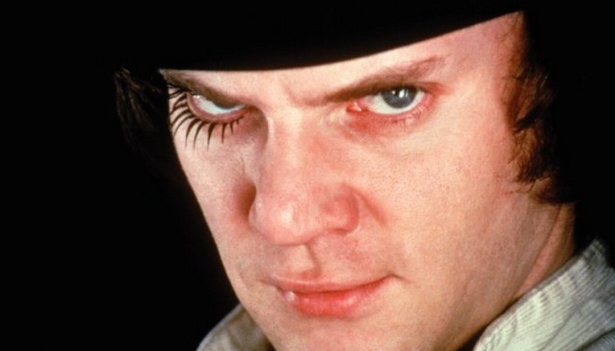
1. A Clockwork Orange (1971)
Stanley Kubrick’s take on Anthony Burgess’ 1962 dystopian fable replicates the highly disorienting experience of traversing a fictional world through the eyes of a Beethoven-loving, Nadsat-speaking, sociopath. Malcolm McDowell gives the performance of his career (see above). So distinctive is the set design, it inspired a chain of Korova Milk Bars. Burgess himself had a complicated relationship with the film and its director. Praising the adaptation as brilliant, he also found its bleak, sardonic ending, and omission of the novel’s redemptive final chapter—also missing from U.S. editions of the book prior to 1986—troubling. The film’s relentless ultraviolence, so disturbing to many a viewer, and many a religious organization, also disturbed the author who imagined it.
2. One Flew Over the Cuckoo’s Nest (1975)
A film adaptation with an even more bravado ensemble cast (Danny DeVito, Brad Dourif, Louise Fletcher, Christopher Lloyd) and incredibly charismatic—and dangerous—lead, Jack Nicholson, Milos Forman’s Cuckoo’s Nest stands perfectly well on its own. But lovers of Ken Kesey’s madcap novel have many reasons for favorable comparison. One vast difference between the two, however, lies in the narrative point-of-view. The book is narrated by willfully silent Chief Bromden—the film mostly takes McMurphy’s point-of-view. Without a voice-over, it would have been near-impossible to stay true to the source, but the result leaves the novel’s narrator mostly on the sidelines—along with many of his thematic concerns. Nonetheless, actor Will Sampson imbues the towering Bromden with deep pathos, empathy, and comic stoicism. When he finally speaks, it’s almost like we’ve been hearing his voice all along (see above).
3. To Kill a Mockingbird (1962)
“Miss Jean Louise, stand up! Your father’s passing.” If this scene (above), doesn’t choke you up just a little, well… I don’t really know what to say.… The sentimental adaptation of the reclusive Harper Lee’s only novel is flawed, righteous, and loveable. Gregory Peck is Atticus Finch (and as far as adaptations go—despite the brave attempts of many a fine actor—is Ahab as well). And the young Mary Badham is Scout. Robert Duvall makes his screen debut as kindly shut-in Boo Radley, audiences learn how to pronounce “chiffarobe”…. It’s as classic a piece of work as the novel—seems almost impossible to separate the two.
4. Apocalypse Now (1979)
Francis Ford Coppola and screenwriter John Milius—the Hollywood character so well caricatured by John Goodman in The Big Lebowski—transform Joseph Conrad’s lean 1899 colonialist novella Heart of Darkness into a grandiose, barely coherent, psychedelic tour-de-force set in the steaming jungles of Vietnam. Brando glowers in shadow, Robert Duvall strikes hilariously macho poses, Martin Sheen genuinely loses his mind, and a coked-up, manic Dennis Hopper shows up, quotes T.S. Eliot, and nearly upstages everyone (above). Roger Ebert loved the even longer, crazier Redux, released in 2001, saying it “shames modern Hollywood’s timidity.” Novelist Jessica Hagedorn fictionalized the movie’s legendary making in the Philippines. How much is left of Conrad? I would say, surprisingly, quite a bit of the spirit of Heart of Darkness survives—maybe even more than in Nicolas Roeg’s straightforward 1994 adaptation with John Malkovich as Kurtz and Tim Roth as Marlow.
5. Trainspotting (1996)
Danny Boyle’s adaptation of Irvine Welsh’s addiction-themed first novel—or rather collection of interlinked stories—about a scrappy bunch of Scottish lowlifes may be very much a product of its moment, but its hard to imagine a more perfect screen realization of Welsh’s punk prose. Character-driven in the best sense of the phrase, Boyle’s comic Trainspotting manages the estimable feat of telling a story about drug addicts and criminal types that doesn’t feature any golden-hearted hookers, mournful interventions, self-righteous, didactic pop sociology, or other Hollywood drug-movie staples. A sequel—based on Welsh’s follow-up novel Porno—may be forthcoming.
And below are 10 more selections from The Guardian’s top 50 in which—I’d say—film and book are both, if not equally, great:
6. Blade Runner (1982) 7. Dr. Zhivago (1965) 8. Empire of the Sun (1987) 9. Catch-22 (1970) 10. Lolita (1962) 11. Tess (1979) 12. The Hound of the Baskervilles (1939) 13. The Day of the Triffids (1962) 14. Alice (1988) 15. Lord of the Flies (1963)
So, there you have it—my top 15 from The Guardian’s list of 50 best adaptations. What are your favorites? Look over their other 35—What glaring omissions deserve mention (The Shining? Naked Lunch? Dr. Strangelove? Lawrence of Arabia? The Color Purple?), which inclusions should be stricken, forgotten, burned? (Why, oh, why was the Tim Burton Charlie and the Chocolate Factory remake picked over the original?) All of the films mentioned are in English—what essential adaptations in other languages should we attend to? And finally, what alternate versions do you prefer to some of the most-seen adaptations of novels or stories?
In his book, Abject Terrors: Surveying the Modern and Postmodern Horror Film, Tony Magistrale talks about Stanley Kubrick’s deep and abiding obsession with the color red. He writes2001: A Space Odyssey “commences Kubrick’s directorial fascination with vivid color, particularly the color red, that becomes the defining trait of the auteur’s subsequent cinema… [T]he particular use of red as the keynote color in Kubrick’s cinematic palette speaks directly to cinematic meaning: The color red underscores varying levels of physical and psychological violence present in Clockwork, The Shining and Barry Lyndon; forces the viewer to make a connection between HAL and demonic energies in 2001; and is associated with the carnal sexuality that is present in nearly every sequence of Eyes Wide Shut.” But it’s one thing to read about this obsession, and another thing to see it. Above we have Rishi Kaneria’s “Red: A Stanley Kubrick Supercut,” which artfully weaves together footage from Spartacus,2001,A Clockwork Orange,Barry Lyndon,The Shining,Full Metal Jacket and Eyes Wide Shut. Now you’ll see what Magistrale means.
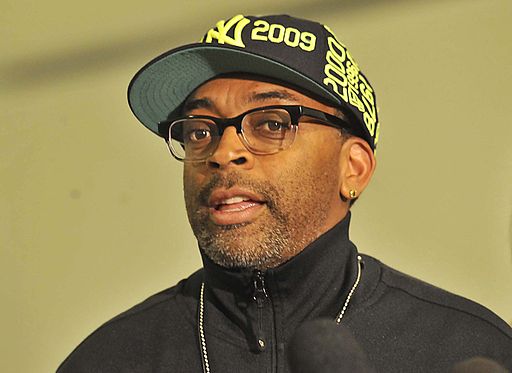
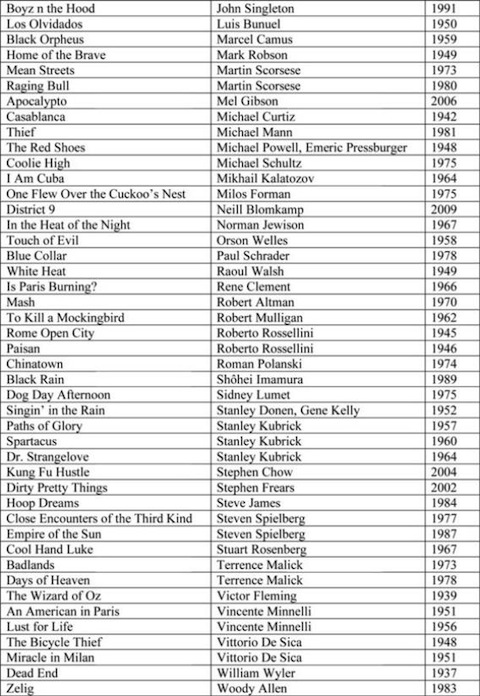
Last year, independent film icon and NYU professor Spike Lee turned to the crowdsourcing site Kickstarter to raise $1.25 million dollars for his latest film. To drum up publicity, he published his list of 87 “essential” movies that he hands out in his graduate film classes. And it is a very idiosyncratic list. Some great, overlooked movies like Charles Burnett’s Killer of Sheep and Steve James’s Hoop Dreams make the cut while other inclusions are more puzzling — Mel Gibson’s Apocalypto, for instance. Or Abel Ferrera’s Bad Lieutenant. The list’s exclusions, however, raised eyebrows. Citizen Kane (?!) somehow didn’t get a mention. Neither did Seven Samurai. Stanley Kubrick’s Spartacus somehow won out over 2001: A Space Odyssey. And such canonical directors as Yasujiro Ozu, Ingmar Bergman, Fritz Lang, John Ford and Charlie Chaplin were left out entirely.
But the internet really took Lee to task for the list’s most glaring omission – there are no women. To that last issue, Lee made amends. In his updated blog entry – “Thank You For That Coat Pulling” – Lee revamped the list to include eight movies by five female directors, bringing the total to 95.
Three of the four women ever to be nominated for a Best Director Oscar wound up on the list – Wertmuller, Campion, Bigelow. I guess Lee isn’t a fan of Sophia Coppola.
Lina Wertmuller managed to get four films on the new list – a feat not shared by any of her male counterparts. That’s right, she bested Kurosawa, Kubrick and Hitchcock. In her heyday, Wertmuller courted controversy by combining sex and left wing politics, which sounds right up Lee’s alley. Fairly or not, Wertmuller’s reputation hasn’t aged well, mostly because feminist critics pilloried her movie for being misogynous. And Guy Ritchie’s unfortunate remake of her 1974 movie Swept Away, starring Madonna, did little to burnish her prestige.
Also on the list is Julie Dash’s Daughter of the Dust, a lyrical landmark of indie cinema about Gullah women living on one of South Carolina’s barrier islands, and French director Euzhan Palcy’s little seen Sugar Cane Alley is about blacks toiling in the sugar cane fields of rural Martinique.
Indiewirenotes that Lee’s additions bump the gender disparity up from 0% to about 8.7%. That’s not a lot, but according to Celluloid Ceiling’s 2013 report, it’s better than it is currently in Hollywood. Of the top 250 earning movies last year, only 6 were directed by women.
Jonathan Crow is a Los Angeles-based writer and filmmaker whose work has appeared in Yahoo!, The Hollywood Reporter, and other publications. You can follow him at @jonccrow. And check out his blog Veeptopus, featuring lots of pictures of vice presidents with octopuses on their heads. The Veeptopus store is here.
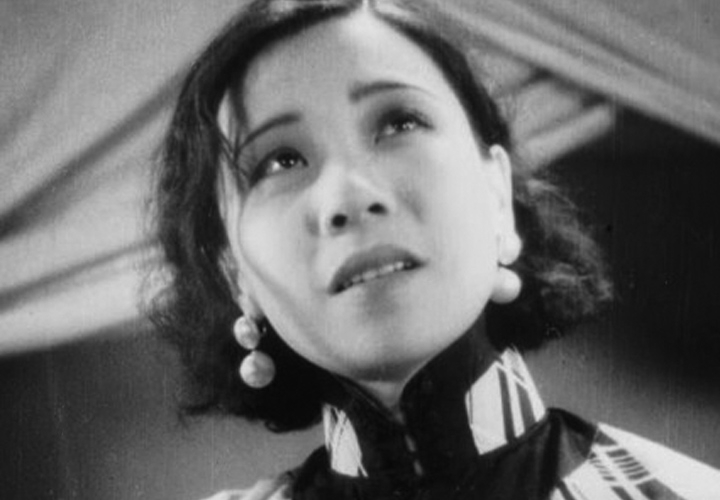
Ruan Lingyu delivered one of the greatest performances in silent cinema, and yet to Western audiences, she is almost completely unknown.
Up until the Imperial Japanese Army invaded the city in 1937, Shanghai was the thriving, cosmopolitan cultural heart of China. The first Chinese film was made in Shanghai in 1905 and, for the next couple of decades, costumed retellings of traditional tales dominated the industry. Then, in the ‘30s, filmmakers like Sun Yu and Cheng Bugao started to make gritty, realistic movies about the struggles of the lower class. Perhaps the greatest of these films is Wu Yonggang’s 1935 masterpiece The Goddess, featuring an absolutely heartbreaking performance by Ruan. You can watch it above.
On paper, the story of The Goddess could easily be mistaken for films by Josef Von Sternberg or G.W. Pabst – a “fallen woman” weepie where the protagonist suffers for the sins of hypocritical society. Ruan plays the nameless lead, a beautiful, impoverished woman forced to sell her body to feed and educate her son. She soon falls in with The Boss, a porcine, dissolute gangster who serves as her pimp. She scrapes and struggles to keep her son out of the same gutter where she finds herself trapped. Yet, at every step, she and her son are taunted and shunned. When she spends everything she has to put her son into a good school, the child is expelled simply because the other parents don’t approve of her. “Even though I am a degenerate woman,” she begs to the school board, “don’t I have the right as a mother to raise him as a good boy?”
While silent film acting tended towards the histrionic, Ruan’s performance is naturalistic while still having an emotional rawness that few actors could match. Just watch the scene where the protagonist is watching her son perform during a school play. Her expression of unadulterated parental pride slowly curdles as she hears vicious whispers from nearby hausfraus. Like Greta Garbo or Marlene Dietrich, Ruan has a wounded beauty that simply rivets you to the screen.
Like many of the characters she played, Ruan came from humble beginnings and had perpetual romantic trouble. When her complicated personal life became the fodder for press, she took an overdose of sleeping pills on March 8, 1935, leaving behind a note that read, “Gossip is a fearful thing.” She was only 24. Ruan’s funeral procession was over three miles long and three women were reportedly so distraught over her death that they committed suicide. The funeral even ended up on the front page of the New York Times who called it “the most spectacular funeral of the century.”
In 1992, Maggie Cheung played Ruan for Stanley Kwan’s Center Stage(1992), which ended up winning a Best Actress prize at the Berlin International Film Festival.
Jonathan Crow is a Los Angeles-based writer and filmmaker whose work has appeared in Yahoo!, The Hollywood Reporter, and other publications. You can follow him at @jonccrow. And check out his blog Veeptopus, featuring lots of pictures of vice presidents with octopuses on their heads. The Veeptopus store is here.
It didn’t take long, only 25 hours, for Griffin Dunne and Susanne Rostock to raise enough money on Kickstarter to complete a documentary on novelist and essayist Joan Didion. Initially hoping to raise $80,000, they’ve already received commitments exceeding $211,000, and they still have four days to go.
We Tell Ourselves Stories In Order to Live will be the first and only documentary about Joan Didion. And it will be made with Joan, using her own words. The trailer for the documentary just premiered on Vogue. It’s fitting, seeing that Didion landed her first job, at Vogue, after winning an essay contest sponsored by the magazine. She also published her seminal essay, ““On Self Respect” in Vogue in 1961.
René Clair’s 1924 avant-garde masterpiece Entr’Acte opens with a cannon firing into the audience and that’s pretty much a statement of purpose for the whole movie. Clair wanted to shake up the audience, throwing it into a disorienting world of visual bravado and narrative absurdity. You can watch it above.
The film was originally designed to be screened between two acts of Francis Picabia’s 1924 opera Relâche. Picabia reportedly wrote the synopsis for the film on a single sheet of paper while dining at the famous Parisian restaurant Maxim’s and sent it to Clair. While that handwritten note was the genesis of what we see on screen, it’s Clair sheer cinematic inventiveness that is why the film is still shown in film schools today.
Clair sought to create a work of “pure cinema,” so he filled the film with just about every camera trick in the book: slow motion, fast motion, split screen and superimpositions among others. The camera is unbound and wildly kinetic. At one point, Clair mounts the camera upside down to the front of a rollercoaster.
In true Dadaist fashion, Clair creates a series of striking images – an upskirt shot of a leaping ballerina; a funeral procession bounding down the street in slow motion; a corpse springing out of a coffin – that seem to cry out for an explanation but remain maddeningly, frequently hilariously obscure.
The movie also serves as a class portrait of the Parisian avant-garde scene of the early ‘20s. Picabia and Erik Satie – who scored the movie – are the ones who fired that cannon. In another scene, Marcel Duchamp and Man Ray can be seen playing chess with each other on a Parisian rooftop.
Compared to Luis Bunuel and Salvador Dali’s notorious 1928 short Un Chien Andalou – a movie that is still quite shocking today – Entr’Acte is a much lighter, funnier work, one that looks to thwart bourgeois expectations of narrative logic but doesn’t quite try to shock them into indignant outrage. In fact, to modern eyes, the movie feels at times like a particularly unhinged Monty Python skit. Picabia himself once asserted that Entr’acte “respects nothing except the right to roar with laughter.” So watch, laugh and prepare to be confused.
Jonathan Crow is a Los Angeles-based writer and filmmaker whose work has appeared in Yahoo!, The Hollywood Reporter, and other publications. You can follow him at @jonccrow. And check out his blog Veeptopus, featuring lots of pictures of vice presidents with octopuses on their heads. The Veeptopus store is here.
You might think that a movie about information from 1953 couldn’t possibly be relevant in the age of iPhone apps and the Internet but you’d be wrong. A Communications Primer, directed by that power couple of design Charles and Ray Eames, might refer to some hopelessly quaint technology – computer punch cards, for instance – but the underlying ideas are as current as anything you’re likely to see at a TED talk. You can watch it above.
In fact, the film made for IBM was the result of the first ever multi-media presentations that Charles Eames developed for the University of Georgia and UCLA. Using slides, music, narration and film, Eames broke down some elemental aspects of communications for the audience. Central to the film is an input/output diagram that was laid out by Claude Shannon, the father of information theory, in his 1949 book, The Mathematical Theory of Communication. As the perhaps overly soothing narrator intones, any message is transmitted by a signal through a channel to its receiver. While in the channel, the signal is altered and degraded by noise. The key to effective communication is to reduce “noise” (construed broadly) that interferes with the message and to generally simplify things.
The issue of signal vs noise is probably more relevant now in this age of perpetual distraction than it was during the Eisenhower administration. Every email, text message or Buzzfeed article seen individually is clearly a signal. Yet for someone trying to work, say on an article about a short film by Charles and Ray Eames, they are definitely noise.
The Eames use the terms “signal,” “noise,” and “communication” quite broadly. Not only do they use these terms to describe, say, a radio broadcast or a message being relayed by Morse code but also the creation of architecture, design and even visual art.
The source of a painting is the mind and experience of the painter. Message? His concept of a particular painting. Transmitter? His talent and technique. Signal? The painting itself. Receiver? All the eyes and nervous systems and previous conditioning of those who see the painting. Destination? Their minds, their emotions, their experience. Now in this case, the noise that tends to disrupt the signal can take many forms. It can be the quality of the light. The color of the light. The prejudices of the viewer. The idiosyncrasies of the painter.
Of course, a painting — or a poem, or a film by Andrei Tarkovsky — is a different kind of signal than an email. It’s message is multilayered and multivalent. And while a generation of cultural theorists would no doubt chafe at Eames’s reductive, Modernist view of art, it is still interesting to think of a painting in the same manner as smoke signals.
The film’s narrator continues:
But besides noise, there are other factors that can keep information from reaching its destination in tact. The background and conditioning of the receiving apparatus may so differ from that of the transmitter that it may be impossible for the receiver to pick up the signal without distortion.
That’s about as good a description of cable new pundits as I’ve ever seen.
Jonathan Crow is a Los Angeles-based writer and filmmaker whose work has appeared in Yahoo!, The Hollywood Reporter, and other publications. You can follow him at @jonccrow. And check out his blog Veeptopus, featuring lots of pictures of vice presidents with octopuses on their heads. The Veeptopus store is here.
We're hoping to rely on loyal readers, rather than erratic ads. Please click the Donate button and support Open Culture. You can use Paypal, Venmo, Patreon, even Crypto! We thank you!
Open Culture scours the web for the best educational media. We find the free courses and audio books you need, the language lessons & educational videos you want, and plenty of enlightenment in between.