With more than 480 fan-made segments culled from over 1,500 submissions, The Empire Strikes Back Uncut (also known as ESB Uncut) features a stunning mash-up of styles and filmmaking techniques, including live action, animation, and stop-motion. The project launched in 2013, with fans claiming 15-second scenes to reimagine as they saw fit – resulting in sequences created with everything from action figures to cardboard props to stunning visual effects. Helmed by Casey Pugh, who oversaw 2010’s Emmy-winning Star Wars Uncut, the new film has a wonderful homemade charm, stands as an affectionate tribute to The Empire Strikes Back, and is a testament to the talent, imagination, and dedication of Star Wars fans.
ESB Uncut was just released yestery, right in time for the weekend. Below we have some more creative takes on the Star Wars films to keep you entertained.
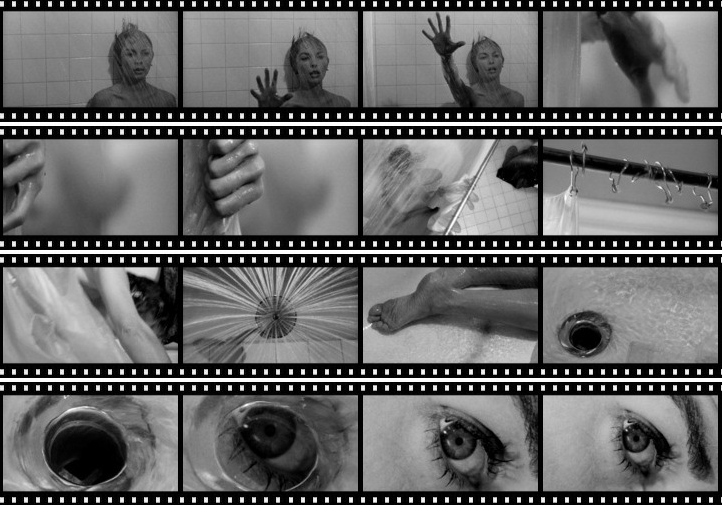
Some directors like John Cassavetes and Wong Kar-wai like to discover the movie as they are making it. Others filmmakers have a very clear conception of the movie right from the beginning. Alfred Hitchcock was very much in that latter category. “Once the screenplay is finished, I’d just as soon not make the film at all,” he once told Roger Ebert. “I have a strongly visual mind. I visualise a picture right down to the final cuts.” And that is very much evident in the final product. From the famous Psycho shower scene to a wild-eyed Jimmy Stewart dangling from a ledge in Vertigo to Cary Grant being menaced by a crop duster in North By Northwest, Hitchcock has produced some of the most memorable, arresting images of the 20th Century.
British artist Dave Pattern set out to highlight Hitch’s visual genius with his 1000 Frames of Hitchcockseries, which compresses each of Hitchcock’s 52 major movies down to a mere 1000 frames. That’s about six seconds of running time.
“It all started when in 2003 I made a website that tries to gather information about Hitchcock DVD releases over the world,” Pattern told Danish movie magazine Echo. “The quality of the publications are very different from country to country. It sort of snowballed from there.”
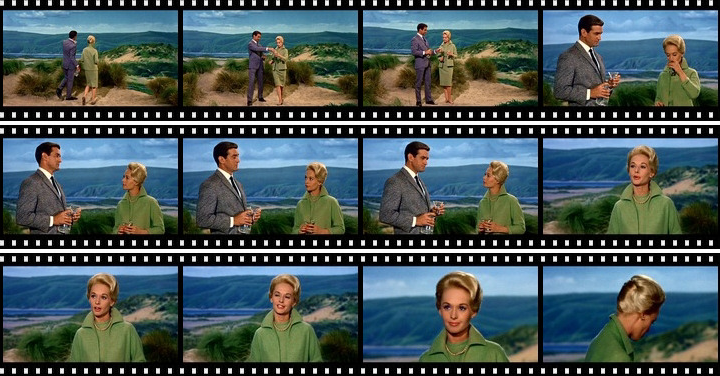
What’s amazing about this project is just how much of the movie comes through in this greatly abbreviated, soundless version. You completely understand that Tippi Hedren is getting terrorized by an implacable enemy in The Birds. You don’t even need to see that malevolent murder of crows. You can see it just in her face. At the beginning of the movie, she’s elegant, aloof and perfectly composed. At the end of the film, she’s unkempt, bloody and broken. Hitchcock’s creepy sexual politics and his famously unwholesome obsession with blondes shines through here.
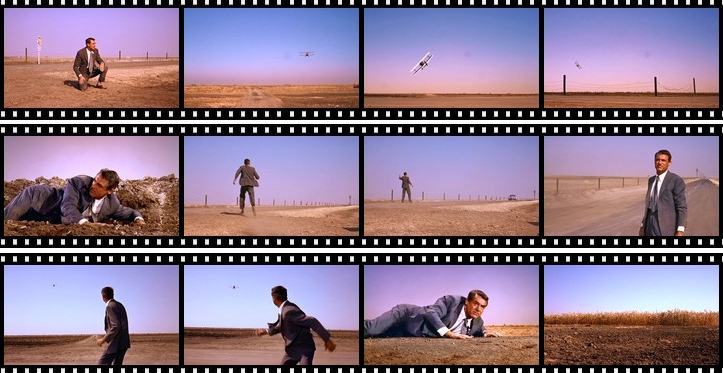
What is utterly apparent in this project – and something you might miss while watching the movie — is Hitchcock’s complete control of color. The palette of The Birds (middle image) is dominated by the color green, from Hedren’s outfit to the color of a pickup truck to the hue of the hills. North By Northwest(bottom), by contrast, is composed mostly of beige and slate blue. Click on the images to view them in a larger format.
Below, you can check out all the movies, each distilled down to 1,000 frames. And, if you’re inspired to dive deep into the works of the Master of Suspense, you can watch 23 of Alfred Hitchcock’s movies for free here.
It was 2012, and Focus Features flew me and about three dozen other journalists to interview Wes Anderson for his latest movie Moonrise Kingdom right on the beach at Cannes. Though the day was hot enough to produce more than a few leathery topless sunbathers, Anderson wore the exact ‘80s-style beige corduroy suit you might expect him to wear. Just like his eccentric, ironic — and given the setting, uncomfortable — sartorial choices, Anderson’s movies are distinctive from frame one. He is Hollywood’s current reigning formalist.
Moonrise Kingdom is probably his most successful recent movie. Though the film is filled with his trademark symmetrical framing, deadpan set design and off-kilter juxtapositions, the film never feels like self-parody, unlike some of his previous movies — think Darjeeling Limited. Set on the remote New Penzance Island in 1965, Moonrise is about a star-crossed pre-teen love affair between Sam, a precocious bespectacled boy scout in a coonskin cap, and Suzy, a troubled teen who favors saddle shoes, raccoon-like eye makeup and above all books. Before she steals away into the woods with Sam, she stuffs her suitcase with six of her favorite (fictitious) books, all swiped from the local library.
Anderson features the books prominently in the movie, giving them titles like The Girl from Jupiter or Disappearance of the 6th Grade. Each book was designed by artists that Anderson personally commissioned. Though Suzy reads parts from three of the books in the film, Anderson originally had a much grander vision: “At one point in the process, when she’s reading these passages from these books,” he told Entertainment Weekly. “I’d thought about going into animation.” The filmmaker had just completed his stopmotion movie The Fantastic Mr. Fox; clearly, animation was on Anderson’s mind.
Ultimately, Anderson decided against this approach, but the idea still apparently intrigued him. So here it is as a promotional piece for Moonrise. In the span of six weeks, blindingly fast for animation, Anderson and his producer Jeremy Dawson managed to animate passages from all six books – written by the filmmaker – in the style of the book covers. The video is hosted by Bob Balaban who played the Moonrise Kingdom’s tuque-sporting narrator.
“I think we all just pitched in and we pulled a lot of favors because it was not like we spent a ton of money doing it,” said Dawson to EW. “People got excited about it because it was a creative thing rather than if they were making a Snickers ad or something.”
Jonathan Crow is a Los Angeles-based writer and filmmaker whose work has appeared in Yahoo!, The Hollywood Reporter, and other publications. You can follow him at @jonccrow. And check out his blog Veeptopus, featuring lots of pictures of vice presidents with octopuses on their heads. The Veeptopus store is here.
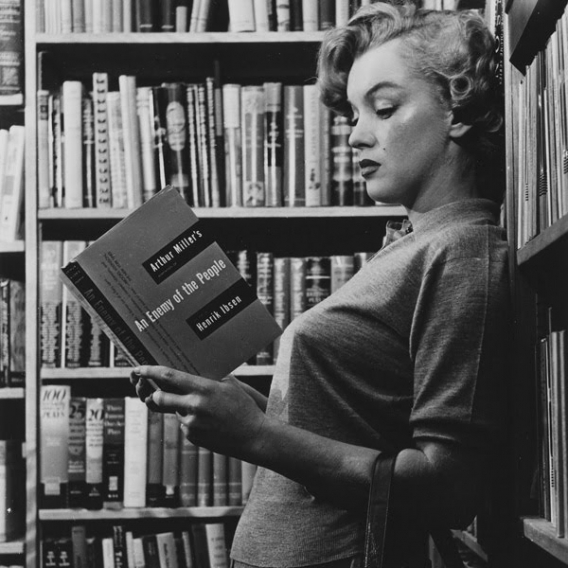
Did she read them all? I don’t know. Have you read every single title on your shelves? (There’s a Japanese word for those books. It’s Tsundoku.)
Feminist biographer Oline Eaton has a great rant on her Finding Jackie blog about the phrase “Marilyn Monroe reading,” and the 5,610,000 search engine results it yields when typed into Google:
There is, within Monroe’s image, a deeply rooted assumption that she was an idiot, a vulnerable and kind and loving and terribly sweet idiot, but an idiot nonetheless. That is the assumption in which ‘Marilyn Monroe reading’ is entangled.
The power of the phrase Marilyn Monroe reading’ lies in its application to Monroe and in our assumption that she wouldn’t know how.
Would that everyone searching that phrase did so in the belief that her passion for the printed word rivaled their own. Imagine legions of geeks loving her for her brain, bypassing Sam Shaw’s iconic subway grate photo in favor of home printed pin ups depicting her with book in hand.
See below, dear readers. Apologies that we’re not set up to keep track of your score for you, but please let us know in the comments section if you’d heartily second any of Marilyn’s titles, particularly those that are lesser known or have faded from the public view.
1) Let’s Make Love by Matthew Andrews (novelization of the movie)
2) How To Travel Incognito by Ludwig Bemelmans
3) To The One I Love Best by Ludwig Bemelmans
4) Thurber Country by James Thurber
5) The Fall by Albert Camus
6) Marilyn Monroe by George Carpozi
7) Camille by Alexander Dumas
8) Invisible Man by Ralph Ellison
9) The Boston Cooking-School Cook Book by Fannie Merritt-Farmer
10) The Great Gatsby by F Scott Fitzgerald
11) From Russia With Love by Ian Fleming
12) The Art Of Loving by Erich Fromm
13) The Prophet by Kahlil Gilbran
14) Ulysses by James Joyce
15) Stoned Like A Statue: A Complete Survey Of Drinking Cliches, Primitive, Classical & Modern by Howard Kandel & Don Safran, with an intro by Dean Martin (a man who knew how to drink!)
16) The Last Temptation Of Christ by Nikos Kazantzakis
17) On The Road by Jack Kerouac
18) Selected Poems by DH Lawrence
19 and 20) Sons And Lovers by DH Lawrence (2 editions)
If you know about Open Culture, surely you know about Ubuweb. If you don’t, its slogan says almost everything you need to know about it: “All Avant-Garde. All the Time.” This vast online repository of cutting-edge cultural artifacts from a variety of eras also adheres steadfastly to the principle of keeping all of its material free: free in the sense of charging you nothing to read, hear or view it, and free in the sense that you can do whatever you want with it. Needless to say, the site, founded by poet Kenneth Goldsmith in 1996, has made many fans, and Ubuweb itself has tapped quite a few of the higher-profile ones to curate top ten lists. Assembled by people like New Yorker music critic Alex Ross, novelists Hari Kunzru and Rick Moody, alterna-pop star Nick “Momus” Currie, these help the potentially (and understandably) bewildered find their way through the trove of Ubuweb’s media, which is universally influential and vanishingly obscure, viscerally transgressive and vertiginously intellectual, eternally exciting and deliberately boring.
This month, Ubuweb called upon our fearless editor here at Open Culture for a top ten list. Most of the picks have been previously featured on OC. The list runs as follows:
“The sheer pleasure one can derive — conventional expectations duly set aside — from the almost tactile quality of Joyce’s prose, its earthy, ancient, elven sounds, seems more to the point of appreciating this odd, frustrating work. Perhaps, like any well-written poem, one simply needs to hear it read aloud. Joyce himself said so, and so you can.”
“Nearing both 70 years of age and total blindness, Borges nonetheless gives a virtuosically wide-ranging series of talks, freely reaching across forms, countries, eras, and languages without the aid of notes. Entitled ‘This Craft of Verse,’ these lectures ostensibly deal with poetry. Alas, like many literary geeks, I know too little of poetry, but if Borges can’t motivate you to learn more, who can?”
“Sontag, they say, ‘sought to liberate art from interpretation (which is a bit ironic, of course, for someone who was essentially an exalted critic). When it came to her own film, she made something that intended to deliberately confound the notion that there was any sort of underlying meaning beyond exactly what the audience was seeing on the screen directly in front of them.’ ”
“Given the Tractatus’s firebombing of an entire area of human endeavor, it’s no surprise it hasn’t fared well in many traditional departments, but that hasn’t stopped Wittgenstein’s work from finding purchase elsewhere, influencing modern artists like Jasper Johns, the Coen Brothers, and, not least surely, Finnish avant garde composer and musician M.A. Numminen. This odd character, who caused a stir in the 60s by setting sex guides to music, took it upon himself to do the same for many of the Tractatus’s propositions, and the results are, well…. Listen for yourself.”
“Huxley had already gained worldwide fame for his views on better living, which was sometimes achieved, he believed, through psychedelic drugs. This might have already sounded like old hat in, say, the San Francisco of the late 1960s, let alone the 70s and onward, but in these recordings Huxley says his piece in — I still can’t quite believe it — the MIT of the early 1960s. But diagnosed a couple years before with the cancer that would claim his life the next, he had nothing to lose by spreading the word of his substance-induced discoveries.”
“Translating Coleman’s technique into ‘a domain that I know better, that of written language,’ Derrida ventures to compare improvisation to reading, since it ‘doesn’t exclude the pre-written framework that makes it possible.’ For him, the existence of a framework—a written composition—even if only loosely referenced in a jazz performance, ‘compromises or complicates the concept of improvisation.’ ”
“Ramone’s interpretation of the piece is enthralling simply as a piece of recorded music. But it’s also a fascinating piece of cultural history, representing a confluence of the foremost figures in early twentieth century modernist literature, mid-century avant-garde music, and late century punk rock.”
“Every sphere of recorded music has its crate-diggers, those happy to flip through hundreds — nay, hundreds of thousands — of obscure, forgotten vinyl albums in search of their subgenre’s even obscurer, more forgotten gems. This holds especially true, if not in number than in avidity, for enthusiasts of the 20th-century classical-experimental-electroacoustic tradition that The Avant-Garde Project takes as its preservation mandate.”
“In this 1963 recording from Pacifica Radio, Toklas reads her notorious recipe. The snack ‘might provide an entertaining refreshment for a Ladies’ Bridge Club or a chapter meeting of the DAR,’ Toklas notes in her reedy, dignified voice.”
“Known to hip academic types and avant-garde-ists, Baudrillard’s maybe the kind of thinker who gets name-dropped more than read (and he’s no easy read). But in the audio clip above, he reads to us, from his poetry no less, while backed by the swirling abstract sounds of The Chance Band. It’s an odd, one-time, assemblage of artists and thinkers Ubuweb describes as ‘unbelievable but true!’ ”
If you’ve already seen everything on it, congratulations: you can consider yourself a true, shall we say, OC OG.
Alfred Hitchcock once said, “There is no terror in the bang, only in the anticipation of it.” This is a guy who directed the greatest slasher scene in movie history – the shower scene in Psycho — but famously never showed Norman Bates’s knife actually stabbing his victim, Marion Crane. The horror of the scene was conveyed through actress Janet Leigh’s shocked expression. Though directors have always understood the power of the face, Hitchcock consistently used facial expressions to carry a movie’s suspense. A person’s face relates primal emotions much more efficiently than shots just of knives, guns or explosions. (Michael Bay, take note.)
For this video, Kogonada strings together expressions from Hitchcock’s vast oeuvre, from Jimmy Stewart’s wild-eyed baby blues waking up from a nightmare in Vertigo, to Ingrid Bergman’s tearful, anxious look in Notorious, to Norman Bates’s bat shit crazy death stare in Psycho. Hitch tended to frame these moments in extreme close up with the eyes right in the middle of the frame. Kogonada rolls back and forth on a couple frames of these moments, giving the video an otherworldly shimmer, timed perfectly with the music. It’s completely mesmerizing.
If you have a hankering to watch complete movies by the master, check out Open Culture’s list of 23 Hitchcock Films. You can watch them right now, online, for free.
Jonathan Crow is a Los Angeles-based writer and filmmaker whose work has appeared in Yahoo!, The Hollywood Reporter, and other publications. You can follow him at @jonccrow. And check out his blog Veeptopus, featuring one new drawing of a vice president with an octopus on his head daily. The Veeptopus store is here.
A quick note: Tonight, HBO will air the premiere of The 50 Year Argument. That’s Martin Scorsese’s new documentary about the influential literary and academic journal, The New York Review of Books.
Writes The New York Times: “Robert Silvers has assigned thousands of pieces for The New York Review of Books, so why not a documentary film? “The 50 Year Argument” … originated along the same lines as one of the lengthy, learned articles in The Review: Mr. Silvers sought out a talented essayist, in this case Martin Scorsese, and asked him to explore a subject — the magazine’s 50-year history — that he was passionate about but not expert in.” The result is a “textured and smart but thoroughly celebratory, a paean to the magazine and the amazingly durable Mr. Silvers, now 84.”
Regrettably, the film isn’t available online. But you can watch the trailer above and then a long Q&A about the film. Recorded in Berlin earlier this year, the Q&A features Scorsese on the stage, along with David Tedeschi (his co-director), NYRB editor Robert Silvers, publisher Rea Hederman, and contributor Michael Greenberg.
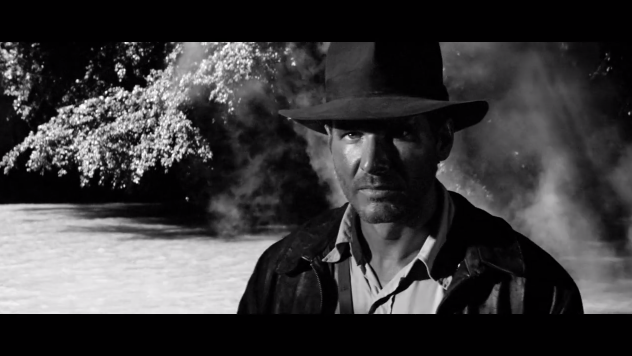
Now comes his latest side project: On his web site, extension765.com, Soderbergh presents a short lesson in “staging,” a term that refers in cinema “to how all the various elements of a given scene or piece are aligned, arranged, and coordinated.” He tells us: “I operate under the theory a movie should work with the sound off, and under that theory, staging becomes paramount.”
To illustrate his point, he takes the entirety of Steven Spielberg’s 1981 film, The Raiders of the Lost Ark; turns it into a silent, black & white film (watch it here); and then adds this commentary:
So I want you to watch this movie and think only about staging, how the shots are built and laid out, what the rules of movement are, what the cutting patterns are. See if you can reproduce the thought process that resulted in these choices by asking yourself: why was each shot—whether short or long—held for that exact length of time and placed in that order? Sounds like fun, right? It actually is. To me. Oh, and I’ve removed all sound and color from the film, apart from a score designed to aid you in your quest to just study the visual staging aspect. Wait, WHAT? HOW COULD YOU DO THIS? Well, I’m not saying I’m like, ALLOWED to do this, I’m just saying this is what I do when I try to learn about staging, and this filmmaker forgot more about staging by the time he made his first feature than I know to this day (for example, no matter how fast the cuts come, you always know exactly where you are—that’s high level visual math shit).
Ok, that’s probably enough film school for today…
We're hoping to rely on loyal readers, rather than erratic ads. Please click the Donate button and support Open Culture. You can use Paypal, Venmo, Patreon, even Crypto! We thank you!
Open Culture scours the web for the best educational media. We find the free courses and audio books you need, the language lessons & educational videos you want, and plenty of enlightenment in between.