Whether because of the popularity of Netflix’s The Queen’s Gambit or because of how much time indoors the past year and a half has entailed, chess has boomed lately. Luckily for those would-be chessmasters who’ve had their interest piqued, everything they need to learn the game is available free online. But the deeper one gets into any given pursuit, the greater one’s desire for concrete representations of that interest. In the case of chess players, how many, at any level, have transcended the desire for a nice board and pieces? And how many have never dreamed of owning one of the finest chess sets money can buy?
Such a set appears in the Business Insider video above. “You can pick up a plastic set for $20 dollars, but a wooden set certified for the World Chess Championship costs $500,” says its narrator. “Much of the value of a high-quality of the set comes down to how well just one piece is made: the knight.”
Properly carved by a master artisan, each knight — with its horse’s head, the only realistic piece in chess — takes about two hours. Very few are qualified for the job, and one knight carver appears in an interview to explain that it took him five or six years to learn it, as against the four or five months required to master carving the other pieces.
The workshop introduced in this video is located in Amritsar (also home to the Golden Temple and its enormous free kitchen, previously featured here in Open Culture). To those just starting to learn about chess, India may seem an unlikely place, but in fact no country has a longer history with the game. “Chess has been played for over 1,000 years, with some form of the game first appearing in India around the sixth century,” says the video’s narrator. “Over the past two centuries, high-level competitions have drawn international interest.” For most of that period, fluctuations in public enthusiasm for chess have resulted in proportionate fluctuations in the demand for chess sets, much of which is satisfied by large-scale industrial production. But the most experienced players presumably feel satisfaction only when handling a knight carved to artisanal perfection.
Based in Seoul, Colin Marshall writes and broadcasts on cities, language, and culture. His projects include the Substack newsletterBooks on Cities, the book The Stateless City: a Walk through 21st-Century Los Angeles and the video series The City in Cinema. Follow him on Twitter at @colinmarshall or on Facebook.
Even if the name Utagawa Hiroshige doesn’t ring a bell, “Hiroshige” by itself probably does. And on the off chance that you’ve never heard so much as his mononym, you’ve still almost certainly glimpsed one of his portrayals of Tokyo — or rather, one of his portrayals of Edo, as the Japanese capital, his hometown, was known during his lifetime. Hiroshige lived in the 19th century, the end of the classical period of ukiyo‑e, the art of woodblock-printed “pictures of the floating world.” In that time he became one of the form’s last masters, having cultivated not just a high level of artistic skill but a formidable productivity.
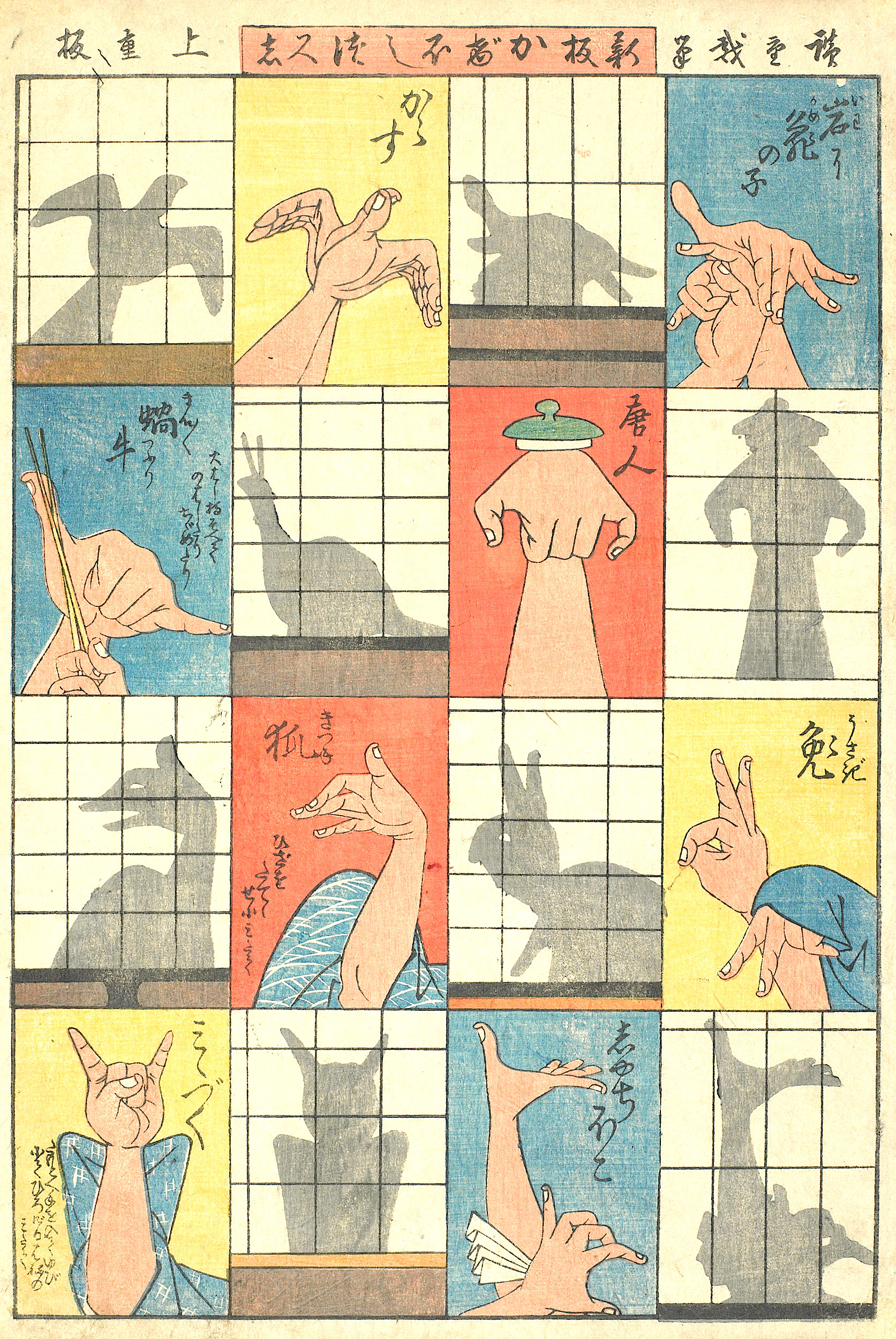
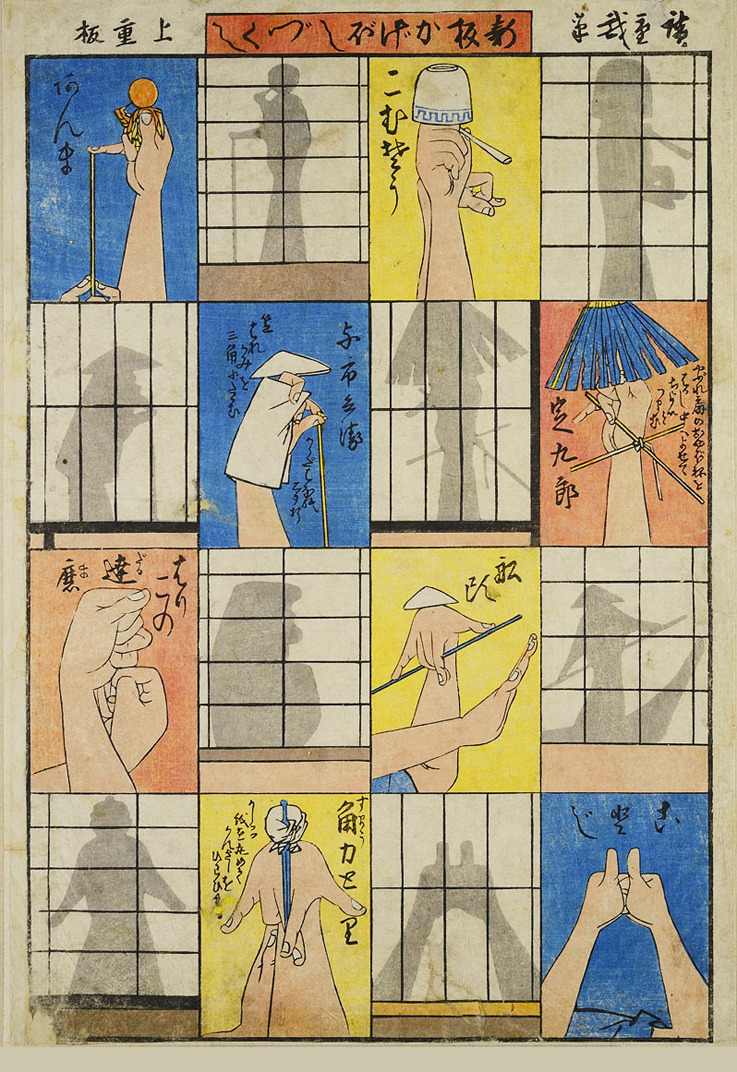
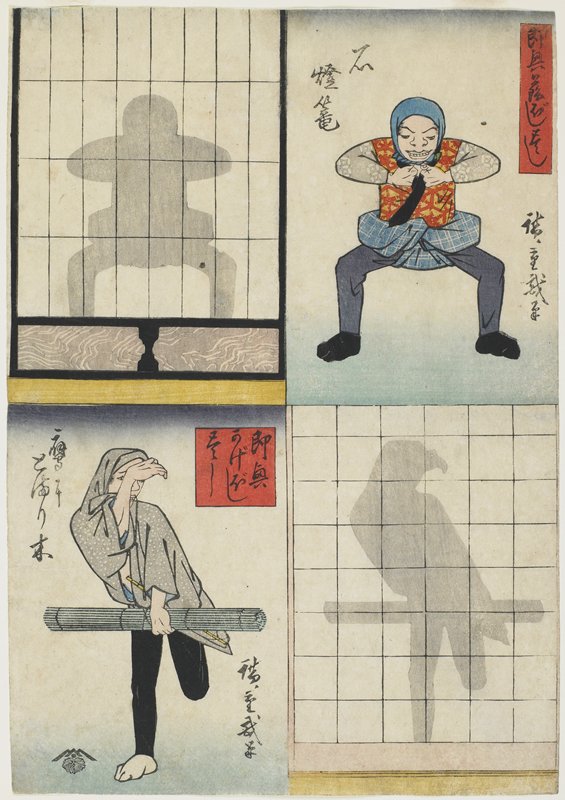
In total, Hiroshige produced more than 8,000 works. Some of those are accounted for by his well-known series of prints like The Fifty-three Stations of the Tōkaidō, The Sixty-nine Stations of the Kisokaidō, One Hundred Famous Views of Edo. But his mastery encompassed more than the urban and rural landscapes of his homeland, as evidenced by this much humbler project: a set of omocha‑e, or instructional pictures for children, explaining how to make shadow puppets.
Hiroshige explains in clear and vivid images “how to twist your hands into a snail or rabbit or grasp a mat to mimic a bird perched on a branch,” writes Colossal’s Grace Ebert. “Appearing behind a translucent shoji screen, the clever figures range in difficulty from simple animals to sparring warriors and are complete with prop suggestions, written instructions for making the creatures move — ‘open your fingers within your sleeve to move the owl’s wings’ or ‘draw up your knee for the fox’s back’ — and guides for full-body contortions.” The difficulty curve does seem to rise rather sharply, beginning with puppets requiring little more than one’s hands and ending with full-body performances surely intended more for amusement than imitation.
But then, kids take their fun wherever they find it, whether in 2021 or in 1842, when these images were originally published. Though it was a fairly late date in the life of Hiroshige, at that time modern Japan hadn’t even begun to emerge. The children who entertained themselves with his shadow puppets against the shoji screens of their homes would have come of age with the arrival of United States Commodore Matthew C. Perry’s “black ships,” which began the long-closed Japan’s process of re-opening itself to world trade — and set off a whirlwind of civilizational transformation that, well over a century and a half later, has yet to settle down.
Based in Seoul, Colin Marshall writes and broadcasts on cities, language, and culture. His projects include the Substack newsletterBooks on Cities, the book The Stateless City: a Walk through 21st-Century Los Angeles and the video series The City in Cinema. Follow him on Twitter at @colinmarshall or on Facebook.
“Culture has come to prize this quality in creative work: the ability to grab people quickly,” and “above pretty much anything else” at that. So says Evan Puschak, who should know: as the Nerdwriter, he runs a popular eponymous channel on Youtube, where everything depends on getting and holding the viewer’s increasingly fleeting attention. Even under such pressures, Puschak has managed to maintain one of the most thoughtful cultural channels around, previously featured here on Open Culture for its video essays on everything from the films of Jean-Luc Godard to the paintings of Edward Hopper to the music of Fleetwood Mac.
But it is Frida Kahlo whom the Nerdwriter credits as a master manipulator of audience attention. “Yes, there’s a sensationalistic obsession with the drama of her life, but that wouldn’t arouse nearly as much interest if it weren’t for the drama of her art — which is also sensational, but in the good way.”
The sensationalistic quality of Kahlo’s paintings owes to the “intimacy of the images” they depict, especially when they communicate “her vulnerability, her physical and emotional pain, but also her defiance and self-confidence, and the pride she so clearly has in her culture.” This comes through with special clarity in the self-portraits she created quite prolifically, and in so doing defined herself as well as the new 20th-century Mexican culture with which she came of age.
“I really, really hesitate to bring up the word selfie,” says Puschak, but “insomuch as her self-portraits are always simultaneously a recording and a performance of identity, they’re bound to be relatable to modern audiences.” In the first half of the 20th century during which Kahlo lived, painting was a relatively efficient way to produce images of oneself. Today, many of us do it dozens of times a day, at the touch of a button, marshaling few artistic resources in the process. But if selfies lack the impact of Kahlo’s self-portraits, it may owe to the ironic reason that the selfies look too good. Kahlo’s painting “has a bit of an amateurish quality to it, in its flattening of depth and skewed perspectives and anatomy.” But she used that style on purpose, paying homage to the folk art of her homeland and also making you feel as if “someone you know” painted these works. Puschak, who refers to her on a first-name basis, seemingly feels that way; but then, he’s far from the only Frida fan to do so.
Based in Seoul, Colin Marshall writes and broadcasts on cities, language, and culture. His projects include the Substack newsletterBooks on Cities, the book The Stateless City: a Walk through 21st-Century Los Angeles and the video series The City in Cinema. Follow him on Twitter at @colinmarshall or on Facebook.
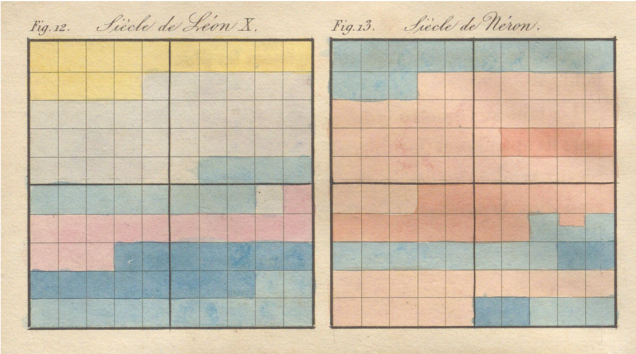
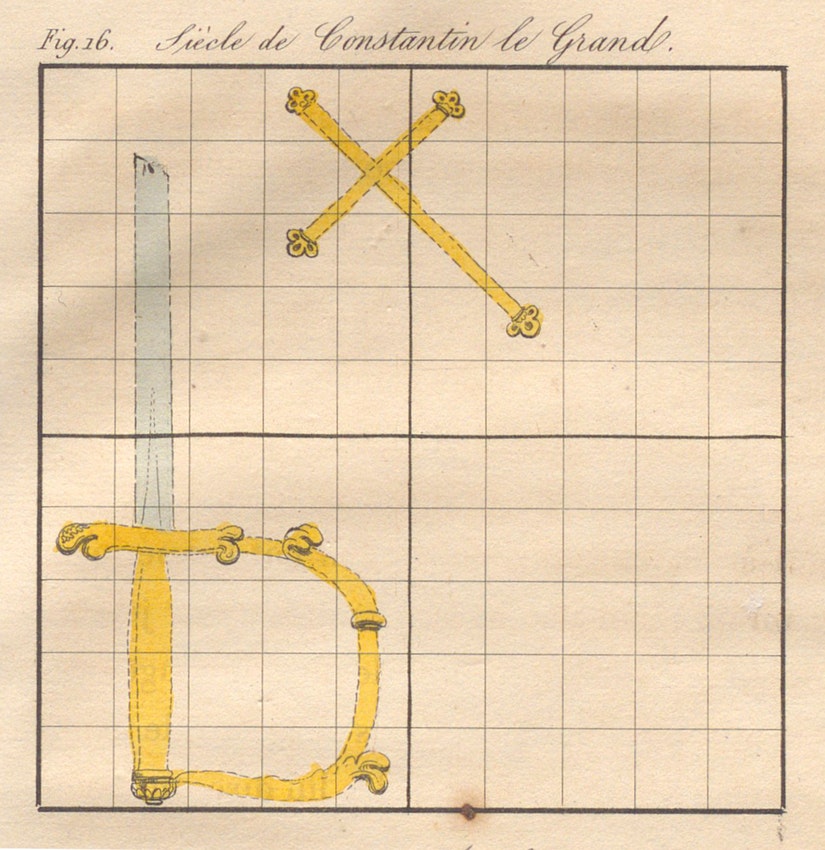
On first encountering Antoni Jażwiński’s “Polish System,” I couldn’t help but think of Incan Quipu, the system that used knotted cords to keep official records. Like Quipu, Jażwiński’s system of colored squares relies on an extreme shorthand to tell complex stories with mnemonic devices. But maybe that’s where the similarities end. Jażwiński’s invention (circa (1820) does not so much resemble other forms of communication as it does the abstract art of the following century.
“Jażwiński’s Méthode polonaise promises that the complexities of centuries can be refined into colors, lines, squares, and just a few marks,” writes Philippa Pitts at Sequitur. “Neatly arranged into a diagram that can be diligently committed to memory, the twists and turns of battles and revolutions are rendered as panes of pure gentle color, quietly plotted as coordinates in a matrix, subsumed back into the orderly progress of history.”
His attempts to impose order on life may have come to little in the end, but as an artifact of visual culture, the “Polish System” is sublime. Pitts goes on to write:
There is a wonderful resonance between Jażwiński’s chronographs and a wide range of artistic production, despite the anachronism of such comparisons. They recall Piet Mondrian’s early checkerboards and Robert Delaunay’s simultaneity. There is something reminiscent of process art here: They evoke the repetitive, cataloguing handwork of Hanne Darboven or Agnes Martin. There appears to be a common calm, comfort, catharsis, or salvation promised by the embrace of rule, order, and logic.
Jażwiński, a Polish educator, invented the system in the 1820s. It was “later brought to public attention in the 1830s and 1840s by General Józef Bem, a military engineer with a penchant for mnemonics,” notes the Public Domain Review. Such systems cropped up everywhere in 19th-century education, such as those pioneered by Emma Willard, the first woman mapmaker in the U.S. “Jażwiński’s contribution (and its later adaptations) proved one of the most popular.”
He explained his system with long paragraphs of text (which you can read here, in French), little of which students were likely to remember. What mattered was whether they could make sense of the color-coding and symbols placed inside the grid system, with each grid standing for an entire century — 100 years of human history reduced, for example, in the figure above, to one name, Constantine the Great, and two symbols, a sword and cross. This was an example of a “chronological constellation,” in which historical events take particular shapes, “sometimes it’s a chair,” Jażwiński wrote, “a sickle, a boat, a letter of the alphabet, etc.”
Even the names neatly printed above the grids are redundant, Pitts suggests. In such systems, called chronographs, “denotative text is of limited use. It is connotative visuality which further condenses the information: Flags, shields, and insignia can serve as shorthand for nations and dynasties, while looming storm clouds, bright sunbursts, and invocations of classical architecture add layers of associated meaning.” The view of history represented by such systems is quaint, at best; their oversimplifications erase more than they could ever communicate. But their visual appeal is undeniable as objects from a pre-Google past, when memorization was the only way to reliably store and access knowledge outside of books.
The Venus de Milo is one of art’s most widely recognized female forms.
The Mona Lisa may be the first stop on many Louvre visitors’ agendas, but Venus, by virtue of being unclothed, sculptural, and prominently displayed, lends herself beautifully to all manner of souvenirs, both respectful and profane.
Renoir is that rare bird who was impervious to her 6’7” charms, describing her as the “big gendarme.” His own Venus, sculpted with the help of an assistant nearly 100 years after the Venus de Milo joined the Louvre’s collection, appears much meatier throughout the hip and thigh region. Her celebrity cannot hold a candle to that of her armless sister.
In the Vox Almanac episode above, host Phil Edwards delves into the Venus de Milo’s appeal, taking a less delirious approach than sculptor Auguste Rodin, who rhapsodized:
…thou, thou art alive, and thy thoughts are the thoughts of a woman, not of some strange, superior being, artificial and imaginary. Thou art made of truth alone, outside of which there is neither strength nor beauty. It is thy sincerity to nature which makes thee all powerful, because nature appeals to all men. Thou art the familiar companion, the woman that each believes he knows, but that no man has ever understood, the wisest not more than the simple. Who understands the trees? Who can comprehend the light?
Edwards opts instead for a Sharpie and a tiny 3‑D printed model, which he marks up like a plastic surgeon, drawing viewers’ attention to the missing bits.
The arms, we know.
Also her earlobes, most likely removed by looters eager to make off with her jewelry.
One of her massive marble feet (a man’s size 15) is missing.
Interestingly, the plinth was among the items discovered by accident on the Greek island of Milos in 1820, along with two pillars topped with busts of Hercules and Hermes, the bisected Venus, and assorted marble fragments, including — maybe — an upper arm and hand holding a round object (a golden apple, mayhaps?)
What he’s most interested in is that plinth, which would have given the lie to the long-standing assertion that the Venus de Milo was created in the Classical era.
This incorrect designation made the Louvre’s newest resident a most welcome replacement for the loot France had been compelled to return to the Vatican in the wake of Napoleon’s first abdication.
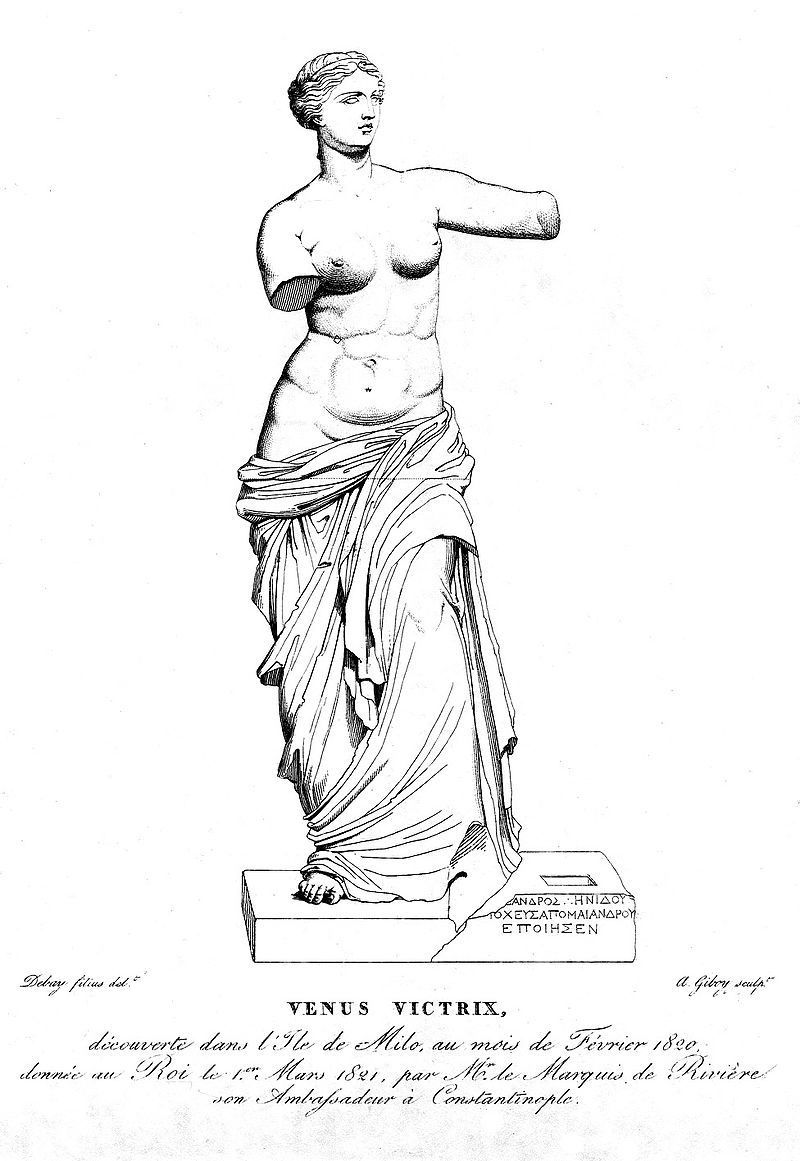
The plinth may have been “lost” under mysterious circumstances, but its inscription was preserved in a sketch by A. Debay, whose father had been a student of Jacques-Louis David, Napoleon’s now-banished First Painter, a Neo-Classicist.
(David’s final painting, Mars Disarmed by Venus and the Three Graces, completed a couple of years after Venus de Milo was installed in the Louvre, was considered a bust.)
Debay’s faithful recreation of the plinth’s inscription as part of his study of the Venus de Milo offers clues as to her creator — “ …andros son of …enides citizen of …ioch at Meander made.”
It also dates her creation to 150–50 BCE, corroborating notes French naval officer Jules d’Urville had made in Greece weeks after the discovery.
The birth of this Venus should have been attributed to the Hellenistic, not Classical period.
Had her true author been known, she likely would’ve been locked away in the museum’s archive, if not sold off. Hellenistic art had by then been denigrated by Renaissance scholars who re-conceived it in anti-classical terms, finding in its expressive, experimental form and emotional content a provocative realism that defied everything their era stood for: modesty, intellect, and equanimity…It helped that the Venus de Milo possessed several classical attributes. Her strong profile, short upper lip, and smooth features, for example, were in keeping with Classical figural conventions, as was the continuous line connecting her nose and forehead. The partially-draped figure with its attenuated silhouette – which the Regency fashion of the day imitated with its empire bust-line – also recalled classical sculptures of Aphrodite, and her Roman counterpart, Venus. Yet despite all these classical identifiers, the Venus de Milo flaunted a definitive Hellenistic influence in her provocatively low-slung drapery, high waist line, and curve-enhancing contrapposto—far more sensual and exaggerated than classical ideals allowed.
It took the Louvre over a hundred years to come clean as to its star sculpture’s true provenance.
What happened to the plinth remains anyone’s guess.
The only mystery the museum’s website seems concerned with is one of identity — is she Aphrodite, goddess of beauty, or Poseidon’s wife, Amphitrite, the sea goddess worshipped on the island on which she was discovered?
Like many schoolchildren, and, for that matter, Goliath, the Biblical giant who was felled by a slingshot, I am a bit of a Philistine.
I admit that the first and, for a long time, primary thing that compelled me about Michelangelo’s David ( 1501–1504) was the frankness with which a certain part of his anatomy was displayed.
Mugs depicting him with a strategically placed fig leaf that dissolves in response to hot liquid, Dress Me Up David fridge magnets, and an endless parade of risqué merchandise suggest that historically, I am not alone.
Kudos to gallerist James Payne, creator and host of the video series Great Art Explained, for his nod to the rabble in opening the above episode not with a view of David’s handsome head or miraculously detailed hands, but rather that most famous of male members.
Having gotten it out of the way right at the top, Payne refrains from mentioning it for nearly 10 minutes, educating viewers instead on other aspects of the statue’s anatomy, including the sculptor’s unusual methods and the narrow, flawed, previously used block of marble from which this masterpiece emerged.
He also delves into the social context into which Michelangelo’s singular vision was delivered.
Florentines were proud of their highly cultured milieu, but were not nearly as comfortable with depictions of nudity as the ancient Greeks and Romans.
This explains the comparative smallness of David’s tackle box. Perhaps Goliath might have gotten away with a gargantuan penis, but David, who vanquished him using intelligence and willpower rather than brute strength, was assigned a size that would convey modesty, respectability, and self-control.
The Bible identifies David as an an Israelite, but Michelangelo decided that this particular Jew should remain uncircumcised, in keeping with Greco-Roman aesthetics. It was a look Christian Florence could get behind, though they also forged 28 copper leaves to conceal David’s controversial manhood.
(This theme returns throughout history — the 1860s saw him outfitted with a temporary fig leaf.)
One wonders how much smaller things would have appeared from the ground, were David installed atop the Duomo, as originally planned. Michelangelo designed his creation with this perspective in mind, deliberately equipping him with larger than usual hands and head.
One of Payne’s viewers points out that David’s face, which conveys both resolve and fear as he considers his upcoming confrontation with Goliath, seems utterly confident when viewed from below.
Given that David is 17’ tall, that’s the vantage point from which most of his in-person admirers experience him. 16th-century Civic leaders, captivated by David’s perfection, placed him not atop the Florentine Cathedral, but rather in Piazza della Signoria, the political heart of Florence, where a replica still faces south toward Rome. (The original was relocated to the Galleria dell’Accademia in 1873, to protect it from the elements.)
Payne points out that David has survived many societal shifts throughout his 600+ years of existence. Fig-leafed or not, he is a perpetual emblem of the underdog, the determined guy armed with only a slingshot, and is thus unlikely to be toppled by history or human passions.
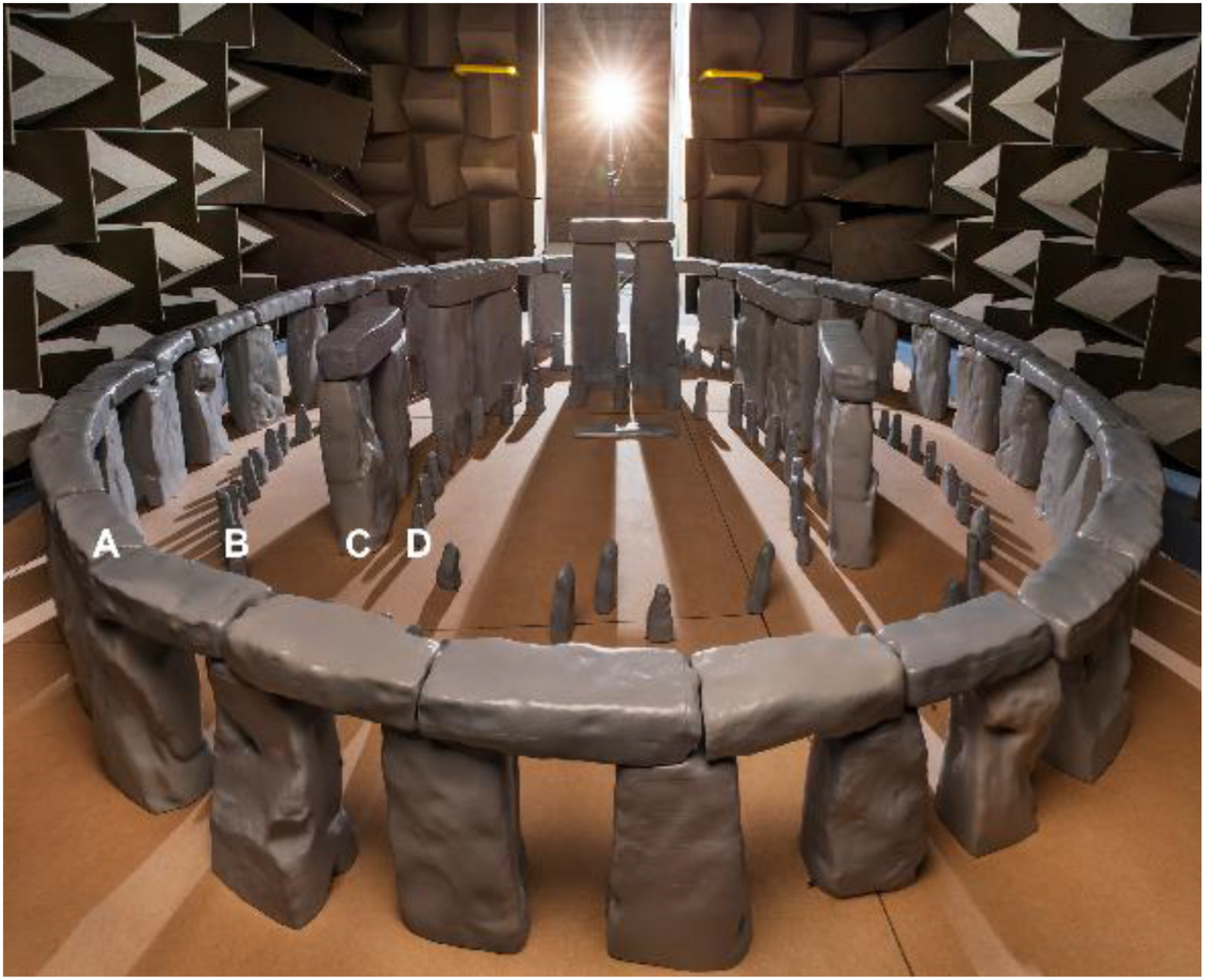
It’s impossible to resist a Spinal Tap joke, but the creators of the complete scale model of England’s ancient Druidic structure pictured above had serious intentions — to understand what those inside the circle heard when the stones all stood in their upright “henge” position. A research team led by acoustical engineer Trevor Cox constructed the model at one-twelfth the actual size of Stonehenge, the “largest possible scale replica that could fit inside an acoustic chamber at the University of Salford in England, where Cox works,” reports Bruce Bower at Science News. The tallest of the stones is only two feet high.
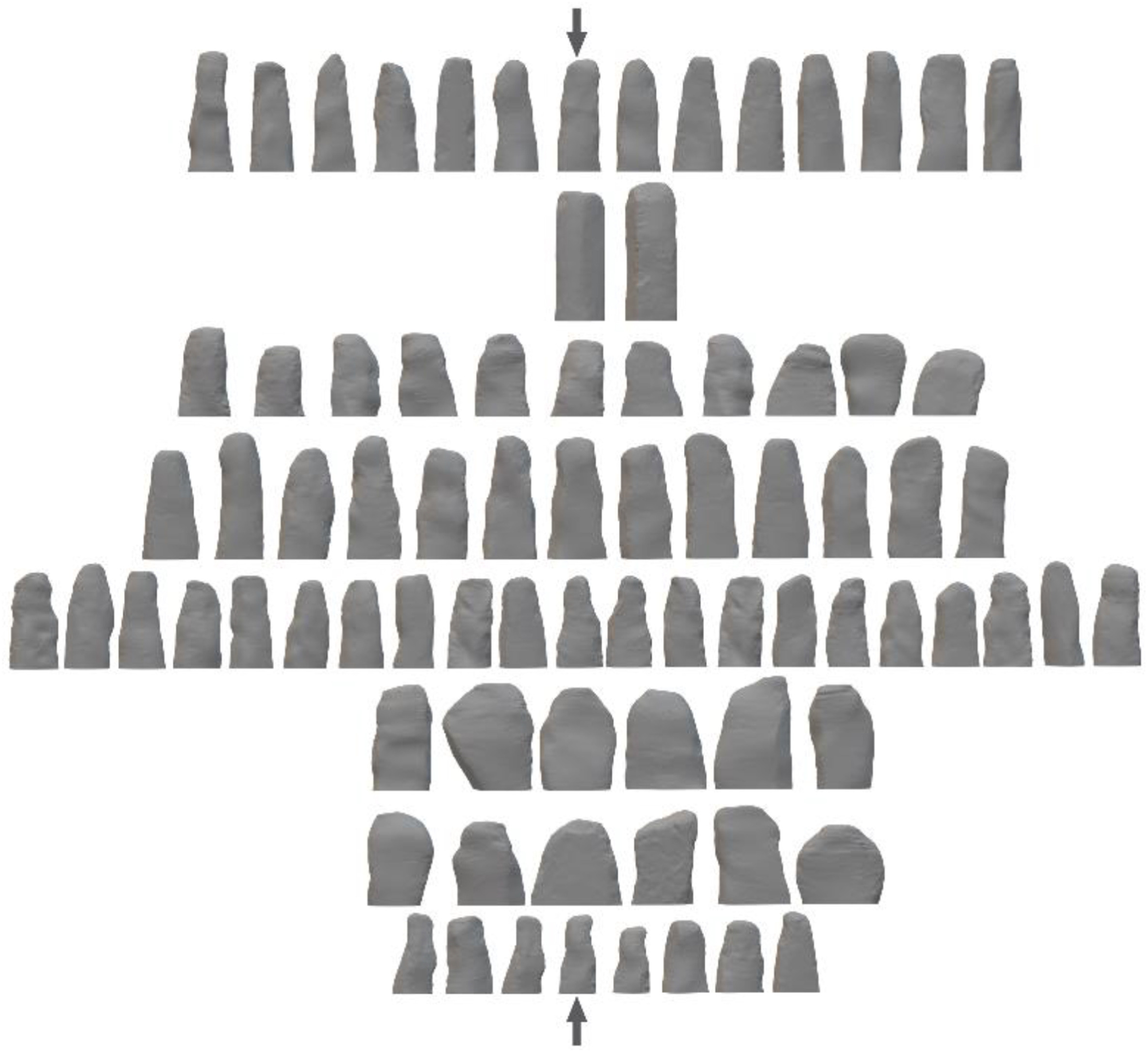
This is not the first time acoustic research has been carried out on Stonehenge, but previous projects were “all based on what’s there now,” says Cox. “I wanted to know how it sounded in 2200 B.C., when all the stones were in place.” The experiment required a lot of extrapolation from what remains. The construction of “Stonehenge Lego” or “Minihenge,” as the researchers call it, assumes that “Stonehenge’s outer circle of standing sarsen stones — a type of silcrete rock found in southern England — had originally consisted of 30 stones.” Today, there are 17 sarsen stones in the outer circle among the 63 complete stones remaining.
“Based on an estimated total 157 stones placed at the site around 4,200 years ago, the researchers 3‑D printed 27 stones of all sizes and shapes,” Bower explains. “Then, the team used silicone molds of those items and plaster mixed with other materials to re-create the remaining 130 stones. Simulated stones were constructed to minimize sound absorption, much like actual stones at Stonehenge.” Once Cox and his team had the model completed and placed in the acoustic chamber, they began experimenting with sound waves and microphones, measuring impulse responses and frequency curves.
What were the results of this sonic Stonehenge recreation? “We expected to lose a lot of sound vertically, because there’s no roof,” says Cox. Instead, researchers found “thousands upon thousands of reflections as the sound waves bounced around horizontally.” Participants in ritual chants or musical celebrations inside the circle would have heard the sound amplified and clarified, like singing in a tiled bathroom. For those standing outside the monument, or even within the outer circle of stones, the sound would have been muffled or dampened. Likewise, the arrangement would have dampened sound entering the inner circle from outside.
Indeed, the effect was so pronounced that “the placement of the stones was capable of amplifying the human voice by more than four decibels, but produced no echoes,” notes Artnet. This suggests that the site’s acoustic properties were not accidental, but designed as part of its essential function for an elite group of participants, “even though the site’s construction would have required a huge amount of manpower.” This is hardly different from other monumental ancient religious structures like pyramids and ziggurats, built for royalty and an elite priesthood. But it’s only one interpretation of the structure’s purpose.
While Cox and his team do not believe acoustics were the primary motivation for Stonehenge’s design — astrological alignment seems to have been far more important — it clearly played some role. Other scholars have their own hypotheses. Research still needs to account for environmental factors — or why “Stonehenge hums when the wind blows hard,” as musicologist Rupert Till points out. Some have speculated the stones may have been instruments, played like a giant xylophone, a theory tested in a 2013 study conducted by researchers from the Royal College of Art, but this, too, remains speculative.
As the great Stonehenge enthusiast Nigel Tufnel once sang, “No one knows who they were, or what they were doing.” But whatever it sounded like, Cox and his colleagues have shown that the best seats were inside the inner circle. Read the research team’s full articlehere.
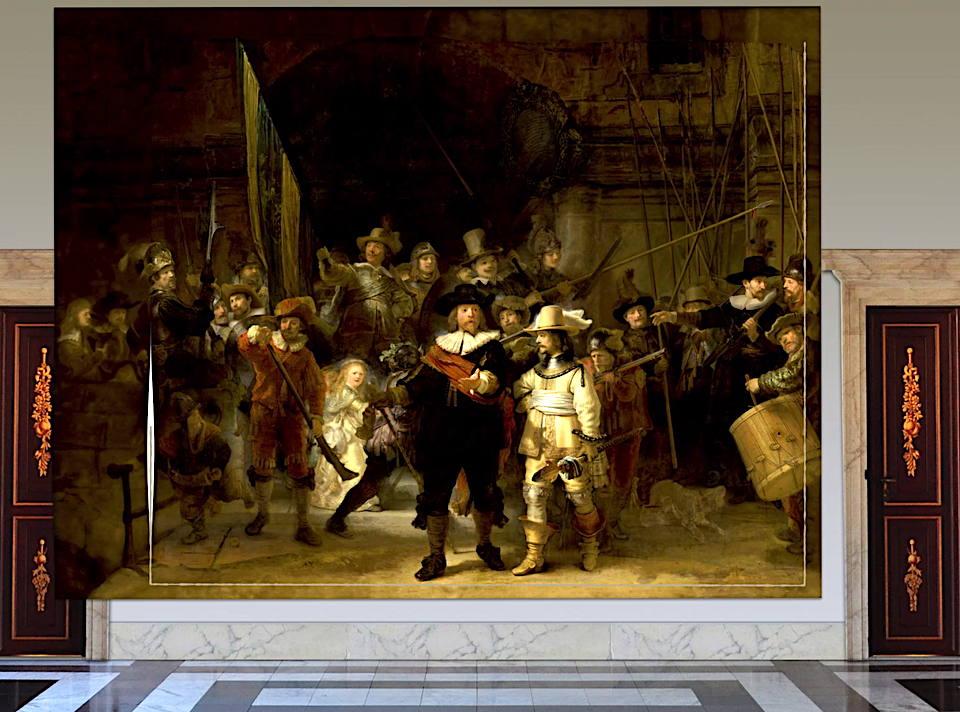
Most of us know Rembrandt’s masterpiece by the name The Night Watch, but it has a longer original title: Militia Company of District II under the Command of Captain Frans Banninck Cocq. By the same token, the version of the painting we’ve all seen — whatever we happen to call it — is smaller than the one Rembrandt originally painted in 1642. “In 1715, the monumental canvas was cut down on all four sides to fit onto a wall between two doors in Amsterdam’s Town Hall,” writes The New York Times’ Nina Siegal. “The snipped pieces were lost. Since the 19th century, the trimmed painting has been housed in the Rijksmuseum, where it is displayed as the museum’s centerpiece, at the focal point of its Gallery of Honor.”
That phase required high imaging technology, to be sure, but it may appear downright conventional compared to the just-unveiled recreation of the work’s three-centuries-missing pieces, which will hang on all four sides of the original at the Rijksmuseum for the next three months. This making-whole wouldn’t have been possible without a small copy made in the 17th century — or the latest artificial-intelligence technology of the 21st.
Image courtesy of the Rijksmuseum
“Rather than hiring a painter to reconstruct the missing pieces, the museum’s senior scientist, Robert Erdmann, trained a computer to recreate them pixel by pixel in Rembrandt’s style,” writes Siegal. Erdmann used “a relatively new technology known as convolutional neural networks, a class of artificial-intelligence algorithms designed to help computers make sense of images.” The process, explained in more detail by Shanti Escalante-De Mattei at ARTNews, involved digitally “splitting up the painting into thousands of tiles and placing matching tiles from both the original and the copy side-by-side,” training multiple neural networks to complete the painting in a style as close as possible to Rembrandt’s rather than the copyist’s. The result, with a few new faces as well as a startlingly different compositional feel than the Night Watch we’ve all seen, would no doubt please Captain Banninck Cocq and his militiamen: this, after all, is the portrait they paid for.
Based in Seoul, Colin Marshall writes and broadcasts on cities, language, and culture. His projects include the Substack newsletterBooks on Cities, the book The Stateless City: a Walk through 21st-Century Los Angeles and the video series The City in Cinema. Follow him on Twitter at @colinmarshall or on Facebook.
We're hoping to rely on loyal readers, rather than erratic ads. Please click the Donate button and support Open Culture. You can use Paypal, Venmo, Patreon, even Crypto! We thank you!
Open Culture scours the web for the best educational media. We find the free courses and audio books you need, the language lessons & educational videos you want, and plenty of enlightenment in between.