Examine the forgotten history of how our federal, state and local governments unconstitutionally segregated every major metropolitan area in America through law and policy.
‘Segregated By Design’ examines the forgotten history of how our federal, state and local governments unconstitutionally segregated every major metropolitan area in America through law and policy.
Prejudice can be birthed from a lack of understanding the historically accurate details of the past. Without being aware of the unconstitutional residential policies the United States government enacted during the middle of the twentieth century, one might have a negative view today of neighborhoods where African Americans live or even of African Americans themselves.
We can compensate for this unlawful segregation through a national political consensus that leads to legislation. And this will only happen if the majority of Americans understand how we got here. Like Jay‑Z said in a recent New York Times interview, “you can’t have a solution until you start dealing with the problem: What you reveal, you heal.” This is the major challenge at hand: to educate fellow citizens of the unconstitutional inequality that we’ve woven and, on behalf of our government, accept responsibility to fix it.
If you would like to support the mission of Open Culture, consider making a donation to our site. It’s hard to rely 100% on ads, and your contributions will help us continue providing the best free cultural and educational materials to learners everywhere. You can contribute through PayPal, Patreon, and Venmo (@openculture). Thanks!
How times have changed since our late 80s college days. Undergrads do research online, upload assignments to a server, stream music, download affirmative sexual consent contracts, and turn to Facebook when it’s time to find a ride home for the holidays.
But one aspect of the collegiate lifestyle remains unchanged.
They still festoon their dorm rooms with posters—the actual paper article, affixed to the walls with blue putty, a carefully curated collection of taste and aspiration.
Freshman, already scrambling to find and loudly articulate an identity, can leave the poster sale with two or three plastic tubes housing scrolls that represent the very essence of their new, parent-free, on-campus selves. Posters become an affordable, demonstrable expression of who they are as a person — or, in the tradition of people eager to leave behind their hometown selves, who they want to be.
Legions of style blogs have decreed that these posters should be given the heave-ho along with the plastic milk crate shelving, come graduation.
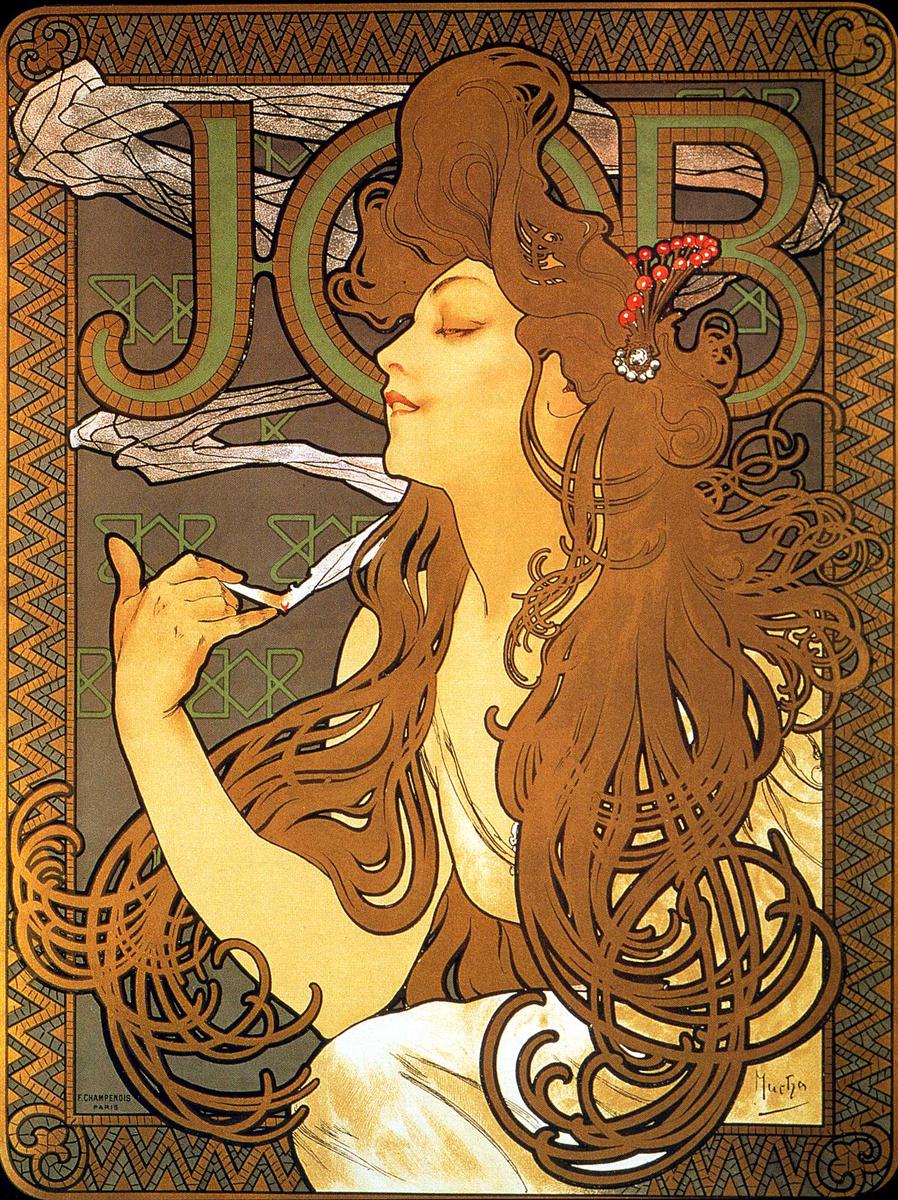
Is Alphonse Mucha’s Byzantine 1896 ad for Job rolling papers somehow unworthy because legions of dewy eyed undergrads have given it a perennial place of unframed honor?
The driving forces behind the newly opened Poster House in New York City would say no. The first American museum dedicated exclusively to poster art, its curators cast a wide net through the form’s 160 year history, whether the end goal of the work was war bond sales, public health education, or straight-up box office sales. As the Poster House writes:
For a poster to succeed, it must communicate. By combining the power of images and words, posters speak to audiences quickly and persuasively. Blending design, advertising, and art, posters clearly reflect the place and time in which they were made.
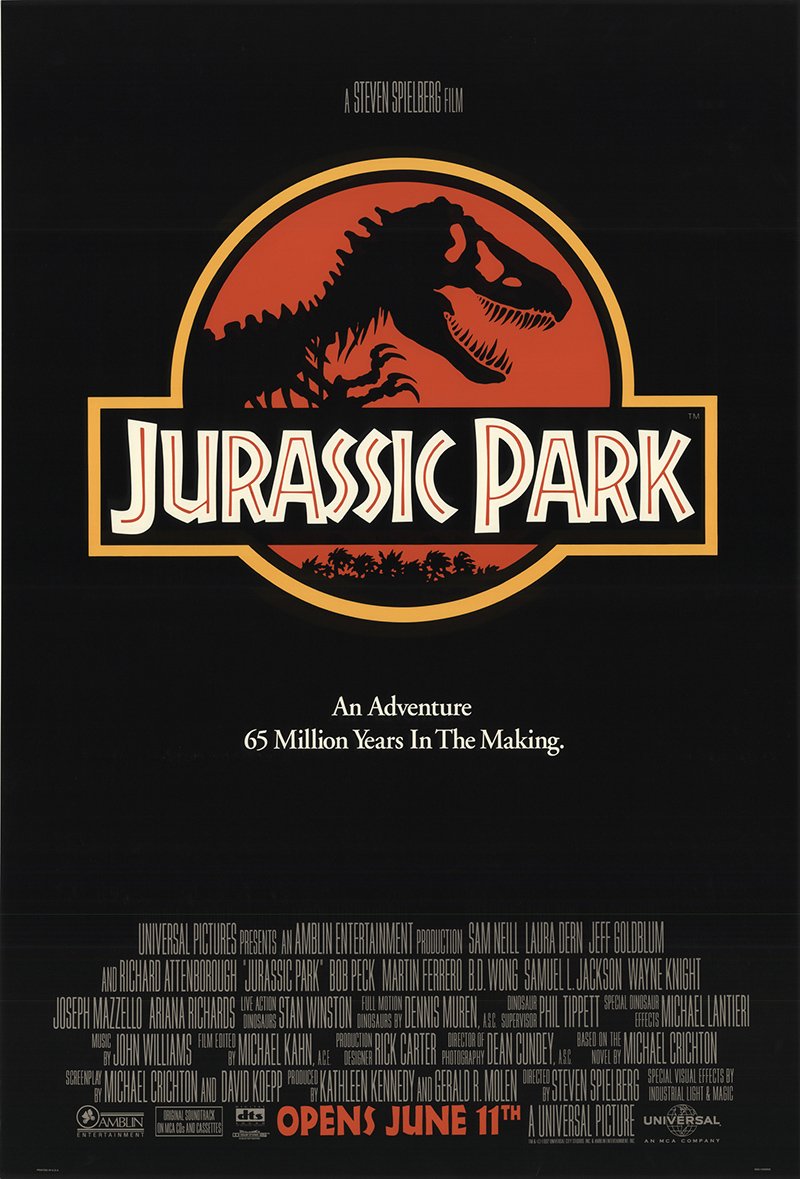
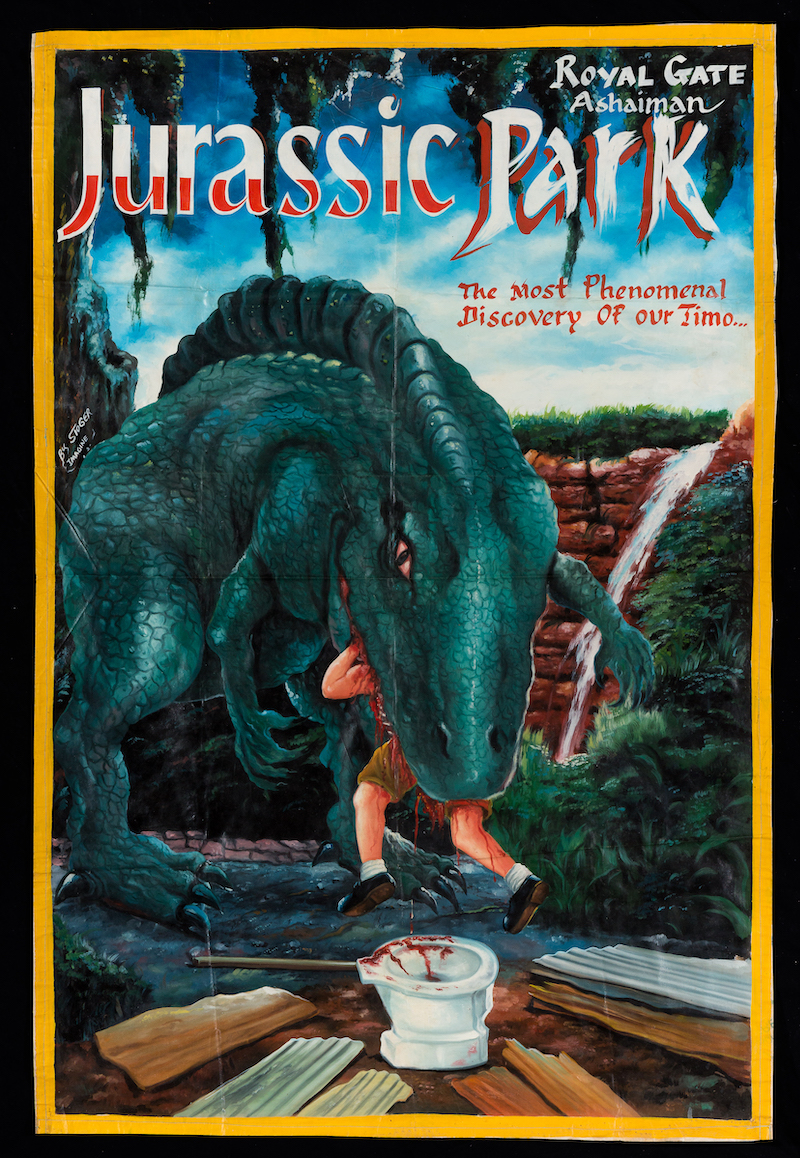
How does the official poster for Jurassic Park, above, compare to the hand-painted, presumably unauthorized image used to market it to audiences in Ghana?
Americans have never like the word “empire,” having seceded from the British Empire to ostensibly found a free nation. The founders blamed slavery on the British, naming the king as the responsible party. Three of the most distinguished Virginia slaveholders denounced the practice as a “hideous blot,” “repugnant,” and “evil.” But they made no effort to end it. Likewise, according to the Declaration of Independence, the British were responsible for exciting “domestic insurrections among us,” and endeavouring “to bring on the inhabitants of our frontiers, the merciless Indian Savages.”
These denunciations aside, the new country nonetheless began a course identical to every other European world power, waging perpetual warfare, seizing territory and vastly expanding its control over more and more land and resources in the decades after Independence.
U.S. imperial power was asserted not only by force of arms and coin but also through an ideological view that made its appearance and growth an act of both divine and secular providence. We see this view reflected especially in the making of maps and early historical infographics.
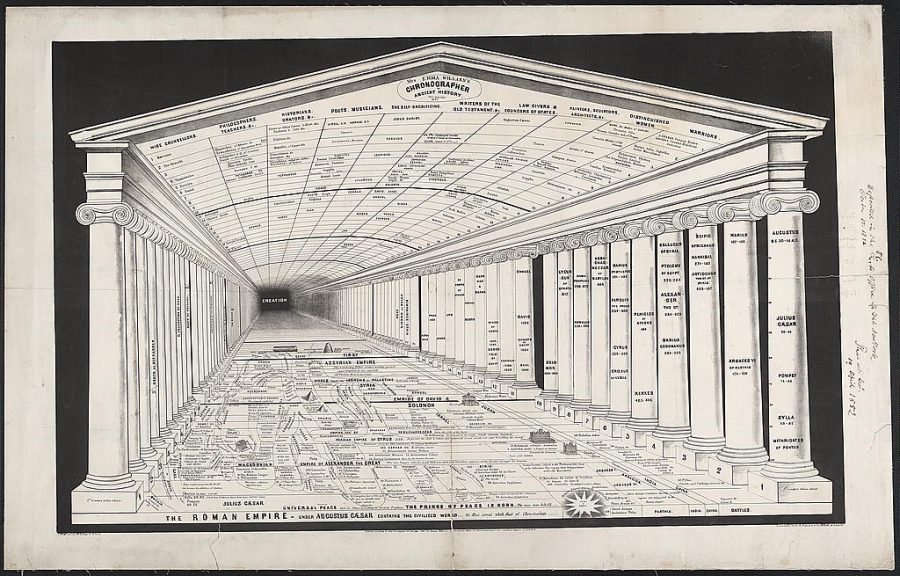
In 1851, three years after war with Mexico had halved that country and expanded U.S. territory into what would become several new states, Emma Willard, the nation’s first female mapmaker, created the “Chronographer of Ancient History” above, a visual representation to “teach students about the shape of historical time,” writes Rebecca Onion at Slate. The Chronographer is a “more specialized offshoot of Willard’s master Temple of Time, which tackled all of history”—or all six thousand years of it, anyway, since “Creation BC 4004.”
Willard made several such maps, illustrating an idea popular among 18th and 19th century historians, and illustrated in many similar ways by other artists: casting history as a succession of great empires, one taking over for another. Viewers of the map stand outside the temple’s stable framing, assured they are the inheritors of its historical largesse. Other visual metaphors told this story, too. Willard, as Ted Widmer points out at The Paris Review. Willard was an “inventive visual thinker,” if also a very conventional historical one.
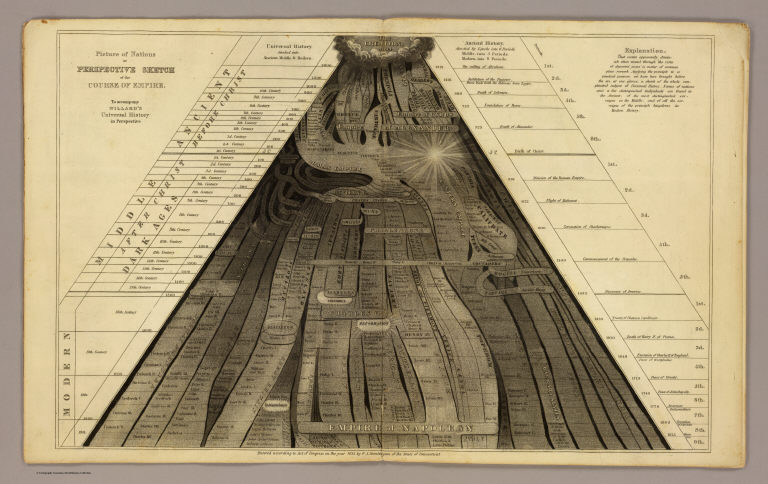
In an earlier map, from 1836, Willard visualized time as a series of branching imperial streams, flowing downward from “Creation.” Curiously, she situates American Independence on the periphery, ending with the “Empire of Napoleon” at the center. The U.S. was both something new in the world and, in other maps of hers, the fruition of a seed planted centuries earlier. Willard’s mapmaking began as an effort to supplement her materials as “a pioneering educator,” founder of the Emma Willard School in Troy, New York, and a “versatile writer, publisher and yes, mapmaker,” who “used every tool available to teach young readers (and especially young women) how to see history in creative new ways.”
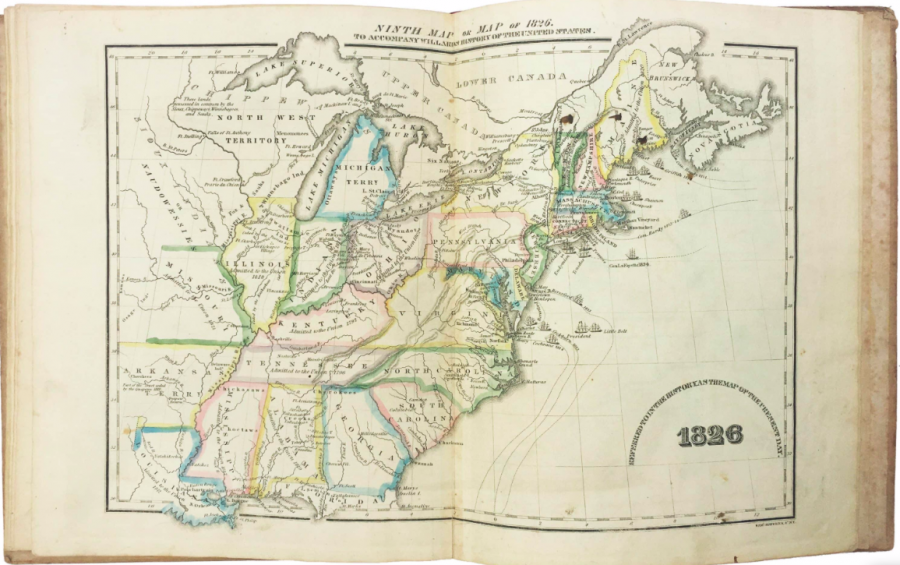
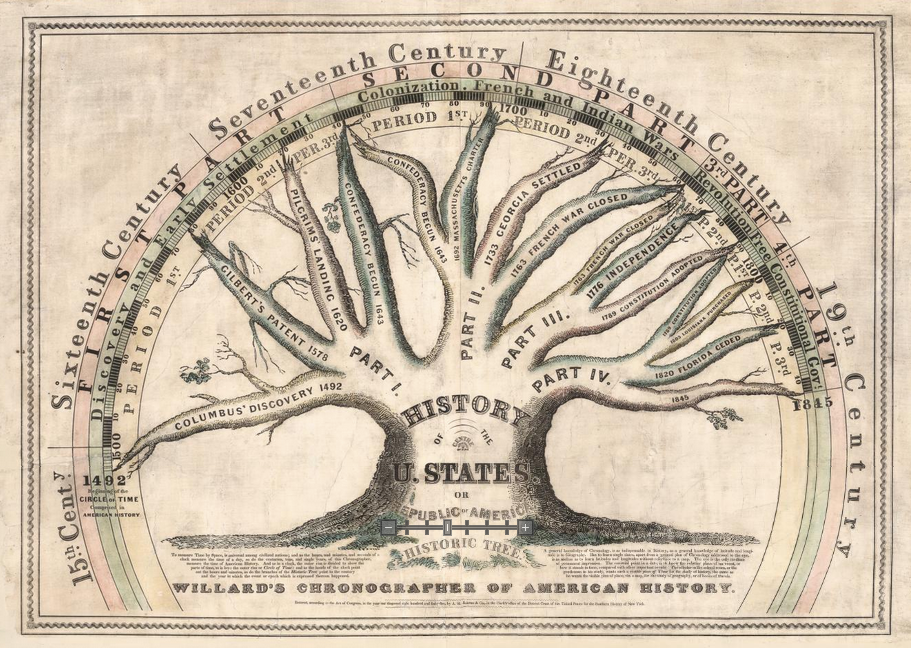
In another “chronographer” textbook illustration, she shows the “History of the U. States or Republic of America” as a tree which had been growing since 1492, though no such place as the United States existed for most of this history. Maps, writes Sarah Laskow at Atlas Obscura, “have the power to shape history” as well as to record it. Willard’s maps told grand, universal stories—imperial stories—about how the U.S. came to be. In 1828, when she was 41, “only slightly older than the United States of America itself,” Willard published a series of maps in her History of the United States, or Republic of America.
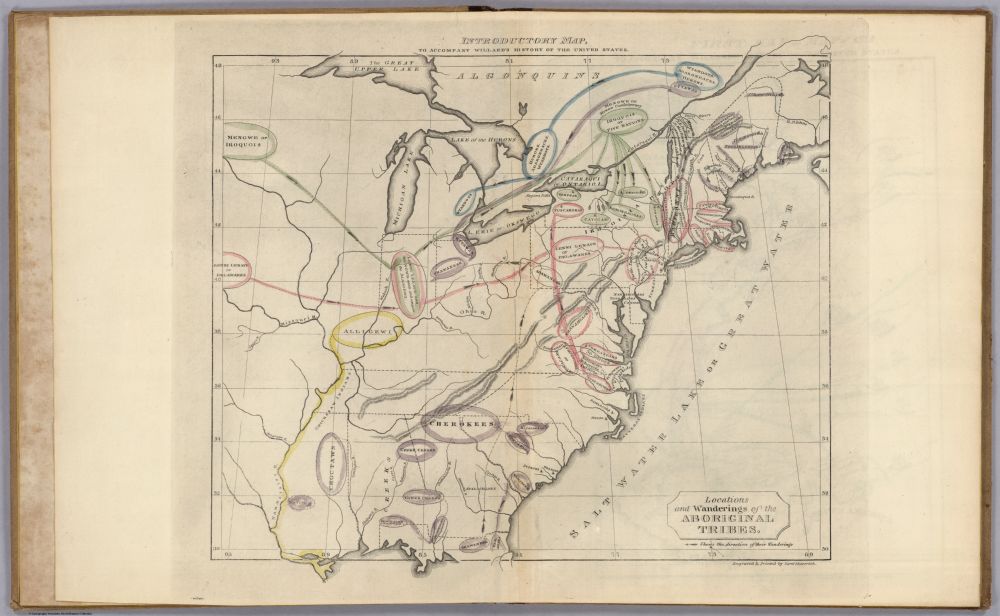
This was “the first book of its kind—the first atlas to present the evolution of America.” Willard’s maps show the movement of Indigenous nations in plates like “Locations and Wanderings of The Aboriginal Tribes… The Direction of their Wanderings,” below—these were part of “a story about the triumph of Anglo settlers in this part of the world. She helped solidify, for both her peers and her students, a narrative of American destiny and inevitability, writes University of Denver historian Susan Schulten. Willard was “an exuberant nationalist,” who generally “accepted the removal of these tribes to the west as inevitable.”
Willard was a pioneer in many respects, including, perhaps, in her adoptation of European neoclassical ideas about history and time in the justification of a new American empire. Her snapshots of time collapse “centuries into a single image,” Schulten explains, as a way of mapping time “in a different way as a prelude to what comes to next.” See many more of Willard’s maps from The History of the United States, or Republic of America, the first historical atlas of the United States, at Boston Rare Maps.
They say that toys were once built to last. But though metal and wood didn’t break quite so easily in the hands of children in the early 20th century as plastic does in the hands of their great- or great-great-grandchildren today, time still hasn’t been especially kind to the playthings of yesteryear. Enter the toy restorer, who can return even the most faded, rusted, beaten-up specimens to a burnished, gleaming condition that would turn the head of even the most smartphone-addled youngster. At least the toy restorer behind the Youtube channel Rescue & Restore seems to possess skills of this kind, and in its channel’s videos you can see them put to use.
Fortunately, Rescue & Restore possesses all the specialized tools needed to not just disassemble and (to the amazement of many a commenter) reassemble everything, but to clean, resurface, and repaint each and every part, and in some cases fabricate new ones from scratch. Apart from the occasional explanatory subtitle, the “host” does all this work without a word.
Despite their simplicity, the videos of Rescue & Restore have drawn millions upon millions of views in a relatively short time. This suggests that the number of people dreaming of a better future for their closets full of long-disused toys might be large indeed, though we should never underestimate the appeal of seeing the old made new again — an experience whose audiovisual satisfaction seems to be heightened by high-resolution shots and clearly captured sounds of all the dremeling, sandblasting, and buffing involved.
Toys originally opened sixty, seventy, eighty Christmases ago have gone through a lot in their long lives, but after Rescue & Restore gets done with them, they could well find their way under the tree again this year.
Based in Seoul, Colin Marshall writes and broadcasts on cities, language, and culture. His projects include the book The Stateless City: a Walk through 21st-Century Los Angeles and the video series The City in Cinema. Follow him on Twitter at @colinmarshall, on Facebook, or on Instagram.
T.S. Eliot asks in the opening stanzas of his Choruses from the Rock, “where is the knowledge we have lost in information?” The passage has been called a pointed question for our time, in which we seem to have lost the ability to learn, to make meaningful connections and contextualize events. They fly by us at superhuman speeds; credible sources are buried between spurious links. Truth and falsehood blur beyond distinction.
But there is another feature of the 21st century too-often unremarked upon, one only made possible by the rapid spread of information technology. Vast digital archives of primary sources open up to ordinary users, archives once only available to historians, promising the possibility, at least, of a far more egalitarian spread of both information and knowledge.
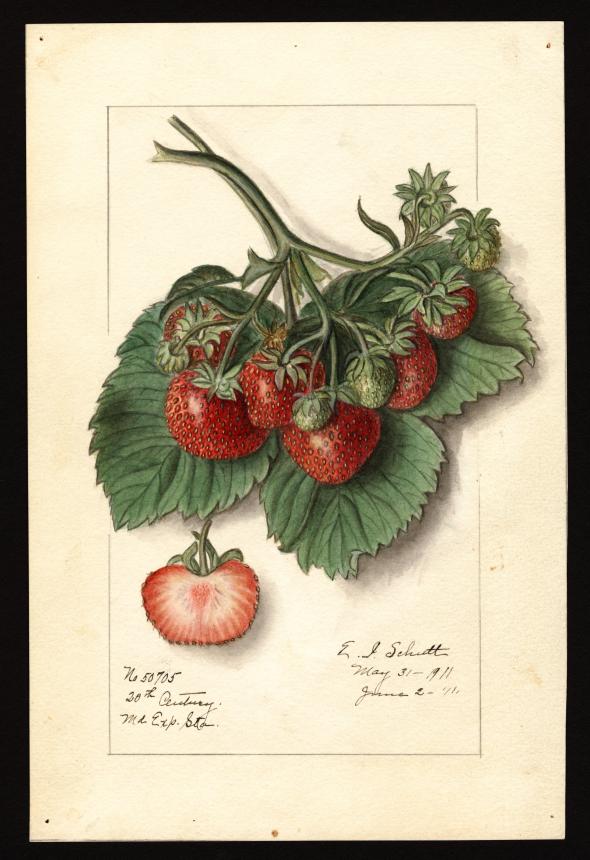
Those archives include the USDA Pomological Watercolor Collection, “over 7,500 paintings, drawings, and wax models commissioned by the USDA between 1886 and 1942,” notes Chloe Olewitz at Morsel. The word “pomology,” “the science and practice of growing fruit,” first appeared in 1818, and the degree to which people depended on fruit trees and fruit stores made it a distinctively popular science, as was so much agriculture at the time.
But pomology was growing from a domestic science into an industrial one, adopted by “farmers across the United States,” writes Olewitz, who “worked with the USDA to set up orchards to serve emerging markets” as “the country’s most prolific fruit-producing regions began to take shape.” Central to the government agency’s growing pomological agenda was the recording of all the various types of fruit being cultivated, hybridized, inspected, and sold from both inside the U.S. and all over the world.
Prior to and even long after photography could do the job, that meant employing the talents of around 65 American artists to “document the thousands and thousands of varieties of heirloom and experimental fruit cultivars sprouting up nationwide.” The USDA made the full collection public after Electronic Frontier Foundation activist Parker Higgins submitted a Freedom of Information Act request in 2015.
Higgins saw the project as an example of “the way free speech issues intersect with questions of copyright and public domain,” as he put it. Historical government-issued fruit watercolors might not seem like the obvious place to start, but they’re as good a place as any. He stumbled on the collection while either randomly collecting information or acquiring knowledge, depending on how you look at it, “challenging himself to discover one new cool public domain thing every day for a month.”
It turned out that access to the USDA images was limited, “with high resolution versions hidden behind a largely untouched paywall.” After investing $300,000, they had made $600 in fees in five years, a losing proposition that would better serve the public, the scholarly community, and those working in-between if it became freely available.
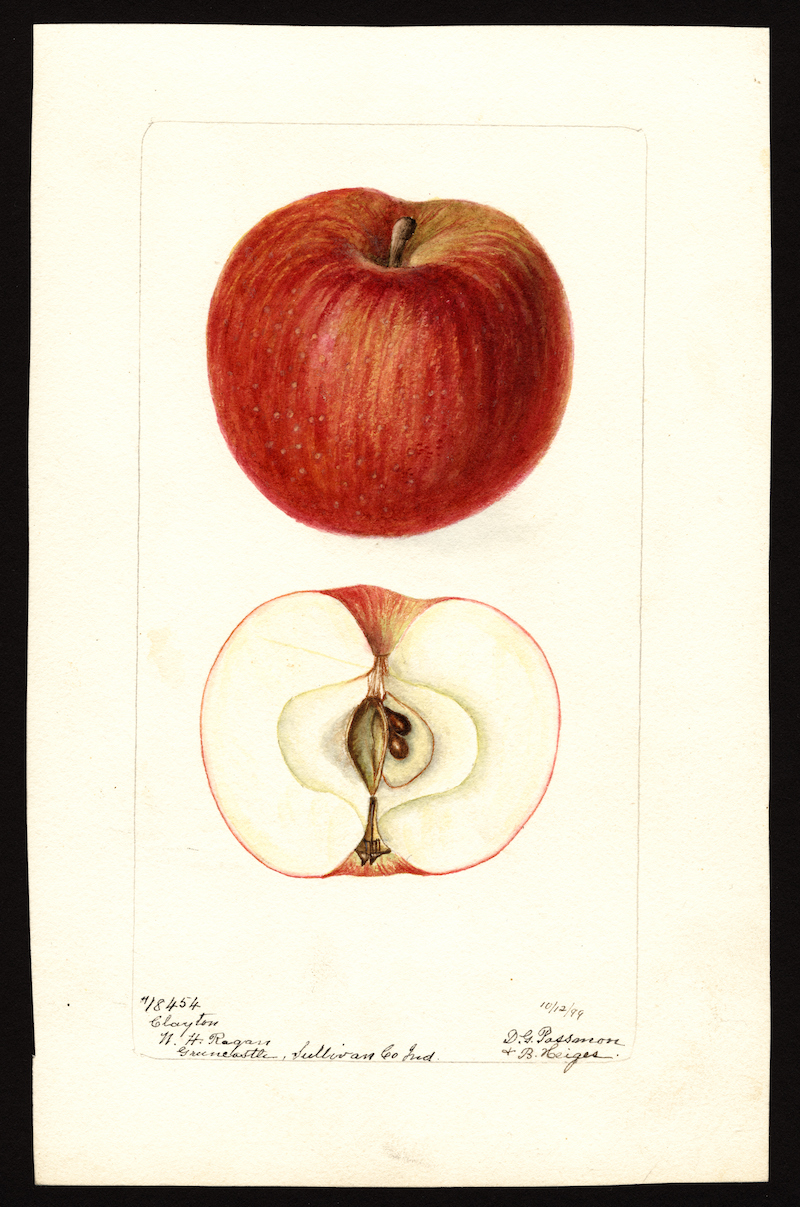
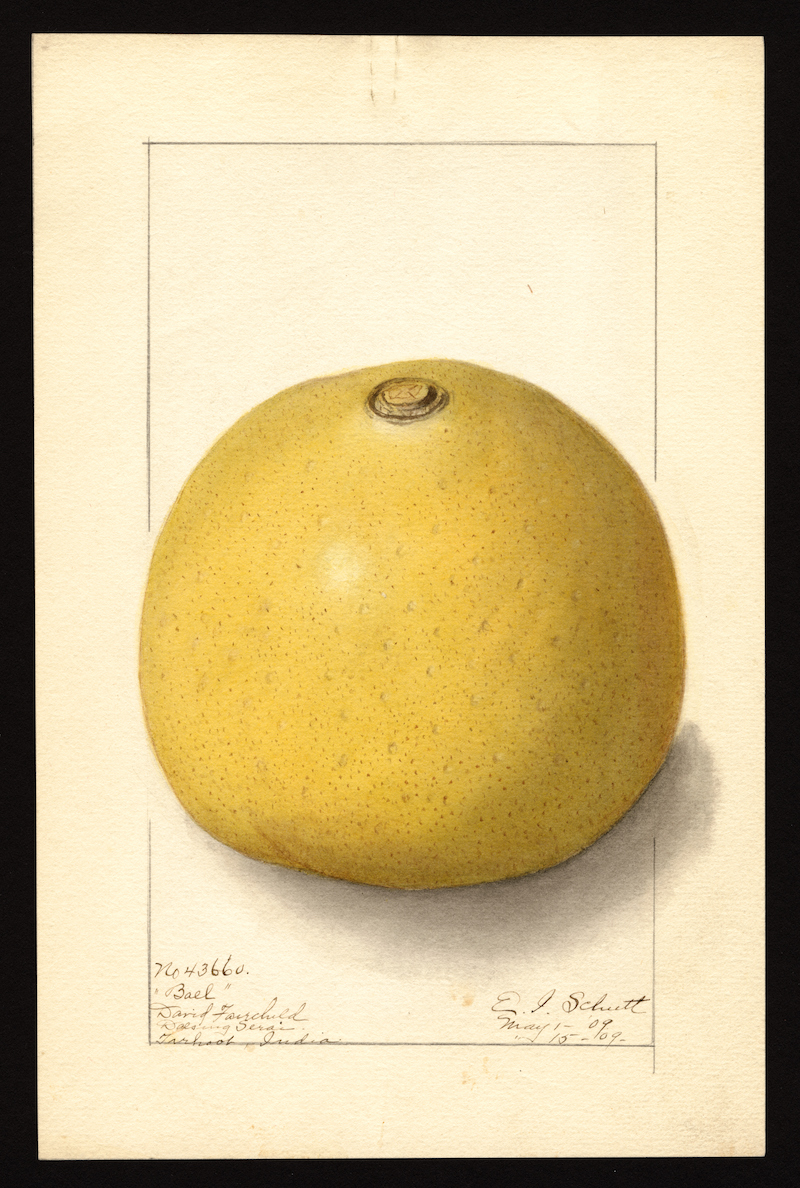
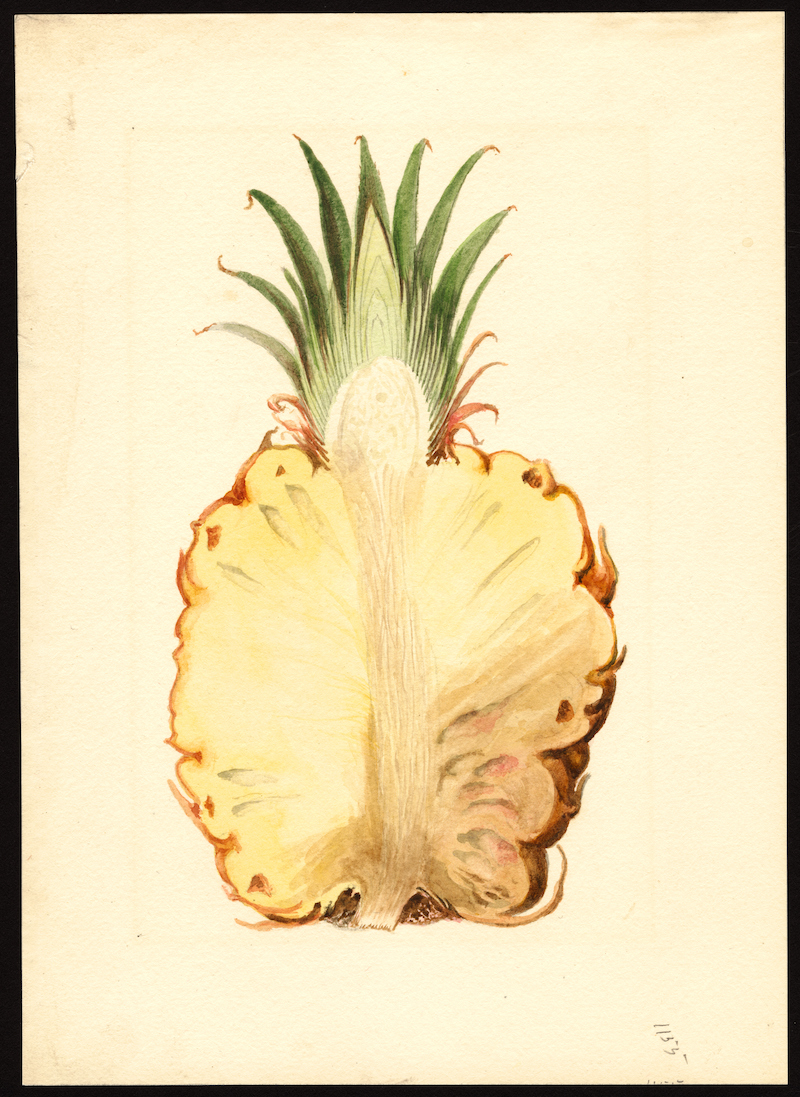
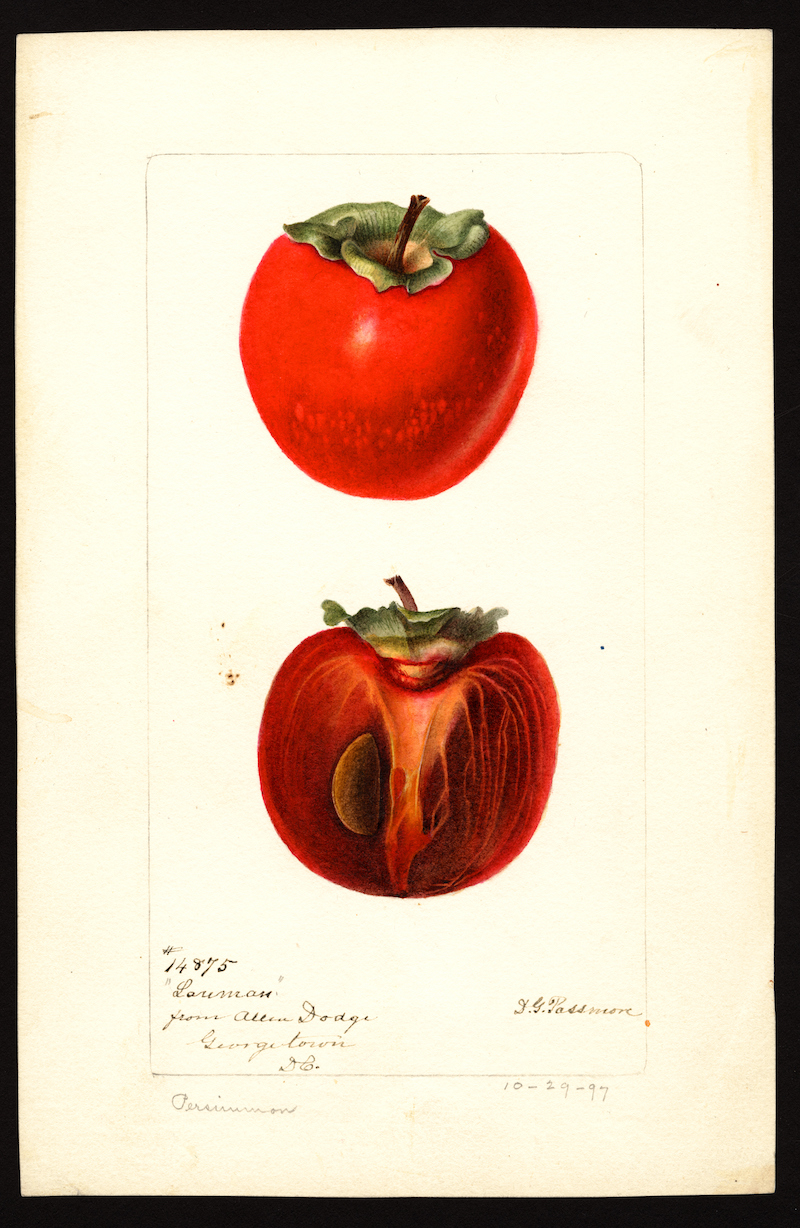
You can explore the entirety of this tantalizing collection of fruit watercolors, ranging in quality from the workmanlike to the near sublime, and from unsung artists like James Marion Shull, who sketched the Cuban pineapple above, Ellen Isham Schutt, who brings us the Aegle marmelos, commonly called “bael” in India, further up, and Deborah Griscom Passmore, whose 1899 Malus domesticus, at the top, describes a U.S. pomological archetype.
It’s easy to see how Higgins could become engrossed in this collection. Its utilitarian purpose belies its simple beauty, and with 3,800 images of apples alone, one could get lost taking in the visual nuances—according to some very prolific naturalist artists—of just one fruit alone. Higgins, of course, created a Twitter bot to send out random images from the archive, an interesting distraction and also, for people inclined to seek it out, a lure to the full USDA Pomological Watercolor Collection.
At what point does an exploration of these images tip from information into knowledge? It’s hard to say, but it’s unlikely we would pursue either one if that pursuit didn’t also include its share of pleasure. Enter the USDA’s Pomological Watercolor Collection here to new and download over 7,500 high-resolution digital images like those above.
After John Ford, the history of U.S. expansion went by the name “How the West Was Won.” Decades earlier, in his essay “Annexation,” Jacksonian journalist John O’Sullivan famously coined the phrase “manifest destiny.” Historian Richard Slotkin called it “regeneration through violence” and novelist Cormac McCarthy summed up the jagged, ever-moving line of westward expansion from sea to sea with two words: Blood Meridian.
Indigenous versions of the story do not tend to enter common parlance in quite the same way, a fact upon which Vine Deloria, Jr. remarks in his “Indian Manifesto,” Custer Died for Your Sins. Violence is always central to the story. Usually the savagery of Native people is taken for granted. Savagery of settlers may be more or less emphasized. Yet the long history of land theft over the course of the centuries is also one of broken treaty after treaty.
Few tribes were defeated in war by the United States, but most sold some land and allowed the United States to hold the remainder in trust for them. In turn, the tribes acknowledged the sovereignty of the United States in preference to other possible sovereigns.
Caught between warring European empires, Indigenous nations made the best deals they could with the advancing U.S. and its army of Civil War veterans. “From this humble beginning the federal government stole some two billion acres of land and continues to take what it can without arousing the ire of the ignorant public.”
The brutality of the 19th century became professionalized, carried out by regulars in uniform, hence the detached language of “Indian wars.” These were followed by other kinds of violence: institutionalized paternalism, further encroachment and enclosure, and the forced removal of thousands of children from their parents and into reeducation camps.
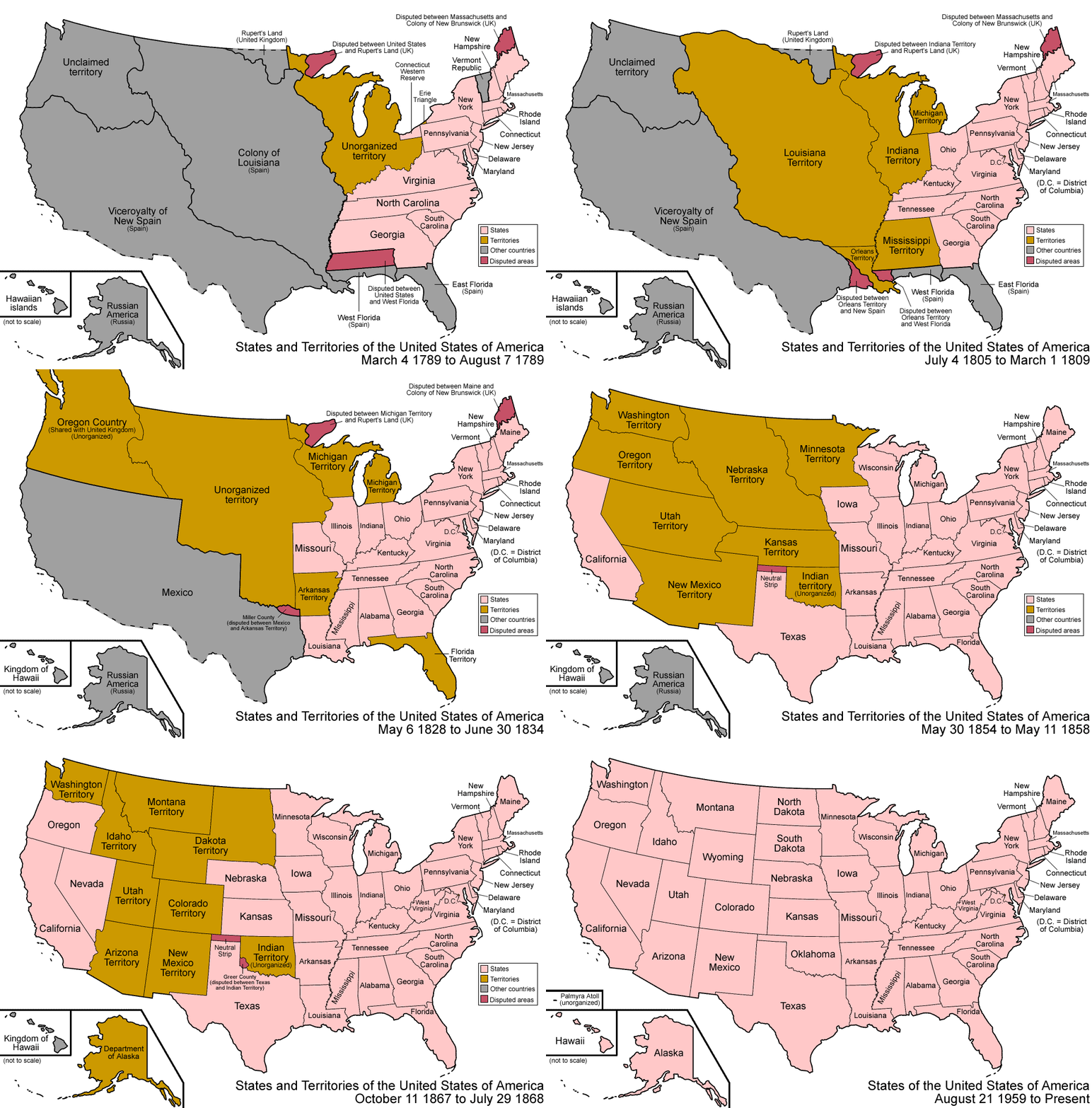
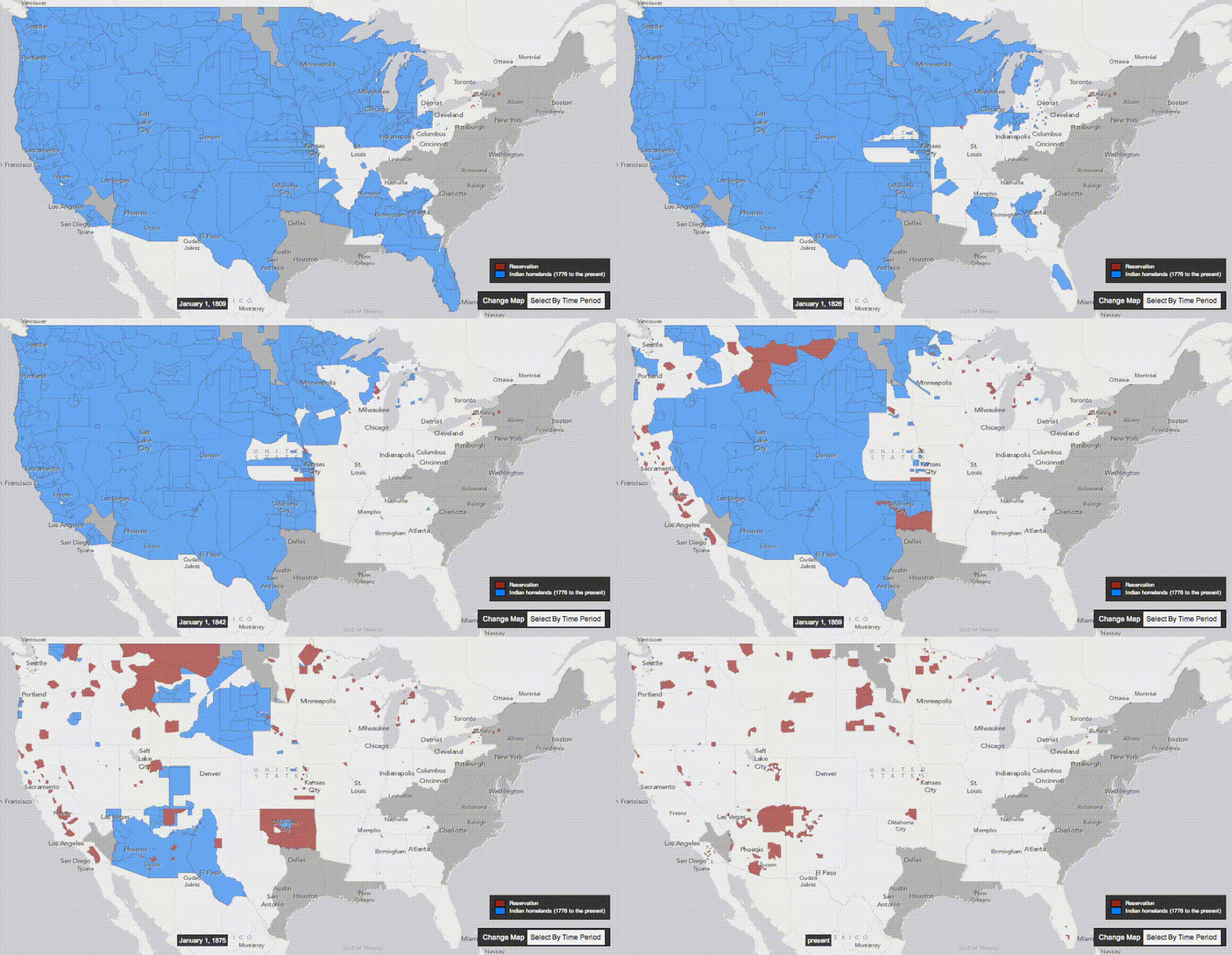
The two maps you see here, with sweepingly broad visual gestures in gif form, illustrate the 19th century seizure of land across the North American continent from the perspective of a U.S. national history and that of an Indigenous multi-national history. The map at the top traces the story from the country’s beginnings in the 13 colonies to the annexation, purchase, and finally statehood of Hawaii and Alaska in 1959.
The above map is more focused, spanning the years 1810 to 1891. As Nick Routley points out in a post at Visual Capitalist, “five of the largest expansion events in U.S. history” took place during the 1800s, though the first one he cites falls outside the timeline above. The 1803 Louisiana Purchase ended up acquiring what now makes up “nearly 25% of the current territory of the United States, stretching from New Orleans all the way up to Montana and North Dakota.”
Other notable events include the 1819 purchase of Florida from Spain by John Quincy Adams, the aforementioned purchase of Alaska from Russia, and the 1845 annexation of Texas. The Mexican-American War of 1848 gets less mention these days, though it expanded slavery and was quite hotly debated at the time by such principled figures as Henry David Thoreau, who refused to pay his poll tax over it and wrote “Civil Disobedience” while in jail.
In the so-called Mexican Cession, Texas became a state and “the United States took control of a huge parcel of land that includes the present-day states of California, Nevada, and Utah, as well as portions of Arizona, Colorado, New Mexico, and Wyoming.” Mexico, on the other hand, “saw the size of their territory halved.” After each seizure of territory, mass migrations westward commenced in wave upon wave.
Routely does not survey these migration events, but you can learn about them in accounts like Roxanne Dunbar-Ortiz’s Indigenous People’s History of the United Statesand Deloria’smanifesto. When we approach the founding and expansion of the U.S. from multiple perspectives, both visual and historical, we understand why critical historians often use the phrase “settler colonialism” rather than “westward expansion” or its synonyms. And why the overused and limited phrase “nation of immigrants” might just as well be “nation of migrants.”
In December 1931, having just embarked on a 40-stop lecture tour of the United States, Winston Churchill was running late to dine with financier Bernard Baruch on New York City’s Upper East Side. He hadn’t bothered to bring Baruch’s address, operating under the incorrect assumption that his friend was so distinguished a personage, any random cab-driving commoner would automatically recognize his building.
Such were the days before cell phones and Google Maps.…
Eventually, Churchill bagged the cab, and shot out across 5th Avenue mid-block, thinking he would fare better on foot.
In England we frequently cross roads along which fast traffic is moving in both directions. I did not think the task I set myself now either difficult or rash. But at this moment habit played me a deadly trick. I no sooner got out of the cab somewhere about the middle of the road and told the driver to wait than I instinctively turned my eyes to the left. About 200 yards away were the yellow headlights of an approaching car. I thought I had just time to cross the road before it arrived; and I started to do so in the prepossession—wholly unwarranted— that my only dangers were from the left.
Another cab ferried the wounded Churchill to Lenox Hill Hospital, where he identified himself as “Winston Churchill, a British Statesman” and was treated for a deep gash to the head, a fractured nose, fractured ribs, and severe shock.
“I do not wish to be hurt any more. Give me chloroform or something,” he directed, while waiting for the anesthetist.
After two weeks in the hospital, where he managed to develop pleurisy in addition to his injuries, Churchill and his family repaired to the Bahamas for some R&R.
It didn’t take long to feel the financial pinch of all those cancelled lecture dates, however. Six weeks after the accident, he resumed an abbreviated but still grueling 14-stop version of the tour, despite his fears that he would prove unfit.
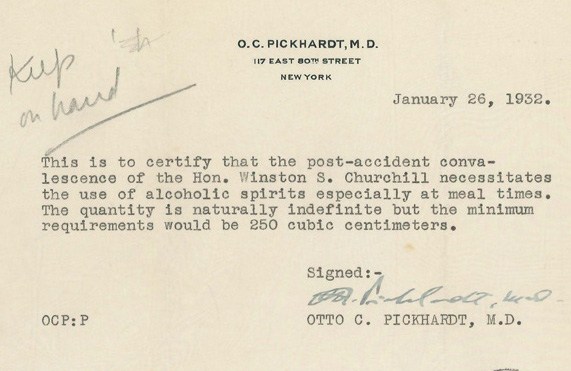
Otto Pickhardt, Lenox Hill’s admitting physician came to the rescue by issuing Churchill the Get Out of Prohibition Free Pass, above. To wit:
…the post-accident convalescence of the Hon. Winston S. Churchill necessitates the use of alcoholic spirits especially at meal times. The quantity is naturally indefinite but the minimum requirements would be 250 cubic centimeters.
Perhaps this is what the eminent British Statesman meant by chloroform “or something”? No doubt he was relieved about those indefinite quantities. Cheers.
Ayun Halliday is an author, illustrator, and Chief Primatologist of the East Village Inky zine. She lives in New York City, some 30 blocks to the north of the scene of Churchill’s accident. Follow her @AyunHalliday
If you’ve seen Pink Floyd in the news lately, it’s maybe because guitarist David Gilmour recently put up his collection of over 120 guitars for a charity auction, fetching “certifiably insane” prices like a whopping $3.975 million for the famous black Strat played on Dark Side of the Moon. (The guitar now “wears the crown as the world’s most expensive six string,” notes Enmore Audio.)
But there’s more going on with ex-Pink Floyd members than Gilmour’s guitars or Roger Waters’ political activism. Drummer Nick Mason, long renowned post-Floyd for his hugely expensive car collection, has taken on another role this month: as a podcast host and music historian in a nine-part series for the Open University/BBC production, The Documentary Podcast.
Titled A History of Music in Technology, Mason’s series covers an awful lot of ground, “charting the history of music and technology and exploring the world of legendary artists, producers and inventors. The series shines a light on game-changing innovations including the synthesizer, electric guitar, samplers, drum machines and the recording studio itself.”
A History of Music in Technology finishes its run tomorrow. Currently, you can stream all but the final installment at BBC News, Apple podcasts, and Stitcher. The first episode— “Sound Recording”—which you can hear above, begins in prehistory. Long before the technology for reproducing sound could be imagined, early humans showed keen interest in the acoustic properties of caves, as University of North Carolina professor Mark Katz explains.
“I think people have always had an infatuation with trying to hold on to [sound], to modify it, to capture it,” says Katz—whether that meant seeking out the best settings for prehistoric drum circles or building structures like cathedrals with specially-designed sonic properties. But for thousands of years, the only way to preserve music was to write it down in notation.
It took until “the back half of the 19th century,” says Mason, “before credible attempts were made to bottle sound for the first time.” (Those very first attempts could record sound but could not play it back.) From the early technological achievements, it’s a long series of leaps, bounds, zig zags, stumbles, and circling back around to find ways not only to record sound but also to amplify and modify it and create it wholesale from electrical signals.
Above and below, you can hear Mason’s hour-long history of the electric guitar (Episode 3), the synthesizer (Episode 5), and samplers and drum machines (Episode 6). Mason dedicates two episodes, 7 and 8, to the development of the recording studio itself—unsurprising for a member of Pink Floyd, a band who, like Hendrix, the Beach Boys, and the Beatles, crafted the essence of their psychedelic sound from studio experiments.
“When sound recording first emerged,” says Mason in “The Studio Part 1” intro, “critics claimed it could be the end of music.” For the dozens of new genres recording and production technology has enabled, it was only the very beginning. Those of us who see computers killing the spontaneity of rock and roll, for example, or the very humanity of music itself, might reflect on how our reactions mirror those of some myopic early critics.
American composer John Philip Sousa, for example, saw recording as “reducing the expression of music to a mathematical system of wheels, cogs, discs, and cylinders,” language that sounds very like the complaints of current-day purists. Maybe artificial intelligence will never write a great love song, but it will most certainly help humans create music as unimaginable to us today as the syncopated thump of electronic music would have been unimaginable to Sousa, king of syncopated brass band marches.
Luddites and technophiles and everyone in-between will learn much from Mason’s series, and the kind of musical education he’s offering—replete with expert informed opinion from scholars and musicians like himself—will go a long way to preparing us for a musical future we might only dimly glimpse now in the most innovative technologies Mason is sure to cover in his final episode
We're hoping to rely on loyal readers, rather than erratic ads. Please click the Donate button and support Open Culture. You can use Paypal, Venmo, Patreon, even Crypto! We thank you!
Open Culture scours the web for the best educational media. We find the free courses and audio books you need, the language lessons & educational videos you want, and plenty of enlightenment in between.