Last September, British archaeologists made a pretty startling discovery. They found, they believed, the bones of Richard III (1452–1485) in a makeshift grave under a parking lot in the city of Leicester. It sounded like a pretty ignominious but karmically justified resting place for the tyrannical medieval king portrayed so famously by William Shakespeare.
From the beginning, the archaeologists were convinced that the skeletal remains belonged to Richard (check out the photo gallery of the bones), but they still needed irrefutable proof. So they took DNA samples and matched them to DNA belonging to Richard’s living descendants. They awaited the results, and today Richard Buckley, the lead archaeologist, told reporters, “Beyond reasonable doubt, the individual exhumed … is indeed Richard III, the last Plantagenet king of England.” You can get more on the story over at The Guardian and The New York Times.
Follow us on Facebook, Twitter and Google Plus and share intelligent media with your friends! They’ll thank you for it.
Think of Masterpiece Theater and you might think of Downton Abbey, Agatha Christie’s Miss Marple,or even the Cookie Monster. But the man who really made the series famous was broadcaster Alistair Cooke, the series’ crisp, avuncular host. Seated in a leather chair, surrounded by bound volumes, Cooke introduced all of the great British programming brought to the States by WGBH—I, Claudius and Upstairs, Downstairs and The Six Wives of Henry VIII—and brought a cozy gravitas to American television.
Cooke died in 2004 and left a legacy as a broadcast essayist: Letter from America, a series of 15-minute radio pieces now collected into an extensive digital archive by BBC Radio 4. The essays aired weekly throughout the world for 58 years, beginning in 1946, sending Cooke’s slightly amused voice over the airwaves. He gave us his ex-pat take on everything from American holidays (including his personal involvement in making George Washington’s birthday a national holiday), to the ways American English varies from British English, to major events in American history.
Cooke captured America’s grief after John F. Kennedy was assassinated, but his eyewitness account of Bobby Kennedy’s death would become one of his most powerful reports. Cooke was in the lobby of the Ambassador Hotel when Kennedy was shot and used scratch paper to scribble down his impressions of the chaos.
He was brilliant at crafting character-driven stories about issues. His piece about John Lennon’s death (above) segued neatly into an exploration of gun violence in America. He reported on the suicide of actress Jean Seberg and used the obituary as an opportunity to discuss the excesses of FBI surveillance and witch-hunting.
Cooke wasn’t as good a writer as he was a reporter (view his original scripts in the Boston University archive) and he audibly sighs during some broadcasts, as if he is either tired or bored. But his point of view is priceless: an observant, charming outsider who fell in love with his adopted country, warts and all.
It’s often remembered as the day the Sixties died. On December 6, 1969, the Rolling Stones and a group of West Coast bands put on a free concert at the Altamont Raceway near San Francisco. The concert was billed as “Woodstock West,” but instead of being another gathering of peace, love and music, it was more like a bad trip.
The event was hastily put together by the Stones to celebrate the end of their American tour, their first with guitarist Mick Taylor. The stage at the venue was unusually low and was situated at the bottom of a hill. To keep the audience of 300,000 people from engulfing the stage, someone had the bright idea of enlisting the Hells Angels motorcycle gang to form a security cordon around the stage in exchange for (essentially) all the beer they could drink.
As the concert descended into chaos, the Hells Angels beat people with pool cues and motorcycle chains. A guitarist and singer for the Jefferson Airplane, Marty Balin, was knocked unconscious. When a man in the audience brandished a pistol during an altercation while the Stones were onstage, he was stabbed and beaten to death by members of the gang.
The whole sorry episode is captured in Gimme Shelter, the classic documentary by the brothers Albert and David Maysles and Charlotte Zwerin. The film was released in 1970 and can be seen above in its entirety. Gimme Shelter contains elements of a typical rock and roll documentary, with footage of the Stones on the road and playing a concert at Madison Square Garden in New York. But the main focus is Altamont. The Maysles brothers hired a large team of cameramen for the event, including filmmaker Robert Elfstrom, Magnum photographer Elliott Erwitt and a young George Lucas.
Gimme Shelter is a fascinating record of the Sixties counterculture as it was falling apart. The last third of the picture is painful to watch but difficult to turn away from. The hubris and naiveté of the time are captured in a scene before the event, when Mick Jagger tells a group of reporters what Altamont is all about: “It’s creating a sort of microcosmic society, which sets an example to the rest of America as to how one can behave in large gatherings.”
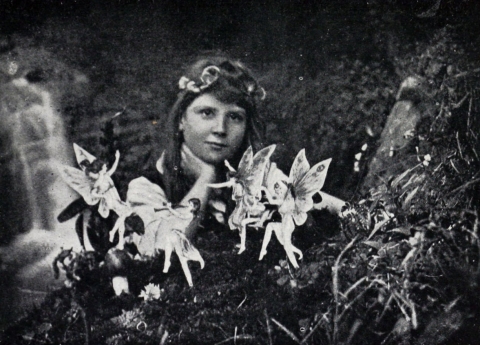
In a previous post, we brought you what is likely the only appearance on film of Sir Arthur Conan Doyle—an interview in which he talks of Sherlock Holmes and spiritualism. Although Conan Doyle created one of the most hardnosed rational characters in literature, the author himself later became converted to a variety of supernatural beliefs, and he was taken in by a few hoaxes. One such famous hoax was the case of the so-called “Cottingley Fairies.” As you can see from the photo above (from 1917), the case involved what Conan Doyle believed was photographic evidence of the existence of fairies, documented by two young Yorkshire girls, Elsie Wright and her cousin Frances Griffiths (the girl in the photo above). According to The Haunted Museum, the story of Doyle’s involvement goes something like this:
In 1920, Conan Doyle received a letter from a Spiritualist friend, Felicia Scatcherd, who informed of some photographs which proved the existence of fairies in Yorkshire. Conan Doyle asked his friend Edward Gardner to go down and investigate and Gardner soon found himself in the possession of several photos which showed very small female figures with transparent wings. The photographers had been two young girls, Elsie Wright and her cousin, Frances Griffiths. They claimed they had seen the fairies on an earlier occasion and had gone back with a camera and photographed them. They had been taken in July and September 1917, near the Yorkshire village of Cottingley.
The two cousins claimed to have seen the fairies around the “beck” (a local term for “stream”) on an almost daily basis. At the time, they claimed to have no intention of seeking fame or notoriety. Elsie had borrowed her father’s camera on a host Saturday in July 1917 to take pictures of Frances and the beck fairies.
Elsie’s father, a skeptic, filed the photos away as a joke, but her mother, Polly Wright, believed, and brought the images to Gardner (there were only two at first, not “several”), who circulated them through the British spiritualist community. When Conan Doyle saw them in 1920, he gave each girl a camera and commissioned them to take more. They produced three additional prints. The online Museum of Hoaxesdetails each of the five photos from the two sessions with text from Edward Gardner’s 1945 Theosophical Society publication The Cottingley Photographs and Their Sequel.
These photos swayed thousands over the course of the century, but arch-skeptic James Randi seemingly debunked them for good when he pointed out that the fairies were ringers for figures in the 1915 children’s book Princess Mary’s Gift Book, and that the prints show discrepancies in exposure times that clearly point to deliberate manipulation. The two women, Elsie and Frances, finally confessed in the early 1980s, fifty years after Conan Doyle’s involvement, that they had faked the photos with paper cutouts. Watch Randi and Elsie Wright discuss the trickery above.
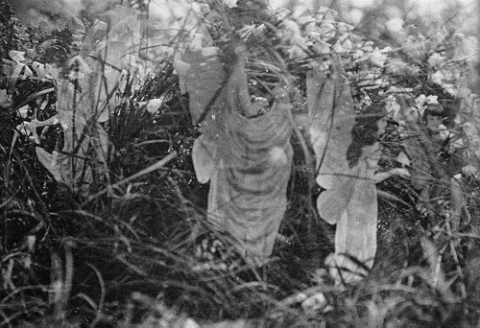
The daughter and granddaughter of Griffiths possess the original prints and one of Conan Doyle’s cameras. Both once believed that the fairies were real, but as the host explains, they were not simply credulous fools. Throughout much of the twentieth century, people looked at the camera as a scientific instrument, unaware of the ease with which images could be manipulated and staged. But even as Frances admitted to the fakery of the first four photos, she insisted that number five was genuine. Everyone on the show agrees, including the host. Certainly Conan Doyle and his friend Edward Gardner thought so. In the latter’s description of #5, he wrote:
This is especially remarkable as it contains a feature quite unknown to the girls. The sheath or cocoon appearing in the middle of the grasses had not been seen by them before, and they had no idea what it was. Fairy observers of Scotland and the New Forest, however, were familiar with it and described it as a magnetic bath, woven very quickly by the fairies and used after dull weather, in the autumn especially. The interior seems to be magnetised in some manner that stimulates and pleases.
I must say, I remain seriously unconvinced. Even if I were inclined to believe in fairies, photo number five looks as phony to me as numbers one through four. But the Antiques Roadshow appearance does add a fun new layer to the story and an air of mystery I can’t help but find intriguing, as Conan Doyle did in 1920, if only for the historical angle of the three generations of Griffiths who held onto the legend and the artifacts. Oh, and the appraisal for the five original photos and Arthur Conan Doyle’s camera? Twenty-five to thirty-thousand pounds—not too shabby for an adolescent prank.
Josh Jones is a freelance writer, editor, and musician based in Washington, DC. Follow him @jdmagness
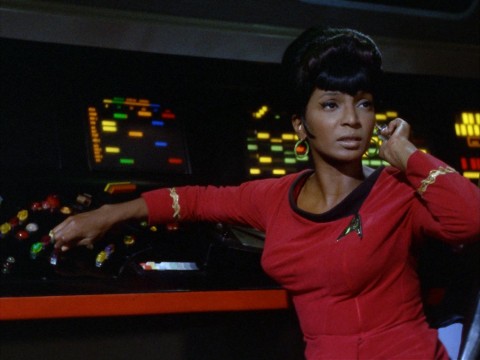
Nichelle Nichols played Lt. Uhura on the original Star Trek series (1966–1969). During the days when African-Americans were still fighting for legal equality in America, her role took on special importance. Her inclusion on the Enterprise pointed to a future when Americans could live and work together, putting race aside. And Nichols made history when Lt. Uhura and Captain Kirk embraced in the first inter-racial kiss on American television.
We can partly thank Martin Luther King, Jr. for all of this. As Nichols explains below, she gave considered leaving Star Trek at the end of Season 1, hoping to pursue a broadway career. But MLK asked her to reconsider. A big fan of the show, Dr. King underscored the importance of her character, of what it meant to future African-Americans, of how her character, through the power of TV, was opening a door that could never be closed. Needless to say, he persuaded her to stay on the show, and the rest is glorious history.
If you would like to support the mission of Open Culture, consider making a donation to our site. It’s hard to rely 100% on ads, and your contributions will help us continue providing the best free cultural and educational materials to learners everywhere. You can contribute through PayPal, Patreon, and Venmo (@openculture). Thanks!
The reading from Cuban-American poet Richard Blanco at President Barack Obama’s second inauguration ceremony today follows a tradition that began 52 years ago, when John F. Kennedy invited his fellow New Englander Robert Frost to read at his inaugural.
Frost was an early supporter of Kennedy. On his 85th birthday (March 26, 1959) he was asked by a reporter about the decline of New England’s cultural influence in America. “The next President of the United States will be from Boston,” replied Frost, according to Poets.org. “Does that sound as if New England is decaying?” At that time Kennedy had yet to formally announce his candidacy, so Frost was asked to explain who he was talking about. “He’s a Puritan named Kennedy. The only Puritans left these days are the Roman Catholics. There. I guess I wear my politics on my sleeve.” When President-elect Kennedy invited the 86-year-old poet to read a poem at his inauguration, if it was not too arduous, Frost cabled his response:
IF YOU CAN BEAR AT YOUR AGE THE HONOR OF BEING MADE PRESIDENT OF THE UNITED STATES, I OUGHT TO BE ABLE AT MY AGE TO BEAR THE HONOR OF TAKING SOME PART IN YOUR INAUGURATION. I MAY NOT BE EQUAL TO IT BUT I CAN ACCEPT IT FOR MY CAUSE–THE ARTS, POETRY, NOW FOR THE FIRST TIME TAKEN INTO THE AFFAIRS OF STATESMEN.
Frost wrote a new poem, “Dedication,” especially for the occasion. But conditions on inauguration day conspired against the old poet. A heavy blanket of snow fell on Washington the night before, and the sunlight that day was intense. In the harsh glare from the sun and snow, Frost found that he couldn’t read the typescript of his new poem. Kennedy had earlier asked Frost, if he wasn’t going to write a new poem, to consider reading his poem on American history, “A Gift Outright.” So when Frost found that he couldn’t read the new poem, he recited “A Gift Outright” from memory.
In the video above, we hear Frost reading the poem, which was written in the late 1930s and first published in 1942. Although some have said the audio is from the Kennedy inauguration, it apparently is not, because Frost reads the original text. For the inauguration, the poet reportedly agreed to Kennedy’s request to make a change in the final line. The phrase “Such as she would become” was changed to a more optimistic “Such as she will become.” (You can read the full text of the poem in a new window.) Sometime after the event, Kennedy put Frost’s inaugural appearance in perspective:
I asked Robert Frost to come and speak at the inauguration because I felt he had something important to say to those of us who are occupied with the business of government, that he would remind us that we were dealing with life, of hopes and fears of millions of people. He has said it well in a poem called “Choose Something Like a Star,”in which he speaks of the fairest star in sight and says, “It asks little of us here./It asks of us a certain height./So when at times the mob is swayed/to carry praise or blame too far,/we may choose something like a star/ to stay our mind on and be stayed.”
Among the many thousands of items in my newsfeed yesterday, three popped out and stuck with me: First, a conservative panel called Independent Women’s Forum convened to discuss their sense that “conservative leaders and funders… don’t take women’s issues seriously.” Panel moderator Christina Hoff Sommers joked, “I’m not sure what’s worse: conservatives ignoring women’s issues or conservatives addressing them.” The tone was light, but the sense of frustration these women feel with their male colleagues was very clear.
Secondly, a UK comedian, Michael J. Dolan published a soul-searching piece much discussed stateside in which he admits he was “a misogynist comedian.” Dolan claims that, like racist comedians of old, “Those peddling misogyny, homophobia or other varieties of hate to drunks who don’t know better are going to find themselves out of favour.” And finally, former president Jimmy Carter wrote an editorial to announce that he is severing his six-decade-long ties with the Southern Baptist Convention because of their view that women should be “subservient” to men. “It is simply self-defeating,” wrote Carter, “for any community to discriminate against half its population.”
I mention these examples because they seem to be part of a general trend of cultural reassessment, after several dismally low points in the discussion of gender equality this past year, about the continued institutionalization—in politics, religion, the workplace, and entertainment—of damaging attitudes toward half of the human species. While it sometimes seems that social change takes place at a glacial pace, with several steps back for every step forward, there are always strong undercurrents of progress that aren’t readily apparent until someone takes the time to organize them into narratives.
This is precisely what the filmmakers of MAKERS aim to do. A “multi-platform video experience” from AOL and PBS, the project showcases “hundreds of compelling stories from women of today and tomorrow… both known and unknown.” Unlike worldwide, policy-based efforts like the just-ended 2013 Global Maternal Health Conference, MAKERS restricts its focus to women in the U.S. and, it seems, relies primarily on individual women with prominent public roles—journalists, activists, writers, and celebrities, or at least that’s the sense one gets from their introductory video (above), which might open them up to charges of elitism. But there is more to the project than celebrity profiles. In their own words, the producers of MAKERS describe the project thus:
MAKERS originated from a very clear premise: over the last half century, the work of millions of women has altered virtually every aspect of American culture. MAKERS features groundbreaking women who have sparked change, been first in their fields and paved the way for those that followed. This initiative also extends to profile hundreds of stories of women who are driving social change today.
Delve into the wealth of short documentary videos on the MAKERS YouTube channel and you’ll see that there are dozens of women profiled who aren’t celebrities in the conventional sense. Sure, we’ve got stars of the screen and the power centers of government and the corporate world, e.g. Ellen DeGeneres, Hilary Clinton, and Yahoo CEO Marissa Mayer, but there are also lesser known “makers,” like 15-year-old Tavi Gevinson, founder and editor-in-chief of webzine Rookie. Gevinson is a prodigy who has built her own online media empire, beginning at the age of 11, when her fashion blog Style Rookie became one of the most popular of its kind. Watch her (below) discuss her own approach to typical teenage insecurities in an excerpt from her longer profile.
Another maker with a deeply inspiring story that you won’t hear in the daily news cycle is Katherine Switzer, the first woman to enter the Boston Marathon in 1967. She did so by signing the form with her initials, making marathon officials think she was a man. Below, Switzer recounts the curiosity, bile, and disturbingly violent harassment she faced during the race. It wasn’t until five years later that the race was officially opened to women. By that time, Switzer was an activist for female runners.
In 2001, none other than Sir Mick Jagger bought the rights to a novel by Robert Harris called Enigma. The novel, a fictionalized account of WWII British codebreakers, then became a feature film, written by Tom Stoppard, produced by Sir Mick, and starring Mr. Dougray Scott and Ms. Kate Winslett as derring-do Bletchley Park mathematicians and cryptanalysts employed in a race against time and the Nazis to break the fabled Enigma code before all hell breaks loose. It all sounds very dramatic (and I’ve heard the film is entertaining), but things didn’t happen quite like that. Reality is never so formulaic or so good-looking. But the Enigma code was broken, and the story of the code machine and its eventual decryption is fascinating on its own terms. As University of Cambridge “Enigma Project Officer” Dr. James Grime says–in the series of videos above and below–it’s a story of “how mathematicians can save lives.” Still with me?
Okay, so in the first video above, Dr. Grime gives us a thorough tour of the Enigma machine (Sir Mick owns one, by the way… but back to the history…). Developed by the Germans, it’s a marvelous encryption method set into a small box that when opened resembles little more than a fancy WWII-era typewriter. Oh, but it’s clever, you see, because the Enigma machine (the one above belongs to science writer Simon Singh) translates ordinary messages into code through an ingenious method by which no letter in the code ever repeats, making it almost impossible to decode in the ordinary ways. The machine was quite complicated for its time; it works by sending the characters typed by the keys through a series of circuits—first through three rotors like those on a combination bike lock, but each with 26 places instead of ten.
Now at this point, the machine was nothing more than what was available to any bank or business wishing to transmit trade secrets. But the German military machines had an extra layer of encoding: at the front of their machines was a “plugboard,” something like a small switchboard. This allowed the coding coming through the rotors to be resequenced for an extra level of scrambling. In the German military machines, the total number of possible combinations for message encryptions comes to a staggering figure in the quadrillions. (The exact number? 158,962,555,217,826,360,000). There’s a little more to the machine than that, but Dr. Grime can explain it much better than I.
Of course, the Enigma Machine had to have a fatal flaw. Otherwise, no novel, no movie, no drama (and maybe no victory?). What was it, you ask? Amazingly, as you will learn above, the very thing that made the Enigma nearly impossible to break, its ability to encode messages without ever repeating a letter, also made the code decipherable. But first, Alan Turing had to step in. Sadly, Turing is missing from Enigma the film. (More sadly, he was disgraced by the country he served, which put him on trial for his sexuality and humiliated him to the point of suicide). But as Grime shows above, Turing is one of the real heroes of the Enigma code story. Cryptanalysts initially discovered that they could decipher ordinary words and phrases (like “Heil Hitler”) in the Enigma messages by matching them up with strings of random letters that never repeated.
But this was not enough. In order for the Enigma code to work for the Germans, each operator—sender and receiver—had to have exactly the same settings on their rotors and plugboards. (The messages were transmitted over radio via Morse code). Each month had its own settings, printed on code sheets in soluble ink that easily dissolved in water. If the Allied codebreakers deciphered the settings, their decryption would be useless weeks later. Furthermore, the German navy had a more complicated method of encoding than either the army or air force. The Polish had developed a machine called the Bombe, which could decipher army and air force codes, but not navy. What Turing did, along with Gordon Welchman, was develop his own version of the Bombe machine, which allowed him to break any version of the Enigma code in under 20 minutes since it bypassed most of the tedious guesswork and trial and error involved in earlier by-hand methods.
This is all very dramatic stuff, and we haven’t had one celebrity step in to dress it up. While I’m certain that Enigma the film is a treat, I’m grateful to Dr. Grime for his engagement with the actual codebreaking methods and real personalities involved.
A third video of extra footage and outtakes is available here if you’re still hungry for more WWII codebreaking secrets.
We're hoping to rely on loyal readers, rather than erratic ads. Please click the Donate button and support Open Culture. You can use Paypal, Venmo, Patreon, even Crypto! We thank you!
Open Culture scours the web for the best educational media. We find the free courses and audio books you need, the language lessons & educational videos you want, and plenty of enlightenment in between.
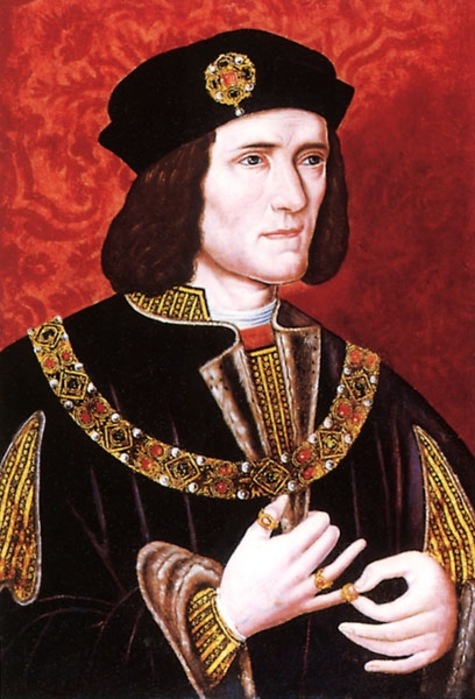 Last September, British archaeologists made a pretty startling discovery. They found, they believed, the bones of Richard III (1452–1485) in a makeshift grave under a parking lot in the city of Leicester. It sounded like a pretty ignominious but karmically justified resting place for the tyrannical medieval king portrayed so famously by William Shakespeare.