Occasionally and with diminishing frequency, we still lament the lost art of letter-writing, mostly because of the degradation of the prose style we use to communicate with one another. But writing letters, in its long heyday, involved much more than putting words on paper: there were choices to be made about the pen, the ink, the stamp, the envelope, and before the envelope, the letterlocking technique. Though recently coined, the term letterlocking describes an old and varied practice, that of using one or several of a suite of physical methods to ensure that nobody reads your letter but its intended recipient — and if someone else does read it, to show that they have.
“To seal a modern-day envelope (on the off chance you’re sealing an envelope at all), it takes a lick or two, at most,” writes Atlas Obscura’s Abigail Cain. Not so for the likes of Mary Queen of Scots or Machiavelli: “In those days, letters were folded in such a way that they served as their own envelope. Depending on your desired level of security, you might opt for the simple, triangular fold and tuck; if you were particularly ambitious, you might attempt the dagger-trap, a heavily booby-trapped technique disguised as another, less secure, type of lock.”
Beginning with “the spread of flexible, foldable paper in the 13th century” and ending around “the invention of the mass-produced envelope in the 19th century,” letterlocking “fits into a 10,000-year history of document security — one that begins with clay tablets in Mesopotamia and extends all the way to today’s passwords and two-step authentication.”
We know about letterlocking today thanks in large part to the efforts of Jana Dambrogio, Thomas F. Peterson Conservator at MIT Libraries. According to MIT News’ Heather Denny, Dambrogio first got into letterlocking (and far enough into it to come up with that term herself) “as a fellow at the Vatican Secret Archives,” previously featured here on Open Culture. “In the Vatican’s collection she discovered paper letters from the 15th and 16th centuries with unusual slits and sliced-off corners. Curious if the marks were part of the original letter, she discovered that they were indications the letters had originally been locked with a slice of paper stabbed through a slit, and closed with a wax seal.”
She and her collaborator Daniel Starza Smith have spent years trying to reconstruct the many variations on that basic method used by letter-writers of old, and you can see one of them, which Mary Queen of Scots used to lock her final letter before her execution, in the video at the top of the post.
Though we in the age of round-the-world, round-the-clock instant messaging — an age when even e‑mail feels increasingly quaint — may find this impressively elaborate, we won’t have even begun to grasp the sheer variety of letterlocking experience until we explore the letterlocking Youtube channel. Its videos include demonstrations of techniques historically used in England, Italy, America, East Asia, and elsewhere, some of them practiced by notables both real and imagined. Tempting though it is to imagine a direct digital-security equivalent of all this today, humanity seems to have changed since the era of letterlocking: as the aphorist Aaron Haspel put it, “We can have privacy or we can have convenience, and we choose convenience, every time.”
Based in Seoul, Colin Marshall writes and broadcasts on cities, language, and culture. His projects include the book The Stateless City: a Walk through 21st-Century Los Angeles and the video series The City in Cinema. Follow him on Twitter at @colinmarshall or on Facebook.
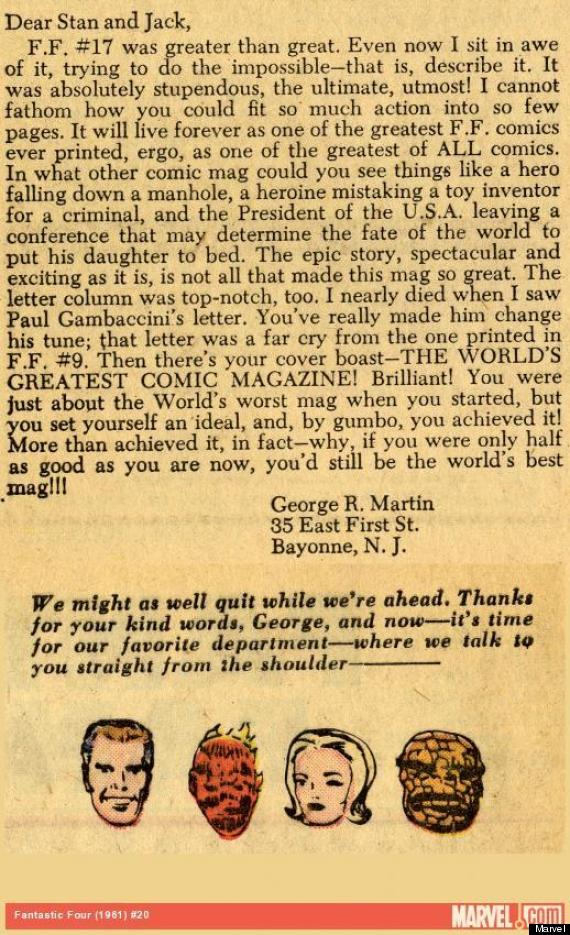
The letter above goes to show two things. George Raymond Richard Martin, otherwise known as George R.R. Martin, or simply as GRRM, had fantasy and writing in his blood from a young age. Decades before he wrote his fantasy novel series A Song of Ice and Fire, which HBO adapted intoGame of Thrones, a 15-year-old George R. Martin sent a fan letter to the now departed Stan Lee and Jack Kirby, the legendary creators of Spider-Man, the Hulk, Thor, the X‑Men and the Fantastic Four(called “F.F.” in the letter).
When you read the note, you can immediately tell that young Martin was steeped in sci-fi and fantasy literature. He could also string together some fairly complex sentences during his teenage years — sentences that many adults would struggle to write today. Above, you can watch Martin read his 1963 fan letter note, and Stan Lee’s short reply: “We might want to quit while we’re ahead. Thanks for your kind words, George.” We’re all surely glad that Lee and Kirby kept going.
If you would like to support the mission of Open Culture, consider making a donation to our site. It’s hard to rely 100% on ads, and your contributions will help us continue providing the best free cultural and educational materials to learners everywhere. You can contribute through PayPal, Patreon, and Venmo (@openculture). Thanks!
In the early United States, devout Christians who would impose their beliefs on others were in the minority among the country’s founders. Thomas Jefferson’s views on the subject are well-known. Much more conservative than Jefferson, fellow Virginian George Washington made frequent statements on religion as part of the essential texture of public life. But while Washington discussed religion as a communal affair with important social and political dimensions, like Jefferson he endorsed religious liberty and freedom of conscience and belief.
But the idea was usually taken to mean that “non-Christians were to be ‘tolerated’ for their beliefs” in a paternalist sense, “with the hope that ‘Jews, Turks, and Infidels” would become Christian.” Washington, however, declared:
It is now no more that toleration is spoken of, as if it was by the indulgence of one class of people, that another enjoyed the exercise of their inherent natural rights. For happily the Government of the United States, which gives to bigotry no sanction, to persecution no assistance requires only that they who live under its protection should demean themselves good citizens, in giving it on all occasions their effectual support.
These words come from Washington’s short 1790 letter to the “the Hebrew Congregation in Newport, Rhode Island,” the first in a series of letters written to citizens of Newport after he and then-secretary of state Jefferson made a visit. The address responds directly to a letter of welcome read to him on his arrival in the city by Moses Seixas, an official of the first Jewish congregation in Newport, which states:
Deprived as we heretofore have been of the invaluable rights of free Citizens, we now (with a deep sense of gratitude to the Almighty disposer of all events) behold a Government, erected by the Majesty of the People—a Government, which to bigotry gives no sanction, to persecution no assistance—but generously affording to All liberty of conscience, and immunities of Citizenship: deeming every one, of whatever Nation, tongue, or language, equal parts of the great governmental Machine….
As did many such proclamations, the document glosses the brutal contradiction of slavery, indigenous slaughter, and actual discrimination religious minorities faced. Nonetheless, the democratic principles Seixas outlined so accorded with Washington’s ideals that the first president repeated key phrases verbatim. This is no mere pandering. When Washington arrived in Newport in 1790, state legislatures were in the process of ratifying what was then the Third Amendment to the Constitution, which we know as the First, prohibiting the establishment of state religion and granting freedom of the press.
Arguments over religious liberty were fierce, and toleration had strict limits. In some states “the rights of minority groups such as Baptists, Presbyterians, Catholics and Quakers were restricted,” notes Touro. “In most states, non-Christians were denied the rights of full citizenship, such as holding public office. Even in religiously liberal Rhode Island, Jews were not allowed to vote.” While the First Amendment “did little to erase these injustices,” Washington’s letter set out ideal conditions in which the country’s “enlarged and liberal policy” granted “liberty of conscience and immunities of citizenship” to all.
That Washington would make such claims in Rhode Island bears particular significance given that the state is “most noted as the place where religious freedom was actually born,” writes former Ambassador and UN Delegate John Loeb. The colony’s 1663 charter “set forth the first political entity in the world to separate the church from the state.” Washington’s statement one hundred and twenty-seven years later “applied—and continues to apply—to every American,” Loeb argues, despite its specific address “to a small group of Jewish citizens.” But that specific address matters. It promised inclusion and protection to a community that had faced centuries of terror.
As historian Melvin Urofsky writes, the letter “to the Hebrew Congregation,” like many other such statements made by the founders, “is a treasure to the entire nation”—a nation that “recognized,” at least in words, “diversity for what it was, one of the country’s greatest assets, and took as its motto E Pluribus Unum—Out of Many, One. The separation of church and state, and with it the freedom of religion enshrined in the First Amendment to the Constitution, has made the United States a beacon of hope to oppressed peoples everywhere.”
The truth young idealistic lovers learn: relationships are messy and complicated—filled with disappointments, misunderstandings, betrayals great and small. They fall apart and sometimes cannot be put back together. It’s easy to grow cynical and bitter. Yet, as James Baldwin famously wrote, “you think your pain and your heartbreak are unprecedented in the history of the world, but then you read.” You read, that is, the life stories and letters of writers and artists who have experienced outsized romantic bliss and torment, and who somehow became more passionately alive the more they suffered.
When it comes to personal suffering, Frida Kahlo’s biography offers more than one person could seem to bear. Already disabled by polio at a young age, she found her life forever changed at 18 when a bus accident sent an iron rod through her body, fracturing multiple bones, including three vertebrae, piercing her stomach and uterus. Recalling the old Gregorian hymn, Kahlo’s friend Mexican writer Andrés Henestrosa remarked that she “lived dying”—in near constant pain, enduring surgery after surgery and frequent hospitalizations.
In the midst of this pain, she found love with her mentor and husband Diego Rivera—and, it must be said, with many others. Kahlo, writes Alexxa Gotthardt at Artsy, “was a prolific lover: Her list of romances stretched across decades, continents, and sexes. She was said to have been intimately involved with, among others, Marxist theorist Leon Trotsky, dancer Josephine Baker, and photographer Nickolas Muray. However, it was her obsessive, abiding relationship with fellow painter Diego Rivera—for whom she’d harbored a passionate crush since she laid eyes on him at age 15—that affected Kahlo most powerfully.”
Her letters to Rivera—himself a prolific extra-marital lover—stretch “across the twenty-seven-year span of their relationship,” writes Maria Popova; they “bespeak the profound and abiding connection the two shared, brimming with the seething cauldron of emotion with which all fully inhabited love is filled: elation, anguish, devotion, desire, longing, joy.”
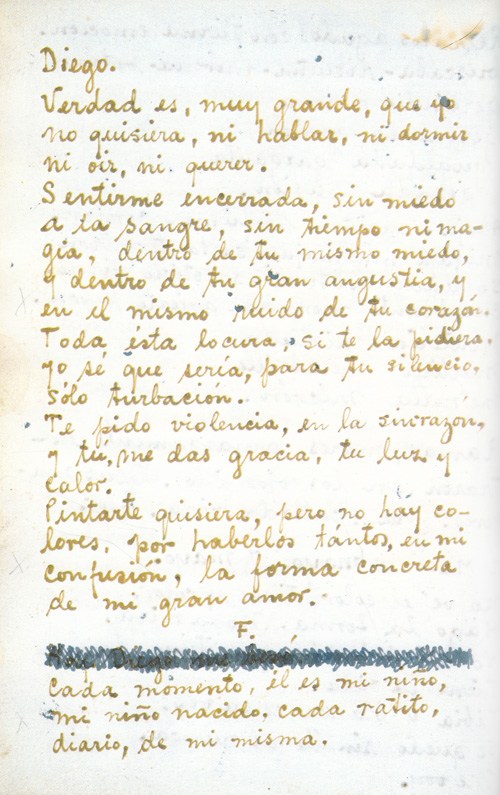
Diego.
Truth is, so great, that I wouldn’t like to speak, or sleep, or listen, or love. To feel myself trapped, with no fear of blood, outside time and magic, within your own fear, and your great anguish, and within the very beating of your heart. All this madness, if I asked it of you, I know, in your silence, there would be only confusion. I ask you for violence, in the nonsense, and you, you give me grace, your light and your warmth. I’d like to paint you, but there are no colors, because there are so many, in my confusion, the tangible form of my great love.
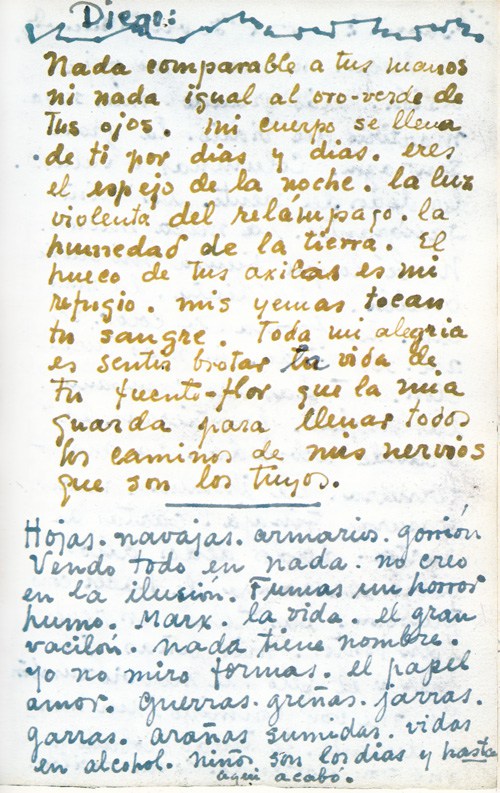
So begins the letter pictured at the top. In another, equally passionate and poetic letter, pictured further up, she writes:
Nothing compares to your hands, nothing like the green-gold of your eyes. My body is filled with you for days and days. you are the mirror of the night. the violent flash of lightning. the dampness of the earth. The hollow of your armpits is my shelter. my fingers touch your blood. All my joy is to feel life spring from your flower-fountain that mine keeps to fill all the paths of my nerves which are yours.
Kahlo and Rivera fell in love in 1928, when she asked him to look at her paintings. Over her mother’s objections, they married the following year. After ten tumultuous years, they divorced in 1939, then remarried in 1940 and stayed partnered until her death in 1954. Over these years, she poured out her emotions in letters, many, like those above, first written in her illustrated diary. Letters to and from her many lovers have also just emerged in a trove of personal artifacts, recently liberated from a bathroom at Casa Azul where they had been kept under lock and key at Rivera’s behest.
Both artists’ many affairs caused tremendous pain and “created rifts between them personally,” notes Katy Fallon at Broadly, although “their relationship has been mythologized past recognition,” in the way of so many other famous couples. In the most egregious betrayal, Rivera even slept with Kahlo’s younger sister Cristina, his favorite model, an act that inspired Frida’s 1937 painting Memory, the Heart, a self-portrait in which she stands with a metal rod piercing her chest, her hands seemingly amputated, face expressionless. We learn the wrong lessons from romanticizing “everything” about Frida and Diego’s life, Patti Smith suggests in her tribute to Kahlo’s love letters. But there is also danger in passing judgment.
“I don’t look at these two as models of behavior,” Smith says, but “the most important lesson… isn’t their indiscretions and love affairs but their devotion. Their identities were magnified by the other. They went through their ups and downs, parted, came back together, to the end of their lives.” In a 1935 letter to Rivera, read by pianist Mona Golabek above, Kahlo forgives his affairs, calling them “only flirtations…. At bottom, you and I love each other dearly, and thus go through adventures without numbers, beatings on doors, imprecations, insults, international claims. Yet, we will always love each other…. All the ranges I have gone through have served only to make me understand in the end that I love you more than my own skin.”
Take an innocuous statement like, “we should teach children about the life of Helen Keller.” What reasonable, compassionate person would disagree? Hers is a story of triumph over incredible adversity, of perseverance and friendship and love. Now, take a statement like, “we should teach children the political writing of Helen Keller,” and you might see brawls in town halls and school board meetings. This is because Helen Keller was a committed socialist and serious political thinker, who wrote extensively to advocate for economic cooperation over competition and to support the causes of working people. She was an activist for peace and justice who opposed war, imperialism, racism, and poverty, conditions that huge numbers of people seem devoted to maintaining—both in her lifetime and today.
Keller’s moving, persuasive writing is eloquent and uncompromising and should be taught alongside that of other great American rhetoricians. Consider, for example, the passage below from a letter she wrote in 1916 to Oswald Villard, then Vice-President of the NAACP:
Ashamed in my very soul I behold in my own beloved south-land the tears of those who are oppressed, those who must bring up their sons and daughters in bondage to be servants, because others have their fields and vineyards, and on the side of the oppressor is power. I feel with those suffering, toiling millions, I am thwarted with them. Every attempt to keep them down and crush their spirit is a betrayal of my faith that good is stronger than evil, and light stronger than darkness…. My spirit groans with all the deaf and blind of the world, I feel their chains chafing my limbs. I am disenfranchised with every wage-slave. I am overthrown, hurt, oppressed, beaten to the earth by the strong, ruthless ones who have taken away their inheritance. The wrongs of the poor endure ring fiercely in my soul, and I shall never rest until they are lifted into the light, and given their fair share in the blessings of life that God meant for us all alike.
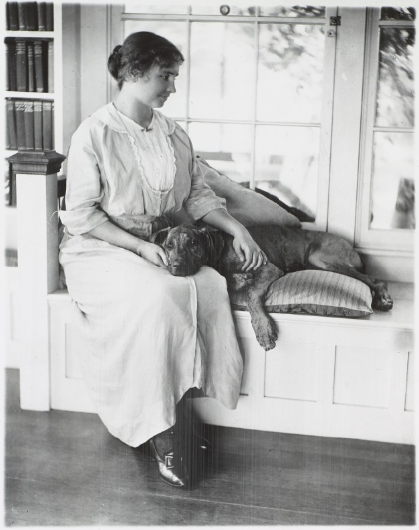
It is difficult to choose any one passage from the letter because the whole is written with such expressive feeling. This is but one document among many hundreds in the new Helen Keller archive at the American Foundation for the Blind (AFB), which has digitized letters, essays, speeches, photographs, and much more from Keller’s long, tireless career as a writer and public speaker. Funded by the National Endowment for the Humanities, the archive includes over 250,000 digital images of her work from the late 19th century to well into the 20th. There are many films of Keller, photos like that of her and her dog Sieglinde at the top, a collection of her correspondence with Mark Twain, and much more.
In addition to Keller’s own published and unpublished work, the archive contains many letters to and about her, press clippings, informative AFB blog posts, and resources for students and teachers. The site aims to be “fully accessible to audiences who are blind, deaf, hard-of-hearing, low vision, or deafblind.” On the whole, this project “presents an opportunity to encounter this renowned historical figure in a new, dynamic, and exciting way,” as AFB writes in a press release. “For example, despite her fame, relatively few people know that Helen Keller wrote 14 books as well as hundreds of essays and articles on a broad array of subjects ranging from animals and atomic energy to Mahatma Gandhi.”
And, of course, she was a lifelong advocate for the blind and deaf, writing and speaking out on disability rights issues for decades. Indeed, it’s difficult to find a subject in which she did not take an interest. The archive’s subject index shows her writing about games, sports, reading, shopping, swimming, travel, architecture and the arts, education, law, government, world religions, royalty, women’s suffrage, and more. There were many in her time who dismissed Keller’s unpopular views, calling her naïve and claiming that she had been duped by nefarious actors. The charge is insulting and false. Her body of work shows her to have been an extraordinarily well-read, wise, cosmopolitan, sensitive, self-aware, and honest critical thinker.
Two years after the NAACP letter, Keller wrote an essay called “Competition,” in which she made the case for “a better social order” against a central conceit of capitalism: that “life would not be worth while without the keen edge of competition,” and that without it “men would lose ambition, and the race would sink into dull sameness.” Keller advances her counterargument with vigorous and incisive reasoning.
This whole argument is a fallacy. Whatever is worth while in our civilization has survived in spite of competition. Under the competitive system the work of the world is badly done. The result is waste and ruin [….] Profit is the aim, and the public good is a secondary consideration. Competition sins against its own pet god efficiency. In spite of all the struggle, toil and fierce effort the result is a depressing state of destitution for the majority of mankind. Competition diverts man’s energies into useless channels and degrades his character. It is immoral as well as inefficient, since its commandment is “Thou shalt compete against thy neighbor.” Such a rule does not foster Truthfulness, honesty, consideration for others. [….] Competitors are indifferent to each other’s welfare. Indeed, they are glad of each other’s failure because they find their advantage in it. Compassion is deadened in them by the necessity they are under of nullifying the efforts of their fellow-competitors.
Keller refused to become cynical in the face of seemingly indefatigable greed, cruelty, and hypocrisy. Though not a member of a mainstream church (she belonged to the obscure Christian sect of Swedenborgianism), she exhorted American Christians to live up to their professions—to follow the example of their founder and the commandments of their sacred text. In an essay written after World War I, she argued movingly for disarmament and “the vital issue of world peace.” While making a number of logical arguments, Keller principally appeals to the common ethos of the nation’s dominant faith.
This is precisely where we have failed, calling ourselves Christians we have fundamentally broken, and taught others to break most patriotically, the commandment of the Lord, “Thou shalt not kill” [….] Let us then try out Christianity upon earth—not lip-service, but the teaching of Him who came upon earth that “all men might have life, and have it more abundantly.” War strikes at the very heart of this teaching.
We can hear Helen Keller’s voice speaking directly to us from the past, diagnosing the ills of her age that look so much like those of our own. “The mythological Helen Keller,” writes Keith Rosenthal, “has aptly been described as a sort of ‘plaster saint;’ a hollow, empty vessel who is little more than an apolitical symbol for perseverance and personal triumph.” Though she embodied those qualities, she also dedicated her entire life to careful observation of the world around her, to writing and speaking out on issues that mattered, and to caring deeply about the welfare of others. Get to know the real Helen Keller, in all her complexity, fierce intelligence, and ferocious compassion, at the American Foundation for the Blind’s exhaustive digital archive of her life and work.
An Indian guru travels to the West with teachings of enlightenment, world peace, and liberation from the soul-killing materialist grind. He attracts thousands of followers, some of them wealthy celebrities, and founds a commercial empire with his teachings. No, this isn’t the story of Bhagwan Shree Rajneesh, the head of the religious movement in Wild Wild Country. There was no miraculous city in the Oregon wilds or fleet of Learjets and Rolls Royces. No stockpile of automatic weapons, planned assassinations, or mass poisonings. Decades before those strange events, another teacher, Maharishi Mahesh Yogi inspired mass devotion among students around the world with the peaceful practice of Transcendental Meditation.
Rolling Stone’s Claire Hoffman—who grew up in a TM community—writes of the movement with ambivalence. For most of his disciples, he was a “Wizard of Oz-type character,” she says, distant and mysterious. But much of what we popularly know about TM comes from its most famous adherents, including Jerry Seinfeld, Katy Perry, David Lynch, the Beach Boys, and, of course, The Beatles, who famously traveled to India in 1968, meditated with Mia Farrow, Donovan, and Mike Love, and wrote some of their wildest, most inventive music after a creative slump following the huge success of Sgt. Pepper’s.
“They stayed in Rishikesh,” writes Maria Popova at Brain Pickings, “a small village in the foothills of the Himalayas, considered the capital of yoga. Immersed in this peaceful community and nurtured by an intensive daily meditation practice, the Fab Four underwent a creative growth spurt—the weeks at Rishikesh were among their most fertile songwriting and composing periods, producing many of the songs on The White Album and Abbey Road.” Unlike most of the Maharishi’s followers, The Beatles got a personal audience. The Indian spiritual teacher “helped them through the shock” of their manager Brian Epstein’s death, and helped them tap into cosmic consciousness without LSD.
They left on a sour note—there were allegations of impropriety, and Lennon, being Lennon, got a bit nasty, originally writing The White Album’s “Sexy Sadie” with the lyrics “Maharishi—what have you done? You made a fool of everyone.” But before their falling out with TM’s founder, before even the trip to India, all four Beatles became devoted meditators, sitting for two twenty-minute sessions a day and finding genuine peace and happiness—or “energy,” as Lennon and Harrison describe it in a 1967 interview with David Frost. The next year, happily practicing, and feverishly writing, in India, Lennon received letters from fans, and responded with enthusiasm.
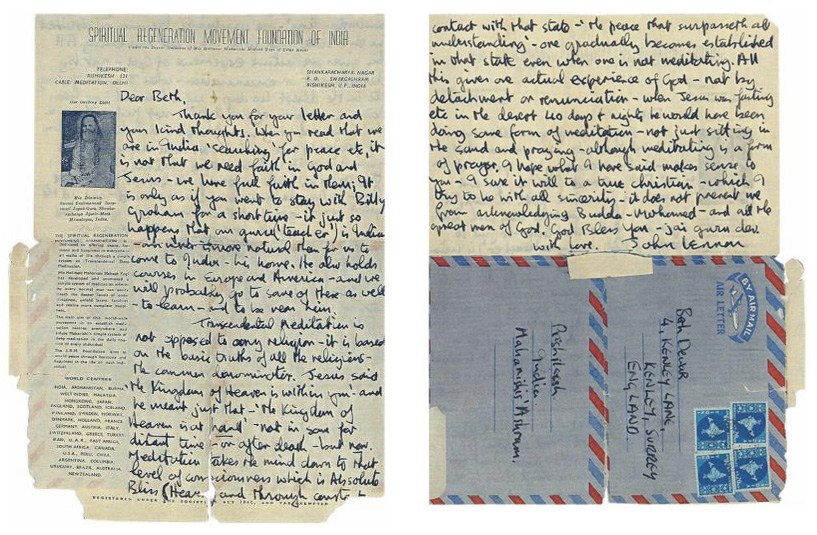
In answer to a letter from a fan named Beth, evidently a devout Christian and apparently threatened by TM and concerned for the bands’ immortal souls, Lennon wrote the following (see his handwritten reply at the top):
Dear Beth:
Thank you for your letter and your kind thoughts. When you read that we are in India searching for peace, etc, it is not that we need faith in God or Jesus — we have full faith in them; it is only as if you went to stay with Billy Graham for a short time — it just so happens that our guru (teacher) is Indian — and what is more natural for us to come to India — his home. He also holds courses in Europe and America — and we will probably go to some of these as well — to learn — and to be near him.
Transcendental meditation is not opposed to any religion — it is based on the basic truths of all religions — the common denominator. Jesus said: “The Kingdom of Heaven is within you” — and he meant just that — “The Kingdom of Heaven is at hand” — not in some far distant time — or after death — but now.
Meditation takes the mind down to that level of consciousness which is Absolute Bliss (Heaven) and through constant contact with that state — “the peace that surpasses all understanding” — one gradually becomes established in that state even when one is not meditating. All this gives one actual experience of God — not by detachment or renunciation — when Jesus was fasting etc in the desert 40 days & nights he would have been doing some form of meditation — not just sitting in the sand and praying — although me it will be a true Christian — which I try to be with all sincerity — it does not prevent me from acknowledging Buddha — Mohammed — and all the great men of God. God bless you — jai guru dev.
With love,
John Lennon
This hardly sounds like the man who imagined no religion. A fan in India wrote Lennon less to inquire and more to acquire, namely money for a trip around the world so that he could “discover the ‘huge treasure’ necessary for achieving inner peace.” Lennon responded with a brief rebuke of the man’s material aspirations, then recommended TM, “through which all things are possible.” (He signs both letters with “jai guru dev,” or “I give thanks to the Guru Dev,” the Maharishi’s teacher. The phrase also appears as the refrain in his “Across the Universe.”)
The letters come from an excellent collection of his correspondence, The John Lennon Letters, which includes other missives extolling the virtues of transcendental meditation. We might take his word for it based on the strength of the creative work he produced during the period. We could also take the word of David Lynch, who describes meditation as the way he catches the creative “big fish.” Or we could go out and find our own methods for expanding our minds and tapping into creative potential.
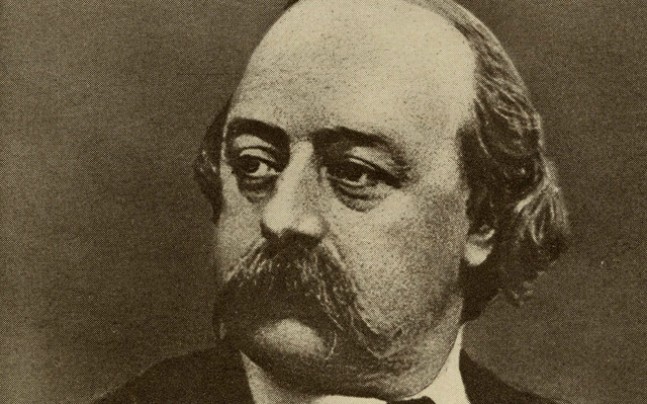
We are what we do — or in other words, we are what we choose to spend our time doing. By this logic, a “musician” who spends one quarter of his time with his instruments and three quarters with Excel, though he counts as no less a human being for it, should by rights call himself a maker of spreadsheets rather than a maker of music. This view may sound stark, but it has its adherents, some of them successful and respected artists. We can rest assured that no less a creator than Gustave Flaubert, for instance, would surely have accepted it, if we take seriously the words of a letter he wrote to his mother in February of 1850.
Though he’d completed several books at the time, the then 28-year-old Flaubert had yet to make it as a man of letters. He did, however, do a fair bit of traveling at that time in his life, composing this particular piece of correspondence during a sojourn in the Middle East. It seems that even halfway across the world, he couldn’t escape his mother’s entreaties to find proper employment, if only “un petite place” that would grant him slightly more social respectability and financial stability. Finally fed up, he clarified his position on the matter of day jobs once and for all:
Now I come to something that you seem to enjoy reverting to and that I utterly fail to understand. You are never at a loss of things to torment yourself about. What is the sense of this: that I must have a job — “a small job,” you say. First of all, what job? I defy you to find me one, to specify in what field, or what it would be like. Frankly, and without deluding yourself, is there a single one that I am capable of filling? You add: “One that wouldn’t take up much of your time and wouldn’t prevent you from doing other things.” There’s the delusion! That’s what Bouilhet told himself when he took up medicine, what I told myself when I began law, which nearly brought about my death from suppressed rage. When one does something, one must do it wholly and well. Those bastard existences where you sell suet all day and write poetry at night are made for mediocre minds — like those horses equally good for saddle and carriage — the worst kind, that can neither jump a ditch nor pull a plow.
In short, it seems to me that one takes a job for money, for honors, or as an escape from idleness. Now you’ll grant me, darling, (1) that I keep busy enough not to have to go out looking for something to do; and (2) if it’s a question of honors, my vanity is such that I’m incapable of feeling myself honored by anything: a position, however high it might be (and that isn’t the kind you speak of) will never give me the satisfaction that I derive from my self-respect when I have accomplished something well in my own way; and finally, if it’s for money, any jobs or job that I could have would bring in too little to make much difference to my income. Weigh all these considerations: don’t knock your head against a hollow idea. Is there any position in which I’d be closer to you, more yours? And isn’t not to be bored one of the principal goals of life?
The letter may well have convinced her: according to a footnote included in The Letters of Gustave Flaubert: 1830–1857, “there seem to have been no further suggestions” that he secure a steady paycheck. Could Flaubert’s mother have had an inkling that her son would become, well, Flaubert? At that point he hadn’t even begun writing Madame Bovary, a project that would begin upon his return to France. Its inspiration came in part from the early version of The Temptation of Saint Anthony he’d completed before embarking on his travels, which his friends Maxime Du Camp and Louis Bouilhet (the reluctant medical student mentioned in the letter) suggested he toss in the fire, telling him to write about the stuff of everyday life instead.
Not all of us, of course, can work the same way Flaubert did, with his days spent in revision of each page and his obsessive lifelong hunt for le mot juste: not for nothing do we call him “the martyr of style.” But whatever we create and however we create it, we ignore the words Flaubert wrote to his mother at our peril. The earning of money has its place, but the idea that any old day job can be easily held down without damage to our real life’s work shades all too easily into self-delusion. We must remember that “when one does something, one must do it wholly and well,” a sentiment made infinitely more powerful by the fact that Flaubert didn’t just articulate it, he lived it — and now occupies one of the highest places in the pantheon of the novel as a result.
Based in Seoul, Colin Marshall writes and broadcasts on cities and culture. His projects include the book The Stateless City: a Walk through 21st-Century Los Angeles and the video series The City in Cinema. Follow him on Twitter at @colinmarshall or on Facebook.
Be not inhospitable to strangers, lest they be angels in disguise.
More than a few visitors to Paris’ fabled Shakespeare & Company bookshop assume that the quote they see painted over an archway is attributable to Yeats or Shakespeare.
In fact, its author was George Whitman, the store’s late owner, a grand “hobo adventurer” in his 20s who made such an impression that he spent the rest of his life welcoming travelers and encouraging young writers, who flocked to the shop. A great many became Tumbleweeds, the nickname given to those who traded a few hours of volunteer work and a pledge to read a book a day in return for spartan accommodation in the store itself.
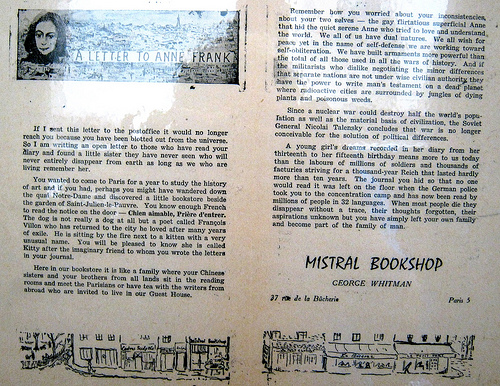
In light of this generosity, Whitman’s 1960 letter to Anne Frank (1929–1945) is all the more moving.
One wonders what inspired him to write it. It’s a not an uncommon impulse, but usually the authors are students close to the same age as Anne was at the time of her death.
Perhaps it was an interaction with a Tumbleweed.
He refrained from mentioning his own service in World War II, possibly because he was posted to a remote weather station in Greenland. Unlike other American veterans, he hadn’t witnessed with his own eyes the sort of hell she endured. If he had, he might not have been able to address her with such initial lightness of tone.
One can’t help but think how delighted the rambunctious young teen would have been by his sense of humor, his descriptions of his bohemian booklovers’ paradise—then called Le Mistral—and references to his dog, François Villon, and cat, Kitty, named in honor of Anne’s pet name for her diary.
His profound observations on the impermanence of life and the politics of war continue to resonate deeply with those who read the letter as its intended recipients’ proxies:
Le Mistral
37 rue de la Bûcherie
Dear Anne Frank,
If I sent this letter to the post office it would no longer reach you because you have been blotted out from the universe. So I am writing an open letter to those who have read your diary and found a little sister they have never seen who will never entirely disappear from earth as long as we who are living remember her.
You wanted to come to Paris for a year to study the history of art and if you had, perhaps you might have wandered down the quai Notre-Dame and discovered a little bookstore beside the garden of Saint-Julien-le-Pauvre. You know enough French to read the notice on the door—Chien aimable, Priere d’entrer. The dog is not really a dog at all but a poet called Francois Villon who has returned to the city he loved after many years of exile. He is sitting by the fire next to a kitten with a very unusual name. You will be pleased to know she is called Kitty after the imaginary friend to whom you wrote the letters in your journal.
Here in our bookstore it is like a family where your Chinese sisters and your brothers from all lands sit in the reading rooms and meet the Parisians or have tea with the writers from abroad who are invited to live in our Guest House.
Remember how you worried about your inconsistencies, about your two selves—the gay flirtatious superficial Anne that hid the quiet serene Anne who tried to love and understand the world. We all of us have dual natures. We all wish for peace, yet in the name of self-defense we are working toward self-obliteration. We have built armaments more powerful than the total of all those used in all the wars in history. And if the militarists who dislike negotiating the minor differences that separate nations are not under the wise civilian authority they have the power to write man’s testament on a dead planet where radioactive cities are surrounded by jungles of dying plants and poisonous weeds.
Since a nuclear could destroy half the world’s population as well as the material basis of civilization, the Soviet General Nikolai Talensky concludes that war is no longer conceivable for the solution of political differences.
A young girl’s dreams recorded in her diary from her thirteenth to her fifteenth birthday means more to us today than the labors of millions of soldiers and thousands of factories striving for a thousand-year Reich that lasted hardly more than ten years. The journal you hid so that no one would read it was left on the floor when the German police took you to the concentration camp and has now been read by millions of people in 32 languages. When most people die they disappear without a trace, their thoughts forgotten, their aspirations unknown, but you have simply left your own family and become part of the family of man.
We're hoping to rely on loyal readers, rather than erratic ads. Please click the Donate button and support Open Culture. You can use Paypal, Venmo, Patreon, even Crypto! We thank you!
Open Culture scours the web for the best educational media. We find the free courses and audio books you need, the language lessons & educational videos you want, and plenty of enlightenment in between.