Henry David Thoreau has at times been upbraided by critics for “everyone’s favorite incriminating biographical factoid,” writes Donovan Hohn at The New Republic: “During the two years he spent at Walden Pond, his mother sometimes did his laundry.” The author who became “America’s original nature boy “played at rugged self-sufficiency,” it is said, “while squatting on borrowed land, in a house built with a borrowed axe”; he played at rugged individualism while relying on friends and family to support him.
Who did Erik Grankvist’s laundry, we might wonder, while he built a log cabin alone during the year he recorded in the edited video above? Grankvist shows how, at 18, he “ventured out alone with only a backpack full of simple hand tools to actualize my dream… [to] build my own traditional off grid log cabin by hand from the materials of the Swedish wilderness. Just like our Forefathers did.” You may notice, or not, the cleanliness of Grankvist’s clothing. You may wonder, “who washed his forefathers’ clothes?”…
Or, you might say, “this isn’t a video about laundry but about building a log cabin!” And you would be correct. As an experiment in building a log cabin from scratch with (mostly) just a few hand tools, it is an extraordinary document: “I had no previous experience in building, gathering materials or filming,” Grankvist writes. “So I started studying myself the old arts and learning from my grandfather and mentor Åke Nilsson. I began to cut down trees and film with my phone, learning as I go.”
The project really picked up steam once Grankvist graduated high school, he writes, suggesting he did not actually live full time in the woods but that someone fed, housed, and clothed him while he worked. We see none of this in the video. We do see a tractor at one point, and Grankvist admits he’d rather the modern extravagance have been a horse.
Does it ruin the magic a little to wonder about the mundane details of the builder’s life — food, clothing, healthcare, etc. — while watching him cut his own timber, clear the land, build a stone foundation and, on top of it, a rustic little cabin? Maybe a little. But as extraordinary as it is to watch an 18-year-old Swede build a log cabin by himself, one also can’t help but remember it takes a village worth of forefathers, and mothers, to make an 18-year-old Swede. But Grankvist does not present his visual Walden as a how-to guide (any more than Thoreau did), but as his own statement of independence, one worth making even if it doesn’t tell the full truth about self-sufficiency.
We subscribe to the theory that art saves lives even in the best of times.
In the midst of a major public health crisis, art takes a front line position, communicating best practices to citizens with eye catching, easy to understand graphics and a few well chosen words.
In March of 2020, less than 2 weeks after COVID-19 brought New York to its knees, Angelina Lippert, the Chief Curator of Poster House, one of the city’s newer museums shared a blog post, considering the ways in which the CDC’s basic hygiene recommendations for helping stop the spread had been touted to previous generations.
As she noted in a lecture on the history of the poster as Public Service Announcement the following month, “mass public health action… is how we stopped tuberculosis, polio, and other major diseases that we don’t even think of today:”
And a major part of eradicating them was educating the public. That’s really what PSAs are—a means of informing and teaching the public en masse. It goes back to that idea … of not having to seek out information, but just being presented with it. Keeping the barrier for entry low means more people will see and absorb the information.
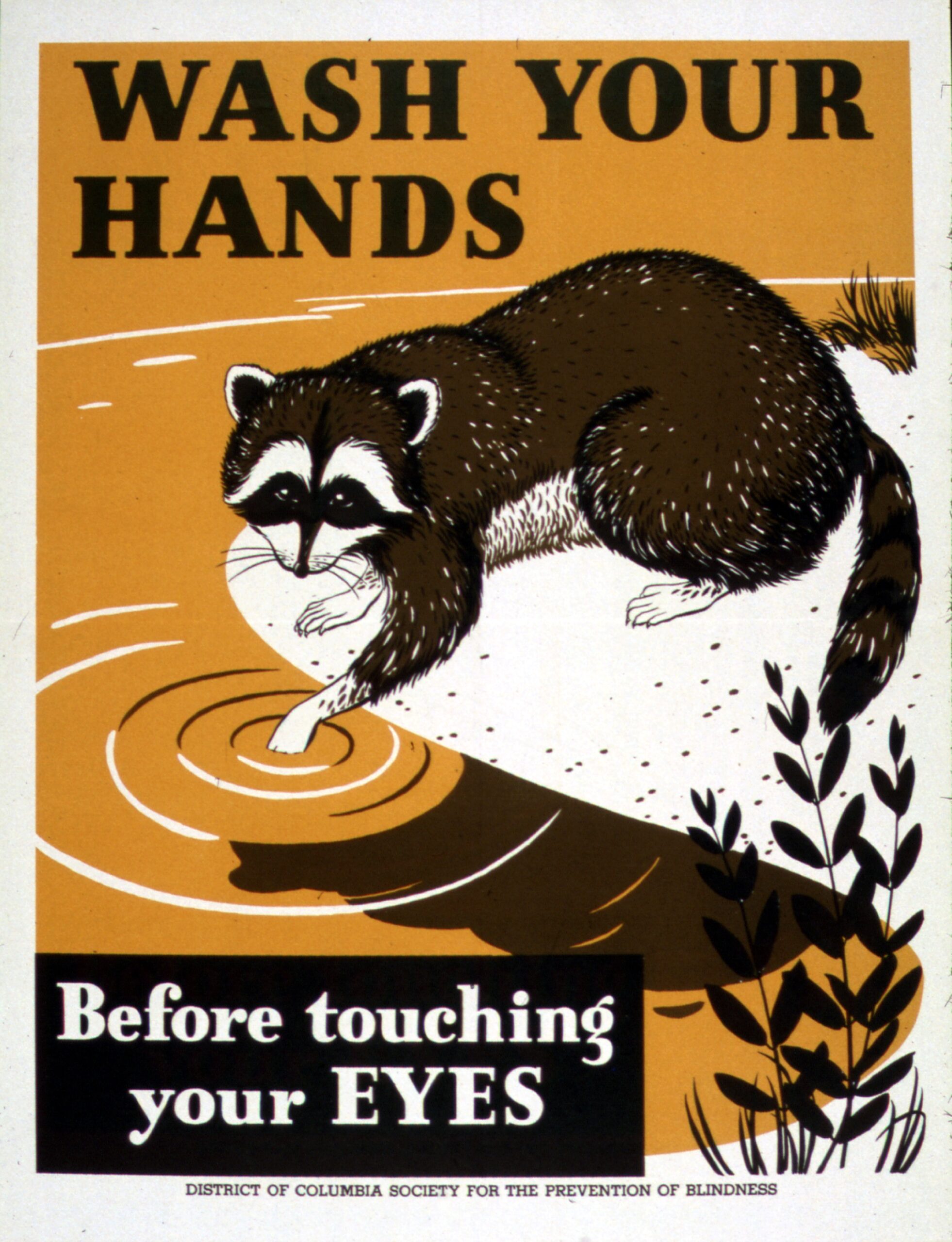
The Office of War Information and the District of Columbia Society for the Prevention of Blindness used an approachable looking raccoon to convince the public to wash hands in WWII.
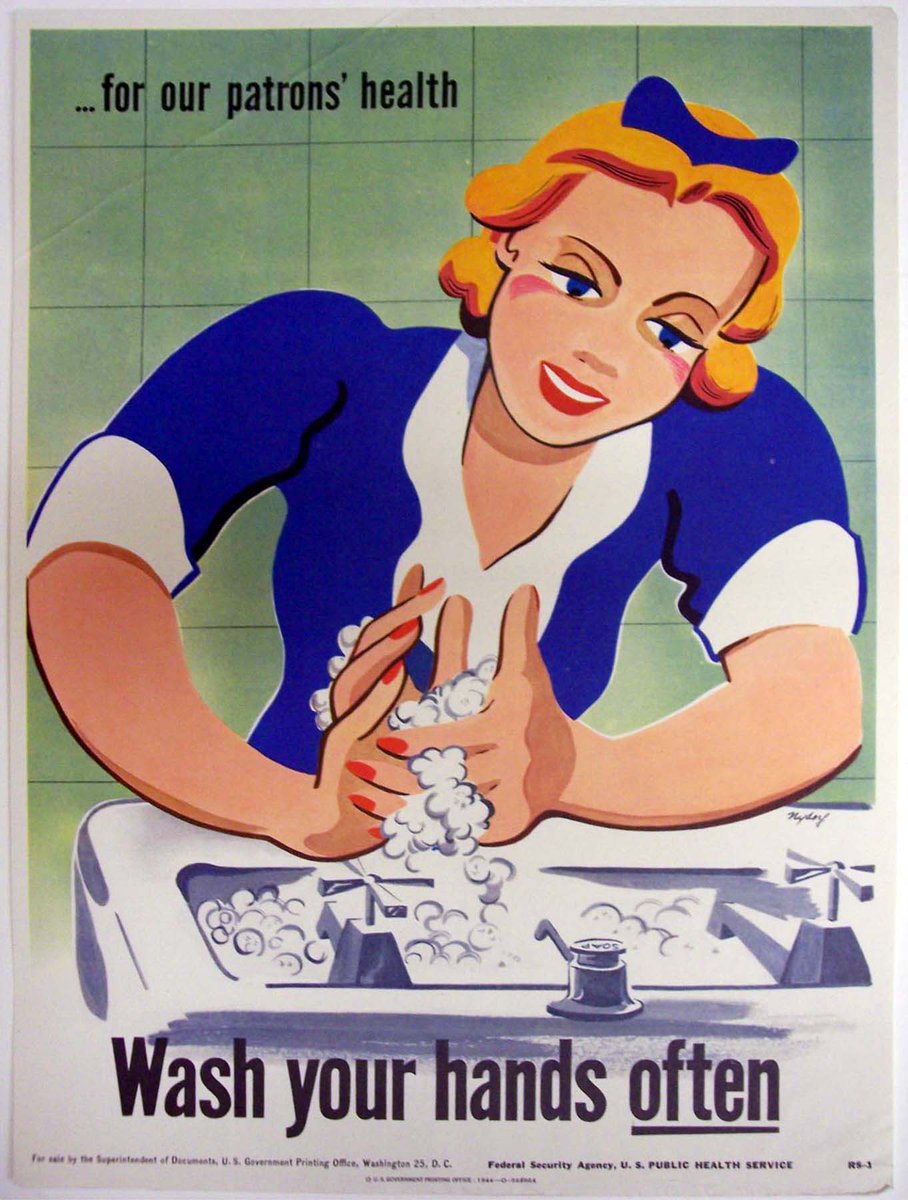
Artist Seymour Nydorf swapped the raccoon for a blonde waitress with glamorous red nails in a series of six posters for the U.S. Public Health Service of the Federal Security Agency
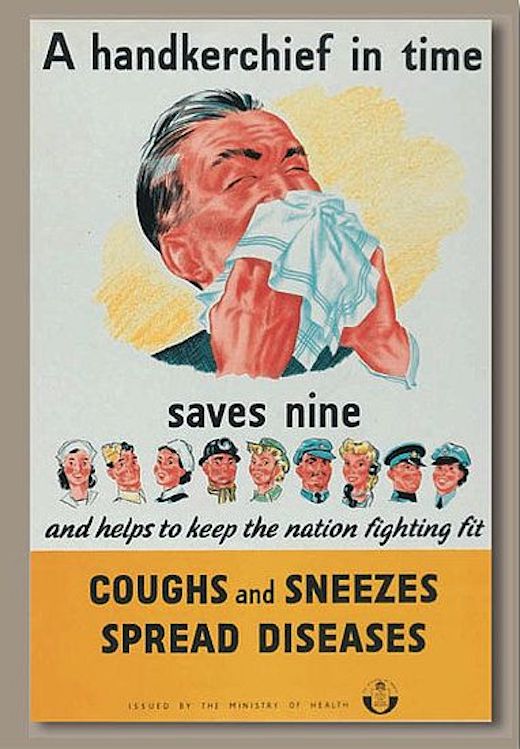
Coughing and sneezing took posters into somewhat grosser terrain.
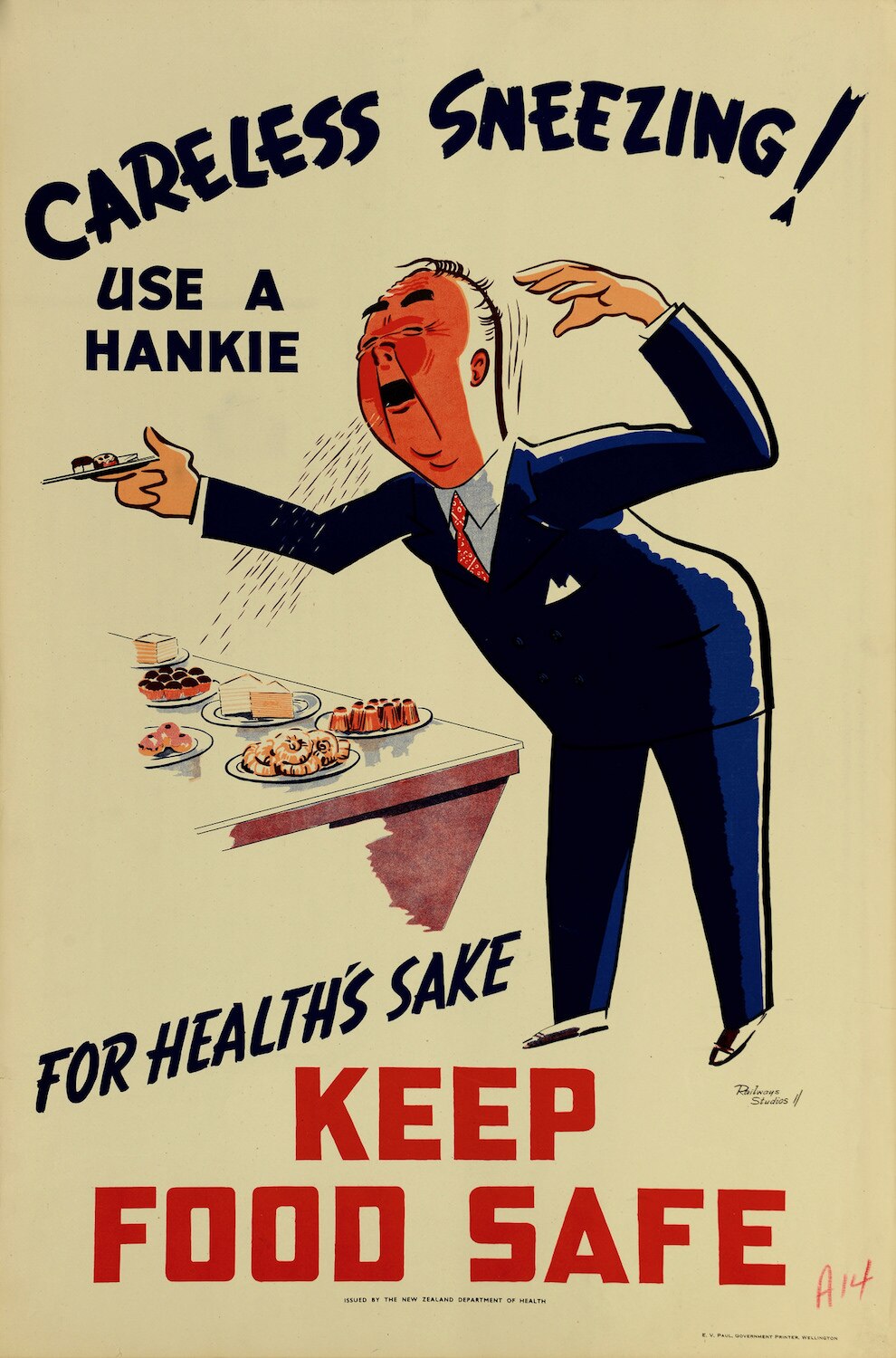
The New Zealand Department of Health’s 50s era poster shamed careless sneezers into using a hankie, and might well have given those in their vicinity a persuasive reason to bypass the buffet table.
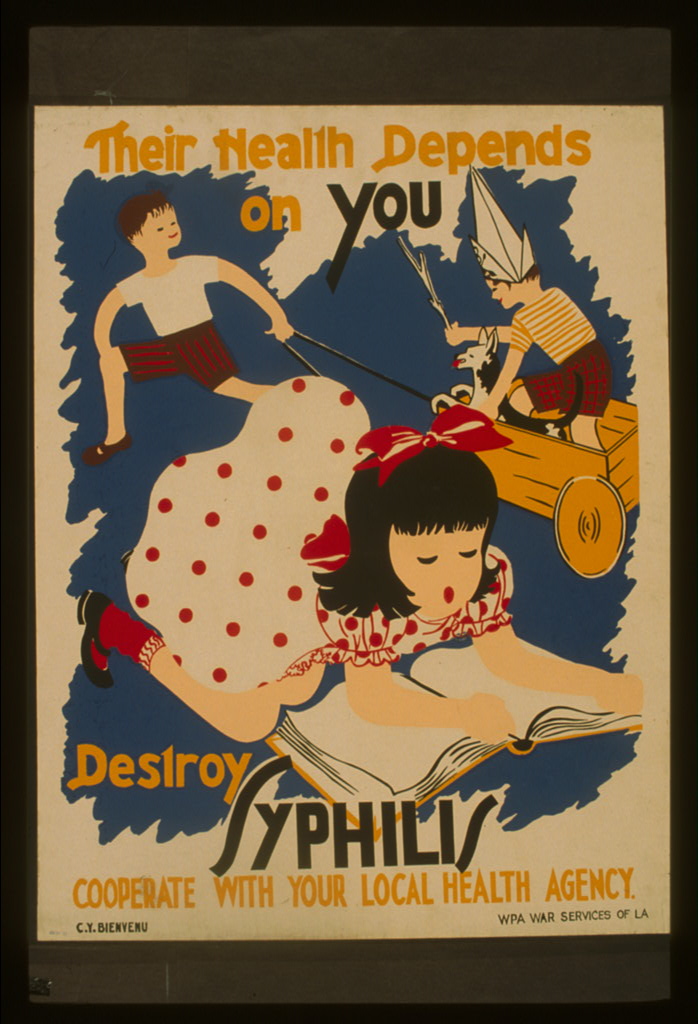
Children’s wellbeing can be a very persuasive tool. The WPA Federal Art Project was not playing in 1941 when it paired an image of a cherubic tot with stern warnings to parents and other family members to curb their affectionate impulses, as well as the transmission of tuberculosis.
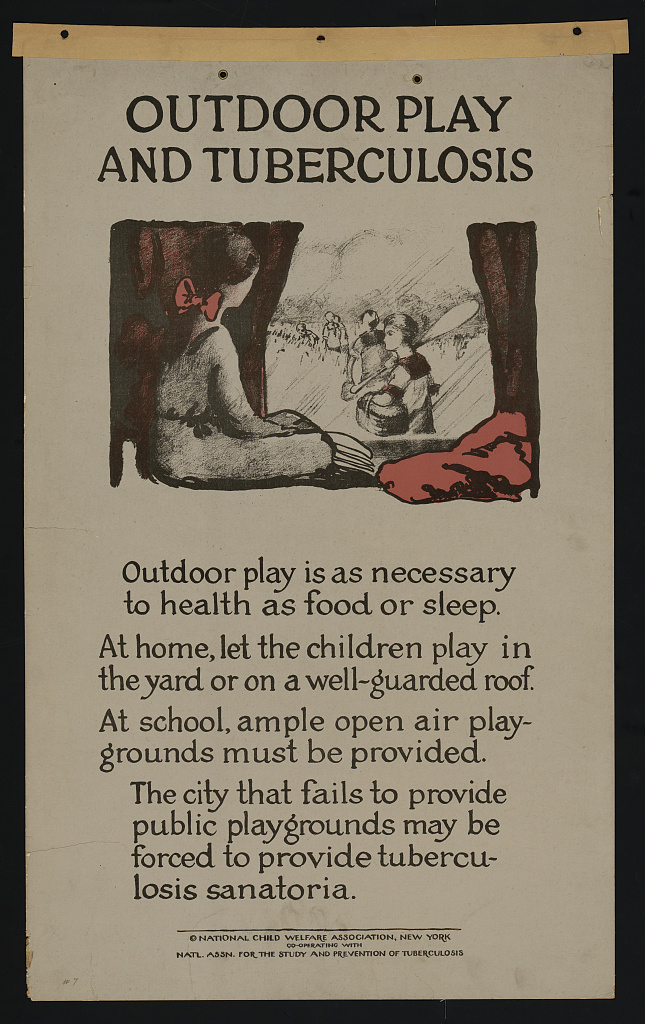
The arresting image packs more of a wallop than this earnest and far wordier, early 20s poster by the National Child Welfare Association and the National Association for the Study and Prevention of Tuberculosis.
Read Poster House Chief Curator Angelina Lippert’s Brief History of PSA Posters here.
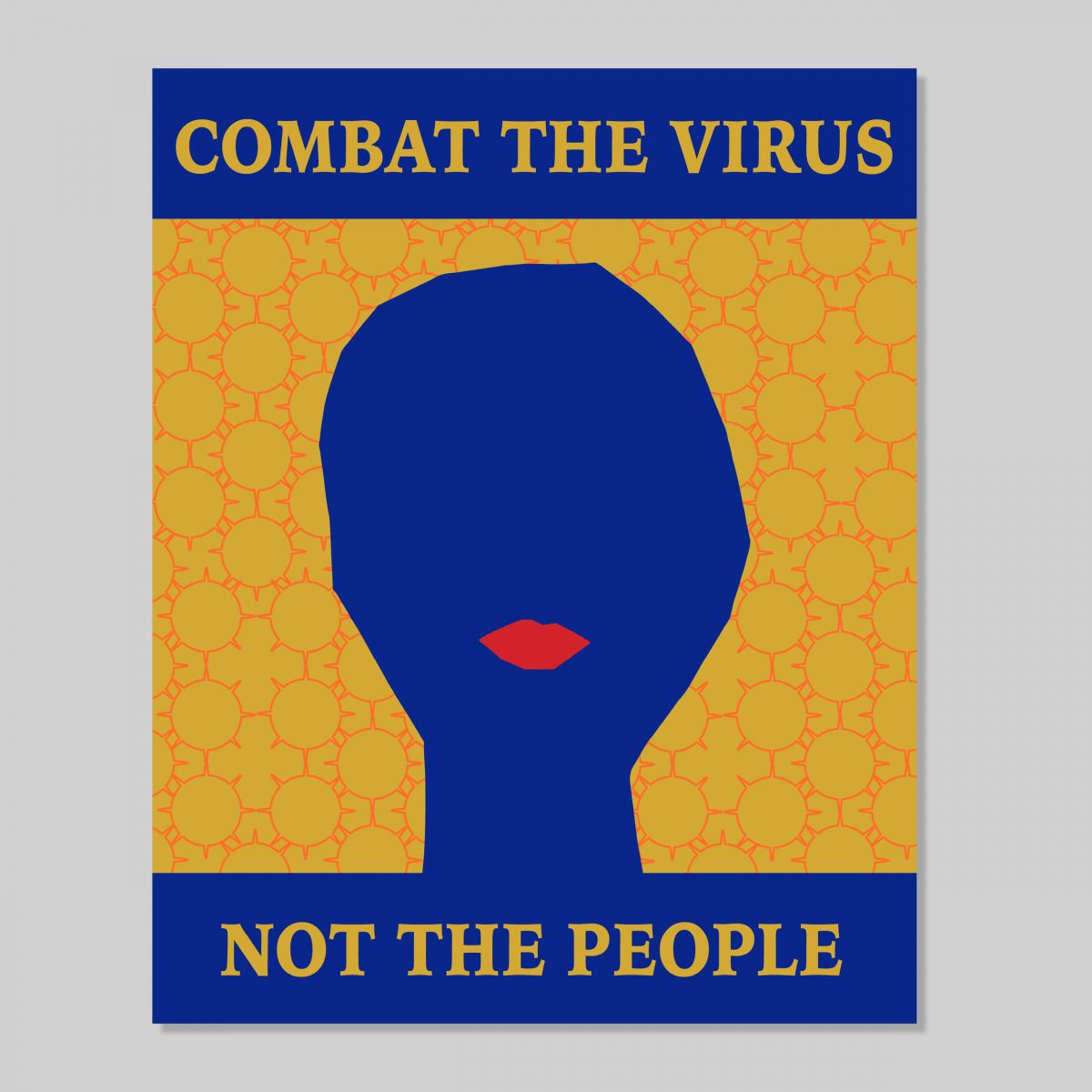
Download the free anti-xenophobia PSAs Poster House commissioned from designer Rachel Gingrich early in the pandemic here.
Here’s the context to a sobering newly-released video from The New York Times:
In the video above, Alexander Stockton, a producer on the Opinion Video team, explores two of the main reasons the number of Covid cases is soaring once again in the United States: vaccine hesitancy and refusal.
“It’s hard to watch the pandemic drag on as Americans refuse the vaccine in the name of freedom,” he says.
Seeking understanding, Mr. Stockton travels to Mountain Home, Ark., in the Ozarks, a region with galloping contagion and — not unrelated — abysmal vaccination rates.
He finds that a range of feelings and beliefs underpins the low rates — including fear, skepticism and a libertarian strain of defiance.
This doubt even extends to the staff at a regional hospital, where about half of the medical personnel are not vaccinated — even while the intensive care unit is crowded with unvaccinated Covid patients fighting for their lives.
Mountain Home — like the United States as a whole — is caught in a tug of war between private liberty and public health. But Mr. Stockton suggests that unless government upholds its duty to protect Americans, keeping the common good in mind, this may be a battle with no end.
In need of someone to perform surgery in a combat zone, you probably wouldn’t choose Alan Alda, no matter how many times you’ve seen him do it on television. This sounds obvious to those of us who believe that actors don’t know how to do anything at all. But a performer like Alda doesn’t become a cultural icon by accident: his particular skill set has enabled him not just to communicate with millions at a time through film and television, but also to navigate his offscreen and personal life with a certain adeptness. In the Big Think video above, he reveals three of his own long-relied-upon strategies to “express your thoughts so that everyone will understand you.”
“I don’t really like tips,” Alda declares. Standard public-speaking advice holds that you should “vary the pace of your speech, vary the volume,” for example, but while sound in themselves, those strategies executed mechanically get to be “kind of boring.” Rather than operating according to a fixed playbook, as Alda sees it, your variations in pace and volume — or your gestures, movements around the stage, and everything else — should occur organically, as a product of “how you’re talking and relating” to your audience. A skilled speaker doesn’t follow rules per se, but gauges and responds dynamically to the listener’s understanding even as he speaks.
But if pressed, Alda can provide three tips “that I do kind of follow.” These he calls “the three rules of three”: first, “I try only to say three important things when I talk to people”; second, “If I have a difficult thing to understand, if there’s something I think is not going to be easy to get, I try to say it in three different ways”; third, ” I try to say it three times through the talk.” He gets deeper into his personal theories of communication in the second video below, beginning with a slightly contrarian defense of jargon: “When people in the same profession have a word that stands for five pages of written knowledge, why say five pages of stuff when you can say one word?” The trouble comes when words get so specialized that they hinder communication between people of different professions.
At its worst, jargon becomes a tool of dominance: “I’m smart; I talk like this,” its users imply, “You can’t really talk like this, so you’re not as smart as me.” But when we actively simplify our language to communicate to the broadest possible audience, we can discover “what are the concepts that really matter” beneath the jargon. All the better if we can tell a dramatic story to illustrate our point, as Alda does at the end of the video. It involves a medical student conveying a patient’s diagnosis more effectively than his supervisor, all thanks to his experience with the kind of “mirroring” exercises familiar to every student of acting. A doctor who can communicate is always preferable to one who can’t; even a real-life Hawkeye, after all, needs to make himself understood once in a while.
Based in Seoul, Colin Marshall writes and broadcasts on cities, language, and culture. His projects include the Substack newsletterBooks on Cities, the book The Stateless City: a Walk through 21st-Century Los Angeles and the video series The City in Cinema. Follow him on Twitter at @colinmarshall or on Facebook.
Anyone who’s taken the train into the city from Bushwick or Williamsburg two or three times, you should be able to chant along with no trouble.
“Mind the gap!” is a sentimental favorite of both native Londoners and first time visitors navigating The Tube with freshly purchased Oyster Cards.
Civil engineer Ted Green has been documenting the mass transit sounds that cue passengers that the subway doors are about to close since 2004, when he logged 26 seconds on the Piccadilly Line in London’s Russell Square Station:
In 2003 I used the Russell Square station daily for a week and it’s the first announcement that caught my attention… Back then the Piccadilly Line did not have on-train station and door closing announcements, it had the beeps, but the stations in central London had automatic announcements from platform speakers aimed at the open train door. Once the Piccadilly Line received on-train announcements a few years later, this announcement was phased out.
Over the course of a decade, the project has expanded to encompass announcements on suburban rail, railways, trams, and light rail.
His travels have taken him to Asia, Australia, Europe, and North America, where curiosity compels him to document what happens during “dwell time,” the brief period when a train is disgorging some riders and taking on others.
Whether the canned recording is verbal or non-verbal, the intent is to keep things moving smoothly, and prevent injuries, though passengers can become blasé, attempting to force their way on or off by thrusting a limb between closing doors at the absolute last minute.
Green’s incredibly popular video compilations aren’t nearly so harrowing.
I think the appeal is the simplicity. You wonder, how can there be so many different variations of beeps? And then you listen, and they’re all so different.
The pandemic only increased his audience, as locked down commuters found themselves longing for the soundtrack of normal life.
And Brooklyn-based Metropolitan Transit Authority worker Fred Argoff’s zine Watch the Closing Doors ushered civilians behind the scenes, sometimes exploring other cities’ subway systems or, in the case of Cincinnati, lack thereof.
Readers, do you have a fondness for a particular underground sound? Tell us what and why in the comments.
As Chris Hedges discovered as a battle-hardened reporter, war is a force that gives us meaning. Whether we sublimate violence in entertainment, have paid professionals and state agents do it for us, or carry it out ourselves, human beings cannot seem to give up their most ancient vice; “we demonize the enemy,” Hedges wrote, “so that our opponent is no longer human,” and “we view ourselves, our people, as the embodiment of absolute goodness…. Each side reduces the other to objects — eventually in the form of corpses.” Each new generation inherits old hatreds, and so forth.…
Maybe one way to break cycles of violence is with controlled violence — using bare fists to settle scores, and walking away with only bruises, a little hurt pride, but no lasting wounds? That’s the idea behind Takanakuy, an Andean festival that takes place each year at Christmas in the province of Chumbivilcas, in the mountains of Peru. The region has a police force made up of around three officers, the nearest courthouse is “a stomach-wrecking 10-hour drive through the mountains,” notes Vice, who bring us the video above. Potentially explosive disputes naturally arise, and must be settled outside the law.
Rather than rely on state intervention, residents wait to slug it out on Takanakuy. The name of the festival come from Quechua — the region’s indigenous language — and means “to hit each other” or, more idiomatically, “when the blood is boiling.” But combatants have had upwards of twelve months to cool before they step into a ring of cheering spectators and go hand-to-hand with an opponent. Fights are also officiated by referees, who do crowd control with short rope whips and call a fight as soon as someone goes down. Takanakuy is ritualized combat, not bloodsport. Although traditionally dominated by men, women, and children also participate in fights, which usually only last a couple minutes or so.
“Some traditionalists disapprove of female participation in Takanakuy,” writes photojournalist Mike Kai Chen at The New York Times, but “an increasing number of women in Chumbivilcas are defying convention and stepping up to fight in front of their community.” Male fighters wear boots, flashy leather chaps, and elaborate, hand-sewn masks with taxidermied birds on top. Women wear elegant dresses with fine embroidery, and wrap their wrists in colorful embroidered cloth. “The ultimate aim is to begin the new year in peace. For this reason every fight… begins and ends with a hug”… or, at the very least, a handshake.
The festival also involves much dancing, eating, drinking, craft sales, and Christmas celebrations. Suemedha Sood at BBC Travel compares Takanakuy to Seinfeld’s “Festivus,” the alt-winter holiday for the airing of grievances and feats of strength. But it’s no joke. “The festival seeks to resolve conflict, strengthen community bonds and hopefully, arrive at a greater peace.” Libertarian economists Edwar Escalante and Raymond March frame Takanakuy as “a credible mechanism of law enforcement in an orderly fashion with social acceptance.” For indigenous teacher and author and participant Victor Laime Mantilla, it’s something more, part of “the fight to reclaim the rights of indigenous people.”
“In the cities,” says Mantilla, “the Chumbivilcas are still seen as a savage culture.” But they have kept the peace amongst themselves with no need for Peruvian authorities, fusing an indigenous music called Huaylia with other traditions that date back even before the Incas. Takanakuy arose as a response to systems of colonial oppression. When “justice in Chumbivilcas was solely administered by powerful people,” Mantilla says, “people from the community always lost their case. What can I do with a justice like that? I’d rather have my own justice in public.”
Before it set itself on fire, HBO’s Game of Thrones resonated deeply with contemporary morality, becoming the most meme-worthy of shows, for good or ill, online. Few scenes in the show’s run — perhaps not even the Red Wedding or the nauseating finale — elicited as much gut-level reaction as Cersei Lannister’s naked walk of shame in the Season 5 finale, a scene all the more resonant as it happened to be based on real events.
In 1483, one of King Edward IV’s many mistresses, Jane Shore, was marched through London’s streets by his brother Richard III, “while crowds of people watched, yelling and shaming her. She wasn’t totally naked,” notes Mental Floss, “but by the standards of the day, she might as well have been,” wearing nothing but a kirtle, a “thin shift of linen meant to be worn only as an undergarment.”
What are the standards of our day? And what is the punishment for violating them? Sarah Brand seemed to be asking these questions when she posted “Red Dress,” a music video showcasing her less than stellar singing talents inside Oxford’s North Gate Church. In less than a month, the video has garnered well over half a million views, “impressive for a musician with hardly any social media footprint or fan base,” Kate Fowler writes at Newsweek.
“It takes only a few seconds,” Fowler generously remarks, “to realize that Brand may not have the voice of an angel.” Or, as one clever commenter put it, “She is actually hitting all the notes… only of other songs. And at random.” Is she ludicrously un-self-aware, an heiress with delusions of grandeur, a sad casualty of celebrity culture, forcing herself into a role that doesn’t fit? Or does she know exactly what she’s doing…
The judgments of medieval mobs have nothing on the internet, Brand suggests. “Red Dress” presents what she calls “a cinematic, holistic portrayal of judgment,” one that includes internet shaming in its calculations. Given the amount of online rancor and ridicule her video provoked, it “did what it set out to do,” she tells the BBC. And given that Brand is currently completing a master’s degree in sociology at Oxford University, many wonder if the project is a sociological experiment for credit. She isn’t saying.
Jane Shore’s walk ended with years locked in prison. Brand offered herself up for the scorn and hatred of the mobs. No one is pointing a pike at her back. She paid for the privilege of having people laugh at her, and she’s especially enjoying “some very, very witty comments” (like those above). She’s also very much aware that she is “no professional singer.”
The style in which I sing the song was important because it reflected the story. The vocals don’t seem to quite fit, they seem out of place and they make people uncomfortable… and the video is this outsider doing things differently and causing discomfort and eliciting all this judgement.
All of this is voluntary performance art, in a sense, though Brand has shown previous aspirations on social media to become a singer, and perhaps faced similar ridicule involuntarily. “Part of what this project deals with,” she says, is judgment “overall as a central theme.” She credits herself as the director, producer, choreographer, and editor and made every creative decision, to the bemusement of the actors, crew, and studio musicians. Yet choosing to endure the gauntlet does not make the gauntlet less real, she suggests.
The shame rained down on Shore was part misogyny, part pent-up rage over injustice directed at a hated better. When anyone can pretend (or pretend to pretend) to be a celebrity with a few hundred bucks for cinematography and audio production, the boundaries between our “betters” and ourselves get fuzzy. When young women are expected to become brands, to live up to celebrity levels of online polish for social recognition, self-expression, or employment, the lines between choice and compulsion blur. With whom do we identify in scenes of public shaming?
Brand is coy in her summation. “Judgmental behavior does hurt the world,” she says, “and that is what I’m trying to bring to light with this project.” Judge for yourself in the video above and the … interesting… lyrics to “Red Dress” below.
Came to church to praise all love Sitting, coming for someone else It didn’t stew well for me But I said it was a lover’s deed
Didn’t trust my own feels Let someone else behind my wheel Said it was love driving me But the only one who should steer is me
Cuz what they saw
They see me in a red dress Hopping on the devil fest Thinking of lust As they judge in disgust What are you doing here?
They see me in a red dress Hopping on the devil fest Thinking of lust As I judge in disgust What am I doing here?
Lettin’ someone else steer
I saw a love, precious and fine Thought I should do anything for time Time to change the hearts and minds Of people not like me in break or stride
Shouldn’t be me, trying to change Thought I’d be something if I remained It just ain’t me singing of sins Watching exclusion getting its wins
Cuz what they saw
They see me in a red dress Hopping on the devil fest Thinking of lust As they judge in disgust What are you doing here?
They see me in a red dress Hopping on the devil fest Thinking of lust As I judge in disgust What am I doing here?
Lettin’ someone else steer
Came to church To praise love Coming for Someone else
But all the eyes Judging in disguise They don’t see me Just the lies
They see me in a red dress No different from the rest Starting to trust As they join in a rush What are we doing here?
They see me in a red dress No different from the rest Starting to trust As I lose my disgust What am I doing here?
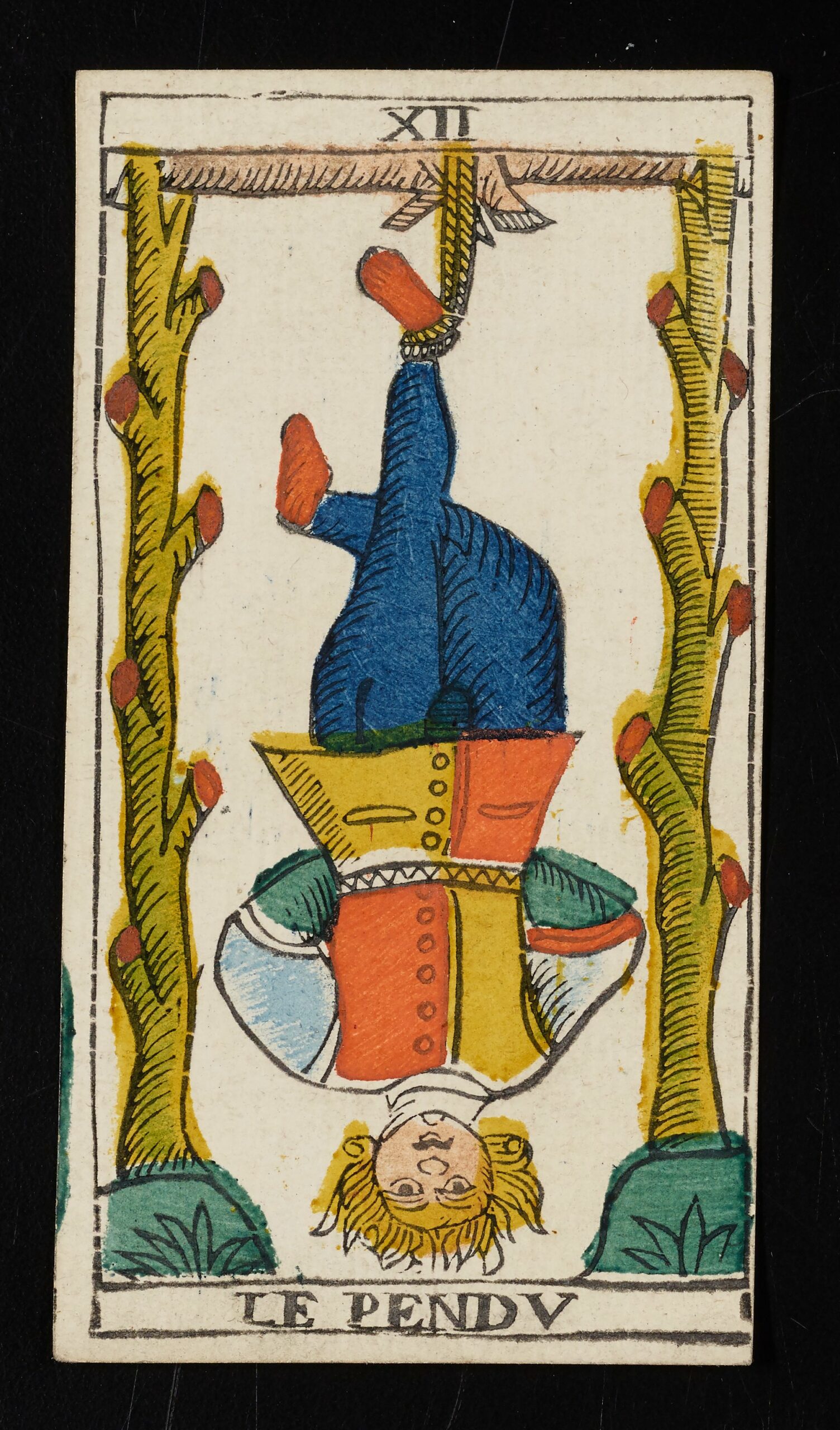
We celebrated my birthday yesterday: [Ted] gave me a lovely Tarot pack of cards and a dear rhyme with it, so after the obligations of this term are over your daughter shall start her way on the road to becoming a seeress & will also learn how to do horoscopes, a very difficult art which means reviving my elementary math.
- Sylvia Plath, in a letter to her mother, 28 October 1956
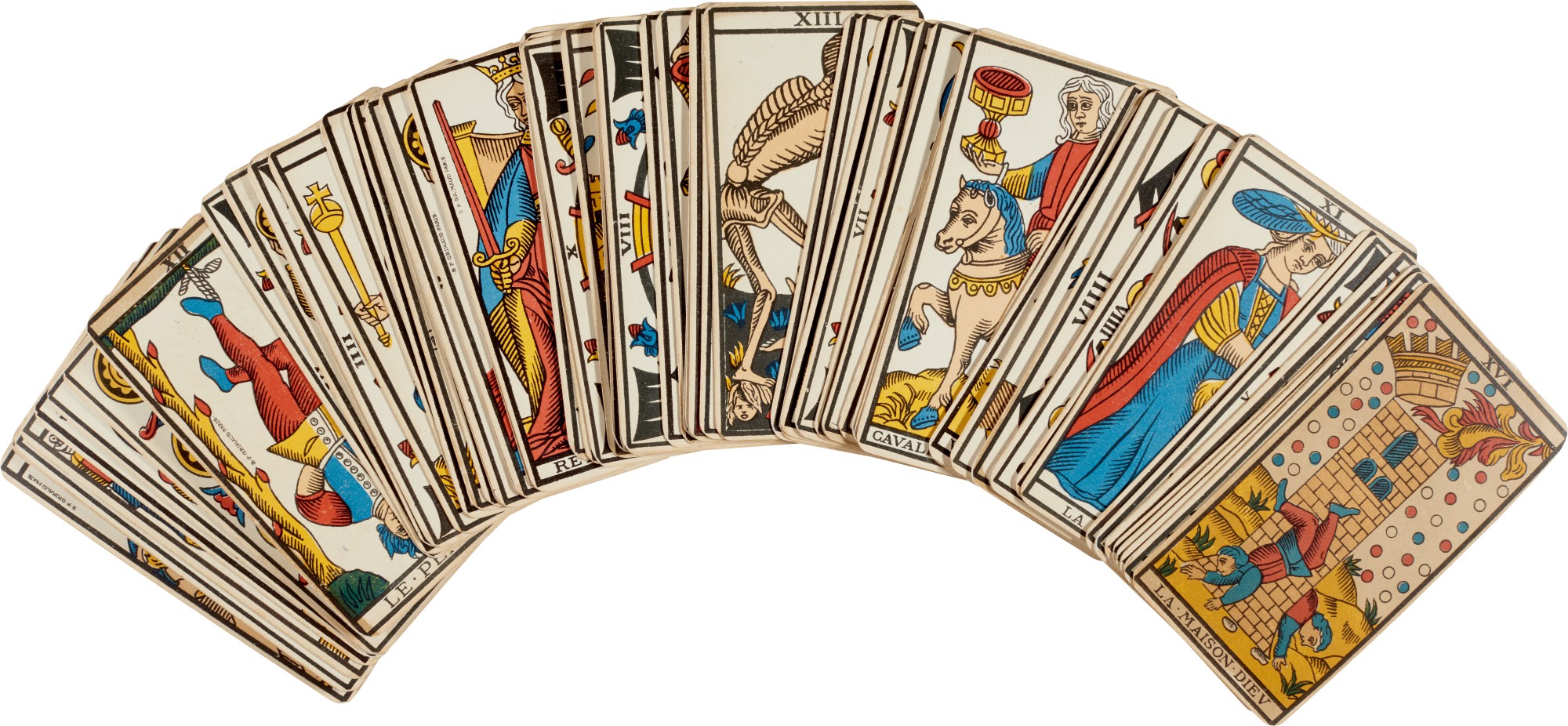
That’s approximately £100,000 more than this lot, a Tarot de Marseille deck printed by playing card manufacturer B.P. Grimaud de Paris, was expected to fetch.
The auction house’s description indicates that a few of the cards were discolored — evidence of use, as supported by Plath’s numerous references to Tarot in her journals.
Recall Tarot’s appearance in “Daddy,” her most widely known poem, and her identification with the Hanging Man card, in a poem of the same name:
By the roots of my hair some god got hold of me.
I sizzled in his blue volts like a desert prophet.
The nights snapped out of sight like a lizard’s eyelid :
A world of bald white days in a shadeless socket.
The next ten are aligned with the numbers of the Minor Arcana. Those are followed by four representing the Court cards. The collection’s final four poems can be seen to reference the pentacles, cups, swords and wands that comprise the Tarot’s suits.
Ariel’s manuscript was rearranged by Hughes, who dropped some of the “more lacerating” poems and added others in advance of its 1965 publication, two years after Plath’s death by suicide. (Hear Plath read poems from Ariel here.)
One wonders if it’s significant that Plath’s Page of Cups, a card associated with positive messages related to family and loved ones, has a rip in it?
We also wonder who paid such a staggering price for those cards.
Will they give the deck a moon bath or salt burial to cleanse it of Plath’s negative energy?
Or is the winning bidder such a diehard fan, the chance to handle something so intimately connecting them to their literary hero neutralizes any occult misgivings?
We rather wish Plath’s Tarot de Marseille had been awarded to Phillip Roberts in Shipley, England, who planned to exhibit them alongside her tarot-influenced poems in a pop up gallery at the Saltaire Festival. To finance this dream, he launched a crowd-funding campaign, pledging that every £100 donor could keep one of the cards, to be drawn at random, with all contributors invited to submit new art or writing to the mini-exhibition: Save Sylvia Plath’s cards from living in the drawers of some wealthy collector, and let’s make some art together!
Alas, Roberts and friends fell £148,990 short of the winning bid. Better luck next time, mate. We applaud your graciousness in defeat, as well as the spirit in which your project was conceived.
We're hoping to rely on loyal readers, rather than erratic ads. Please click the Donate button and support Open Culture. You can use Paypal, Venmo, Patreon, even Crypto! We thank you!
Open Culture scours the web for the best educational media. We find the free courses and audio books you need, the language lessons & educational videos you want, and plenty of enlightenment in between.