If you’ve ever run a marathon in costume, or for that matter, boarded public transportation with a large musical instrument or a bulky bag of athletic equipment, you know that gear can be a burden best shed.
But what if that gear is your first, nay, best line of defense against a fellow knight fixing to smite you in the name of their liege?
Such gear is non-optional.
Curious about the degree to which 15th-century knights were encumbered by their protective plating, medievalist Daniel Jaquet commissioned a top armor specialist from the Czech Republic to make a suit specific to his own personal measurements. The result is based on a 15th century specimen in Vienna that has been studied by the Wallace Collection’s archaeometallurgist Alan Williams. As Jaquet recalled in Sciences et Avenir:
We had to make compromises in the copying process, of course, because what interested me above all was to be able to do a behavioral study, to see how one moved with this equipment on the back rather than attaching myself to the number of exact rivets…we knew the composition and the hardness of the parts that we could compare to our replica.
The accomplished martial artist tested his mobility in the suit with a variety of highly public, modern activities: reaching for items on the highest supermarket shelves, jogging in the park, scaling a wall at a climbing gym, taking the Metro …
It may look like showboating, but these movements helped him assess how he’d perform in combat, as well as lower stress activities involving sitting down or standing up.
His armored experience sheds light on those of early 15th-century knight Jean le Maingre, aka Boucicaut, whose impressive career was cut short in 1415, when he was captured by the English at the Battle of Agincourt.
Boucicaut kept himself in tip top physical condition with a regular armored fitness regimen. His chivalric biography details gearing up for exercises that include running, chopping wood, vaulting onto a horse, and working his way up a ladder from the underside, without using his feet.
Jaquet duplicates them all in the above video.
(Reminder to those who would try this at home, make sure you’re capable of performing these exercises in lightweight shorts and t‑shirt before attempting to do them in armor.)
Like Boucicault’s, Jaquet’s armor is bespoke. Those who’ve struggled to lift their arms in an off-the-rack jacket will appreciate the trade off. It’s worth spending more to ensure sufficient range of movement.
In Boucicault’s day, ready-made pieces of lesser quality could be procured at markets, trading fairs, and shops in populous areas. You could also try your luck after battle, by stripping the captive and the dead of theirs. Size was always an issue. Too small and your movement would be restricted. Too big, and you’d be hauling around unnecessary weight.
Jaquet describes his load as being on par with the weight 21st-century soldiers are required to carry. Body armor is a lifesaver, according to a 2018 study by the Center for a New American Security, but it also reduces mobility, increases fatigue, and reduces mission performance.
Gizmodo’s Jennifer Ouellette finds that medieval knights faced similar challenges:
The legs alone were carrying an extra 15 to 18 pounds, so the muscles had to work that much harder to overcome inertia to set the legs in motion. There is also evidence that the thin slits in the face mask, and tight chest plate, restricted oxygen flow even further.
For those looking for a lighter read, here is Jaquet’s account of taking a commercial flight in armor (and some best practice tips for those attempting the same.)
Stephen Fry got sent off to a faraway boarding school at the age of seven. His subsequent years of student life far from home taught him, among other things, a set of effective strategies to deflect bullying. (“I suppose it all began when I came out of the womb,” he once said when asked at what point he acknowledged his sexuality, and that must have given him plenty of time to consider what it was to stand outside the mainstream.) The particular line he recommends delivering in the Q&A clip above (recorded at The Oxford Union) may not be for everyone, but he also has a larger point to make, and he makes it with characteristic eloquence. The eternal threat of bullying, he says, is “why nature gave us, or enough of a percentage of us, wit — or at least what might pass for it.”
Wit, which Fry possesses in a famous abundance, must surely have carried him through a great many situations both professional and personal. A modern-day intellectual and aesthetic heir to Oscar Wilde, Fry has the advantage of having lived in a time and place without being subject to the kind of punishment visited on the author of “The Ballad of Reading Gaol.” But that doesn’t mean he’s had an easy time of it. He cites an “ancient metaphor” he’s kept in mind: “No matter how dark it is, the smallest light is visible; no matter how light it is, a bit of dark is nothing.” The challenges he’s faced in life — none of them a million miles, presumably, from the kind endured by those seen to be different in other ways — have sent him to the wells of history, philosophy, and even mythology.
“We have to return to Nietzsche,” Fry says, and specifically The Birth of Tragedy. “He argued that tragedy was born out of ancient Greece, out of a spirit that the Athenians had as they grew up as a special tribe that somehow managed to combine two qualities of their twelve Olympic deities.” Some of these qualities were embodied in Athena, goddess of wisdom, and Apollo, god of harmony, music, mathematics, and rhetoric. But then we have Dionysius, “god of wine and festival and riot. Absolute riot.” Tragedies, according to Nietzsche, “look at the fact that all of us are torn in two,” with part of us inclined toward Athenian and Apollonian pursuits, where another part of us “wants to wrench our clothes off, dive into the grapes, and make slurping, horrible noises of love and discord.”
This all comes down to the thoroughly modern myth that is Star Trek. On the Enterprise we have Mr. Spock, who embodies “reason, logic, calculation, science, and an absolute inability to feel”; we have Bones, “all gut reaction”; and “in the middle, trying to be a perfect mix of the two of them,” we have Captain Kirk, “who wanted the humanity of Bones, but some of the reasoning judgment of Spock.” The Enterprise, in a word, is us: “Each one of us, if we examine ourselves, knows there is an inner beast who is capable of almost anything — in mind, at least — and there is an inner monk, an inner harmonious figure.” Each side keeps getting the better of the other, turning even the bullied into bullies on occasion. The best you can do, in Fry’s view, is to “go forth, be mad, be utterly proud of who you are — whatever you are — and for God’s sake, try everything.”
Based in Seoul, Colin Marshall writes and broadcasts on cities and culture. His projects include the book The Stateless City: a Walk through 21st-Century Los Angeles and the video series The City in Cinema. Follow him on Twitter at @colinmarshall or on Facebook.
…or, even more thrillingly, a child hominin on the High Tibetan Plateau, 169,000 to 226,000 years ago!
Perhaps one day your surface-marring gesture will be conceived of as a great gift to science, and possibly art. (Try this line of reasoning with the angry homeowner or shopkeeper who’s intent on measuring your hand against the one now permanently set into their new cement walkway.)
Tell them how in 2018, professional ichnologists doing fieldwork in Quesang Hot Spring, some 80 km northwest of Lhasa, were over the moon to find five handprints and five footprints dating to the Middle Pleistocene near the base of a rocky promontory.
Researchers led by David Zhang of Guangzhou University attribute the handprints to a 12-year-old, and the footprints to a 7‑year-old.
In a recent article in Science Bulletin, Zhang and his team conclude that the children’s handiwork is not only deliberate (as opposed to “imprinted during normal locomotion or by the use of hands to stabilize motion”) but also “an early act of parietal art.”
The Uranium dating of the travertine which received the kids’ hands and feet while still soft is grounds for excitement, moving the dial on the earliest known occupation (or visitation) of the Tibetan Plateau much further back than previously believed — from 90,000–120,000 years ago to 169,000–226,000 years ago.
That’s a lot of food for thought, evolutionarily speaking. As Zhang told TIME magazine, “you’re simultaneously dealing with a harsh environment, less oxygen, and at the same time, creating this.”
Zhang is steadfast that “this” is the world’s oldest parietal art — outpacing a Neanderthal artist’s red-pigmented hand stencil in Spain’s Cave of Maltravieso by more than 100,000 years.
Nick Barton, Professor of Paleolithic Archeology at Oxford wonders if the traces, intentionally placed though they may be, are less art than child’s play. (Team Wet Cement!)
Zhang counters that such arguments are predicated on modern notions of what constitutes art, driving his point home with an appropriately stone-aged metaphor:
When you use stone tools to dig something in the present day, we cannot say that that is technology. But if ancient people use that, that’s technology.
Cornell University’s Thomas Urban, who co-authored the Science Bulletin article with Zhang and a host of other researchers shares his colleagues aversion’ to definitions shaped by a modern lens:
Different camps have specific definitions of art that prioritize various criteria, but I would like to transcend that and say there can be limitations imposed by these strict categories that might inhibit us from thinking more broadly about creative behavior. I think we can make a solid case that this is not utilitarian behavior. There’s something playful, creative, possibly symbolic about this. This gets at a very fundamental question of what it actually means to be human.
For instance, when was the last time you slaughtered someone for rendering offense to your Lord?
Not that the best practices surrounding such an assignment aren’t fascinating. Still, you’ll probably benefit more from incorporating the samurai approach to dealing with gossips or clueless colleagues.
If you want to adaptMaster Ninja Natori Masazumi’s Edo period instructions for cleaning blood from long swords, without damaging the blade, to polishing your stainless steel fridge, have at it:
Place horse droppings inside some paper and wipe it over a blade that has been used to cut someone. This will leave traces of the wiping and the blood will no longer be seen. If there are no horse droppings available to wipe the blade with, use the back of your straw sandals or soil inside paper.
The second scroll, “Ippei Yoko,” contains some explicit marching orders for the former.
If you’re squeamish — or eating — you may want to duck out of the video before Natori Masazumi’s granular instructions on the severing of enemy heads. (15:30 onward.)
Alternatively, you could make like an inexperienced young samurai and harden yourself to the graphic realities of bloodshed by attending executions and violent punishments in your downtime.
Again, the more everyday wisdom of “Heika Jodan,” the first scroll, will likely prove more pertinent. A few chestnuts to get you started:
Don’t say something about someone behind their back that you are not prepared to repeat to their face.
Keep your distance from “stupid” associates, but also resist the urge to make fun of them.
Never shy away from an act of virtue.
In an emergency, exit in a swift, but orderly manner.
Compliment the food when you’re a guest in someone’s home, even if you don’t like it.
If you’re the host, and two guests begin fighting, try to help settle the matter discreetly, to avoid lasting injuries or grudges.
Don’t pass the buck to excuse your own misdeeds.
Don’t panic in an unexpected situation — the first thing you should do is take a breath and settle your mind.
Whether traveling or just out and about, be prepared with necessary items, including, pencil, paper, money, medications…
When tempted to regale others with any supernatural encounters you may have had, remember that less is more.
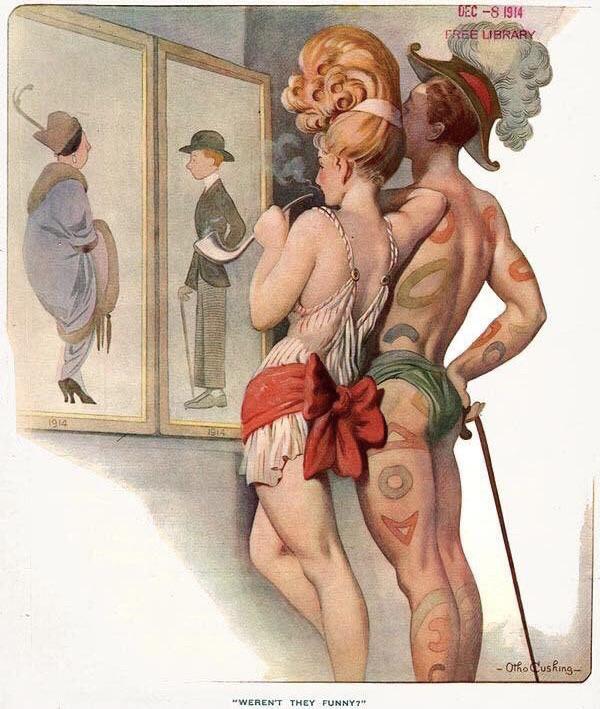
Though still just within living memory, 1950 now seems as if it belongs not just to the past but to a wholly bygone reality. Yet that year once stood for the future: that is to say, a time both distant enough to fire up the imagination and near enough to instill a sense of trepidation. It must have felt that way, at least, to the subscribers of Life magazine in December of 1914, when they opened an issue of that magazine dedicated in part to predicting the state of humanity 36 years hence. Its bold cover depicts a man and woman of the 1950s amusedly regarding pictures of a man and woman in 1914: the latter wear buttoned-up European street clothing, while the former have on almost nothing at all.
As rendered by illustrator Otho Cushing, the thoroughly modern 1950s female wears a kind of slip, something like a garment from ancient Greece updated by abbreviation. Her male counterpart takes his inspiration from an even earlier stage of civilization, his loincloth covering as few as possible of the abstract patterns painted or tattooed all over his body. (About his choice to top it all off with a plumed helmet, an entire PhD thesis could surely be written.)
Any credible vision of the future must draw inspiration from the past, and Cushing’s interests equipped him well for the task: 28 years later, his New York Times obituary would refer to his early specialization in depicting “handsome young men and women in Greek or modern costumes.”
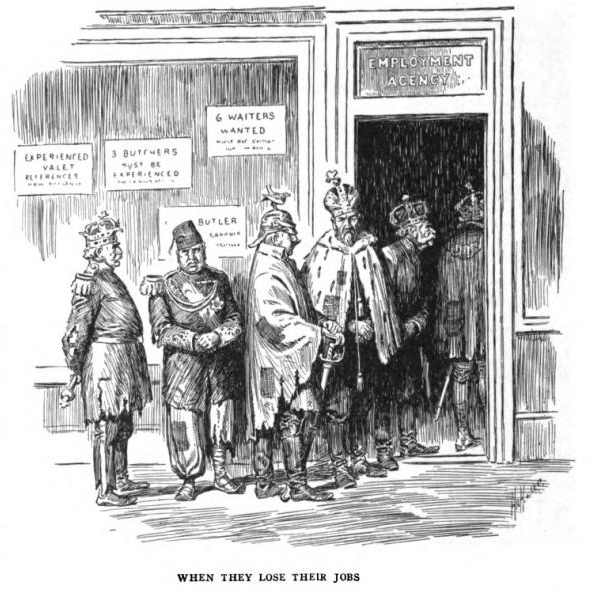
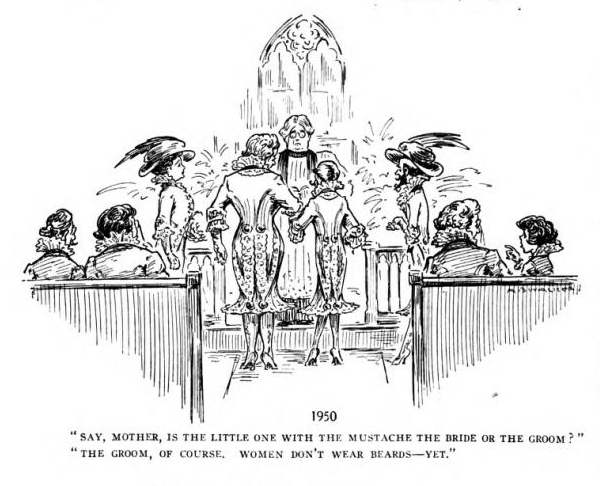
Even though fashions have yet to make a return to antiquity, how many outfits on the street of any major city today would scandalize the average Life reader of 1914? Of course, the cover is essentially a gag, as is much of the ostensible prognostication inside. As circulated again not long ago in a tweet thread by Andy Machals, it foresees monarchs in the unemployment line, boys’ jobs taken by girls, women acquiring harems of men, and the near-extinction of marriage. But some predictions, like 30 miles per hour becoming a slow enough driving speed to be ticketable, have come true. Another piece imagines people of the 1950s hiring musicians to accompany them throughout each phase of the day. Few of us do that even in the 2020s, but living our digitally soundtracked lives, we may still wonder how our early 20th-century ancestors managed: “Between meals they listened to almost absolutely nothing.”
Based in Seoul, Colin Marshall writes and broadcasts on cities, language, and culture. His projects include the Substack newsletterBooks on Cities, the book The Stateless City: a Walk through 21st-Century Los Angeles and the video series The City in Cinema. Follow him on Twitter at @colinmarshall or on Facebook.
Oh, to be in the studio audience of CBS’ Television City in Hollywood on September 9th, 1956, to see Elvis Presley’s gyrating pelvis rocket him to superstardom on The Ed Sullivan Show.
His appearance made television history, but 60 million home viewers were left to fill in some major blanks, as the rising heartthrob was filmed from the waist up whenever he was in motion.
Sullivan had been hesitant to book Elvis, not wanting to court the outrage the magnetic young singer had sparked in two “suggestive” appearances on The Milton Berle Show earlier that year. Elvis, he told the press, was “not my cup of tea” and “wasn’t fit for family entertainment.”
Elvis was displeased by this jokey spin, but submitted, and newcomer Allen’s ratings clobbered Sullivan’s that week.
Sullivan sent Steve Allen a telegram:
Steven Presley Allen, NBC TV, New York City. Stinker. Love and kisses. Ed Sullivan.
Whether Sullivan was throwing down a gauntlet, or delivering congratulations with a side of poor sportsmanship is somewhat unclear, but Sullivan was now ready to claim his stake, at ten times the price.
The $5,000 appearance fee that had been floated prior to Elvis’ appearance on The Milton Berle Show, had ballooned to the jaw dropping sum of $50,000 for 3 episodes.
Sullivan and Presley’s names are forever linked for that historic first appearance, but injuries from a car crash knocked the host out of commission. Actor Charles Laughton subbed in as host from Sullivan’s New York studio, and was charged with ushering in Elvis’s remote appearance in a very particular way.
Presley was the headliner, and a Sullivan headliner normally opened the show, but Sullivan was burying him. Laughton had to make the moment invisible: to act as if nobody was actually waiting for anything. He did it instantly, with complete command, with the sort of television presence that some have and some — Steve Allen, or Ed Sullivan himself — don’t. It’s a sense of ease, a querulous interrogation of the medium itself, affirming one’s own odd, irreducible subjectivity against the objectivity enforced by any system of representations: that is, getting it across that at any moment that you might forget where you are and say whatever comes into your head, which was exactly what half the country hoped and half the country feared might be the case with Elvis Presley.
Laughton, who elsewhere in the show used a reading of James Thurber’s Red Riding Hood parody, “The Little Girl and the Wolf” to insinuate that “it’s not so easy to fool little girls nowadays as it used to be,” settled on a non-committal “and now, away to Hollywood to meet Elvis Presley!”
Elvis, clad in a non-threatening plaid jacket on a set trimmed with guitar-shaped cut outs, thanked Laughton, and wiped his brow:
Wow. This is probably the greatest honor I’ve ever had in my life. Ah. There’s not much I can say except, it really makes you feel good. We want to thank you from the bottom of our heart.
His first number, “Don’t Be Cruel,” had an immediate effect on the teenage girls in attendance, who knew what they were seeing.
“Thank you, ladies,” he said, coyly acknowledging what all knew to be true, before going on to debut the title song of the motion picture he was in town to film, Love Me Tender, his first of 31 such vehicles.
Disc jockeys tuned in to tape the unreleased song for play on their radio shows, shooting pre-sales up to nearly a million.
As a great philosopher once said…’You ain’t nothin’ but a hound dog!’
Cue screams.
A week later, The New York Times’ Jack Gould alleged that in booking Elvis, Sullivan had failed to “exercise good sense and display responsibility,” moralizing that “in some ways it was perhaps the most unpleasant of (the singer’s) recent three performances:
Mr. Presley initially disturbed adult viewers — and instantly became a martyr in the eyes of his teen- age following — for his striptease behavior on last spring’s Milton Berle program. Then with Steve Allen he was much more sedate. On the Sullivan program he injected movements of the tongue and indulged in wordless singing that were singularly distasteful.
At least some parents are puzzled or confused by Presley’s almost hypnotic power; others are concerned; perhaps most are a shade disgusted and content to permit the Presley fad to play itself out.
Neither criticism of Presley nor of the teen-agers who admire him is particularly to the point. Presley has fallen into a fortune with a routine that in one form or another has always existed on the fringe of show business; in his gyrating figure and suggestive gestures the teen-agers have found something that for the moment seems exciting or important.
Cue more screams.
A month and a half after his first Sullivan Show booking, Elvis and Sullivan met in the New York studio for a follow up, along with a chaste youth choir, the Little Gaelic Singers, and ventriloquist Señor Wences. (S’alright? S’alright.)
“Don’t Be Cruel,” “Love Me Tender,” and “Hound Dog” were on the menu again, along with a brand new release — “Love Me,” above.
Señor Wences was not the tough act to follow here.
The appearance resulted in more wildly high ratings for Sullivan, and a growing awareness of the perils of rock n’ roll, as embodied by Elvis’ well lubricated nether regions, which the camera, fooling no one, again shied from at crucial moments.
Cue another million teenage fan club enrollments, as well as parents, clergy and other concerned citizens who came together to burn the singer in effigy in Nashville and St. Louis.
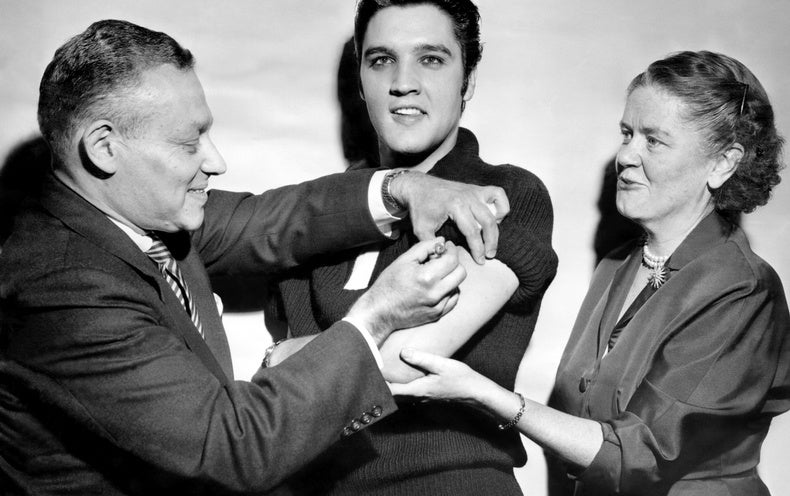
Nearly as notable, from the perspective of 2021, was the public service Elvis performed backstage, allowing himself to be photographed receiving the polio vaccine, in hopes his legions of admirers would follow suit.
Elvis’ third visit to Sullivan’s show, January 6th, 1957, would prove to be his last, owing to the astronomical fee his manager Colonel Tom Parker set for future television appearances: $300,000 with the promise of two guest spots and an hour-long special. An attempt to book Elvis for Sullivan’s 10th anniversary celebration, was thwarted by the fact that Elvis was abroad, serving in the Army.
Another massive audience tuned in for another helping of hits — “Hound Dog,” “Love Me Tender,” “Heartbreak Hotel,” and “Don’t Be Cruel,” as well as newer material — “Too Much” and “When My Blue Moon Turns To Gold Again.”
Between songs, Sullivan advised the swooning teenagers to rest their larynxes and introduced Elvis’ performance of the gospel standard, “Peace in the Valley,” by urging viewers to contribute to a Hungarian refugee relief fund Elvis supported.
While many fans persist in the belief that the gospel number was included as an affectionate nod to the singer’s beloved mother, Gladys, a letter from Colonel Parker’s assistant to Elvis suggests that the choice had more to do with his host:
Mr. Sullivan thought it might be very appropriate for you to sing a hymn or a semi-religious song on the show. You certainly can sing a hymn very effectively and I think it would make a very strong impression on all the viewers. It has been suggested that a song like ‘Peace in the Valley’ might be held in readiness. We have obtained the music on this song and are forwarding it to you.”
This time, home viewers really were left to guess what was going on below the star’s sequined vest and open collared blouse, described by Marcus as “the outlandish costume of a pasha, if not a harem girl:”
From the make-up over his eyes, the hair falling in his face, the overwhelmingly sexual cast of his mouth, he was playing Rudolph Valentino in The Sheik, with all stops out. That he did so in front of the Jordanaires, who this night appeared as the four squarest-looking men on the planet, made the performance even more potent.
Sullivan’s first co-producer, Marlo Lewis, intimated that the decision to formalize a waist-up policy for Elvis’ third visit was sparked by a rumor that had dogged his prior appearances. To wit:
Elvis has been hanging a small soft-drink bottle from his groin underneath his pants, and when he wiggles his leg it looks as though his pecker reaches down to his knee!
Meanwhile, it appeared Sullivan was no longer willing to be lumped in with Elvis’ detractors, closing the show by saying:
I wanted to say to Elvis Presley and the country that this is a real decent, fine boy, and wherever you go, Elvis, we want to say we’ve never had a pleasanter experience on our show with a big name than we’ve had with you. So now let’s have a tremendous hand for a very nice person!
Had Elvis won him over, or was it, as cultural critic Tim Parrish asserts, that Colonel Parker, “had threatened to remove Elvis from the show if Sullivan did not apologize for telling the press that Elvis’s ‘gyrations’ were immoral.”
Watch all of Elvis Presley’s performances on The Ed Sullivan Show in HD here.
For a glimpse of the 1956 Gibson J‑200 Elvis played in that final appearance, and speculation as to whether he crossed paths with fellow guests Carol Burnett and Lena Horne, watch Graceland archivist Angie Marchese’s show and tell of ephemera related to his stints on the Ed Sullivan Show.
But we here at Open Culture think his greatest gift to home viewers are his Art History School profiles of well-known artists like Henri de Toulouse-Lautrec and Vincent Van Gogh.
An avid storyteller, he’s drawn to those with tragic histories — the decision to pivot from impersonating the artist, as he did with Van Gogh, to serving as a reporter interested in how such details as syphilis and alcoholism informed lives and careers is a wise one.
Priestly makes a convincing case that Lautrec’s aristocratic upbringing contributed to his misery. His short stature was the result, not of dwarfism, but Pyknodysostosis (PYCD) a rare bone weakening disease that surely owed something to his parents’ status as first cousins.
His appearance made him a subject of lifelong mockery, and ensured that the freewheeling artist scene in Montmartre would prove more welcoming than the blueblood milieu into which he’d been born.
Priestly makes a meal of that Demi-monde, introducing viewers to many of the players.
He heightens our appreciation for Lautrec’s masterpiece, At the Moulin Rouge, by briefly orienting us to who’s seated around the table: writer and critic Édouard Dujardin, dancer La Macarona, photographer Paul Secau, and “champagne salesman and debauchee” Maurice Guibert, who earlier posed as a lecherous patron in Lautrec’s At the Café La Mie.
Queen of the Cancan La Goulue hangs out in the background with another dancer, the wonderfully named La Môme Fromage.
Lautrec places himself squarely in the mix, looking very much at home.
Consider that these names, like those of frequent Lautrec subjects acrobatic dancer Jane Avril and chanteuse Yvette Guilbert were as celebrated in Belle Epoque Montmartre as many of the painters Lautrec rubbed shoulders with — Degas, Pissarro, Cézanne, Van Gogh and Manet.
In an article in The Smithsonian, Paul Trachtman recounts how Lautrec discovered the model for Manet’s famous nude Olympia, Victorine Meurent, “living in abject poverty in a top-floor apartment down a Montmartre alley. She was now an old, wrinkled, balding woman. Lautrec called on her often, and took his friends along, presenting her with gifts of chocolate and flowers — as if courting death itself.”
Meanwhile Degas sniffed that Lautrec’s studies of women in a brothel “stank of syphilis.”
Perhaps Priestly will delve into Degas for an upcoming Art History School episode … there’s no shortage of material there.
Above are three more of Paul Priestly’s Art History School profiles that we’ve enjoyed on Frances Bacon,Edvard Munch and Gustav Klimt. You can subscribe to his channel here.
In fiction the inspirational high-school English teacher is a cliché, despite (or indeed due to) the fact that so many of us have had at least one of them in real life. For generations of students who passed through San Francisco’s prestigious Lowell High School, that teacher was Flossie Lewis. Long after her retirement, she went surprisingly viral in a 2016 PBS interview clip about her thoughts on aging. It seemed she retained her power to inspire, not just for her more than seven million online viewers, but also for the PBS producers who later reunited her with her former students in the very same classroom where she once taught them.
You can see this reunion take place in the video above, which also includes Flossie telling her own story of having fled Brooklyn spinsterhood on a Greyhound bus headed west. “I could command the attention of a class,” she says of the source of her power as a teacher. “I had a voice. I had that kind of personality that did not seem teacherly, but was provocative.”
Onetime student Daniel Handler, better known as the novelist Lemony Snicket, credits Flossie with an “ability to startle.” Another, now an architect, remembers “gravitas” — and his having been “intimidated by her name. Flossie is a very unusual name.” Or at least it is today, its popularity (driven, it seems, by the Bobbsey Twins books) having peaked in the early 20th century.
Flossie is also representative of her generation in another way: not particularly caring for the music of Bob Dylan. Though she can’t have been thrilled with that guitar-playing (relative) youngster’s 2016 Nobel Prize for Literature, she’s willing to hear her students out on the subject. “The trivial task before us is to decide whether Bobby Dylan is worth the laureate,” she declares to the group of Lowell alumni gathered in her old classroom. Now all middle-aged, her former students include Dylan defenders and Dylan deniers alike, but what unites them are their undimmed memories of their teacher’s mixture of rigor, compassion, and sheer eccentricity. As one of them recalls, “You read us a sonnet from Shakespeare and said, ‘It’s no good.’ ” Whatever his generational relevance, the poet from Hibbing may never have stood a chance.
Based in Seoul, Colin Marshall writes and broadcasts on cities, language, and culture. His projects include the Substack newsletterBooks on Cities, the book The Stateless City: a Walk through 21st-Century Los Angeles and the video series The City in Cinema. Follow him on Twitter at @colinmarshall or on Facebook.
We're hoping to rely on loyal readers, rather than erratic ads. Please click the Donate button and support Open Culture. You can use Paypal, Venmo, Patreon, even Crypto! We thank you!
Open Culture scours the web for the best educational media. We find the free courses and audio books you need, the language lessons & educational videos you want, and plenty of enlightenment in between.