From Barcelona comes “Alike,” a short animated film by Daniel Martínez Lara and Rafa Cano Méndez. Made with Blender, an open-source 3D rendering program, “Alike” has won a heap of awards and clocked an impressive 10 million views on Youtube and Vimeo. A labor of love made over four years, the film revolves around this question: “In a busy life, Copi is a father who tries to teach the right way to his son, Paste. But … What is the correct path?” To find the answer, they have to let a drama play out. Which will prevail? Creativity? Or conformity? It’s an internal conflict we’re all familiar with.
If you would like to support the mission of Open Culture, consider making a donation to our site. It’s hard to rely 100% on ads, and your contributions will help us continue providing the best free cultural and educational materials to learners everywhere. You can contribute through PayPal, Patreon, and Venmo (@openculture). Thanks!
Would you take study tips from Bill Murray? After high school, he did spend some time as a pre-medical student at Regis University in Denver — before dropping out to return to his hometown of Chicago and get his start in comedy with the famed improv group Second City. Still, Regis did eventually award him an honorary Doctor of Humanities a decade ago, and you have to admit that the fame-and-fortune path worked out for him. In fact, it worked out and then some: seeing the massive success of Ghostbusters (and the temptations thereof) looming in 1984, Murray decided to make his return to school, this time to study philosophy, history, and French — and at the Sorbonne, no less.
The Spotify playlist below offers brief selections of spoken-word wisdom related to studying and learning in general, part of the fruit of a project by Murray and German cellist Jan Vogler. (If you don’t have Spotify’s free software, you can download it here.)
They recently made an album together called New Worlds, where the sounds of Vogler’s classical trio accompany Murray’s voice, singing and reading classic works of American music and literature from Mark Twain to Van Morrison. They also recorded this selection of memories, galvanizing messages, and “intense study tips” briefly summarized as follows: “Don’t cram,” “Concentrate,” “One problem,” “Sleep on it,” “Take a bath,” “Focus on others,” “More is more,” “Take a break,” and “Build a routine.”
Listen to the playlist and you can hear Murray expand on these suggestions, some of which will resonate with material we’ve previously featured here on Open Culture: the psychological phenomenon that has us do our best thinking in the shower (or indeed the bath), for instance, or the intellectual foundations of Murray’s comedic persona. If you find his advice useful, you might also look to the example he sets with how he runs his career, famously taking risks on untested ideas or collaborators (including a certain Wes Anderson) and going to great lengths (up to and including replacing his agent with a voicemail box) to avoid getting caught in the gears of his industry. Whether studying a subject or becoming the most beloved comic actor of your generation, in other words, you’ve got to find a path that works for you and you alone. As one track of Murray and Vogler’s helpful playlist puts it, “Good luck.”
Based in Seoul, Colin Marshall writes and broadcasts on cities and culture. His projects include the book The Stateless City: a Walk through 21st-Century Los Angeles and the video series The City in Cinema. Follow him on Twitter at @colinmarshall or on Facebook.
One wonders what might have become of Richard Atkins’ musical career had he come of age in this millennium, when youngsters suffering from acute stage fright regularly attract stadium-sized followings on Youtube.
This was most definitely not the case in 1968, when Atkins, aged 19, took the stage in a small Hollywood club filled with music industry brass, there specifically to see him.
Unfortunately, talent could only take him so far. Having learned to play guitar only a couple of years earlier in the wake of a disfiguring motorcycle accident, he and partner Richard Manning had recorded an album, Richard Twice, for Mercury Records. The presence on that record of several members of the Wrecking Crew, an informal, but legendary group of LA session musicians, conferred extra pop pedigree. The Acid Archives later called it “a virtually perfect pop album, the kind of thing that would have ruled the charts if the wind had been blowing the right way that month.”
Alas, one tiny technical difficulty at the start of the gig caused Manning to flee, leaving the freaked out and frighteningly ill equipped Atkins to deal with the yawning chasm that had opened between him and the audience. The only fix that occurred to him was a Bugs Bunny-inspired soft shoe, a move that apparently went over big with his Mom, prior to the accident, when he had two legs and could balance without a crutch.
As recounted in Matthew Salton’s animated documentary, above, this soul crushing moment is not without humor. Atkins, affably narrating his own story, has had 50 years to mull that night over, and realizes that blown opportunities are probably more universal than successfully snagged brass rings (American Idol, anyone?)
Over the ensuing years, Atkins found fulfillment as a woodworker and family man, but music remained a painful what-if, addressed largely through avoidance.
Salton’s exuberantly scratchy animation comes as Atkins is taking steps to conquer his stage fright, performing out at small cafes, festivals, and potluck suppers near his Pacific Northwest home.
He’s been posting old songs, gently reminding listeners, “before I’m judged too harshly, remember that I was 18 and living in North Hollywood, probably raging hormones and in the music business to boot!”
He’s also writing and sharing new songs, including the touching “Life Is A Rollercoaster,” above.
Performing on Facebook Live in conjunction with Salton’s New York Times Op-Doc essay, he tears up when the interviewer informs him that his daughter has just posted an encouraging comment, and eagerly confirms his availability when another commenter asks if he’d be up for a gig.
Ben Sansum is something of a young fogey. He’s only 35 years old, but he lives in the year 1946. Entirely. The pictures on his wall in his Cambridgeshire home, the supplies in his cupboard, the music played on his turntable, the clothes he wears–everything comes from 1946 and the post WWII era. His motivation is partly aesthetic. He likes living in a period home, he tells us. But it also goes deeper than that. As he notes, our modern world moves so quickly, it sometimes pays to hang onto old world charms.
If you would like to support the mission of Open Culture, consider making a donation to our site. It’s hard to rely 100% on ads, and your contributions will help us continue providing the best free cultural and educational materials to learners everywhere. You can contribute through PayPal, Patreon, and Venmo (@openculture). Thanks!
“Over 6 million people visit the Mona Lisa at the Louvre each year. Many share their visit on social media.” Created by Daniel McKee, this dizzying video gathers together hundreds of the photos that get taken at the museum and then wind up on Instagram. Only a minute long, it’s a nice succinct commentary on our time…
Hues which have words, and speak to ye of heaven,
Floats o’er this vast and wondrous monument,
And shadows forth its glory.
—Lord Byron, Childe Harold’s Pilgrimage (1818)
A modern visitor to Rome, drawn to the Coliseum on a moonlit night, is unlikely to be so bewitched, sandwiched between his or her fellow tourists and an army of vendors aggressively peddling light-up whirligigs, knock off designer scarves, and acrylic columns etched with the Eternal City’s must-see attractions.
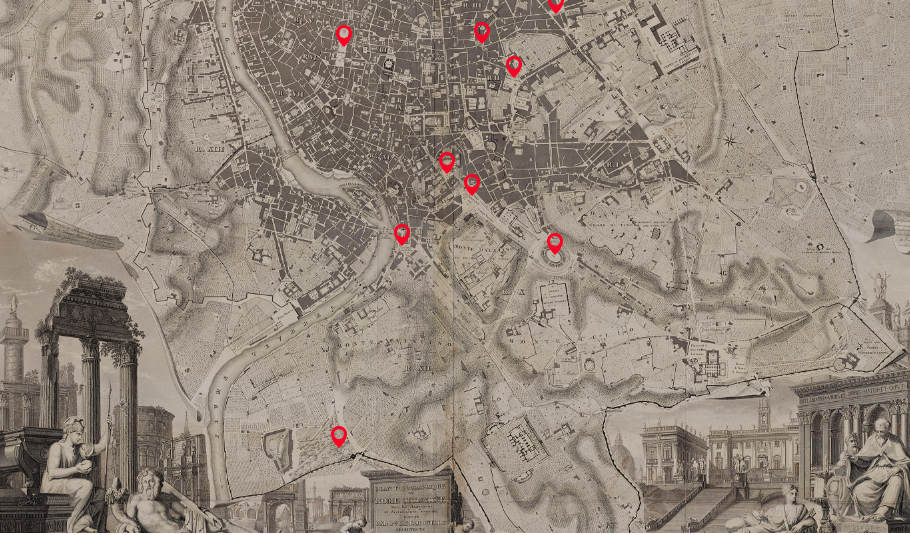
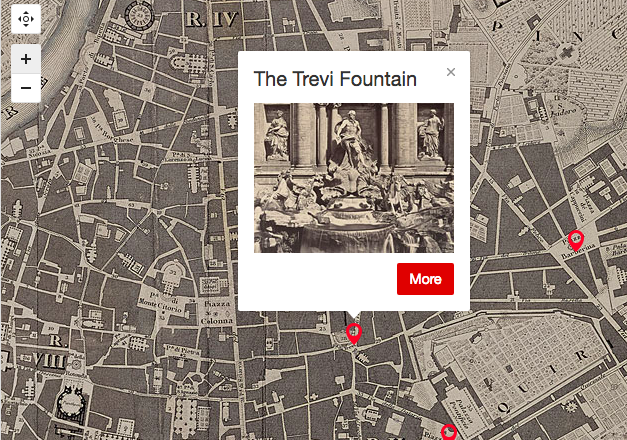
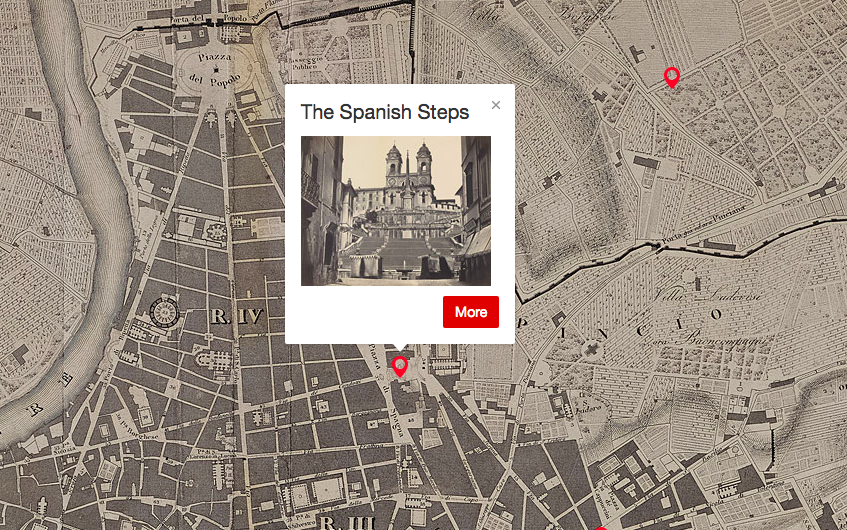
These days, your best bet for touring Rome’s best known landmarks in peace may be an interactive map, compliments of the Morgan Library and Museum. Based on Paul-Marie Letarouilly’s picturesque 1841 city plan, each digital pin can be expanded to reveal descriptions by nineteenth-century authors and side-by-side, then-and-now comparisons of the featured monuments.
The enduring popularity of the film Three Coins in the Fountain, coupled with the invention of the selfie stick has turned the area around the Trevi Fountain into a pickpocket’s dream and a claustrophobe’s worst nightmare.
Not so in Nathaniel Hawthorne’s day, though unlike Lord Byron, he cultivated a cool remove, at least at first:
They and the rest of the party descended some steps to the water’s brim, and, after a sip or two, stood gazing at the absurd design of the fountain, where some sculptor of Bernini’s school had gone absolutely mad in marble. It was a great palace-front, with niches and many bas-reliefs, out of which looked Agrippa’s legendary virgin, and several of the allegoric sisterhood; while, at the base, appeared Neptune, with his floundering steeds and Tritons blowing their horns about him, and twenty other artificial fantasies, which the calm moonlight soothed into better taste than was native to them. And, after all, it was as magnificent a piece of work as ever human skill contrived. At the foot of the palatial façade was strown, with careful art and ordered irregularity, a broad and broken heap of massive rock, looking as if it might have lain there since the deluge. Over a central precipice fell the water, in a semicircular cascade; and from a hundred crevices, on all sides, snowy jets gushed up, and streams spouted out of the mouths and nostrils of stone monsters, and fell in glistening drops; while other rivulets, that had run wild, came leaping from one rude step to another, over stones that were mossy, slimy, and green with sedge, because in a century of their wild play, Nature had adopted the Fountain of Trevi, with all its elaborate devices, for her own.
The human statues garbed as gladiators and charioteers spend hours in the blazing sun at the foot of the Spanish Steps—the heirs to the artists and models who populated William Wetmore Story’s Roba di Roma:
All day long, these steps are flooded with sunshine in which, stretched at length, or gathered in picturesque groups, models of every age and both sexes bask away the hours when they are free from employment in the studios. … Sometimes a group of artists, passing by, will pause and steadily examine one of these models, turn him about, pose him, point out his defects and excellences, give him a baiocco, and pass on. It is, in fact, a models’ exchange.
The Medici Villa houses the Académie de France, and its gardens remain a pleasant respite, even in 2017. Visitors who aren’t wholly consumed with finding a wifi signal may find themselves fantasizing about a different life, much as Henry James did in his Italian Hours:
Such a dim light as of a fabled, haunted place, such a soft suffusion of tender grey-green tones, such a company of gnarled and twisted little miniature trunks—dwarfs playing with each other at being giants—and such a shower of golden sparkles drifting in from the vivid West! … I should name for my own first wish that one didn’t have to be a Frenchman to come and live and dream and work at the Académie de France. Can there be for a while a happier destiny than that of a young artist conscious of talent and of no errand but to educate, polish and perfect it, transplanted to these sacred shades?…What mornings and afternoons one might spend there, brush in hand, unpreoccupied, untormented, pensioned, satisfied—either persuading one’s self that one would be “doing something” in consequence or not caring if one shouldn’t be.
I don’t know what time you’re reading this post but “What do you really want to do in life?” is a question that can wake you up right fast, or make you want to pack it in and sleep on it.
It’s also a question asked maybe a bit too early of our young people, which starts with fantasy (“What do you want to be when you grow up?” “A spaceman!”) and by our teens it turns into a more serious, fate-deciding inquiry by people who may not be happy with their station in life.
Actor Bryan Cranston takes on this question in this Big Think video, and extolls the virtues of travel and wandering.
“Traveling forces you to be social,” Cranston says. “You have to get directions.You have to learn where things are. You’re attuned to your environment.”
Cranston thought he was going to be a policeman when he entered college. Then he took an acting class. So, at 19, Cranston explored America for two years by motorcycle with his brother, in essence to find themselves by getting lost. He says he’s passed on this directionless wandering to his now 24 year-old daughter.
That idea of letting go and just wandering also dovetails nicely into his other advice about auditions. You don’t go there to get a job, you go to create a character and present it. The rest is out of your control.
Now, Cranston says that the period between high school/college and the “real world” is the best time to do it, but there’s really no time like right now. To quote Nigerian author Chimamanda Ngozi Adichie, “I think you travel to search and you come back home to find yourself there,” and the boats are always leaving. Just jump on.
Ted Mills is a freelance writer on the arts who currently hosts the artist interview-based FunkZone Podcast and is the producer of KCRW’s Curious Coast. You can also follow him on Twitter at @tedmills, read his other arts writing at tedmills.com and/or watch his films here.
Masterpiece, Runyararo Mapfumo’s short film above, will feel very familiar to anyone who has struggled for words to share with a friend after his or her underwhelming Off-Off-Broadway solo show, open mic performance, or art installation…
Equally familiar, from the reverse angle, to any artist who’s ever invited a trusted friend to view his or her passion project, hoping for approval or at the very least, interest… something more robust than the paltry crumbs the friend manages to eek out under pressure.
A British Film Institute London Film Festival selected short, Masterpiece focuses on a tight group of male friends… one of whom has reached beyond the communal comfort zone in the service of his art. His earnestness confounds his old pals, who clown around outside the gallery where they’ve gathered for an after hours preview of his work, one staunchly asserting that he only showed up because his mum made him, and also, he was told there’d be free food.
Once inside the friends are left alone to puzzle out his masterpiece. What to say? Maybe they should draw parallels to the current socio-political situation? Perhaps they could tell their friend his work is reminiscent of German Expressionism?
Yoko Ono or Marcel Duchamp would have made a more apt comparison, as writer-director Mapfumo is surely aware. Masterpiece is notable for more than just its pitch-perfect take on artist vs. befuddled but still supportive friends. As Mapfumo told Directors Notes:
I’ve been told time and time again to “write what you want to see.” I started thinking about what that meant to me in a everyday context. These characters are black men that I recognize…I didn’t want the conflict to revolve around their identity but rather through their observations.
We're hoping to rely on loyal readers, rather than erratic ads. Please click the Donate button and support Open Culture. You can use Paypal, Venmo, Patreon, even Crypto! We thank you!
Open Culture scours the web for the best educational media. We find the free courses and audio books you need, the language lessons & educational videos you want, and plenty of enlightenment in between.