It’s a cautionary tale about what happens when the world you prepared yourself for changes and leaves you behind. Coldly, and sometimes without warning.
Above, watch Steve Cutts’ 2014 animated mockumentary, “Where Are They Now?”. Starring Roger and Jessica Rabbit, and featuring cameos by Garfield and The Smurfs, the short film revisits cartoon characters who had it all in the 1980s. Then hit the skids in the early 90s. Hard. “We had done our jobs,” says an aged Jessica Rabbit. “Now we were forgotten about. Obsolete.” It’s a bleak picture that Cutts paints. But, it’s not all bad. He-Man became a wealthy lingerie designer. We could all use a well-thought-out Plan B.
The calendar date may be arbitrary, a quirk of history that could have been otherwise—but it’s no coincidence, I think, that New Year’s produces a reflective mood, a time of looking both backward and forward, especially in those parts of the world currently held in winter’s chill and dark, awaiting the thaw of spring. The turn of the Gregorian calendar seems to beg us to produce some sober wisdom amidst the revelry of the holidays: to account for what we’ve learned, ruminate on intentions, take general stock of our personal stores.
It’s also a time when we connect with our younger selves (many of us having just spent a few days visiting parents, hometowns, and childhood bedrooms). Those younger selves can seem callow and naïve in hindsight, and though it’s hardly any use living with regret, we might wish with some degree of rue that we could have handled some things better—and applied the hard-won realizations of the present much earlier. It’s a common enough sentiment, handled perfectly in The Faces’ “Ooh La La.”
I wish, for example, that I had learned how to meditate years before I did. It might have saved my young, moody, impulsive self a world a grief. (But then again, without that grief, would I have ever learned to meditate?) Recently, a MetaFilter user revisited a post from 2013 that asked the question (“What is a life changing realization that you wish you’d had sooner?”) to the internet community at large. The responses ranged from the fairly generic (“it’s okay if you don’t want to be friends with your exes”) to the personal, specific, and colorful. See a sampling of the answers below from both the original 2013 thread and the recent 2017 repost:
Love leaves scars. And that’s a good thing. We want to be permanently affected by the ones that we love. Otherwise, it’s not really love. And like any other scar, it begins as a painful wound, goes through the period of laudable pus during which you drain out all the bad stuff, and then, eventually, heals to a painless but visible scar.
This seems kinda silly, but a couple of years ago I realized that I am under no obligation to finish a book that I don’t like. As a reader, that was such an epiphany!
The most important and dangerous tool in the lives of average people is compound interest.
Behaviour is driven by emotion, not rational thought: instead of trying to force myself to do things by berating myself, I get my emotions in order first by synthesising the feeling of having already done it. My procrastination has been radically reduced, and I’m freer to get on and do the things I need to do.
Take other people’s head injuries seriously. Someone who’s just had a blow to the brain is not qualified to judge whether it is “no big deal.”
Honor the parts of yourself that are elusive and mysterious and maybe unintelligible to other people. Whether that means embracing an identity like “queer nonbinary trans woman” or becoming more comfortable with crying and not knowing why or not having opinions and answers at hand… Practice not knowing.
I’m partial to these offerings because I find them moving, funny, or conversant with whatever meager wisdom I like to think I’ve acquired after much trial and error. But what about you? As 2017 winds to a close—a year fraught with more stress and anxiety than most—which answers leap out to you? Or, if you’re brave and feel like sharing, what would you like to pass on to your younger, more bumbling self if you could go back and have a sit-down with him or her? Please pass along your thoughts and wisdom in the comments below.
’Tis the season to break out the family recipes of beloved relatives, though often their provenance is not quite what we think.
(Imagine the cognitive dissonance upon discovering that Mother swiped “her” Italian Zucchini Crescent Pie from Pillsbury Bake-Off winner, Millicent Nathan of Boca Raton, Florida…)
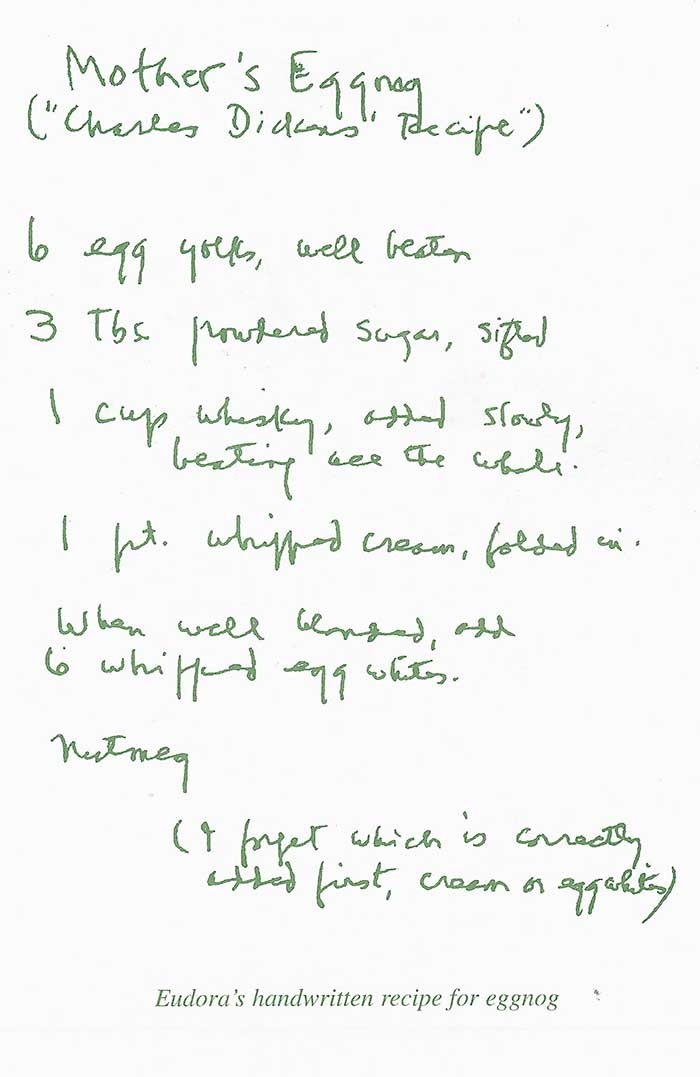
When it came to crediting the eggnog she dubbed “the taste of Christmas Day,” above, Pulitzer Prize-winning author Eudora Welty shared it out equally between her mother and author Charles Dickens:
In our house while I was growing up, I don’t remember that hard liquor was served at all except on one day in the year. Early on Christmas morning, we woke up to the sound of the eggbeater: Mother in the kitchen was whipping up eggnog. All in our bathrobes, we began our Christmas before breakfast. Throughout the day Mother made batches afresh. All our callers expected her eggnog.
It was ladled from the punch bowl into punch cups and silver goblets, and had to be eaten with a spoon. It stood up in peaks. It was rich, creamy and strong. Mother gave full credit for the recipe to Charles Dickens.
Nice, but perhaps Dickens is undeserving of this honor? The contents of his punchbowl bore little resemblance to Mother Welty’s, as evidenced by an 1847 letter to his childhood friend, Amelia Filloneau, in which he shared a recipe he promised would make her “a beautiful Punchmaker in more senses than one”:
Peel into a very strong common basin (which may be broken, in case of accident, without damage to the owner’s peace or pocket) the rinds of three lemons, cut very thin, and with as little as possible of the white coating between the peel and the fruit, attached. Add a double-handfull of lump sugar (good measure), a pint of good old rum, and a large wine-glass full of brandy — if it not be a large claret-glass, say two. Set this on fire, by filling a warm silver spoon with the spirit, lighting the contents at a wax taper, and pouring them gently in. Let it burn for three or four minutes at least, stirring it from time to Time. Then extinguish it by covering the basin with a tray, which will immediately put out the flame. Then squeeze in the juice of the three lemons, and add a quart of boiling water. Stir the whole well, cover it up for five minutes, and stir again.
This sounds very like the “seething bowls of punch” the jolly Ghost of Christmas Present shows Ebenezer Scrooge in A Christmas Carol, dimming the chamber with their delicious steam.
It’s also vegan, in contrast to what you might have been served in the Welty ladies’ home.
Why not serve both? In the words of Tiny Tim, “Here’s to us all!”
Eudora Welty’s Mother’s Eggnog (Attributed, Perhaps Erroneously, to Charles Dickens)
6 egg yolks, well beaten
Add 3 tbsp. powdered sugar
Add 1 cup whiskey, added slowly, beating all the while
Fold in 1 pint whipped cream
Whip 6 whipped egg whites and add to the mixture above.
Illustrator Steve Cutts sets his latest animation, “Happiness,” in a teeming urban environment, with hundreds of near identical cartoon rats standing in for human drudges in an unfulfilling, and not unfamiliar race.
Packed subway cars, a bombardment of advertising, soul-deadening office jobs, and Black Friday sales are just a few of the indignities Cutts’ rodents are subjected to, to the tune of Bizet’s “L’amour est un oiseau rebelle.”
Rampant over-consumption—a major preoccupation for this artist—offers illusory relief, and a great deal of fun for viewers with the time to hit pause, to better savor the grim details.
They may also serve as an antidote to the sort of messaging we’re constantly on the receiving end of, whether we live in city, country or somewhere in-between. Check out the scene as Cutts pans up from the subway platform, 52 seconds in:
The panty-clad female model for Blah cologne’s fashionably black and white ad is emaciated nearly to the point of death.
“You’re better than laces” flatters the latest (laceless) shoe from a swoosh-bedecked footwear manufacturer, while a radiator-colored beverage floats above the motto “Just drink it, morons.”
Krispo Flakes fight depression with “the bits other cereals don’t want.”
Heaven help us all, there’s even a poster for TRUMP The Musical.
This freeze-frame scrutiny could make an excellent activity for any class where middle and high schoolers are encouraged to think critically about their role as consumers.
As Cutts, a one-time employee of the digital marketing agency, Isobar, who contributed to campaigns for such global giants as Coca-Cola, Google, Reebok, and Toyota, told Reverb Press in 2015:
These are things that affect us all on a fundamental level so naturally they’re a main focus for a lot of my work. Humanity has the power to be great in so many ways and yet at the same time we are fundamentally flawed. I think it’s the conflict between these two that fascinates me the most. As a race of beings we’ve made incredible achievements in such a short space, but at the same time we seem so overwhelmingly intent on destroying ourselves and everything around us. It would be very interesting to see where we’ll be in a hundred years. The term insanity is intriguing – it’s almost like we’re encouraged to act in a way that seems genuinely insane when you look at it objectively, but it’s often accepted as normal right now. I think we will have to evolve beyond our current thinking and way of doing things if we want to survive.
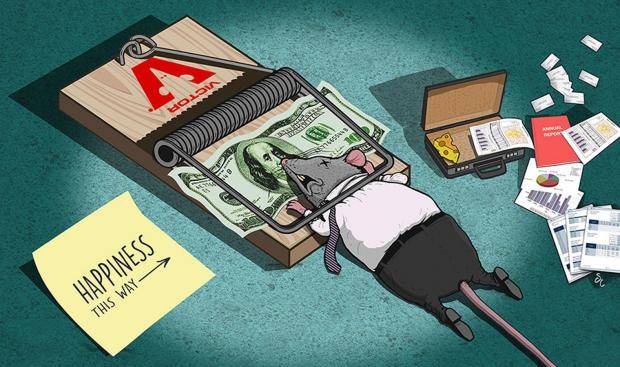
See more of Cutts’ animated work here. And while he doesn’t go out of his way to hype his online store, a gallery quality print of The Rat Trap would make a fantastic gift from your cubicle mate’s Secret Santa. (HURRY! TIME IS RUNNING OUT!!!)
English animator Steve Cutts has a knack for satirizing the excesses of modern society. Just watch his 2012 short animation “Man,” and you’ll see what I mean. In three short minutes, Cutts covers a lot of ground, documenting the rise of human civilization and its ever-escalating assault on nature and our natural resources. It’s funny. It’s biting. And it may give you pause as we gear up for Christmas, the apotheosis of American materialism.
If you would like to support the mission of Open Culture, consider making a donation to our site. It’s hard to rely 100% on ads, and your contributions will help us continue providing the best free cultural and educational materials to learners everywhere. You can contribute through PayPal, Patreon, and Venmo (@openculture). Thanks!
To what writer, besides Ayn Rand, do the business-minded techies and tech-minded businessmen of 21st-century Silicon Valley look for their inspiration? The name of Samuel Beckett may not, at first, strike you as an obvious answer — unless, of course, you know the origin of the phrase “Fail better.” It appears five times in Beckett’s 1983 story “Worstward Ho,” the first of which goes like this: “Ever tried. Ever failed. No matter. Try again. Fail again. Fail better.” The sentiment seems to resonate naturally with the mentality demanded by the world of tech startups, where nearly every venture ends in failure, but failure which may well contain the seeds of future success.
Or rather, the apparent sentiment resonates. “By itself, you can probably understand why this phrase has become a mantra of sorts, especially in the glamorized world of overworked start-up founders hoping against pretty high odds to make it,” writes Books on the Wall’s Andrea Schlottman.
“We think so, too. That is, until you read the rest of it.” The paragraph immediately following those much-quoted lines runs as follows:
First the body. No. First the place. No. First both. Now either. Now the other. Sick of the either try the other. Sick of it back sick of the either. So on. Somehow on. Till sick of both. Throw up and go. Where neither. Till sick of there. Throw up and back. The body again. Where none. The place again. Where none. Try again. Fail again. Better again. Or better worse. Fail worse again. Still worse again. Till sick for good. Throw up for good. Go for good. Where neither for good. Good and all.
“Throw up for good” — a rich image, certainly, but perhaps not as likely to get you out there disrupting complacent industries as “Fail better,” which The New Inquiry’s Ned Beauman describes as “experimental literature’s equivalent of that famous Che Guevara photo, flayed completely of meaning and turned into a successful brand with no particular owner. ‘Worstward Ho’may be a difficult work that resists any stable interpretation, but we can at least be pretty sure that Beckett’s message was a bit darker than ‘Just do your best and everything is sure to work out ok in the end.’
But if Beckett’s words don’t provide quite the cause for optimism we thought they did, the story of his life actually might. “Beckett had already experienced plenty of artistic failure by the time he developed it into a poetics,” writes Chris Power in TheGuardian. “No one was willing to publish his first novel, Dream of Fair to Middling Women, and the book of short stories he salvaged from it, More Pricks Than Kicks (1934), sold disastrously.” And yet today, even those who’ve never read a page of his work — indeed, those who’ve never even read the “Fail better” quote in full — acknowledge him as one of the 20th century’s greatest literary masters. Still, we have good cause to believe that Beckett himself probably regarded his own work as, to one degree or another, a failure. Those of us who revere it would do well to remember that, and maybe even to draw some inspiration from it.
Based in Seoul, Colin Marshall writes and broadcasts on cities and culture. His projects include the book The Stateless City: a Walk through 21st-Century Los Angeles and the video series The City in Cinema. Follow him on Twitter at @colinmarshall or on Facebook.
New York, New York—there are many ways of assessing whether or not you’ve “made” it here—these days it includes an appearance on photographer Brandon Stanton’s wildly popular blog, Humans of New York, in which a spontaneous street portrait is anchored by a personal quote or longer anecdote.
Following several books and a UN-sponsored world tour to document humans in over twenty countries, the project has morphed into a 13-episode docu-series as part of Facebook’s original video content platform.
Aided by cinematographer Michael Crommett, Stanton elicits his customary blend of universal and specific truths from his interview subjects. Extending the moment into the video realm affords viewers a larger window onto the complexities of each human’s situation.
Take episode four, “Relationships,” above:
An ample, unadorned woman in late-middle age recalls being swept off her feet by a passion that still burns bright…
An NYU grad stares uncomfortably in her purple cap and gown as her divorced parents air various regrets…
A couple with mismatched views on marriage are upstaged by a spontaneous proposal unfolding a few feet away…
La Vie en Rose holds deep meaning for two couples, despite radically different locations, presentations, and orientations.
A little girl has no problem calling the shots around her special fella…
I love you, New York!!!
Other themes include Money, Time, Purpose, and Parenting.
One of the great pleasures of both series and blog is Stanton’s open-mindedness as to what constitutes New York and New Yorkers.
Some interviews take place near such tourist-friendly locales as Bethesda Fountain and the Washington Square Arch, but just as many transpire alongside noticeably Outer Borough architecture or the blasted cement heaths aproning its less sought after public schools.
Below, Stanton explains his goal when conducting interviews and demonstrates how a non-threatening approach can soften strangers to the point of candor.
Normalization—the mainstreaming of people and ideas previously banished from public life for good reason—has become the operative description of a massive societal shift toward something awful. Whether it’s puff pieces on neo-Nazis in major national newspapers or elected leaders who are also documented sexual predators, a good deal of work goes into making the previously unthinkable seem mundane or appealing.
I try not to imagine too often where these things might lead, but one previously unthinkable scenario, the openly public mass surveillance apparatus of George Orwell’s 1984 has pretty much arrived, and has been thoroughly normalized and become both mundane and appealing. Networked cameras and microphones are installed throughout millions of homes, and millions of us carry them with us wherever we go. The twist is that we are the ones who installed them.
As comic Keith Lowell Jensen remarked on Twitter a few years ago, “What Orwell failed to predict is that we’d buy the cameras ourselves, and that our biggest fear would be that nobody was watching.” By appealing to our basic human need for connection, to vanity, the desire for recognition, and the seemingly instinctual drive for convenience, technology companies have persuaded millions of people to actively surveille themselves and each other. They incessantly gather our data, as Tim Wu shows in The Attention Merchants, and as a byproduct have provided access to our private spaces to government agents and who-knows-who-else.
Computers, smartphones, and “smart” devices can nearly all be hacked or commandeered. Former director of national intelligence James Clapper reported as much last year, telling the U.S. Senate that intelligence agencies might make extended use of consumer devices for government surveillance. Webcams and “other internet-connected cameras,” writes Eric Limer at Popular Mechanics, “such as security cams and high-tech baby monitors, are… notoriously insecure.” James Comey and Mark Zuckerberg both cover the cameras on their computers with tape.
The problem is far from limited to cameras. “Any device that can respond to voice commands is, by its very nature, listening to you all the time.” Although we are assured that those devices only hear certain trigger words “the microphone is definitely on regardless” and “the extent to which this sort of audio is saved or shared is unclear.” (Recordings on an Amazon Echo are pending use as evidence in a murder trial in Arkansas.) Devices like headphones have even been turned into microphones, Limer notes, which means that speakers could be as well, and “Lipreading software is only getting more and more impressive.”
I type these words on a Siri-enabled Mac, an iPad lies nearby and an iPhone in my pocket… I won’t deny the appeal—or, for many, the necessity of connectivity. The always-on variety, with multiple devices responsible for controlling greater aspects of our lives may not be justifiable. Nonetheless, 2017 could “finally be the year of the smart home.” Sales of the iPhone X may not meet Apple’s expectations. But that could have more to do with price or poor reviews than with the creepy new facial recognition technology—a feature likely to remain part of later designs, and one that makes users much less likely to cover or otherwise disable their cameras.
The thing is, we mostly know this, at least abstractly. Bland bulleted how-to guides make the problem seem so ordinary that it begins not to seem like a serious problem at all. As an indication of how mundane insecure networked technology has become in the consumer market, major publications routinely run articles offering helpful tips on how “stop your smart gadgets from ‘spying’ on you” and “how to keep your smart TV from spying on you.” Your TV may be watching you. Your smartphone may be watching you. Your refrigerator may be watching you. Your thermostat is most definitely watching you.
Yes, the situation isn’t strictly Orwellian: Oceana’s constantly surveilled citizens did not comparison shop, purchase, and customize their own devices voluntarily. (It’s not strictly Foucauldian either, but has its close resemblances.) Yet in proper Orwellian doublespeak, “spying” might have a very flexible definition depending on who is on the other end. We might stop “spying” by enabling or disabling certain features, but we might not stop “spying,” if you know what I mean.
So who is watching? CIA documents released by a certain unsavory organization show that the Agency might be, as the BBC segment at the top reports. As might any number of other interested parties from data-hoarding corporate bots to tech-savvy voyeurs looking to get off on your candid moments. We might assume that someone could have access at any time, even if we use the privacy controls. That so many people have become dependent on their devices, and will increasingly become so in the future, makes the question of what to do about it a trickier proposition.
We're hoping to rely on loyal readers, rather than erratic ads. Please click the Donate button and support Open Culture. You can use Paypal, Venmo, Patreon, even Crypto! We thank you!
Open Culture scours the web for the best educational media. We find the free courses and audio books you need, the language lessons & educational videos you want, and plenty of enlightenment in between.