Time is a measure of energy, a measure of motion. And we have agreed internationally on the speed of the clock. And I want you to think about clocks and watches for a moment. We are of course slaves to them. And you will notice that your watch is a circle, and that it is calibrated, and that each minute, or second, is marked by a hairline which is made as narrow as possible, as yet to be consistent with being visible.
However true, that’s a particularly stress-inducing observation from one who was known for his Zen teachings…
The pressure is ameliorated somewhat by Bob McClay’s trippy time-based animation, above, narrated by Watts. Putting Mickey Mouse on the face of Big Ben must’ve gone over well with the countercultural youth who eagerly embraced Watts’ Eastern philosophy. And the tangible evidence of real live magic markers will prove a tonic to those who came of age before animation’s digital revolution.
The short originally aired as part of the early 70’s series,The Fine Art of Goofing Off, described by one of its creators, the humorist and sound artist, Henry Jacobs, as “Sesame Street for grown-ups.”
Time preoccupied both men.
One of Jacobs’ fake commercials on The Fine Art of Goofing Off involved a pitchman exhorting viewers to stop wasting time at idle pastimes: Log a few extra golden hours at the old grindstone.
A koan-like skit featured a gramophone through which a disembodied voice endlessly asks a stuffed dog, “Can you hear me?” (Jacobs named that as a personal favorite.)
And when we think of a moment of time, when we think what we mean by the word “now”; we think of the shortest possible instant that is here and gone, because that corresponds with the hairline on the watch. And as a result of this fabulous idea, we are a people who feel that we don’t have any present, because the present is instantly vanishing — it goes so quickly. It is always becoming past. And we have the sensation, therefore, of our lives as something that is constantly flowing away from us. We are constantly losing time. And so we have a sense of urgency. Time is not to be wasted. Time is money. And so, because of the tyranny of this thing, we feel that we have a past, and we know who we are in terms of our past. Nobody can ever tell you who they are, they can only tell you who they were.
Most healthy people practice at least some form of what we call these days “self-care,” whether it be yoga, meditation, running, writing, art, music, therapy, coloring books, or what-have-you. And if you’re functioning tolerably well in the madness of our times, you’re probably dipping regularly into the well of at least one restorative discipline, in addition to whatever larger beliefs you may hold.
But perhaps you feel at loose ends—unable to find the time or money for yoga classes or painting, feeling too restless to sit motionless for half an hour or more a day.… The activities that sustain our psyches should not feel unattainable. One need not be a yogi, Zen monk, marathoner, or Impressionist to find regular fulfilment in life. Perhaps regular, ordinary activities have the power to make us just as happy.
Recent research suggests that tasks such as “knitting, crocheting and jam-making” can “work wonders for wellbeing,” writes Tom Ough at The Telegraph, as can other creative practices like “cooking, baking, performing music, painting, drawing, sketching, digital design and creative writing.” All may have profound effects on emotional health. This list might expand indefinitely to include any hands-on activity with measurable results, from woodworking to beekeeping.
A 2016 study of 658 students at New Zealand’s Otago University found that engaging in small creative pursuits on a daily basis produces enthusiasm and feelings of “flourishing”—“a mental health term describing happiness and meaning.” The results of, say, making a loaf of bread or a scarf, don’t simply benefit us in the moment, but carry over into the future. As the study’s lead author Tamlin Connor notes, “engaging in creative behaviour leads to increases in well-being the next day, and this increased well-being is likely to facilitate creative activity on the same day.”
The more we bake, the more we’ll want to bake, the happier we’ll feel.
Does focusing our attention on small, achievable daily tasks lead to the kind of metaphysical fulfilment most people seem to crave—what Viktor Frankl called “man’s search for meaning”? Not necessarily, no. “Recent research suggests,” notes Daisy Grewal at Scientific American, “that while happiness and a sense of meaning often overlap, they also diverge in important and surprising ways.” Frankl may not be wrong about the need for meaning, but even he admitted that seeking it out is not identical to the pursuit of happiness.
In a 2013 study published in The Journal of Positive Psychology, Roy Baumeister, Kathleen Vohs, Jennifer Aaker, and Emily Garbinsky found that happiness, “flourishing,” or emotional well-being correlate strongly with “satisfying one’s needs and wants” as well as with “being a giver rather than a taker.” Philosophy, politics, religion, and art may seek truth or coherence, but while “concerns with personal identity and expressing the self contributed to meaning,” they have little lasting effect on happiness, as many a philosopher, priest, or poet may tell you. On the other hand, while having comfortable economic means does measurably improve happiness, it does not contribute significantly to a sense of larger purpose (that which, Frankl argued strenuously, can save our lives in times of crisis).
Baumeister and his colleagues obtained their findings by surveying around 400 American adults over a period of three weeks, during which time the participants monitored a variety of daily activities. In one reading of the Otago University study, Daisy Meager at Vicefocuses specially on baking as a means to ward off a “shitty mood.” It may be a matter of taste—some may prefer making sauces to cakes. The effects are the same, “a common cure,” writes Danny Lewis at Smithsonian, “for stress or feeling down.”
Further arguing, however, for baking as a special form of “flourishing,” Julie Thomson at HuffPodescribes the act as “a productive form of self-expression and communication” and consults with experts like Ohana and Donna Pincus, associate professor of psychological and brain sciences at Boston University, who told Thomson, “Baking has the benefit of allowing people creative expression.” People who may not be natural artists, writers, or musicians. Yet baking is also a kind of problem-solving as well as a creative act, and “actually requires a lot of full attention.”
You have to measure, focus physically on rolling out dough. If you’re focusing on smell and taste, on being present with what you’re creating, that act of mindfulness in that present moment can also have a result in stress reduction.
The reference to mindfulness is apt. (Go ahead and read about a course on “Breaditation,” make fun of it, then try it at home.) I know not a few people who swear they cannot meditate to save their lives, but who will happily spend a couple hours on a Saturday evening baking brioche or plates of cookies. But there’s more to it than the meditative absorption that comes from mindful activity. Baking, says Pincus—and cooking in general—is a form of altruism. “The nice thing about baking,” she ways, “is that you have such a tangible reward at the end and that can feel very beneficial to others.”
So the research suggests that—whatever activities one gravitates toward—finding happiness on a daily basis involves more than using Pinterest boards and magazines to craft a cozy, stylish new life. Though any sustained creative activity may do the trick, we approach closer to lasting happiness as well as greater fulfillment—to meaning—when we direct activity to a “connection with other people” through generosity.
Alan Holly’s short animated film, Coda, was shortlisted for the 2015 Academy Awards and nominated for an Annie Award, on its way to winning 18 awards at film festivals across the world (including Best Animated Short Film at South by Southwest). As you probably know, a coda is typically the passage that brings a song/musical piece to a close. In the case of Holly’s film, it refers to the end of life, a soul’s attempt to bargain with Death before eventually accepting his fate.
According to Filmbase, the nine-minute, hand-animated film is “the culmination of two years of painstaking work by a small team of dedicated animation artists” in Ireland. And it’s voiced “by Brian Gleeson (Standby, The Stag, Love/Hate) and Orla Fitzgerald (The Wind that Shakes the Barley).”
Aesthetically, writes Short of the Week, the “film combines many elements in a unique way—the flat shapes and refined color palettes (seen also in work by Matthias Hoegg) with the painterly, organic movement of greats like Miyazaki. In fact, one could almost view the film as a modern day Miyazaki film with it’s piano score, surreal elements, and powerful characters.”
If you would like to support the mission of Open Culture, consider making a donation to our site. It’s hard to rely 100% on ads, and your contributions will help us continue providing the best free cultural and educational materials to learners everywhere. You can contribute through PayPal, Patreon, and Venmo (@openculture). Thanks!
The digital revolution created a mighty forum for those who once held forth from around the pickle barrel or atop a sturdy soap box.
The Internet has spawned many commentators whose thoughts are cogent, well researched and well argued, but they’re sadly outnumbered by a multitude of blowhards, windbags, and other self-appointed experts, forcefully expressing opinions as fact.
And, as you’ve likely heard, many consumers fail to check credentials before believing unsubstantiated statements are the rock solid truth, to be repeated and acted upon, sometimes to lasting consequence.
Compare the unmanageability of our situation to that of 40 years ago, when an obnoxious bloviator could apparently be silenced by the introduction of irrefutable authority…
Ah, wait, this is fiction…
A notable thing about the above scene from 1977’s Annie Hall—besides how beautifully the comedy holds up—is that the bad guy’s not stupid. His qualifications are actually quite impressive.
(We speak here of the Guy in Line, not writer-director-star Woody Allen, whose reputation has been permanently tarnished by personal misconduct, some of it easy to substantiate.)
The scene’s best punchline comes from pitting intellectual against intellectual, not intellectual against some mythical “regular” American, as we’ve come to expect.
The audience is well positioned to side with Allen and his ace-in-the-hole, media philosopher Marshall McLuhan. It’s a revenge fantasy designed to appeal to anyone whose freedom has been impinged by some loudmouthed stranger sounding off in a public area.
That’s all of us, right? (Though how many of us are willing to cop to the occasions when we may have been the narcissistic jerk monopolizing the conversation at top volume …)
The courtly McLuhan, a last minute replacement for director Federico Fellini, possessed the perfect temperament to skewer the overinflated self-worth of a pontificating egomaniac.
He was, however, not much of a performer, according to Russell Horton, who played the Guy in Line:
Woody would pull him out and he’d say something like, ‘Well you’re wrong, young man.’ Or, ‘Oh, gee, I don’t know what to say.’… We did like 17 or 18 takes, and if you look at it carefully in the movie, McLuhan says, ‘You mean my whole fallacy is wrong’ which makes no sense. How can you have your fallacy wrong?
Read the recent, and extremely amusing Entertainment Weekly interview with Guy in Line (and voice of the Trix cereal rabbit) Horton in its entirety here.
It’s not uncommon to have a knee jerk response to Bob Thiele and George David Weiss’ now-ubiquitous “What a Wonderful World.”
The quality of your reaction is likely determined by your worldview.
A misty-eyed bride-to-be browsing tunes for her upcoming reception’s father-daughter dance will not be coming at things from the same angle as the directors of Bowling for Columbine, Good Morning, Vietnam, and—unexpectedly—Madagascar.
As Jack Doyle notes on the Pop History Dig, Armstrong dug the song, and performed it often, hoping to strike a chord of hope and optimism during a period of great civil unrest:
Seems to me it ain’t the world that’s so bad but what we’re doing to it, and all I’m saying is: see what a wonderful world it would be if only we’d give it a chance. Love, baby, love. That’s the secret…
The song’s white authors shared his view, and hoped his crossover appeal would promote feelings of racial harmony on all sides of the record-buying public. It was a hit in the UK, but a slow starter in the US, not really catching on until its appearance on Good Morning, Vietnam’s soundtrack (1987).
Half a century after its release, “What a Wonderful World” has entered the pantheon, as anyone with a television and ears can attest.
Its simple lyrics involving roses, rainbows, and babies have resulted in a number of hideously syrupy covers. With so many choices, it’s almost impossible to pick a least-favorite. Their gooeyness does a disservice to the power of the original.
What’s so poignant about the performance, above, are the moments where the darkness cuts through the treacle, ever so briefly. Check out Armstrong’s expressions at :25, :50, and 1:49, and interpret it how you will.
A montage of bombings and peaceful demonstrators being stomped underfoot would’ve seemed premature at such an early stage in the song’s history, so Armstrong smiled through, as he laid the groundwork for later performers’ layered interpretations. Some of the ones we find most compelling are below:
Nick Cave & the Pogues’ Shane MacGowan unhappiness has them reeling off their stools, even as they shake hands to comic effect.
Ministry’s sinister take opens with a lovely lonely piano that, like the listener’s eardrums, gets plowed under by a massive attack of industrial noise.
Joey Ramone had already been diagnosed with the cancer that cut his life short when he recorded his version, that ends on a note of unabashed pop-punk joy.
Now more than ever, there’s tremendous pressure to make it big while you’re young.
Pity the 31-year-old who fails to make it onto a 30-under-30 list…
The soon-to-graduate high schooler passed over for YouTube stardom…
The great hordes who creep into middle age without so much as a TED Talk to their names…
Social media definitely magnifies the sensation that an unacceptable number of our peers have been granted first-class cabins aboard a ship that’s sailed without us. If we weren’t so demoralized, we’d sue Instagram for creating the impression that everyone else’s #VanLife is leading to book deals and profiles in The New Yorker.
Don’t despair, dear reader. Charles Bukowski is about to make your day from beyond the grave.
In 1993, at the age of 73, the late writer and self-described “spoiled old toad,” took a break from recording the audiobook of Run With the Hunted to reflect upon his “crappy” life.
Some of these thoughts made it into Drew Christie’s animation, above, a reminder that the smoothest road isn’t always necessarily the richest one.
In service of his ill-paying muse, Bukowski logged decades in unglamorous jobs —dishwasher, truckdriver and loader, gas station attendant, stock boy, warehouseman, shipping clerk, parking lot attendant, Red Cross orderly, elevator operator, and most notoriously, postal carrier and clerk. These gigs gave him plenty of material, the sort of real world experience that eludes those upon whom literary fame and fortune smiles early.
One might also take comfort in hearing a writer as prodigious as Bukowski revealing that he didn’t hold himself to the sort of daily writing regimen that can be difficult to achieve when one is juggling day jobs, student loans, and/or a family. Also appreciated is the far-from-cursory nod he accords the therapeutic benefits that are available to all those who write, regardless of any public or financial recognition:
Three or four nights out of seven. If I don’t get those in, I don’t act right. I feel sick. I get very depressed. It’s a release. It’s my psychiatrist, letting this shit out. I’m lucky I get paid for it. I’d do it for nothing. In fact, I’d pay to do it. Here, I’ll give you ten thousand a year if you’ll let me write.
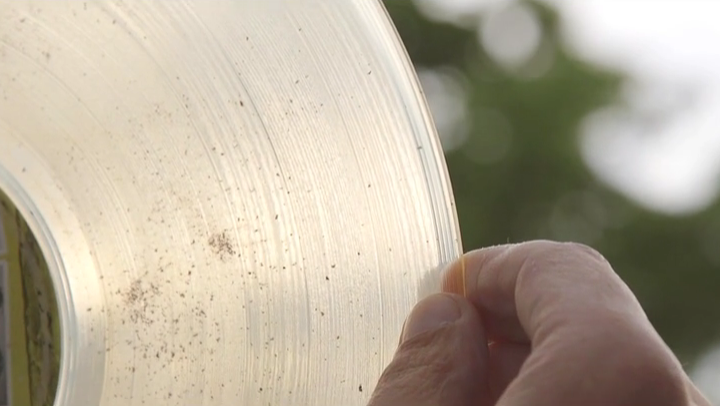
In February, Ted Mills wrote about a new company–And Vinyly–which will press your ashes into a playable vinyl record when your time eventually runs out. The basic service runs $4,000, and it gets you 30 copies of a record containing your ashes. The rub is that you can’t “use copyright-protected music to fill up the 12 minutes per side, so no ‘Free Bird’ or ‘We Are the Champions,’ unfortunately.”
But it does raise the question, as I put on Twitter yesterday… If you could head into eternity pressed into a cherished album, which would you choose? This isn’t necessarily a what-record-would-you-take-to-a-deserted island scenario, taken to the nth degree. Meaning, it’s not necessarily a question of what record would you listen to endlessly, for eternity (although you could choose to make it that). Rather, the question might be: What album do you have a deep, abiding personal connection with? Which record captures your spirit? And, when thrown on the turntable, can keep you sonically in this world?
My pick, Abbey Road.“Come Together” has a bit of anti-establishment bite. “Here Comes the Sun” and “Something” tap into something emotional and nostalgia-inducing for me. And, oh, that medley on Side 2! Just click play any time.
Your picks? Please add them to the comments below.
If you would like to support the mission of Open Culture, consider making a donation to our site. It’s hard to rely 100% on ads, and your contributions will help us continue providing the best free cultural and educational materials to learners everywhere. You can contribute through PayPal, Patreon, and Venmo (@openculture). Thanks!
“None of us has really the ability to understand our path until it’s over,” the celebrated graphic designer Milton Glaser muses less than a minute into the above video.
The 86-year-old Glaser’s many contributions to pop culture—the I ❤ NY logo, the psychedelic portrait of a rainbow-haired Bob Dylan, DC Comics’ classic bullet logo—confer undeniable authority. To the outside eye, he seems to have a pretty firm handle on the path he’s been traveling for lo these many decades. Aspirant designers would do well to give extra consideration to any advice he might share.
As would the rest of us.
His “Ten Things I Have Learned,” originally delivered as part of a talk to the AIGA—a venerable membership organization for design professionals—qualifies as solid life advice of general interest.
Yes, the Internet spawns bullet-pointed tips for better living the way spring rains yield mushrooms, but Glaser, a self-described “child of modernism” who’s still a contender, does not truck in pithy Instagram-friendly aphorisms. Instead, his list is born of reflection on the various turns of a long and mostly satisfying creative career.
We’ve excerpted some of his most essential points below, and suggest that those readers who are still in training give special emphasis to number seven. Don’t place too much weight on number nine until you’ve established a solid work ethic. (See number four for more on that.)
MILTON GLASER”S TEN RULES FOR WORK AND LIFE (& A BONUS JOKE ABOUT A RABBIT).
1. YOU CAN ONLY WORK FOR PEOPLE THAT YOU LIKE
Some years ago I realized that… all the work I had done that was meaningful and significant came out of an affectionate relationship with a client.
2. IF YOU HAVE A CHOICE NEVER HAVE A JOB
Here, Glaser quotes composer John Cage: Never have a job, because if you have a job someday someone will take it away from you and then you will be unprepared for your old age.
3. SOME PEOPLE ARE TOXIC AVOID THEM.
Glaser recommends putting a questionable companion to a gestalt therapy test. If, after spending time with that person “you are more tired, then you have been poisoned. If you have more energy, you have been nourished. The test is almost infallible and I suggest that you use it for the rest of your life.”
4. PROFESSIONALISM IS NOT ENOUGH (or THE GOOD IS THE ENEMY OF THE GREAT)
Glaser concedes that a record of dependable excellence is something to look for in a brain surgeon or auto mechanic, but for those in the arts, “continuous transgression” is thequality to cultivate. Professionalism does not allow for that because transgression has to encompass the possibility of failure and if you are professional your instinct is not to fail, it is to repeat success.
5. LESS IS NOT NECESSARILY MORE
I have an alternative to the proposition that I believe is more appropriate. ‘Just enough is more.’
6. STYLE IS NOT TO BE TRUSTED
Style change is usually linked to economic factors, as all of you know who have read Marx. Also fatigue occurs when people see too much of the same thing too often.
7. HOW YOU LIVE CHANGES YOUR BRAIN
The brain is the most responsive organ of the body…. Thought changes our life and our behavior. I also believe that drawing works in the same way…. Drawing also makes you attentive. It makes you pay attention to what you are looking at, which is not so easy.
8. DOUBT IS BETTER THAN CERTAINTY
One of the signs of a damaged ego is absolute certainty. Schools encourage the idea of not compromising and defending your work at all costs. Well, the issue at work is usually all about the nature of compromise…. Ideally, making everyone win through acts of accommodation is desirable.
9. IT DOESN’T MATTER
Glaser credits essayist Roger Rosenblatt’s Rules for Aging (misidentifying the title as Aging Gracefully) with helping him articulate his philosophy here.It doesn’t matter what you think. It does not matter if you are late or early, if you are here or there, if you said it or didn’t say it, if you are clever or if you were stupid. If you were having a bad hair day or a no hair day or if your boss looks at you cockeyed or your boyfriend or girlfriend looks at you cockeyed, if you are cockeyed. If you don’t get that promotion or prize or house or if you do – it doesn’t matter.
10. TELL THE TRUTH
It’s interesting to observe that in the new AIGA’s code of ethics there is a significant amount of useful information about appropriate behavior towards clients and other designers, but not a word about a designer’s relationship to the public. If we were licensed, telling the truth might become more central to what we do.
BONUS JOKE
A butcher was opening his market one morning and as he did a rabbit popped his head through the door. The butcher was surprised when the rabbit inquired ‘Got any cabbage?’ The butcher said ‘This is a meat market – we sell meat, not vegetables.’ The rabbit hopped off. The next day the butcher is opening the shop and sure enough the rabbit pops his head round and says ‘You got any cabbage?’ The butcher now irritated says ‘Listen you little rodent, I told you yesterday we sell meat, we do not sell vegetables and the next time you come here I am going to grab you by the throat and nail those floppy ears to the floor.’ The rabbit disappeared hastily and nothing happened for a week. Then one morning the rabbit popped his head around the corner and said ‘Got any nails?’ The butcher said ‘No.’ The rabbit said ‘Ok. Got any cabbage?’’
We're hoping to rely on loyal readers, rather than erratic ads. Please click the Donate button and support Open Culture. You can use Paypal, Venmo, Patreon, even Crypto! We thank you!
Open Culture scours the web for the best educational media. We find the free courses and audio books you need, the language lessons & educational videos you want, and plenty of enlightenment in between.