It would be a long time before such innovations as seat belts, baby seats, and airbags were introduced. These safety measures do a fine job of minimizing human damage in motor vehicle accidents, but they can’t prevent the collisions themselves.
To remedy this, Ford, the company responsible for the Model T and hundreds of motor vehicles since, recently enlisted Jaffee and his fellow cartoonists, MK Brown and Bill Plympton, to educate the public on the dangers of distracted driving. Turns out this preventable scourge rivals intoxication and hazardous road conditions as a leading cause of accidents.
Jaffee’s take, animated by J.J. Sedelmaier, above, will never be mistaken for filmmaker Werner Herzog’s harrowing anti-texting documentary PSA, From One Second to the Next, or even Jaffee’s own anti-drunk driving fold-in from MAD’s March 1975 issue.
Instead, he offers a gentle, child-friendly metaphor in which an uncaged bird becomes a havoc-wreaking distraction. (Fortunately, everyone’s wearing his seatbelt, and the little boy is riding in back, in compliance with CDC recommendations.)
National Lampoon alum, Brown, tiptoes closer to the true causes of distraction, with the alien-themed segment, above, also animated by Sedelmaier. If it seems likelier that the alien’s earthling wife might do her henpecking via text rather than actual call these days—well, sometimes dramatic liberties are warranted to get the message across.
Unsurprisingly, Plympton’s self-animated contribution is the most graphic, a direct descendent of his fabulously grotesque cartoon primers 25 Ways To Quit Smoking and How To Kiss. Moral? Assuming you want to keep your teeth in your head, the vegetable matter wedged in between can wait ’til you reach your destination.
Ayun Halliday is an author, illustrator, and Chief Primatologist of the East Village Inky. Her plan for avoiding accidents is to refrain from driving whenever possible. Follow her @AyunHalliday
A few weeks ago, I took my kids to see Paul McCartney launch his One on One Tour in Fresno, California. The highlight? Seeing him play “Hard Day’s Night” and “Love Me Do” live for the first time since the 1960s? Not really. Watching Sir Paul wave at my kids when they held up a “Cheerio Paul” sign? Yeah, that was worth the price of the tickets alone.
But none of that compares to the scene that played out earlier this week in Buenos Aires. Above, watch little Leila sweetly ask Paul to play a little bass, get her wish granted, and rock to some “Get Back.” It’s pretty adorable.
If you would like to support the mission of Open Culture, consider making a donation to our site. It’s hard to rely 100% on ads, and your contributions will help us continue providing the best free cultural and educational materials to learners everywhere. You can contribute through PayPal, Patreon, and Venmo (@openculture). Thanks!
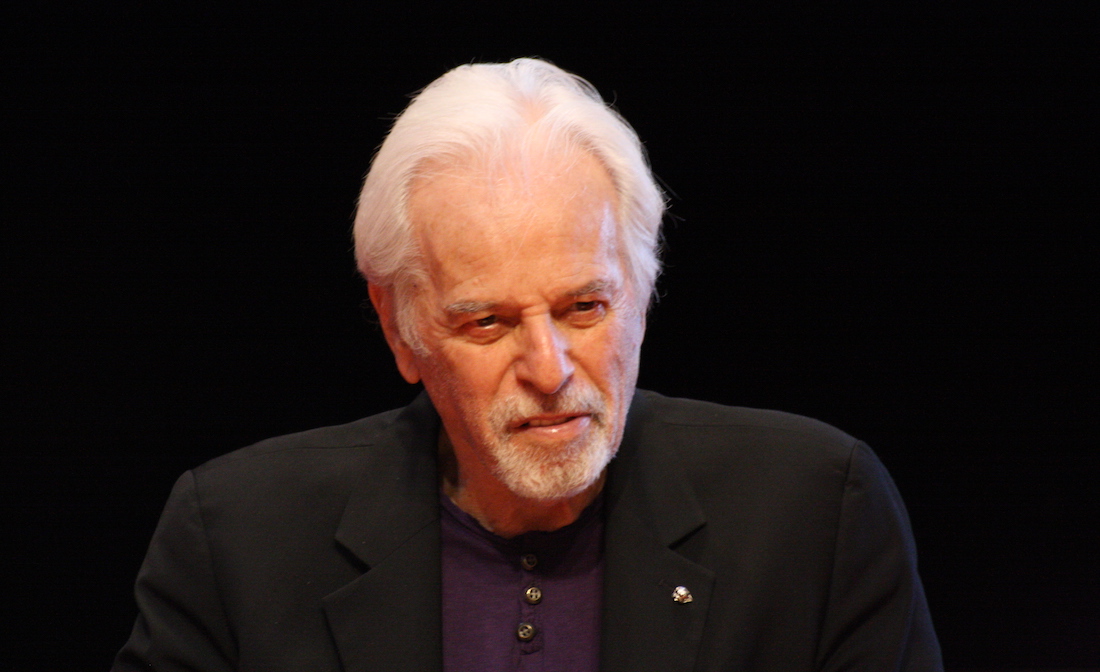
If you’re a fan of science fiction or the films of David Lynch, you’ve surely seen the 1984 film adaptation of Frank Herbert’s cult classic sci-fi novel, Dune (though Lynch himself may prefer that you didn’t). And indeed, it’s very likely that, by now, you’ve heard the incredible story of what Dune might have been, had it been directed ten years earlier by psychedelic Chilean filmmaker, writer, composer, and psychotherapist Alejandro Jodorowsky. Perhaps you even caught Jonathan Crow’s post on this site featuring Jodorowsky’s proposed storyboards—drawn by French artist Moebius—for what would most certainly would have been “a mind-bogglingly grand epic” of a movie. Alas, Jodorowsky’s Dune never came about, though it did later lead to the documentary Jodorowsky’s Dune, which Matt Zoller Seitz pronounced “a call to arms for dreamers everywhere.”
That description applies not only to the film about a film that could have been, but also to the entirety of Jodorowsky’s work, including his—thoroughly bizarre and captivating—early features, El Topo and The Holy Mountain, and the creation of a comic book universe like no other. Called “The Jodoverse,” the world of his comic books is, as writer Warren Ellis says, “astonishingly beautiful and totally mad”—again, a succinct description of Jodorowsky’s every artistic endeavor. Witness below, for example, the stunning trailer for his most recent feature film, 2014’s The Dance of Reality. You may find the visual excesses so overwhelming that you only half-hear the narration.
Listen (or read) carefully, however. Jodorowsky has as much to tell us with his cryptically poetic pronouncements as he does with his visionary imagery. Do you find his epigrams platitudinous, sententious, Pollyannaish, or naïve? Jodorowsky doesn’t mind. He calls, remember, to the dreamers, not the hard-bitten, cynical realists. And if you’re one of the dreamers who hears that call, you’ll find much to love in the list below of Jodorowsky’s 82 Commandments for living. But so too, I think, will the realists. These come from Jodorowsky’s memoir The Spiritual Journey of Alejandro Jodorowsky, and the list comes via Dangerous Minds, who adapted it from “the better part of three pages” of text.
As Jodorowsky frames these maxims in his book, they originated with influential Russian mystic George Gurdjieff, and were told to him by Gurdjieff’s daughter, Reyna d’Assia. Perhaps that’s so. But you’ll note, if you know Jodorowsky’s writing—or simply took a couple minutes time to watch the trailer above—that they sound enough like the author’s own words to have been brought forth from his personal storehouse of accumulated wisdom. In any case, Jodorowsky has always been quick to acknowledge his spiritual teachers, and whether these are his second-hand accounts of Gurdjieff or his own inventions has no bearing on the substance therein.
Often sounding very much like Biblical proverbs or Buddhist precepts, the commandments are intended, d’Assia says in Jodorowsky’s account, to help us “change [our] habits, conquer laziness, and become… morally sound human being[s].” As she remarks in the book, before she delivers the below in a lengthy monologue, “to be strong in the great things, we must also be strong in the small ones.” Therefore…
Ground your attention on yourself. Be conscious at every moment of what you are thinking, sensing, feeling, desiring, and doing.
Always finish what you have begun.
Whatever you are doing, do it as well as possible.
Do not become attached to anything that can destroy you in the course of time.
Develop your generosity ‒ but secretly.
Treat everyone as if he or she was a close relative.
Organize what you have disorganized.
Learn to receive and give thanks for every gift.
Stop defining yourself.
Do not lie or steal, for you lie to yourself and steal from yourself.
Help your neighbor, but do not make him dependent.
Do not encourage others to imitate you.
Make work plans and accomplish them.
Do not take up too much space.
Make no useless movements or sounds.
If you lack faith, pretend to have it.
Do not allow yourself to be impressed by strong personalities.
Do not regard anyone or anything as your possession.
Share fairly.
Do not seduce.
Sleep and eat only as much as necessary.
Do not speak of your personal problems.
Do not express judgment or criticism when you are ignorant of most of the factors involved.
Do not establish useless friendships.
Do not follow fashions.
Do not sell yourself.
Respect contracts you have signed.
Be on time.
Never envy the luck or success of anyone.
Say no more than necessary.
Do not think of the profits your work will engender.
Never threaten anyone.
Keep your promises.
In any discussion, put yourself in the other person’s place.
Admit that someone else may be superior to you.
Do not eliminate, but transmute.
Conquer your fears, for each of them represents a camouflaged desire.
Help others to help themselves.
Conquer your aversions and come closer to those who inspire rejection in you.
Do not react to what others say about you, whether praise or blame.
Transform your pride into dignity.
Transform your anger into creativity.
Transform your greed into respect for beauty.
Transform your envy into admiration for the values of the other.
Transform your hate into charity.
Neither praise nor insult yourself.
Regard what does not belong to you as if it did belong to you.
Do not complain.
Develop your imagination.
Never give orders to gain the satisfaction of being obeyed.
Pay for services performed for you.
Do not proselytize your work or ideas.
Do not try to make others feel for you emotions such as pity, admiration, sympathy, or complicity.
Do not try to distinguish yourself by your appearance.
Never contradict; instead, be silent.
Do not contract debts; acquire and pay immediately.
If you offend someone, ask his or her pardon; if you have offended a person publicly, apologize publicly.
When you realize you have said something that is mistaken, do not persist in error through pride; instead, immediately retract it.
Never defend your old ideas simply because you are the one who expressed them.
Do not keep useless objects.
Do not adorn yourself with exotic ideas.
Do not have your photograph taken with famous people.
Justify yourself to no one, and keep your own counsel.
Never define yourself by what you possess.
Never speak of yourself without considering that you might change.
Accept that nothing belongs to you.
When someone asks your opinion about something or someone, speak only of his or her qualities.
When you become ill, regard your illness as your teacher, not as something to be hated.
Look directly, and do not hide yourself.
Do not forget your dead, but accord them a limited place and do not allow them to invade your life.
Wherever you live, always find a space that you devote to the sacred.
When you perform a service, make your effort inconspicuous.
If you decide to work to help others, do it with pleasure.
If you are hesitating between doing and not doing, take the risk of doing.
Do not try to be everything to your spouse; accept that there are things that you cannot give him or her but which others can.
When someone is speaking to an interested audience, do not contradict that person and steal his or her audience.
Live on money you have earned.
Never brag about amorous adventures.
Never glorify your weaknesses.
Never visit someone only to pass the time.
Obtain things in order to share them.
If you are meditating and a devil appears, make the devil meditate too.
A little more than a year ago, Sheryl Sandberg’s 47-year-old husband, Dave Goldberg, died unexpectedly. The ultimate cause, heart disease. Sandberg has since endured many dark days. And now, for the first time, she’s talking publicly about the whole experience, and particularly about what death has taught her about life.
Sandberg picked the appropriate venue to speak out–the commencement ceremonies at UC-Berkeley this past weekend. Graduation speeches traditionally ask accomplished figures to give life advice to young graduates, and, painful as it might have been, that’s what Sandberg offered. One day or another, you’ll experience howling losses of your own, and what can get you through these experiences–Sandberg wants you to know–is resilience. She remarked:
And when the challenges come, I hope you remember that anchored deep within you is the ability to learn and grow. You are not born with a fixed amount of resilience. Like a muscle, you can build it up, draw on it when you need it. In that process you will figure out who you really are—and you just might become the very best version of yourself.
Class of 2016, as you leave Berkeley, build resilience.
Build resilience in yourselves. When tragedy or disappointment strikes, know that you have the ability to get through absolutely anything. I promise you do. As the saying goes, we are more vulnerable than we ever thought, but we are stronger than we ever imagined.
If you would like to support the mission of Open Culture, consider making a donation to our site. It’s hard to rely 100% on ads, and your contributions will help us continue providing the best free cultural and educational materials to learners everywhere. You can contribute through PayPal, Patreon, and Venmo (@openculture). Thanks!
Earlier this month, 1999 members of Choir!Choir!Choir!–a group that meets weekly and sings their hearts out–showed up at Toronto’s Massey Hall and paid tribute to Prince. In a matter of hours, writes Toronto Life, “choir leaders Nobu Adilman and Daveed Goldman led the crowd through a three-part arrangement of Prince’s “When Doves Cry.” And the result is touching. All proceeds went to the Regent Park School of Music and the Share The Music programme. You can see the group’s earlier tributes to David Bowie here, and many other performances on their YouTube channel.
If you would like to support the mission of Open Culture, consider making a donation to our site. It’s hard to rely 100% on ads, and your contributions will help us continue providing the best free cultural and educational materials to learners everywhere. You can contribute through PayPal, Patreon, and Venmo (@openculture). Thanks!
For many of us, washi paper is the art supply equivalent of a dish that’s “too pretty to eat.” I love to look at it, but would be loathe to mar its beauty with my amateur creative efforts.
Kurotani has the distinction of being Japan’s oldest paper-making town, and as documented by filmmaker Kuroyanagi Takashi, above, the washi process has changed little in 800 years.
In the pre-industrial age, washi-making was seasonal. Farmers planted the paper mulberry (kozo), mitsumata, and gampi plants essential to the process along with their food crops. Come havest-time, they would soak these plants’ fibrous inner barks until they were soft enough to be cleaned and pounded.
Then as now, the resulting pulp was added mixed with liquid and a mucilage to yield a (not particularly delicious sounding, and definitely not too pretty to eat…) spreadable paste.
The sheets are formed on bamboo screens, then stacked and pressed until dry.
The end result is both strong and flexible, making it a favorite of bookbinders. Its absorbency is prized by printmakers, including Rembrandt.
If you have a yen to witness the labor-intensive, traditional process up close, Dutch washi craftsman Rogier Uitenboogaart runs a guest house as part of his studio in nearby Kamikoya.
The rest of us must content ourselves with Takashi’s meditative 5‑minute documentary.
Ayun Halliday is an author, illustrator, and Chief Primatologist of the East Village Inky zine. She writes a monthly column about people who love their jobs for Mainichi Weekly, a bilingual Japanese newspaper. Follow her @AyunHalliday
As various nature documentaries over the years have made explicit, the animal kingdom possesses courtship rituals of such yearning and grace, they can make the erotic fumblings of our species seem a very clumsy dance indeed.
The above spot for Japan’s first condom manufacturer, Sagami Industries, offers a vision of how humans might bring a little animal feeling to their tender moments.
(It’s worth noting that while this delight is sponsored by a condom company, humans are the only animal to take prophylactic measures to ward off sexually transmitted diseases and unwanted pregnancies.)
But without Rossellini’s plainspoken narration, this Act of Love remains mysterious, until the end, when the identity of the creatures the human dancers are embodying is revealed. Those of us who aren’t zoologists will likely find that their clothing provides the clearest clues up until that point.
Sagami’s English website takes a broader view, with in-depth reports on the sexual practices of 73 different beasts, birds and insects. Taxonomy, habitat, and size range are noted — a scientific approach to what could very well serve as non-human online dating profiles.
Lionesses’ unabashed preference for virile young males gets them dubbed “true cougars.”
And E.B. White fans may find themselves shocked by the vigor of coupling orb weavers, seemingly the one fact of spider life Charlotte refrained from explaining to her piglet friend, Wilbur :
After mating, the male suddenly severs the mating thread so that both he and the female end up dangling at separate ends. This may look like a very abrupt parting of ways, but not so fast! The male immediately re-strings his mating thread and resumes his strumming. And despite having been cast off so suddenly, the female again falls under the spell of his courtship vibrations, transferring to the new mating thread to mate a second time. As soon as they do so, the male severs the thread once more so that the two spiders can go through the whole routine again…and again and again and again.
Last year, we highlighted the Harvard Grant Study and The Glueck Study, two 75-year studies that have traced the lives and development of hundreds of men, trying to get answers to one big question: How can you live a long and happy life? For answers, watch Robert Waldinger above. He’s the director of what’s now called the Harvard Study of Adult Development and also an associate professor of psychiatry at Harvard Medical School.
According to the decades-long study, you won’t get health and happiness from wealth and fame (nor hard work), the mirages that many Americans chase after. Instead they come from something a little more obtainable, if you work at it—good, strong relationships with family, friends, colleagues, and folks in your community. These relationships, the study finds, protect us mentally and physically. They increase our happiness and extend our lives, whereas, conversely, loneliness and corrosive relationships put us into decline sooner than we’d like. The key takeaway here: good relationships are the foundation on which we build the good life. Start putting that into practice today.
If you would like to support the mission of Open Culture, consider making a donation to our site. It’s hard to rely 100% on ads, and your contributions will help us continue providing the best free cultural and educational materials to learners everywhere. You can contribute through PayPal, Patreon, and Venmo (@openculture). Thanks!
We're hoping to rely on loyal readers, rather than erratic ads. Please click the Donate button and support Open Culture. You can use Paypal, Venmo, Patreon, even Crypto! We thank you!
Open Culture scours the web for the best educational media. We find the free courses and audio books you need, the language lessons & educational videos you want, and plenty of enlightenment in between.