And now for a different kind of graduation speech.
Most commencement speeches provide answers of sorts–pieces of wisdom you can carry with you, life strategies you can use down the road. Above James Ryan, Dean of Harvard’s School of Education, offers something else–not answers, but questions, the five essential questions to ask as you move through life. He elaborates on each above:
1.) Wait, what?
2.) I wonder, why/if?
3.) Couldn’t we at least?
4.) How can I help?
5.) What really matters?
Bonus question: And did you get what you wanted out of life, even so?
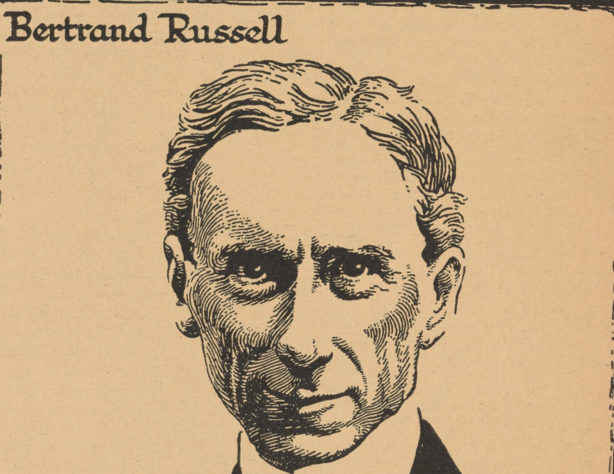
“The whole problem with the world is that fools and fanatics are always so certain of themselves, but wiser people so full of doubts.” — Bertrand Russell
Our hearts go out to the families and friends who lost loved ones in Orlando this morning.
If you’re a veteran reader of Open Culture, you may remember a 2010 video tribute called “Kubrick vs Scorsese.” To make the video, Leandro Copperfield, a young cinephile living in Rio de Janeiro, spent 25 days re-watching 35 films, selecting more than 500 scenes, and then editing them into an homage to his two favorite directors. Watch it here.
No doubt, it must have come as a surprise when, six years later, Copperfield received a video from Scorsese himself, praising the montage Leandro made so long ago. Again, if you’re an old-timer here, you’ll know that this isn’t the first time Scorsese has shown kindness to younger artists. In 2014, we recounted the story of Colin Levy, a teenage filmmaker who met with Scorsese, and came away with a list of 39 Foreign Films Essential for a Young Filmmaker. Props to Marty for being a good mentor and teacher too.
If you would like to support the mission of Open Culture, consider making a donation to our site. It’s hard to rely 100% on ads, and your contributions will help us continue providing the best free cultural and educational materials to learners everywhere. You can contribute through PayPal, Patreon, and Venmo (@openculture). Thanks!
In 1969, Laurence J. Peters, a professor at the University of Southern California, published the bestselling book, The Peter Principle: Why Things Always Go Wrong, where he advanced this theory: “In a hierarchy every employee tends to rise to his level of incompetence … in time every post tends to be occupied by an employee who is incompetent to carry out its duties.” Meanwhile, the real work gets “accomplished by those employees who have not yet reached their level of incompetence.”
Above, Adam Westbrook offers a short introduction to “The Peter Principle” and its corollary, the concept of “creative incompetence.” If you take “The Peter Principle” seriously, you’ll know that not all promotions are good ones. As you move upward, you might find that you’re dealing with more headaches .… and less work that you truly enjoy. To preempt the bad promotion, Peters suggested (somewhat light-heartedly) engaging in some “creative incompetence”–that is, creating “the impression that you have already reached your level of incompetence. Creative incompetence will achieve the best results if you choose an area of incompetence which does not directly hinder you in carrying out the main duties of your present position.” In short, find the job you really like, do it well, but give your boss the occasional oddball reason not to mess with a good thing.
Got examples of your own creative incompetence to recommend? Feel free to add them in the comments below.
If you would like to support the mission of Open Culture, consider making a donation to our site. It’s hard to rely 100% on ads, and your contributions will help us continue providing the best free cultural and educational materials to learners everywhere. You can contribute through PayPal, Patreon, and Venmo (@openculture). Thanks!
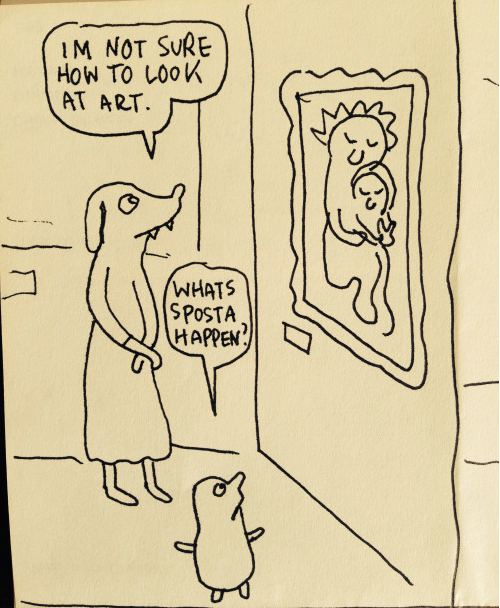
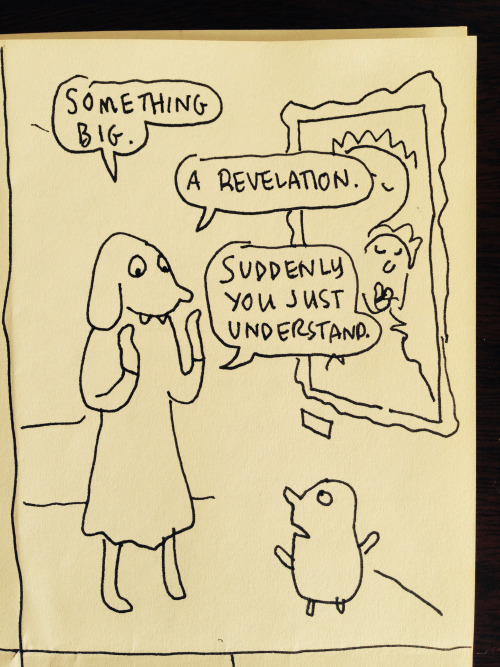
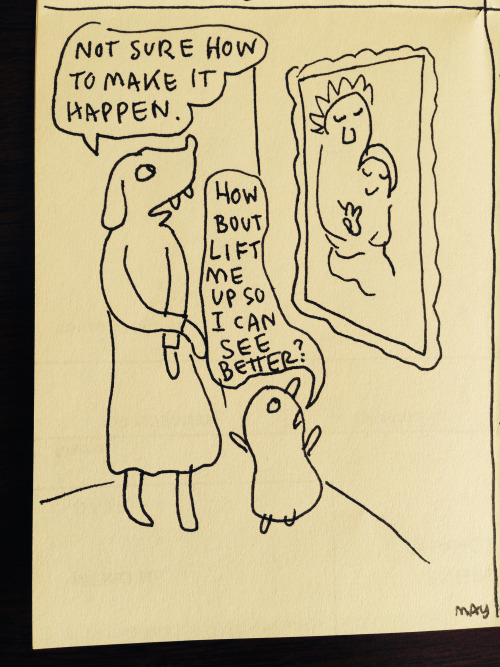
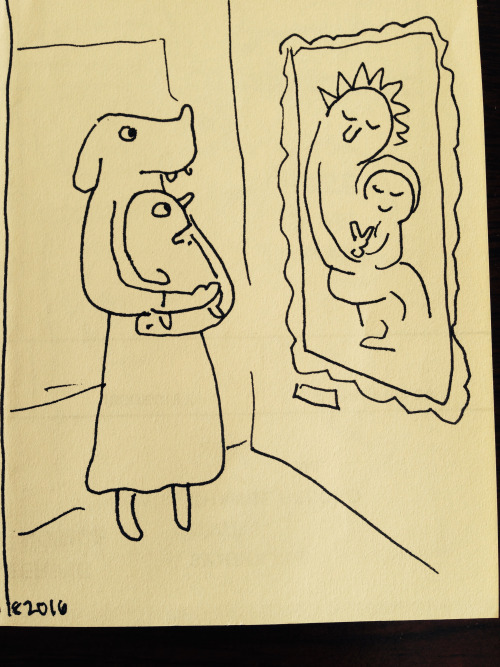
Despite the small, narrative doodle posted to her Tumblr a couple of weeks back, inspirational teacher and cartoonist Lynda Barry clearly has no shortage of strategies for viewing art in a meaningful way.
She takes a Socratic approach with students and readers eager to forge a deeper personal connection to images.
She traces this tendency back forty years, to when she studied with Marilyn Frasca at Evergreen State College. Could Frasca have anticipated what she wrought when she asked the young Barry, “What is an image?”
For Barry, who claims to have spent over forty years trying to answer the above question, there will almost always be an emotional component. In a 2010 interview with The Paris Review, she addressed the ways in which art, visual and otherwise, can fill certain crucial holes:
In the course of human life we have a million phantom-limb pains—losing a parent when you’re little, being in a war, even something as dumb as having a mean teacher—and seeing it somehow reflected, whether it’s in our own work or listening to a song, is a way to deal with it.
The Greeks knew about it. They called it catharsis, right? And without it we’re fucked. I think this is the thing that keeps our mental health or emotional health in balance, and we’re born with an impulse toward it.
No wonder the snaggle-toothed dog woman on Barry’s Tumblr looks so anxious. She craves that elusive something that never much troubled Helen Hockinson’s museum-going comic matrons.
(Had revelation been on the menu, those ladies would have dutifully paged through the most highly recommended guidebook of the day, confident they’d find it within those pages.)
These days, the internet abounds with pointers on how to get the most from art.
Another critic, New York magazine’s firebrand, Jerry Saltz, recommends an aggressively tactile approach for those who would look at art like an artist. Get up close. Cop a feel. Try to see how any given piece is made. (He himself is given to contemplating art with his hips thrust forward and head tilted back as far as it will go, in duplication of Jasper Johns’ stance.)
Of course, some of us don’t mind a hint or two to help us feel we’re on the right track. Those in that camp might enjoy the Metropolitan Museum of Art’s 82nd and 5th series, in which expert curators wax rhapsodic about their love of particular works in the collection.
You understand that this is just the tip of the proverbial ‘berg…
Readers, if you have any tips for achieving revelation through art, please share them by leaving a comment below.
And don’t forget to lift your shorter companion up so he can see better.
Tonight, we pass along the sad news that Muhammad Ali, one of the great athletes and personalities of our time, has passed away at the age of 74. Having battled Parkinson’s Disease for decades, his passing doesn’t come as a complete surprise. But, for anyone who remembers Ali in his prime, this news will certainly come as a blow. There is perhaps not a better way to remember Ali’s life and times than to watch the 1978 episode of This Is Your Life, the long-running TV show that followed this format:
Each week, an unsuspecting celebrity would be lured by some ruse to a location near the studio. The celebrity would then be surprised with the news that they are to be the featured guest. Next, the celebrity was escorted into the studio, and one by one, people who were significant in the guest’s life would be brought out to offer anecdotes. At the end of the show, family members and friends would surround the guest, who would then be presented with gifts.
This show (recorded in England in this case) is an endearing tribute to the champ, all the more moving to watch now because Ali is gone. The highlight comes around the 38 minute mark, when Smokin Joe Frazier, Ali’s great rival, pays a surprising visit.
Muhammad you will be missed.
If you would like to support the mission of Open Culture, consider making a donation to our site. It’s hard to rely 100% on ads, and your contributions will help us continue providing the best free cultural and educational materials to learners everywhere. You can contribute through PayPal, Patreon, and Venmo (@openculture). Thanks!
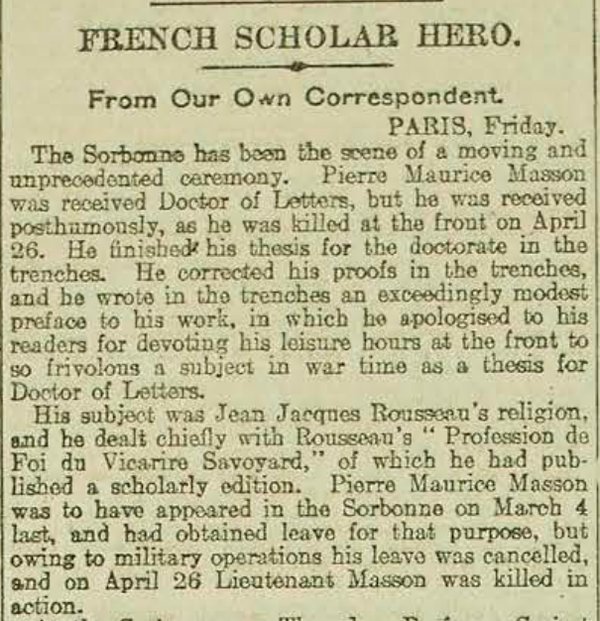
Connie Ruzich, a WWI poetry blogger, recently highlighted on Twitter a historic newspaper clipping that will put the travails of academe into perspective. Getting a Ph.D. is always hard. But hard is relative.
Case in point…
100 years ago, Pierre Maurice Masson, a young scholar, found himself fighting in north-eastern France. Drafted in 1914, Masson rose through the military ranks, moving from sergeant, to sub-lieutenant, to lieutenant. Meanwhile, in the discomfort of the trenches, he continued working on his doctoral thesis–a long dissertation on the religious training of Jean-Jacques Rousseau. By the spring of 1916, he had completed the text, corrected the proofs, and drafted an introduction (of course, that comes last). Finally, he announced to friends, “The monster is ready!” And he sought a leave of absence to return to the Sorbonne to receive his doctorate.
Alas, that didn’t happen. The newspaper clip above tells the rest of the poignant story.
You can read Masson’s posthumously published thesis, La formation religieuse de Rousseau, free online.
If you would like to support the mission of Open Culture, consider making a donation to our site. It’s hard to rely 100% on ads, and your contributions will help us continue providing the best free cultural and educational materials to learners everywhere. You can contribute through PayPal, Patreon, and Venmo (@openculture). Thanks!
97 percent or more of actively publishing climate scientists agree: Climate-warming trends over the past century are extremely likely due to human activities. In addition, most of the leading scientific organizations worldwide have issued public statements endorsing this position.
In view of such numbers, its understandable that a suburban Joe with a freezer full of factory-farmed beef and multiple SUVs in his garage would cling to the position that global warming is a lie. It’s his last resort, really.
But such self-rationalizations are not truth. They are truthiness.
Or to use the old-fashioned word favored by philosopher Harry Frankfurt, above: bullshit!
Frankfurt–a philosopher at Princeton and the author of On Bullshit–allows that bullshit artists are often charming, or at their very least, colorful. They have to be. Achieving their ends involves engaging others long enough to persuade them that they know what they’re talking about, when in fact, that’s the opposite of the truth.
Speaking of opposites, Frankfurt maintains that bullshit is a different beast from an out-and-out lie. The liar makes a specific attempt to conceal the truth by swapping it out for a lie.
The bullshit artist’s approach is far more vague. It’s about creating a general impression.
There are times when I admit to welcoming this sort of manure. As a maker of low budget theater, your honest opinion of any show I have Little Red Hen’ed into existence is the last thing I want to hear upon emerging from the cramped dressing room, unless you truly loved it.
I’d also encourage you to choose your words carefully when dashing a child’s dreams.
But when it comes to matters of public policy, and the public good, yes, transparency is best.
It’s interesting to me that filmmakers James Nee and Christian Britten transformed a portion of their learned subject’s thoughts into voiceover narration for a lightning fast stock footage montage. It’s diverting and funny, featuring such ominous characters as Nosferatu, Bill Clinton, Charlie Chaplin’s Great Dictator, and Donald Trump, but isn’t it also the sort of misdirection sleight of hand at which true bullshitters excel?
Frankfurt expands upon his thoughts on bullshit in his aptly titled bestselling book,On Bullshit and its followup On Truth.
We're hoping to rely on loyal readers, rather than erratic ads. Please click the Donate button and support Open Culture. You can use Paypal, Venmo, Patreon, even Crypto! We thank you!
Open Culture scours the web for the best educational media. We find the free courses and audio books you need, the language lessons & educational videos you want, and plenty of enlightenment in between.