I like old newspaper, smoothing it out to read about what was happening on the day an older relative packed away the good crystal or some other fragile tchotchke.
Traveling in India, I dug how the snacks I purchased to eat on the train came wrapped in old book pages. When my traveling companion realized he had lost his journal, there was comfort in knowing that it would be reincarnated as cones to hold delicious chana jor garam.
Taking a thrift store frame apart, I was thrilled to discover that behind the previous owners kittens in a basket print lurked a homemade Mother’s Day card from the 40’s and a calendar page that noted the date someone named David quit drinking. (I sent it along to Found Magazine.)
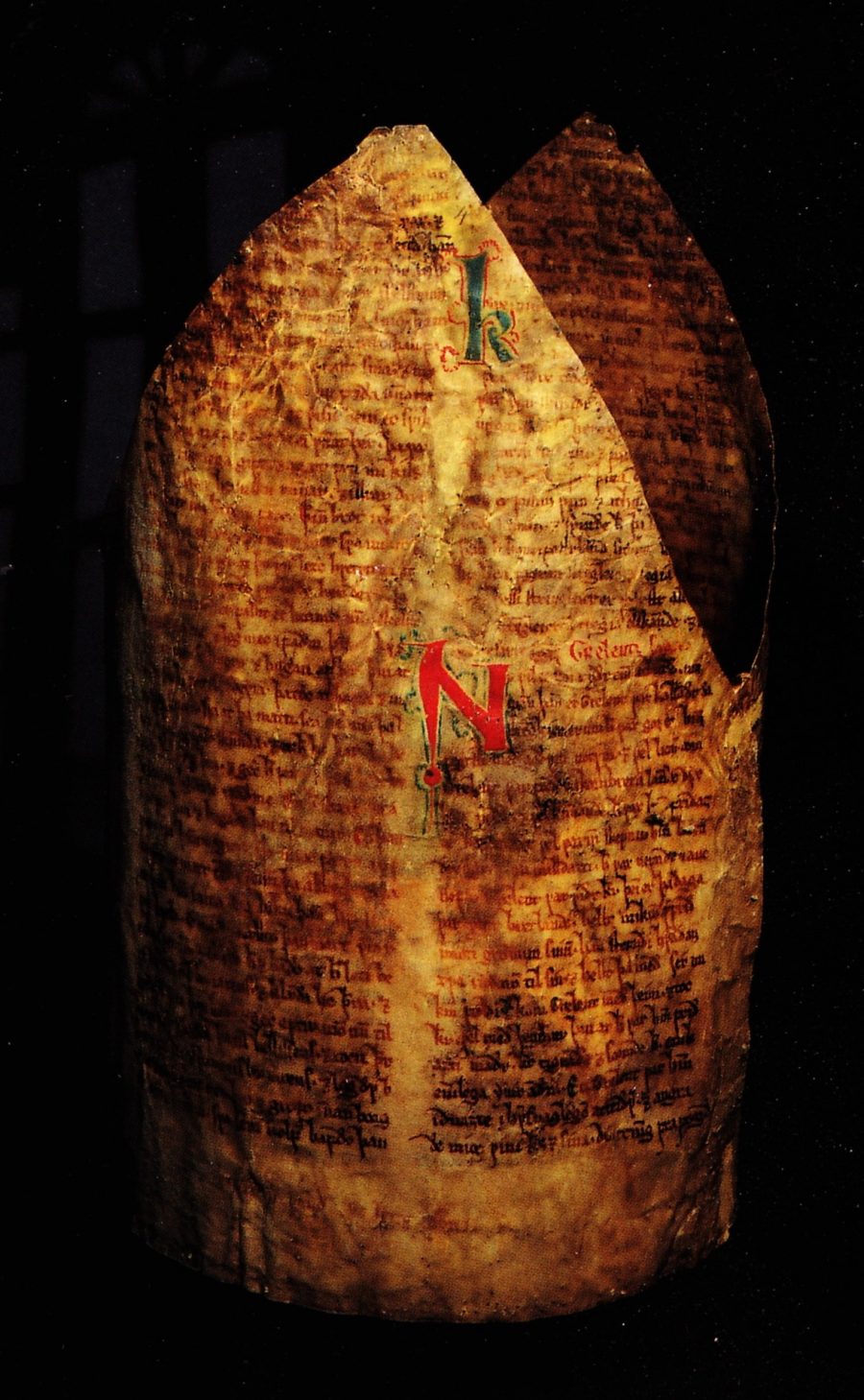
Apparently, it’s a rich tradition, putting old pages to good use, once they start feeling like they’ve outlived their intended purpose. The bishop likely didn’t know the specifics on the material that made his hat stand up. I’ll bet the sisters of the German Cistercian convent where the dress above originated were more concerned with the outward appearance of the garments they were stitching for their wooden statues than the not-for-display lining.
As Dutch art historian Erik Kwakkel explains on his medievalfragments blog, the invention of the Gutenberg press demoted scads of handwritten text to more proletarian purpose. Ultimately, it’s not as grim as it sounds:
the dismembered books were to have a second life: they became travelers in time, stowaways… with great and important stories to tell. Indeed, stories that may otherwise not have survived, given that classical and medieval texts frequently only come down to us in fragmentary form. The early history of the Bible as a book could not be written if we were to throw out fragment evidence.
For the last three decades my right ankle has been the site of a deeply botched tattoo. It was supposed to be a yin yang, but with every passing year, it looks more and more like a cancerous mole. The drunken Vietnam Vet who administered it barely glanced at the design taking shape on my once virgin skin as he chatted with a pal. I was too intimidated to say, “Um…is it just me or are you filling in the white circle?” (I convinced myself that he knew what he was doing, and the ink would recede as it healed. Needless to say…)
My pathetic, little yin-ya’ is an embarrassment in an era of intricate four-color sleeves and souped up rockabilly gorgeousness, but I confess, I’ve grown fond of it. The fact that I have an out-of-balance symbol for balance permanently engraved onto my body is far more appropriate than the poorly grasped flash art could have been. It’ll be with me til the day I die.
I feel fortunate to have developed tender feelings for my bush league modification. Claudia Aguirre’s TED-Ed lesson “What Makes Tattoos Permanent,” above, does not make an easy case for removal.
In the words of your grandma, don’t embellish your birthday suit with any old junk.
Choose wisely! If you’re veering toward a Tasmanian devil or a rose, do yourself a favor and browse the Museum of Online Museums. Feel a kinship with anything there? Good! Once you’ve figured out how to best feature it on your hide, take Aguirre’s anatomy-based quiz. See if it’s true that you’ll be barred from burial in a Jewish cemetery. Your tattoo artist will likely be impressed that you cared enough to do some research. Watch a couple of episodes of the Smithsonian’s Tattoo Odysseyfor good measure.
Then lay in a tube of Preparation H, and prepare to love whatever you wind up with. It’s a lot easier than the pain of regret.
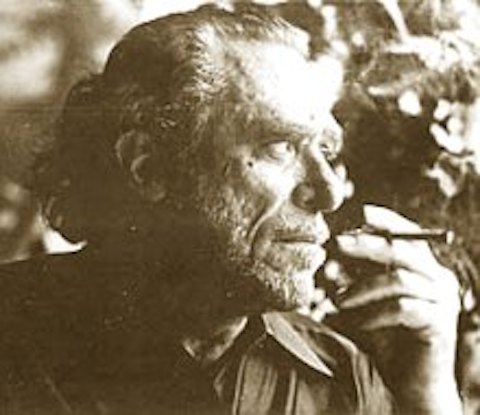
Charles Bukowski—or “Hank” to his friends—assiduously cultivated a literary persona as a perennial drunken deadbeat. He mostly lived it too, but for a few odd jobs and a period of time, just over a decade, that he spent working for the United States Post Office, beginning in the early fifties as a fill-in letter carrier, then later for over a decade as a filing clerk. He found the work mind-numbing, soul-crushing, and any number of other adjectives one uses to describe repetitive and deeply unfulfilling labor. Actually, one needn’t supply a description—Bukowski has splendidly done so for us, both in his fiction and in the epistle below unearthed by Letters of Note.
In Bukowski’s first novel Post Office (1971), the writer of lowlife comedy and pathos builds in plenty of wish-fulfillment for his literary alter ego Henry Chinaski. Kyle Ryan at The Onion’s A.V. Club sums it up succinctly: “In Bukowski’s world, Chinaski is practically irresistible to women, despite his alcoholism, misogyny, and general crankiness.” In reality, to say that Bukowski found little solace in his work would be a gross understatement. But unlike most of his equally miserable co-workers, Bukowski got to retire early, at age 49, when, in 1969, Black Sparrow Press publisher John Martin offered him $100 a month for life on the condition that he quit his job and write full time.
Needless to say, he was thrilled, so much so that he penned the letter below fifteen years later, expressing his gratitude to Martin and describing, with characteristic brutal honesty, the life of the average wage slave. And though comparisons to slavery usually come as close to the level of absurd exaggeration as comparisons to Nazism, Bukowski’s portrait of the 9 to 5 life makes a very convincing case for what we might call the thesis of his letter: “Slavery was never abolished, it was only extended to include all the colors.”
After reading his letter below, you may feel a great deal more sympathy, if you did not already, with Bukowski’s life choices. You may find yourself, in fact, re-evaluating your own.
8–12-86
Hello John:
Thanks for the good letter. I don’t think it hurts, sometimes, to remember where you came from. You know the places where I came from. Even the people who try to write about that or make films about it, they don’t get it right. They call it “9 to 5.” It’s never 9 to 5, there’s no free lunch break at those places, in fact, at many of them in order to keep your job you don’t take lunch. Then there’s OVERTIME and the books never seem to get the overtime right and if you complain about that, there’s another sucker to take your place.
You know my old saying, “Slavery was never abolished, it was only extended to include all the colors.”
And what hurts is the steadily diminishing humanity of those fighting to hold jobs they don’t want but fear the alternative worse. People simply empty out. They are bodies with fearful and obedient minds. The color leaves the eye. The voice becomes ugly. And the body. The hair. The fingernails. The shoes. Everything does.
As a young man I could not believe that people could give their lives over to those conditions. As an old man, I still can’t believe it. What do they do it for? Sex? TV? An automobile on monthly payments? Or children? Children who are just going to do the same things that they did?
Early on, when I was quite young and going from job to job I was foolish enough to sometimes speak to my fellow workers: “Hey, the boss can come in here at any moment and lay all of us off, just like that, don’t you realize that?”
They would just look at me. I was posing something that they didn’t want to enter their minds.
Now in industry, there are vast layoffs (steel mills dead, technical changes in other factors of the work place). They are layed off by the hundreds of thousands and their faces are stunned:
“I put in 35 years…”
“It ain’t right…”
“I don’t know what to do…”
They never pay the slaves enough so they can get free, just enough so they can stay alive and come back to work. I could see all this. Why couldn’t they? I figured the park bench was just as good or being a barfly was just as good. Why not get there first before they put me there? Why wait?
I just wrote in disgust against it all, it was a relief to get the shit out of my system. And now that I’m here, a so-called professional writer, after giving the first 50 years away, I’ve found out that there are other disgusts beyond the system.
I remember once, working as a packer in this lighting fixture company, one of the packers suddenly said: “I’ll never be free!”
One of the bosses was walking by (his name was Morrie) and he let out this delicious cackle of a laugh, enjoying the fact that this fellow was trapped for life.
So, the luck I finally had in getting out of those places, no matter how long it took, has given me a kind of joy, the jolly joy of the miracle. I now write from an old mind and an old body, long beyond the time when most men would ever think of continuing such a thing, but since I started so late I owe it to myself to continue, and when the words begin to falter and I must be helped up stairways and I can no longer tell a bluebird from a paperclip, I still feel that something in me is going to remember (no matter how far I’m gone) how I’ve come through the murder and the mess and the moil, to at least a generous way to die.
To not to have entirely wasted one’s life seems to be a worthy accomplishment, if only for myself.
Koko the Gorilla, who celebrates her 43rd birthday today, keeps pretty down-to-earth company for a celebrity. While others court the paparazzi with their public canoodling and high profile Twitter feuds, Koko’s most comfortable hanging with non-marquee-name kittens and palsPenny Patterson and Ron Cohn, the human doctors who’ve headed her caregiving team for the past 41 years.
Her privacy is closely guarded, but there have been a handful of times over the years when her name has been linked to other celebs…
Above, actor William Shatner recalls how, as a younger man, he called upon her in her quarters. He was nervous, approaching submissively, but determined not to retreat. “I love you, Koko,” he told her. “I love you.”
She responded by gripping a part of his anatomy that just happens to be one of the thousand or so words that comprise her American Sign Language vocabulary. One that takes two hands to sign…
Their time was fleeting, but as evidenced below, the connection was intense.
Comedian Robin Williams also claims to have shared “something extraordinary” with Koko. Their flirtation seems innocent enough, despite Williams’ NSFW description of their encounter, below. (He undercuts his credibility by referring to her as a “silverback”.)
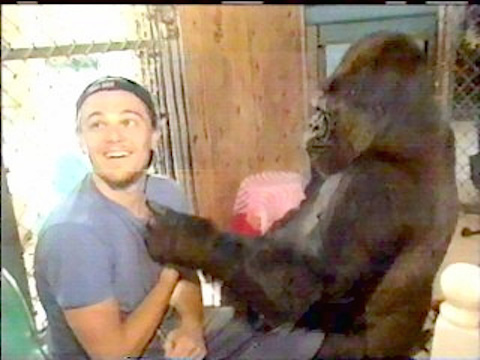
Leonardo DiCaprio is yet another famous admirer to be caught on camera with Koko. Is it any wonder that she embodies all of the qualities he claims to look for in a potential love interest: “humility, a sense of humor and not a lot of drama”? No word as to how the Titanic hunk measures up against the qualities Koko looks for in a mate, though footage of their one and only meeting has been known to get fans fantasizing in the comments section: “I wish I was that gorilla ;) lol I looooooooooooooooove u Leo”
From the lady’s perspective, Koko’s sweetest celebrity encounter was almost certainly with her favorite, the late children’s television host, Fred Rogers. She removed his shoes and socks, he studied her lips, love was a primary topic and yet their time together does not invite prurient speculation. I can’t think of another human male as deserving of her affection.
According to the film summary, the new documentary “depicts the life of American computer programmer, writer, political organizer and Internet activist Aaron Swartz. It features interviews with his family and friends as well as the internet luminaries who worked with him. The film tells his story up to his eventual suicide after a legal battle, and explores the questions of access to information and civil liberties that drove his work.”
Follow Open Culture on Facebook and Twitter and share intelligent media with your friends. Or better yet, sign up for our daily email and get a daily dose of Open Culture in your inbox. And if you want to make sure that our posts definitely appear in your Facebook newsfeed, just follow these simple steps.
If you dream of becoming the next Disney Channel star, you’d do well to heed the advice of casting director Judy Taylor, who uses “read” and “talent” according to their industry definitions, and seems unlikely to cut anyone slack for youth or inexperience.
If, however, you’ve got the soul of a poet, a painter, a musical adventurer, all three, or none of the above, I suggest falling to your knees and thanking Denmark’s Louisiana Museum of Modern Art for providing you with an alternative. The weekly videos on art, literature, design and architecture for its Louisiana Channel are a goldmine of inspiration for non-mainstream types both young and old, but certain segments speak explicitly to those just embarking on the journey.
As any number of us geezers can attest, Patti Smith and David Byrne speak with authority. It’s okay if you’ve never heard of them. If you were three or four decades further along, you would have.
(As to Marina Abramović, go easy on your parents if they need to spend a moment or two dialing her up on Wikipedia. I’ll bet Patti or David wouldn’t peer down their noses at someone for not recognizing one of the world’s greatest living performance artists. Excuse the dangling preposition, but she’s definitely someone worth finding out about.)
I realize I don’t speak for most of America, but for me, these guys loom larger than Jay‑Z and Beyonce combined. I also realize that in terms of both wealth and name recognition, there’s a stable full of teen celebrities who leave them in the dust.
Interesting how all three resist the notion of talent as something to be commodified.
Abramović, above, speaks of artistic exploration in literal terms. In her view difficult work should be pursued with the bravery of 17th-century sailors who sallied forth, believing that the world was flat. I suspect she’s a tougher cookie than casting director Taylor. Witness her differentiation between garden variety artists and great artists, the month long rubbish basket task she assigned her students, and the rigorousness of her own practice.
Her fellow trailblazer Smith has a more maternal touch. The path she promotes is similarly twisty, low-paying, and hard, but counterbalanced with “the most beautiful experiences.”
Byrne tackles some of the more practical aspects of committing to the artistic way. To wit, there’s no shame in day jobs, even if it’s been eons since he was in a position to need one. He also makes some very valid points about technology, below, with nary a peep as to the impossibility of concentrating on one’s studies when one is checking Twitter every two seconds. We all stand to benefit.
- Ayun Halliday is the author of seven books, including No Touch Monkey! And Other Travel Lessons Learned Too Late. Follow her @AyunHalliday
The comedian Jim Carrey, who remains dedicated to the practice of Transcendental Meditation, gave a commencement speech at the Maharishi University of Management, which combines teaching traditional subjects (math, business administration, etc.) with less conventional topics like TM and “Sustainable Living.” In the speech, Carrey put some things in perspective for the graduates: “The decisions we make in this moment are based in either love or fear. So many of us choose our path out of fear disguised as practicality. What we really want seems impossibly out of reach and ridiculous to expect so we never ask the universe for it.” And then, drawing on his own personal experience, particularly as a child, he offers this advice: “I learned many, many lessons from my father, but not least of which is that you can fail at something you don’t want, so you might as well take a chance doing what you love.” You can watch the full speech here.
We're hoping to rely on loyal readers, rather than erratic ads. Please click the Donate button and support Open Culture. You can use Paypal, Venmo, Patreon, even Crypto! We thank you!
Open Culture scours the web for the best educational media. We find the free courses and audio books you need, the language lessons & educational videos you want, and plenty of enlightenment in between.