Ah, the Buzzfeedlisticle. Gawker’s Tom Scocca recently described the dreaded online publishing phenom as “aggressively designed to ‘go viral’ within a specific microtargeted population and to be worthless to every other reader on the planet.” Maybe something of an exaggeration. Then again, it seems that “17 Things Bears Are Better at Than You” may reach a minor contingent of readers, and “7 Fantastic Needlepoint Fashion Magazine Covers” may indeed have limited appeal. Of course, the listicle precedes the internet, and drives content beyond Buzzfeed. A staple of Cosmo, it’s always been a narrow form, except when it comes to such irresistible clickbait as “before they were famous” lists, such as this selection of awkward photos of TV personalities.
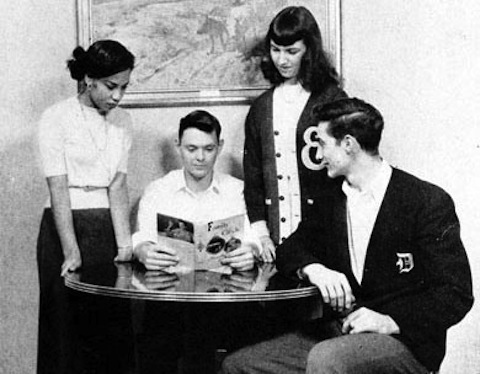
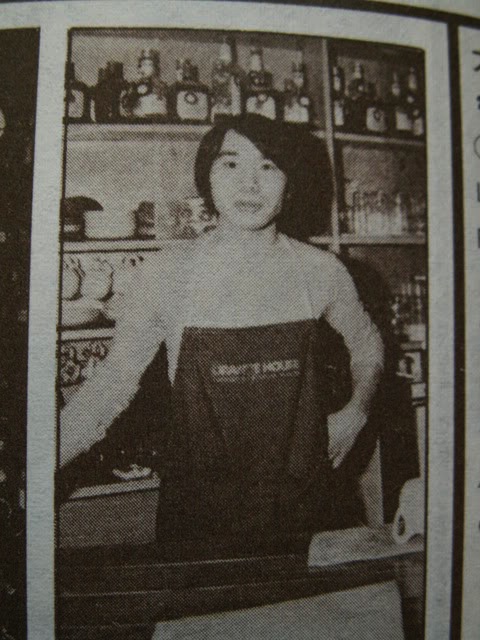
But sometimes even Buzzfeed takes the high road. A recent spread, for instance, showcased 24 photos of famous authors as young, anonymous men and women. Take, for example, the pic at the top of a teenage Toni Morrison (then Chloe Wofford) from 1949. Taken at Ohio’s Lorraine High School, we see senior class treasurer Morrison posed with serious intent, gazing at some sort of magazine with three of her classmates. Buzzfeed pilfered this photo from another literary listicle, Flavorwire’s “20 Famous Authors’ Adorable School Photos.” Not a Morrison fan? No worries. You may be enlightened or amused by the photo above, of a young Haruki Murakami, working in his Tokyo jazz bar, the Peter Cat, before writing his first novel, Hear the Wind Sing, in 1979.
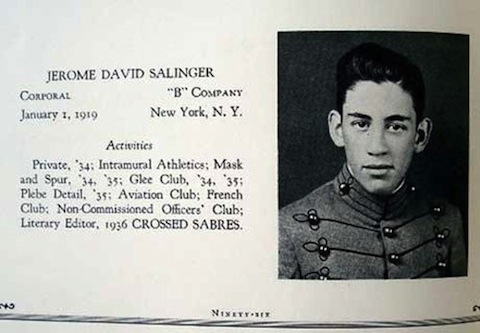
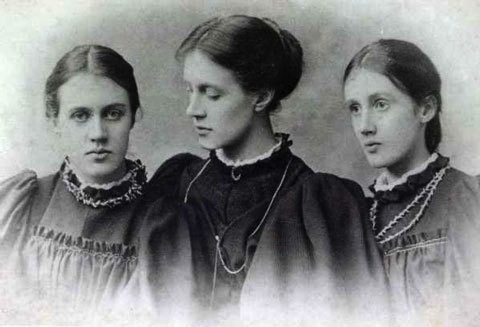
Then we have the famous recluse J.D. Salinger above, from his 1936 yearbook photo from Valley Forge Military Academy. We learn that the future Franny and Zooey author was a corporal who put in time in the glee club, the aviation and French clubs, and served as the literary editor for the yearbook (called Crossed Sabres.) A copy of the yearbook, signed by Salinger, went up for auction last year for $2,400. Also from the Buzzfeed list, below, (and also lifted from Flavorwire), we have the tender portrait of a 14-year-old Virginia Woolf (nee Stephen—on the right), circa 1896, posed with her sisters Stella and Vanessa (left and center).
There are several more photos floating around out there of famous authors as awkward or very intense young men and women. They may not give us the same thrill as seeing the latest hot young thing as an acne-plagued goofball with braces, but they provide us with visual windows on the stages of our favorite writers’ development as real people in real life.
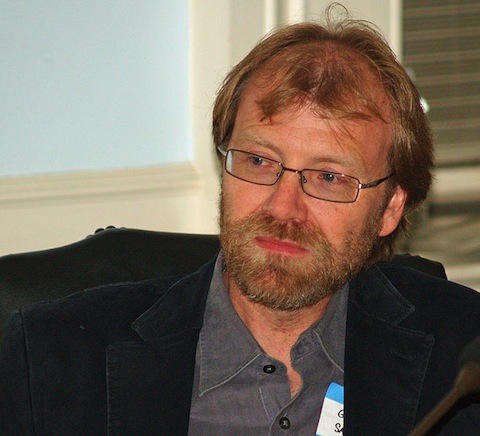
Full disclosure: I love George Saunders. Can I say that? Can I say that George Saunders rekindled my faith in contemporary fiction? Is that too fawning? Obsequious, but true! Oh, how bored I had become with fourth-hand derivative Carver, cheapened Cheever, sometimes the sad approximations of Chuck Palahniuk. So boring. It had gotten so all I could read was Philip K. Dick, over and over and over. And Alice Walker. And Wuthering Heights. And Thomas Hardy. Do you see the pass I’d come to? Then Saunders. In a writing class I took, with one of Gordon Lish’s acolytes (no names), I read Saunders. I read Wells Towers, Padgett Powell, Aimee Bender—a host of modern writers who were doing something new, in short, sometimes very short, forms, but explosive!
What is it about George Saunders that grips? He has mastered frivolity, turned it into an art of diamond-like compression. And for this, he gets a MacArthur Fellowship? Well, yes. Because what he does is brilliant, in its shockingly unaffected observations of humanity. George Saunders is an accomplished writer who puts little store in his accomplishments. Instead, he values kindness most of all, and generosity. These are the qualities he extols, in his typically droll manner, in a graduation speech he delivered to the 2013 graduating class at Syracuse University. Kindness: a little virtue, you might say. The New York Timeshas published his speech, and I urge you to read it in full. I’m going to give you half, below, and challenge you to find George Saunders wanting.
Down through the ages, a traditional form has evolved for this type of speech, which is: Some old fart, his best years behind him, who, over the course of his life, has made a series of dreadful mistakes (that would be me), gives heartfelt advice to a group of shining, energetic young people, with all of their best years ahead of them (that would be you).
And I intend to respect that tradition.
Now, one useful thing you can do with an old person, in addition to borrowing money from them, or asking them to do one of their old-time “dances,” so you can watch, while laughing, is ask: “Looking back, what do you regret?” And they’ll tell you. Sometimes, as you know, they’ll tell you even if you haven’t asked. Sometimes, even when you’ve specifically requested they not tell you, they’ll tell you.
So: What do I regret? Being poor from time to time? Not really. Working terrible jobs, like “knuckle-puller in a slaughterhouse?” (And don’t even ASK what that entails.) No. I don’t regret that. Skinny-dipping in a river in Sumatra, a little buzzed, and looking up and seeing like 300 monkeys sitting on a pipeline, pooping down into the river, the river in which I was swimming, with my mouth open, naked? And getting deathly ill afterwards, and staying sick for the next seven months? Not so much. Do I regret the occasional humiliation? Like once, playing hockey in front of a big crowd, including this girl I really liked, I somehow managed, while falling and emitting this weird whooping noise, to score on my own goalie, while also sending my stick flying into the crowd, nearly hitting that girl? No. I don’t even regret that.
But here’s something I do regret:
In seventh grade, this new kid joined our class. In the interest of confidentiality, her Convocation Speech name will be “ELLEN.” ELLEN was small, shy. She wore these blue cat’s‑eye glasses that, at the time, only old ladies wore. When nervous, which was pretty much always, she had a habit of taking a strand of hair into her mouth and chewing on it.
So she came to our school and our neighborhood, and was mostly ignored, occasionally teased (“Your hair taste good?” – that sort of thing). I could see this hurt her. I still remember the way she’d look after such an insult: eyes cast down, a little gut-kicked, as if, having just been reminded of her place in things, she was trying, as much as possible, to disappear. After awhile she’d drift away, hair-strand still in her mouth. At home, I imagined, after school, her mother would say, you know: “How was your day, sweetie?” and she’d say, “Oh, fine.” And her mother would say, “Making any friends?” and she’d go, “Sure, lots.”
Sometimes I’d see her hanging around alone in her front yard, as if afraid to leave it.
And then – they moved. That was it. No tragedy, no big final hazing.
One day she was there, next day she wasn’t.
End of story.
Now, why do I regret that? Why, forty-two years later, am I still thinking about it? Relative to most of the other kids, I was actually pretty nice to her. I never said an unkind word to her. In fact, I sometimes even (mildly) defended her.
But still. It bothers me. So here’s something I know to be true, although it’s a little corny, and I don’t quite know what to do with it:
What I regret most in my life are failures of kindness.
Those moments when another human being was there, in front of me, suffering, and I responded…sensibly. Reservedly. Mildly.
Or, to look at it from the other end of the telescope: Who, in your life, do you remember most fondly, with the most undeniable feelings of warmth?
Those who were kindest to you, I bet.
It’s a little facile, maybe, and certainly hard to implement, but I’d say, as a goal in life, you could do worse than: Try to be kinder.
Since 2009, the organization VIDA: Women in the Literary Arts has sought to bring balance to the representation of female authors in the literary world. As revealed by the 2010 controversy begun by author Jodi Picoult over the gushing treatment Jonathan Franzen’s Freedom received in the New York Times, the disparity, and the bias, are real. Author Jennifer Weiner chimed in as well, writing: “when a man writes about family and feelings, it’s literature with a capital L, but when a woman considers the same topics, it’s romance, or a beach book.” This fracas—involving a number of mostly New York literati and the death of the term “chick lit”—didn’t split evenly down gender lines. Both male and female writers lined up to defend Picoult and Franzen, but it did open up legitimate questions about the old (mostly white) boys club that claims the upper echelons of literary fiction and the brass ring that is the New York Times book review.
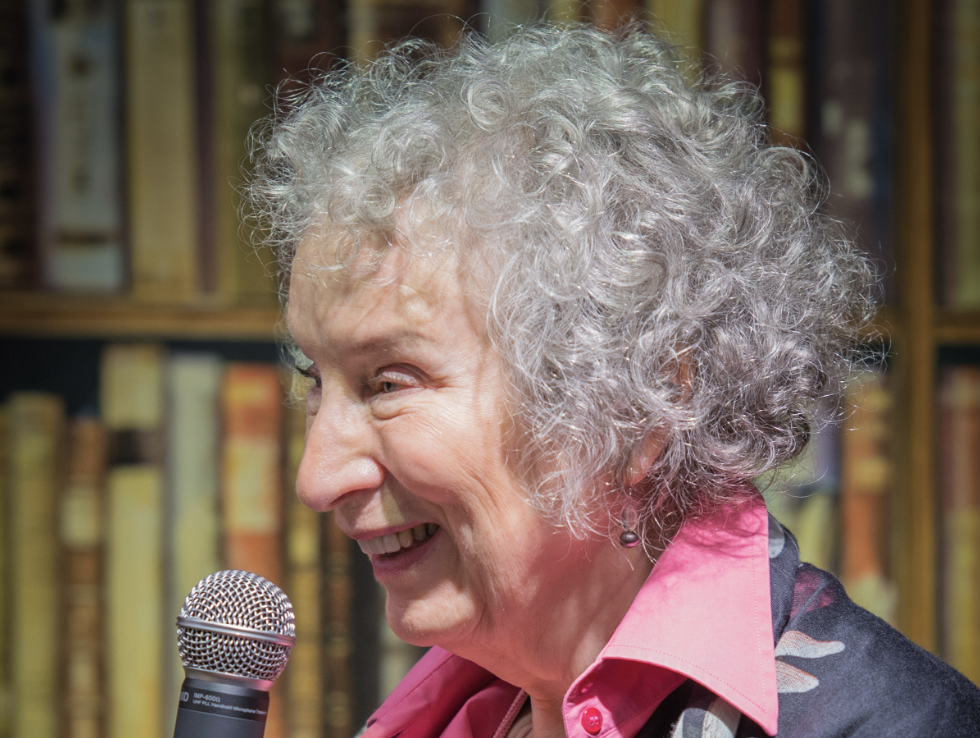
What received no notice in the popular media during all this chatter was the place of women writers in genre fiction, which mostly lives outside the gates and rarely gets much notice from the critics (with the exception of a handful of “serious” writers and the Young Adult market). Well, there is a discussion about gender parity in the science fiction world taking place now on the blog of sci-fi critic and writer Ian Sales. Sales curates SF Mistressworks—a blog for women sci-fi writers—and after reviewing a 1975 anthology called Women of Wonder, he asked readers over at his blog to submit their favorite short fiction by women writers. His goal? To collect 100 stories and novellas as a counter to the classic, and almost wholly male-dominated collection, 100 Great Science Fiction Short Short Stories, edited by Isaac Asimov. You can read the full list of 100 over at Sales’ blog. Below, we’ve excerpted those stories that are freely available online. If you’re a science fiction fan and find yourself unable to name more than one or two female authors in the genre (everyone knows, for example, the fabulous Ursula K. Le Guin and Margaret Atwood, pictured above), you might want to take a look at some of the great work you’ve missed out on.
Sales’ list spans several decades and, as he writes, demonstrates “a good spread of styles and themes and approaches across the genre.”
1 ‘The Fate of the Poseidonia’, Clare Winger Harris (1927, short story) online here
12 ‘The New You’, Kit Reed (1962, short story) online here
13 ‘The Putnam Tradition’, Sonya Dorman (1963, short story) online here
16 ‘The Heat Death of the Universe’, Pamela Zoline (1967, short story) online here
28 ‘The View from Endless Scarp’, Marta Randall (1978, short story) online here
51 ‘The Road to Jerusalem’, Mary Gentle (1991, short story) online here
71 ‘Captive Girl’, Jennifer Pelland (2006, short story) online here
79 ‘Spider the Artist’, Nnedi Okrafor (2008, short story) online here
81 ‘Eros, Philia, Agape’, Rachel Swirsky (2009, novelette) online here
82 ‘Non-Zero Probabilities’, NK Jemisin (2009, short story) online here
85 ‘Blood, Blood’, Abbey Mei Otis (2010, short story) online here and here
88 ‘Amaryllis’, Carrie Vaughn (2010, short story) online here
89 ‘I’m Alive, I Love You, I’ll See You in Reno’, Vylar Kaftan (2010, short story) online here
91 ‘Six Months, Three Days’, Charlie Jane Anders (2011, short story) online here
93 ‘The Cartographer Bees and the Anarchist Wasps’, E Lily Yu (2011, short story) online here
94 ‘Silently and Very Fast’, Catherynne M Valente (2011, novella) online here, here and here
96 ‘A Vector Alphabet of Interstellar Travel’, Yoon Ha Lee (2011, short story) online here
97 ‘Immersion’, Aliette de Bodard (2012, short story) online here
98 ‘The Lady Astronaut of Mars’, Mary Robinette Kowal (2012, novelette) online here
* Please note: an earlier version of this post was titled “The 100 Best Sci-Fi Stories by Women Writers (Read 20 for Free Online).” As this list’s curator, Ian Sales, points out unequivocally below, this is not meant to be a definitive “best of” in any sense. Our apologies for misreading his intentions.
Have you ever wondered what it would have been like to be present when Oscar Wilde was delivering those dazzling epigrams of his? In this classic sketch from Monty Python’s Flying Circus, we’re presented with one hilarious possibility.
The sketch is from Episode 39 of the Flying Circus, the last episode of season three, which was recorded on May 18, 1972 but not aired until January 18, 1973. The scene takes place in 1895, in the drawing room of Wilde’s London home. Holding court amid a roomful of sycophants, Wilde (played by Graham Chapman) competes with the Irish writer George Bernard Shaw (Michael Palin) and the American-born painter James McNeill Whistler (John Cleese) to impress Queen Victoria’s son Albert Edward (Terry Jones), the Prince of Wales and future King Edward VII.
As for the historical basis of the sketch, “There seems to be no evidence for the convivial triumvirate of Whistler, Wilde, and Shaw,” writes Darl Larsen in Monty Python’s Flying Circus: An Utterly Complete, Thoroughly Unillustrated, Absolutely Unauthorized Guide, “especially as late as 1895, when Whistler was caring for his terminally ill wife and Wilde was in the early stages of his fall from grace.” Wilde’s play The Importance of Being Earnest opened in February of that year, and shortly afterward he became embroiled in a legal battle with the Marquess of Queensberry that led eventually to his imprisonment for homosexuality. Wilde was once a protégé of Whistler, but their friendship had deteriorated by 1895. Whistler was apparently jealous of Wilde’s success, and believed he had stolen many of his famous lines. When Wilde reportedly said “I wish I had said that” in response to a witty remark by Whistler in about 1888, the painter famously retorted, “You will, Oscar, you will.” Shaw worked as a London theatre critic in the 1890s, and the Prince of Wales was a patron of the arts.
In the Python sketch, Wilde kicks off a round of witticisms with his famous line, “There is only one thing in the world worse than being talked about, and that is not being talked about.” But things go rapidly downhill as the conversation turns into an exercise in heaping abuse on the Prince of Wales and pinning the blame on a rival:
WILDE: Your Majesty is like a big jam doughnut with cream on the top.
PRINCE: I beg your pardon?
WILDE: Um…It was one of Whistler’s.
WHISTLER: I never said that.
WILDE: You did, James, you did.
WHISTLER: Well, Your Highness, what I meant was that, like a doughnut, um, your arrival gives us pleasure…and your departure only makes us hungry for more. [The prince laughs and nods his head.] Your Highness, you are also like a stream of bat’s piss.
PRINCE: What?
WHISTLER: It was one of Wilde’s. One of Wilde’s.
WILDE: It sodding was not! It was Shaw!
SHAW: I…I merely meant, Your Majesty, that you shine out like a shaft of gold when all around is dark.
PRINCE: Oh.
WILDE: Right. Your Majesty is like a dose of clap–
WHISTLER: –Before you arrive is pleasure, and after is a pain in the dong.
Tolkien fans, tell me: were you disappointed with the first installment of Peter Jackson’s Hobbit film trilogy? Did you find it as lumbering and clumsy as a trio of cockney trolls, or as ugly as a bug-eyed and be-wattled goblin king? Pining away for the days when The Lord of the Rings films were the go-to pop-culture fantasy references—before, say, Twilight harshed that buzz? Well, I could recommend to you some of the fan-made films that stepped in to fill the LOTR void in recent years. There’s the not-very-good Born of Hope and the very much better The Hunt for Gollum. I’ve seen them both because, well…. I just needed to is all.
But there is another way. I know it’s perverse, possibly subversive, and maybe, just maybe, even dangerous. Turn off the computer and open the books up again—your yellowed, crumbly paperbacks, your Barnes & Noble economy re-issue editions (I won’t judge), hell, turn on the Kindle. Savor the languages Tolkien invented and the English that he re-invented, immerse yourself in a literary world at once utterly fantastic and perfectly morally serious. Do that, and your craving for spectacle may vanish, maybe replaced by a craving for more Tolkien—like his retelling of events in the Norse Edda saga in his Legend of Sigurd and Gudrun.
And while you’re reading up on that one, listen to the audio above of Tolkien himself reading from Chapter IV of The Two Towers. The richness of his English voice makes me wish we had recordings of him reading all three novels, but we must work with what we’ve got, and it is good. Enjoy.
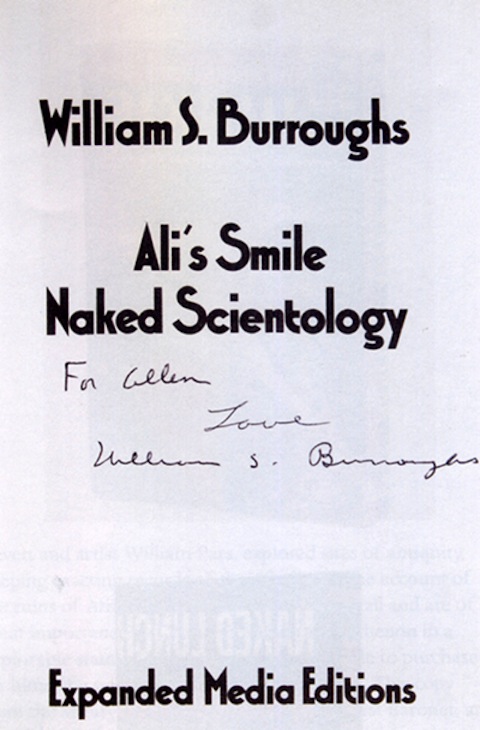
Crash director Paul Haggis impressed us all when his defection from the Church of Scientology became the subject of “The Apostate,” a 2011 New Yorker profile by Lawrence Wright. But Haggis’ high-profile departure from the lavish if shadowy house that L. Ron Hubbard built had a notable precedent in William S. Burroughs’ Naked Scientology. The Naked Lunch author and Beat Luminary published it after his own disillusionment with the organization of Scientology, though he retained his esteem for what he considered their mind-improving techniques. Booktryst offers a brief summary of Burroughs’ intense flirtation with the Church and its teachings: his initial attraction “because of its promise to liberate the mind by clearing it of traumatic memories that impeded personal growth, and, by extension, social progress and freedom from social control,” and his ultimate disappointment that, as biographer Ted Morgan puts it, he “had hoped to find a method of personal emancipation and found instead another control system.”
For a more in-depth look at what brought Burroughs into Scientology and what put him off of it, read Lee Konstantinou’s i09 post on the subject. “Burroughs took Scientology quite seriously indeed for the better part of a decade — during what was arguably his most artistically fertile period,” Konstantinou writes. “Today, where so much attention focuses on the science fictional origins of Scientology, it is easy to forget how seemingly in harmony the Church was with a whole range of countercultural, ‘New Age,’ and anti-psychiatric practices in the Sixties.” He files Scientology with Burroughs’ other “mind-expanding and mind-freeing practice,” including hallucinogens, “Mayan calendrical mind control systems,” apomorphine, and his signature “cut-up” texts. To hear all about it straight from Burroughs, read his 1970 Los Angeles Free Press j’accuse against Hubbard and his “fascist” tendencies, and the whole of Naked Scientology in PDF form.
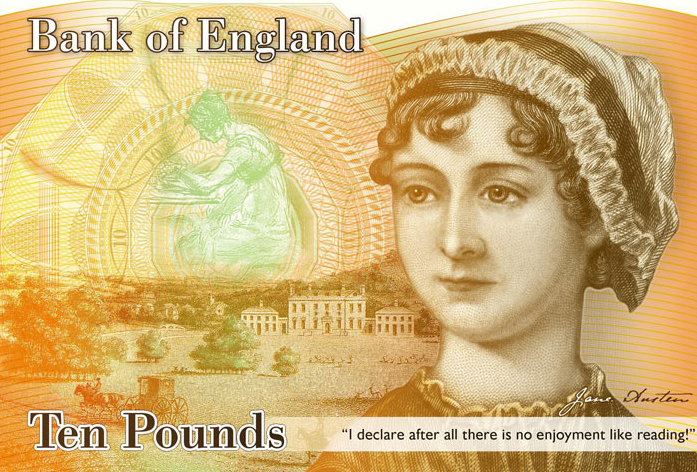
Earlier this year, the Royal Mail released a stamp collection commemorating Jane Austen’s six novels. Now, word has leaked out that, probably starting in 2017, the author of Pride and Prejudice will appear on the £10 note. Said Mark Carney, the new governor of the Bank of England, “Jane Austen certainly merits a place in the select group of historical figures to appear on our banknotes. Her novels have an enduring and universal appeal and she is recognised as one of the greatest writers in English literature.” Only three women have appeared on English banknotes since they started portraying historical figures in 1970. Austen will be the fourth. The Guardian has more on this good story here.
We're hoping to rely on loyal readers, rather than erratic ads. Please click the Donate button and support Open Culture. You can use Paypal, Venmo, Patreon, even Crypto! We thank you!
Open Culture scours the web for the best educational media. We find the free courses and audio books you need, the language lessons & educational videos you want, and plenty of enlightenment in between.
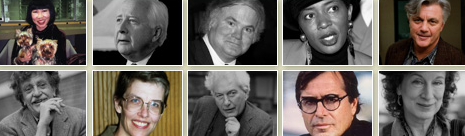 The Celebrity Lecture Series was established at Michigan State University in 1988, and it has “featured some of the most illustrious scholars, critics, novelists, poets, and creative artists of our time.” Now, thanks to a special online archive, you can revisit these lectures presented by the likes of Amy Tan, Arthur Miller, Joyce Carol Oates, Kurt Vonnegut, Jr., Margaret Atwood, Maya Angelou, Norman Mailer, Paul Theroux, Philip Roth, Richard Ford, Susan Sontag, Tom Wolfe, Carlos Fuentes, August Wilson, E.L. Doctorow, Edward Albee, Isabel Allende, Garry Wills, Jane Smiley, John Irving, John Updike and Joseph Heller. Just click on any of the links above and you can stream the audio lectures for free online.