“Slight Rebellion Off Madison” — The first story J.D. Salinger ever published in The New Yorker was also a story that introduced readers to his most famous character, Holden Caulfield, long before the publication of The Catcher in the Rye. According to Paul Alexander’s biography of Salinger, the editors of The New Yorker accepted “Slight Rebellion Off Madison” back in 1941, but delayed publishing it when the US entered World War II. The time just didn’t feel right for a story about jaded, cynical youth. Eventually the war ended and the story appeared in the magazine on December 21, 1946. The Catcher in the Rye came out five years later, in July, 1951.
In the story, Holden Caulfield, “on vacation from Pencey Preparatory School for Boys,” meets up in New York City with Sally Hayes, also on vacation from prep school, and together they go to the movies, smoke in the lobby, drink, complain about the tedium of school, dream of leaving the big city for Vermont, and maybe getting married one day. Other characters who later appear in Salinger’s generation-defining novel — for example, Carl Luce — also make appearances too.
You can read “Slight Rebellion Off Madison” in the New Yorker archive. Clickhere to see a facsimile of how the story originally appeared in the magazine. When you click through, please click on the image/page to zoom into the text.
Note: Another story story featuring Holden Caulfield — “I’m Crazy” — appeared in the December, 22 1945 edition of Collier’s. It starts here and ends here.
An old friend of mine and I have a code phrase for a phenomenon that everyone knows well: One learns that an artist one admires, maybe even loves, is not only a flawed and warty mortal, but also an abusive monster or worse. The phrase is “Ezra Pound.” We’ll look at each other knowingly whenever a conversation turns to a troubling but brilliant figure and say in unison, “Ezra Pound.” Why? Because Ezra Pound was crazy.
Or at least that was Ernest Hemingway’s explanation for why one of the greatest literary benefactors and most innovative and influential poets of the early twentieth century became a raving lunatic booster for anti-Semitic fascism in a series of over one hundred broadcasts he made in Italy during WWII. Pound wasn’t simply a crank—he was a deeply enthusiastic supporter of Hitler and Mussolini, and his rantings—many available here in transcript and some in original audio here (or right below) —made no secret about whom he considered the enemies of Europe and America: the Jews.
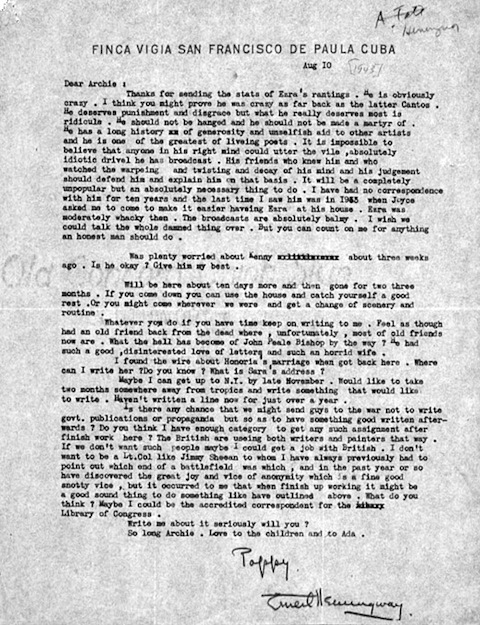
Hemingway wrote the letter above to Archibald MacLeish expressing his shock and dismay that their mutual friend and colleague had completely run off the rails. For Hemingway, the only way to deal with the situation was to “prove [Pound] was crazy as far back as the latter Cantos.” Hemingway writes, “He deserves punishment and disgrace but what he really deserves most is ridicule”
He should not be hanged and he should not be made a martyr of…. It is impossible to believe that anyone in his right mind could utter the vile, absolutely idiotic drivel he has broadcast. His friends who knew him and who watched the warpeing and twisting and decay of his mind and his judgement should defend him and explain him on that basis. It will be a completely unpopular but an absolutely necessary thing to do. [sic]
This Pound’s many friends did do, and when he was finally captured in Italy and tried for treason, Pound was sentenced to a psych ward, where he wrote and published the award-winning The Pisan Cantos amid great uproar and outrage from many in the literary community. This is unsurprising. Although Pound publicly repudiated his stint as a fascist broadcaster, his hard-right racist views did not change. In his later life, he formed friendships with white supremacists and remained controversial, contrarian, and… well, crazy.
And yet, it is hard to dismiss Pound, even if his star has fallen below the horizon of modernist literary history. It may be possible to argue that his fascist streak was in fact several miles long, extending back into his post-WWI politics and his humorous but haranguing book-length essays on Western Culture and Its Decline throughout the 30s. As Louis Menand writes in The New Yorker, this Pound may have been ripe for misinterpretation by the more brutish and less refined, a la Nietzsche, since he “believed that bad writing destroyed civilizations and that good writing could save them, and although he was an élitist about what counted as art and who mattered as an artist, he thought that literature could enhance the appreciation of life for everyone.” Pound was also a mother hen figure for a generation of modernists who flourished under his editorial direction—as well as that of Poetry magazine founder Harriet Monroe. Menand writes:
No doubt Eliot, James Joyce, William Butler Yeats, Robert Frost, William Carlos Williams, H.D., Ernest Hemingway, Ford Madox Ford, and Marianne Moore would have produced interesting and innovative work whether they had known Pound or not, but Pound’s attention and interventions helped their writing and sped their careers. He edited them, reviewed them, got them published in magazines he was associated with, and included them in anthologies he complied; he introduced them to editors, to publishers, and to patrons; he gave them the benefit of his time, his learning, his money, and his old clothes.
And all of this is not even to mention, of course, Pound’s incredible poetic output, which demonstrates such a mastery of form and language (East and West) that he is well-remembered as the founder of one of the most influential modernist movements: Imagism. This side of Pound cannot be erased by his later lapse into despicable hatred and paranoia, but neither does the early Pound cancel out the latter. Both Pounds exist in history, for as long as he’s remembered, and every time I learn some new disturbing fact about an artist I admire, I shake my head and silently invoke the most extreme and bafflingly troubling case—one that can’t be resolved or forgotten—“Ezra Pound.”
Note: Elmore Leonard, the crime writer who gave us Get Shorty, Freaky Deaky, and Glitz, died at his home in Bloomfield Village, Michigan. He was 87. If you never had a chance to read Leonard, you can start with “Ice Man,” a 2012 story that appeared in The Atlantic. It’s free online. You can also get a feel for his writing by revisiting a post written here by Mike Springer last year. It gives an overview of Leonard’s tips for aspiring writers. And, in so doing, it provides valuable insight into how Leonard approached his craft. Elmore Leonard’s Ultimate Guide for Would-Be Writers is reprinted in full below.
“If it sounds like writing,” says Elmore Leonard, “I rewrite it.”
Leonard’s writing sounds the way people talk. It rings true. In novels like Get Shorty, Rum Punch and Out of Sight, Leonard has established himself as a master stylist, and while his characters may be lowlifes, his books are received and admired in the highest circles. In 1998 Martin Amis recalled visiting Saul Bellow and seeing Leonard’s books on the old man’s shelves. “Bellow and I agreed,” said Amis, “that for an absolutely reliable and unstinting infusion of narrative pleasure in a prose miraculously purged of all false qualities, there was no one quite like Elmore Leonard.”
In 2006 Leonard appeared on BBC Two’s The Culture Show to talk about the craft of writing and give some advice to aspiring authors. In the program, shown above, Leonard talks about his deep appreciation of Ernest Hemingway’s work in general, and about his particular debt to the 1970 crime novel The Friends of Eddie Coyle, by George V. Higgins. While explaining his approach, Leonard jots down three tips:
“You have to listen to your characters.”
“Don’t worry about what your mother thinks of your language.”
“Try to get a rhythm.”
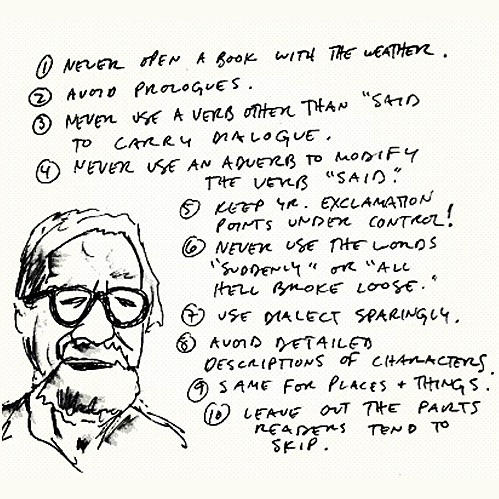
“I always refer to style as sound,” says Leonard. “The sound of the writing.” Some of Leonard’s suggestions appeared in a 2001 New York Times article that became the basis of his 2007 book, Elmore Leonard’s 10 Rules of Writing. Here are those rules in outline form:
You can read more from Leonard on his rules in the 2001 Times article. And you can read his new short story, “Ice Man,” in The Atlantic.
There may be no more a despicable yet ridiculous narrator in twentieth century fiction than the sleazy, condescending Humbert Humbert. And there may be no better name in twentieth century fiction than Dolores Haze, Humbert’s 12-year-old stepdaughter and love interest, whom he calls, among other things, his “nymphette,” Lolita.
Vladimir Nabokov’s tragicomic 1955 novel Lolitastill has the power to shock, disgust, and elicit wry laughter from readers, with its satirical take on decadent old Europe and wisecracking young America. True to its mid-century U.S. setting and sensationalistic subject matter, the novel is packed not only with Humbert’s obsessively creepy description and layers of literary allusion, but also with plenty of pulpy action, if we are to believe in the events Humbert narrates.
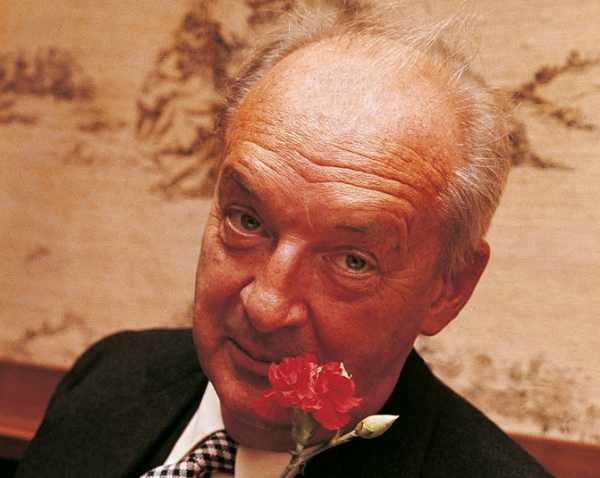
In the novel’s penultimate chapter, Humbert tracks down Clare Quilty, another predatory older man who takes advantage of Lolita. Humbert confronts, then kills Quilty (or so it seems). In the final chapter, Humbert also dies, and we learn that the novel is in fact his memoir, willed only to be published after he and Lolita have died. In the audio clip at the top, hear Vladimir Nabokov himself read from the climactic chapter in which Humbert faces Quilty down, and directly above, see the author read those first unforgettable lines: “Lolita, light of my life, fire of my loins. My sin, my soul. Lo-lee-ta.”
Find more recordings of Nabokov reading his work here.
The way people read on the internet has encouraged the provision of “tips,” especially presented as short sentences collected in lists. While we here at Open Culture seldom ride that current, we make exceptions for lists of tips by authors best known for their long-form textual achievements. Richard Ford (The Sportswriter books), Jonathan Franzen (The Corrections and Freedom), and Anne Enright (The Portable Virgin, The Gathering) here offer ten suggestions each to guide your own writing habits. Though presumably learned in the process of writing novels, many of these lessons apply just as well to other forms. I, for example, write mostly essays, but still find great value in Franzen’s instruction to treat the reader as a friend, Enright’s point that description conveys opinion, and Ford’s injunction not to write reviews (or at least, as I read it, not reviews as so narrowly defined).
Some of these tips have to do with technique: Ford advises against drinking while writing, Franzen advises against using “then” as a conjunction, and Enright advises you simply to keep putting words on the page. Others have more to do with maintaining a certain temperament: “Don’t have arguments with your wife in the morning, or late at night,” says Ford; “You have to love before you can be relentless,” says Franzen; “Have fun,” says Enright. And as any successful writer knows, you can’t pull it off at all without a strong dose of practicality, as exemplified by Enright’s “Try to be accurate about stuff,” Franzen’s doubt that “anyone with an internet connection at his workplace is writing good fiction,” and Ford’s “Don’t have children.” Can we draw out an overarching guideline? Avoid distraction, perhaps. But you really have to read these authors’ lists in full, like you would their novels, to grasp them. The lists below originally appeared in The Guardian, along with tips from various other esteemed writers.
Richard Ford
1 Marry somebody you love and who thinks you being a writer’s a good idea.
5 Don’t have arguments with your wife in the morning, or late at night.
6 Don’t drink and write at the same time.
7 Don’t write letters to the editor. (No one cares.)
8 Don’t wish ill on your colleagues.
9 Try to think of others’ good luck as encouragement to yourself.
10 Don’t take any shit if you can possibly help it.
Jonathan Franzen
1 The reader is a friend, not an adversary, not a spectator.
2 Fiction that isn’t an author’s personal adventure into the frightening or the unknown isn’t worth writing for anything but money.
3 Never use the word “then” as a conjunction – we have “and” for this purpose. Substituting “then” is the lazy or tone-deaf writer’s non-solution to the problem of too many “ands” on the page.
4 Write in the third person unless a really distinctive first-person voice offers itself irresistibly.
5 When information becomes free and universally accessible, voluminous research for a novel is devalued along with it.
6 The most purely autobiographical fiction requires pure invention. Nobody ever wrote a more autobiographical story than “The Metamorphosis”.
7 You see more sitting still than chasing after.
8 It’s doubtful that anyone with an internet connection at his workplace is writing good fiction.
9 Interesting verbs are seldom very interesting.
10 You have to love before you can be relentless.
Anne Enright
1 The first 12 years are the worst.
2 The way to write a book is to actually write a book. A pen is useful, typing is also good. Keep putting words on the page.
3 Only bad writers think that their work is really good.
4 Description is hard. Remember that all description is an opinion about the world. Find a place to stand.
5 Write whatever way you like. Fiction is made of words on a page; reality is made of something else. It doesn’t matter how “real” your story is, or how “made up”: what matters is its necessity.
6 Try to be accurate about stuff.
7 Imagine that you are dying. If you had a terminal disease would you finish this book? Why not? The thing that annoys this 10-weeks-to-live self is the thing that is wrong with the book. So change it. Stop arguing with yourself. Change it. See? Easy. And no one had to die.
8 You can also do all that with whiskey.
9 Have fun.
10 Remember, if you sit at your desk for 15 or 20 years, every day, not counting weekends, it changes you. It just does. It may not improve your temper, but it fixes something else. It makes you more free.
It’s hard to imagine a time when George Orwell didn’t exercise masterful control over the English language. But if you go far enough back, you’ll find proof that every writer starts somewhere. We all begin as mortals.
In December 2, 1911, an 8‑year-old Eric Blair (the birth name of Orwell), wrote a letter to his mother, Ida, detailing his day-to-day affairs at St. Cyprian’s School, a boarding school in Southern England. The letter is sweet for many reasons, not least because of the phonetic spelling/misspellings that run through the note. The original/uncorrected text appears below. It’s one of many letters gathered on GeorgeOrwellNovels.com, and it’s also the very first letter published in a new volume this week, George Orwell: A Life in Letters. The endearing letter was apparently sent with a cute picture enclosed. You can see it right above.
My dear Mother, I hope you are alright,
It was Mrs: Wilkes birthday yesterday, we had aufel fun after tea and played games all over the house. We all went for a walk to Beachy-Head.
I am third in Arithmatick.
‘Its’ very dull today, and dosent look as if its going to be very warm. Thank you for your letter.
It is getting very near the end of the term, there are only eighteen days more. On Saturday evening we have dncing, and I am going to say a piece of poetry, some of the boys sing.
Give my love to Father and Avril. Is Togo alright, We had the Oxford and Cambridge Matches yesterday. Cambridge won in the first and third, and the second did not have a Match. I am very glad Colonel Hall6 has given me some stamps, he said he wold last year but I thought he had forgoten. Its a beastly wet day today all rain and cold.
I am very sorry to hear we had those beastly freaks of smelly white mice back.
I hope these arnt smelly one. if they arnt I shall like them.
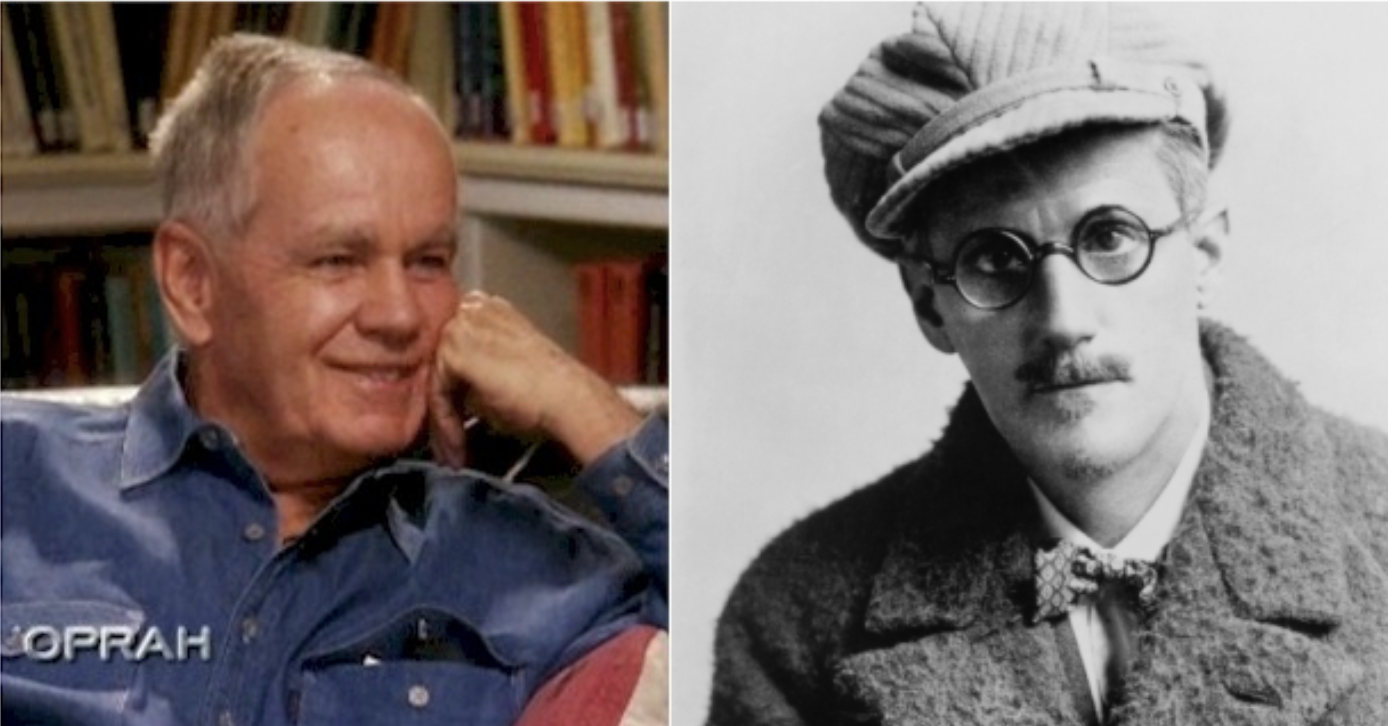
Cormac McCarthy has been—as one 1965 reviewer of his first novel, The Orchard Keeper, dubbed him—a “disciple of William Faulkner.” He makes admirable use of Faulknerian traits in his prose, and I’d always assumed he inherited his punctuation style from Faulkner as well. But in his very rare 2008 televised interview with Oprah Winfrey, McCarthy cites two other antecedents: James Joyce and forgotten novelist MacKinlay Kantor, whose Andersonville won the Pulitzer Prize in 1955. Joyce’s influence dominates, and in discussion of punctuation, McCarthy stresses that his minimalist approach works in the interest of maximum clarity. Speaking of Joyce, he says,
James Joyce is a good model for punctuation. He keeps it to an absolute minimum. There’s no reason to blot the page up with weird little marks. I mean, if you write properly you shouldn’t have to punctuate.
So what “weird little marks” does McCarthy allow, or not, and why? Below is a brief summary of his stated rules for punctuation:
1. Quotation Marks:
McCarthy doesn’t use ’em. In his Oprah interview, he says MacKinlay Kantor was the first writer he read who left them out. McCarthy stresses that this way of writing dialogue requires particular deliberation. Speaking of writers who have imitated him, he says, “You really have to be aware that there are no quotation marks, and write in such a way as to guide people as to who’s speaking.” Otherwise, confusion reigns.
2. Colons and semicolons:
Careful McCarthy reader Oprah says she “saw a colon once” in McCarthy’s prose, but she never encountered a semicolon. McCarthy confirms: “No semicolons.”
Of the colon, he says: “You can use a colon, if you’re getting ready to give a list of something that follows from what you just said. Like, these are the reasons.” This is a specific occasion that does not present itself often. The colon, one might say, genuflects to a very specific logical development, enumeration. McCarthy deems most other punctuation uses needless.
3. All other punctuation:
Aside from his restrictive rationing of the colon, McCarthy declares his stylistic convictions with simplicity: “I believe in periods, in capitals, in the occasional comma, and that’s it.” It’s a discipline he learned first in a college English class, where he worked to simplify 18th century essays for a textbook the professor was editing. Early modern English is notoriously cluttered with confounding punctuation, which did not become standardized until comparatively recently.
McCarthy, enamored of the prose style of the Neoclassical English writers but annoyed by their over-reliance on semicolons, remembers paring down an essay “by Swift or something” and hearing his professor say, “this is very good, this is exactly what’s needed.” Encouraged, he continued to simplify, working, he says to Oprah, “to make it easier, not to make it harder” to decipher his prose. For those who find McCarthy sometimes maddeningly opaque, this statement of intent may not help clarify things much. But lovers of his work may find renewed appreciation for his streamlined syntax.
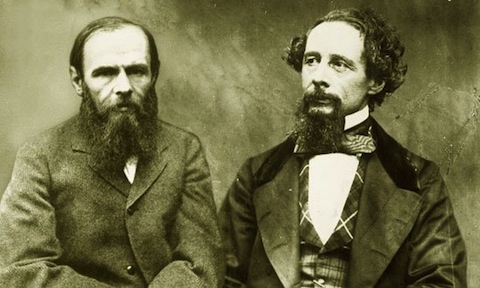
Given the way nineteenth-century literature is sometimes conceived—as the special province of a few great, hairy celebrity novelists—one might imagine that a meeting between Charles Dickens and Fyodor Dostoevsky would not be an unusual occurrence. Maybe it was even routine, like Jay Z and Kanye bumping elbows at a party! So when I read that the two had once met, in London in 1862, my first thought was, “well, sure. And then Herman Melville and Gustave Flaubert stopped by, and they got into a brawl over the check.” Alright, that’s ridiculous. Melville didn’t achieve any degree of fame until after his death, after all, and while the other three were respected, even wildly famous (in Dickens’ case), it is unlikely they read much of each other, much less traveled hundreds of miles for personal visits.
And yet, the story of Dickens and Dostoevsky—since revealed to be as much a fabrication as the image above—was plausible enough to find purchase in two recent Dickens biographies. Though the two men had vastly different sensibilities, their shared experiences of the seamier side of life, and their sprawling serialized novels cataloguing their time’s social ills in great detail, would seem likely to draw them together. New York Times literary critic Michiko Kakutani seemed to think so when she repeated the story as told in Claire Tomalin’s 2011 Charles Dickens, A Life. Tomalin—who found the story in the Dickensian, the journal of the Dickens Fellowship, and reported it in good faith—recounts how the Russian novelist intentionally sought out his English counterpart in London, and, upon finding him, heard Dickens bare his soul, confessing that he longed to be like his honest, simple characters, but used his own personal failings to construct his villains.
The story might still have currency had not several Russian literature scholars read Kakutani’s review and found it far too credulous: Why would Dostoevsky have only mentioned the encounter in a letter written sixteen years after the fact, a letter no scholar has seen? What language would the two men have in common—and if they had one, probably French, would they be fluent enough to have a heart to heart? And even if Dostoevsky visited London in 1862, as it seems, he did, would he have intentionally sought out Charles Dickens? Eric Naiman, professor of Slavic Language and Literatures at UC Berkeley, doubted all of this, and, in undertaking some research, found it to be the elaborate production of a man named A.D. Harvey, who has created for himself a coterie of fictional academic identities so thorough as to constitute what Naiman calls a “community of scholars who can analyse, supplement and occasionally even ruthlessly criticise each other’s work.”
As far as literary hoaxers go, Harvey is quite accomplished. You may find his story—driven, as such things often are, by wounded ego, misplaced talent, vanity, and frustrated ambition—much more interesting than any supposed tête-à-tête between the Russian and British novelists. A recent Guardian piece profiles the “man behind the great Dickens and Dostoevsky hoax,” and Eric Naiman’s exhaustive Times Literary Supplement expose of the hoax shows us just how deeply embedded such spurious lore can become in a literary community before it can be rooted out by skeptical scholars. The lesson here is trite, I guess. Don’t believe everything you read. But when we’re inclined—mostly for good reasons—to trust the word of those who pose as experts and authorities, this can be a hard lesson to heed.
We're hoping to rely on loyal readers, rather than erratic ads. Please click the Donate button and support Open Culture. You can use Paypal, Venmo, Patreon, even Crypto! We thank you!
Open Culture scours the web for the best educational media. We find the free courses and audio books you need, the language lessons & educational videos you want, and plenty of enlightenment in between.
 “Slight Rebellion Off Madison” — The first story J.D. Salinger ever published in The New Yorker was also a story that introduced readers to his most famous character, Holden Caulfield, long before the publication of The Catcher in the Rye. According to Paul Alexander’s biography of Salinger, the editors of The New Yorker accepted “Slight Rebellion Off Madison” back in 1941, but delayed publishing it when the US entered World War II. The time just didn’t feel right for a story about jaded, cynical youth. Eventually the war ended and the story appeared in the magazine on December 21, 1946. The Catcher in the Rye came out five years later, in July, 1951.