Samuel Beckett long had a fondness for Berlin, from his first trip in the late 1920s–when he fell in love with his cousin while visiting his uncle on his mom’s side–to his longtime relationship with his German translator Erika Tophoven and with the Schiller Theater, which produced many of his plays.
The above footage shows the 63-year old Beckett walking the streets of Berlin, asking for directions, or reading the daily paper at a cafe. At one point he is seen walking with a woman (possibly Tophoven?).
Why was this film shot? It has the feeling of surveillance footage, but the more logical explanation is that it was b‑roll for some news feature. Beckett was awarded the Nobel Prize for Literature in 1969, so that might be the reason.
However, the illogical but *best* reason is that Beckett was filming the title sequence for his detective show pilot, named, of course, Beckett. YouTube user oobleckboy created this hilarious rework a few years ago, which we told you about then. But it’s worth another look, surely.
On a more serious note, Beckett’s main tour of Berlin came long before his journey as a playwright. Self-taught in the language and interested in the culture, he traveled to Berlin right after the 1936 Olympic Games and stayed through 1937. He had lost his job in Dublin, and he had fallen out with James Joyce, so he was avoiding Paris. So Beckett traveled to Berlin to devour the arts. He knew the dangers of the rising Nazi threat and took it seriously. Instead he wanted to see the culture before it disappeared. (And it would, on one hand through the Nazis and their campaign against “degenerate art.” On the other, from the Allies bombing during the war.) Beckett spent countless hours in museums. He attended operas. He got so fluent in the language he could read Schopenhauer (for the style, not the content, apparently).
Lastly, it was on one of those Berlin museum trips where he saw the painting Two Men Contemplating the Moon by Caspar David Friedrich. The image would stick in his mind until many years later when it would influence the set design for his most famous play, Waiting for Godot. (A country road. A tree. Evening.) You can see the painting here.
Ted Mills is a freelance writer on the arts who currently hosts the Notes from the Shed podcast and is the producer of KCRW’s Curious Coast. You can also follow him on Twitter at @tedmills, and/or watch his films here.
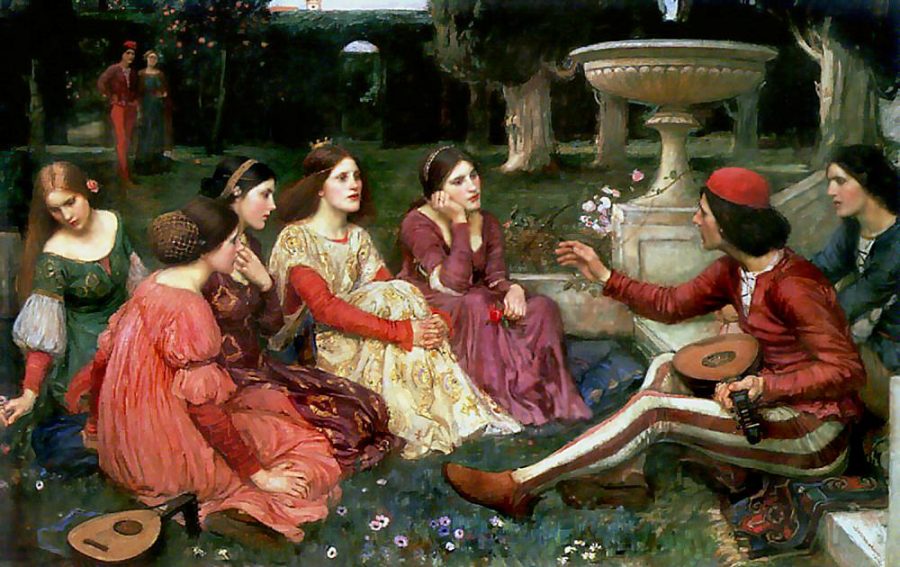
I remember reading selections of Giovanni Boccaccio’s Decameron in my early high school years—and I remember reading them as light, bawdy tales about aristocrats in gardens. We were briefly introduced to the frame narrative, set amidst the 1348 outbreak of plague in Florence, which killed off half the city’s population. But the Black Death seemed almost mythological in scope—a phantom on the periphery. As Albert Camus writes in The Plague, a book also appearing on bestseller and recommended reading lists everywhere: “a dead man has no substance unless one has actually seen him dead, a hundred million corpses broadcast through history are no more than a puff of smoke.”
I don’t recall reading how Florentines “dropped dead in open streets, both by day and by night, whilst a great many others, though dying in their own houses, drew their neighbors’ attention to the fact more by the smell of their rotting corpses.” The picture Boccaccio paints is so incredibly bleak, one is amazed we’ve come to “see the Decameron as a collection of entertaining stories to keep next to your bed,” as Andre Spicer writes at New Statesman. “This scourge had implanted so great a terror in the hearts of men and women that brothers abandoned brothers,” Boccaccio writes, “uncles their nephews, sisters their brothers… fathers and mothers refused to nurse and assist their children.”
This is unimaginable, or so we thought, having never lived through any kind of plague ourselves. Made up of tales swapped by ten friends who escape Florence for a country villa to wait out the epidemic, telling 100 stories between them to pass the time in quarantine, the Decameron, if it has left schools since my time, will surely return with significant emphasis on what was previously given as background. Of course, Italians are revisiting with much renewed interest these tales “of life lessons and folly, of tragedy and happiness, of virtue and vice,” as the blog Tuscan Trends notes.
Read by actors from the Oranona Theatre, with musical accompaniment, a live production of the stories has been going on for a decade. But only now does it constitute a trend, offered as “entertainment for Italians who are confined to their homes escaping a plague seven centuries after Boccaccio wrote his masterpiece of early Italian prose.” (Hear these performances in Italian at the Oranona Facebook page here.) What does this story cycle communicate across 700 years?
“Over the centuries, during other outbreaks of epidemic illness,” says Professor Martin Marafioti in the video above, “the work has become relevant, over and over and over again.” The book offers what Marafioti calls “narrative prophylaxis,” a medicine prescribed by Italian theologian Nicolas of Burgo, another of the many literary voices in Italy’s “canon of contagion.” In a plague advice book, Burgo warns against “fear, anger, sadness, excessive anguish, heavy thoughts and similar things. And equally one should take care to be joyful, to be happy, to listen to lullabies, stories and melodies.”
This advice may be well and good for those who can decamp to well-provisioned houses for two weeks (or months). As Massimo Riva, chair of Brown University’s Italian Studies Department, says in a recent interview, in answer to a question about Boccaccio’s relevance:
I would point to the ethical dilemma the ten young protagonists face in their decision to (temporarily) abandon the city. This decision can be interpreted in two different and somewhat opposite ways: as an escape from the common destiny of those who can afford a luxurious shelter (similar to the doomsday bunkers that very rich people build for themselves today); and as the utopian desire to rebuild together a better, more ethical and harmoniously natural way of life, out of the ruins of the old world.
These two options need not be mutually exclusive, but they might very well rebuild the old exclusions in the new world. More positively, Spicer writes, in some TED-like language that might seem anachronistic in discussions of a 14th century text: Boccaccio “understood the importance of what we now call ‘wellbeing’”; he had “faith in the curative power of stories,” a fact “supported by dozens of studies”; and he “understood the crucial role of what we now call social networks in public health crises.”
I don’t remember any of that in the Boccaccio I read in high school. But I’m starting to see some of it now as I revisit these 700-year-old stories, dipping in and out as time allows and finding in them what Spicer calls the critical “importance of connection when we are socially isolated,” whether in comfortable vacation homes, cramped city apartments, or even more confining circumstances. We need stories to help us figure who we are when everything comes apart. And we need people who will listen to us tell ours. Read and download the full text of the Decameron here.
Topping lists of plague novels circulating these days, Albert Camus’ 1947 The Plague (La Peste), as many have been quick to point out, is about more than its blunt title would suggest. The book incorporates Camus’ experience as editor-in-chief of Combat, a French Resistance newspaper, and serves as an allegory for the spread of fascism and the Nazi occupation of France. It also illustrates the evolution of his philosophical thought: a gradual turn toward the primacy of the absurd, and away from associations with Sartre’s Existentialism.
But The Plague’s primary subject is, of course, a plague—a fictional outbreak in the Algerian “French prefecture” of Oran. Here, Camus relocates a 19th century cholera outbreak to sometime in the 1940s and turns it into the rat-borne epidemic that killed tens of millions in centuries past. As Daniel Defoe had done 175 years before in A Journal of the Plague Year—drawing on his own experiences as a journalist—Camus “immersed himself in the history of plagues,” notes the School of Life. Camus even quotes Defoe in the novel’s epigraph: “It is as reasonable to represent one kind of imprisonment by another, as it is to represent anything that really exists by that which exists not.”
Camus “read books on the Black Death that killed 50 million people in Europe in the 14th century; the Italian plague of 1629 that killed 280,000 people across the plains of Lombardy and the Veneto, the great plague of London of 1665 as well as plagues that ravaged cities on China’s eastern seaboard during the 18th and 19th centuries.” Perhaps more timely now than in its time, The Plague puts Camus’ historical knowledge in the mind of its protagonist, Dr. Bernard Rieux, who remembers in his growing alarm “the plague at Constantinople that, according to Procopius, caused ten thousand deaths in a single day.”
Rieux embodies another theme in the novel—the seemingly endless human capacity for denial, even among well-meaning, knowledgeable experts. Despite his reading of history and up-close observation of the outbreak, Rieux fails—or refuses—to acknowledge the disease for what it is. That is, until an older colleague says to him, “Naturally, you know what this is.” Forced to say the word “plague” aloud, Rieux allows the spreading epidemic to become real for the first time.
[L]ike our fellow citizens, Rieux was caught off his guard, and we should understand his hesitations in the light of this fact; and similarly understand how he was torn between conflicting fears and confidence. When a war breaks out, people say: “It’s too stupid; it can’t last long.” But though a war may well be “too stupid,” that doesn’t prevent its lasting. Stupidity has a knack of getting its way; as we should see if we were not always so much wrapped up in ourselves.
In this respect our townsfolk were like everybody else, wrapped up in themselves; in other words they were humanists: they disbelieved in pestilences.
Perpetually busy with mercantile projects and ideas about progress, the town, like “humanists,” ignores the reappearance of history and believe plagues to belong to the distant past. Camus writes that such people “pass away… first of all, because they haven’t taken their precautions.”
Everybody knows that pestilences have a way of recurring in the world; yet somehow we find it hard to believe in ones that crash down on our heads from a blue sky. There have been as many plagues as wars in history; yet always plagues and wars take people equally by surprise.
Whether we are prepared for them or not, plagues and wars will come upon us, aided by the brute force of human idiocy and irrationality. This terrible truth flies in the face of the untethered freedom of Sartrean existentialism. “They fancied themselves free,” Camus’ narrator says of Oran’s townspeople, “and no one will ever be free so long as there are pestilences.” The novel proceeds to illustrate just how devastating a deadly epidemic can be to our most cherished notions.
In Camus’ philosophy, “our lives,” the School of Life points out, “are fundamentally on the edge of what he termed ‘the absurd.’” But this “should not lead us to despair pure and simple,” though the feeling may be a stage along the way to “a redemptive tragi-comic perspective.” The recognition of finitude, of failure, ignorance, and repetition—what philosopher Miguel de Unamuno called “the tragic sense of life”—can instead cure us of the “behaviors Camus abhorred: a hardness of heart, an obsession with status, a refusal of joy and gratitude, a tendency to moralize and judge.” Whatever else The Plague is about, Camus shows that in a struggle for survival, these attitudes can prove worse than useless and can be the first to go.
Describing conditions characteristic of life in the early 21st century, future historians may well point to such epidemic viral illnesses as SARS, MERS, and the now-rampaging COVID-19. But those focused on culture will also have their pick of much more benign recurring phenomena to explain: topical book lists, for instance, which crop up in the 21st-century press at the faintest prompting by current events. As the coronavirus has spread through the English-speaking world over the past month, pandemic-themed reading lists have appeared in all manner of outlets: Time, PBS, the Hollywood Reporter, the Guardian, the Globe and Mail, Haaretz, Vulture, Electric Literature, and others besides.
As mankind’s oldest deadly foe, disease has provided themes to literature since literature’s very invention. In the European canon, no such work is more venerable than The Decameron, written by Renaissance humanist Giovanni Boccaccio in the late 1340s and early 1350s. “His protagonists, seven women and three men, retreat to a villa outside Florence to avoid the pandemic,” writes TheGuardian’s Lois Beckett, referring to the bubonic plague, or “Black Death,” that ravaged Europe in the mid-14th century. “There, isolated for two weeks, they pass the time by telling each other stories” — and “lively, bizarre, and often very filthy stories” at that — “with a different theme for each day.”
A later outbreak of the bubonic plague in London inspired Robinson Crusoe author Daniel Defoe to write the A Journal of the Plague Year. “Set in 1655 and published in 1722, the novel was likely based, in part, on the journals of the author’s uncle,” writes the Globe and Mail’s Alec Scott. Defoe’s diarist “speaks of bodies piling up in mass graves, of sudden deaths and unlikely recoveries from the brink, and also blames those from elsewhere for the outbreak.” A Journal of the Plague Year appears on these reading lists as often as Albert Camus’ The Plague, previously featured here on Open Culture. “Camus’ famous work about the inhabitants of an Algerian town who are stricken by the bubonic plague was published back in 1947,” writes PBS’ Courtney Vinopal, “but it has struck a chord with readers today living through the coronavirus.”
Of novels published in the past decade, none has been selected as a must-read in coronavirus quarantine as often as Emily St. John Mandel’s Station Eleven. “After a swine flu pandemic wipes out most of the world’s population, a group of musicians and actors travel around newly formed settlements to keep their art alive,” says Time. “Mandel showcases the impact of the pandemic on all of their lives,” weaving together “characters’ perspectives from across the planet and over several decades to explore how humanity can fall apart and then, somehow, come back together.” Ling Ma’s darkly satirical Severancealso makes a strong showing: Electric Literature describes it as “a pandemic-zombie-dystopian-novel, but it’s also a relatable millennial coming-of-age story and an intelligent critique of exploitative capitalism, mindless consumerism, and the drudgery of bullshit jobs.”
Since a well-balanced reading diet (and those of us stuck at home for weeks on end have given much thought to balanced diets) requires both fiction and nonfiction, several of these lists also include works of scholarship, history, and journalism on the real epidemics that have inspired all this literature. Take Richard Preston’s bestsellerThe Hot Zone: The Terrifying True Story of the Origins of the Ebola Virus, which Gregory Eaves at Medium calls “a hair-raising account of the appearance of rare and lethal viruses and their ‘crashes’ into the human race.” For an episode of history more comparable to the coronavirus, there’s John M. Barry’s The Great Influenza: The Story of the Deadliest Pandemic in History, “a tale of triumph amid tragedy, which provides us with a precise and sobering model as we confront the epidemics looming on our own horizon.”
Based in Seoul, Colin Marshall writes and broadcasts on cities, language, and culture. His projects include the book The Stateless City: a Walk through 21st-Century Los Angeles and the video series The City in Cinema. Follow him on Twitter at @colinmarshall, on Facebook, or on Instagram.
The apotheosis of prestige realist plague film, Steven Soderburgh’s 2011 Contagion, has become one of the most popular features on major streaming platforms, at a time when people have also turned increasingly to books of all kinds about plagues, from fantasy, horror, and science fiction to accounts that show the experience as it was in all its ugliness—or at least as those who experienced it remembered the events. Such a work is Daniel Defoe’s semi-fictional history “A Journal of the Plague Year,” a book he wrote “in tandem with an advice manual called ‘Due Preparations for the Plague,’ in 1722,” notes Jill Lepore at The New Yorker.
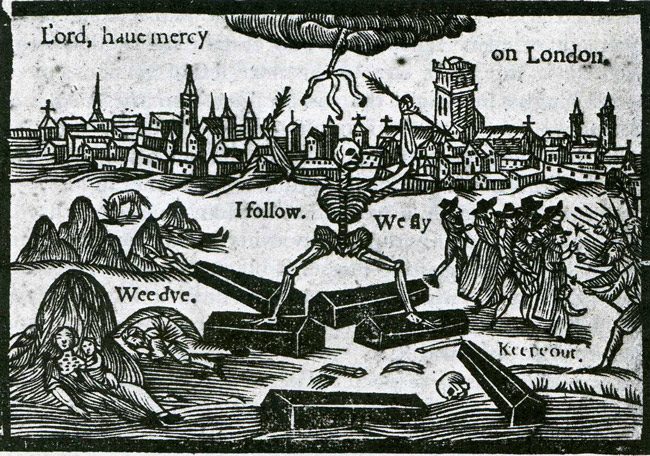
In 1722, Defoe had reason to believe the plague might come back to London, and wreak the devastation it caused in 1665, the “plague year” he detailed, when one in every five Londoners died. This was not a story of heroes making sacrifices to save the city. “Everyone behaved badly, though the rich behaved the worst,” Lepore writes. “Having failed to heed warnings to provision, they sent their poor servants out for supplies,” spreading the infection throughout the city. Defoe earnestly hoped to head off such catastrophe. He wrote to issue an admonition, as he put it, “both to us and to posterity, though we should be spared from that portion of this bitter cup.”
The cup, Lepore writes, “has come out of its cupboard.” But so too has the resilience found in Albert Camus’ 1946 novel Le Peste (The Plague), based on a real cholera outbreak in Algeria in 1849. Though fictional, it draws on Camus’ study of historical plagues and his experience as a member of the French Resistance. Camus seems to have found the plague as metaphor particularly uplifting, nicknaming his twins Catherine and Jean, “Plague” and “Cholera,” respectively.
Whether we see it as a story of a siege brought on by sickness, or an allegory of an occupation, Camus wrote of the novel that “the inhabitants, finally freed, would never forget the difficult period that made them face the absurdness of their existence and the precariousness of the human condition. What’s true of all the evils in the world is true of plagues as well. It helps men to rise above themselves.” Defoe might disagree, but plagues in his time were not also accompanied by widespread Nazism, a double crisis that might doubly force us to “reflect on what is real, what is important, and become more human,” says Catherine Camus of the soaring new popularity of her father’s novel.
We can do this through reading in our real-life quarantine. “Reading is an infection,” Lepore writes, “a burrowing into the brain: books contaminate, metaphorically, and even microbiologically” as physical objects capable of ferrying germs. Plagues are mass-existential crises on the level of WWII or the Lisbon earthquake that shook the faith of Europe’s intellectuals. They are also settings for love and terror, from Boccaccio and Gabriel Garcia Marquez to Edgar Allan Poe and Margaret Atwood.
Vulture has published an “essential list” of 20 plague books to read, including many of the classics mentioned above, and a book that is hardly remembered but might be thought of as an ancestor to Atwood’s plague-ridden futures: Mary Shelley’s The Last Man, published in 1826 during the second of two virulent cholera pandemics. In the novel, Shelley claims to have discovered the story in prophetic writing about the end of the 21st century, telling of a disease that wipes out the human race. If you’d rather not indulge that kind of fantasy just yet, you’ll find varying degrees of imaginative and soberly realist fiction and history in the list of plague classics below, all freely available at Project Gutenberg.
Libraries may have shut their possibly contaminated books behind closed doors, bookstores may be deemed nonessential, but reading—and writing—about plague years feels like a necessary cultural activity to help us understand who we are apt to become in such times.
He is a “geek cultural icon”: Captain Picard and Professor X. We’ve heard him gamely voice a ridiculous animated character in American Dad. We know him as an advocate for victims of domestic violence, a tragic reality he witnessed as a child. There are many sides to Patrick Stewart, but at his core, Shakespeare nerds know, he’s a Shakespearean. Maybe you’ve seen him in 2010’s Ceaușescu-inspired Macbeth or the 2012 BBC production of Richard II, or as Claudius in 2009’s televised Royal Shakespeare Company Hamlet, with David Tennant in the title role?
Only the most enviable nerds, however, have seen him live on stage with the RSC, in any number of roles, minor and major, that he has played since joining the company in 1966. He’s as august a Shakespearean actor as Olivier or Gielgud. So, imagine Olivier or Gielgud reading a Shakespeare sonnet to you every day, right in the comfort of your own home. Maybe even better (some might say), we have the mellifluous Stewart delivering the goods, to soothe us in our days of isolation.
After receiving a very enthusiastic response when he “randomly and elegantly recited Shakespeare’s Sonnet 116 to his fans on social media,” writes Laughing Squid, Stewart “decided to read one Shakespeare sonnet aloud each day in hopes of ‘keeping the doctor away.’” Think of it as preventative medicine for the itchy, cooped-up soul. On his Instagram, Sir Patrick shows up lounging comfortably in casual clothes, furthering the illusion that he’s joined us in our living rooms—or we’ve joined him in his.
Where the intimacy of celebrity social media can sometimes feel cloying and insincere, Stewart seems to feel so genuinely at home with his setting and his text that we do too. The actor occasionally adds some brief commentary. In his reading of Sonnet 2, above, he says before beginning, “this is one of my favorites.”
When forty winters shall besiege thy brow, And dig deep trenches in thy beauty’s field, Thy youth’s proud livery so gazed on now, Will be a totter’d weed of small worth held: Then being asked, where all thy beauty lies, Where all the treasure of thy lusty days; To say, within thine own deep sunken eyes, Were an all-eating shame, and thriftless praise. How much more praise deserv’d thy beauty’s use, If thou couldst answer ‘This fair child of mine Shall sum my count, and make my old excuse,’ Proving his beauty by succession thine! This were to be new made when thou art old, And see thy blood warm when thou feel’st it cold.
Maybe we all feel we’re growing old in the boredom and anxiety of our new siege-like conditions. The poet urges us to make the most it. Sure, plenty of people are already engaged in making children, without any help from Shakespeare or Patrick Stewart, but those who aren’t might decide to work on other legacies that will outlive them.
Stewart tells Variety that his only regret during his time with the RSC is that he “might have perhaps been a rather bolder, pushier and more extravagant actor.” But it’s his understatement and subtlety that make him so compelling. He also says that his first year with the RSC was, “at that point, the happiest year of my working life,” though he was only cast to play small roles until he was made an Associate Artist in 1967, just one year after joining.
He worked alongside a “new nucleus of talent” that included Helen Mirren and Ben Kingsley and remained exclusively with the company until 1982. (See a young Stewart as Oberon in A Midsummer Night’s Dream production from 1977.) Stewart returned to the stage with the RSC often, and while his Instagram readings are hardly comparable in scope and intensity to his Shakespearean work on stage and screen, they have proven a true balm for lovers of Shakespeare’s poetry, as read by Patrick Stewart as a loveably bookish homebody, which turns out to be an unsurprisingly large number of people.
If you’re in dire need of such a thing—or just can’t miss the opportunity to see one of the greatest living Shakespearean actors read all of the Sonnets in his sweats—check in with Stewart’s Instagram to get caught up and for the latest installment, and follow along with poems here. For even more Shakespearean Stewart geekery, read his recollection of his 1965 Royal Shakespeare Company audition—in which company co-founder John Barton had him perform Henry V’s famous Agincourt speech four times in a row before inviting him to join.
Do we need professional critics regulating our entertainment intake? Noah has written for numerous publications including The Washington Post, The Atlantic, NBC News, The Guardian, Slate, and Vox, and his work has come up for discussion in multiple past Pretty Much Pop episodes.
He was invited to join hosts Mark Linsenmayer, Erica Spyres, and Brian Hirt in spelling out the functions of criticism, the idea of criticism as art, ideological vs. aesthetic critique, and whether there’s anything wrong with being negative about other people’s art. While we talk mostly about film, Noah also writes about TV, comics, music and more.
First, read some articles by Noah about criticism:
At the end, after Noah leaves, Mark lays out a taxonomy of criticism: supporter, decoder, taste enforcer, and hater. Noah practices all of these! Follow him on Twitter @nberlat and get scads of his writing by supporting him at patreon.com/noahberlatsky.
Watchers of Westworld will have heard a character in the most recent episode utter the line, “for the first time, history has an author.” It’s as loaded a bit of dialogue as the series has dropped on fans, not least for its suggestion that in the absence of a god we should be better off with an all-knowing machine.
The line might bend the ear of literary scholars for another reason. The idea of authorship is a complicated one. In one sense, maybe, everyone is an author of history, and in another, perhaps no one is. But it’s difficult to comprehend these abstractions—we crave stories with strong characters, hence our veneration of Great Men and Women of the past.
Still, in many times and places, individual authorship was irrelevant. Renaissance thinkers revalued the author as an auctoritas, a worthy figure of influence and renown. “Death of the author” theorists pointed out that the appearance of a literary text could never be reduced to a single, unchanging personality. In religious studies, questions of authorship open onto minefield after minefield. There may be no commonly agreed-upon way to think about what an author is.
Does it make sense, then, to talk about the “world’s first author”? Perhaps. In the TED-Ed lesson above by Soraya Field Fiorio, we learn that the first known person to use written language for literary purposes was named was Enheduanna, a powerful Mesopotamian high priestess who wrote forty-two hymns and three epic poems in cuneiform 4,3000 hundred years ago.
Daughter of Sargon of Akkad, who placed her in a position to rule, Enheduanna lived about “1,500 years before Homer and about 500 years before the Biblical patriarch Abraham.” (There’s considerable doubt, of course, about whether either of those people existed, whether they wrote the works attributed to them, or whether such works were penned by committee, so to speak.)
Sargon was also an author, having composed an autobiography, The Legend of Sargon, that “exerted a powerful influence over the Sumerians he sought to conquer,” notes Joshua J. Mark at the Ancient History Encyclopedia. But first, Enheduanna used her position as high priestess to unify her father’s empire with religious hymns that praised the gods of each major Sumerian city. “In her writing, she humanized the once aloof gods,” just as Homer would hundreds of years later. “Now they suffered, fought, loved, and responded to human pleading.”
Her hymns to Inanna are her most defining literary achievement, but Enheduanna has somehow been completely left out of history. “We know who the first novelist is,” writes Charles Halton at Lit Hub, “eleventh century Japanese Noblewoman Murasaki Shikibu, who wrote the Tale of Genji.” Likewise, we know the first novelist of the western world, Miguel de Cervantes, and the first essayist, Michel de Montaigne. But “ask any person in your life who wrote the first poem and they’re apt to draw a blank.”
Maybe this is because, unlike novels, we don’t think of poetry as being invented by a single individual. It seems as though it must have sprung from the collective psyche not long after humans began using language. Yet from the point of view of literary history—which, like most histories, consists of a succession of great names—Enheduanna certainly deserves the honor as the world’s first known poet and first known author. Learn more about her in the lesson above.
We're hoping to rely on loyal readers, rather than erratic ads. Please click the Donate button and support Open Culture. You can use Paypal, Venmo, Patreon, even Crypto! We thank you!
Open Culture scours the web for the best educational media. We find the free courses and audio books you need, the language lessons & educational videos you want, and plenty of enlightenment in between.