A fond and appreciative portrait of one of American journalism’s superstars, “Joan Didion: The Center Will Not Hold” may not contain any revelations that will surprise those who’ve followed Didion’s eloquent, often autobiographical writing over the years. But the fact that it was made by her nephew, actor/filmmaker Griffin Dunne, gives it a warmth and intimacy that might not have graced a more standard documentary.
If you would like to sign up for Open Culture’s free email newsletter, please find it here. It’s a great way to see our new posts, all bundled in one email, each day.
If you would like to support the mission of Open Culture, consider making a donation to our site. It’s hard to rely 100% on ads, and your contributions will help us continue providing the best free cultural and educational materials to learners everywhere. You can contribute through PayPal, Patreon, and Venmo (@openculture). Thanks!
Over the course of this tumultuous year, new CIA director Mike Pompeo has repeatedly indicated that he would move the Agency in a “more aggressive direction.” In response, at least one person took on the guise of former Chilean president Salvador Allende and joked, incredulously, “more aggressive”? In 1973, the reactionary forces of General Augusto Pinochet overthrew Allende, the first elected Marxist leader in Latin America. Pinochet then proceeded to institute a brutal 17-year dictatorship characterized by mass torture, imprisonment, and execution. The Agency may not have orchestrated the coup directly but it did at least support it materially and ideologically under the orders of President Richard Nixon, on a day known to many, post-2001, as “the other 9/11.”
The Chilean coup is one of many CIA interventions into the affairs of Latin America and the former European colonies in Africa and Asia after World War II. It is by now well known that the Agency “occasionally undermined democracies for the sake of fighting communism,” as Mary von Aue writes at Vice, throughout the Cold War years. But years before some of its most aggressive initiatives, the CIA “developed several guises to throw money at young, burgeoning writers, creating a cultural propaganda strategy with literary outposts around the world, from Lebanon to Uganda, India to Latin America.” The Agency didn’t invent the post-war literary movements that first spread through the pages of magazines like The Partisan Reviewand The Paris Reviewin the 1950s. But it funded, organized, and curated them, with the full knowledge of editors like Paris Review co-founder Peter Matthiessen, himself a CIA agent.
The Agency waged a cold culture war against international Communism using many of the people who might seem most sympathetic to it. Revealed in 1967 by former agent Tom Bradenin the pages of the Saturday Evening Post, the strategy involved secretly diverting funds to what the Agency called “civil society” groups. The focal point of the strategy was the CCF, or “Congress for Cultural Freedom,” which recruited liberal and leftist writers and editors, oftentimes unwittingly, to “guarantee that anti-Communist ideas were not voiced only by reactionary speakers,” writes Patrick Iber at The Awl. As Braden contended in his exposé, in “much of Europe in the 1950s, socialists, people who called themselves ‘left’—the very people whom many Americans thought no better than Communists—were about the only people who gave a damn about fighting Communism.”
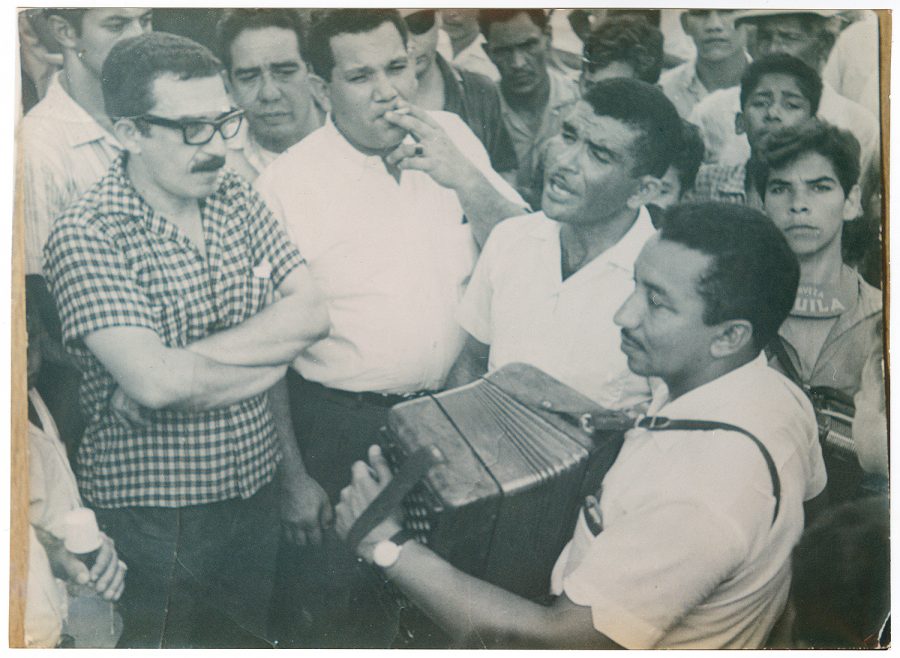
No doubt some literary scholars would find this claim tendentious, but it became agency doctrine not only because the CIA saw funding and promoting writers like James Baldwin, Gabriel Garcia Márquez, Richard Wright, and Ernest Hemingway as a convenient means to an end, but also because many of the program’s founders were themselves literary scholars. The CIA began as a World War II spy agency called the Office of Strategic Services (OSS). After the war, says Guernica magazine editor Joel Whitney in an interview with Bomb, “some of the OSS guys became professors at Ivy League Universities,” where they recruited people like Matthiessen.
The more liberal guys who were part of the brain trust that formed the CIA saw that the Soviets in Berlin were getting masses of people from other sectors to come over for their symphonies and films. They saw that culture itself was becoming a weapon, and they wanted a kind of Ministry of Culture too. They felt the only way they could get this paid for was through the CIA’s black budget.
McCarthy-ism reigned at the time, and “the less sophisticated reactionaries,” says Whitney, “who represented small states, small towns, and so on, were very suspicious of culture, of the avant-garde, the little intellectual magazines, and of intellectuals themselves.” But Ivy League agents who fancied themselves tastemakers saw things very differently.
Whitney’s book, Finks: How the CIA Tricked the World’s Best Writers, documents the Agency’s whirlwind of activity behind literary magazines like the London-based Encounter, French Preuves, Italian Tempo Presente, Austrian Forum, Australian Quadrant, Japanese Jiyu, and Latin American Cuadernos and Mundo Nuevo. Many of the CCF’s founders and participants conceived of the enterprise as “an altruistic funding of culture,” Whitney tells von Aue. “But it was actually a control of journalism, a control of the fourth estate. It was a control of how intellectuals thought about the US.”
While we often look at post-war literature as a bastion of anti-colonial, anti-establishment sentiment, the pose, we learn from researchers like Iber and Whitney, was often carefully cultivated by a number of intermediaries. Does this mean we can no longer enjoy this literature as the artistic creation of singular geniuses? “You want to know the truth about the writers and publications you love,” says Whitney, “but that shouldn’t mean they’re ruined.” Indeed, the Agency’s cultural operations went far beyond the little magazines. The Congress of Cultural Freedoms used jazz musicians like Louie Armstrong, Dave Brubeck, and Dizzy Gillespie as “goodwill ambassadors” in concerts all over the world, and funded exhibitions of Abstract Expressionists like Mark Rothko, Jackson Pollack, and Willem de Kooning.
The motives behind funding and promoting modern art might mystify us unless we include the context in which such cultural warfare developed. After the Cuban Revolution and subsequent Communist fervor in former European colonies, the Agency found that “soft liners,” as Whitney puts it, had more anti-Communist reach than “hard liners.” Additionally, Communist propagandists could easily point to the U.S.‘s socio-political backwardness and lack of freedom under Jim Crow. So the CIA co-opted anti-racist writers at home, and could silence artists abroad, as it did in the mid-60s when Louis Armstrong went behind the Iron Curtain and refused to criticize the South, despite his previous strong civil rights statements. The post-war world saw thriving free presses and arts and literary cultures filled with bold experimentalism and philosophical and political debate. Knowing who really controlled these conversations offers us an entirely new way to view the directions they inevitably seemed to take.
Quick fyi: Next year, an archive of 6,000 letters by Marcel Proust will be digitized and made freely available online. The letters come from the collection of Philip Kolb, a Proust scholar from the University of Illinois at Urbana Champaign. According to The New York Times, “the first tranche of the letters, several hundred related to the First World War, are expected to be published online by Nov. 11, 2018, to coincide with the 100th anniversary of the end of the war.” We’ll update you when the letters actually appear online.
There may be innumerable moral and philosophical reasons why we should read certain books, hear certain symphonies, see certain paintings…. Those reasons are mostly intangible, which makes them nobler, I suppose, than the reasons we should buy a luxury car or vacation home. Nevertheless, the salesmanship of high culture can sometimes feel of a piece, making subtle, or not so subtle, appeals to safety, status, and investment value. What of pure enjoyment? The immersion in a work of art because it simply feels good? To allow for pleasure alone to guide our aesthetic tastes, some might feel, would be amoral; would cheapen culture and elevate some supposedly vulgar products to the status of high art. Can’t have that.
Of course, how much high art was once considered a hazard to good taste and public morality? Modernism puffs out its chest with pride for having fostered many creative works that shocked and titillated their first mass audiences. James Joyce’s Ulysses ranks quite highly upon that list. The novel’s initial reputation as highbrow smut seems at odds with Sam Slote’s characterization of it in the TED-Ed video above as “both a literary masterpiece and one of the hardest works of literature to read.” But it can be all those things and more. Inside the dense experimental epic is a charmingly detailed travelogue of Dublin, a theological treatise on heresy, a series of Freudian jokes with the kinds of sophomoric punchlines “stately, plump Buck Mulligan” would appreciate….
Not for nothing has Joyce inspired a cult following, if not something of a downright cult, whose members gather all over the world on June 16th for “Bloomsday”—the single day on which the novel takes place, and on which Joyce met his lifelong partner Nora Barnacle in 1904. Dressed in period costume, Joyce fans read the novel aloud, and hundreds make the pilgrimage to Dublin to follow the perambulations of protagonists Leopold Bloom and Stephen Dedalus. “What is it,” asks Slote, an Associate Professor at Trinity College Dublin’s School of English, “about this famously difficult novel that inspires so many people?” Professor Slote is no dilettante but an expert who has published six books on Joyce and an annotated edition of Ulysses. He admits “there’s no one simple answer to that question.”
Nevertheless, the answers Slote does provide in the six-minute animated intro to Ulysses relate not to the novel’s moral, social, psychological, or political virtues, but to those qualities that give readers enjoyment. Each chapter is written in a different style,” a play, a “cheesy romance novel,” an imitation of music. Ulysses is a modern parody of Homer’s Odyssey and a virtuoso medley of technical performances, including a chapter which “reproduces the evolution of English literary prose style, from its beginnings in Anglo Saxon right up to the 20th century.” The final chapter, Molly Bloom’s stream-of-consciousness soliloquy, is a tour-de-force, capping off the “narrative gymnastic routines.” The shifting styles are augmented by “some of the most imaginative uses of language you’ll find anywhere.”
As for the novel’s frequent passages of “impenetrable” density? Well, Slote admits that “it’s up to the reader to let their eyes skim over them or grab a shovel and dig in.” In the remaining few minutes, he may have you convinced that the pleasure is worth the effort.
Virginia Woolf dissuaded readers from playing the critic in her essay “How Should One Read a Book?” But in addition to her novels, she is best known for her literary criticism and became a foundational figure in feminist literary theory for her imaginative polemic “A Room of One’s Own,” an essay that takes traditional criticism to task for its presumptions of male literary superiority.
Women writers like herself, she argues, had always been a privileged few with the means and the freedom to pursue writing in ways most women couldn’t. These conditions were so rare for women throughout literary history that innumerable artists may have gone unnoticed and unheralded for their lack of opportunity. Her observation would have put her readers in mind of Thomas Gray’s revered “Elegy Written in a Country Churchyard,” with its famous line about a pauper’s grave: “Some mute inglorious Milton here may rest.”
Woolf alludes to the poem, writing of “some mute and inglorious Jane Austen,” and makes a case that would-have-been women writers were exceptionally marginalized by gender—by its intersections with power and privilege and their lack. She famously constructed a scenario—brought into pop culture by The Smiths and Bananarama singer Siobhan Fahey—involving Shakespeare’s fictional sister Judith, whose talent and ambition are squashed for the sake of her brother’s education. It is hardly a far-fetched idea. We might remember Mozart’s sister Nannerl, who was also a child prodigy, whose career ended with her childhood, and who disappeared in her brother’s shadow.
In the TED-Ed video at the top, Woolf scholar and doctoral candidate at the University of Wisconsin Iseult Gillespie describes the import of Woolf’s thought experiment. Shakespeare’s sister stands in for every woman who is pushed into domestic labor and marriage while the men in her family pursue their goals unhindered. “Woolf demonstrates the tragedy of genius restricted,” just as Langston Hughes would do a couple decades later. Her particular genius, says Gillespie, lies in her ability to portray “the internal experience of alienation…. Her characters frequently live inner lives that are deeply at odds with their external existence.”
The video outlines Woolf’s own biography: her inclusion in the “Bloomsbury Group”—a social circle including E.M. Forster and Virginia’s soon-to-be husband Leonard Woolf. And it sketches out the innovative literary techniques of her novels. Woolf thought of herself, as Alain de Botton says in his short introduction above, as a “distinctively modernist writer at odds with a raft of the staid and complacent assumptions of 19th century English literature.” One such assumption, as she writes in “A Room of One’s Own,” includes an opinion that “the best woman was intellectually the inferior of the worst man.”
Woolf’s own modernist breakthroughs rival those of her contemporaries James Joyce and Ezra Pound. Her favorite women writers rank as highly as men in the same canon in any serious study; but this is of course beside the point. It wasn’t the truth or falsehood of claims about women’s inferiority that determined their power, but rather the social power of those who made such claims.
Domineering fathers, spotlight-stealing brothers, moralizing clergymen, the gatekeeping intellectuals of “Oxbridge”—Woolf’s portmanteau for the snobbery and chauvinism of Oxford and Cambridge dons: it was such men who determined not only whether or not a woman might pursue her writing, but whether she lived or died in penury, mute and inglorious. Woolf knew much of what she wrote, having grown up surrounded by the cream of 19th-century literary society, and having had to “steal an education from her father’s study,” as de Botton notes, while her brothers went off to Cambridge. She was nonetheless well aware of her privilege and used it not only to create new forms of writing, but to open new literary spaces for women writers to come.
In 1874, Stepan Andreevich Bers published The Cookbook and gave it as a gift to his sister, countess Sophia Andreevna Tolstaya, the wife of the great Russian novelist, Leo Tolstoy. The book contained a collection of Tolstoy family recipes, the dishes they served to their family and friends, those fortunate souls who belonged to the aristocratic ruling class of late czarist Russia. Almost 150 years later, this cookbook has been translated and republished by Sergei Beltyukov.
Available in an inexpensive Kindle format ($3.99), Leo Tolstoy’s family recipe book features dozens of recipes, everything from Tartar Sauce and Spiced Mushrooms (what’s a Russian kitchen without mushrooms?), to Stuffed Dumplings and Green Beans à la Maître d’Hôtel, to Coffee Cake and Viennese Pie. The text comes with a translation, too, of Russian weights and measures used during the period. One recipe Mr. Beltyukov provided to us (which I didn’t see in the book) is for the Tolstoy’s good ole Mac ‘N’ Cheese dish. It goes something like this:
Bring water to a boil, add salt, then add macaroni and leave boiling on light fire until half tender; drain water through a colander, add butter and start putting macaroni back into the pot in layers – layer of macaroni, some grated Parmesan and some vegetable sauce, macaroni again and so on until you run out of macaroni. Put the pot on the edge of the stove, cover with a lid and let it rest in light fire until the macaroni are soft and tender. Shake the pot occasionally to prevent them from burning.
We’ll leave you with bon appétit! — an expression almost certainly heard in the homes of those French-speaking Russian aristocrats.
If you would like to sign up for Open Culture’s free email newsletter, please find it here. It’s a great way to see our new posts, all bundled in one email, each day.
If you would like to support the mission of Open Culture, consider making a donation to our site. It’s hard to rely 100% on ads, and your contributions will help us continue providing the best free cultural and educational materials to learners everywhere. You can contribute through PayPal, Patreon, and Venmo (@openculture). Thanks!
Note: This post first appeared on OC back in 2014.
It’s worth taking note of this: In a newly-released audiobook, Lin-Manuel Miranda (the creator and star of Hamilton) narrates Junot Diaz’s Pulitzer Prize-winning novel, The Brief Wondrous Life of Oscar Wao. Above and below, listen to excerpts of an unabridged reading that lasts nearly 10 hours. And also note that Miranda is joined at points by Tony Award-winning actress, Karen Olivo.
NB: Audible is an Amazon.com subsidiary, and we’re a member of their affiliate program.
If you would like to sign up for Open Culture’s free email newsletter, please find it here. It’s a great way to see our new posts, all bundled in one email, each day.
If you would like to support the mission of Open Culture, consider making a donation to our site. It’s hard to rely 100% on ads, and your contributions will help us continue providing the best free cultural and educational materials to learners everywhere. You can contribute through PayPal, Patreon, and Venmo (@openculture). Thanks!
It can seem that the writing of literature and the theory of literature occupy separate great houses, Game of Thrones-style, or even separate countries held apart by a great sea. Perhaps they war with each other, perhaps they studiously ignore each other or obliquely interact at tournaments with acronymic names like MLA and AWP. Like Thomas Pynchon’s characterization of the political right and left, scholars and writers represent opposing poles, the hothouse and the street. That rare beast, the academic poet, can seem like something of a unicorn, or dragon.
…Or like the ominous talking raven in Edgar Allan Poe’s most famous of poems.
The divide between theory and practice is a recent development, a product of state budgeting, political brinksmanship, the relentless publishing mills of academia that force scholars to find a pigeonhole and stay there.… In days past, poets and scholar/theorists frequently occupied the same place at the same time—Wallace Stevens, T.S. Eliot, Samuel Taylor Coleridge, Percy Shelley, and, of course, Poe, whose perennially popular “The Raven” serves as a point-by-point illustration for his theory of composition just as thoroughly as Eliot’s great works bear out his notion of the “objective correlative.”
Poe’s object, the titular creature, is an “archetypal symbol,” writes Dana Gioia, in a poem that aims for what its author calls a “unity of effect.” In his 1846 essay “The Philosophy of Composition,” Poe the poet/theorist tells us in great detail how “The Raven” satisfies all of his other criteria for literature as well, such as achieving its intent in a single sitting, using a repeated refrain, and so on.
Should we have any doubt about how much Poe wanted us to see the poem as the deliberate outcome of a conceptual scheme, we find him three years later, in 1849, the year of his death, delivering a lecture on the “Poetic Principle,” and concluding with a reading of “The Raven.”
John Moncure Daniel of the Richmond Semi-Weekly Examiner remarked after attending one of these talks that “the attention of many in this city is now directed to this singular performance.” At that point, Poe, who hardly made a dime from “The Raven,” had to suffer the indignity of having all of his work go out of print during his brief, unhappy lifetime. Moncure and the Examiner thereby furnished readers “with the only correct copy ever published,” previous appearances, it seems, having contained punctuation errors.
Nonetheless, for all of Poe’s pedantry and penury, “The Raven“ ‘s first appearances made him semi-famous. His readings were a sensation, and it’s a sure bet that his audiences came to hear him read the poem, not deliver a lecture on its principles. Oh, for some proto-Edison in the room with an early recording device. What would it be like to hear the mournful, grief-stricken, alcoholic genius—master of the macabre and inventor of the detective story—intone the raven’s enigmatic “Nevermore”?
While Poe’s speaking voice has receded irretrievably into history, his poetic voice may live close to forever. So mesmerizing are his meter and diction that many great actors known especially for their voices have become possessed by “The Raven.”
Finally, we would be remiss not to mention The Simpsons’ James Earl Jones-narrated parody, a worthy teaching tool for distracted young visual learners. Is it a shame that we now think of “The Raven” as a Halloween yarn fit for the Treehouse of Horror or any number of enjoyable exercises in spooky oratory—rather than the theoretical thought experiment its author seemed to intend? Does Poe rotisserie in his grave as Homer snores in a wingback chair? Probably. But as the author told us himself at length, the poem works! It still never fails to excite our morbid curiosity, enchant our gothic sensibility, and maybe send a chill or two down the spine. Maybe we never really needed Poe to explain it to us.
We're hoping to rely on loyal readers, rather than erratic ads. Please click the Donate button and support Open Culture. You can use Paypal, Venmo, Patreon, even Crypto! We thank you!
Open Culture scours the web for the best educational media. We find the free courses and audio books you need, the language lessons & educational videos you want, and plenty of enlightenment in between.