Book history buffs don’t need to be told, but the rest of us probably do: incunable—from a Latin word meaning “cradle,” “swaddling clothes,” or “infancy”—refers to a book printed before 1501, during the very first half-century of printing in Europe. An overwhelming number of the works printed during this period were in Latin, the transcontinental language of philosophy, theology, and early science. Yet one of the most revered works of the time, Dante’s Divine Comedy—written in Italian—fully attained its status as a literary classic in the latter half of the 15th century.
In addition to numerous commentaries and biographies of its author, over 10 editions of the epic Medieval poem— the tale of Dante’s descent into hell and rise through purgatory and paradise—appeared in the period of incunabula, the first in 1472. The 1481 edition contained art based on Sandro Botticelli’s unfinished series of Divine Comedy illustrations. The first fully-illustrated edition appeared in 1491. None of these printings included the word Divine in the title, which did not come into use until 1555. The Commedia, as it was originally called, continued to gain in stature into the 16th century, where it received lavish treatment in other illustrated editions.
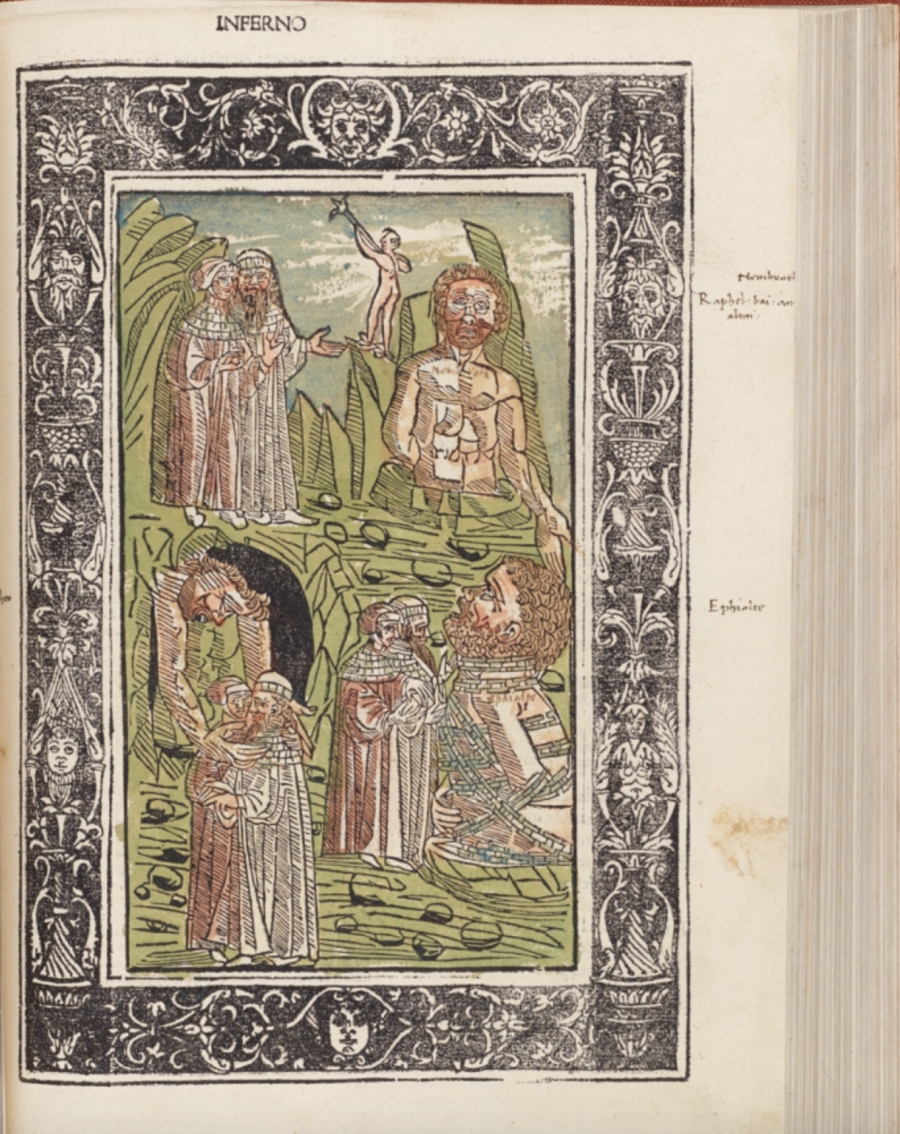
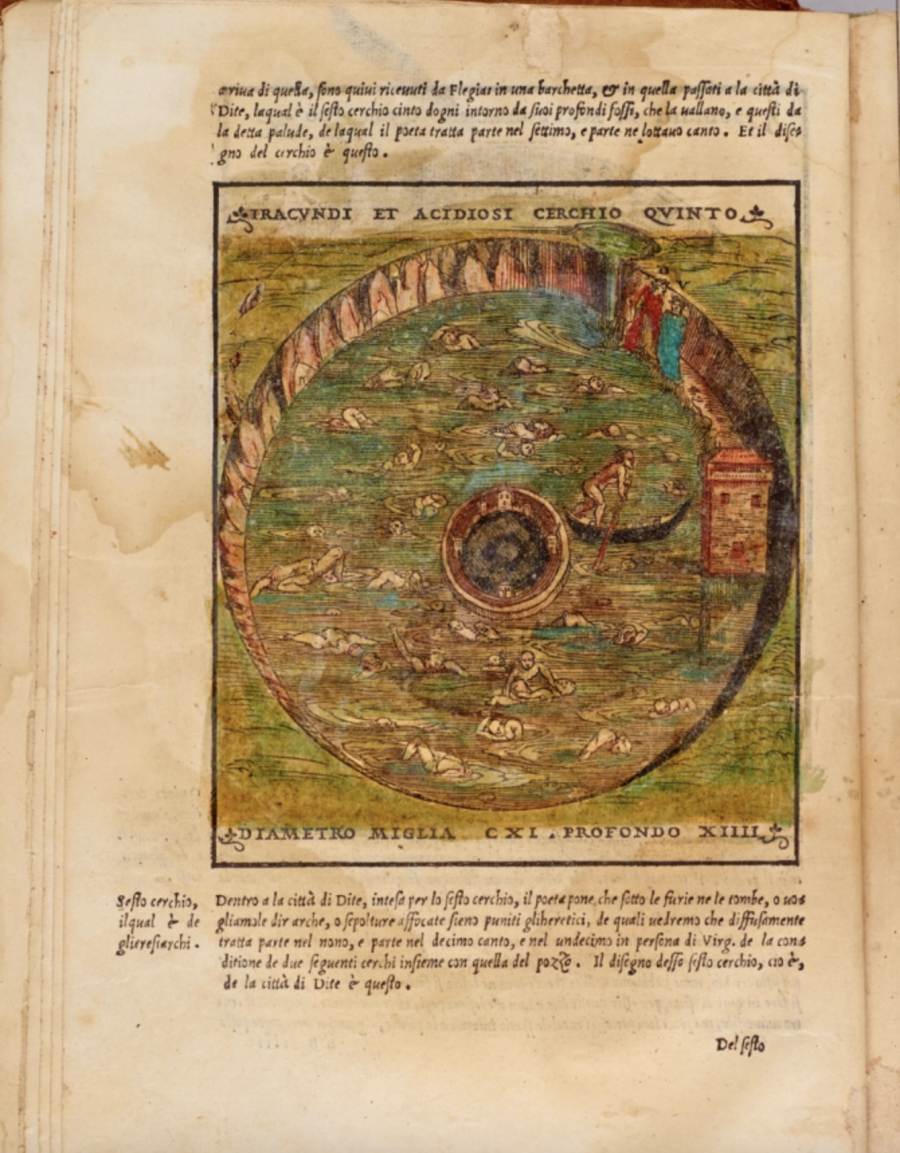
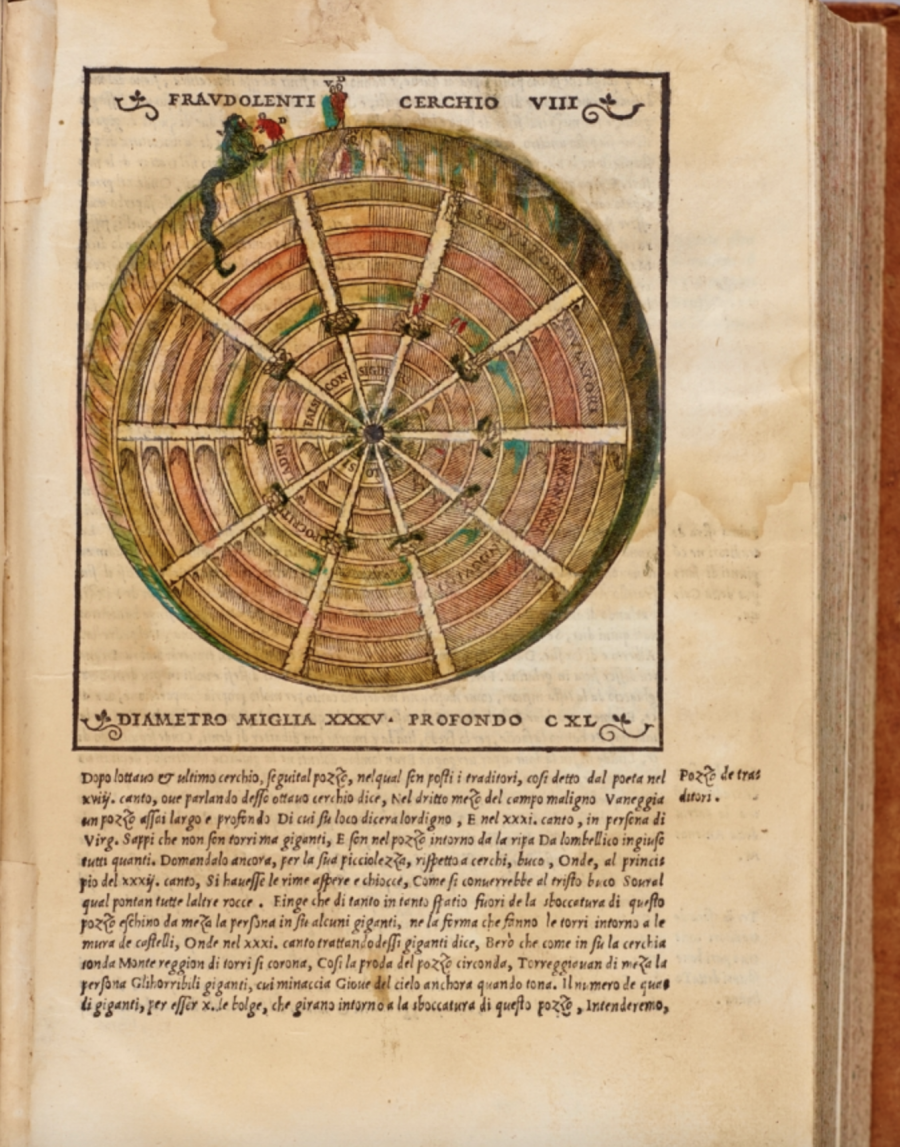
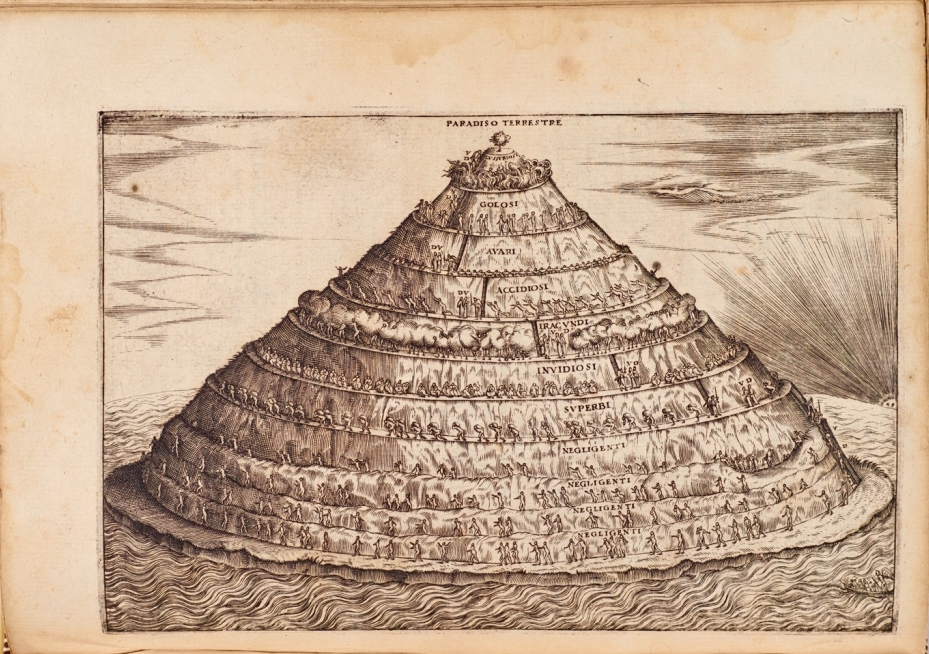
You can see Illustrations from three of the editions from the first 100-plus years of printing here, and many more at Digital Dante, a collaborative effort from Columbia University’s Library and Department of Italian. These images, from Columbia’s Rare Book and Manuscript Library, represent a 1497 woodcut edition, at the top, with a number of hand-colored pages; an edition from 1544, above, with almost 90 circular and traditionally-composed scenes, all of them probably hand-colored in the 19th century; and a 1568 edition with three engraved maps, one for each book, like the carefully-rendered visualization of purgatory, below.
Of this last edition, Jane Siegel, Librarian for Rare Books, writes, “the relative lack of illustrations are balanced by the fineness and detail made possible by using expensive copper engravings as a medium, and by the lively decorated and historiated woodcut initials sprinkled throughout the volume at the head of each canto.” Each of these historical artifacts shows us a lineage of craftsmanship in the infancy and early childhood of printing, a time when literary works of art could be turned doubly into masterpieces with illustration and typography that complemented the text. Luckily for lovers of Dante, finely-illustrated editions of the Divine Comedy have never gone away.
The list of English translators of Homer’s Odyssey includes an illustrious bunch of names every student of literature knows: Thomas Hobbes, Alexander Pope, William Cowper, Samuel Butler, T.E. Lawrence, Robert Fitzgerald, Robert Fagles…. Should you look further into the history of Homeric translation, you might notice one thing immediately. All of Homer’s translators, to a man, have been men. None have, presumably, approached the text from a woman’s point of view.
But what would that entail? Perhaps a certain critical distance, suspicion even—an unwillingness to readily identify with or admire the hero or credit the tales of his exploits at their supposed value. As Margaret Atwood writes in the introduction to The Penelopiad—her reimagining of the tale from Penelope’s perspective—“The story as told in The Odyssey doesn’t hold water: there are too many inconsistencies.”
Atwood is not a translator. Prolific poet and scholar Anne Carson, on the other hand, has published acclaimed translations of Sappho, Euripides, and Aeschylus. Of the art, she writes, “Silence is as important as words in the practice and study of translation.” Though Carson calls the observation “cliché,” the experience of another rare female classics translator in a field overcrowded with men bears out the importance of silence in a personal way.
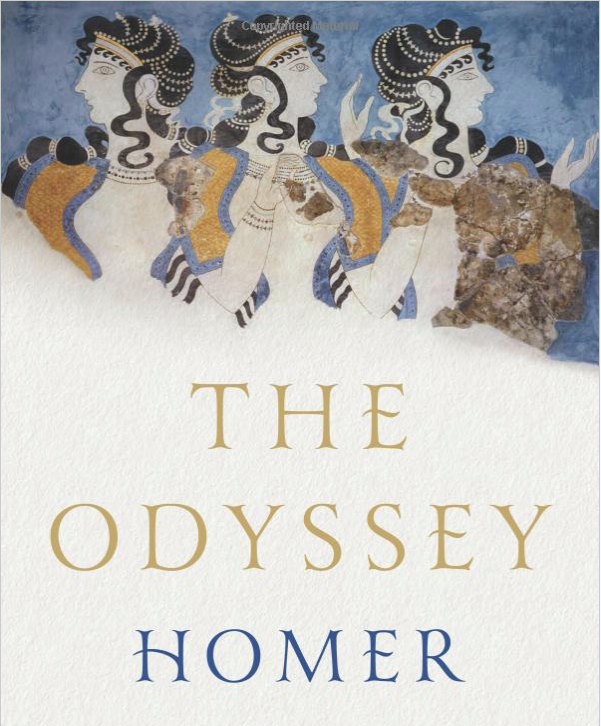
Classicist Emily Wilson has made the first translation of The Odyssey by a woman. Her version, writes Wyatt Mason at The New York Times, approaches the text afresh, apart from the chattering conversations between hundreds of years of previous attempts. “Wilson has made small but, it turns out, radical changes to the way many key scenes of the epic are presented,” notes Mason. This translation is a corrective, she believes, of a text that “has through translation accumulated distortions that affect the way even scholars who read Greek discuss the original.”
Confronting silence is a theme of Wilson’s interview with Mason about her new translation. From a family of accomplished scholars, most notably her father, novelist and critic A.N. Wilson, she remembers her childhood as “a lot of silence… As a kid I was just aware of unhappiness, and aware of these things that weren’t ever being articulated.” She gravitated toward classics because of shyness and fear of mispronouncing living languages. “You don’t have to have beautiful Latin pronunciation,” she says. “It took away a whole level of shame.”
Greek tragedy appealed to Wilson because of its tumultuous irruption into the silence and shame of repressed emotion: “I had a childhood where it was very hard to name feelings, and just the fact that tragedy as a genre is very good at naming feelings. It’s all going to be talked out. I love that about it.” Her attention to emotional nuance as much as to action, concept, and image in part inspires her careful, independent approach to the language of the text. As a salient example, Wilson discusses the word polytropos, used as the first description we get of the poem’s hero.
The prefix poly… means “many” or “multiple.” Tropos means “turn.” “Many” or “multiple” could suggest that he’s much turned, as if he is the one who has been put in the situation of having been to Troy, and back, and all around, gods and goddesses and monsters turning him off the straight course that, ideally, he’d like to be on. Or, it could be that he’s this untrustworthy kind of guy who is always going to get out of any situation by turning it to his advantage. It could be that he’s the turner.
Mason surveys the many renderings of the word by some of Wilson’s “60 some predecessors.” Though these translations display “quite a range,” they also tend toward similarly flattering interpretations of Odysseus as “the turner.” He’s “prudent,” “for wisdom’s various arts renown’d,” “for shrewdness famed/And genius versatile,” “crafty,” “much-versed,” “deep,” “sagacious,” “ingenious,” “so wary and wise,” “clever,” and—in Stanley Lombardo’s translation—“cunning.”
Tell me about a complicated man.
Muse, tell me how he wandered and was lost
when he had wrecked the holy town of Troy,
and where he went, and who he met, the pain
he suffered in the storms at sea, and how
he worked to save his life and bring his men
back home. He failed to keep them safe; poor fools,
they ate the Sun God’s cattle, and the god
kept them from home. Now goddess, child of Zeus,
tell the old story for our modern times.
Find the beginning.
The silence in Wilson’s approach here is of the “metaphysical” variety—as Carson puts it—where “intentions are harder to define.” It is a refusal to make hasty appraisals or assume singular design or agency. “What gets us to ‘complicated,’” she says, “is both that I think it has some hint of the original ambivalence and ambiguity… and hints at ‘There might be a problem with him.’” We will learn about his turning and his being turned, and we must make up our own minds about what sort of person he is. The word also resonates strongly with contemporary usage. “I wanted it to feel like an idiomatic thing,” says Wilson, “that you might say about somebody: that he is complicated.” It is, she admits, “a flag. It says, ‘Guess what?—this is different.’ ”
Complicated: from a certain point of view, we might say this about everybody, which adds a modern layer of anxious, and very human, universalism to the description of the poem’s hero, so often cast as a heroic trickster archetype. Wilson expects pushback for her refusal to adhere to what she calls the “boys’ club” of classical translation shibboleths, many passed down from Matthew Arnold’s criteria in his 1860 lectures “On Translating Homer.” These criteria, she says, are about “noblesse oblige… you’re going to be the kind of gentlemen who’s going to have gone to Rugby and that will be the kind of language that we speak… It’s describing a boys’ club.”
Her observations turn the gaze back upon the lineage of male translators, examining how gender, as well as class and nationality, features in the way they used language. “I do think that gender matters,” she says, “and I’m not going to not say it’s something I’m grappling with.” But gender is only one part of the complicated identity of any translator. Wilson describes her approach as “trying to take this task and this process of responding to this text and creating this text extremely seriously, with whatever I have, linguistically, sonically, emotionally.” You may appreciate the results yourself—either enjoying them afresh or comparing them to previous translations you’ve loved, liked, or loathed—by purchasing a copy Wilson’s Odyssey starting today.
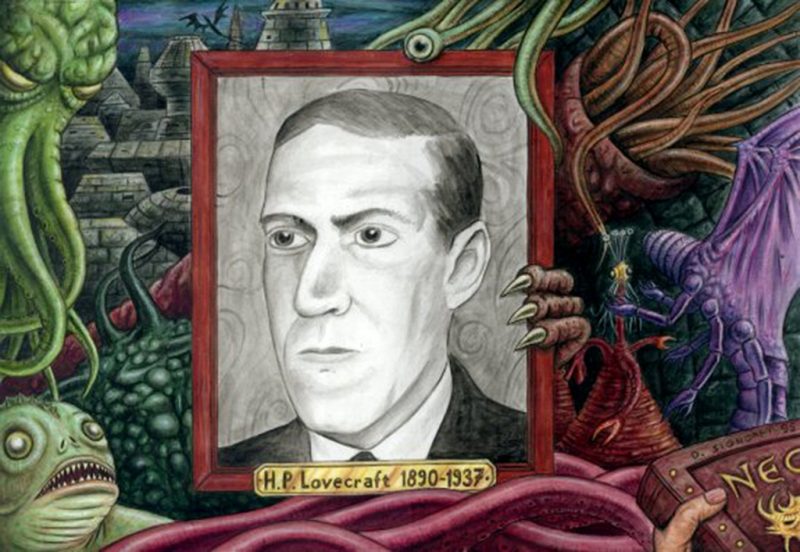
“The most merciful thing in the world, I think, is the inability of the human mind to correlate all its contents. We live on a placid island of ignorance in the midst of black seas of infinity, and it was not meant that we should voyage far.” So writes the narrator of “The Call of Cthulhu,” the best-known story by Howard Phillips Lovecraft, who, before he burnt out and died young, spent his whole literary career looking into that infinity and reporting on the psychological effects of what he sensed lurking there. What better writer to read on Halloween night, when — amid all the partying and the candy — we all permit ourselves a glimpse into the abyss?
Indeed, what better writer to hear on Halloween night? Once it gets dark, consider firing up this fourteen-hour Spotify playlist of H.P. Lovecraft audiobooks, featuring readings of not just “The Call of Cthulhu” but The Shadow over Innsmouth, “The Dunwich Horror,” “The Thing on the Doorstep,” and other stories besides. (If you don’t have Spotify’s free software, you can download it here.)
Though Lovecraft has a much wider readership now than he ever accrued in his lifetime, some of your guests might still never have heard his work and thus struggle to pin it down: is it horror? Is it suspense? Is it the macabre, the sort of thing perfected by Lovecraft’s predecessor in frightening American letters Edgar Allan Poe?
The word they need is “weird,” not in the modern sense of “somewhat unusual,” but in the early 20th-century sense — the sense of Weird Tales, the pulp magazine that published Lovecraft — of a heady blend of the supernatural, the mythical, the scientific, and the mundane. Joyce Carol Oates once wrote that Lovecraft’s stories, seldom sensational, “develop by way of incremental detail, beginning with quite plausible situations — an expedition to Antarctica, a trip to an ancient seaside town, an investigation of an abandoned eighteenth-century house in Providence, Rhode Island, that still stood in Lovecraft’s time. One is drawn into Lovecraft by the very air of plausibility and characteristic understatement of the prose, the question being When will weirdness strike?” An ideal question to ask while floating along the black sea of Halloween night.
Based in Seoul, Colin Marshall writes and broadcasts on cities and culture. His projects include the book The Stateless City: a Walk through 21st-Century Los Angeles and the video series The City in Cinema. Follow him on Twitter at @colinmarshall or on Facebook.
A fond and appreciative portrait of one of American journalism’s superstars, “Joan Didion: The Center Will Not Hold” may not contain any revelations that will surprise those who’ve followed Didion’s eloquent, often autobiographical writing over the years. But the fact that it was made by her nephew, actor/filmmaker Griffin Dunne, gives it a warmth and intimacy that might not have graced a more standard documentary.
If you would like to support the mission of Open Culture, consider making a donation to our site. It’s hard to rely 100% on ads, and your contributions will help us continue providing the best free cultural and educational materials to learners everywhere. You can contribute through PayPal, Patreon, and Venmo (@openculture). Thanks!
Over the course of this tumultuous year, new CIA director Mike Pompeo has repeatedly indicated that he would move the Agency in a “more aggressive direction.” In response, at least one person took on the guise of former Chilean president Salvador Allende and joked, incredulously, “more aggressive”? In 1973, the reactionary forces of General Augusto Pinochet overthrew Allende, the first elected Marxist leader in Latin America. Pinochet then proceeded to institute a brutal 17-year dictatorship characterized by mass torture, imprisonment, and execution. The Agency may not have orchestrated the coup directly but it did at least support it materially and ideologically under the orders of President Richard Nixon, on a day known to many, post-2001, as “the other 9/11.”
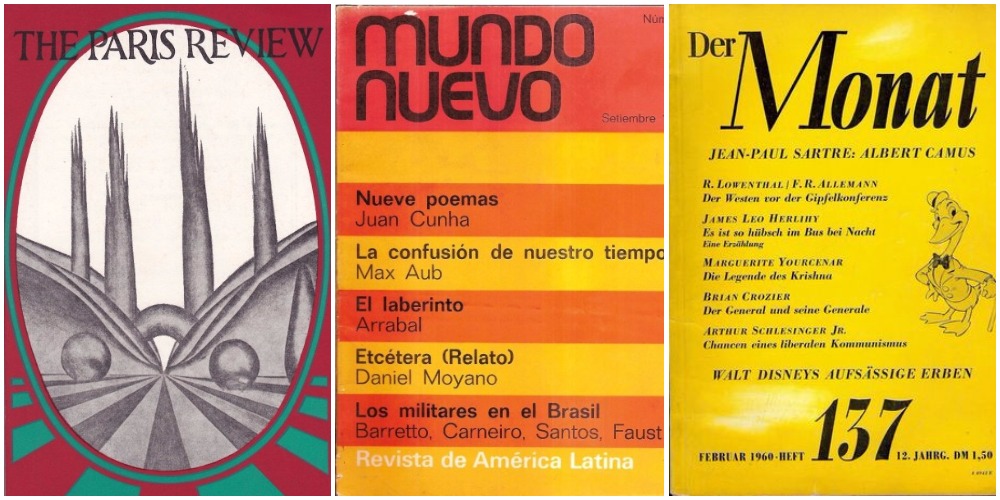
The Chilean coup is one of many CIA interventions into the affairs of Latin America and the former European colonies in Africa and Asia after World War II. It is by now well known that the Agency “occasionally undermined democracies for the sake of fighting communism,” as Mary von Aue writes at Vice, throughout the Cold War years. But years before some of its most aggressive initiatives, the CIA “developed several guises to throw money at young, burgeoning writers, creating a cultural propaganda strategy with literary outposts around the world, from Lebanon to Uganda, India to Latin America.” The Agency didn’t invent the post-war literary movements that first spread through the pages of magazines like The Partisan Reviewand The Paris Reviewin the 1950s. But it funded, organized, and curated them, with the full knowledge of editors like Paris Review co-founder Peter Matthiessen, himself a CIA agent.
The Agency waged a cold culture war against international Communism using many of the people who might seem most sympathetic to it. Revealed in 1967 by former agent Tom Bradenin the pages of the Saturday Evening Post, the strategy involved secretly diverting funds to what the Agency called “civil society” groups. The focal point of the strategy was the CCF, or “Congress for Cultural Freedom,” which recruited liberal and leftist writers and editors, oftentimes unwittingly, to “guarantee that anti-Communist ideas were not voiced only by reactionary speakers,” writes Patrick Iber at The Awl. As Braden contended in his exposé, in “much of Europe in the 1950s, socialists, people who called themselves ‘left’—the very people whom many Americans thought no better than Communists—were about the only people who gave a damn about fighting Communism.”
No doubt some literary scholars would find this claim tendentious, but it became agency doctrine not only because the CIA saw funding and promoting writers like James Baldwin, Gabriel Garcia Márquez, Richard Wright, and Ernest Hemingway as a convenient means to an end, but also because many of the program’s founders were themselves literary scholars. The CIA began as a World War II spy agency called the Office of Strategic Services (OSS). After the war, says Guernica magazine editor Joel Whitney in an interview with Bomb, “some of the OSS guys became professors at Ivy League Universities,” where they recruited people like Matthiessen.
The more liberal guys who were part of the brain trust that formed the CIA saw that the Soviets in Berlin were getting masses of people from other sectors to come over for their symphonies and films. They saw that culture itself was becoming a weapon, and they wanted a kind of Ministry of Culture too. They felt the only way they could get this paid for was through the CIA’s black budget.
McCarthy-ism reigned at the time, and “the less sophisticated reactionaries,” says Whitney, “who represented small states, small towns, and so on, were very suspicious of culture, of the avant-garde, the little intellectual magazines, and of intellectuals themselves.” But Ivy League agents who fancied themselves tastemakers saw things very differently.
Whitney’s book, Finks: How the CIA Tricked the World’s Best Writers, documents the Agency’s whirlwind of activity behind literary magazines like the London-based Encounter, French Preuves, Italian Tempo Presente, Austrian Forum, Australian Quadrant, Japanese Jiyu, and Latin American Cuadernos and Mundo Nuevo. Many of the CCF’s founders and participants conceived of the enterprise as “an altruistic funding of culture,” Whitney tells von Aue. “But it was actually a control of journalism, a control of the fourth estate. It was a control of how intellectuals thought about the US.”
While we often look at post-war literature as a bastion of anti-colonial, anti-establishment sentiment, the pose, we learn from researchers like Iber and Whitney, was often carefully cultivated by a number of intermediaries. Does this mean we can no longer enjoy this literature as the artistic creation of singular geniuses? “You want to know the truth about the writers and publications you love,” says Whitney, “but that shouldn’t mean they’re ruined.” Indeed, the Agency’s cultural operations went far beyond the little magazines. The Congress of Cultural Freedoms used jazz musicians like Louie Armstrong, Dave Brubeck, and Dizzy Gillespie as “goodwill ambassadors” in concerts all over the world, and funded exhibitions of Abstract Expressionists like Mark Rothko, Jackson Pollack, and Willem de Kooning.
The motives behind funding and promoting modern art might mystify us unless we include the context in which such cultural warfare developed. After the Cuban Revolution and subsequent Communist fervor in former European colonies, the Agency found that “soft liners,” as Whitney puts it, had more anti-Communist reach than “hard liners.” Additionally, Communist propagandists could easily point to the U.S.‘s socio-political backwardness and lack of freedom under Jim Crow. So the CIA co-opted anti-racist writers at home, and could silence artists abroad, as it did in the mid-60s when Louis Armstrong went behind the Iron Curtain and refused to criticize the South, despite his previous strong civil rights statements. The post-war world saw thriving free presses and arts and literary cultures filled with bold experimentalism and philosophical and political debate. Knowing who really controlled these conversations offers us an entirely new way to view the directions they inevitably seemed to take.
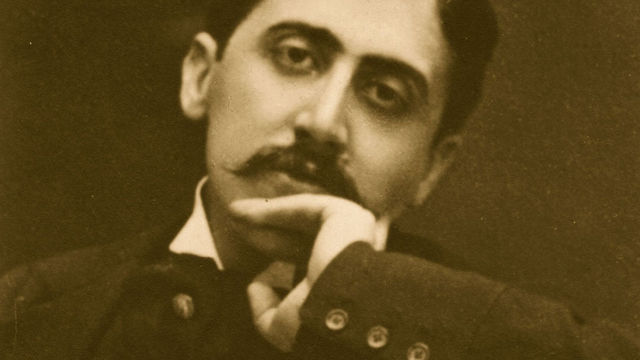
Quick fyi: Next year, an archive of 6,000 letters by Marcel Proust will be digitized and made freely available online. The letters come from the collection of Philip Kolb, a Proust scholar from the University of Illinois at Urbana Champaign. According to The New York Times, “the first tranche of the letters, several hundred related to the First World War, are expected to be published online by Nov. 11, 2018, to coincide with the 100th anniversary of the end of the war.” We’ll update you when the letters actually appear online.
There may be innumerable moral and philosophical reasons why we should read certain books, hear certain symphonies, see certain paintings…. Those reasons are mostly intangible, which makes them nobler, I suppose, than the reasons we should buy a luxury car or vacation home. Nevertheless, the salesmanship of high culture can sometimes feel of a piece, making subtle, or not so subtle, appeals to safety, status, and investment value. What of pure enjoyment? The immersion in a work of art because it simply feels good? To allow for pleasure alone to guide our aesthetic tastes, some might feel, would be amoral; would cheapen culture and elevate some supposedly vulgar products to the status of high art. Can’t have that.
Of course, how much high art was once considered a hazard to good taste and public morality? Modernism puffs out its chest with pride for having fostered many creative works that shocked and titillated their first mass audiences. James Joyce’s Ulysses ranks quite highly upon that list. The novel’s initial reputation as highbrow smut seems at odds with Sam Slote’s characterization of it in the TED-Ed video above as “both a literary masterpiece and one of the hardest works of literature to read.” But it can be all those things and more. Inside the dense experimental epic is a charmingly detailed travelogue of Dublin, a theological treatise on heresy, a series of Freudian jokes with the kinds of sophomoric punchlines “stately, plump Buck Mulligan” would appreciate….
Not for nothing has Joyce inspired a cult following, if not something of a downright cult, whose members gather all over the world on June 16th for “Bloomsday”—the single day on which the novel takes place, and on which Joyce met his lifelong partner Nora Barnacle in 1904. Dressed in period costume, Joyce fans read the novel aloud, and hundreds make the pilgrimage to Dublin to follow the perambulations of protagonists Leopold Bloom and Stephen Dedalus. “What is it,” asks Slote, an Associate Professor at Trinity College Dublin’s School of English, “about this famously difficult novel that inspires so many people?” Professor Slote is no dilettante but an expert who has published six books on Joyce and an annotated edition of Ulysses. He admits “there’s no one simple answer to that question.”
Nevertheless, the answers Slote does provide in the six-minute animated intro to Ulysses relate not to the novel’s moral, social, psychological, or political virtues, but to those qualities that give readers enjoyment. Each chapter is written in a different style,” a play, a “cheesy romance novel,” an imitation of music. Ulysses is a modern parody of Homer’s Odyssey and a virtuoso medley of technical performances, including a chapter which “reproduces the evolution of English literary prose style, from its beginnings in Anglo Saxon right up to the 20th century.” The final chapter, Molly Bloom’s stream-of-consciousness soliloquy, is a tour-de-force, capping off the “narrative gymnastic routines.” The shifting styles are augmented by “some of the most imaginative uses of language you’ll find anywhere.”
As for the novel’s frequent passages of “impenetrable” density? Well, Slote admits that “it’s up to the reader to let their eyes skim over them or grab a shovel and dig in.” In the remaining few minutes, he may have you convinced that the pleasure is worth the effort.
Virginia Woolf dissuaded readers from playing the critic in her essay “How Should One Read a Book?” But in addition to her novels, she is best known for her literary criticism and became a foundational figure in feminist literary theory for her imaginative polemic “A Room of One’s Own,” an essay that takes traditional criticism to task for its presumptions of male literary superiority.
Women writers like herself, she argues, had always been a privileged few with the means and the freedom to pursue writing in ways most women couldn’t. These conditions were so rare for women throughout literary history that innumerable artists may have gone unnoticed and unheralded for their lack of opportunity. Her observation would have put her readers in mind of Thomas Gray’s revered “Elegy Written in a Country Churchyard,” with its famous line about a pauper’s grave: “Some mute inglorious Milton here may rest.”
Woolf alludes to the poem, writing of “some mute and inglorious Jane Austen,” and makes a case that would-have-been women writers were exceptionally marginalized by gender—by its intersections with power and privilege and their lack. She famously constructed a scenario—brought into pop culture by The Smiths and Bananarama singer Siobhan Fahey—involving Shakespeare’s fictional sister Judith, whose talent and ambition are squashed for the sake of her brother’s education. It is hardly a far-fetched idea. We might remember Mozart’s sister Nannerl, who was also a child prodigy, whose career ended with her childhood, and who disappeared in her brother’s shadow.
In the TED-Ed video at the top, Woolf scholar and doctoral candidate at the University of Wisconsin Iseult Gillespie describes the import of Woolf’s thought experiment. Shakespeare’s sister stands in for every woman who is pushed into domestic labor and marriage while the men in her family pursue their goals unhindered. “Woolf demonstrates the tragedy of genius restricted,” just as Langston Hughes would do a couple decades later. Her particular genius, says Gillespie, lies in her ability to portray “the internal experience of alienation…. Her characters frequently live inner lives that are deeply at odds with their external existence.”
The video outlines Woolf’s own biography: her inclusion in the “Bloomsbury Group”—a social circle including E.M. Forster and Virginia’s soon-to-be husband Leonard Woolf. And it sketches out the innovative literary techniques of her novels. Woolf thought of herself, as Alain de Botton says in his short introduction above, as a “distinctively modernist writer at odds with a raft of the staid and complacent assumptions of 19th century English literature.” One such assumption, as she writes in “A Room of One’s Own,” includes an opinion that “the best woman was intellectually the inferior of the worst man.”
Woolf’s own modernist breakthroughs rival those of her contemporaries James Joyce and Ezra Pound. Her favorite women writers rank as highly as men in the same canon in any serious study; but this is of course beside the point. It wasn’t the truth or falsehood of claims about women’s inferiority that determined their power, but rather the social power of those who made such claims.
Domineering fathers, spotlight-stealing brothers, moralizing clergymen, the gatekeeping intellectuals of “Oxbridge”—Woolf’s portmanteau for the snobbery and chauvinism of Oxford and Cambridge dons: it was such men who determined not only whether or not a woman might pursue her writing, but whether she lived or died in penury, mute and inglorious. Woolf knew much of what she wrote, having grown up surrounded by the cream of 19th-century literary society, and having had to “steal an education from her father’s study,” as de Botton notes, while her brothers went off to Cambridge. She was nonetheless well aware of her privilege and used it not only to create new forms of writing, but to open new literary spaces for women writers to come.
We're hoping to rely on loyal readers, rather than erratic ads. Please click the Donate button and support Open Culture. You can use Paypal, Venmo, Patreon, even Crypto! We thank you!
Open Culture scours the web for the best educational media. We find the free courses and audio books you need, the language lessons & educational videos you want, and plenty of enlightenment in between.




.jpg)