From the very beginning of Europe’s incursions into the so-called New World, the ecology, the people, and the civilizations of the Americas became transmuted into legend and fantasy. Early explorers imagined the landscape they encountered as filled with marvels—creatures that arose from their own unconscious and from a literary history of exotic myths dating back to antiquity. And as the native people assumed the character of giants and monsters, savages and demons in travel accounts, their cities became repositories of unimaginable wealth, ripe for the taking.
Foremost among these legends was the city of El Dorado. Sought by the Spanish, Italians, and Portuguese throughout the 15th and 16th centuries and by Walter Raleigh in the 17th, “El Dorado,” says folklorist Jim Griffith, “shifted geographical locations until finally it simply meant a source of untold riches somewhere in the Americas.” A couple hundred years after Raleigh’s last ill-fated expedition, Edgar Allan Poe suggested the location of this city: “Over the Mountains of the Moon, down the Valley of the Shadow, ride, boldly ride… if you seek for El Dorado.”
These colonial encounters, and the feverish accounts they produced, “contained the seeds,” says Gabriel García Márquez in his 1982 Nobel Prize acceptance speech, “of our present-day novels.” El Dorado, “our so avidly sought and illusory land,” remained on imaginary maps of explorers well past the age of exploration: “As late as the last century, a German mission appointed to study the construction of an interoceanic railroad… concluded that the project was feasible” only if the rails were made of gold.
As Márquez’s work has often recounted, especially his epic One Hundred Years of Solitude, other commodities sufficed when the gold didn’t materialize, and the struggle between conquerors, adventurers, mercenaries, dictators, and opportunists on the one hand, and people fiercely determined to survive on the other has made “Latin America… a boundless realm of haunted men and historic women, whose unending obstinacy blurs into legend. We have not had a moment’s rest.”
Márquez’s speech, “The Solitude of Latin America,” weaves together the region’s founding history, its literature, and its bloody civil wars, military coups, and “the first Latin American ethnocide of our time” into an accumulating account of “immeasurable violence and pain,” the result of “age-old inequities and untold bitterness… oppression, plundering and abandonment.” To this catalogue, “we respond with life,” says Márquez, while “the most prosperous countries have succeeded in accumulating powers of destruction such as to annihilate, a hundred times over… the totality of all living beings that have ever drawn breath on this planet of misfortune.”
From the utopian dream of cities of gold and endless wealth, we arrive at a dystopian world bent on destroying itself. And yet,“faced with this awesome reality,” Márquez refuses to despair. He quotes from his literary hero William Faulkner’s Nobel speech—“I decline to accept the end of man”—then articulates another vision:
We, the inventors of tales, who will believe anything, feel entitled to believe that it is not yet too late to engage in the creation of the opposite utopia. A new and sweeping utopia of life, where no one will be able to decide for others how they die, where love will prove true and happiness be possible, and where the races condemned to one hundred years of solitude will have, at last and forever, a second opportunity on earth.
You can hear all of Márquez’s extraordinary speech read in English at the top of the post, and in Spanish by Márquez himself below that. The latter was made available by Maria Popova, and you can read a full transcript of the speech in English at Brain Pickings.
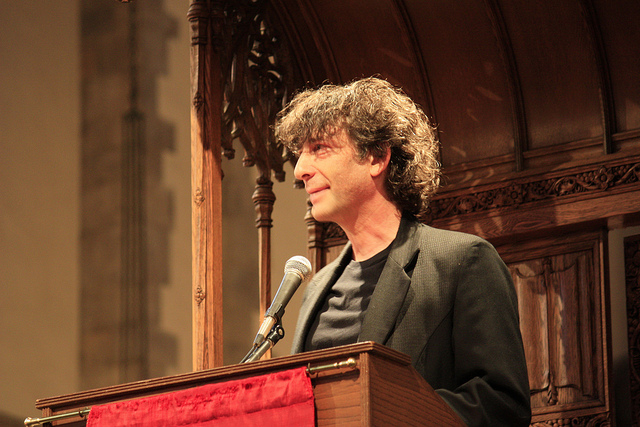
Everybody knows Neil Gaiman, but they all know him best for different work: writing comic books like Sandman, novels like American Gods, television series like Neverwhere, movies like MirrorMask, an early biography of Duran Duran. What does all that — and everything else in the man’s prolific career — have in common? Stories. Every piece of work Gaiman does involves him telling a story of one kind or another, and so his profile in the culture has risen to great heights as, simply, a storyteller. That made him just the right man for the job when the Long Now Foundation, with its mission of thinking far back into the past and far forward into the future, needed someone to talk about how certain stories survive through both those time frames and beyond.
“Do stories grow?” Gaiman asks his years-in-the-making Long Now lecture, listenable on Soundcloud right below or viewable as a video here. “Pretty obviously — anybody who has ever heard a joke being passed on from one person to another knows that they can grow, they can change. Can stories reproduce? Well, yes. Not spontaneously, obviously — they tend to need people as vectors. We are the media in which they reproduce; we are their petri dishes.” He goes on to bring out examples from cave paintings, to secret retellings of Gone with the Wind in a Nazi concentration camp, to a warning to future generations not to dig into nuclear waste sites — designed for passage into the minds of posterity as a robustly crafted story.
Stories, writes the Long Now Foundation founder Stewart Brand, “outcompete other stories by hanging over time. They make it from medium to medium — from oral to written to film and beyond. They lose uninteresting elements but hold on to the most compelling bits or even add some.” He knows that, Gaiman knows that, and I think that all of us who have told stories sense its truth on an instinctive level: “The most popular version of the Cinderella story (which may have originated long ago in China) has kept the gloriously unlikely glass slipper introduced by a careless French telling.”
Another beloved British teller of tales, Douglas Adams, also had thoughts on the almost biological nature of literature. “We were talking about The Hitchhiker’s Guide to the Galaxy,” Gaiman recalled elsewhere, “which was something which resembled an iPad, long before it appeared. And I said when something like that happens, it’s going to be the death of the book. Douglas said no. Books are sharks.” And what did he mean by that? “Sharks have been around for a very long time. There were sharks before there were dinosaurs, and the reason sharks are still in the ocean is that nothing is better at being a shark than a shark.” So not only do the best stories evolve to last the longest, so do the forms they take.
Every generation, it seems, has its preferred bestselling genre fiction. We’ve had fantasy and, at least in very recent history, vampire romance keeping us reading. The fifties and sixties had their westerns and sci-fi. And in the forties, it won’t surprise you to hear, detective fiction was all the rage. So much so that—like many an irritable contrarian critic today—esteemed literary tastemaker Edmund Wilson penned a cranky New Yorker piece in 1944 declaiming its popularity, writing “at the age of twelve… I was outgrowing that form of literature”; the form, that is, perfected by Edgar Allan Poe, Arthur Conan Doyle, and Wilkie Collins, and imitated by a host of pulp writers in Wilson’s day. Detective stories, in fact, were in vogue for the first few decades of the 20th century—since the appearance of Sherlock Holmes and a derivative 1907 character called “the Thinking Machine,” responsible, it seems, for Wilson’s loss of interest.
Thus, when Wilson learned that “of all people,”Paul Grimstad writes, T.S. Eliot “was a devoted fan of the genre,” he must have been particularly dismayed, as he considered Eliot “an unimpeachable authority in matters of literary judgment.” Eliot’s tastes were much more ecumenical than most critics supposed, his “attitude toward popular art forms… more capacious and ambivalent than he’s often given credit for.” The rhythms of ragtime pervade his early poetry, and “in his later years he wanted nothing more than to have a hit on Broadway.” (He succeeded, sixteen years after his death.) Eliot peppered his conversation and poetry with quotations from Arthur Conan Doyle and wrote several glowing reviews of detective novels by writers like Dorothy Sayers and Agatha Christie during the genre’s “Golden Age,” publishing them anonymously in his literary journal The Criterion in 1927.
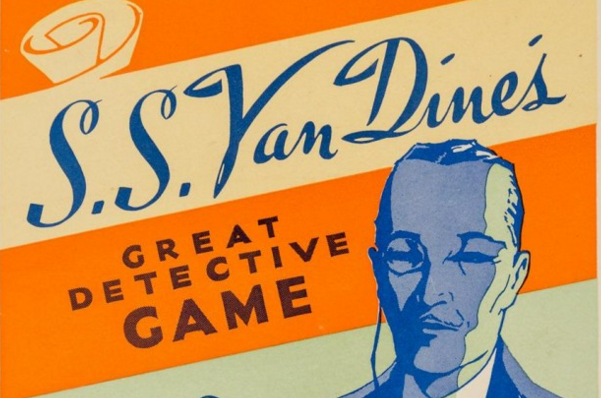
One novel that impressed him above all others is titled The Benson Murder Case by an American writer named S.S. Van Dine, pen name of an art critic and editor named Willard Huntington Wright. Referring to an eminent art historian—whose tastes guided those of the wealthy industrial class—Eliot wrote that Van Dine used “methods similar to those which Bernard Berenson applies to paintings.” He had good reason to ascribe to Van Dine a curatorial sensibility. After a nervous breakdown, the writer “spent two years in bed reading more than two thousand detective stories, during with time he methodically distilled the genre’s formulas and began writing novels.” The year after Eliot’s appreciative review, Van Dine published his own set of criteria for detective fiction in a 1928 issue of The American Magazine. You can read his “Twenty Rules for Writing Detective Stories” below. They include such proscriptions as “There must be no love interest” and “The detective himself, or one of the official investigators, should never turn out to be the culprit.”
Rules, of course, are made to be broken (just ask G.K. Chesterton), provided one is clever and experienced enough to circumvent or disregard them. But the novice detective or mystery writer could certainly do worse than take the advice below from one of T.S. Eliot’s favorite detective writers. We’d also urge you to see Raymond Chandler’s 10 Commandments for Writing Detective Fiction.
THE DETECTIVE story is a kind of intellectual game. It is more — it is a sporting event. And for the writing of detective stories there are very definite laws — unwritten, perhaps, but none the less binding; and every respectable and self-respecting concocter of literary mysteries lives up to them. Herewith, then, is a sort Credo, based partly on the practice of all the great writers of detective stories, and partly on the promptings of the honest author’s inner conscience. To wit:
1. The reader must have equal opportunity with the detective for solving the mystery. All clues must be plainly stated and described.
2. No willful tricks or deceptions may be placed on the reader other than those played legitimately by the criminal on the detective himself.
3. There must be no love interest. The business in hand is to bring a criminal to the bar of justice, not to bring a lovelorn couple to the hymeneal altar.
4. The detective himself, or one of the official investigators, should never turn out to be the culprit. This is bald trickery, on a par with offering some one a bright penny for a five-dollar gold piece. It’s false pretenses.
5. The culprit must be determined by logical deductions — not by accident or coincidence or unmotivated confession. To solve a criminal problem in this latter fashion is like sending the reader on a deliberate wild-goose chase, and then telling him, after he has failed, that you had the object of his search up your sleeve all the time. Such an author is no better than a practical joker.
6. The detective novel must have a detective in it; and a detective is not a detective unless he detects. His function is to gather clues that will eventually lead to the person who did the dirty work in the first chapter; and if the detective does not reach his conclusions through an analysis of those clues, he has no more solved his problem than the schoolboy who gets his answer out of the back of the arithmetic.
7. There simply must be a corpse in a detective novel, and the deader the corpse the better. No lesser crime than murder will suffice. Three hundred pages is far too much pother for a crime other than murder. After all, the reader’s trouble and expenditure of energy must be rewarded.
8. The problem of the crime must he solved by strictly naturalistic means. Such methods for learning the truth as slate-writing, ouija-boards, mind-reading, spiritualistic se’ances, crystal-gazing, and the like, are taboo. A reader has a chance when matching his wits with a rationalistic detective, but if he must compete with the world of spirits and go chasing about the fourth dimension of metaphysics, he is defeated ab initio.
9. There must be but one detective — that is, but one protagonist of deduction — one deus ex machina. To bring the minds of three or four, or sometimes a gang of detectives to bear on a problem, is not only to disperse the interest and break the direct thread of logic, but to take an unfair advantage of the reader. If there is more than one detective the reader doesn’t know who his codeductor is. It’s like making the reader run a race with a relay team.
10. The culprit must turn out to be a person who has played a more or less prominent part in the story — that is, a person with whom the reader is familiar and in whom he takes an interest.
11. A servant must not be chosen by the author as the culprit. This is begging a noble question. It is a too easy solution. The culprit must be a decidedly worth-while person — one that wouldn’t ordinarily come under suspicion.
12. There must be but one culprit, no matter how many murders are committed. The culprit may, of course, have a minor helper or co-plotter; but the entire onus must rest on one pair of shoulders: the entire indignation of the reader must be permitted to concentrate on a single black nature.
13. Secret societies, camorras, mafias, et al., have no place in a detective story. A fascinating and truly beautiful murder is irremediably spoiled by any such wholesale culpability. To be sure, the murderer in a detective novel should be given a sporting chance; but it is going too far to grant him a secret society to fall back on. No high-class, self-respecting murderer would want such odds.
14. The method of murder, and the means of detecting it, must be be rational and scientific. That is to say, pseudo-science and purely imaginative and speculative devices are not to be tolerated in the roman policier. Once an author soars into the realm of fantasy, in the Jules Verne manner, he is outside the bounds of detective fiction, cavorting in the uncharted reaches of adventure.
15. The truth of the problem must at all times be apparent — provided the reader is shrewd enough to see it. By this I mean that if the reader, after learning the explanation for the crime, should reread the book, he would see that the solution had, in a sense, been staring him in the face-that all the clues really pointed to the culprit — and that, if he had been as clever as the detective, he could have solved the mystery himself without going on to the final chapter. That the clever reader does often thus solve the problem goes without saying.
16. A detective novel should contain no long descriptive passages, no literary dallying with side-issues, no subtly worked-out character analyses, no “atmospheric” preoccupations. such matters have no vital place in a record of crime and deduction. They hold up the action and introduce issues irrelevant to the main purpose, which is to state a problem, analyze it, and bring it to a successful conclusion. To be sure, there must be a sufficient descriptiveness and character delineation to give the novel verisimilitude.
17. A professional criminal must never be shouldered with the guilt of a crime in a detective story. Crimes by housebreakers and bandits are the province of the police departments — not of authors and brilliant amateur detectives. A really fascinating crime is one committed by a pillar of a church, or a spinster noted for her charities.
18. A crime in a detective story must never turn out to be an accident or a suicide. To end an odyssey of sleuthing with such an anti-climax is to hoodwink the trusting and kind-hearted reader.
19. The motives for all crimes in detective stories should be personal. International plottings and war politics belong in a different category of fiction — in secret-service tales, for instance. But a murder story must be kept gemütlich, so to speak. It must reflect the reader’s everyday experiences, and give him a certain outlet for his own repressed desires and emotions.
If you want a guide through James Joyce’s Finnegans Wake—the modernist author’s “wordiest aria,” writes Kirkus Reviews, “and surely the strangest ever sung in any language”—you’d be hard pressed find a better one than novelist Anthony Burgess. Not only did Burgess turn his study of Joyce to very good account in creating his own polyglot language in A Clockwork Orange, but he has “tastefully selected the more readable portions” of Joyce’s final novel in an abridged version, A Shorter Finnegans Wake. No doubt “pedants will object,” writes Kirkus, but if anyone can edit Joyce, it’s Burgess, who has written a thorough introduction to Joyce’s language, a guide to Joyce “for the Ordinary Reader,” and the most comprehensive summary of Joyce’s last novel that I’ve ever encountered—proving that it can be done. Finnegans Wake makes sense!… sort of…
But not, however, as any straightforward story; after all, writes Burgess, “What Joyce is doing… is to make his hero re-live the whole of history in a night’s sleep.” And what Burgess does is show us the complex scaffolding and symbolism of that dream. What he does not do is explain away the music of Joyce’s novel—for it is, after all, not only one long dream, but one long song, the “strangest ever sung.” We can hear Joyce himself sing from the novel’s Anna Livia Plurabelle section in the video at the top (accompanied by subtitles and a very cool animation, I must say). His lilting tenor enthralls, but his is not the only way to sing Finnegans Wake. Indeed, the novel, though very odd and very difficult, is Joyce’s invitation to the world.
And the world has responded (“Here Comes Everybody!”). Last year, Waywords and Meansigns, a Joyce project co-founded by Derek Pyle, brought together artists and musicians from around the globe to sing, read, and set to music the words of Finnegans Wake. Open Culture’s Ted Mills wrote a post describing the “staggering 30+ hours” of Joyce interpretation, and concluded, “Those who read this and feel they’ve missed out on the creativity of tackling Finnegans Wake, don’t worry.” The project was then soliciting contributors for a forthcoming second edition, and now it has arrived. You can hear it in full above, an answer to the question “How many ways are there to read James Joyce’s great and bizarre novel?”
Seventeen different musicians from all around the world, each assigned to render a chapter aurally. The only requirements: the chapter’s words must be audible, unabridged, and more or less in their original order.
We begin with pages 3–29, “The Fall,” read in a rapid deadpan over avant-garde free jazz by Mr. Smolin & Double Naught Spy Car. Next, we have “The Humphriad I: His Agnomen and Reputation,” read by producer David Kahne against a backdrop of minimalist synths, tinkling keyboards, and waves of burbling electronic noise. Perhaps one of my favorite musicians—whose songwriting has always struck me as particularly Joycean—Mike Watt of the Minutemen and fIREHOSE promises to deliver his musical contribution for “Shem the Penman” very soon. In its place is a message from Pyle, who urges you to sign up for the Waywords and Meansigns mailing list for updates. After his message is a brief excerpt from conversation he had with Watt on the bass player’s podcast.
Finnegans Wake, says Watt, “shares with Ulysses the idea of wanting to try and talk about everything.” Joyce, Watt goes on, wanted to “transcend” in his writing the circumstances of his troubled family life, failing eyesight, and financial difficulties; and he was also just “having some fun.” That’s also a good description of the various renderings of Joyce represented in this compilation as these artists try to transcend ordinary ways of reading great literature, and clearly have lots fun in the doing. See the Waywords and Meansigns website for production credits and a complete tracklisting indicating the specific pages, chapters, and sections of each reading.
Gather round, children and listen to Grandma reminiscin’ ‘bout the days when studying comics meant changing out of your pajamas and showing up at the bursar’s office, check in hand.
Actually, Grandma’s full of it. Graphic novels are enjoying unprecedented popularity and educators are turning to comics to reach reluctant readers, but as of this writing, there still aren’t that many programs for those interested in making a career of this art form.
At the very least, you’ll learn a thing or two about layout, the relationship of art to text, and using compression to denote the passage of time.
It’s the sort of nitty gritty training that would benefit both veterans and newbies alike.
Ready to sign up? The free course, which starts in February, will require approximately 10 hours per week. The syllabus is below.
Session 1: Defining Comics
Identify key relationships in sample texts & demonstrate the use of various camera angles on a comics page
Session 2: Comics Relationships
Create Text-Image and Image-Image Panels
Session 3: Time And Space
One Second, One Hour, One Day Comics Challenge
Session 4: Layout And Grid Design
Apply multiple panel grids to provided script
Session 5: Thumbnails
Create thumbnail sketches of a multipage scene
We all know the name Goethe — some of us even know the full name, Johann Wolfgang von Goethe. I’ve never lived in the renowned 18th- and 19th-century writer, politician, and cultural polymath’s homeland of Germany, but even when I lived in Los Angeles, I regularly went to my local branch of the Goethe-Institute for German cultural events. Even in Korea, where I live now, Goethe has left a wide if shallow mark: you can see The Sorrows of Young Wertherin the form of an elaborate stage musical, for instance, and buy almost all the goods you need in life from the enormous conglomerate named after the young lady on whom Werther concentrates his doomed affections, Lotte.
But why, more than 180 years after Goethe’s death, does his name still come up in so many different contexts? And given that, why do so many of us know so little about his long, varied, colorful, and highly productive life and career? This sounds like a job for the video wing of Alain de Botton’s School of Life, whose short primers continue to bring us up to speed on why the legacies of so many cultural figures (with one section given over to the literary) have endured, or should endure. “Goethe is one of the great minds of European civilisation, though his work is largely unknown outside of the German speaking countries,” says de Botton in their video on Goethe: “He deserves our renewed attention.”
To fill out the details provided in the School of Life’s video, you can read an overview of Goethe’s career (including details on the proper pronunciation of his name) in the accompanying Book of Life entry online. It tells the story of not just Young Werther’s creator, but “one of Europe’s big cultural heroes – comparable to the likes of Shakespeare, Dante and Homer,” skilled in letters, of course, but also in “physiology, geology, botany and optics,” who also spent stretches of his career as “a diplomat, fashion guru, a senior civil servant, a pornographer, the head of a university, a fine artist, an adventurous traveller, the director of a theatre company and the head of a mining company.”
We might call Goethe, insofar as he developed his own mastery, spanning so much of the human experience, a Renaissance man out of time — but one who, in his way, outdid even the actual men of the Renaissance. “We have so much to learn from him,” adds the Book of Life. “We don’t often hear people declaring a wish to be a little more like ‘Goethe.’ But if we did, the world would be a more vibrant and humane place.”
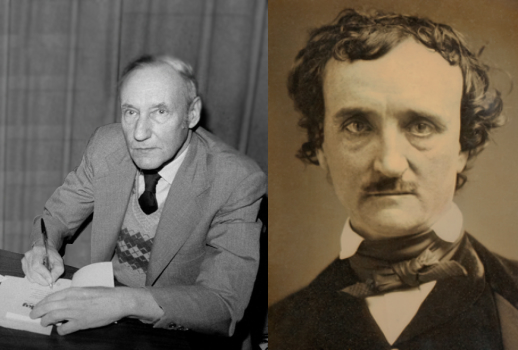
The label “American original” gets slapped onto a lot of different people, but it seems to me that, especially in the realm of letters, we could find no two luminaries who merit it more in the 19th century than psychological horror pioneer Edgar Allan Poe, and in the 20th century William S. Burroughs, sui generis even within the Beat Generation. So how could we resist featuring the recording just below, free to hear on Spotify (whose software, if you don’t have it yet, you can download here), of Burroughs reading Poe’s tale — because, as you know if you read him, he wrote not stories but tales — “The Masque of the Read Death”?
The 1842 tale itself, still haunting today more than 170 years after its publication, tells of a prince and his coterie of a thousand aristocrats who, in order to protect themselves from a Black Plague-like disease—the titular Red Death—sweeping through common society, take refuge in an abbey and weld the doors shut. In need of amusements (this all takes place about century and a half before Netflix, remember), the prince throws a masquerade ball. What, then, should interrupt this good time but the inexplicable arrival of an uninvited guest in a costume reminiscent of the corpse of a Red Death victim — possibly an embodiment of the Red Death itself?
Poe could tell a seriously resonant tale, and so could Burroughs. Though completely different in form, aesthetic, setting, and psychology, both writers’ works strike just the right ominous tone and leave just enough unexplained to seep into our subconscious in vivid and sometimes even unwanted ways. And so it makes perfect sense for Burroughs and his voice of a jaded but still amused ancient to join the formidable lineup of Poe’s interpreters, which includes Christopher Walken, Vincent Price, Christopher Lee, James Earl Jones, Iggy Pop, Lou Reed, and Stan Lee. But among them all, who better than Burroughs to articulate “The Masque of the Red Death’s” final line: “And Darkness and Decay and the Red Death held illimitable dominion over all.”
You can hear more of Burroughs reading Poe, in performances recorded for the computer game The Dark Eye, in Ted Mills’ previous post here.
In the picture above, you can see the original Winnie the Pooh bear, joined by his friends Tigger, Kanga, Eeyore, and Piglet. They all now live at The New York Public Library, where kids and adults can see them on display. It should be noted that Roo isn’t in the picture because he was lost a long time ago. Meanwhile you won’t find Owl or Rabbit, because they weren’t originally based on stuffed animals.
If you would like to support the mission of Open Culture, consider making a donation to our site. It’s hard to rely 100% on ads, and your contributions will help us continue providing the best free cultural and educational materials to learners everywhere. You can contribute through PayPal, Patreon, and Venmo (@openculture). Thanks!
We're hoping to rely on loyal readers, rather than erratic ads. Please click the Donate button and support Open Culture. You can use Paypal, Venmo, Patreon, even Crypto! We thank you!
Open Culture scours the web for the best educational media. We find the free courses and audio books you need, the language lessons & educational videos you want, and plenty of enlightenment in between.