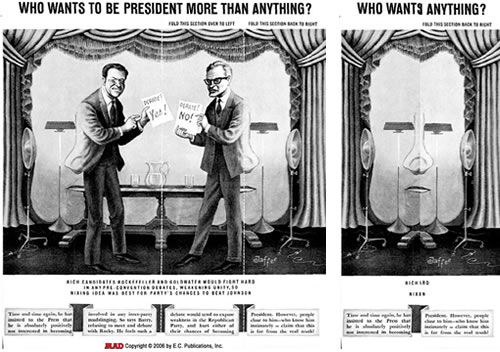
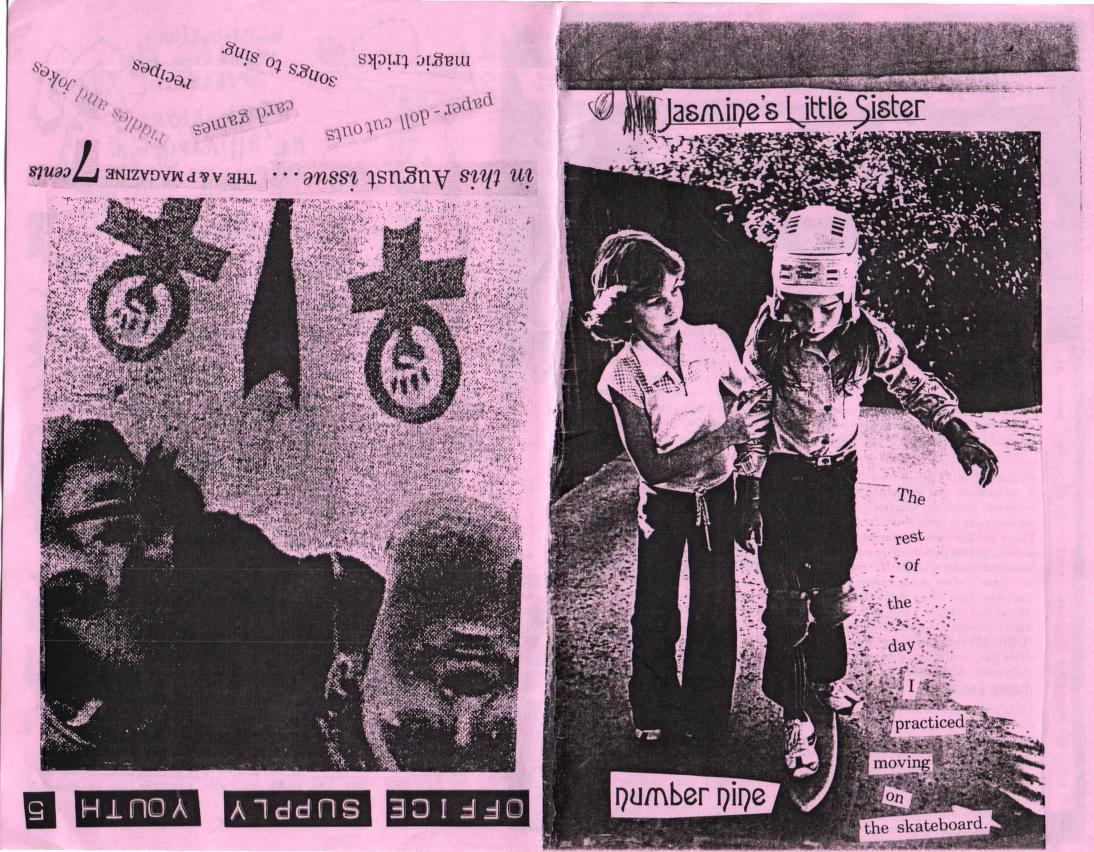
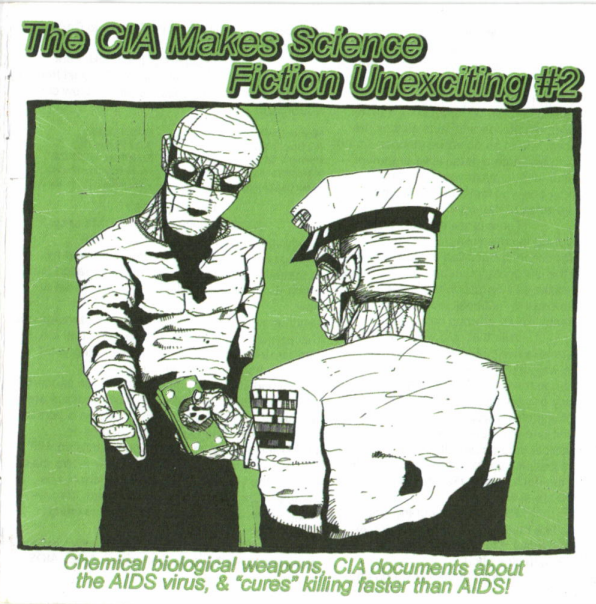
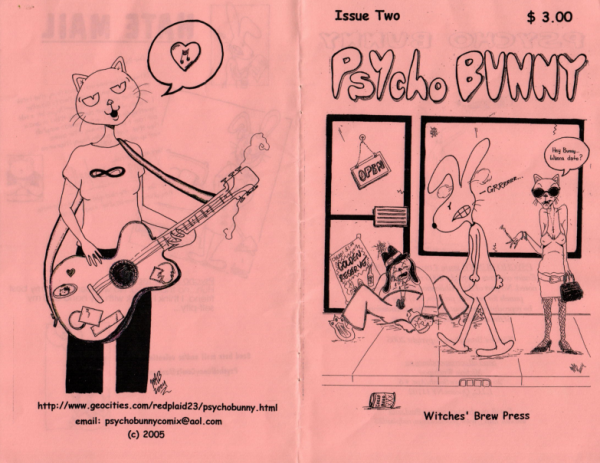
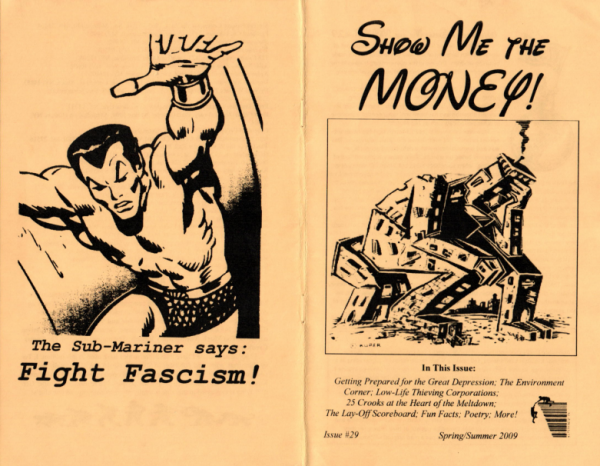
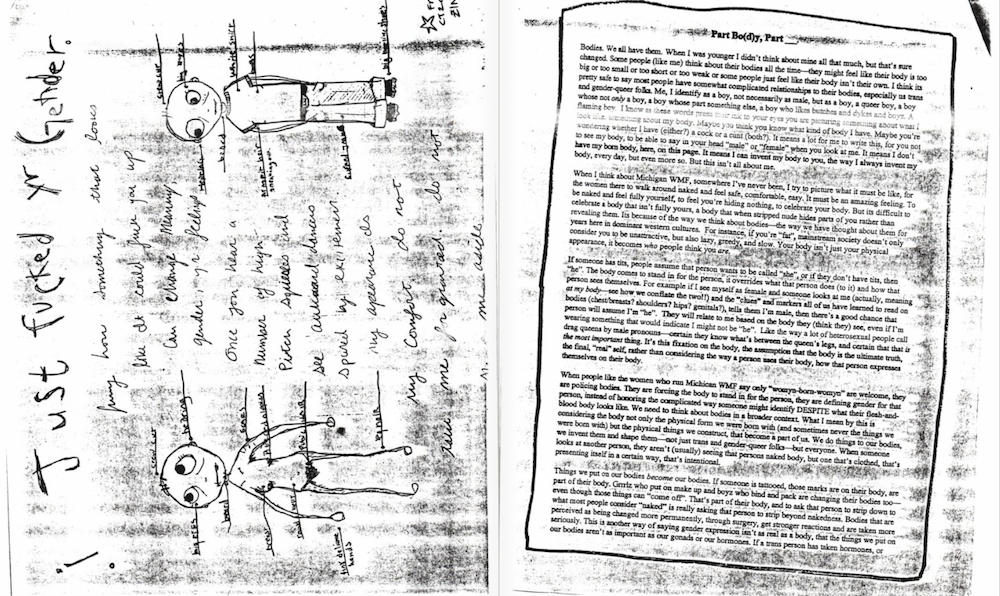
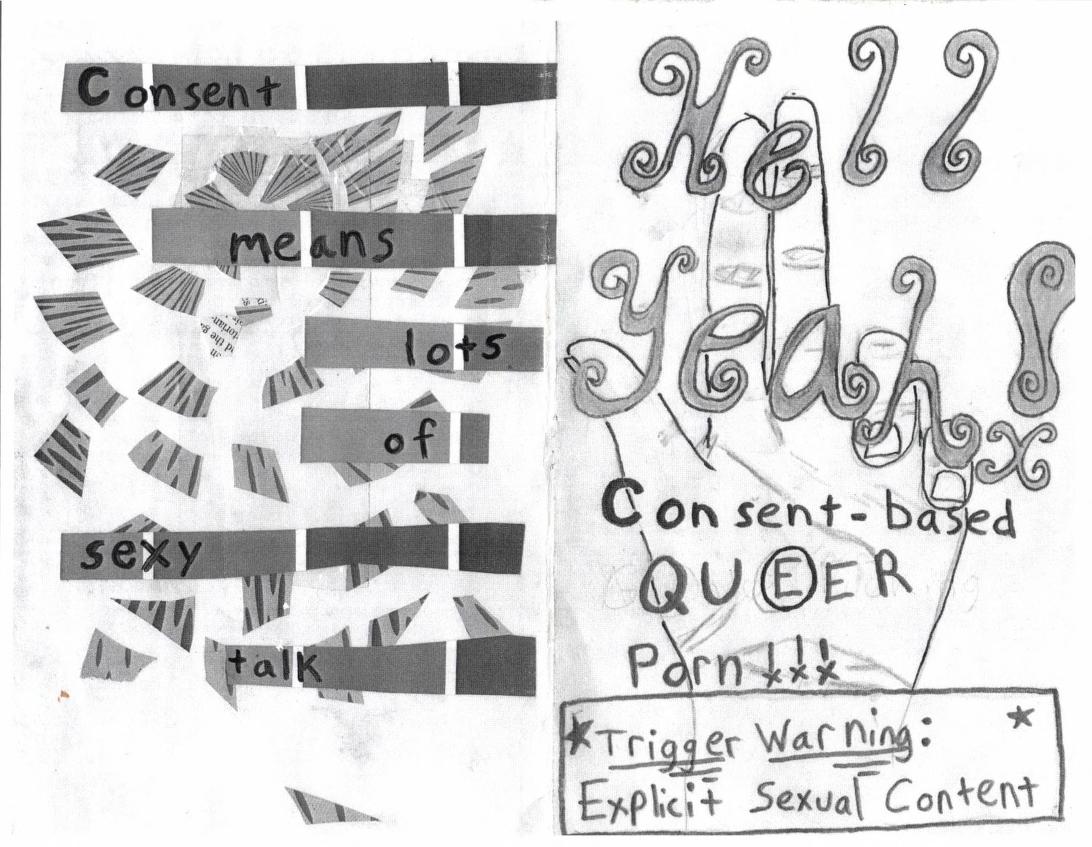
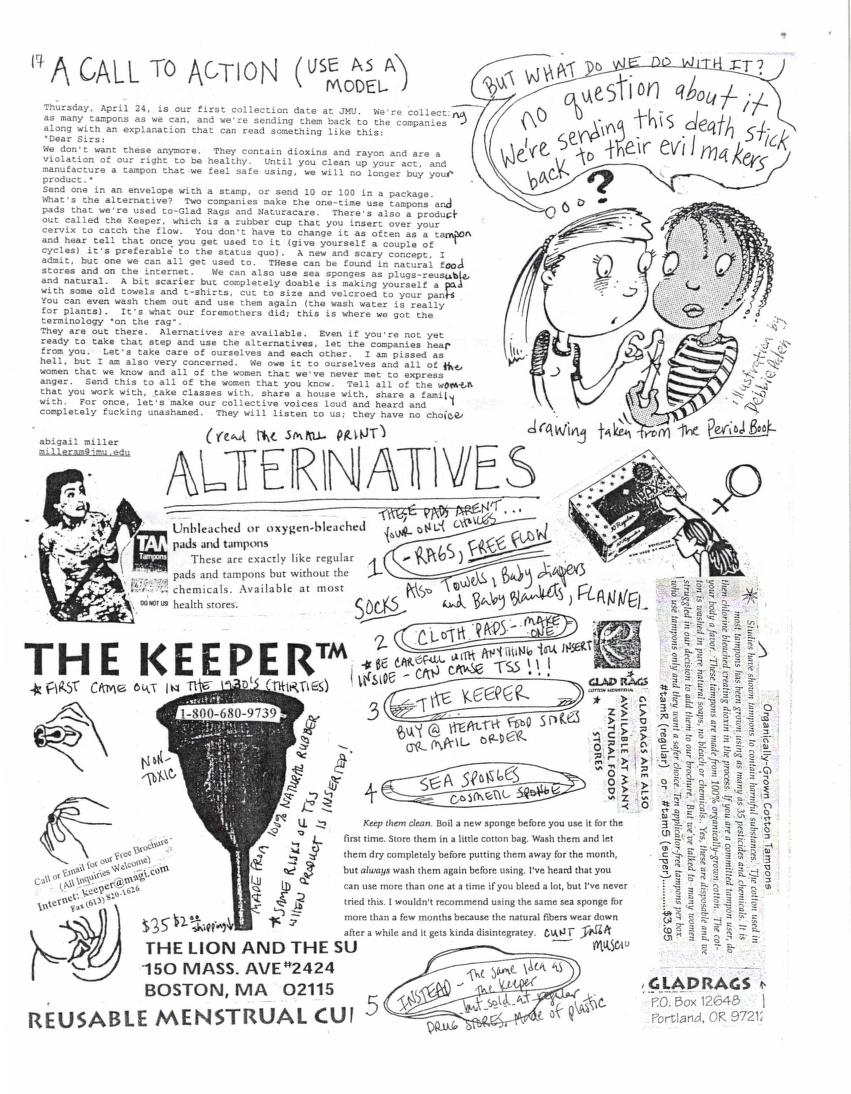
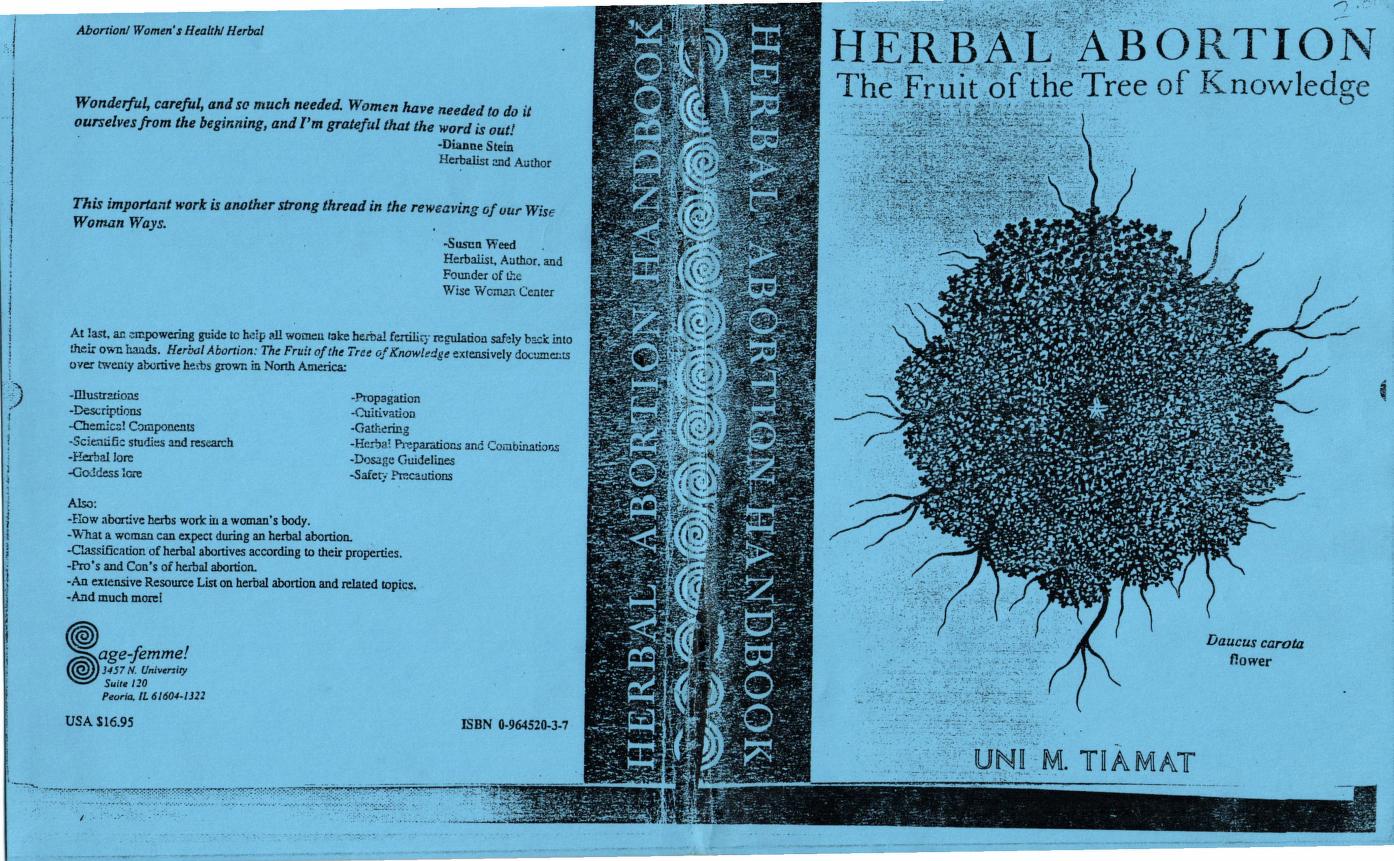
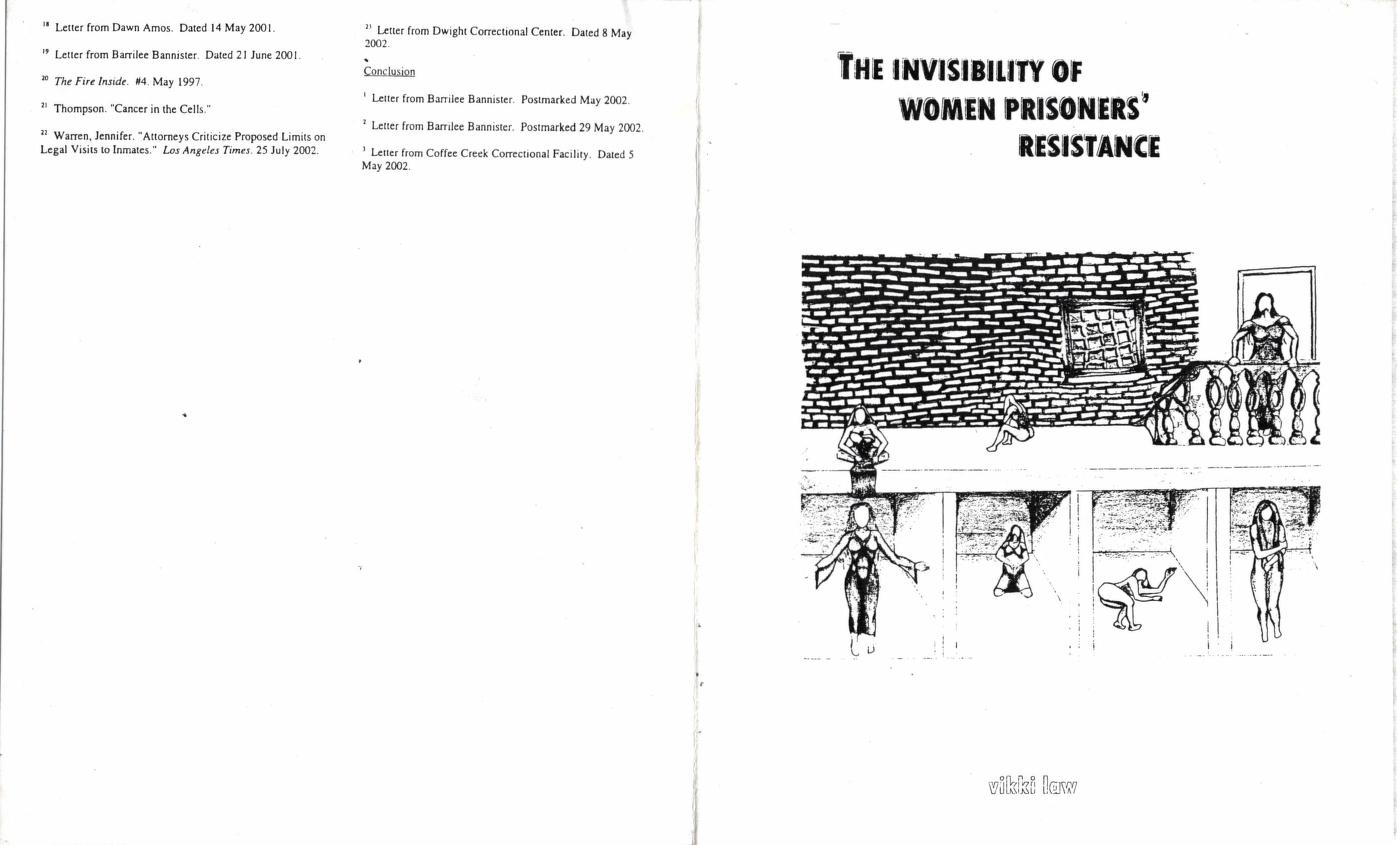
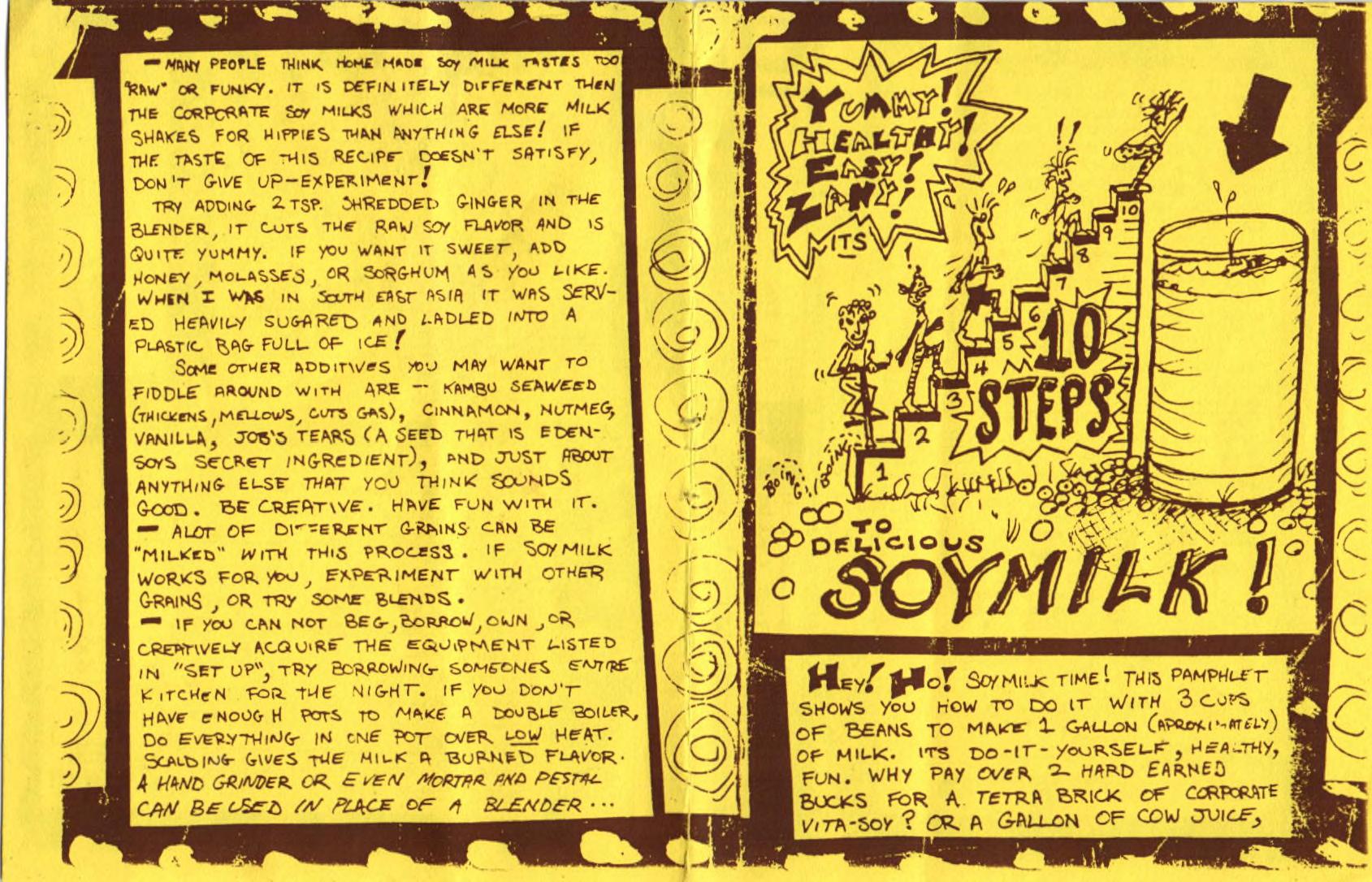
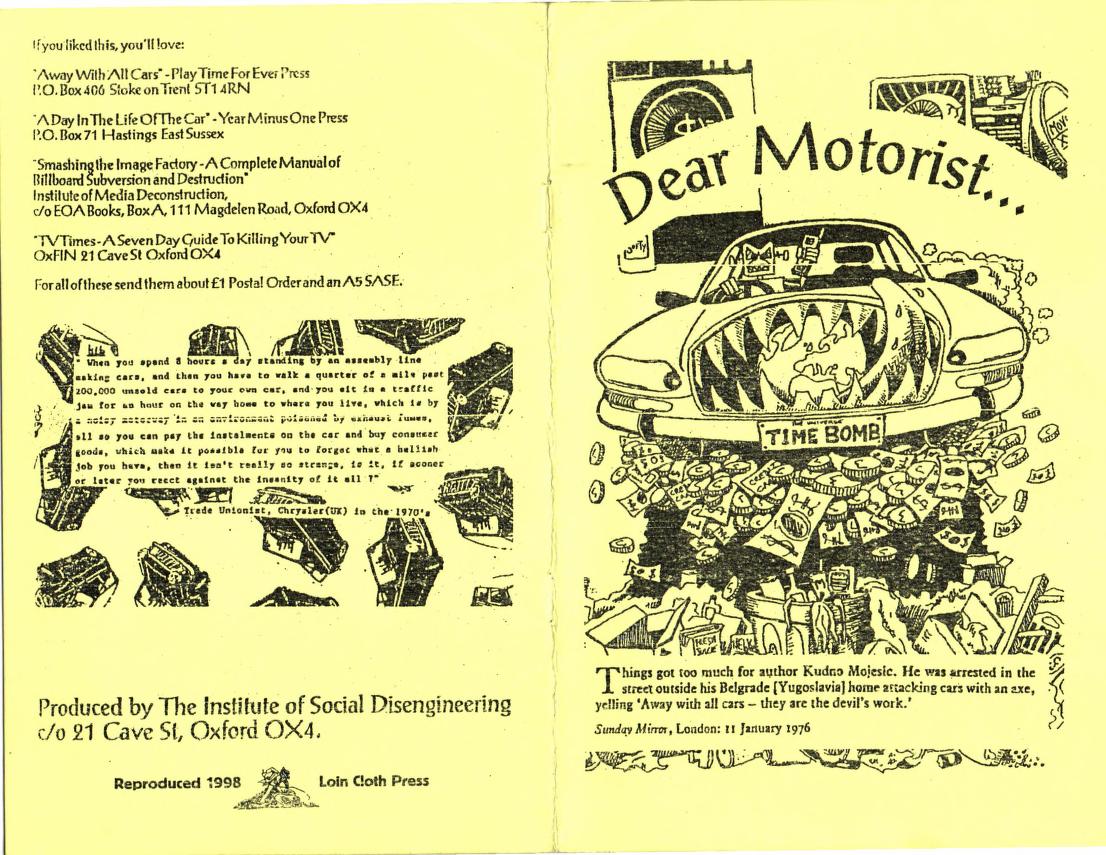
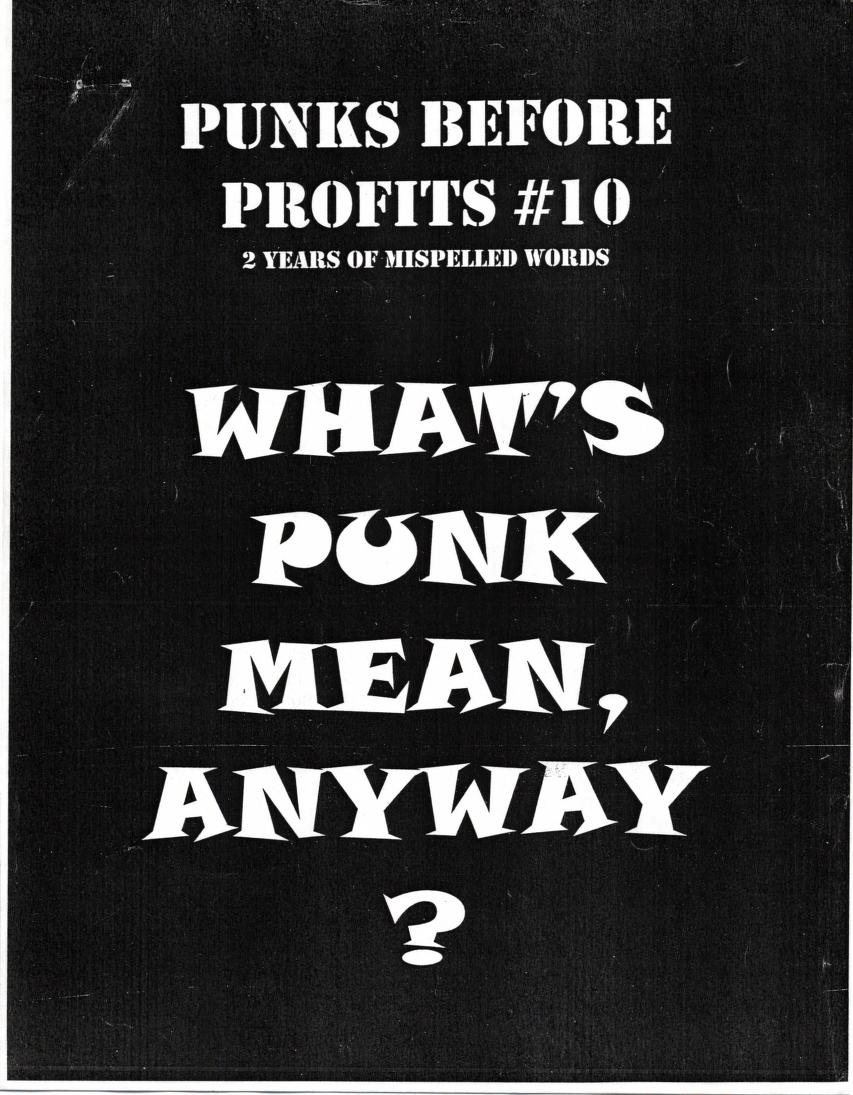
No matter how many readers they attract, the creators of these small-circulation labors of love take their agendas very seriously. Whether the ultimate goal is to inform, to agitate, to smear or to celebrate, their contents are as raw as the cut-and-paste aesthetic that provided their defacto look, pre-Etsy.
While some zinesters are good about preserving master copies and donating back issues to zine libraries, many others’ titles fall through the cracks of history, as the makers age out of the practice, or move on to other interests.
Individual zines’ best chance at survival lies in academia, where experienced archivists and fleets of interns have the time and resources to catalogue and digitize thousands of poorly photocopied, often handwritten pages.
Unsurprisingly, the largest number of titles falls into the Music category. Before the Internet, punk shows were the most reliable channel of zinely distribution, and few of these fanzines are devoid of political content.
Below, Kansas University English professor Frank Farmer (who arranged for the donation) and archivist Becky Schulte discuss the importance of “counter-public documents” and zine culture.
No need to scramble to the fallout shelter, friends.
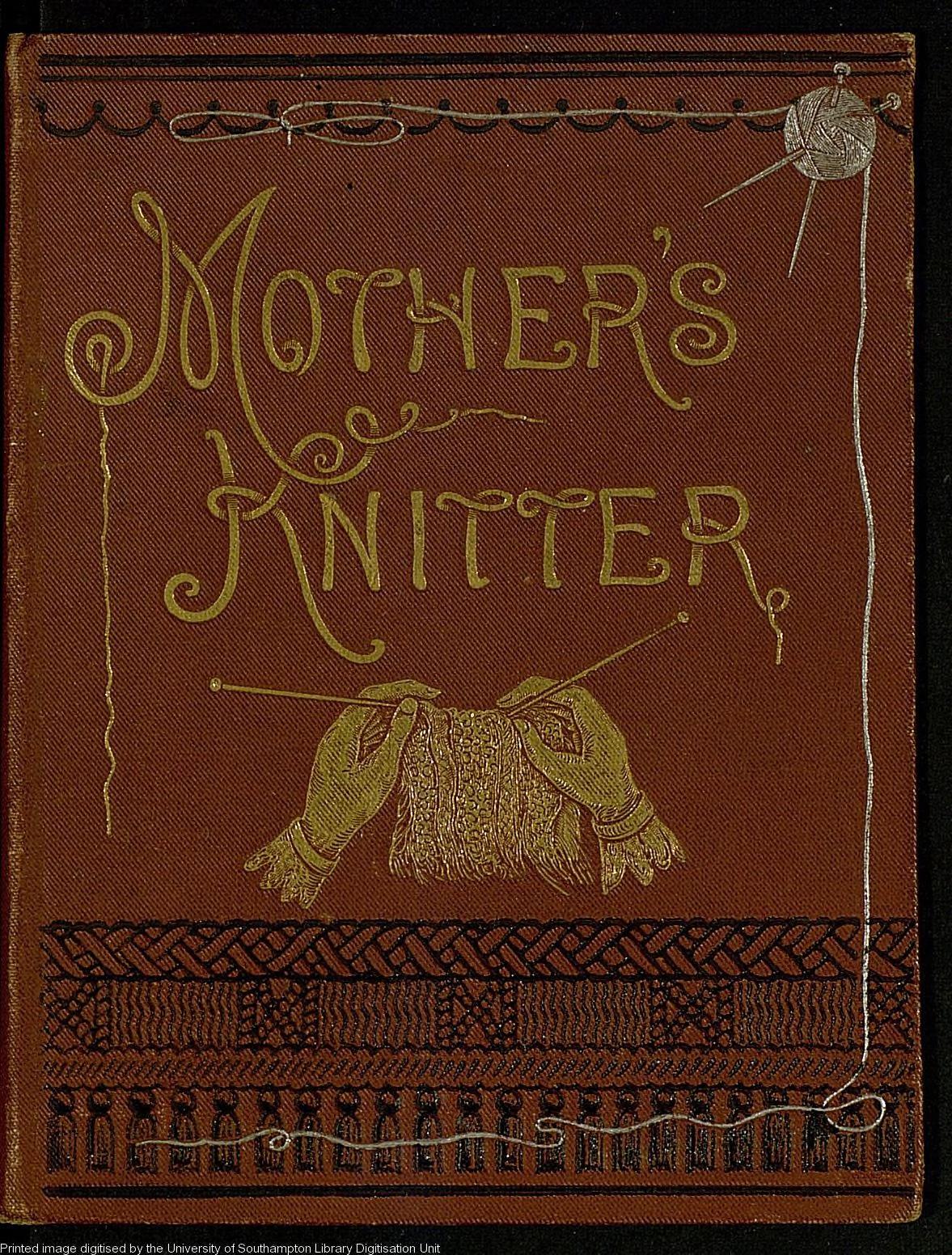
That massive boom you just heard is merely the sound of thousands of crafters’ minds being blown en masse by the University of Southhampton’s Knitting Reference Library, an extensive resource of books, catalogues, patterns, journals and magazines—over seventeen decades worth.
Viva la Handmade Revolution!
The basics of the form—knitting, purling, increasing, decreasing, casting on and off—have remained remarkably consistent throughout the generations. No wonder there’s an enduring tradition of learning to knit at grandma’s knee…
What has evolved is the nature of the finished products.
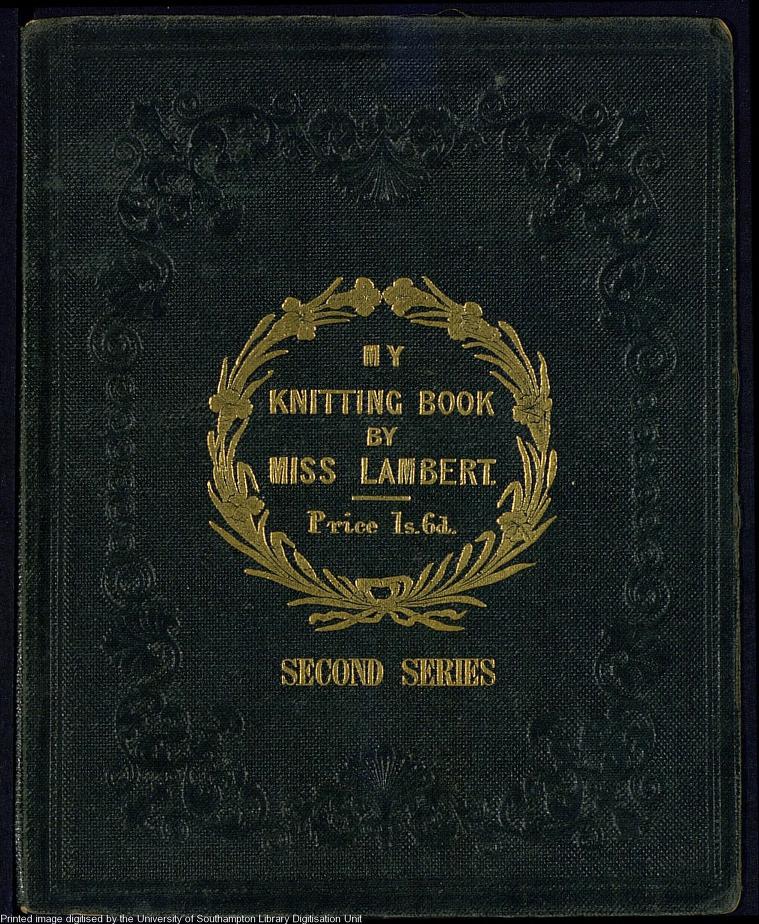
Miss Lambert’s “Baby Quilt in Stripes of Alternate Colors” from her 1847 Knitting Book could still hold its own against any other handcrafted shower gift, but even the most hardcore modern crafter would find it challenging to find takers for her “Carriage Sock,” which is meant to be worn over the shoe.
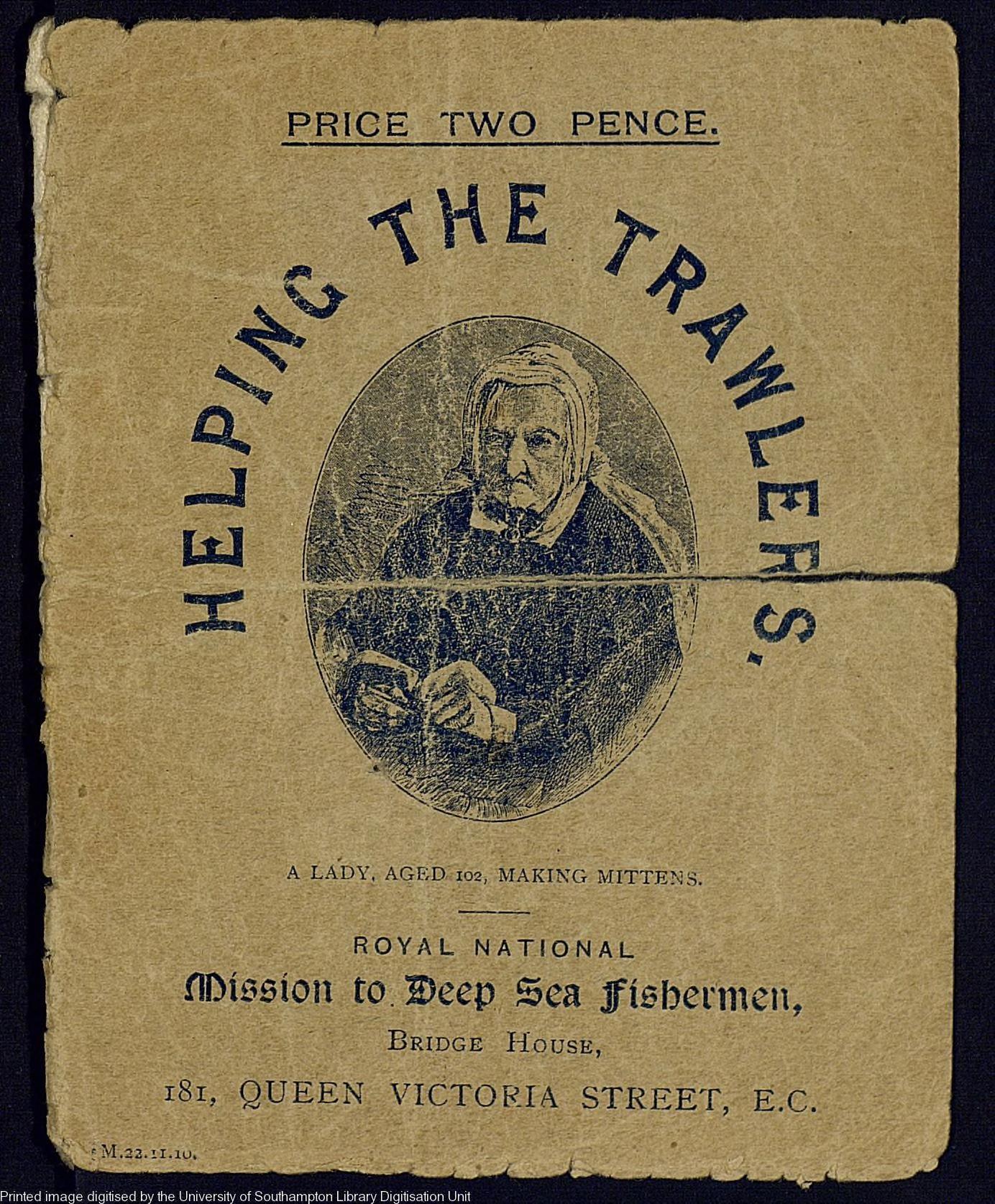
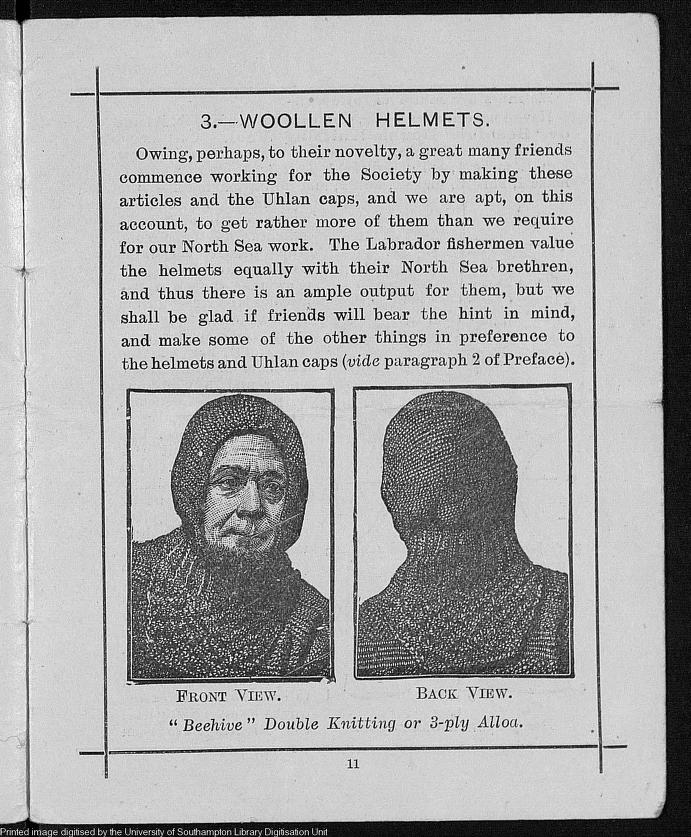
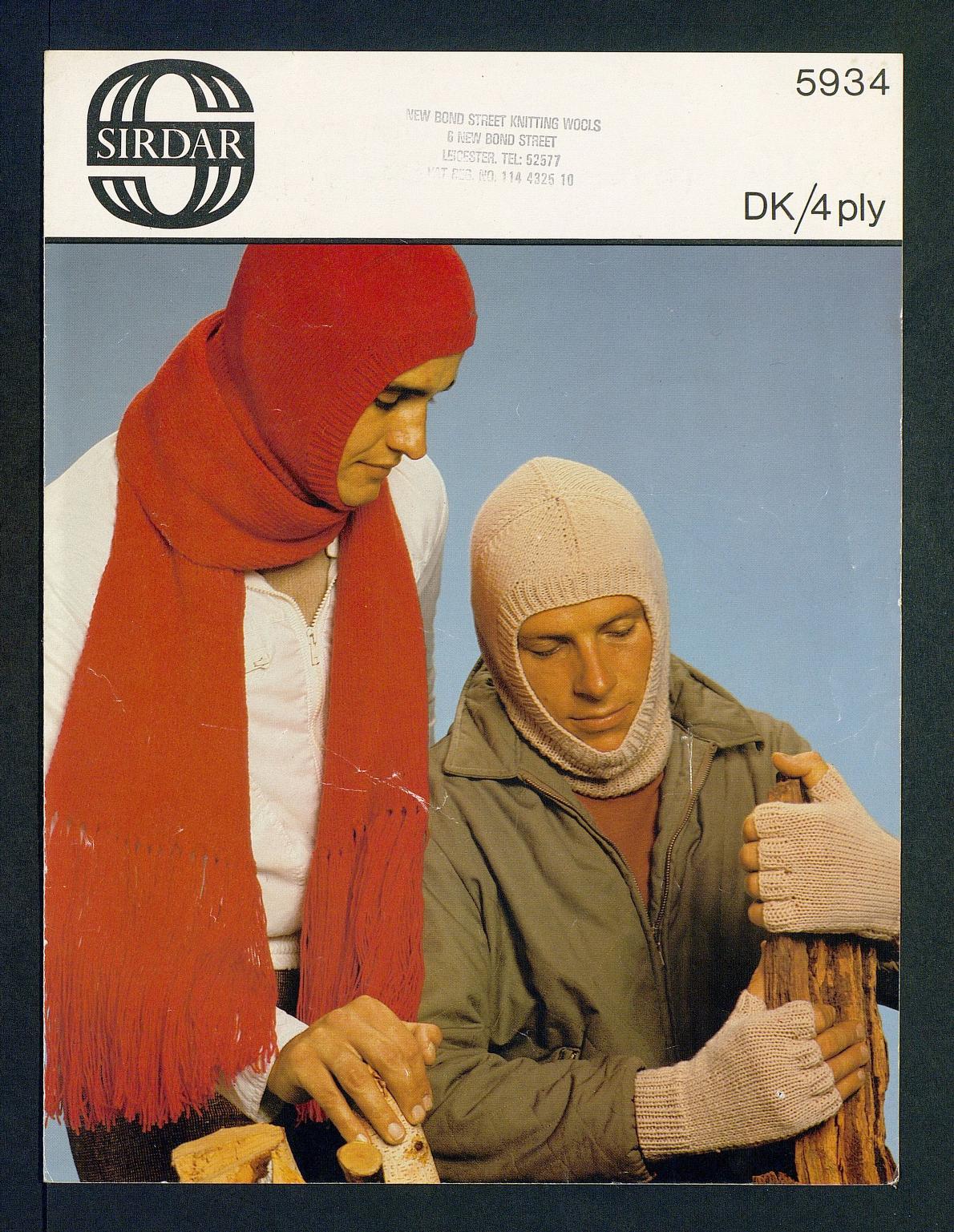
Ditto the “Woolen Helmets” in Helping the Trawlers, a 32-page pamphlet published by the Royal National Mission to Deep Sea Fishermen. The hope was that civic-minded knitters might be moved to donate handmade socks, mittens, and other items to combat the chill faced by poor working men facing the elements on freezing decks.
Not surprisingly, the eager volunteer knitting force gravitated toward the pamphlet’s most baroque item, putting the publisher in a delicate position:
Owing, perhaps, to their novelty, a great many friends commence working for the Society by making these articles and the Uhlan caps, and we are apt, on this account, to get rather more of them than we require for our North Sea work. The Labrador fishermen value the helmets equally with their North Sea breathren, and thus there is an ample output for them, but we shall be glad if friends will bear the hint in mind, and make some of the other things in preference to the helmets and Uhlan caps.
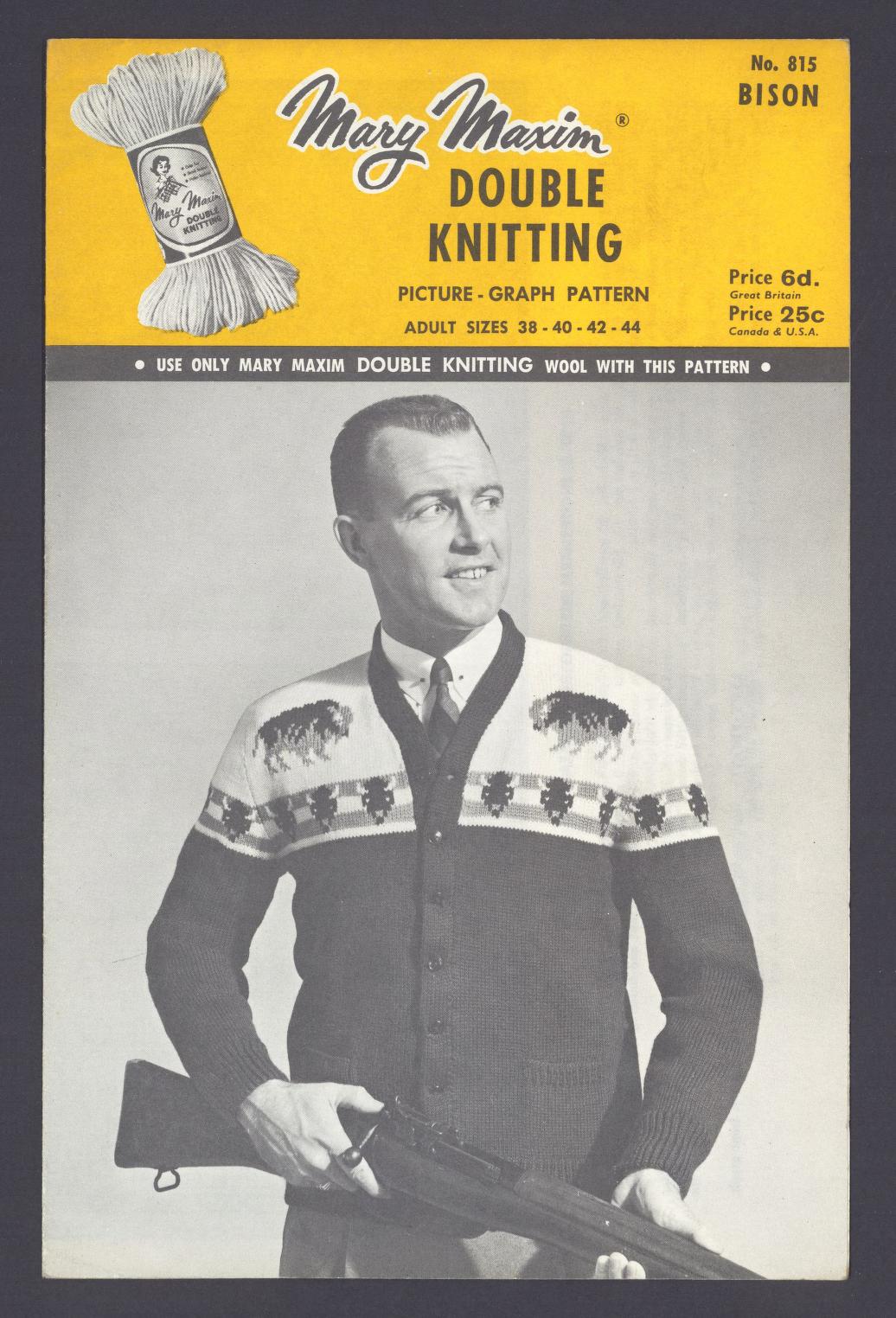
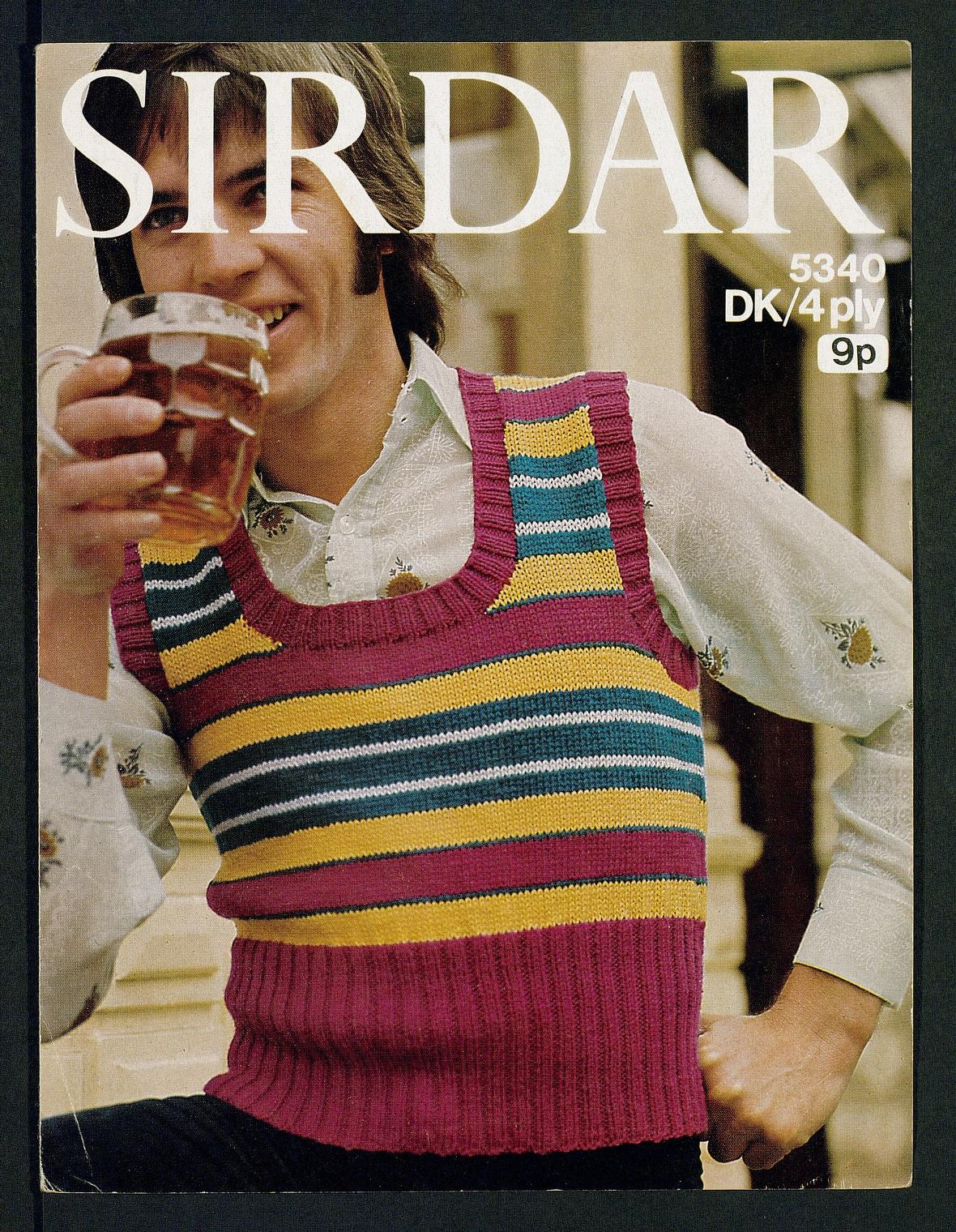
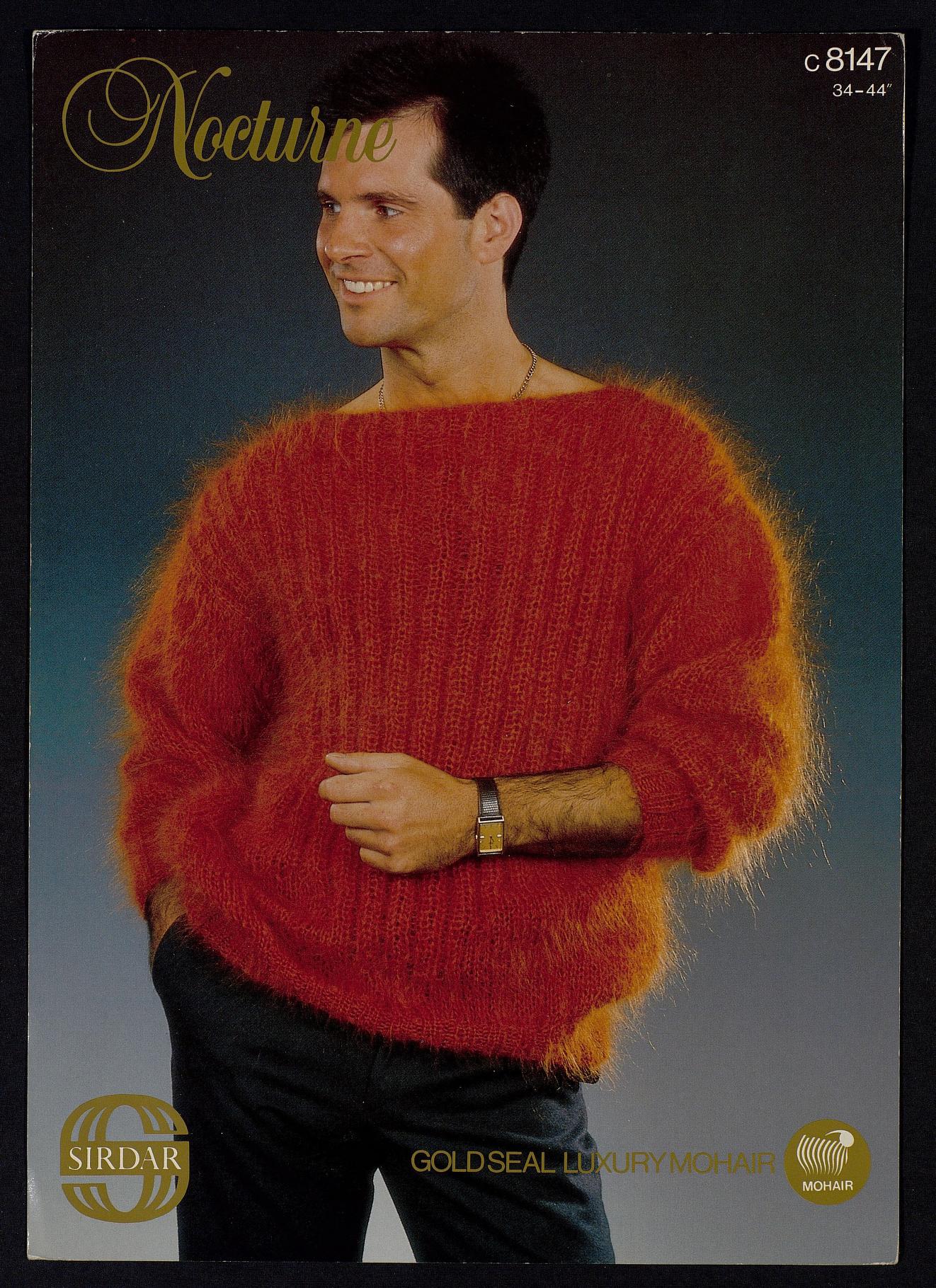
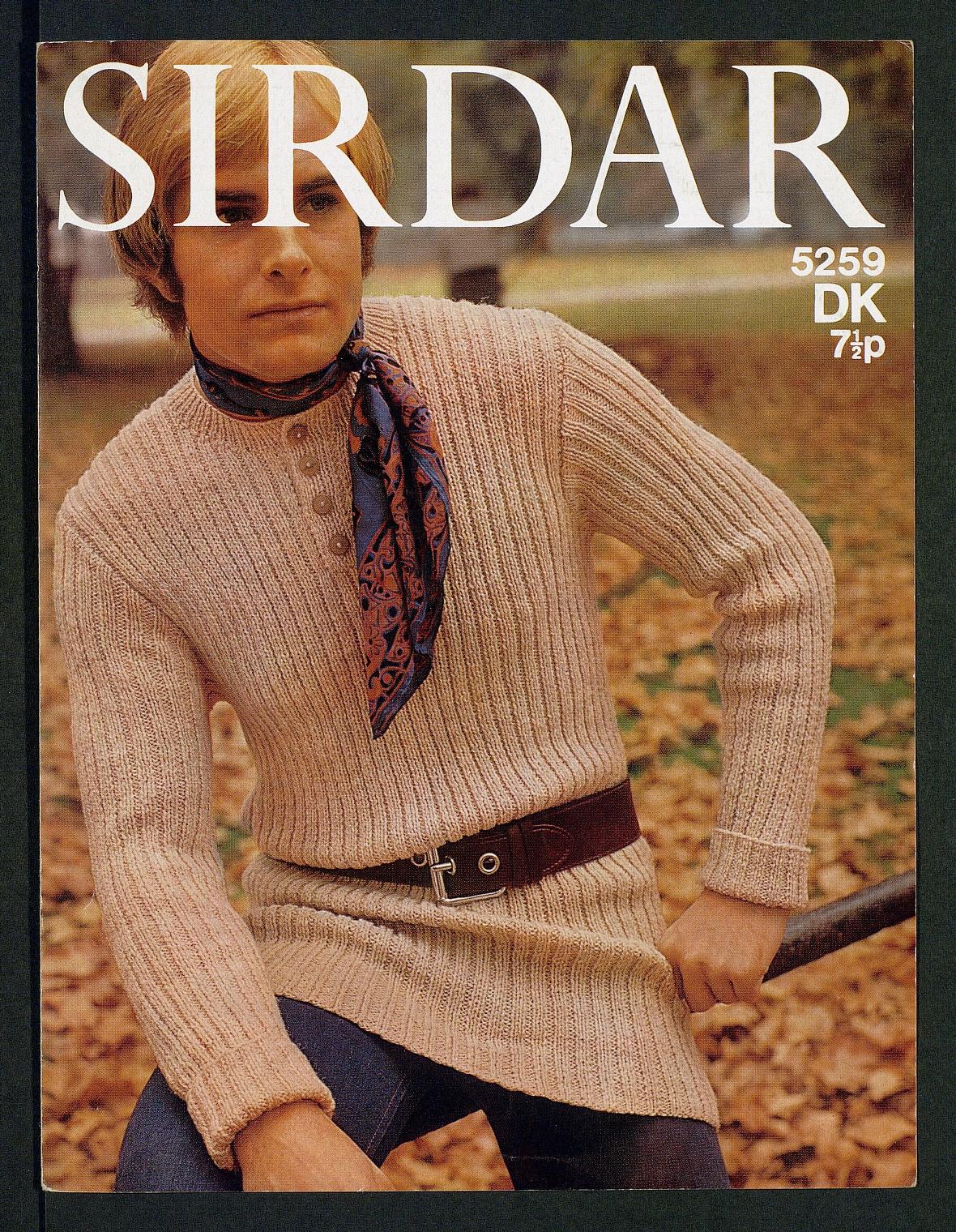
Even without step-by-step instructions, the pattern envelopes’ cover images can still provide inspiration…and no small degree of amusement. Some enterprising librarian should get cracking on a sub-collection, Fashion Crimes Against Male Knitwear Models, 1960–1980:
I just last week returned from a visit to Tokyo, where I did what I always do there: shop for magazines. Despite not paying the magazine shelves a whole lot of attention in Korea, where I live, and practically none at all in America, where I’m from, I can’t resist lingering for hours over the ones in Japan, a country whose print publishing industry seems much stronger than that of any other, and whose publications showcase the culture’s formidable design sensibility that has only grown more compelling over the centuries.
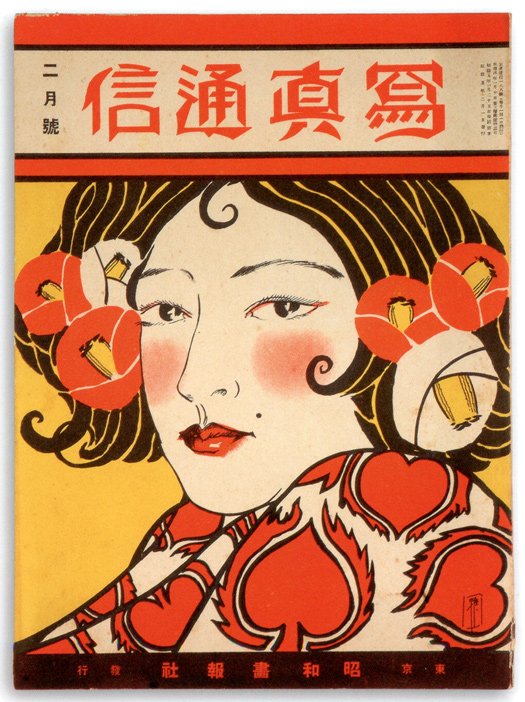
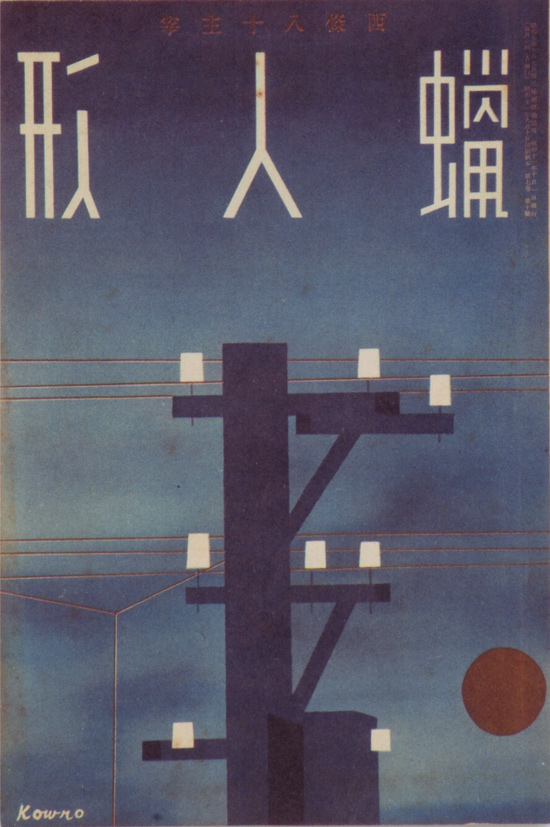
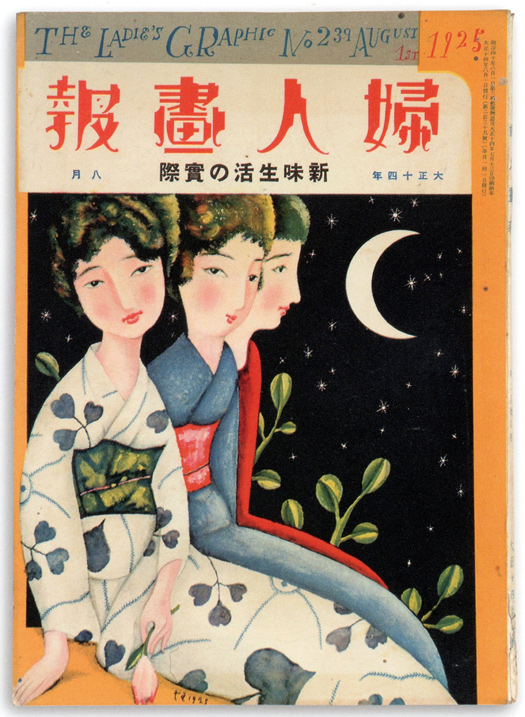
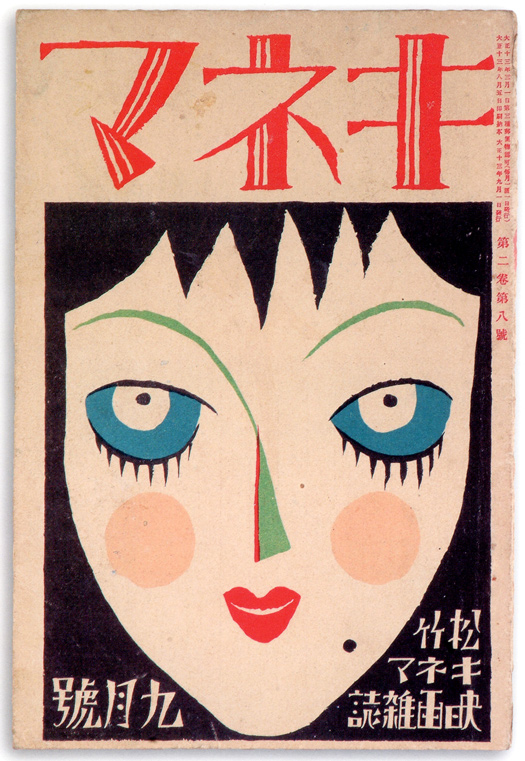
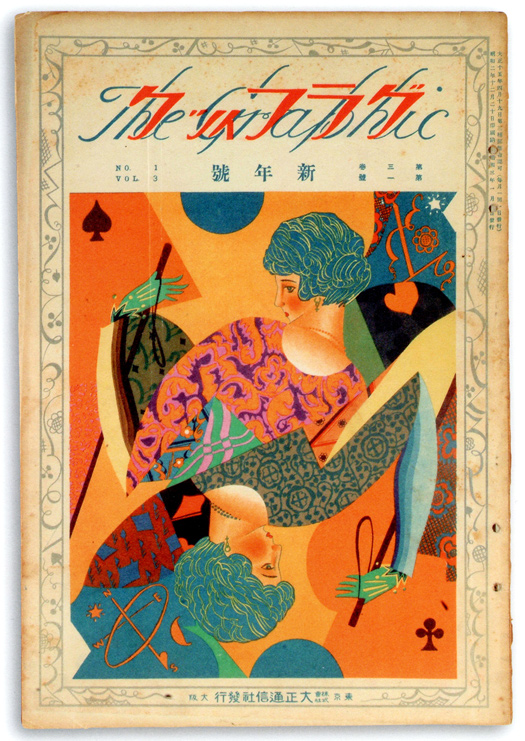
Will Schofield, who runs the international and historical book design blog 50 Watts, knows this, and he also knows that Japanese design has been making magazine covers interesting since Japan first had magazines to cover. The images here come from two of his posts, Extraordinary early 20th century magazine covers from Japan and 25 Vintage Magazine Covers from Japan. The earlier ones, which he describes as a mixture of “charming children’s covers with the creepy modernist covers,” come from Bookcover Design in Japan 1910s-40s. “Published in 2005 by PIE Books,” writes Schofield, “this incredible book is already out-of-print and becoming hard to find (it was actually hard for me to find and I spend hours per day searching for rare books).”
As for the more recent post, he writes that it “began as a compilation of magazine covers from the website of a Japanese antiquarian dealer. I dug through all 1500 or so images and saved (like a good little digital hoarder) hundreds to feature, though only 8 made the first cut.”
Both posts together present a curated collection of nearly 50 mostly prewar Japanese magazine covers, still vivid and of a decidedly high artistic standards these 70 to 103 years later. On my own shopping trip, I picked up an issue of Free & Easy, my favorite men’s style magazine published anywhere — its final issue, incidentally, and one whose cover, despite depicting no less an American icon than Dick Tracy, admirably carries this tradition of Japanese magazine art one step further.
“If you remember the sixties,” goes the famous and variously attributed quotation, “you weren’t really there.” And, psychological after-effects of first-hand exposure to that era aside, increasingly many of us weren’t born anywhere near in time to take part.
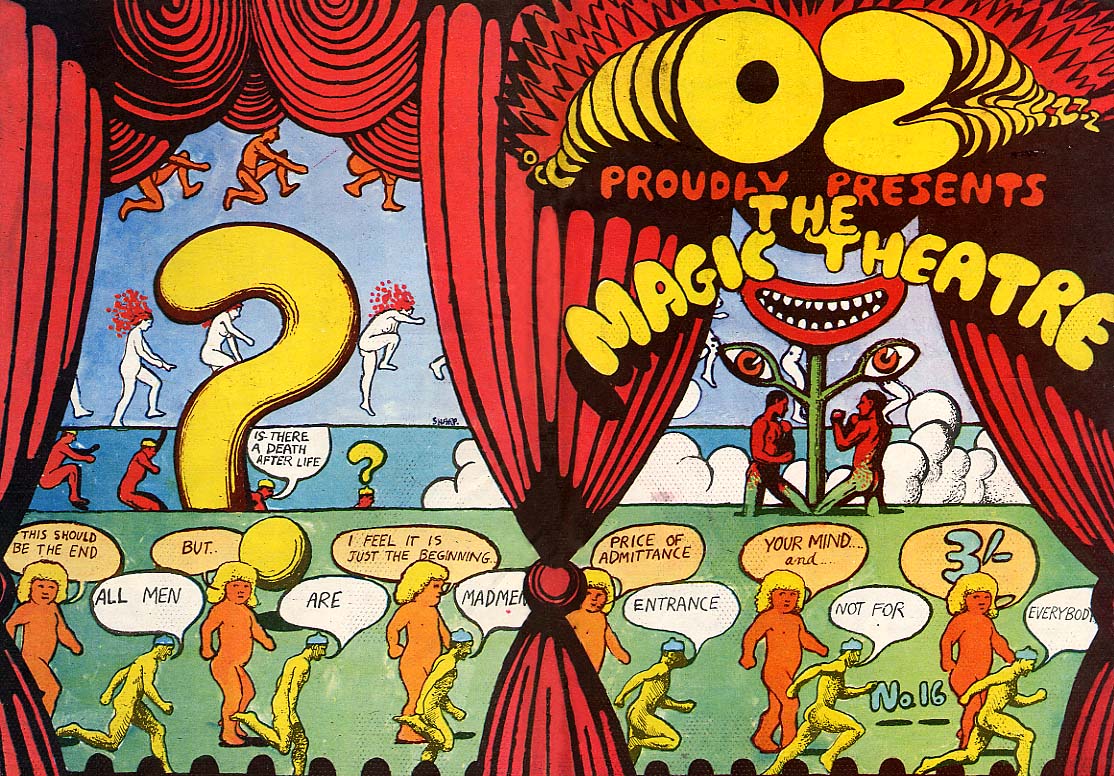
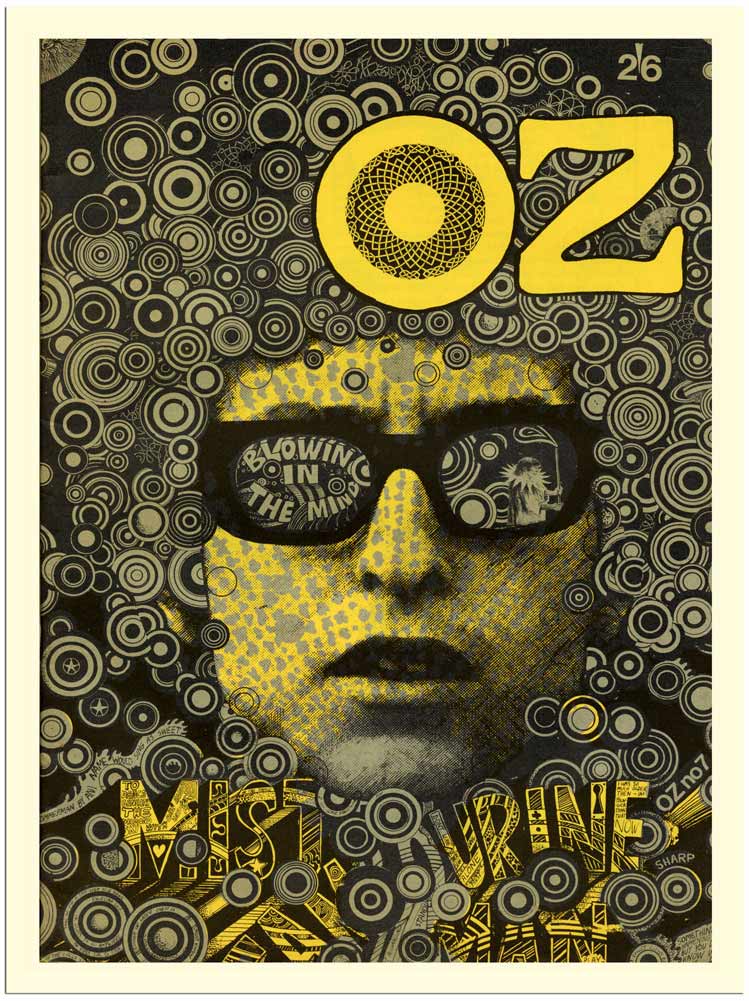
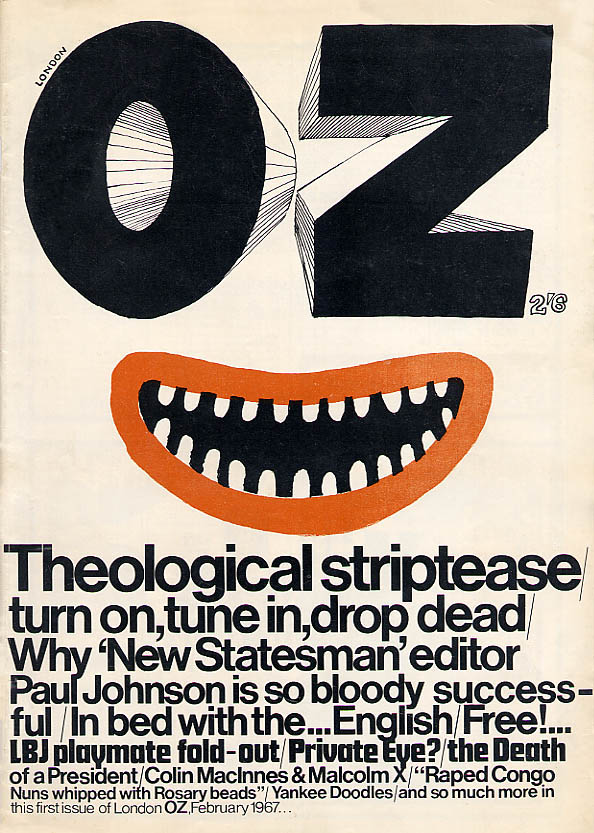
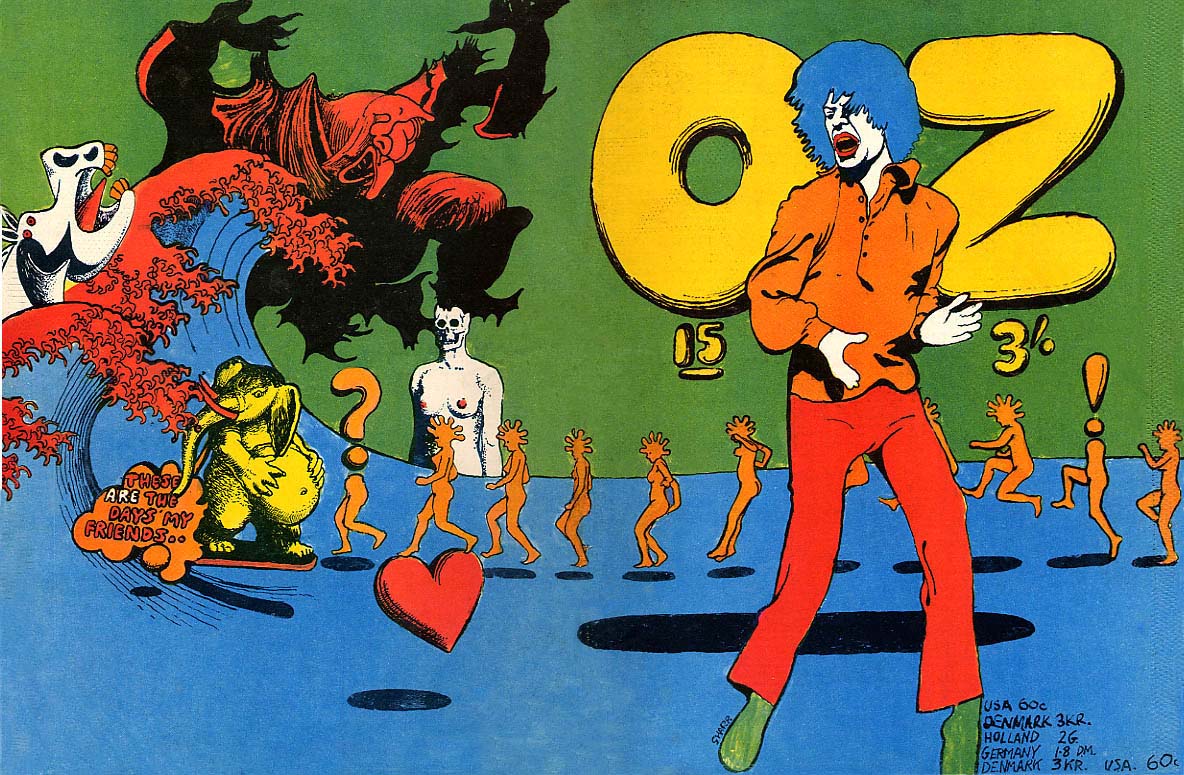
Those of us from the wrong place or the wrong time have had to draw what understanding of the sixties we could from that much-mythologized period’s music and movies, as well as the cloudy reflections of those who lived through it (or claimed to). But now we can get a much more direct sense through the complete digital archives of Oz, sometimes called the most controversial magazine of the sixties.
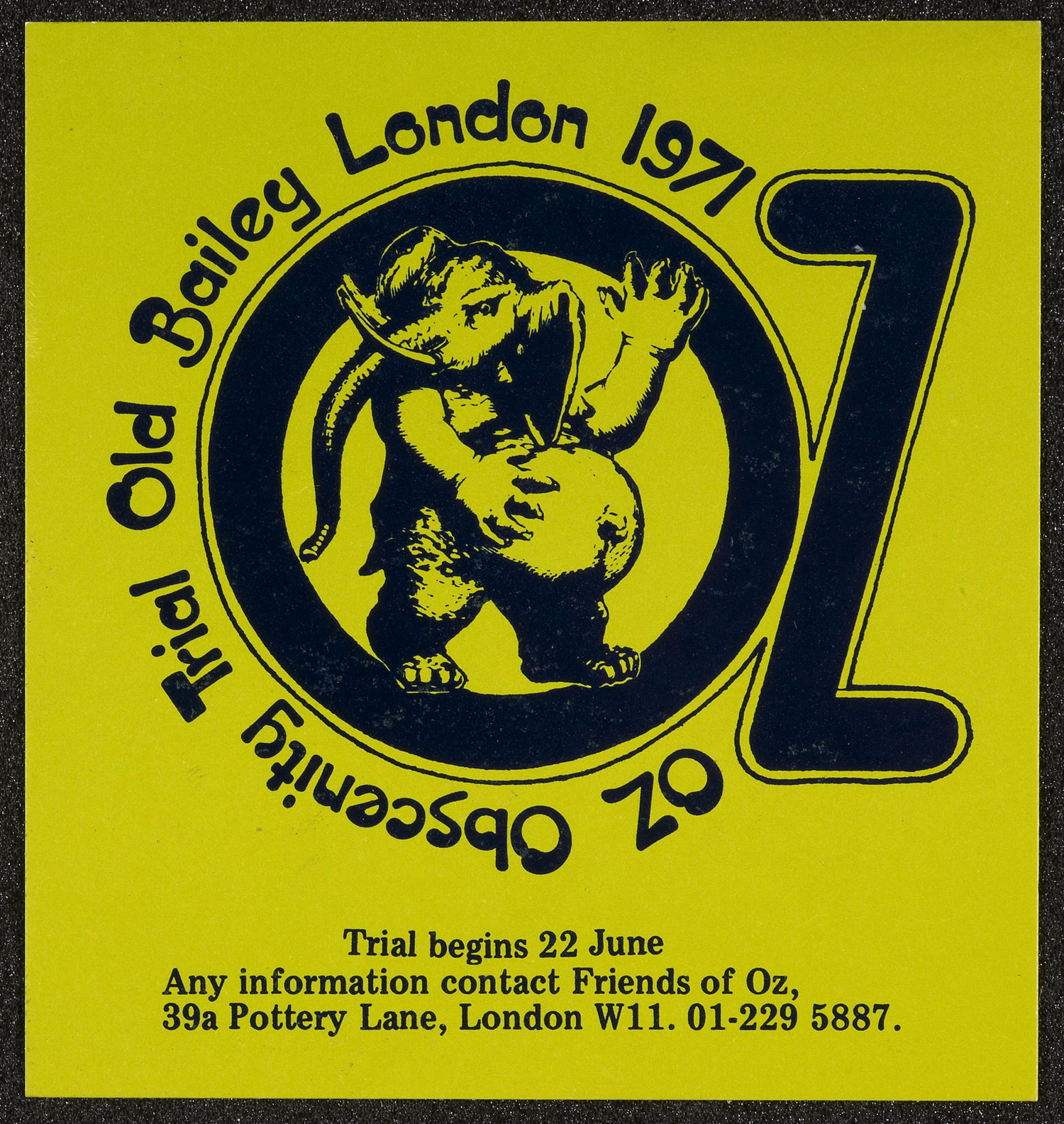
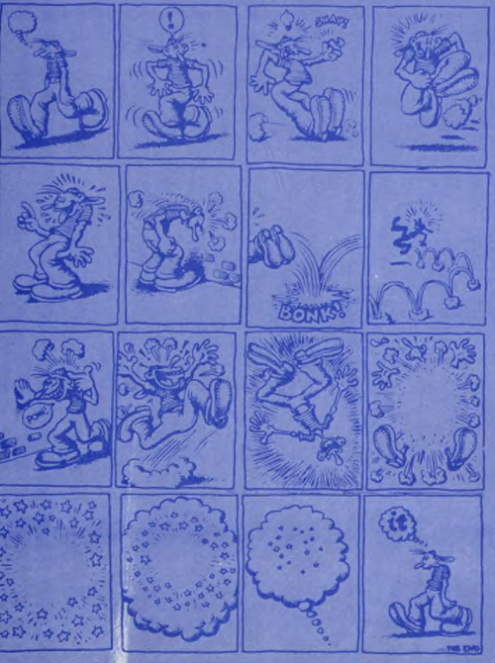
In The Guardian, Chitra Ramaswamy describes the London magazine as “the icon – and the enfant terrible – of the underground press. Produced in a basement flat off Notting Hill Gate, Oz was soon renowned for psychedelic covers by pop artist Martin Sharp, cartoons by Robert Crumb, radical feminist manifestos by Germaine Greer, and anything else that would send the establishment apoplectic. By August 1971, it had been the subject of the longest obscenity trial in British history. It doesn’t get more 60s than that.” Even its print run, which began in 1967 and ended in 1973, perfectly brackets the period people really talk about when they talk about the sixties.
The online archive has gone up at the web site of the University of Wollongong, who two years ago put up a similar digital collection of all the issues of Oz’s eponymous satirical predecessor produced in Sydney. “Please be advised,” notes the front page, “this collection has been made available due to its historical and research importance. It contains explicit language and images that reflect attitudes of the era in which the material was originally published, and that some viewers may find confronting.” And while Oz today wouldn’t likely get into the kind of deep and high-profile legal trouble it did back then — in addition to the famous 1971 trial for the London version, the Sydney one got hit with two obscenity charges during the previous decade — the sheer transgressive zeal on display all over the magazine’s pages in its heyday still impresses.
“Fifty years later, it’s important as a capsule of the times, but also as a work of art,” says Michael Organ, a library manager at the university, in the Guardian article. “Oz is a record of the cultural revolution. Many of the issues it raised, such as the environment, sexuality and drug use, are no longer contentious. In fact, they have now become mainstream.”
All this goes for the deliberately provocative editorial content — the stuff some viewers may find “confronting” — as well as the incidental content: ads for novels by Henry Miller and Jean Genet, “dates computer matched to your personality and tastes,” a machine promising “a hot line to infinity/journey through the incredible landscapes of your mind/kaleidoscopic moving changing image on which your mind projects its own changing/stun yourself & astonish friends,” and the “liquid luxury” of the Aquarius Water Bed. It does not, indeed, get more sixties than that. Enter the Oz archive here.
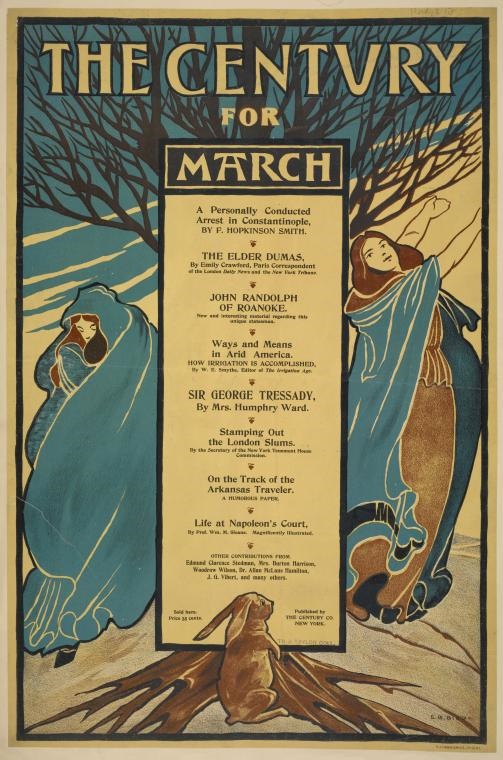
A scroll through any collection of contemporary graphic design portfolios makes for a dizzying tour of the seemingly unlimited range of colors, textures, fonts, etc. available to the modern commercial artist. From the most colorful pop art to the subtlest fine art, it seems that any and every vision can be realized on the page or screen thanks to digital technology. Turn the dial back over a hundred years, and the posters, magazine covers, and advertisements can seem primitive by initial comparison, somewhat washed out and anemic, and certainly nothing like the candy-colored visual feast that meets our eyes on laptop and smartphone screens these days.
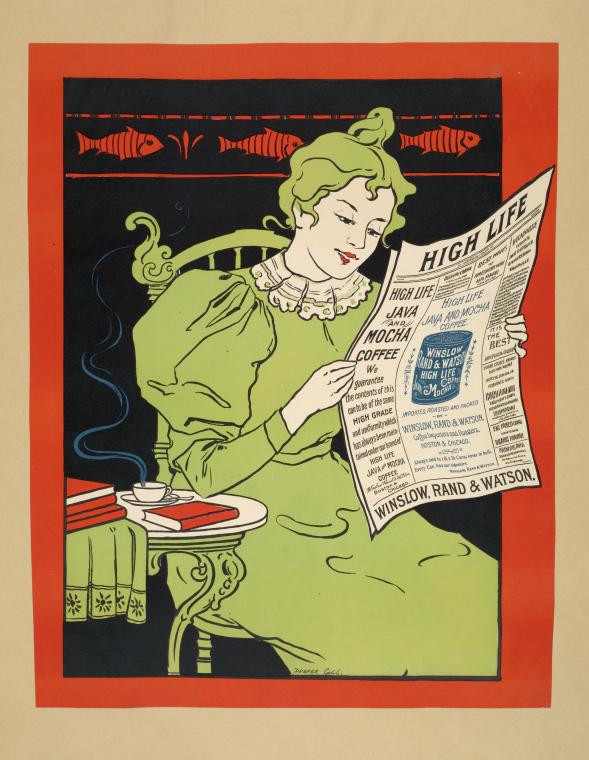
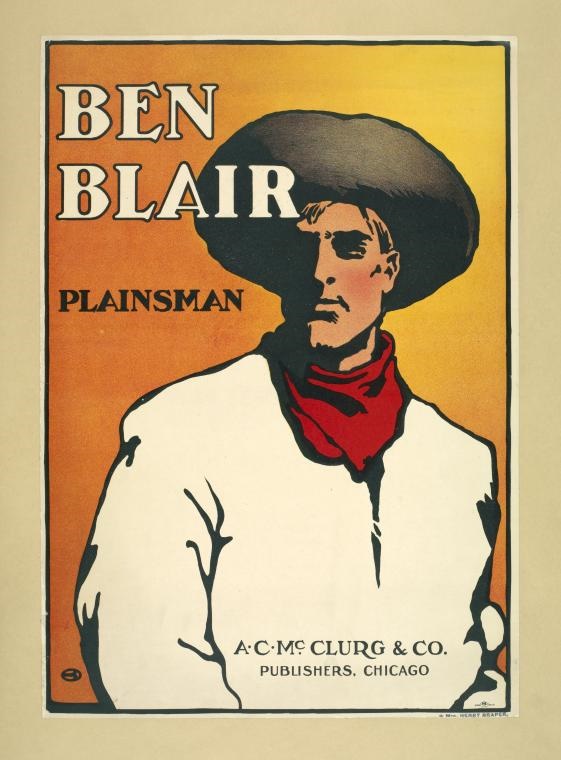
But look closer at the design of a century past, and you’ll find, I think, just as much variety, skill, and imagination—if not nearly so much color and slickness—as is on display today. And though software enables designers to create images and surfaces of which their predecessors could only dream, those hand-illustrated graphics of the past hold a strikingly simple allure that still commands our attention—drawing from art nouveau, impressionism, pre-Raphaelite, and other fine art forms and incorporating modernist lines and contrasts.
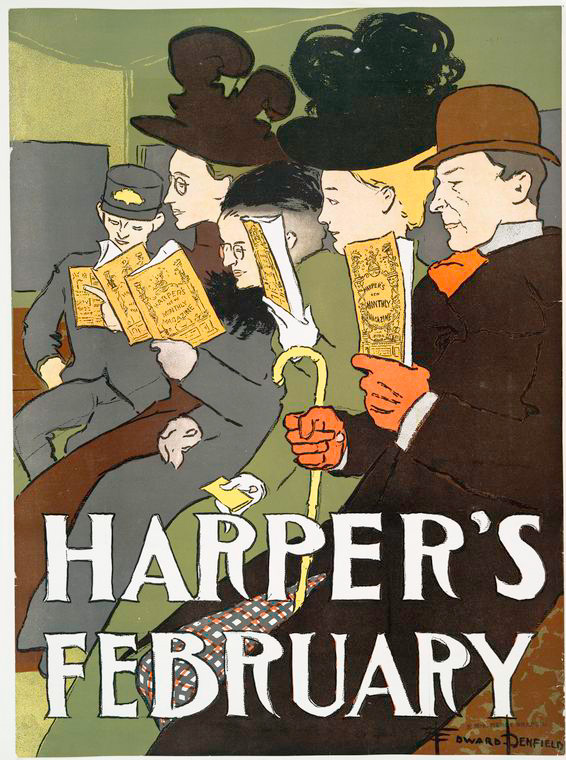
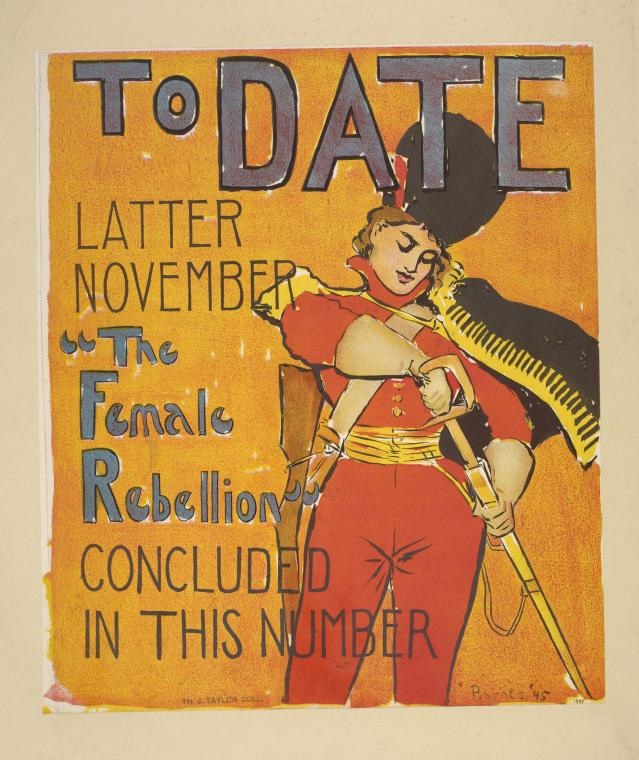
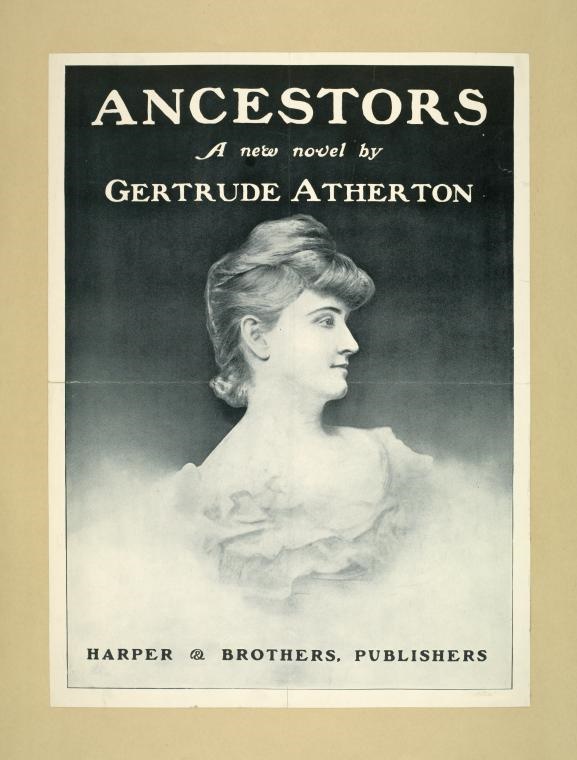
“The advent of the art poster in America,” writes NYPL, “is traceable to the publication of Edward Penfield’s poster advertising the March 1893 issue of Harper’s. [See a collection of his Harper’s posters here.] Unlike earlier advertising posters, Penfield’s work presented an implied graphic narrative to which text was secondary. In this way, and subsequently, in the hands of major artists such as Penfield, Will Bradley and Ethel Reed, the poster moved from the realm of commercial art to an elevated, artistic position.” These posters quickly became collector’s items, and “became more desirable than the publication they were advertising.”
As such, the turn-of-the-century art poster pushed the publishing industry toward graphically illustrated-magazine covers and book jackets. The increasingly stylish, beautifully-executed posters on display in the NYPL archive show us not only the development of modern commercial design as advertising, but also its development as an art form. Though we may have needed Andy Warhol and his contemporaries to remind us that commercial art can just as well be fine art, a look through this stunning gallery of posters shows us that popular graphics and fine art often traded places long before the pop art revolution.
The end of 2015 has been dominated by crises. At times, amidst the daily barrage of fearful spectacle, it can be difficult to conceive of the years around the corner in ways that don’t resemble the next crop of blow-em-up action movies, nearly every one of which depicts some variation on the seemingly inexhaustible theme of the end-of-the-world. There’s no doubt many of our current challenges are unprecedented, but in the midst of anxieties of all kinds it’s worth remembering that—as Steven Pinker has thoroughly demonstrated—“violence has declined by dramatic degrees all over the world.”
In other words, as bad as things can seem, they were much worse for most of human history. It’s a long view cultural historian Otto Friedrich took in a grim survey called The End of the World: A History. Written near the end of the Cold War, Friedrich’s book documents some 2000 years of European catastrophe, during which one generation after another genuinely believed the end was nigh. And yet, certain far-seeing individuals have always imagined a thriving human future, especially during the profoundly destructive 20th century.
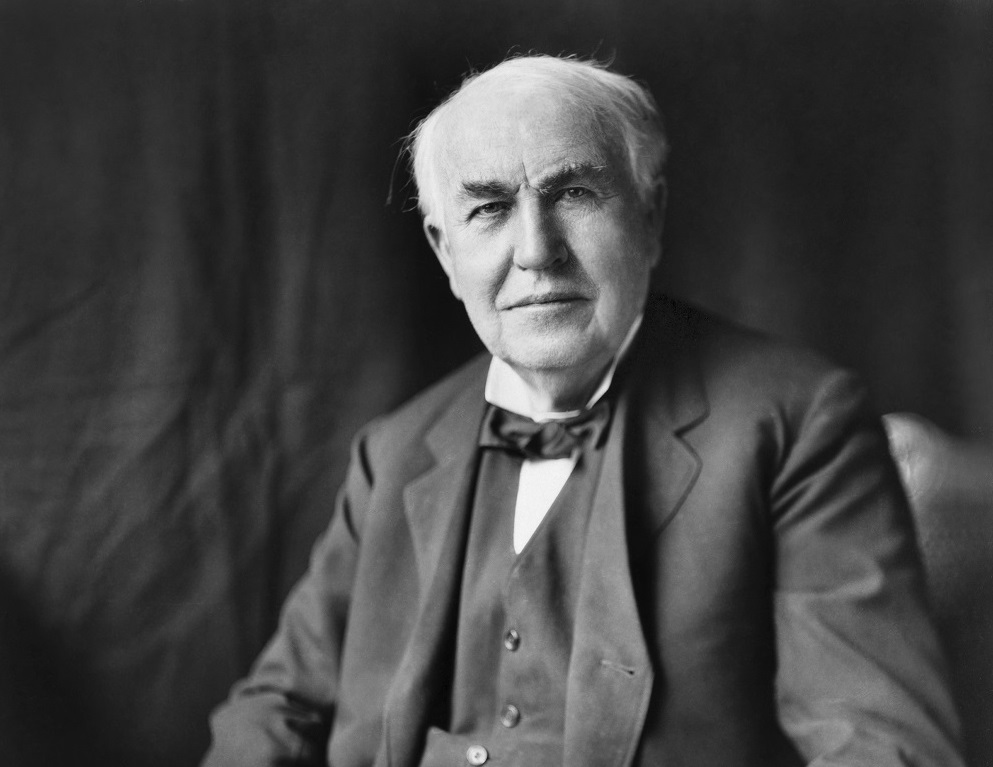
In 1900, engineer John Elfreth Watkins made a survey of the scientific minds of his day. As we noted in a previous post, some of those predictions of the year 2000 seem prescient, some preposterous; all boldly extrapolated contemporary trends and foresaw a radically different human world. At the height of the Cold War in 1964, Isaac Asimov partly described our present in his 50 year forecast. In 1926, and again 1935, no less a visionary than Nikola Tesla looked into the 21st century to envision a world both like and unlike our own.
1. Steam power, already on the wane, will rapidly disappear: “In the year 2011 such railway trains as survive will be driven at incredible speed by electricity (which will also be the motive force of all the world’s machinery).”
2. “[T]he traveler of the future… will fly through the air, swifter than any swallow, at a speed of two hundred miles an hour, in colossal machines, which will enable him to breakfast in London, transact business in Paris and eat his luncheon in Cheapside.”
3. “The house of the next century will be furnished from basement to attic with steel… a steel so light that it will be as easy to move a sideboard as it is today to lift a drawing room chair. The baby of the twenty-first century will be rocked in a steel cradle; his father will sit in a steel chair at a steel dining table, and his mother’s boudoir will be sumptuously equipped with steel furnishings….”
4. Edison also predicted that steel reinforced concrete would replace bricks: “A reinforced concrete building will stand practically forever.” By 1941, he told Cosmopolitan, “all constructions will be of reinforced concrete, from the finest mansions to the tallest skyscrapers.”
5. Like many futurists of the previous century, and some few today, Edison foresaw a world where tech would eradicate poverty: “Poverty was for a world that used only its hands,” he said; “Now that men have begun to use their brains, poverty is decreasing…. [T]here will be no poverty in the world a hundred years from now.”
6. Anticipating agribusiness, Edison predicted, “the coming farmer will be a man on a seat beside a push-button and some levers.” Farming would experience a “great shake-up” as science, tech, and big business overtook its methods.
7. “Books of the coming century will all be printed leaves of nickel, so light to hold that the reader can enjoy a small library in a single volume. A book two inches thick will contain forty thousand pages, the equivalent of a hundred volumes.”
8. Machines, Edison told Cosmopolitan, “will make the parts of things and put them together, instead of merely making the parts of things for human hands to put together. The day of the seamstress, wearily running her seam, is almost ended.”
9. Telephones, Edison confidently predicted, “will shout out proper names, or whisper the quotations from the drug market.”
10. Anticipating the logic of the Cold War arms race, though underestimating the mass destruction to precede it, Edison believed the “piling up of armaments” would “bring universal revolution or universal peace before there can be more than one great war.”
11. Edison “sounds the death knell of gold as a precious metal. ‘Gold,’ he says, ‘has even now but a few years to live. They day is near when bars of it will be as common and as cheap as bars of iron or blocks of steel.’”
He then went on, astonishingly, to echo the pre-scientific alchemists of several hundred years earlier: “’We are already on the verge of discovering the secret of transmuting metals, which are all substantially the same matter, though combined in different proportions.’”
Excited by the future abundance of gold, the Miami Metropolis piece on Edison’s predictions breathlessly concludes, “In the magical days to come there is no reason why our great liners should not be of solid gold from stem to stern; why we should not ride in golden taxicabs, or substituted gold for steel in our drawing rooms.”
In reading over the predictions from shrewd thinkers of the past, one is struck as much by what they got right as by what they got often terribly wrong. (Matt Novak’s Paleofuture, which brings us the Miami Metropolis article, has chronicled the checkered, hit-and-miss history of futurism for several years now.) Edison’s tone is more strident than most of his peers, but his accuracy was about on par, further suggesting that neither the most confident of techno-futurists, nor the most baleful of doomsayers knows quite what the future holds: their clearest forecasts obscured by the biases, technical limitations, and philosophical categories of their present.
Needless to say, before the development and widespread use of photography in mass publications, illustrations provided the only visual accompaniment to religious texts, novels, books of poetry, scientific studies, and magazines literary, lifestyle, and otherwise. The development of techniques like etching, engraving, and lithography enabled artists and printers to better collaborate on more detailed and colorful plates. But whatever the media, behind each of the millions of illustrations to appear in manuscript and print—before and after Gutenberg—there was an artist. And many of those artists’ names are now well known to us as exemplars of graphic art styles.
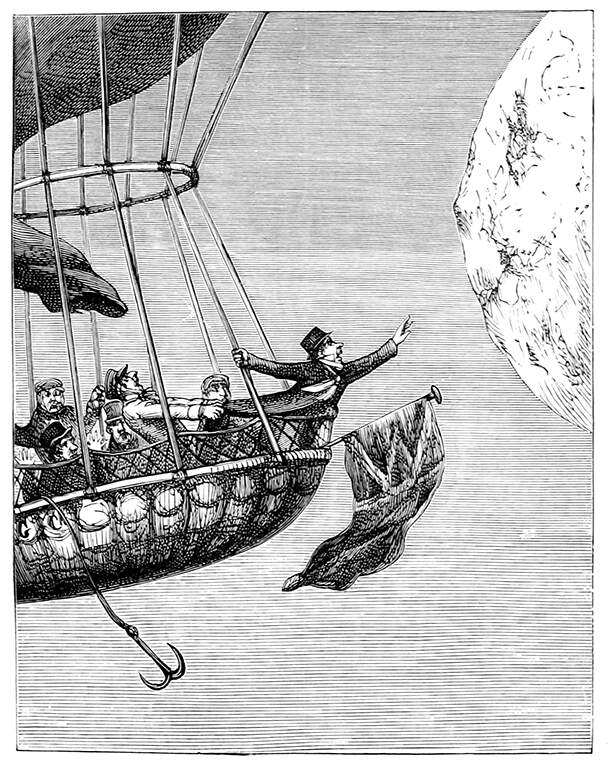
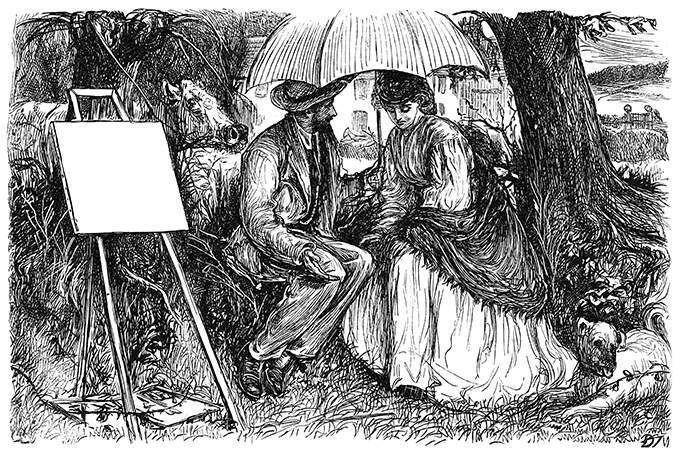
It was in the 19th century that book and magazine illustration began its golden age. Illustrations by artists like George Cruikshank (see his “’Monstre’ Balloon” above”) were so distinctive as to make their creators famous. The hugely influential English satire magazine Punch, founded in 1841, became the first to use the word “cartoon” to mean a humorous illustration, usually accompanied by a humorous caption. The drawings of Punch cartoons were generally more visually sophisticated than the average New Yorker cartoon, but their humor was often as pithy and oblique. And at times, it was narrative, as in the cartoon below by French artist George Du Maurier.
The lengthy caption beneath Du Maurier’s illustration, “Punch’s physiology of courtship,” introduces Edwin, a landscape painter, who “is now persuading Angelina to share with him the honours and profits of his glorious career, proposing they should marry on the proceeds of his first picture, now in progress (and which we have faithfully represented above).” The humor is representative of Punch’s brand, as is the work of Du Maurier, a frequent contributor until his death. You can find much more of Cruikshank and Du Maurier’s work at Old Book Illustrations, a public domain archive of illustrations from artists famous and not-so-famous. You’ll find there many other resources as well, such as biographical essays and a still-expanding online edition of William Savage’s 1832 compendium of printing terminology, A Dictionary of the Art of Printing.
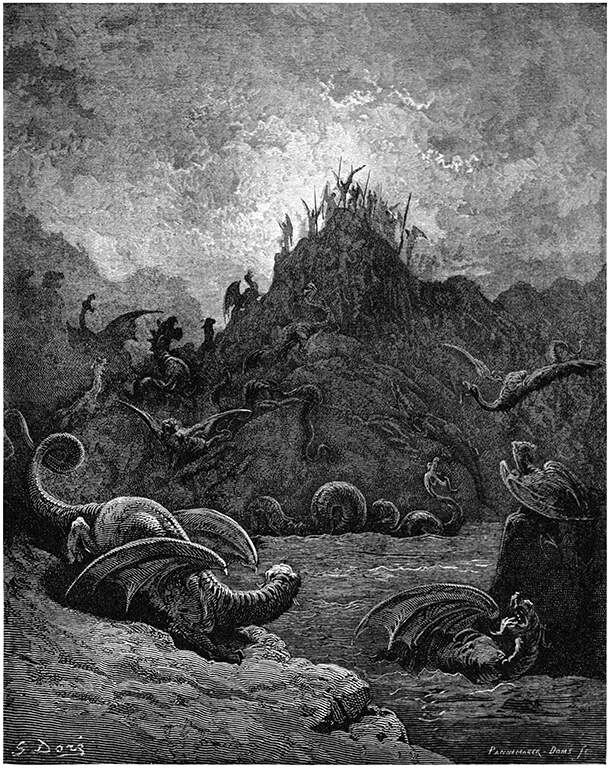
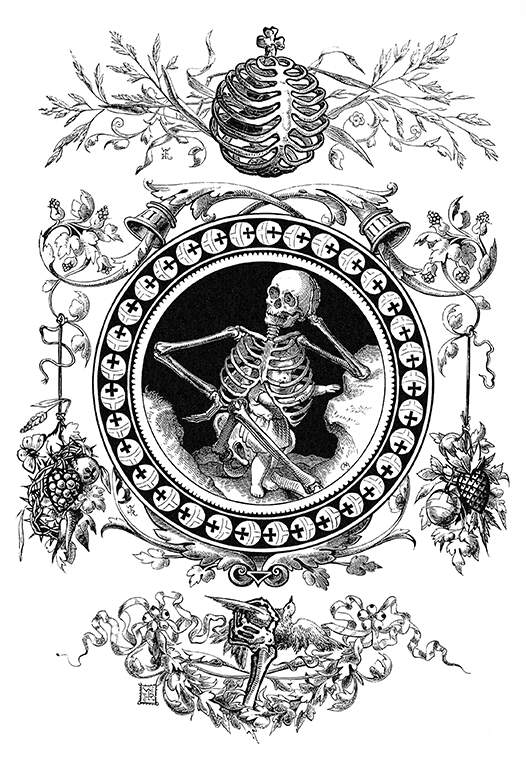
Old Book Illustrations allows you to download high resolution images of its hundreds of featured scans, “though it appears,” writes Boing Boing, “the scans are sometimes worse-for-wear.” Most of the illustrations also “come with lots of details about their original creation and printing.” You’ll find there many illustrations from an artist we’ve featured here several times before, Gustave Doré (see “Gorgons and Hydras” from his Paradise Lost edition, above). As much as artists like Cruikshank and Du Maurier can be said to have dominated the illustration of periodicals in the 19th century, Doré dominated the field of book illustration. In a laudatory biographical essay on the French artist, Elbert Hubbard writes, “He stands alone: he had no predecessors, and he left no successors.” You’ll find a beautifully, and morbidly, 19th century illustrated edition of 17th century poet Francis Quarles’ Emblems, with pages like that below, illustrating “The Body of This Death.”
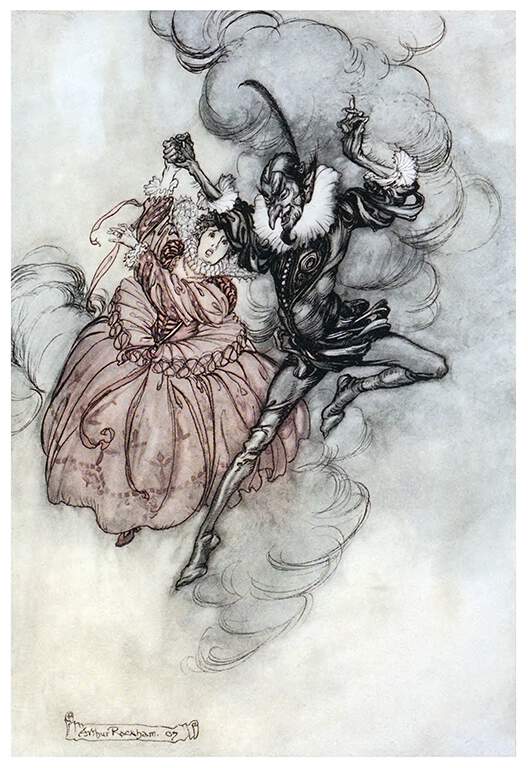
Not all of the illustrations at Old Book Illustrations date from the Victorian era, though most do. Some of the more striking exceptions come from Arthur Rackham, known primarily as an early 20th century illustrator of fantasies and folk tales. See his “Pas de Deux” below from his edition of The Ingoldsby Legends. These are but a very few of the many hundreds of illustrations available, and not all of them literary or topical (see, for example, the “Science & Technology” category). Be sure also to check out the OBI Scrapbook Blog, a running log of illustrations from other collections and libraries.
From the December 6, 1938 issue of LOOK magazine comes this vintage “infographic” showing “The Wonders Within Your Head.” It takes the human brain/head and presents it as a series of rooms, each carrying out a different function. Drawn a little more than a decade after Calvin Coolidge famously declared “The business of America is business,” it’s not surprising that the cognitive functions are depicted in corporate or industrial terms.
Besides for this visualization, the same edition of LOOK featured articles on Jean Harlow, Joan Crawford, President Roosevelt, and the Tragedy of the European Jews. Kristallnacht, or the “Night of Broken Glass,” had taken place a month before in Nazi Germany — another sign that the world was about to become a very, very dark place.
We're hoping to rely on loyal readers, rather than erratic ads. Please click the Donate button and support Open Culture. You can use Paypal, Venmo, Patreon, even Crypto! We thank you!
Open Culture scours the web for the best educational media. We find the free courses and audio books you need, the language lessons & educational videos you want, and plenty of enlightenment in between.