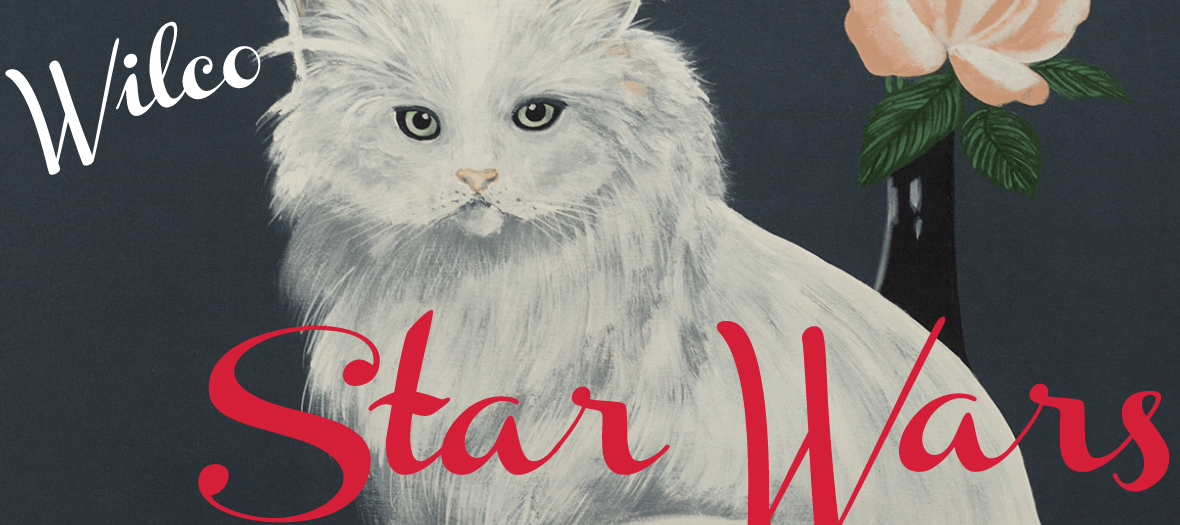
A quick heads up, Wilco just released its ninth studio album, Star Wars. And right now you can download it for free via Wilco’s website. But don’t dilly dally, the free download will only be available for 30 days. On the band’s Instagram account, Jeff Tweedy gave a simple explanation for the unexpected giveaway: “Well, the biggest reason, and I’m not sure we even need any others, is that it felt like it would be fun.” Indeed.
Last week: we highlighted a couple more downloads that will be free for a limited time. Find them below.
Fans of Twin Peaks, the early-1990s television series co-created and in large part directed by David Lynch, have had a lot to get excited about recently. Most prominently, we’ve heard a lot of will-he-or-won’t-he talk about whether Lynch will participate in the show’s much-discussed 21st-century reboot. That has no doubt stoked public interest in Twin Peaks (available on Hulu here), which in some sense has never really died away, even though it went off the air 24 years ago (and by all accounts got pretty lackluster in its second season); some of us, while we wait for the new series, have even engaged in all manner of Twin Peaks-themed writing, art, and even music projects.
Many Australian Twin Peaks fans, while they wait for the new series, made it over to Queensland’s Gallery of Modern Art earlier this year for the exhibitionDavid Lynch: Between Two Worlds. If they went on April 18th, they saw experimental post-punk band Xiu Xiu perform their own interpretation of the Twin Peaks score. “The music of Twin Peaks is everything that we aspire to as musicians and is everything that we want to listen to as music fans,” says Xiu Xiu leader Jamie Stewart. “It is romantic, it is terrifying, it is beautiful, it is unnervingly sexual. The idea of holding the ‘purity’ of the 1950s up to the cold light of a violent moon and exposing the skull beneath the frozen, worried smile has been a stunning influence on us.”
Xiu Xiu, since Stewart formed it in San Jose in 2002, has steadily gained a reputation as, in the words of Vice, “the weirdest band you know.” Part of that has to do with the formal adventurousness of their music itself, and part to do with their invariably disturbing music videos. No wonder, then, that they would feel such an affinity with David Lynch, no stranger to getting called “weird” by audiences and the maker of some unsettling music and music videos himself. Given the potential overlap in their followings, and given that nobody seems to know how many production decisions the new Twin Peaks has yet made, perhaps someone can check and see whether Xiu Xiu might have the time to record its score?
Les Paul, known primarily for the iconic guitar that bears his name, also invented most of the recording technology we still use today, including the use of reverb as a studio effect. But of course he didn’t invent reverberation anymore than he invented the guitar; he just turned both of them electric. Reverb has existed as long as there have been soundwaves, obstacles for them to hit, and ears to hear what happens when they do. In every possible space—landscape, cityscape, and architectural formation—the effect announces itself differently, though we’re seldom aware of it unless we’re in grand, cavernous spaces like a cathedral or mountain gorge.
But musicians and audio engineers like Les Paul have always paid special attention to the way sound manifests in space, as have singers like the gent above, who calls himself the Wikisinger, real name Joachim Müllner. With “no artificial reverb added,” Müllner demonstrates how much environment contributes to the quality of what we hear with a montage of sound and video clips from several—very aesthetically pleasing—locations.
In each place, Müllner sings the same strange song: in a tunnel, an attic, a field before an oil derricks, the nave of a cathedral, and an anechoic chamber—which resembles the interior of an alien spacecraft and produces no reflections whatsoever. Sometimes the effect is subtle, inviting you to lean in and listen more closely; sometimes it’s outsized and operatic.
The filmmaker’s claim to “no artificial reverb” sounds a little slippery after viewing the Wikisinger’s performance since one of the most dramatic clips features his voice, and person, reduplicated several times. And we should keep in mind that no recording technology is perfectly transparent. Microphones and other equipment always add, or subtract, something to the sound. As slick as an advertisement, the short video uses a heavily mediated form to convey the simple idea of natural reverberation. You may, in fact, have seen something just like this not long ago. Before the Wikisinger, there was the Wikidrummer. In another “no reverb added” video above, he snaps, cracks, booms, and crashes through the same beat in garages, open fields, and underpasses. With each abrupt shift in location comes an abrupt shift in the frequency and duration of the sounds, as the full spectrum collides with metal, concrete, asphalt, and open air.
The ways in which sound and space interact can determine the shape of a musical form. This subject has given musician, artist, and theorist of music and art, David Byrne much to think about. As he puts in in a TED talk above, the “nature of the room”—the quality of its reverb—guides the evolution of musical genres and styles. Beginning with the example of CBGBs and like dive bars around the country, he describes how the art punk pioneered by his band the Talking Heads depended on such spaces and “didn’t sound all that great” in places strictly designed for music, like Carnegie Hall. His talk then takes us to some fascinating architectural environments, such as the kinds of rooms Mozart composed and played in. Byrne speaks to the neophytes as well as to the audiophiles among us, and his talk works as a perfect intellectual complement to the sonic and visual adventure on offer in the Wikisinger and –drummer’s videos. Both approaches equally persuade us of the prime significance of that intangible wonder called reverb.
Heavy Metal owes many debts, though it doesn’t always acknowledge them—debts to classical music, through guitarists like Yngwie Malmsteen, to the blues, through Led Zeppelin and Deep Purple, and to jazz, through a host of players, including Black Sabbath’s guitarist Tony Iommi. But while other players have picked up techniques from the jazz idiom like blast beats and sweep picking, Iommi found something else: the motivation to relearn to play the guitar after losing three of the fingertips on his right hand in an industrial accident, on his last day on the job, right before he was to embark on a European tour. He was only 17 years old. Iommi narrates the story himself above in “Fingers Bloody Fingers,” a powerful animated short by illustrator Paul Blow and animator Kee Koo.
After the gruesome accident, Iommi, “extremely depressed,” tragically resigned himself to never play the guitar again — that is, until his factory manager visited him in the hospital and told him the story of Django Reinhardt, the Belgian-Romani swing guitarist who lost two fingers in a terrible fire at age 18, himself just on the verge of stardom and highly sought after by the greatest bandleaders of the day. In the clip above from the French documentary Trois doigts de genie (Three Fingers of Genius), learn how Reinhardt overcame his disability to become one of the most famous guitarists of his day, and see why Iommi was so inspired by his story. “A lesser musician would have given up,” wrote Mike Springer in a previous post, “but Reinhardt overcame the limitation by inventing his own method of playing.” Iommi, of course, did the same, also along the way introducing a lighter gauge of string, which millions of rock guitarists now use.
Reinhardt toured and recorded with his own ensembles and with Duke Ellington and others. Unfortunately precious little footage of him exists, but you can see him above with violinist Stephane Grappelli in their Quintette du Hot Club and in a few other short clips in this post. Once you hear Django’s story of overcoming adversity, and once you hear him play, you’ll understand why he inspired Iommi to push through his own pain and limitations to become one of the most influential guitarists of his generation.
We’ve seen Europeans cover famous rock and metal bands in an American folk style—Finnish musicians playing AC/DC, Iron Maiden, and Dio in Appalachian folk, to be exact. Now, prepare to hear famous rock and metal bands in a distinctively European folk style: Medieval Belarusian folk, played by the beautifully named Stary Olsa. The band’s name derives from a stream in East Belarus—their clothing, instrumentation, and rhythms from an early Lithuanian state called the Grand Duchy—but the songs are all 20th century radio fodder. Above, see them do Deep Purple’s “Child in Time,” and below, they tackle the Red Hot Chili Peppers’ “Californication.”
Stary Olsa’s cover of Metallica’s “One” (further down), already an incredibly dramatic song, works particularly well in their syncopated Spartan style. The sounds and costuming of the accomplished Belarusian musicians will inevitably remind you—if you haven’t been under a rock in Belarus—of that Medieval-style fantasy show in which your favorite characters meet horribly violent ends week after week.
When we look at the bloody history of Medieval Europe, the gruesomeness of Westeros can seem like only a slight exaggeration—dragons and ice zombies aside—of the so-called “dark ages.” These associations, and the solemnity of the song selection and starkness of the voices and instruments, lend Stary Olsa’s performances a gravitas that, frankly, elevates some of the material far above its pop origins (I’m looking at you, Red Hot Chili Peppers).
In order for such meldings of styles, periods, and cultures to work, whether they be played for laughs or deeply serious, the musicianship must be top notch. Such was the case with Finnish bluegrass metal cover band Steve ‘N’ Seagulls, and such is certainly the case with Stary Olsa, who have appeared on Belarusian TV (from which some of these videos come) and are currently finding a level of popularity outside their native country that few Belarusian bands have achieved. It’s unlikely we’ll see them soon on the rock festival circuit, but their status as an internet sensation is all but guaranteed. Just below, see the band translate a medley of The Beatles’ “Obla-La-Di, Ob-La-Da” and “Yellow Submarine” into their musical idiom, proving that they don’t just do dark, haunting, and mysterious; they’re also positively danceable.
The Montreux Jazz Festival — the second largest jazz festival in the world — has seen many acts come and go since it kicked off in 1967. Miles Davis, Keith Jarrett, Nina Simone, Bill Evans and Ella Fitzgerald have all played there. And now we have the first concert performed by a jazz pianist (Al Blatter) and The Cosmic Piano, an instrument created by particle physicists at CERN, the home of the Large Hadron Collider, in Switzerland. The Cosmic Piano works something like this: “When a cosmic ray passes through one of four separate detector pads of the Cosmic Piano, it triggers a musical note and a colourful flash of light.” The rays arrive in random intervals, and once they’re combined with Blatter’s notes, you get some interesting polyrhythmic jazz. Catch a few highlights above, and get more background information and video clips on CERN’s web site.
It’s easy to write off the Grateful Dead—and I’ll admit I did for years—as aging “hippies stuck in the Summer of Love,” as a recent Wired article puts it. But this reputation belies a musical depth due in part, as we pointed out yesterday, to the band’s lyrical sophistication. But it isn’t only their lyricism, or their self-sustaining subculture, that has consistently won them generations of devoted followers born long after Jerry Garcia and company got their start at Ken Kesey’s Acid Test parties. “Long before it became necessary (or cool) to do so,” writes Wired, “the band embraced a DIY ethos in everything from manufacturing its own gear to publishing its own music distribution system. The Dead’s obsession with technology was almost inseparable from the band’s psychedelic ambition and artistic independence.”
Not only has the Dead fostered what is surely the most widespread bootleg industry in existence, but they also “pioneered rock concert broadcasts,” starting with a Carousel Ballroom show in 1968. Thanks to the spread of the Grateful Dead gospel through channels both official and unofficial, we have access to quality recordings of Jerry Garcia’s last show with the Grateful Dead twenty years ago, and to their last shows as a band, played just this past week in a two-city, 50th anniversary “Fare Thee Well” series of concerts in Santa Clara and at Chicago’s Soldier Field. The final shows are now largely available online thanks to the efforts of an enterprising “taper,” as the diligent amateur recording engineers who capture each Dead show are called.
Opinions on these final gigs have varied widely, but no matter how uneven some of the performances, as always—scattered amidst the ramshackle jams—the Dead conjure trance states of interlocking rhythms and harmonies that make all the listening worthwhile. We may never get the chance to see them sprawl out live on stage again, but thanks to the stalwart taper community, nearly every moment of the Dead’s 50 year career in rock and roll—from the confusingly noodly to the truly sublime—has been preserved for the ages. Thousands of concerts can be found at The Internet Archive, one of the best sanctioned Grateful Dead bootleg archives on the web. Don’t miss it.
Just about twenty years ago, on July 9, 1995, the Grateful Dead played their last show with Jerry Garcia. Neither the fans, nor the band knew this would be so, but anyone paying attention could have seen it coming. Garcia’s cocaine and heroin use had long dominated his life; despite interventions by his bandmates, a few stints in rehab, a diabetic coma, and the death of keyboardist Brent Mydland, the singer and guitarist continued to relapse. Exactly one month after that final concert, he died of a heart attack.
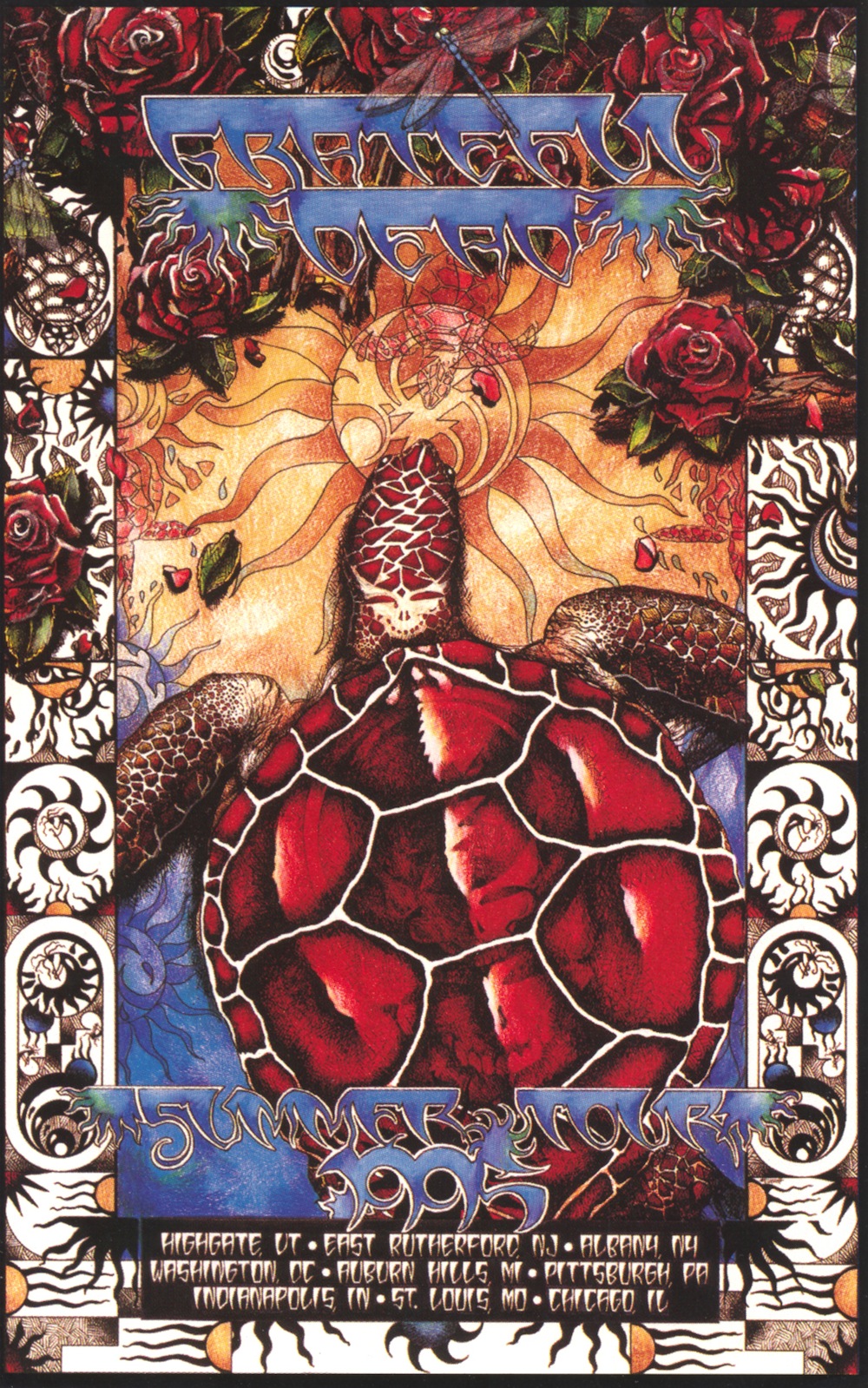
And what a poignant show it was. (See the tour poster above, hear the entire set below, and see a setlist here), opening with the band’s comeback hit “Touch of Grey” and closing with a fireworks display set to Hendrix’s “Star Spangled Banner.”
Garcia sounds frail, his voice a bit thin and ragged, and the lyrics—penned by Robert Hunter—strike a painfully ironic note: “I will get by… I will survive.” Just last night, twenty years after that moment, fans once again said goodbye to the Dead, as they played their last of three final concerts without Jerry at Chicago’s Soldier’s Field, the same venue where Garcia last sang “Touch of Grey“ ‘s fateful words.
The Grateful Dead’s official output may have been uneven at times, marred by excess and tragedy, but the band’s words remained consistently inspired and inspiring, each song a poetic vignette filled with oblique references and witty, heartfelt turns of phrase. We mostly have Robert Hunter to thank for those hundreds of memorable verses. An accomplished poet and translator of Rainer Maria Rilke’s Duino Elegies and Sonnets to Orpheus, Hunter served, writes Rolling Stone, as the band’s “primary in-house poet.” In a rare and moving interview with the magazine, the reclusive writer muses on his former role, and hedges on the meaning of his songs: “I’m open to questions about interpretation, but I generally skate around my answers because I don’t want to put those songs in a box.”
Hunter’s reluctance to interpret his lyrics hasn’t stopped fans and scholars of the Dead from doing so. There have been university exhibits and academic conferences devoted to the Grateful Dead. And true students of the band can study the many literary references and allusions in their songwriting with The Annotated Grateful Dead Lyrics, an online project begun in 1995 by UC Santa Cruz Research Associate David Dodd, and turned into a book in 2005. The extensive hypertext version of the project includes editorial footnotes explaining each song’s references, with sources. Also included in these glosses are “notes from readers,” who weigh in with their own speculations and scholarly addenda.
If you have any doubt about just how steeped in poetic history the pre-eminent hippie band’s catalog is, see for example the annotated “Terrapin Station,” a song that reaches back to Homer and alludes to Lewis Carroll, William Blake, Plato, and T.S. Eliot. Or, so, at least, say Dodd and his readers, though some of their interpretations may seem a bit tenuous. Hunter himself told Rolling Stone, “people think I have a lot more intention at what I do because it sounds very focused and intentional. Sometimes I just write the next line that occurs to me, and then I stand back and look at it and say, ‘This looks like it works.’ ” But just because a poet isn’t consciously quoting Homer doesn’t mean he isn’t, especially a poet as densely allusive as Robert Hunter.
Take, for example, “Uncle John’s Band,” which contains the line “Ain’t no time to hate.” One reader, Aaron Bibb, points us toward these lines of Emily Dickinson:
I had no time to Hate— Because The Grave would hinder Me— And Life was not so Ample I Could finish—Enmity—
Woven throughout the song are references to American poetry and folk music—from Robert Frost’s “Fire and Ice,” to the Gadsden Flag, to an Appalachian rag. Another of the band’s most popular songs, “Friend of the Devil,” cribs its title and chorus from American folk singer Bill Morrissey’s song “Car and Driver”—and also references Don McLean’s “American Pie.” Drawing as much on the Western literary canon as on the American songbook, Hunter’s writing situates the Dead’s Americana in a tradition stretching over centuries and continents, giving their music depth and complexity few other rock bands can claim.
The online annotated Grateful Dead also includes “Thematic Essays,” a bibliography and “bibliography of songbooks,” films and videos, and discographies for the band and each core member. There may be no more exhaustive a reference for the band’s output contained all in one place, though readers of this post may know of comparable guides in the vast sea of Grateful Dead commentary and compendiums online, in print, and on tape. The band may have played its last show twenty years ago, and again just last night without its beloved leader, but the proliferating, serious study of their songcraft and lyrical genius shows us that they will, indeed, survive.
We're hoping to rely on loyal readers, rather than erratic ads. Please click the Donate button and support Open Culture. You can use Paypal, Venmo, Patreon, even Crypto! We thank you!
Open Culture scours the web for the best educational media. We find the free courses and audio books you need, the language lessons & educational videos you want, and plenty of enlightenment in between.