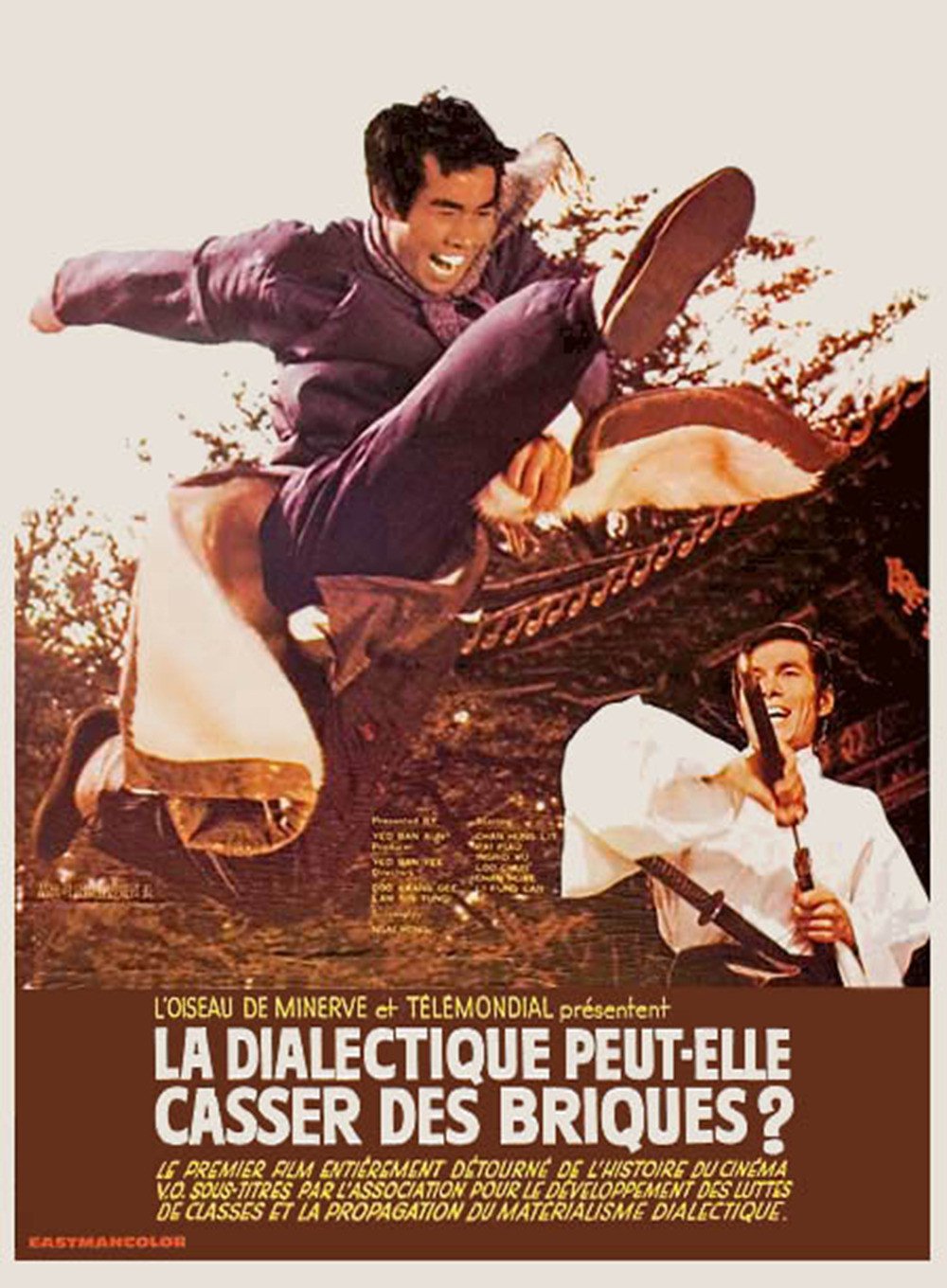
And here I’d always considered La Chinoise the only French-language film that used both borrowed Chinese imagery and lofty theory to mount a critique of capitalism. It turns out that six years after Jean-Luc Godard made that movie, Sinologist, Situationist, and filmmaker René Viénet came out with the next important volume in that fascinating minor tradition, La Dialectique Peut-Elle Casser Des Briques?(Can Dialectics Break Bricks?), an entire Hong Kong martial-arts picture entirely repurposed into, as Dangerous Minds’ Richard Metzger puts it, “a critique of class conflicts, bureaucratic socialism, the failures of the French Communist Party, Maoism, cultural hegemony, sexual equality and the way movies prop up Capitalist ideology.”
Using as its visual material 1972’s Crush, Tu Guangqi’s hand-to-hand-combat-intensive tale of Korean rebellion against Japanese imperialism, the film followed the model of Woody Allen’s What’s Up, Tiger Lily? “which re-dubbed humorous dialogue over a Japanese spy movie to make the plot about a recipe for egg salad […] but here the cinematic Situationist provocateur is less out for laughs (although there are plenty of them) and more about the political subversion.” This intersection of lo-fi chop-socky action with high-flown revolutionary jargon and academic name-dropping (“My Foucaults! My Lacans! And if that’s not enough, I’ll even send my structuralists”) has for decades struck its viewers as sublimely ridiculous. But do the images and the dialogues really clash as totally as they would seem to?
“Like many Hong Kong productions of the early seventies,” writes Luke White at Kung Fu with Braudel, “the scenario of the original film is clearly one in which colonial exploitation and resistance are at issue. Set in Korea under the Japanese occupation that lasted much of the first half of the twentieth century, the heroes (those turned by Viénet into ‘the Proletarians’) are the members of a martial arts school who start to resist the colonial violence of the militaristic Japanese forces. However potentially conservative the nationalistic dimension of its narrative, this is also a work about struggle and liberation from tyranny in some of its most typically modern forms.” In its multiplicity of possible interpretations, La Dialectique Peut-Elle Casser Des Briques? joins the ranks of all the most interesting works of art — and it certainly makes for a refreshing break from actually reading your Foucaults, your Lacans, and your structuralists.
This year we’ve been featuring short animated videos from BBC Radio 4, all covering the big questions: How did everything begin?What makes us human?What is love?How can I know anything at all? They’ve all come scripted by philosopher Nigel Warburton (he of Philosophy Bites podcast fame) and narrated by a host of notables from both sides of the pond like Stephen Fry, Gillian Anderson, Aidan Turner, and Harry Shearer. They’ve illustrated the philosophical concepts at hand not just with elaborate and joke-filled drawings that come to life before your eyes, but with direct reference to the ideas of history’s best-known thinkers: Aristotle, Descartes, Hume, Wittgenstein, de Beauvoir, Sartre, Freud, Chomsky — the list goes on.
If you would like to support the mission of Open Culture, consider making a donation to our site. It’s hard to rely 100% on ads, and your contributions will help us continue providing the best free cultural and educational materials to learners everywhere. You can contribute through PayPal, Patreon, and Venmo (@openculture). Thanks!
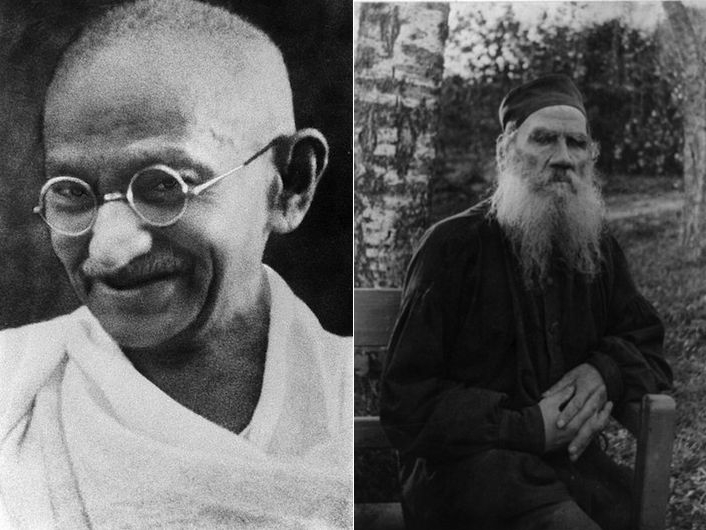
Some of the most rigorous moral thinkers of the past century have spent time on the wrong side of questions they deemed of vital importance. Mohandas Gandhi, for example, at first remained loyal to the British, manifesting many of the vicious prejudices of the Empire against Black South Africans and lobbying for Indians to serve in the war against the Zulu. Maya Jasanoff in New Republic describes Gandhi during this period of his life as a “crank.” At the same time, he developed his philosophy of non-violent resistance, or satyagraha, in South Africa as an Indian suffering the injustices inflicted upon his countrymen by both the Boers and the British.
Gandhi’s sometime contradictory stances may be in part understood by his rather aristocratic heritage and by the warm welcome he first received in London when he left his family, his caste, and his wife and child in India to attend law school in 1888. And yet it is in London that he first began to change his views, becoming a staunch vegetarian and encountering theosophy, Christianity, and many of the contemporary writers who would shift his perspective over time. Gandhi received a very different reception in England when he returned in 1931, the de facto leader of a burgeoning revolutionary movement in India whose example was so important to both the South African and U.S. civil rights movements of succeeding decades.
One of the writers who most deeply guided Gandhi’s political, spiritual, and philosophical evolution, Leo Tolstoy, experienced his own dramatic transformation, from landed aristocrat to social radical, and also renounced property and position to advocate strenuously for social equality. Gandhi eagerly read Tolstoy’s The Kingdom of God is Within You, the novelist’s statement of Christian anarchism. The book, Gandhi wrote in his autobiography, “left an abiding impression on me.” After further study of Tolstoy’s religious writing, he “began to realize more and more the infinite possibilities of universal love.”
It was in England, not India, where Gandhi first read “A Letter to a Hindu,” Tolstoy’s 1908 reply to a note from Indian revolutionary Taraknath Das on the question of Indian independence. Tolstoy divides his lengthy, thoughtful “Letter” into short chapters, each of which begins with a quotation from the Vedas. “Indeed,” writes Maria Popova, the missive “puts in glaring perspective the nuanceless and hasty op-eds of our time.” It so affected Gandhi that, in 1909, he wrote to Tolstoy, thus beginning a correspondence between the two that lasted through the following year. “I take the liberty of inviting your attention to what has been going on in the Transvaal for nearly three years,” begins Gandhi’s first letter, somewhat abruptly, “There is in that Colony a British Indian population of nearly 13,000. These Indians have, for several years, labored under various legal disabilities.”
The prejudice against color and in some respects against Asians is intense in that Colony….The climax was reached three years ago, with a law that many others and I considered to be degrading and calculated to unman those to whom it was applicable. I felt that submission to a law of this nature was inconsistent with the spirit of true religion. Some of my friends and I were and still are firm believers in the doctrine of nonresistance to evil. I had the privilege of studying your writings also, which left a deep impression on my mind.
Gandhi refers to a law forcing the Indian population in South Africa to register with the authorities. He goes on to inquire about the authenticity of the “Letter” and asks permission to translate it, with payment, and to omit a negative reference to reincarnation that offended him. Tolstoy responded a few months later, in 1910, allowing the translation free of charge, and allowing the omission, with the qualification that he believed “faith in re-birth will never restrain mankind as much as faith in the immortality of the soul and in divine truth in love.” Overall, however, he expresses solidarity, greeting Gandhi “fraternally” and writing,
God help our dear brothers and co-workers in the Transvaal! Among us, too, this fight between gentleness and brutality, between humility and love and pride and violence, makes itself ever more strongly felt, especially in a sharp collision between religious duty and the State laws, expressed by refusals to perform military service.
The two continued to write to each other, Gandhi sending Tolstoy a copy of his Indian Home Rule and the translated “Letter,” and Tolstoy expounding at length on the errors—and what he saw as the superior characteristics—of Christian doctrine. You can read their full correspondence here, along with Tolstoy’s “Letter to a Hindu” and Gandhi’s introduction to his edition. Despite their religious differences, the exchange further galvanized Gandhi’s passive resistance movement, and in 1910, he founded a community called “Tolstoy Farm” near Johannesburg.
Gandhi’s views on African independence would change, and Nelson Mandela later adopted Gandhi and the Indian independence movement as a standard for the anti-apartheid movement. We’re well aware, of course, of Gandhi’s influence on Martin Luther King, Jr. For his part, Gandhi wrote glowingly of Tolstoy, and the model the novelist provided for his own anti-colonial campaign. In a speech 18 years later, he said, “When I went to England, I was a votary of violence, I had faith in it and none in nonviolence.” After reading Tolstoy, “that lack of faith in nonviolence vanished…Tolstoy was the very embodiment of truth in this age. He strove uncompromisingly to follow truth as he saw it, making no attempt to conceal or dilute what he believed to be the truth. He stated what he felt to be the truth without caring whether it would hurt or please the people or whether it would be welcome to the mighty emperor. Tolstoy was a great advocate of nonviolence in his age.”
The problem of violence, perhaps the true root of all social ills, seems irresolvable. Yet, as most thoughtful people have realized after the wars of the twentieth century, the dangers human aggression pose have only increased exponentially along with globalization and technological development. And as Albert Einstein recognized after the nuclear attacks on Hiroshima and Nagasaki—which he partly helped to engineer with the Manhattan Project—the aggressive potential of nations in war had reached mass suicidal levels.
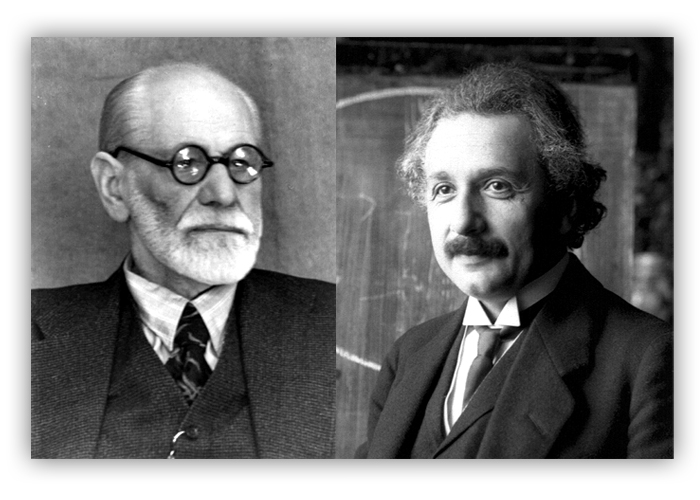
After Einstein’s involvement in the creation of the atomic bomb, he spent his life “working for disarmament and global government,” writes psychologist Mark Leith, “anguished by his impossible, Faustian decision.” Yet, as we discover in letters Einstein wrote to Sigmund Freud in 1932, he had been advocating for a global solution to war long before the start of World War II. Einstein and Freud’s correspondence took place under the auspices of the League of Nation’s newly-formed International Institute of Intellectual Cooperation, created to foster discussion between prominent public thinkers. Einstein enthusiastically chose Freud as his interlocutor.
In his first letter to the psychologist, he writes, “This is the problem: Is there any way of delivering mankind from the menace of war?” Well before the atomic age, Einstein alleges the urgency of the question is a matter of “common knowledge”—that “with the advance of modern science, this issue has come to mean a matter of life and death for Civilization as we know it.”
Einstein reveals himself as a sort of Platonist in politics, endorsing The Republic’s vision of rule by elite philosopher-kings. But unlike Socrates in that work, the physicist proposes not city-states, but an entire world government of intellectual elites, who hold sway over both religious leaders and the League of Nations. The consequence of such a polity, he writes, would be world peace—the price, likely, far too high for any world leader to pay:
The quest of international security involves the unconditional surrender by every nation, in a certain measure, of its liberty of action—its sovereignty that is to say—and it is clear beyond all doubt that no other road can lead to such security.
Einstein expresses his proposal in some sinister-sounding terms, asking how it might be possible for a “small clique to bend the will of the majority.” His final question to Freud: “Is it possible to control man’s mental evolution so as to make him proof against the psychosis of hate and destructiveness?”
Freud’s response to Einstein, dated September, 1932, sets up a fascinating dialectic between the physicist’s perhaps dangerously naïve optimism and the psychologist’s unsentimental appraisal of the human situation. Freud’s mode of analysis tends toward what we would now call evolutionary psychology, or what he calls a “’mythology’ of the instincts.” He gives a mostly speculative account of the prehistory of human conflict, in which “a path was traced that led away from violence to law”—itself maintained by organized violence.
Freud makes explicit reference to ancient sources, writing of the “Panhellenic conception, the Greeks’ awareness of superiority over their barbarian neighbors.” This kind of proto-nationalism “was strong enough to humanize the methods of warfare.” Like the Hellenistic model, Freud proposes for individuals a course of humanization through education and what he calls “identification” with “whatever leads men to share important interests,” thus creating a “community of feeling.” These means, he grants, may lead to peace. “From our ‘mythology’ of the instincts,” he writes, “we may easily deduce a formula for an indirect method of eliminating war.”
And yet, Freud concludes with ambivalence and a great deal of skepticism about the elimination of violent instincts and war. He contrasts ancient Greek politics with “the Bolshevist conceptions” that propose a future end of war and which are likely “under present conditions, doomed to fail.” Referring to his theory of the competing binary instincts he calls Eros and Thanatos—roughly love (or lust) and death drives—Freud arrives at what he calls a plausible “mythology” of human existence:
The upshot of these observations, as bearing on the subject in hand, is that there is no likelihood of our being able to suppress humanity’s aggressive tendencies. In some happy corners of the earth, they say, where nature brings forth abundantly whatever man desires, there flourish races whose lives go gently by; unknowing of aggression or constraint. This I can hardly credit; I would like further details about these happy folk.
Nonetheless, he says wearily and with more than a hint of resignation, “perhaps our hope” that war will end in the near future, “is not chimerical.” Freud’s letter offers no easy answers, and shies away from the kinds of idealistic political certainties of Einstein. For this, the physicist expressed gratitude, calling Freud’s lengthy response “a truly classic reply…. We cannot know what may grow from such seed.”
This exchange of letters, contends Humboldt State University philosophy professor John Powell, “has never been given the attention it deserves.… By the time the exchange between Einstein and Freud was published in 1933 under the title Why War?, Hitler, who was to drive both men into exile, was already in power, and the letters never achieved the wide circulation intended for them.” Their correspondence is now no less relevant, and the questions they address no less urgent and vexing. You can read the complete exchange at professor Powell’s site here.
Big books can be daunting. Big, complicated books can seem insurmountable, especially if you’re trying to read them on your own. How many of you have tried to read Joyce’s Ulysses’ and bailed out within 30 pages? Raise your hands. Well, perhaps you’ll be pleased to learn about Frank Delaney’s Re:Joyce podcast, which, since 2012, has been taking listeners on a slow walk through Joyce’s masterpiece, sometimes sentence by sentence. Episode 273 has just been posted, which features Delaney unpacking a scene in “Hades,” or what amounts to Chapter 6. By my count, Frank has only covered about 15% of the book. So it’s hardly too late to jump in.
If you’re looking to work your way through another bear of a book, give Hegel’s Phenomenology of the Spirit a try. Written in 1807, the Phenomenology had a profound effect on the development of German and Western philosophy, and it’s a notoriously difficult read. That’s where the Youtube series “Half Hour Hegel” comes in handy. Created by Gregory Sadler, a philosopher by training, the series features “25–35 minute YouTube videos leading students through the entire text of G.W.F. Hegel’s Phenomenology of Spirit, paragraph by paragraph, engaging in a close reading of the text without skipping any of the material.”
You can find 67 videos so far (watch the playlist above), covering 5 main portions of the text: the Preface (lectures 1–31), the Introduction (lectures 32–38), Sense-Certainty (lectures 39–44), Perception (lectures 45–51), and Force and the Understanding (lectures 52–65).” By the end of the project, there will be roughly 300 videos in the series. You can keep tabs on the video playlist here. And you can support Sadler’s work over on his Patreon page.
If you would like to support the mission of Open Culture, consider making a donation to our site. It’s hard to rely 100% on ads, and your contributions will help us continue providing the best free cultural and educational materials to learners everywhere. You can contribute through PayPal, Patreon, and Venmo (@openculture). Thanks!
We’ve all seen them, on the boardwalks of Venice Beach or of the Jersey Shore: poop-joke t‑shirts that state the gist of various world religions or philosophies by reference to the aforementioned bodily function. Clever they aren’t, but the form adapts to another, more tasteful formulation (pun most definitely intended) in the list above, which briefly describes the philosophical programs of sixteen prominent Western thinkers with reference to that universally beloved food, the donut. To wit: pre-Socratic Greek philosopher Heraclitus gets summed up with “You can’t eat the same donut twice,” a twist on one of his famous few aphorisms. Ludwig Wittgenstein’s philosophy becomes an elliptical series of possible donuts in various language games: “Fried Pastry, Zero, Parking lot spin, Spare tire.” And so on.
No need to point out the oversimplification inherent in this strategy; that’s kind of the point. It’s a joke, after all, but one the author—whoever that is—clearly intends as a means of breaking the ice and getting down to more serious explorations. But what if the donut is the serious exploration? Such is the case in a 2001 article published in the journal Basic Objects: Case Studies in Theoretical Primitives by Columbia philosophy professor Achille C. Varzi.
Simply titled (in the British spelling) “Doughnuts,” Varzi’s paper explores the donut, or “torus” in the language of topographers, as a theoretical object for an ontological thought experiment. In short, he asks whether or not we can say that the donut hole is an actual existing entity or simply a figure of speech, a “façon de parler.” In the traditional view, that of the topographers, who practice “a sort of rubbery geometry…. The only thing that matters is the edible stuff. The hole is a mere façon de parler.”
On another, more three-dimensional view of the relationship “between void and matter,” things look different: “We must be very serious about treating them [donut holes] as fully-fledged entities, on a par with the material objects that surround them.” The real existence of the hole cannot be easily dismissed without running into a problem, “the dilemma of every eliminative strategy: if successful, it ends up eliminating everything just in order to eliminate nothings.” No hole, no donut. (Though, as Simone De Beauvoir apparently recognized, “Patriarchy is responsible for the shape of the donut.”) The donut hole thesis also forms part of the argument in an academic philosophy paper from 2012 entitled “Being Positive About Negative Facts” from Philosophy & Phenomenological Research. On the way to showing that “negative facts exist in the usual sense of existence,” authors Stephen Barker and Mark Jago, both of the University of Nottingham, come to similar conclusions about the donut, with reference to earlier work by Varzi:
Holes pose something of a philosophical quandary and, perhaps as a result of their mystery, are often treated as immaterial entities (Casati and Varzi 1994). Yet we seem to be able to perceive holes, gaps, dents and the like. The view of holes as immaterial objects is, we think, very much in line with thinking of the negative as the metaphysically undead. Given our acceptance of negative facts, we can offer a story about holes on which they are material entities. If there is a donut hole then there is a spatial region involving the instantiation of donut-dough which is intimately connected with an absence thereof.
Make of these claims what you will, but I think what we see in both essays is that serious interest in a frivolous object can produce illuminating discussion. That describes the thesis of the site Improbable Research, who bring us both of these donut examples; their motto—“Research that makes people LAUGH and then THINK.” I don’t know if either essay—or even the donut joke at the top of the page—really makes for ha-ha laughs so much, but these arguments about the material existence of the immaterial space of donut holes certainly challenged my thinking.
Punk rock and its accoutrements—including the handmade, Xeroxed ‘zine—pass into history, replaced by Taylor Swift and Snapchat, or whatever. But as a piece of history, the ‘zine will always stand as a marker of a particular era, of the 80s/early 90s explosion of critical consciousness fostered by young kids reading Nietzsche, Foucault, and Camus, then forming their own bands, labels, and networks. Crucial to the period is the emergence of Riot Grrrl bands like Bikini Kill and their assault on oppressive gender politics, in punk rock and everywhere else. And crucial to many such punks’ understanding of gender was the work of critical theorist Judith Butler.
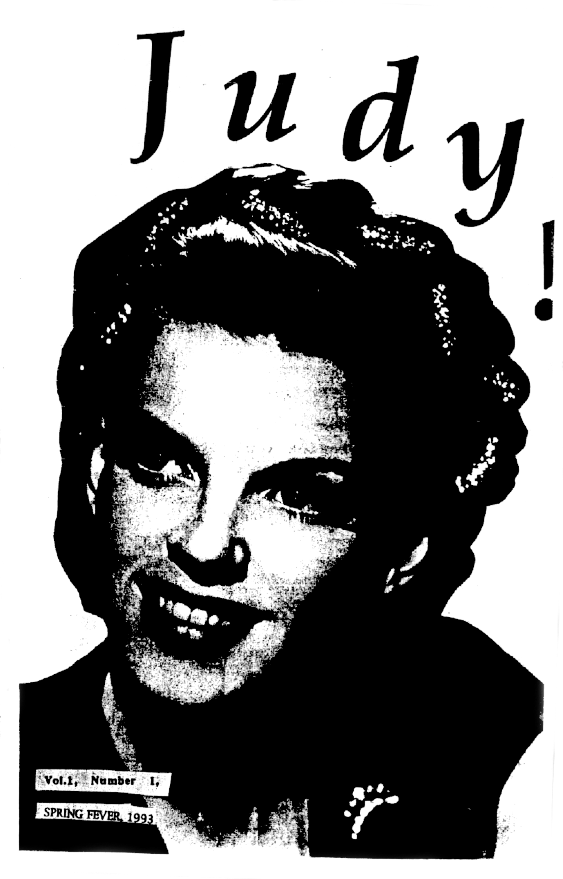
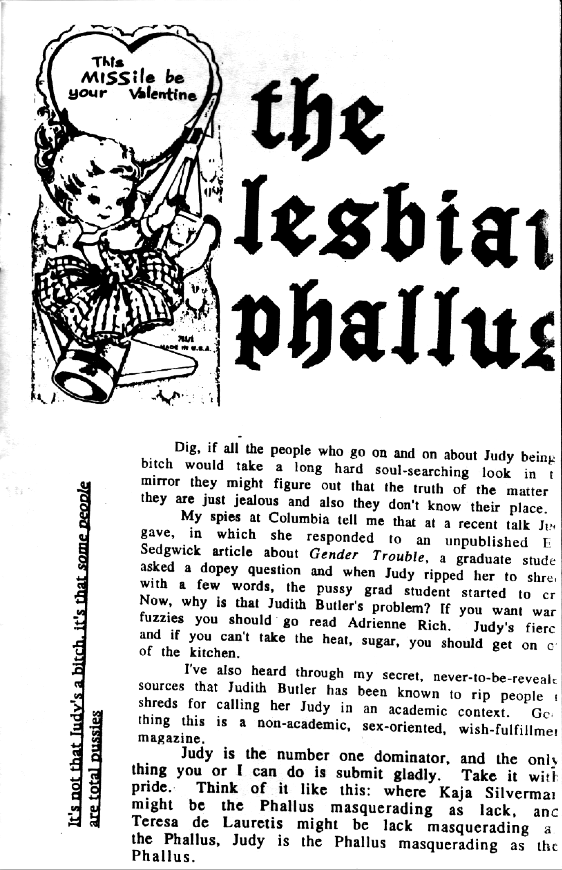
“Riot Grrrl didn’t herald the beginnings of third wave feminism,” writes Sophia Satchell Baeza in Canvas, “we’ll give that to the emergence of post-structuralist Queer theory, and the work of Judith Butler—but it did help define it aesthetically as much as formally for a new generation of indignant feminists.” An essential part of that aesthetic—the ‘zine—spread the tenets of Riot Grrrl anger, determination, and irony to cities far and wide. And, in 1993, a group of intellectual scenesters created the ultimate punk homage to Butler’s undeniable influence: Judy!, an honest-to-goodness Judith Butler fanzine, complete with murky, mimeographed photo spreads and serial killer typescript. (See the cover at the top, with photo of Judy Garland.) “Let’s talk about that real glamour gal of theory, Judy Butler,” begins one free-form introductory essay.
She’s especially good to see live, if you can. Her performances are rife with witty repartee about her mom or whatever and the three times I’ve seen her, she’s been sporting little tailored black jackets. She’s a bit Gap but she’s still a fox.
This cavalier hipster tone hides the voice of a likely grad student, who mentions M.L.A. (the Modern Language Association’s conference), and other post-structuralist theorists like Gayatri Spivak, Eve Sedgwick, and Julia Kristeva. There are footnotes and references to Butler’s classic Gender Trouble amidst much more irreverent, catty rhetoric like “Judy is the number one dominator, and the only thing you or I can do is submit gladly.” It’s great fun, if that’s what you’re into—and if you get the combo of ‘zine aesthetic and academic feminist theory. There’s even a quiz to test your knowledge of the latter’s high priestess professors and inscrutable argot: “are you a theory-fetishizing biscuithead?”
As much as it knowingly pokes fun at itself, in both form and content the artifact represents a perfect hybridization of streetwise mid-nineties punk rock and challenging mid-nineties high feminist theory. Central to the latter, Judith Butler challenges cultural norms in ways that very much inform our popular understanding of gender and sexuality today. And ‘zine culture, though it may appear mostly in museums and retrospectives these days, lives on in spirit in the work of hip, cultural mavens like Rookie’s Tavi Gevinson. Above, see Butler discuss her theory of gender performativity. And Read the entire issue of Judy!, the fanzine, here.
How did everything begin?What makes us human?What is the self?How do I live a good life?What is love? We’ve all asked these questions, if only within our heads, and recently a series of BBC animations written by philosopher Nigel Warburton and narrated by a variety of celebrities have done their level best to answer them–or at least to point us in the direction of answering them for ourselves by not just telling but wittily showing us what great minds have thought and said on the issues before we came along. Most recently, they’ve taken on that eternal conundrum, “How can I know anything at all?”
The already philosophically inclined will have recognized this as the foundational question of epistemology, that formidable branch of philosophy concerned with what we know, how we know, and whether we can know in the first place. Many familiar names in the history of philosophy have stepped onto this field, including Ludwig Wittgenstein, with whose thoughts this series of extremely brief explanatory videos begins. It lays out his analogy of the beetle in a box, wherein each person holds a box containing what they call a “beetle,” but nobody can look inside another’s box to confirm whether their idea of a beetle aligns with anyone else’s.
In Wittgenstein’s view, says actor Aidan Turner, “there can’t be more to the public meaning of a language than we’re capable of teaching each other, and the private ‘something’—the ‘beetle’—can’t have a role in that teaching, because we can’t get at it.” The next video, in asking whether we should believe in miracles, brings in Scottish Enlightenment thinker David Hume, who thought that “if we follow the rule of proportioning our beliefs to the available evidence, there will always be more evidence that the eyewitness accounts were mistaken than not.” Hume’s predecessor George Berkeley makes an appearance to weigh in on whether anything exists—or, more precisely, whether anything exists besides our minds, which convince us that we experience real things out there in the world.
Finally, the series lands on a method we can use to know, one science has relied on, with seeming success, for quite some time now: Karl Popper’s idea of falsification. “Rather than looking for supporting evidence, Popper argued that scientists go out of their way to refute their own hypotheses, testing them to destruction,” leaving those that remain, at least provisionally, as knowledge. Though none of these videos exceed two minutes in length, each one, dense with both philosophical and pop-cultural references, will leave you with more knowledge about epistemology than you went in with—assuming they don’t leave you disbelieving in knowledge itself.
We're hoping to rely on loyal readers, rather than erratic ads. Please click the Donate button and support Open Culture. You can use Paypal, Venmo, Patreon, even Crypto! We thank you!
Open Culture scours the web for the best educational media. We find the free courses and audio books you need, the language lessons & educational videos you want, and plenty of enlightenment in between.