Ludwig Wittgenstein, enfant terrible or idiot savant? A student of the great Bertrand Russell and protégé of renowned mathematician and logician Gottlob Frege, the angry young upstart’s Tractatus Logico-Philosophicus put both elder thinkers on notice: The days of their comfortable assumptions were numbered, in a series of austere, cryptic aphorisms and symbolic propositions that make very little sense to those of us who lack the prodigious intellects of Russell and Frege. While Wittgenstein is often dismissed, writes Paul Horwich at New York Times’ philosophy blog “The Stone,” as “self indulgently obscure,” perhaps the real reason many academic philosophers reject his work is that it renders them superfluous. Philosophy, Wittgenstein obliquely claimed in his half-mystical, hyper-logical treatise, “can’t give us the kind of knowledge generally regarded as its raison d’être.”
Given the Tractatus’s firebombing of an entire area of human endeavor, it’s no surprise it hasn’t fared well in many traditional departments, but that hasn’t stopped Wittgenstein’s work from finding purchase elsewhere, influencing modern artists like Jasper Johns, the Coen Brothers, and, not least surely, Finnish avant garde composer and musician M.A. Numminen.
This odd character, who caused a stir in the 60s by setting sex guides to music, took it upon himself to do the same for many of the Tractatus’s propositions, and the results are, well…. Listen for yourself. At the top of the post, we have video of Numminen performing the fifth and final movement of his Tractatus suite—the famous final proposition of that strange little book: “Whereof one cannot speak, thereof one must be silent” (“Woven man nicht sprechen kann, darüber muss man schweigen”). Numminen sings this in German, in his high-pitched, creaking voice. The rest of the suite he sings in English. Just above, hear the first movement, “The World Is…,” and below, hear movements 2–4, “In Order To Tell…,” “A Thought Is…,” and “The General Form Of A Truth Function.” He even sings the symbols, in breathless transcription. You can stream and download the full suite at Ubuweb and follow along at the Tractatus hypertext here.
Should Numminen’s tinpan alley-like compositions strike you as a particularly ridiculous setting for Wittgenstein’s genius, fear not; the Motet below (“Excerota Tractati Logico-Philosophici”), by composer Elisabeth Lutyens, treats the eccentric German’s work with a great deal more reverence.
Perhaps one of the difficulties of writing concisely on Badiou is that Badiou himself roams far and wide—from Hegel to Lacan, Kant, Marx, Descartes, and even St. Paul. Not easily identifiable as belonging to one school or another, Badiou’s work, though staunchly politically left, resists anti-humanist postmodernism and seeks to ground truth in universals. It’s an unsurprising tack given that he first trained in mathematics.
As if his philosophical work weren’t enough, Badiou also writes novels and plays. Of the latter, his Ahmed the Philosopher: 34 Short Plays for Children & Everyone Else has recently appeared in an English translation by Joseph Litvak. Just above, you can see Litvak as Ahmed and Badiou himself as “a curmudgeonly French demon,” writes Critical Theory, “who takes joy in informing for the police.” Filmed in Germany in 2011,
This scene, entitled “Terror,” serves as a commentary on French xenophobia towards Arab immigrants. Badiou at one point also draws reference to Nazi-occupied France, a sort of “good old days” for Badiou’s callous character.
Badiou as the “demon of the cities” spotlights the brute limitations imposed by violent, unjust police, who summarily execute innocent people in the streets. Taking perverse pleasure in describing such an occurrence, the demon leers, “I like to imagine that I’m hidden behind a curtain. I salivate!” before going on to describe with relish the even uglier scenario of a “bungled” shooting. The audience giggles uneasily, unsure quite how to respond to the exaggerated evil Badiou performs. It seems unthinkable, absurd, their nervous laughter suggests, that anyone but a cartoon devil could take such sadistic delight in this kind of cruelty, much less, as the demon does, initiate it with anonymous libel. It’s an unnerving performance of an even more unnerving piece of writing. Below, you can see more scenes from Ahmed the Philosopher, performed in English sans Badiou at UC Irvine in 2010.
If you like Badiou as an actor, this may be your only chance to see him perform. However, the extroverted philosopher hopes to break into Hollywood in another capacity—bringing his translation of Plato’s Republicto the screen, with, in his grand design, Brad Pitt in the leading role, Sean Connery as Socrates, and Meryl Streep as “Mrs. Plato.” I wish him all the luck in the world. With the blockbuster success of religous epics like Noah, perhaps we’re primed for a Hollywood version of ancient Greek thought, though like the former film, purists would no doubt find ample reason to fly up in arms over a guaranteed multitude of philosophical blasphemies.
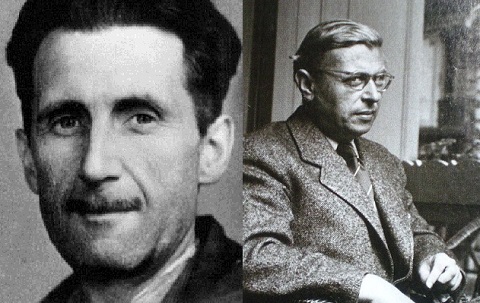
Yesterday we featured George Orwell’s review of Adolf Hitler’s Mein Kampf — not just an isolated newspaper piece, or one of a scattered few, in a life otherwise spent churning out important novels like Animal Farm and 1984, but a particularly perceptive book review among the many in his prolific journalistic career. (He even wrote “Confessions of a Book Reviewer,” the definitive article on that practice.) Today we have another of Orwell’s pieces taking on a well-known 20th-century Continental figure: this time, the French existentialist philosopher Jean-Paul Sartre and his book Portrait of the Antisemite.
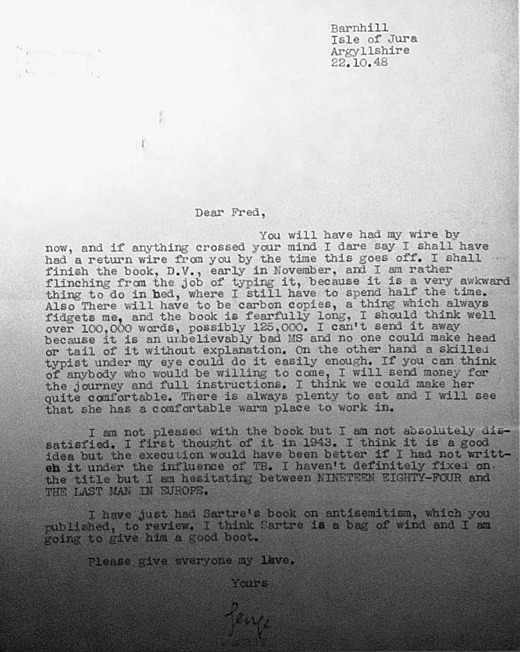
But as a prelude to the review, have a look at the October 1948 letter above, posted originally at Letters of Note. In it, Orwell writes to his publisher Frederic Warburg, keeping him posted on the state of the manuscript of 1984. Then, at the very end, he adds that “I have just had Sartre’s book on antisemitism, which you published, to review. I think Sartre is a bag of wind and I am going to give him a good boot.” That “good boot,” which ran in TheObserver the next month, goes like this:
Antisemitism is obviously a subject that needs serious study, but it seems unlikely that it will get it in the near future. The trouble is that so long as antisemitism is regarded simply as a disgraceful aberration, almost a crime, anyone literate enough to have heard the word will naturally claim to be immune from it; with the result that books on antisemitism tend to be mere exercises in casting motes out of other people’s eyes. M. Sartre’s book is no exception, and it is probably no better for having been written in 1944, in the uneasy, self-justifying, quisling-hunting period that followed on the Liberation.
At the beginning, M. Sartre informs us that antisemitism has no rational basis: at the end, that it will not exist in a classless society, and that in the meantime it can perhaps be combated to some extent by education and propaganda. These conclusions would hardly be worth stating for their own sake, and in between them there is, in spite of much cerebration, little real discussion of the subject, and no factual evidence worth mentioning.
We are solemnly informed that antisemitism is almost unknown among the working class. It is a malady of the bourgeoisie, and, above all, of that goat upon whom all our sins are laid, the “petty bourgeois.” Within the bourgeoisie it is seldom found among scientists and engineers. It is a peculiarity of people who think of nationality in terms of inherited culture and property in terms of land.
Why these people should pick on Jews rather than some other victim M. Sartre does not discuss, except, in one place, by putting forward the ancient and very dubious theory that the Jews are hated because they are supposed to have been responsible for the Crucifixion. He makes no attempt to relate antisemitism to such obviously allied phenomena as for instance, colour prejudice.
Part of what is wrong with M. Sartre’s approach is indicated by his title. “The” anti-Semite, he seems to imply all through the book, is always the same kind of person, recognizable at a glance and, so to speak, in action the whole time. Actually one has only to use a little observation to see that antisemitism is extremely widespread, is not confined to any one class, and, above all, in any but the worst cases, is intermittent.
But these facts would not square with M. Sartre’s atomised vision of society. There is, he comes near to saying, no such thing as a human being, there are only different categories of men, such as “the” worker and “the” bourgeois, all classifiable in much the same way as insects. Another of these insect-like creatures is “the” Jew, who, it seems, can usually be distinguished by his physical appearance. It is true that there are two kinds of Jew, the “Authentic Jew,” who wants to remain Jewish, and the “Inauthentic Jew,” who would like to be assimilated; but a Jew, of whichever variety, is not just another human being. He is wrong, at this stage of history, if he tries to assimilate himself, and we are wrong if we try to ignore his racial origin. He should be accepted into the national community, not as an ordinary Englishman, Frenchman, or whatever it may be, but as a Jew.
It will be seen that this position is itself dangerously close to anti-semitism. Race prejudice of any kind is a neurosis, and it is doubtful whether argument can either increase or diminish it, but the net effect of books of this kind, if they have an effect, is probably to make antisemitism slightly more prevalent than it was before. The first step towards serious study of antisemitism is to stop regarding it as a crime. Meanwhile, the less talk there is about “the” Jew or “the” antisemite, as a species of animal different from ourselves, the better.
In Philosophy Now, Martin Tyrrell writes on Orwell’s relationship to the subject, which he saw “as a kind of gratuitous cleverness and he had no appetite for that. In Orwell’s writings, fiction or non-fiction, there are few good intellectuals. Where they appear, then it is usually only to spin words without meaning. At best, they are inadvertently confusing; at worst, deliberately so: Marxists, for example, or nationalists or Anglo or Roman Catholics. Or Jean-Paul Sartre. [ … ] Bewildered by existentialism, what most irked Orwell about Sartre was his seeming denial of individuality.” Tyrrell describes Orwell as “an individualist so much so that, when he came to list his reasons for becoming a writer, he put ‘sheer egoism’ at the top. In addition, and much more controversially, his review of Mein Kampf sees in Hitler more than a little of the tragic Orwellian hero, the small man embarked upon a doomed revolt.” Not everyone, of course, will agree with Orwell’s aggressively plainspoken takes on Hitler and Nazism, or Sartre and existentialism, but try substituting a variety of other controversial “-isms” for “antisemitism” in the review above, and you’ll see how we’d still think more clearly if we bore his observations in mind today.
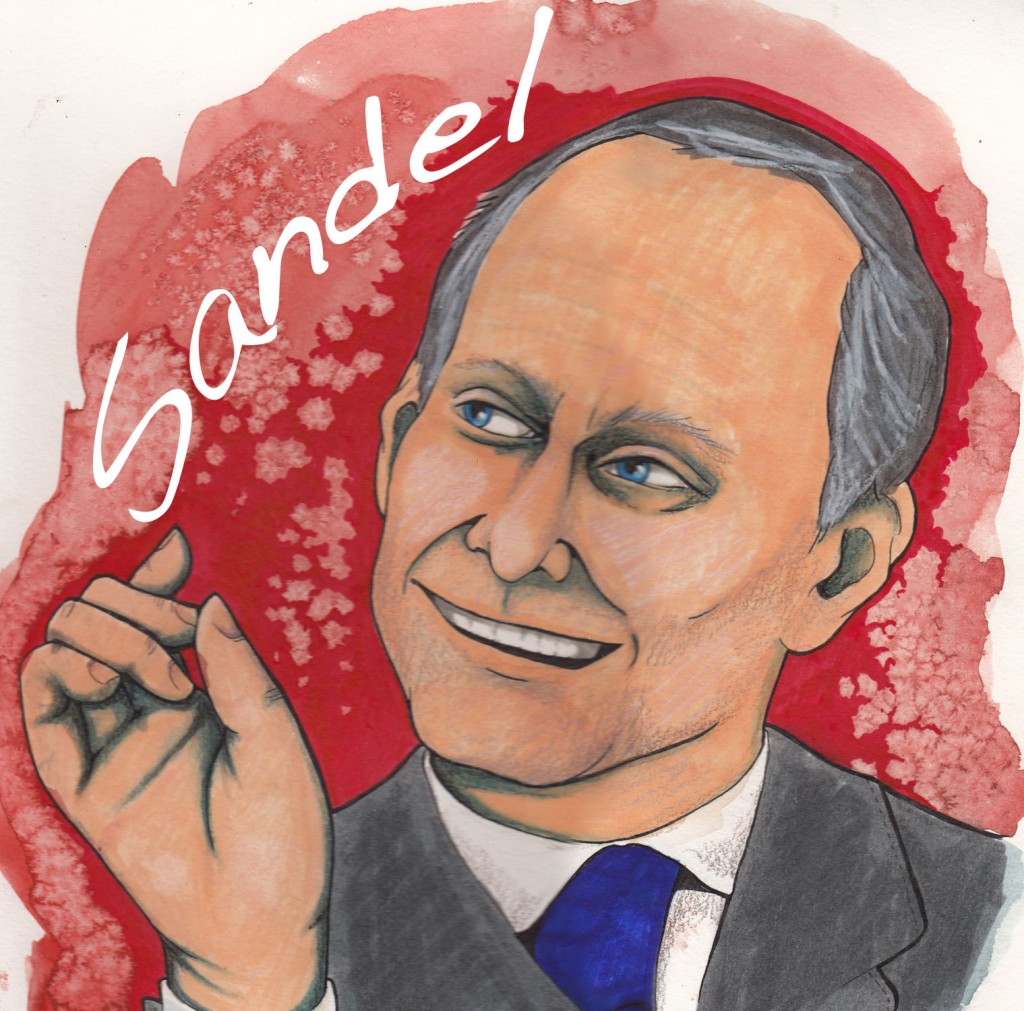
In July, the Partially Examined Life philosophy podcast discussed Sandel’s first (and most academically influential) book, 1982’s Liberalism and the Limits of Justice, in which he argued that society can’t be neutral with regard to claims about what the good life amounts to. Modern liberalism (by which he means the tradition coming from John Locke focusing on rights; this includes both America’s current liberals and conservatives) acknowledges that people want different things and tries to keep government in a merely mediating role, giving people as much freedom as possible.
So what’s the alternative? Sandel thinks that public discourse shouldn’t just be about people pushing for what they want, but a dialogue about what is really good for us. He gives the famous example of the Nazis marching in Skokie. A liberal would defend free speech, even if the speech is repellent. Sandel thinks that we can acknowledge that some speech is actually pernicious, that the interests of that community’s Holocaust survivors are simply more important than the interests of those who want to spread a message of hate.
A week later, a follow-up episode brought Sandel himself onto the podcast, primarily to speak about his most recent book, What Money Can’t Buy: The Moral Limits of Markets. A more popular work, this book considers numerous examples of the market society gone amok, where everything from sex to body parts to advertising space on the side of one’s house is potentially for sale.
Sandel helped us understand the connection between this and his earlier work: In remaining neutral among competing conceptions of what’s really good for us, liberalism has made an all-too-quick peace with unfettered exchange. If two people want to make a deal, who are the rest of us to step in and stop it? Liberal thinking does justify preventing supposedly free exchanges on the grounds that they might not actually be free, e.g. one side is under undue economic pressure, not mature or fully informed, in some way coerced or incompetent. But Sandel wants to argue that some practices can be merely degrading, even if performed willingly, and that a morally neutral society doesn’t have the conceptual apparatus to formulate such a claim. Instead, as exemplified by his course on justice, Sandel thinks that moral issues need to be a part of public debate. By extension, we can’t pretend that economics is a morally neutral science that merely measures human behavior. Our emphasis on economics in public policy crowds out other positive goods like citizenship and integrity.
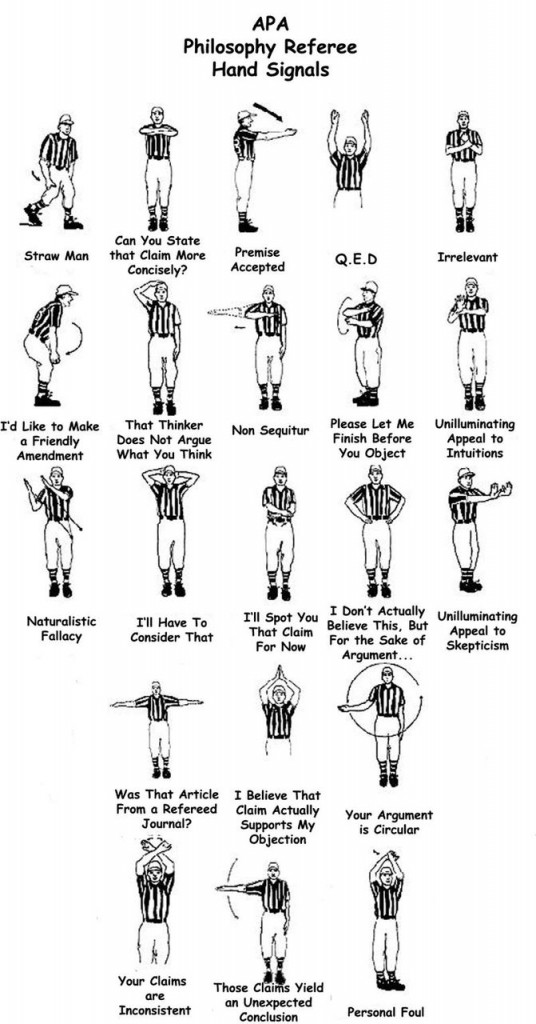
The next time you’re presiding over an intense philosophical debate, feel free to use these hand signals to referee things. Devised by philosophy prof Landon Schurtz, these hand signals were jokingly meant to be used at APA (American Philosophy Association) conferences. Personally, I think they would have made a great addition to the famous Monty Python soccer match where the Germans (Kant, Nietzsche & Marx) played the indomitable Ancient Greeks (Aristotle, Plato & Archimedes). Imagine Confucius, the referee, whirling his hand in a circle and penalizing Wittgenstein for making a circular argument. Priceless.
I know, it’s a dated reference now, but since I still watch the remade Battlestar Galactica series on Netflix, the mystical refrain—“All of this has happened before and will happen again”–still seems fresh to me. At any rate, it’s fresher than the clichéd “history repeats itself.” However you phrase it, the truism looks more and more like a genuine truth the more one studies ancient history, literature, and philosophy. The conflicts and concerns that feel so of the moment also occupied the minds and lives of people living hundreds, and thousands, of years ago, and whatever you make of that, it certainly helps put the present into perspective. Can we benefit from studying the wisdom, and the folly, of the ancients? To this question, I like to turn to an introductory essay C.S. Lewis penned to the work of a certain church father:
Every age has its own outlook. It is specially good at seeing certain truths and specially liable to make certain mistakes. We all, therefore, need the books that will correct the characteristic mistakes of our own period. And that means the old books. […] If we read only modern books […] where they are true they will give us truths which we half knew already. Where they are false they will aggravate the error with which we are already dangerously ill. The only palliative is to keep the clean sea breeze of the centuries blowing through our minds, and this can be done only by reading old books.
I may disagree with Lewis about many things, including that “clean sea breeze” of history, but I take to heart his point about reading the ancients to mitigate our modern biases and shine light on our blind spots. To that end, we present links to several excellent online courses on the ancients from institutions like Yale, NYU, and Stanford, free to peruse or take in full. See our master list—Free Courses in Ancient History, Literature & Philosophy—for 36 quality offerings. As always, certain courses provide more resources than others, and a few only offer their lectures through iTunes. These are decisions course administrators have made, not us! Even so, these free resources are invaluable to those wishing to acquaint, or reacquaint, themselves with the study of ancient humanities.
Michel Foucault’s time in the United States in the last years of his life, particularly his time as a lecturer at UC Berkeley, proved to be extraordinarily productive in the development of his theoretical understanding of what he saw as the central question facing the contemporary West: the question of the self. In his 1983 Berkeley lectures in English on “The Culture of the Self,” Foucault stated and restated the question in a variety of ways—“What are we in our actuality?,” “What are we today?”—and his investigations amount to “an alternative to the traditional philosophical questions: What is the world? What is man? What is truth? What is knowledge? How can we know something? And so on.” So write the editors of the posthumously published 1988 essay collection Technologies of the Self, titled after a lecture Foucault delivered at the University of Vermont in 1982.
In that talk, Foucault notes that “the hermeneutics of the self has been confused with theologies of the soul—concupiscence, sin, and the fall from grace.” The technique of confession, central even to secular psychoanalysis, informs a subjectivity that, for Foucault, always develops under the ever-watchful eyes of normalizing institutions. But in “The Culture of the Self,” Foucault reaches back to ancient Greek conceptions of “care of the self” (epimelieia beautou) to locate a subjectivity derived from a different tradition—a counterpoint to religious confessional and Freudian subjectivities and one he has discussed in terms of the technique of “self writing.” (The Care of the Self also happens to be the subtitle of the third volume of Foucault’s History of Sexuality, and “The Culture of the Self” the title of its second chapter.)
The notion that one is granted selfhood through the ministrations of others comes in for ridicule in the first few minutes of his “Culture of the Self” lecture above. Foucault relates a story by second century Greek satirist Lucian to illustrate a humorous point about “those guys who nowadays regularly visit a kind of master who takes their money from them in order to teach them how to take care of themselves.” He identifies the ancient version of this dubious authority as the philosopher, but it seems that he intends in modern times to refer more broadly to psychiatrists, psychologists, and all manner of religious figures and self-help gurus.
Foucault sets up the joke to introduce his first entrée into the pursuit of “the historical ontology of ourselves,” a consideration of Kant’s essay “What is Enlightenment?” In that work, the most prominent German Enlightenment philosopher describes “man’s emergence from his self-imposed nonage,” a term he defines as “the inability to use one’s own understanding without another’s guidance.” From there, Foucault opens up his investigation to an analysis of “three sets of relations: our relations to truth, our relations to obligation, our relations to ourselves and to the others.” You’ll have to listen to the full set of lectures, above in all five parts, to follow Foucault’s inquiry through its many passages and divergences and learn how he arrives at this conclusion: “The self is not so much something hidden and therefore something to be excavated but as a correlate of the technologies of self that it co-evolves with over millennium.”
The Q&A session, above, was held on a different day and is also well worth a listen. Foucault addresses several queries about his own methodology, issues of disciplinary boundaries, and other clarifying (or not) concerns related to his main lecture. See this site for a transcript of the questions from the audiences and Foucault’s insightful, and sometimes quite funny, answers.
If you’re one of our philosophically-minded readers, you’re perhaps already familiar with Stanford professor John Perry. He’s one of the two hosts of the Philosophy Talk radio show that airs on dozens of public radio stations across the US. (Listen to a recent show here.) Perry has the rare ability to bring philosophy down to earth. He also, it turns out, can help you work through some worldly problems, like managing your tendency to procrastinate. In a short essay called “Structured Procrastination” — which Marc Andreessen (founder of Netscape, Opsware, Ning, and Andreessen Horowitz) read and called “one of the single most profound moments of my entire life” – Perry gives some tips for motivating procrastinators to take care of difficult, timely and important tasks. Perry’s approach is unorthodox. It involves creating a to-do list with theoretically important tasks at the top, and less important tasks at the bottom. The trick is to procrastinate by avoiding the theoretically important tasks (that’s what procrastinators do) but at least knock off many secondary and tertiary tasks in the process. The approach involves “constantly perpetrating a pyramid scheme on oneself” and essentially “using one character flaw to offset the bad effects of another.” It’s unconventional, to be sure. But Andreesen seems to think it’s a great way to get things done. You can read “Structured Procrastination” here.
Have your procrastination tips? Add them to the comments section below. Would love to get your insights.
We're hoping to rely on loyal readers, rather than erratic ads. Please click the Donate button and support Open Culture. You can use Paypal, Venmo, Patreon, even Crypto! We thank you!
Open Culture scours the web for the best educational media. We find the free courses and audio books you need, the language lessons & educational videos you want, and plenty of enlightenment in between.