Second City has given us many great improv comedy sketches and comedians over the decades … and now comic videos on YouTube too. From this video collection comes the “Too Philosophical Pop Song,” whose opening lines resemble the hackneyed lyrics of so many contemporary pop tunes.
We’ve got to be young while we live, and live while we are young.
We’ve got to live for tonight because tomorrow won’t come.
We’ve all heard these existential clichés before, right? But then, the “Too Philosophical Pop Song” gets, well, too philosophical, swerving darkly of course.
We have to party like we’ll never see tomorrow, thereby destroying the intrinsic value of this moment and ourselves.
The certainty of death invalidates our actions tonight.
We’re thrown into this universe with no purpose, compelled to fabricate meaning.
There is no good, there is no right, and our morals are crafted out of reason.
Makes it a little hard to get your groove on … unless you’re a UVA grad student or one of those heady guys at PartiallyExaminedLife. Don’t miss their podcast.
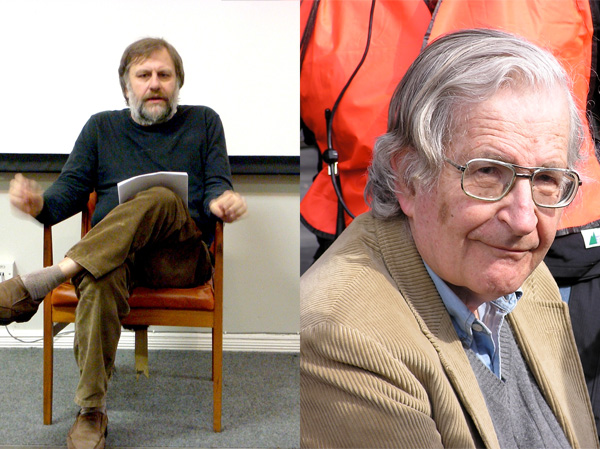
The rift between the two high-profile intellectuals began, as you may recall, when Chomsky criticized Žižek and other continental philosophers for essentially talking nonsense — for cloaking trivialities in fancy language and using the scientific-sounding term “theory” to describe propositions that could never be tested empirically. Žižek lashed back, saying of Chomsky, “I don’t think I know a guy who was so often empirically wrong.” He went on to criticize Chomsky’s controversial early position on American assessments of the Khmer Rouge atrocities in Cambodia. (To read Žižek’s comments, click here to open the earlier post in a new window.) In response yesterday, Chomsky said he had received numerous requests to comment on our post:
I had read it, with some interest, hoping to learn something from it, and given the title, to find some errors that should be corrected — of course they exist in virtually anything that reaches print, even technical scholarly monographs, as one can see by reading reviews in professional journals. And when I find them or am informed about them I correct them.
But not here. Žižek finds nothing, literally nothing, that is empirically wrong. That’s hardly a surprise. Anyone who claims to find empirical errors, and is minimally serious, will at the very least provide a few particles of evidence — some quotes, references, at least something. But there is nothing here — which, I’m afraid, doesn’t surprise me either. I’ve come across instances of Žižek’s concept of empirical fact and reasoned argument.
Chomsky goes on to recount an instance when he says Žižek misattributed a “racist comment on Obama” to Chomsky, only to explain it away later and say that he had discussed the issue with Chomsky on the telephone. “Of course,” writes Chomsky, “sheer fantasy.” Chomsky then moves on to Žižek’s comments reported by Open Culture, which he says are typical of Žižek’s methods. “According to him,” writes Chomsky, “I claim that ‘we don’t need any critique of ideology’ — that is, we don’t need what I’ve devoted enormous efforts to for many years. His evidence? He heard that from some people who talked to me. Sheer fantasy again, but another indication of his concept of empirical fact and rational discussion.”
Chomsky devotes the rest of his article to defending his work with Edward Herman on the Khmer Rouge atrocities. He claims that no factual errors have been found in their work on the subject, and he draws attention to a passage in their book After the Cataclysm, quoted last week by Open Culture reader Poyâ Pâkzâd, in which they write, “our primary concern here is not to establish the facts with regard to postwar Indochina, but rather to investigate their refraction through the prism of Western ideology, a very different task.”
The word “philosopher” tends to conjure up the archetypal image of an ascetic figure standing above the follies of everyday life, absorbed in thought. Perhaps that’s why so many people have found it fascinating to hear of the disagreements between Noam Chomsky and Slavoj Žižek.
Several weeks ago we posted an excerpt from an interview in which Chomsky accuses Žižek, along with Jacques Lacan and Jacques Derrida, of empty “posturing.” Yesterday we posted Žižek’s response to Chomsky: “I don’t think I know a guy who was so often empirically wrong.” Some of the responses have been amusing. “The gloves are off!” wrote one reader on Twitter. “Fight! Fight! Fight!” said another.
Of course, we should bear in mind that the two celebrity intellectuals are not really at each other’s throats. Chomsky gave his brief assessment of Žižek and the others in response to a question during a long interview back in December. Žižek’s remarks were a small part of a two-hour panel discussion on various topics. It’s hard to imagine either man seething over what the other has said.
Still, the boisterousness of many of the responses reminded us of the studio audience in this 2009 sketch (above) from The Chaser’s War on Everything, an Australian comedy show. The sketch is a parody of The Jerry Springer Show and the other tabloid TV talk shows that multiplied like weeds in the 1990s. It’s extremely silly, but good for a laugh.
Earlier this month we posted an excerpt from an interview in which linguist Noam Chomsky slams the Slovenian philosopher and cultural critic Slavoj Žižek, along with the late French theorists Jacques Lacan and Jacques Derrida, for cloaking trivial ideas in obscure and inflated language to make them seem profound.
“There’s no ‘theory’ in any of this stuff,” Chomsky says to an interviewer who had asked him about the three continental thinkers, “not in the sense of theory that anyone is familiar with in the sciences or any other serious field. Try to find in all of the work you mentioned some principles from which you can deduce conclusions, empirically testable propositions where it all goes beyond the level of something you can explain in five minutes to a twelve-year-old. See if you can find that when the fancy words are decoded. I can’t. So I’m not interested in that kind of posturing. Žižek is an extreme example of it.”
Chomsky’s remarks sparked a heated debate on Open Culture and elsewhere. Many readers applauded Chomsky; others said he just didn’t get it. On Friday, Žižek addressed some of Chomsky’s criticisms during a panel discussion with a group of colleagues at the Birkbeck Institute for the Humanities in London:
Žižek’s remarks about Chomsky don’t appear until about the one-hour, 30-minute mark, but Sam Burgum, a PhD student at the University of York, has transcribed the pertinent statements and posted them on his site, EsJayBe. Here are the key passages:
What is that about, again, the academy and Chomsky and so on? Well with all deep respect that I do have for Chomsky, my first point is that Chomsky, who always emphasizes how one has to be empirical, accurate, not just some crazy Lacanian speculations and so on… well I don’t think I know a guy who was so often empirically wrong in his descriptions in his whatever! Let’s look… I remember when he defended this demonstration of Khmer Rouge. And he wrote a couple of texts claiming: No, this is Western propaganda. Khmer Rouge are not as horrible as that.” And when later he was compelled to admit that Khmer Rouge were not the nicest guys in the Universe and so on, his defense was quite shocking for me. It was that “No, with the data that we had at that point, I was right. At that point we didn’t yet know enough, so… you know.” But I totally reject this line of reasoning.
For example, concerning Stalinism. The point is not that you have to know, you have photo evidence of gulag or whatever. My God you just have to listen to the public discourse of Stalinism, of Khmer Rouge, to get it that something terrifyingly pathological is going on there. For example, Khmer Rouge: Even if we have no data about their prisons and so on, isn’t it in a perverse way almost fascinating to have a regime which in the first two years (’75 to ’77) behaved towards itself, treated itself, as illegal? You know the regime was nameless. It was called “Angka,” an organization — not communist party of Cambodia — an organization. Leaders were nameless. If you ask “Who is my leader?” your head was chopped off immediately and so on.
Okay, next point about Chomsky, you know the consequence of this attitude of his empirical and so on — and that’s my basic difference with him — and precisely Corey Robinson and some other people talking with him recently confirmed this to me. His idea is today that cynicism of those in power is so open that we don’t need any critique of ideology, you reach symptomatically between the lines, everything is cynically openly admitted. We just have to bring out the facts of people. Like “This company is profiting in Iraq” and so on and so on. Here I violently disagree.
First, more than ever today, our daily life is ideology. how can you doubt ideology when recntly I think Paul Krugman published a relatively good text where he demonstrated how this idea of austerity, this is not even good bourgeois economic theory! It’s a kind of a primordial, common-sense magical thinking when you confront a crisis, “Oh, we must have done something wrong, we spent too much so let’s economize and so on and so on.”
My second point, cynicists are those who are most prone to fall into illusions. Cynicists are not people who see things the way they really are and so on. Think about 2008 and the ongoing financial crisis. It was not cooked up in some crazy welfare state; social democrats who are spending too much. The crisis exploded because of activity of those other cynicists who precisely thought “screw human rights, screw dignity, all that maters is,” and so on and so on.
So as this “problem” of are we studying the facts enough I claim emphatically more than ever “no” today. And as to popularity, I get a little bit annoyed with this idea that we with our deep sophisms are really hegemonic in the humanities. Are people crazy? I mean we are always marginal. No, what is for me real academic hegemony: it’s brutal. Who can get academic posts? Who can get grants, foundations and so on? We are totally marginalized here. I mean look at my position: “Oh yeah, you are a mega-star in United States.” Well, I would like to be because I would like power to brutally use it! But I am far from that. I react so like this because a couple of days ago I got a letter from a friend in United States for whom I wrote a letter of recommendation, and he told me “I didn’t get the job, not in spite of your letter but because of your letter!” He had a spy in the committee and this spy told him “You almost got it, but then somebody says “Oh, if Žižek recommends him it must be something terribly wrong with him.”
So I claim that all these “how popular we are” is really a mask of… remember the large majority of academia are these gray either cognitivists or historians blah blah… and you don’t see them but they are the power. They are the power. On the other hand, why are they in power worried? Because you know… don’t exaggerate this leftist paranoia idea that “we can all be recuperated” and so on and so on. No! I still quite naively believe in the efficiency of theoretical thinking. It’s not as simple as to recuperate everything in. But you know there are different strategies of how to contain us. I must say that I maybe am not innocent in this, because people like to say about me, “Oh, go and listen to him, he is an amusing clown blah blah blah.” This is another way to say “Don’t take it seriously.”
Hannah Arendt’s work has come under some critical fire lately, what with the release of the Margarethe Von Trotta-directed biopic, starring German actress Barbara Sukowa as the controversial political theorist. At issue in the film and the surrounding commentary are Arendt’s (allegedly misleading) characterizations of the subject of her 1963 book Eichmann in Jerusalem, as well as her ambivalent—some have said callous, even “victim-blaming”—treatment of other Jews. None of these controversies are new, however. As Arendt scholar Roger Berkowitz notes in a recent New York Times editorial, at the time of her book’s publication, “Nearly every major literary and philosophical figure in New York chose sides in what the writer Irving Howe called a ‘civil war’ among New York intellectuals.”
While acknowledging Arendt’s flaws, Berkowitz seeks to exonerate the best-known concept that emerged from her work on Eichmann’s trial, the “banality of evil.” And while it can be comforting to have an interpreter explain, and defend, the work of a major, controversial, thinker, there is no intellectual substitute for engaging with the work itself.
In the age of the media interview—radio, television, podcast and otherwise—one can usually see and hear an author explain her views in person. And so we have the interview above (in German with English subtitles), in which Arendt sits with television presenter and journalist Gunter Gaus for a German program called Zur Person (The Person), a Charlie Rose-like show that featured celebrities, important thinkers, and politicians (including an appearance by Henry Kissinger).
A blogger at Jewish Philosophy Place writes that Arendt’s interview—a transcript of which was later published in The Portable Hannah Arendt as “What Remains? Language Remains”—is “slow and deliberative, not sharp and declarative, moving in circles, not straight lines.” The interview touches on a variety of topics, drawing on ideas expressed in Arendt’s earlier works, The Origins of Totalitarianismand The Human Condition. She is somewhat cagey when it comes to the so-called “Eichmann Controversy,” and she may have had personal as well as professional reasons for indirection. Her affair with her former professor, avowed and unrepentant Nazi Martin Heidegger, dogged her post-war career, and the aforementioned intellectual “civil war” probably increased her circumspection.
Arendt’s critics, then and now, often remark upon what the Jewish Philosophy Place writer succinctly calls her “disdain for others.” While the new biopic (trailer above) may obscure much of this critical controversy—unfilmable as such things are anyway—readers wishing to understand one of the Holocaust’s most famous interpreters should read, and hear, her in her own words before making any judgments.
To the delight and satisfaction of hundreds of our readers, we recently featured an interview in which Noam Chomsky slams postmodernist intellectuals like Slavoj Zizek and Jacques Lacan as “charlatans” and posers. The turn against postmodernism has been long in coming, a backlash the political right has made theater of for years, but that thinkers on the political left, like anarchist Chomsky, Marxist Vivek Chibber, and self-described “old leftist” Alan Sokal have pursued with just as much vigor (and more rigor). In the interview clip above, Chomsky makes a blanket critique of what the interviewer calls the “left criticism of science” as imperialist, racist, sexist, etc. His answers shed quite a bit of light on what Chomsky perceives as the political ramifications of postmodern thought as well as the origins of the discourse.
Chomsky characterizes leftist postmodern academics as “a category of intellectuals who are undoubtedly perfectly sincere” (I suspect this is a bit of uncharacteristic politesse on his part). Nonetheless, in his critique, such thinkers use “polysyllabic words and complicated constructions” to make claims that are “all very inflated” and which have “a terrible effect on the third world.” Chomsky argues (as does Chibber) that “in the third world, popular movements really need serious intellectuals to participate. If they’re all ranting postmodernists… well, they’re gone.” His assessment of postmodern critiques of science echoes his criticism of Zizek and Lacan. (Chomsky appears to use the words “polysyllabic” and “monosyllabic” as terms for jargon vs. ordinary language.):
It’s considered very left wing, very advanced. Some of what appears in it sort of actually makes sense, but when you reproduce it in monosyllables, it turns out to be truisms. It’s perfectly true that when you look at scientists in the West, they’re mostly men, it’s perfectly true that women have had a hard time breaking into the scientific fields, and it’s perfectly true that there are institutional factors determining how science proceeds that reflect power structures. All of this can be described literally in monosyllables, and it turns out to be truisms. On the other hand, you don’t get to be a respected intellectual by presenting truisms in monosyllables.
This last point is something Chomsky elaborates on as the impetus for post-structuralism in the academy, saying “it’s pretty easy to figure out what’s going on. Suppose you’re a literary scholar…. If you do your work seriously, that’s fine, but you don’t get any prizes for it.” He makes the claim that humanities scholars use mystifying jargon and cook up “theory” in order to compete with theoretical physicists and mathematicians, who get prizes, grants, and prestige for advancing incredibly complicated scientific work.
Even more than this general accusation against theorists in the humanities, Chomsky makes the political point that French intellectuals in Paris, “the center of the rot,” were the last group of leftists to be dedicated, “flaming” Stalinists and Maoists. In order to save face, such people had to suddenly become “the first people in the world to have discovered the gulags.” It’s a very damning characterization, and one he could no doubt support, as he does all of his claims, with a dizzying number of specific examples, though he declines to name names here. He does, however, reference Alan Sokal and Jean Bricmont’s sadly out-of-print Intellectual Impostures, a book that patiently exposes French post-structuralist thinkers’ abuse of scientific concepts. (Sokal, a physics professor, famously punked a well-regarded humanities journal in the mid-nineties with a phony article).
Chomsky’s cranky contrarianism is nothing new, and some of his polemic recalls the analytic case against “continental” philosophy or Karl Popper’s case against pseudo-science, although his investment is political as much as philosophical. The interviewer then moves on to religion. Chomsky’s thoughts on that subject are generally nuanced and fair-minded, but we don’t get to hear them here, alas, though he’s had plenty to say elsewhere.
It is sometimes noted–typically with admiration–that France is a place where a philosopher can still be a celebrity. It sounds laudable. But celebrity culture can be corrosive, both to the culture at large and to the celebrities themselves. So it’s worth asking: What price have French philosophy and its devotees (on the European continent and elsewhere) paid for the glamour?
Perhaps one casualty is clarity. The writings of the French postmodernist philosophers (and those inspired by them) are notoriously abstruse. In a scathing critique of theorist Judith Butler, an American who writes in the French poststructuralist style, philosopher Martha Nussbaum of the University of Chicago suggests that the abstruseness is calculated to inspire admiration:
Some precincts of the continental philosophical tradition, though surely not all of them, have an unfortunate tendency to regard the philosopher as a star who fascinates, and frequently by obscurity, rather than as an arguer among equals. When ideas are stated clearly, after all, they may be detached from their author: one can take them away and pursue them on one’s own. When they remain mysterious (indeed, when they are not quite asserted), one remains dependent on the originating authority. The thinker is heeded only for his or her turgid charisma.
On Friday we posted an excerpt from an interview in which linguist Noam Chomsky (something of a political celebrity himself) excoriates Jacques Derrida and Jacques Lacan, along with Lacan’s superstar disciple, Slovenian theorist Slavoj Žižek, for using intentionally obscure and inflated language to pull the wool over their admirers’ eyes and make trivial “theories” seem profound. He calls Lacan a “total charlatan.”
Lacan had a penchant for using trendy mathematical terms in curious ways. In a passage on castration anxiety, for example, he equates the phallus with the square root of minus one:
The erectile organ can be equated with the √-1, the symbol of the signification produced above, of the jouissance [ecstasy] it restores–by the coefficient of its statement–to the function of a missing signifier: (-1).
Chomsky’s criticism of Lacan and the others provoked a wide range of comments from our readers. Today we thought we would keep the conversation going with a fascinating audio clip (above) of philosopher John Searle of the University of California, Berkeley, describing how Michel Foucault and Pierre Bourdieu–two eminent French thinkers whose abilities Searle obviously respected–told him that if they wrote clearly they wouldn’t be taken seriously in France.
Searle begins by reciting Paul Grice’s four Maxims of Manner: be clear, be brief, be orderly, and avoid obscurity of expression. These are systematically violated in France, Searle says, partly due to the influence of German philosophy. Searle translates Foucault’s admission to him this way: “In France, you gotta have ten percent incomprehensible, otherwise people won’t think it’s deep–they won’t think you’re a profound thinker.”
Searle has been careful to separate Foucault from Derrida, with whom Searle had an unfriendly debate in the 1970s over Speech Act theory. “Foucault was often lumped with Derrida,” Searle says in a 2000 interview with Reason magazine. “That’s very unfair to Foucault. He was a different caliber of thinker altogether.” Elsewhere in the interview, Searle says:
With Derrida, you can hardly misread him, because he’s so obscure. Every time you say, “He says so and so,” he always says, “You misunderstood me.” But if you try to figure out the correct interpretation, then that’s not so easy. I once said this to Michel Foucault, who was more hostile to Derrida even than I am, and Foucault said that Derrida practiced the method of obscurantisme terroriste (terrorism of obscurantism). We were speaking in French. And I said, “What the hell do you mean by that?” And he said, “He writes so obscurely you can’t tell what he’s saying. That’s the obscurantism part. And then when you criticize him, he can always say, ‘You didn’t understand me; you’re an idiot.’ That’s the terrorism part.” And I like that. So I wrote an article about Derrida. I asked Michel if it was OK if I quoted that passage, and he said yes.
Noam Chomsky’s well-known political views have tended to overshadow his groundbreaking work as a linguist and analytic philosopher. As a result, people sometimes assume that because Chomsky is a leftist, he would find common intellectual ground with the postmodernist philosophers of the European Left.
What you’re referring to is what’s called “theory.” And when I said I’m not interested in theory, what I meant is, I’m not interested in posturing–using fancy terms like polysyllables and pretending you have a theory when you have no theory whatsoever. So there’s no theory in any of this stuff, not in the sense of theory that anyone is familiar with in the sciences or any other serious field. Try to find in all of the work you mentioned some principles from which you can deduce conclusions, empirically testable propositions where it all goes beyond the level of something you can explain in five minutes to a twelve-year-old. See if you can find that when the fancy words are decoded. I can’t. So I’m not interested in that kind of posturing. Žižek is an extreme example of it. I don’t see anything to what he’s saying. Jacques Lacan I actually knew. I kind of liked him. We had meetings every once in awhile. But quite frankly I thought he was a total charlatan. He was just posturing for the television cameras in the way many Paris intellectuals do. Why this is influential, I haven’t the slightest idea. I don’t see anything there that should be influential.
We're hoping to rely on loyal readers, rather than erratic ads. Please click the Donate button and support Open Culture. You can use Paypal, Venmo, Patreon, even Crypto! We thank you!
Open Culture scours the web for the best educational media. We find the free courses and audio books you need, the language lessons & educational videos you want, and plenty of enlightenment in between.