Jacques Derrida, the founder of Deconstruction, was something of an academic rock star during his day. He packed auditoriums whenever and wherever he spoke. Films were made about him. And a generation of academics churned out Derridean deconstructions of literary texts. All of this made Derrida’s star rise ever higher. But whether it did much good for Comp Lit, French and English programs across the US, that’s another story.
But we digress from the main point here. Our friendly French philosopher spent a fair amount of time teaching in the US and got acquainted with American attitudes. Sometimes, he says, we can be manipulative and utilitarian. What exactly do you mean Mr. Derrida? Can you please elaborate? Of course, he does above.
Note: If you aren’t quite clear on what deconstruction is all about, you can watch two lectures devoted to the subject (here and here) from Yale’s course on Literary Theory. Entitled “Introduction to Theory of Literature,” this course, taught by Paul Fry, is listed in the Literature section of our big collection of Free Online Courses.
On Monday, we told you where you can download Free Courses from Top Philosophers (Foucault, Searle, Russell and the rest). As the day went along, our list grew thanks to reader suggestions, and we also discovered another promising resource — a podcast called “The History of Philosophy Without Any Gaps,” created by Peter Adamson, Professor of Ancient and Medieval Philosophy at King’s College London:
Beginning with the earliest ancient thinkers, the series will look at the ideas and lives of the major philosophers (eventually covering in detail such giants as Plato, Aristotle, Avicenna, Aquinas, Descartes, and Kant) as well as the lesser-known figures of the tradition.
That’s what Adamson promises, and he doesn’t disappoint. Over the past 34 months, Adamson has produced 136 episodes, each about 20 minutes long, covering the PreSocratics (Pythagoras, Zeno, Parmenides, etc) and then Socrates, Plato and Aristotle. That’s roughly 45 hours of audio, and there’s no telling how many more hours of audio will bring us to the modern period. The more, the better, we say.
If you would like to support the mission of Open Culture, consider making a donation to our site. It’s hard to rely 100% on ads, and your contributions will help us continue providing the best free cultural and educational materials to learners everywhere. You can contribute through PayPal, Patreon, and Venmo (@openculture). Thanks!
You can download hundreds of Free Courses from Great Universities. (Perhaps you already knew that.) And that includes courses by some of the biggest minds teaching in philosophy. (Is that old news too? Or some welcomed good news?) So we’re starting the week by giving you a rundown of some notable mentions.
John Searle began teaching philosophy at UC-Berkeley in 1959, and first did important work on “speech act” theory. Later he turned to consciousness and artificial intelligence, out of which came his famous “Chinese room” thought experiment. You can find a nice trio of classes online.
Walter Kaufmann spent 33 years teaching philosophy at Princeton. And more than anyone else, Kaufmann introduced Nietzsche’s philosophy to the English-speaking world and made it possible to take Nietzsche seriously as a thinker. Here he delivers three lectures on existentialists.
Lectures on Nietzsche, Kierkegaard and Sartre — Web Site
Leo Strauss landed at The University of Chicago in 1949, where he spent decades teaching and writing on political philosophy, especially the political thought of the Ancients. His intellectual legacy is controversial, but his courses valuable.
Bertrand Russell was one of the most important British philosophers of the last century — a logician, essayist and social critic best known for his work in mathematical logic and analytic philosophy. When it comes to this lecture series, start with the bottom lecture first and then work your way up.
Authority & the Individual: Six BBC Lectures — Web Site
Michel Foucault taught history and philosophy at the Collège de France and published influential writings on power, knowledge, and discourse.
Six Lectures on Truth & Subjectivity presented on the UC Berkeley campus (English) - YouTube
Michael Sandel has taught political philosophy at Harvard since 1980. His course on justice (below) has been taken by more than 15,000 students, making it the most popular undergraduate course at Harvard. This version aired on PBS and the web.
Justice: A Journey in Moral Reasoning - YouTube — Web Site
In 2008, the evolutionary biologist Richard Dawkins presented The Genius of Charles Darwin, a three-part documentary that was later named “Best TV Documentary Series” at the British Broadcast Awards. During the filming of the program, Dawkins interviewed various experts — biologists, philosophers, clergyman, evolutionary psychologists, etc. — and wound up with 18 hours of raw footage. Some of the uncut interviews have now made their way online (as well as DVD), and we’re highlighting a few today.
Above, Dawkins spends a good while with Peter Singer, the Princeton philosopher, otherwise known as the Father of the Animal Rights Movement. The wide-ranging conversation continually comes back to animal rights and vegetarianism and why Darwinism lends support to both. The best part comes toward the end, when Singer tells Dawkins (a meat eater), “I have assimilated Darwin on this issue better than you have because .… you’re still influenced by these vestiges of religious belief that separate us from the animals.…” Dawkins out-Dawkinsed.
Cynicism. Ruthlessness. Deviousness. Power politics. These words are often associated with Niccolò Machiavelli, the author of The Prince (1532). But, it turns out, he was anything but. He was a sweet man (though something of a philanderer), a profound democrat, good looking, a party animal. In short, Machiavelli has gotten a bad rap, says novelist Salman Rushdie.
To get more insight into this badly misunderstood figure, we’d recommend spending time with Philosophy Bites’ interview (MP3 or iTunes) with Quentin Skinner, one of England’s finest intellectual historians who has written extensively on Machiavelli. You can also find The Prince listed in our collection of Free eBooks. H/T Andrew Sullivan
If you would like to support the mission of Open Culture, consider making a donation to our site. It’s hard to rely 100% on ads, and your contributions will help us continue providing the best free cultural and educational materials to learners everywhere. You can contribute through PayPal, Patreon, and Venmo (@openculture). Thanks!
In 1973, Orson Welles narrated this animated short, which features somewhat surreal artwork by Dick Oden. You can see more of Oden’s work here.
The Allegory of the Cave illustrates Plato’s view of knowledge as presented in Book VII of The Republic: in ordinary experience, we see only shadows of the true world, which we can only behold by pursuing rigorous philosophical analysis.
If you would like to support the mission of Open Culture, consider making a donation to our site. It’s hard to rely 100% on ads, and your contributions will help us continue providing the best free cultural and educational materials to learners everywhere. You can contribute through PayPal, Patreon, and Venmo (@openculture). Thanks!
Stephen B. Smith, a political science professor at Yale University since 1984, has made available a 24-lecture course, Introduction to Political Philosophy, which covers Plato, Aristotle, Machiavelli, Hobbes, Locke, Rousseau, and Tocqueville.
His approach is highly literary. In his Republic lectures, for instance, he spends a good chunk of the time discussing the metaphors and characters involved. One of Smith’s major concerns is what citizenship amounts to. The lecture above is on Plato’s “Apology,” and while this may be Plato’s most famous work (with its dictum that “The unexamined life is not worth living”), it’s less about political philosophy than about the virtuous life. Smith sees these topics as intimately related, and in his closing lecture, he gives a defense of patriotism, saying that in the ivy league environment, expressing an interest in patriotism is like confessing an interest in child pornography.
Back in 1948, Britain was making another difficult transition, moving from the trauma of World War II to the chill of the Cold War. Hoping to give radio listeners some clarity on contemporary affairs, the BBC began airing an annual series of lectures — the Reith Lectures — that featured leading thinkers of the day. 60 years later, the tradition continues, and during this long stretch, some legendary figures have graced the BBC’s airwaves: Michael Sandel, Edward Said, John Searle, John Kenneth Galbraith, George Kennan, and Robert Oppenheimer, just to name a few. (And, yes, the list unfortunately skews heavily male.)
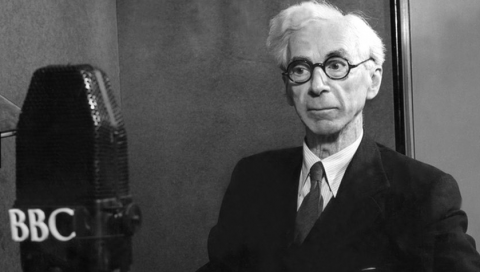
Late last month, the BBC put the complete audio archive online, which gives you access to 240 lectures in total. Where’s the best place to start? How about at the beginning, with the inaugural lectures presented by philosopher Bertrand Russell in 1948. His lecture series, Authority and the Individual, delved into an age old question in political philosophy — the individual and his/her relationship with communities and states. The head of the BBC later groused that Russell spoke “too quickly and had a bad voice.” But the real complaints came from the Soviets, who interpreted Russell’s lectures as an attack on Communism. You can find the lectures here; the first lecture appears at the bottom of the page.
Note: Our Twitter friends around the world said that they could almost universally access the lectures. If you experience any geo-restricting, we apologize in advance.
We're hoping to rely on loyal readers, rather than erratic ads. Please click the Donate button and support Open Culture. You can use Paypal, Venmo, Patreon, even Crypto! We thank you!
Open Culture scours the web for the best educational media. We find the free courses and audio books you need, the language lessons & educational videos you want, and plenty of enlightenment in between.