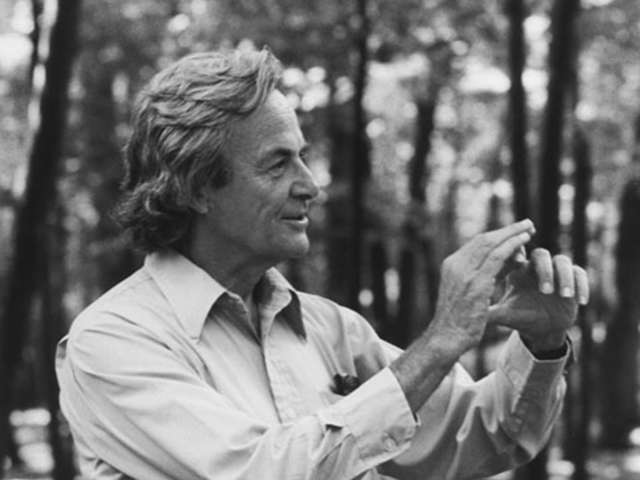
First presented in the early 1960s at Caltech by the Nobel Prize-winning physicist Richard Feynman, the lectures were eventually turned into a book by Feynman, Robert B. Leighton, and Matthew Sands. The text went on to become arguably the most popular physics book ever written, selling more than 1.5 million copies in English, and getting translated into a dozen languages.
Schrödinger’s Cat is one of the more famous thought experiments in modern physics, created by Austrian physicist Erwin Schrödinger back in 1935. The Telegraph summarizes the gist of the experiment as follows:
In the hypothetical experiment … a cat is placed in a sealed box along with a radioactive sample, a Geiger counter and a bottle of poison.
If the Geiger counter detects that the radioactive material has decayed, it will trigger the smashing of the bottle of poison and the cat will be killed.
The experiment was designed to illustrate the flaws of the ‘Copenhagen interpretation’ of quantum mechanics, which states that a particle exists in all states at once until observed.
If the Copenhagen interpretation suggests the radioactive material can have simultaneously decayed and not decayed in the sealed environment, then it follows the cat too is both alive and dead until the box is opened.
Note: An earlier version of this post appeared on our site early last year.
If you would like to sign up for Open Culture’s free email newsletter, please find it here. It’s a great way to see our new posts, all bundled in one email, each day.
If you would like to support the mission of Open Culture, consider making a donation to our site. It’s hard to rely 100% on ads, and your contributions will help us continue providing the best free cultural and educational materials to learners everywhere. You can contribute through PayPal, Patreon, and Venmo (@openculture). Thanks!
Here’s an extraordinary recording of Albert Einstein from the fall of 1941, reading a full-length essay in English:
The essay is called “The Common Language of Science.” It was recorded in September of 1941 as a radio address to the British Association for the Advancement of Science. The recording was apparently made in America, as Einstein never returned to Europe after emigrating from Germany in 1933.
Einstein begins by sketching a brief outline of the development of language, before exploring the connection between language and thinking. “Is there no thinking without the use of language,” asks Einstein, “namely in concepts and concept-combinations for which words need not necessarily come to mind? Has not every one of us struggled for words although the connection between ‘things’ was already clear?”
Despite this evident separation between language and thinking, Einstein quickly points out that it would be a gross mistake to conclude that the two are entirely independent. In fact, he says, “the mental development of the individual and his way of forming concepts depend to a high degree upon language.” Thus a shared language implies a shared mentality. For this reason Einstein sees the language of science, with its mathematical signs, as having a truly global role in influencing the way people think:
The supernational character of scientific concepts and scientific language is due to the fact that they have been set up by the best brains of all countries and all times. In solitude, and yet in cooperative effort as regards the final effect, they created the spiritual tools for the technical revolutions which have transformed the life of mankind in the last centuries. Their system of concepts has served as a guide in the bewildering chaos of perceptions so that we learned to grasp general truths from particular observations.
Einstein concludes with a cautionary reminder that the scientific method is only a means toward an end, and that the welfare of humanity depends ultimately on shared goals.
Perfection of means and confusion of goals seem–in my opinion–to characterize our age. If we desire sincerely and passionately for the safety, the welfare, and the free development of the talents of all men, we shall not be in want of the means to approach such a state. Even if only a small part of mankind strives for such goals, their superiority will prove itself in the long run.
The immediate context of Einstein’s message was, of course, World War II. The air force of Einstein’s native country had only recently called off its bombing campaign against England. A year before, London weathered 57 straight nights of bombing by the Luftwaffe. Einstein had always felt a deep sense of gratitude to the British scientific community for its efforts during World War I to test the General Theory of Relativity, despite the fact that its author was from an enemy nation.
“The Common Language of Science” was first published a year after the radio address, in Advancement of Science 2, no. 5. It is currently available in the Einstein anthologies Out of My Later Years and Ideas and Opinions.
Note: An earlier version of this post appeared on our site in March 2013.
If you would like to sign up for Open Culture’s free email newsletter, please find it here. It’s a great way to see our new posts, all bundled in one email, each day.
If you would like to support the mission of Open Culture, consider making a donation to our site. It’s hard to rely 100% on ads, and your contributions will help us continue providing the best free cultural and educational materials to learners everywhere. You can contribute through PayPal, Patreon, and Venmo (@openculture). Thanks!
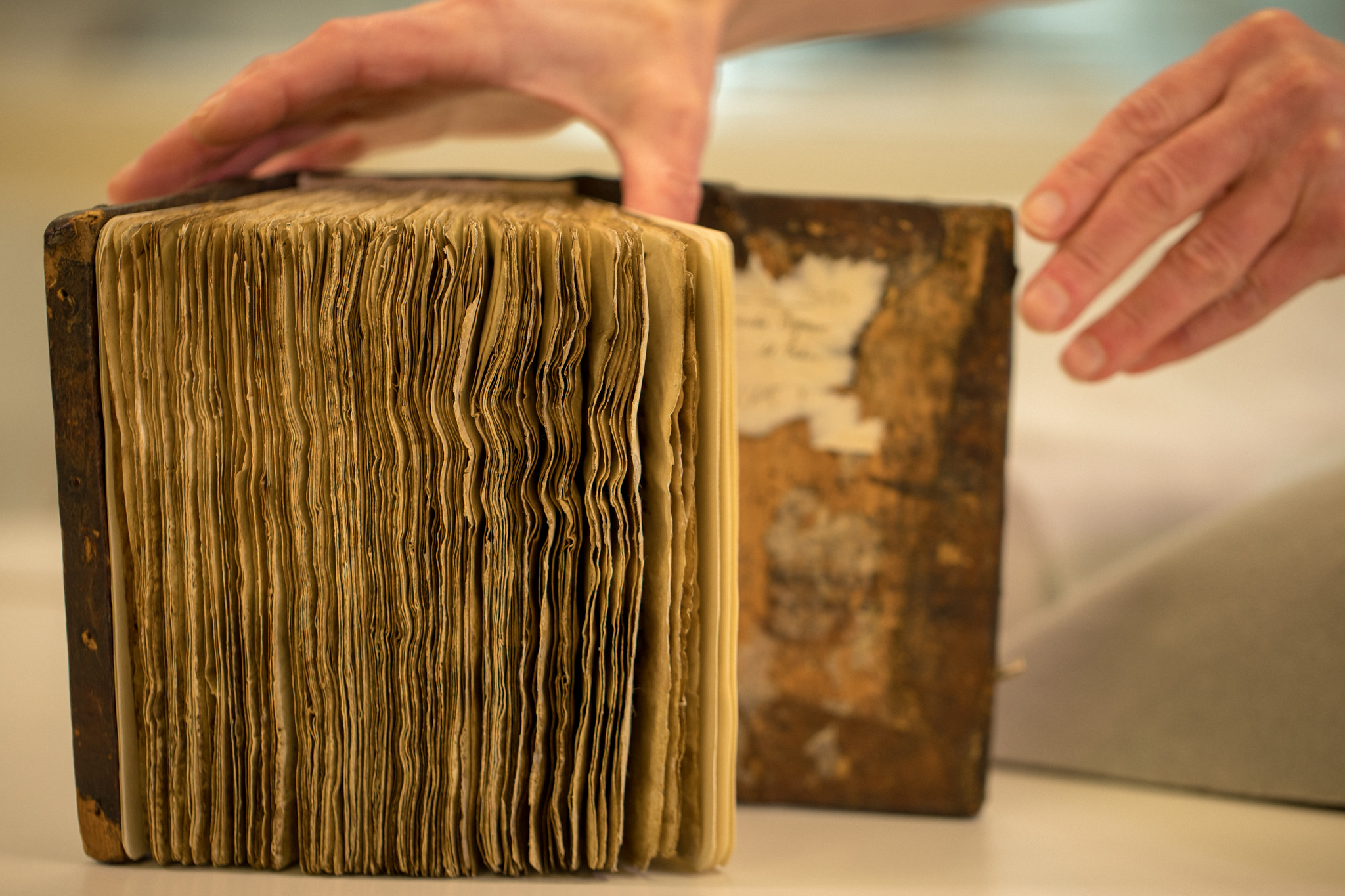
Long before humanity had paper to write on, we had papyrus. Made of the pith of the wetland plant Cyperus papyrus and first used in ancient Egypt, it made for quite a step up in terms of convenience from, say, the stone tablet. And not only could you write on it, you could rewrite on it. In that sense it was less the paper of its day than the first-generation video tape: given the expense of the stuff, it often made sense to erase the content already written on a piece of papyrus in order to record something more timely. But you couldn’t completely obliterate the previous layers of text, a fact that has long held out promise to scholars of ancient history looking to expand their field of primary sources.
Originally composed by Galen of Pergamon, “an influential physician and a philosopher of early Western medicine,” the work made its way into the 6th-century Islamic world through a translation into a language between Greek and Arabic called Syriac.
Alas, “despite the physician’s fame, the most complete surviving version of the translated manuscript was erased and written over with hymns in the 11th century – a common practice at the time.” Palimpsest, the word coined to describe such texts written, erased, and written over on pre-paper materials like papyrus and parchment, has long since had a place in the lexicon as a metaphor for anything long-historied, multi-layered, and fully understandable only with effort. The Stanford team’s effort involved a technique called X‑ray fluorescence (XRF), whose rays “knock out electrons close to the nuclei of metal atoms, and these holes are filled with outer electrons resulting in characteristic X‑ray fluorescence that can be picked up by a sensitive detector.”
Those rays “penetrate through layers of text and calcium, and the hidden Galen text and the newer religious text fluoresce in slightly different ways because their inks contain different combinations of metals such as iron, zinc, mercury and copper.” Each of the leather-bound book’s 26 pages takes ten hours to scan, and the enormous amounts of new data collected will presumably occupy a variety of experts on the ancient world — on the Greek and Islamic civilizations, on their languages, on their medicine — for much longer thereafter. But you do have to wonder: what kind of unimaginably advanced technology will our descendants a millennium and a half years from now be using to read all of the stuff we thought we’d erased?
Based in Seoul, Colin Marshall writes and broadcasts on cities and culture. His projects include the book The Stateless City: a Walk through 21st-Century Los Angeles and the video series The City in Cinema. Follow him on Twitter at @colinmarshall or on Facebook.
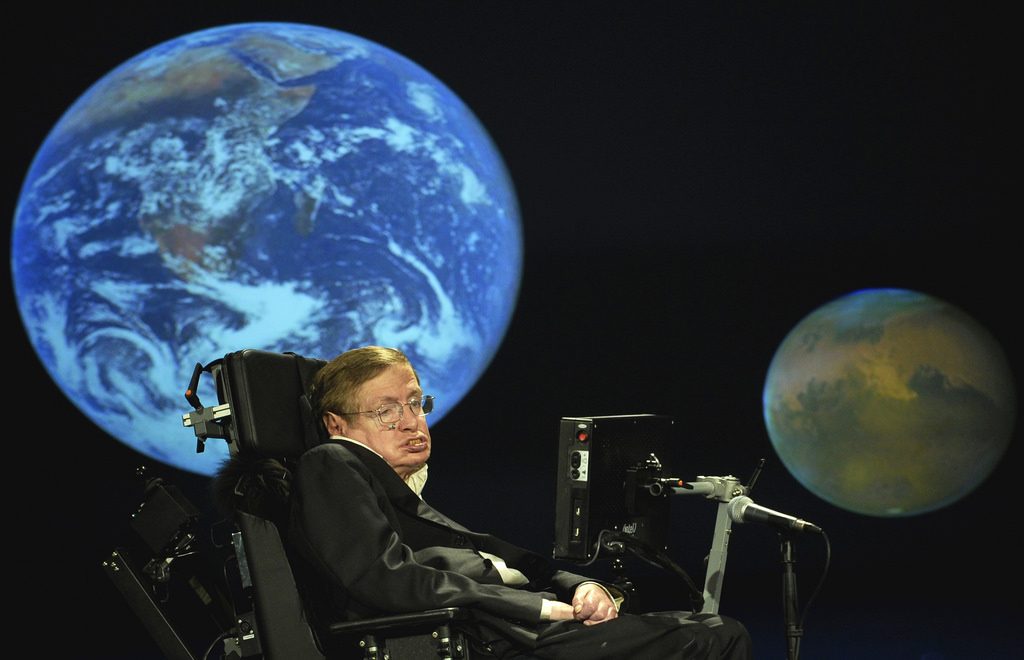
Earlier today, they laid Stephen Hawking to rest in a private funeral held at University Church of St. Mary the Great in Cambridge, England. Although the funeral itself was attended by only 500 guests, the streets of Cambridge swelled with onlookers who broke into applause as the coffin holding the physicist made its way into the church, leaving us with some proof that there’s still something right in a world tilting toward the wrong, that we can still appreciate someone who overcame so much, and left us with even more.
If you would like to sign up for Open Culture’s free email newsletter, please find it here. It’s a great way to see our new posts, all bundled in one email, each day.
If you would like to support the mission of Open Culture, consider making a donation to our site. It’s hard to rely 100% on ads, and your contributions will help us continue providing the best free cultural and educational materials to learners everywhere. You can contribute through PayPal, Patreon, and Venmo (@openculture). Thanks!
Who among us has never fantasized about traveling through time? But then, who among us hasn’t traveled through time? Every single one of us is a time traveler, technically speaking, moving as we do through one second per second, one hour per hour, one day per day. Though I never personally heard the late Stephen Hawking point out that fact, I feel almost certain that he did, especially in light of one particular piece of scientific performance art he pulled off in 2009: throwing a cocktail party for time travelers — the proper kind, who come from the future.
“Hawking’s party was actually an experiment on the possibility of time travel,” writes Atlas Obscura’s Anne Ewbank. “Along with many physicists, Hawking had mused about whether going forward and back in time was possible. And what time traveler could resist sipping champagne with Stephen Hawking himself?” ”
By publishing the party invitation in his mini-series Into the Universe With Stephen Hawking, Hawking hoped to lure futuristic time travelers. You are cordially invited to a reception for Time Travellers, the invitation read, along with the the date, time, and coordinates for the event. The theory, Hawking explained, was that only someone from the future would be able to attend.”
Alas, no time travelers turned up. Since someone possessed of that technology at any point in the future would theoretically be able to attend, does Hawking’s lonely party, which you can see in the clip above, prove that time travel will never become possible? Maybe — or maybe the potential time-travelers of the future know something about the space-time-continuum-threatening risks of the practice that we don’t. As for Dr. Hawking, I have to imagine that he came away satisfied from the shindig, even though his hoped-for Ms. Universe from the future never walked through the door. “I like simple experiments… and champagne,” he said, and this champagne-laden simple experiment will continue to remind the rest of us to enjoy our time on Earth, wherever in that time we may find ourselves.
Based in Seoul, Colin Marshall writes and broadcasts on cities and culture. His projects include the book The Stateless City: a Walk through 21st-Century Los Angeles and the video series The City in Cinema. Follow him on Twitter at @colinmarshall or on Facebook.
Ask anyone who’s pursued a career in the sciences what first piqued their interest in what would become their field, and they’ll almost certainly have a story. Gazing at the stars on a camping trip, raising a pet frog, fooling around with computers and their components: an experience sparks a desire for knowledge and understanding, and the pursuit of that desire eventually delivers one to their specific area of specialization.
Or, as they say in science, at least it works that way in theory; the reality usually unrolls less smoothly. On such a journey, just like any other, it might help to have a map.
Enter the work of science writer and physicist Dominic Walliman, whose animated work on the Youtube channel Domain of Science we’ve previously featured here on Open Culture. (See the “Related Content” section below for the links.)
Walliman’s videos astutely explain how the subfields of biology, chemistry, mathematics, physics, and computer science relate to each other, but now he’s turned that same material into infographics readable at a glance: maps, essentially, of the intellectual territory. He’s made these maps, of biology, chemistry, mathematics, physics, and computer science, freely available on his Flickr account: you can view them all on a single page here along with a few more of his infographics..
As much use as Walliman’s maps might be to science-minded youngsters looking for the best way to direct their fascinations into a proper course of study, they also offer a helpful reminder to those farther down the path — especially those who’ve struggled with the blinders of hyperspecialization — of where their work fits in the grand scheme of things. No matter one’s field, scientific or otherwise, one always labors under the threat of losing sight of the forest for the trees. Or the realm of life for the bioinformatics, biophysics, and biomathematics; the whole of mathematics for the number theory, the differential geometry, and the differential equations; the workings of computers for the scheduling, the optimization, and the boolean satisfiability.
Based in Seoul, Colin Marshall writes and broadcasts on cities and culture. His projects include the book The Stateless City: a Walk through 21st-Century Los Angeles and the video series The City in Cinema. Follow him on Twitter at @colinmarshall or on Facebook.
Ten days before Stephen Hawking’s death, Neil DeGrasse Tyson sat down with the world-famous physicist for an interview on Tyson’s StarTalk podcast. “I picked his legendary brain,” says Tyson in his introduction, “on everything, from the big bang to the origins of the universe.” He starts off, however, with some softballs. Hawking’s favorite food? He likes oysters. Favorite drink? Pimms.
Your appreciation for Tyson’s earnestly awkward small talk may vary. He’s prone to making himself laugh, which doesn’t elicit laughs from Hawking, whose communication was, of course, extraordinarily constrained. And yet, when it came to matters most of consequence to him, he was eloquent, witty, profound into his final days.
Though we cannot detect any tonal inflection in Hawking’s computer voice, we know him as a sensitive, compassionate person as well as a brilliant mind. It doesn’t sound like he’s bragging when—in answer to Tyson’s question about his favorite equation (at 4:10)—he replies, “the equation I discovered relating the entropy of black hole to the area of its horizon.” “How many people,” Tyson replies, chuckling, “get to say that their favorite equation is one they came up with? That’s badass.”
Cutaway segments with Tyson, theoretical physicist Janna Levin, and comedian Matt Kirshen surround the short interview, with Levin offering her professional expertise as a cosmologist to explain Hawking’s ideas in lay terms. His favorite equation, she says, demonstrates that black holes actually radiate energy, returning information, though in a highly disordered form, that was previously thought lost forever.
At 8:05, hear Hawking’s answer to the question of what he would ask Isaac Newton if he could go back in time. Whether we understand his reply or not, we learn how “badass” it is in the cutaway commentary (which begins to seem a little ESPN-like, with Levin as the seasoned player on the panel). Rather than asking Newton a question Hawking himself didn’t know the answer to, which Newton likely couldn’t answer either, Hawking would ask him to solve a problem at the limit of Newton’s own studies, thereby testing the Enlightenment giant’s abilities.
Offered ad-free in Hawking’s memory, the podcast interview also tackles the question of whether it might ever be possible to actually travel back in time, at 24:00 (the answer may disappoint you). Michio Kaku joins the panel in the studio to clarify and sticks around for the remainder of the discussion. The panel also answers fan-submitted questions, and Bill Nye makes an appearance at 42:16. Hawking’s interview makes up a comparatively small portion of the show.
His answers, by necessity, were very brief and to the point. His final theories, by contrast, are mind-expandingly vast, opening us up to the secrets of black holes and the existence of the multiverse. While Hawking’s theoretical work may have been too speculative for the Nobel committee, who need hard evidence to make a call, his legacy as “one of our greatest minds, of our generation, of the century, or maybe, ever,” as Tyson says, seems secure.
We're hoping to rely on loyal readers, rather than erratic ads. Please click the Donate button and support Open Culture. You can use Paypal, Venmo, Patreon, even Crypto! We thank you!
Open Culture scours the web for the best educational media. We find the free courses and audio books you need, the language lessons & educational videos you want, and plenty of enlightenment in between.