Hear a Supercut of the Last Second of Every AC/DC Song

acdc songs

Image by Weatherman90, via Wiki­me­dia Com­mons

Last sum­mer, Paul Mar­shall, a DJ at the clas­sic rock sta­tion 100.7 KSLX in Phoenix Ari­zona, went the dis­tance in try­ing to answer a ques­tion: how many AC/DC songs end in pret­ty much the same way? The result of his study is the super­cut below. On his Face­book page, Mar­shall writes:

It took a LONG time to go through. I promise you, *no song was repeat­ed.* These are all the final notes, of almost every AC/DC song ever record­ed (very few songs in their his­to­ry, fade out. They were omit­ted). They know how to end a song. That’s for sure. Feel free to share, steal, and give to your morn­ing show with­out cred­it­ing me (you know who you are!). Annnd.…power chord!

All of this puts the quote attrib­uted to Angus Young (AC/DC co-founder/­gui­tarist) in a fun­ny light: “I’m sick to death of peo­ple say­ing we’ve made 11 albums that sounds exact­ly the same, Infact, [sic] we’ve made 12 albums that sound exact­ly the same.”

Enjoy!

via @WFMU

If you would like to sign up for Open Culture’s free email newslet­ter, please find it here. It’s a great way to see our new posts, all bun­dled in one email, each day.

If you would like to sup­port the mis­sion of Open Cul­ture, con­sid­er mak­ing a dona­tion to our site. It’s hard to rely 100% on ads, and your con­tri­bu­tions will help us con­tin­ue pro­vid­ing the best free cul­tur­al and edu­ca­tion­al mate­ri­als to learn­ers every­where. You can con­tribute through Pay­Pal, Patre­on, and Ven­mo (@openculture). Thanks!

by | Permalink | Make a Comment ( 4 ) |

Tiny Tim Performs a Bizarre Cover of Rod Stewart’s “Do Ya Think I’m Sexy” on The Tonight Show (1979)

In 1979, cult musi­cian Tiny Tim ditched his ukulele and tip­toed out of the tulips to cov­er Rod Stew­art’s “Do Ya Think I’m Sexy” on The Tonight Show, above.

The Gong Show-wor­thy per­for­mance left host John­ny Car­son—and pre­sum­ably the major­i­ty of home viewers—speechless.

Was it com­e­dy or a fad­ing, men­tal­ly unbal­anced nov­el­ty act’s attempt to rekin­dle the pas­sion of a fick­le spot­light?

Maybe just a par­tic­u­lar­ly unbri­dled for­ay into new artis­tic ter­ri­to­ry… Like his elab­o­rate­ly for­mal man­ners, Tiny Tim’s usu­al reper­toire harkened to an ear­li­er peri­od. (“No one knew more about old music than Tiny Tim,” Bob Dylan once remarked.)

His odd­ly demure com­port­ment is in short sup­ply here as he veers from his cus­tom­ary falset­to to a more man­ly low­er reg­is­ter, strip­ping off jack­et and braces to show­case a port­ly, mid­dle aged mid-sec­tion. Musi­cian­ship also seems a bit want­i­ng, though to be fair, that’s rarely the cri­te­ria by which we mea­sure the suc­cess of an act that ends with writhing on the floor.

What­ev­er his inten­tions, Tiny Tim’s place in the annals of WTF per­for­mance his­to­ry would be secured on this turn alone.

A few years lat­er, he record­ed a 20s-tinged “Do Ya Think I”m Sexy” with Gary Lawrence & His Siz­zling Syn­co­pa­tors, released inside a greet­ing card as a 6” flexi disc. The video,  below, hon­ors his vin­tage sen­si­bil­i­ties while simul­ta­ne­ous­ly scream­ing 1982.

Relat­ed Con­tent:

The 15 Worst Cov­ers of Bea­t­les Songs: William Shat­ner, Bill Cos­by, Tiny Tim, Sean Con­nery & Your Excel­lent Picks

George Har­ri­son Explains Why Every­one Should Play the Ukulele, With Words and Music

Are You One of the 2% Who Can Solve “Einstein’s Riddle”?

It’s some­times called “Ein­stein’s Rid­dle” because, accord­ing to leg­end, Ein­stein invent­ed it as a child. Oth­ers say that the puz­zle was actu­al­ly designed by Lewis Car­roll, best known as the author of Alice’s Adven­tures in Won­der­land. (Car­roll was also a logi­cian.) Where did this brain teas­er orig­i­nate? We’re not real­ly sure. Per­haps it was a 1962 issue of Life Inter­na­tion­al mag­a­zine.

In any event, “Ein­stein’s Rid­dle” is a good test of your men­tal agili­ty. They say that only 2% of the pop­u­la­tion can solve the prob­lem. The TED-Ed video above will walk you through one ver­sion of the rid­dle. If you don’t want any assis­tance, you can find oth­er ver­sions online.

If you would like to sign up for Open Culture’s free email newslet­ter, please find it here. It’s a great way to see our new posts, all bun­dled in one email, each day.

If you would like to sup­port the mis­sion of Open Cul­ture, con­sid­er mak­ing a dona­tion to our site. It’s hard to rely 100% on ads, and your con­tri­bu­tions will help us con­tin­ue pro­vid­ing the best free cul­tur­al and edu­ca­tion­al mate­ri­als to learn­ers every­where. You can con­tribute through Pay­Pal, Patre­on, and Ven­mo (@openculture). Thanks!

Relat­ed Con­tent:

Albert Ein­stein Impos­es on His First Wife a Cru­el List of Mar­i­tal Demands

Lis­ten as Albert Ein­stein Reads ‘The Com­mon Lan­guage of Sci­ence’ (1941)

Albert Ein­stein Express­es His Admi­ra­tion for Mahat­ma Gand­hi, in Let­ter and Audio

Hap­pi­ness is Los­ing Your­self in Cre­ativ­i­ty (or “Find­ing Flow”)

Free Online Physics Cours­es

by | Permalink | Make a Comment ( 5 ) |

A Fittingly Strange Animation of What’s Going On Inside Charles Manson’s Mind

In 1968, Charles Man­son lis­tened to The Bea­t­les’ White Album and came away think­ing that Amer­i­ca was on the verge of an apoc­a­lyp­tic race war between whites and blacks. As Man­son imag­ined it, the race war would be trig­gered by a shock­ing, chaot­ic event called “Hel­ter Skel­ter” — a named bor­rowed from a song on the White Album. And, like most mega­lo­ma­ni­acs, Man­son put him­self at the cen­ter of the dra­ma. In the sum­mer of 1969, Man­son had mem­bers of his cult com­mit a series of infa­mous mur­ders in South­ern Cal­i­for­nia, hop­ing that African-Amer­i­cans would be blamed and the race war would begin. Instead, a lengthy police inves­ti­ga­tion led to Man­son’s arrest on Decem­ber 2, 1969 and his con­vic­tion soon there­after, mak­ing him then, and now, one of Amer­i­ca’s noto­ri­ous inmates.

Through the 1980s, Man­son, even though behind bars, remained a very pub­lic fig­ure, giv­ing high pro­file inter­views to Tom Sny­der, Char­lie Rose, and Ger­al­do Rivera. But then, he began to fade from view, for what­ev­er rea­sons. For the past 20 years, we haven’t heard much from him. Until this came along. Above, you can watch Leah Shore’s ani­ma­tion of nev­er-before-heard phone con­ver­sa­tions between Charles Man­son and Mar­lin Maryn­ick (who lat­er pub­lished a best-sell­ing biog­ra­phy called Charles Man­son Now). Fit­ting­ly strange, the ani­ma­tion reminds us of the very odd things going on inside Man­son’s mind. Off kil­ter as ever, he goes in all kinds of unex­pect­ed direc­tions.

via Vice

Relat­ed Con­tent:

The Time Neil Young Met Charles Man­son, Liked His Music, and Tried to Score Him a Record Deal

Tim­o­thy Leary’s Wild Ride and the Fol­som Prison Inter­view

Aleis­ter Crow­ley: The Wickedest Man in the World Doc­u­ments the Life of the Bizarre Occultist, Poet & Moun­taineer

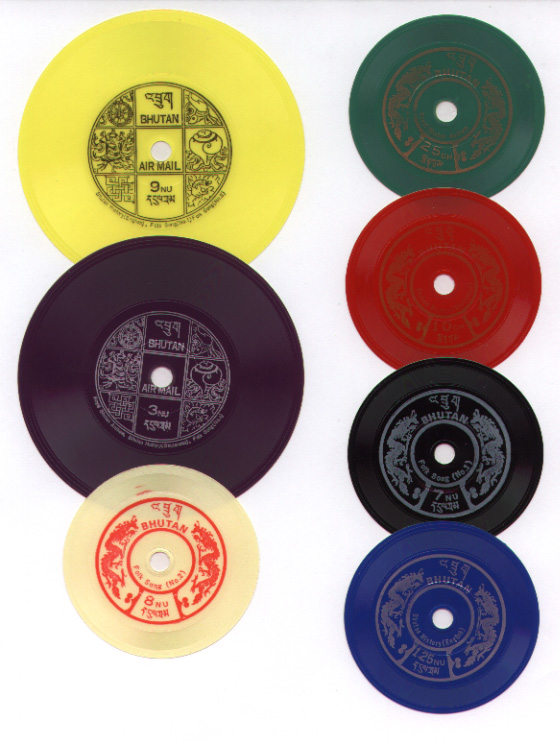
Postage Stamps from Bhutan That Double as Playable Vinyl Records

Bhutan_record_stamps

The tiny, Himalayan king­dom of Bhutan has a unique nation­al aspi­ra­tion that sets it apart from its neigh­bors, Chi­na and India. (And cer­tain­ly the Unit­ed States too.) Rather than increas­ing its gross nation­al prod­uct, Bhutan has instead made it a goal to increase the Gross Nation­al Hap­pi­ness of its cit­i­zens. There’s wealth in health, not just mon­ey, the Bhutanese have argued. And since the 197os, the coun­try has tak­en a holis­tic approach to devel­op­ment, try­ing to increase the spir­i­tu­al, phys­i­cal, and envi­ron­men­tal health of its peo­ple. And guess what? The strat­e­gy is pay­ing off. A 2006 glob­al sur­vey con­duct­ed by Busi­ness Week found that Bhutan is the hap­pi­est coun­try in Asia and the eighth-hap­pi­est coun­try in the world.

It’s per­haps only a nation devot­ed to hap­pi­ness that could throw its sup­port behind this — postage stamps that dou­ble as playable vinyl records. Cre­at­ed by an Amer­i­can entre­pre­neur Burt Todd in the ear­ly 70s, at the request of the Bhutanese roy­al fam­i­ly, the “talk­ing stamps” shown above could be stuck on a let­ter and then lat­er played on a turntable. Accord­ing to Tod­d’s 2006 obit­u­ary in The New York Times, one stamp “played the Bhutanese nation­al anthem,” and anoth­er deliv­ered “a very con­cise his­to­ry of Bhutan.” Thanks to WFMU, our favorite inde­pen­dent free form radio sta­tion, you can hear clips of talk­ing stamps above and below. Don’t you feel hap­pi­er already?

via The Reply All Pod­cast

Fol­low Open Cul­ture on Face­book and Twit­ter and share intel­li­gent media with your friends. Or bet­ter yet, sign up for our dai­ly email and get a dai­ly dose of Open Cul­ture in your inbox. And if you want to make sure that our posts def­i­nite­ly appear in your Face­book news­feed, just fol­low these sim­ple steps.

Relat­ed Con­tent:

How to Clean Your Vinyl Records with Wood Glue

Sovi­et Hip­sters Boot­legged West­ern Pop Music on Dis­card­ed X‑Rays: Hear Orig­i­nal Audio Sam­ples

How Vinyl Records Are Made: A Primer from 1956

by | Permalink | Make a Comment ( 2 ) |

The Falling Water: A Rube Goldberg Machine That Makes a Fine Cocktail

Joseph Her­sch­er, a kinet­ic artist from New Zealand, has a knack for mak­ing some pret­ty imag­i­na­tive Rube Gold­berg machines. Back in 2012, we showed you The Page Turn­er, a device that gives cre­ative assis­tance to any­one still read­ing news­pa­pers in a print for­mat. Next week, we’ll hope­ful­ly get a chance to fea­ture his most recent con­trap­tion. (Stay tuned for more on that.) But for now, as we head into the week­end, let’s admire The Falling Water, Her­scher’s cock­tail-mak­ing machine that plays on the name of a famous Frank Lloyd Wright cre­ation. You can watch it go above. And for those who want to play along at home, here is the recipe for the drink:

- 30mls (1Oz) 42BELOW Fei­joa Vod­ka
— Ch’i or Lemon­ade
— Long slice of seed­less cucum­ber
— Ice

Cut a long thin piece of cucum­ber on a diag­o­nal.
Rest it against the inside of a High­ball glass.
Fill the glass with ice, add 42BELOW Fei­joa.
Top with Ch’i or Lemon­ade.

Enjoy!

Relat­ed Con­tent:

An Ani­mat­ed Tour of Falling­wa­ter, One of Frank Lloyd Wright’s Finest Cre­ations

The Page Turn­er: A Fab­u­lous Rube Gold­berg Machine for Read­ers

F. Scott Fitzger­ald Con­ju­gates “to Cock­tail,” the Ulti­mate Jazz-Age Verb (1928)

As Benevolent Dictator, Vladimir Nabokov Would Abolish Muzak & Bidets: What Would Make Your List?

nabokov abolish

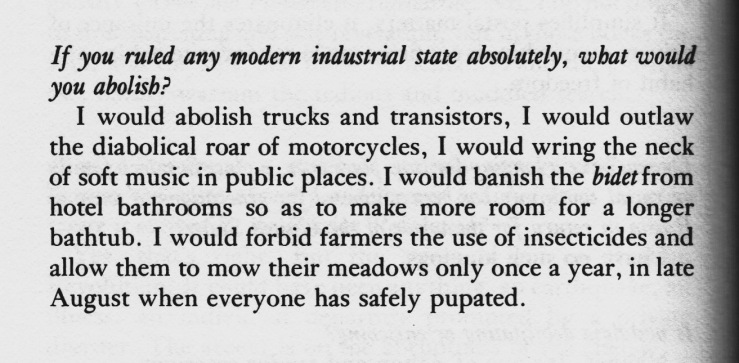
In 1969, the BBC’s James Moss­man con­duct­ed an exten­sive inter­view with Vladimir Nabokov, which was first pub­lished in a mag­a­zine called The Lis­ten­er, and lat­er in a book enti­tled Strong Opin­ionsSome of Moss­man­’s ques­tions were seri­ous: “You’ve said that you’ve explored time’s prison and have found no way out. Are you still explor­ing…? Some were lighter: “Why do you live in hotels?” (Answer here.) And still oth­er ques­tions fell some­where in between, like: “If you ruled any mod­ern indus­tri­al state absolute­ly, what would you abol­ish?” It turns out that loud nois­es, muzak, bidets, and insec­ti­cides made the great nov­el­ist and lep­i­dopter­ist’s list.

Which rais­es the ques­tion, if allowed to play benev­o­lent dic­ta­tor for a day, what would you oblit­er­ate? Me? I’d prob­a­bly start with almost any­thing like­ly to appear in today’s Bill­board Top 5 — dreck that’s not too far from muzak.

via Bib­liok­lept

Relat­ed Con­tent:

Vladimir Nabokov Names the Great­est (and Most Over­rat­ed) Nov­els of the 20th Cen­tu­ry

Vladimir Nabokov’s Delight­ful But­ter­fly Draw­ings

Vladimir Nabokov Cre­ates a Hand-Drawn Map of James Joyce’s Ulysses

Vladimir Nabokov Makes Edi­to­r­i­al Tweaks to Franz Kafka’s Novel­la The Meta­mor­pho­sis

Discover The Backwards Brain Bicycle: What Riding a Bike Says About the Neuroplasticity of the Brain

Like most of us, engi­neer Des­tin San­dlin, cre­ator of the edu­ca­tion­al sci­ence web­site Smarter Every Day, learned how to ride a bike as a child. Archival footage from 1987 shows a con­fi­dent, mul­let-haired San­dlin pilot­ing a two-wheel­er like a boss.

Flash for­ward to the present day, when a welder friend threw a major wrench in Sandlin’s cycling game by tweak­ing a bike’s handlebar/front wheel cor­re­spon­dence. Turn the han­dle­bars of the “back­wards bike” to the left, and the wheel goes to the right. Steer right, and the front wheel points left.

San­dlin thought he’d con­quer this beast in a mat­ter of min­utes, but in truth it took him eight months of dai­ly prac­tice to con­quer his brain’s cog­ni­tive bias as to the expect­ed oper­a­tion. This led him to the con­clu­sion that knowl­edge is not the same thing as under­stand­ing.

He knew how to ride a nor­mal bike, but had no real grasp of the com­plex algo­rithm that kept him upright, a simul­ta­ne­ous bal­let of bal­ance, down­ward force, gyro­scop­ic pro­ces­sion, and nav­i­ga­tion.

As he assures fans of his Youtube chan­nel, it’s not a case of the stereo­typ­i­cal unco­or­di­nat­ed sci­ence geek—not only can he jug­gle, when he took the back­wards bike on tour, a glob­al ros­ter of audi­ence vol­un­teers’ brains gave them the exact same trou­ble his had.

Inter­est­ing­ly, his 6‑year-old son, who’d been rid­ing a bike for half his young life, got the hang of the back­wards bike in just two weeks. Children’s brain’s pos­sess much more neu­ro­plas­tic­i­ty than those of adults, whose senior­i­ty means habits and bias­es are that much more ingrained.

It couldn’t have hurt that San­dlin bribed the kid with a trip to Aus­tralia to meet an astro­naut.

Did the ardu­ous­ness of mas­ter­ing the back­wards bike ruin San­dlin for nor­mal­ly con­fig­ured bicy­cles? Watch the video above all the way to the end for an incred­i­ble spon­ta­neous moment of mind over mat­ter.

Relat­ed Con­tent:

The Physics of the Bike

The Mys­te­ri­ous Physics Behind How Bikes Ride by Them­selves

Sci­ence Behind the Bike: Four Videos from the Open Uni­ver­si­ty on the Eve of the Tour de France

The Neu­ro­science of Drum­ming: Researchers Dis­cov­er the Secrets of Drum­ming & The Human Brain

Ayun Hal­l­i­day is an author, illus­tra­tor, and Chief Pri­ma­tol­o­gist of the East Vil­lage Inky zine. Fol­low her @AyunHalliday

« Go BackMore in this category... »
Quantcast