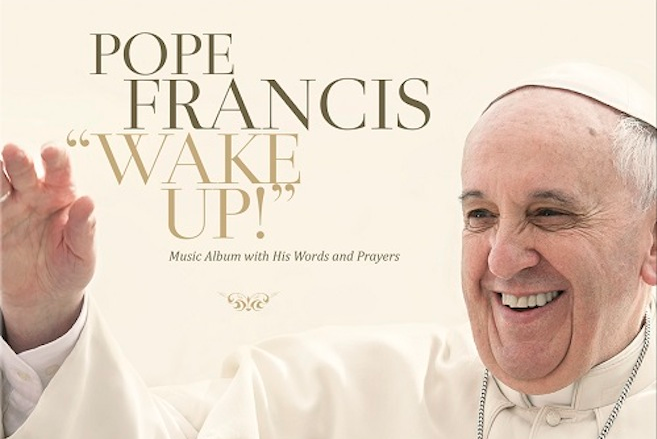
According to Rolling Stone, “The Vatican-approved LP … features the Pontiff delivering sacred hymns and excerpts of his most moving speeches in multiple languages paired with uplifting musical accompaniment ranging from pop-rock to Gregorian chant.” The Pope’s songs will focus on themes that Americans are getting familiar with this week: “peace, dignity, environmental concerns and helping those most in need.“Pope Francis: Wake Up! will officially go on sale on November 27th. Yup, Black Friday.
If you would like to support the mission of Open Culture, consider making a donation to our site. It’s hard to rely 100% on ads, and your contributions will help us continue providing the best free cultural and educational materials to learners everywhere. You can contribute through PayPal, Patreon, and Venmo (@openculture). Thanks!
Some of the most rigorous moral thinkers of the past century have spent time on the wrong side of questions they deemed of vital importance. Mohandas Gandhi, for example, at first remained loyal to the British, manifesting many of the vicious prejudices of the Empire against Black South Africans and lobbying for Indians to serve in the war against the Zulu. Maya Jasanoff in New Republic describes Gandhi during this period of his life as a “crank.” At the same time, he developed his philosophy of non-violent resistance, or satyagraha, in South Africa as an Indian suffering the injustices inflicted upon his countrymen by both the Boers and the British.
Gandhi’s sometime contradictory stances may be in part understood by his rather aristocratic heritage and by the warm welcome he first received in London when he left his family, his caste, and his wife and child in India to attend law school in 1888. And yet it is in London that he first began to change his views, becoming a staunch vegetarian and encountering theosophy, Christianity, and many of the contemporary writers who would shift his perspective over time. Gandhi received a very different reception in England when he returned in 1931, the de facto leader of a burgeoning revolutionary movement in India whose example was so important to both the South African and U.S. civil rights movements of succeeding decades.
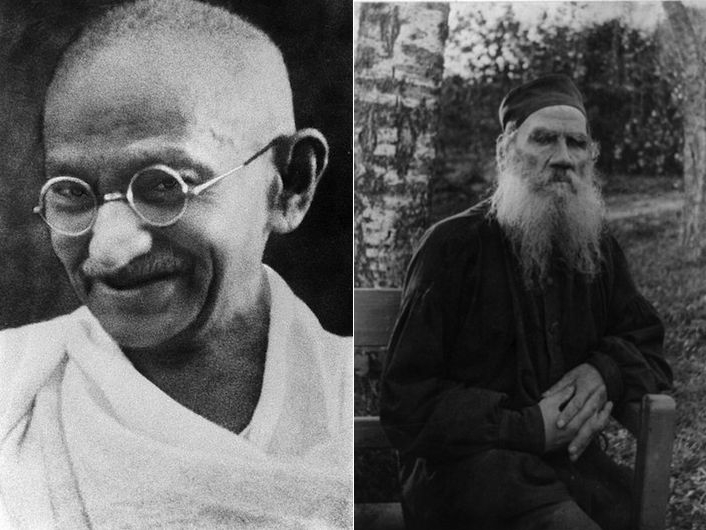
One of the writers who most deeply guided Gandhi’s political, spiritual, and philosophical evolution, Leo Tolstoy, experienced his own dramatic transformation, from landed aristocrat to social radical, and also renounced property and position to advocate strenuously for social equality. Gandhi eagerly read Tolstoy’s The Kingdom of God is Within You, the novelist’s statement of Christian anarchism. The book, Gandhi wrote in his autobiography, “left an abiding impression on me.” After further study of Tolstoy’s religious writing, he “began to realize more and more the infinite possibilities of universal love.”
It was in England, not India, where Gandhi first read “A Letter to a Hindu,” Tolstoy’s 1908 reply to a note from Indian revolutionary Taraknath Das on the question of Indian independence. Tolstoy divides his lengthy, thoughtful “Letter” into short chapters, each of which begins with a quotation from the Vedas. “Indeed,” writes Maria Popova, the missive “puts in glaring perspective the nuanceless and hasty op-eds of our time.” It so affected Gandhi that, in 1909, he wrote to Tolstoy, thus beginning a correspondence between the two that lasted through the following year. “I take the liberty of inviting your attention to what has been going on in the Transvaal for nearly three years,” begins Gandhi’s first letter, somewhat abruptly, “There is in that Colony a British Indian population of nearly 13,000. These Indians have, for several years, labored under various legal disabilities.”
The prejudice against color and in some respects against Asians is intense in that Colony….The climax was reached three years ago, with a law that many others and I considered to be degrading and calculated to unman those to whom it was applicable. I felt that submission to a law of this nature was inconsistent with the spirit of true religion. Some of my friends and I were and still are firm believers in the doctrine of nonresistance to evil. I had the privilege of studying your writings also, which left a deep impression on my mind.
Gandhi refers to a law forcing the Indian population in South Africa to register with the authorities. He goes on to inquire about the authenticity of the “Letter” and asks permission to translate it, with payment, and to omit a negative reference to reincarnation that offended him. Tolstoy responded a few months later, in 1910, allowing the translation free of charge, and allowing the omission, with the qualification that he believed “faith in re-birth will never restrain mankind as much as faith in the immortality of the soul and in divine truth in love.” Overall, however, he expresses solidarity, greeting Gandhi “fraternally” and writing,
God help our dear brothers and co-workers in the Transvaal! Among us, too, this fight between gentleness and brutality, between humility and love and pride and violence, makes itself ever more strongly felt, especially in a sharp collision between religious duty and the State laws, expressed by refusals to perform military service.
The two continued to write to each other, Gandhi sending Tolstoy a copy of his Indian Home Rule and the translated “Letter,” and Tolstoy expounding at length on the errors—and what he saw as the superior characteristics—of Christian doctrine. You can read their full correspondence here, along with Tolstoy’s “Letter to a Hindu” and Gandhi’s introduction to his edition. Despite their religious differences, the exchange further galvanized Gandhi’s passive resistance movement, and in 1910, he founded a community called “Tolstoy Farm” near Johannesburg.
Gandhi’s views on African independence would change, and Nelson Mandela later adopted Gandhi and the Indian independence movement as a standard for the anti-apartheid movement. We’re well aware, of course, of Gandhi’s influence on Martin Luther King, Jr. For his part, Gandhi wrote glowingly of Tolstoy, and the model the novelist provided for his own anti-colonial campaign. In a speech 18 years later, he said, “When I went to England, I was a votary of violence, I had faith in it and none in nonviolence.” After reading Tolstoy, “that lack of faith in nonviolence vanished…Tolstoy was the very embodiment of truth in this age. He strove uncompromisingly to follow truth as he saw it, making no attempt to conceal or dilute what he believed to be the truth. He stated what he felt to be the truth without caring whether it would hurt or please the people or whether it would be welcome to the mighty emperor. Tolstoy was a great advocate of nonviolence in his age.”
I don’t think anybody really knows why they’re doing anything. If you stop someone on the subway and say, “Where are you going — in the deepest sense of the word?” you can’t really expect an answer. I really don’t know why I’m here. It’s a matter of “What else would I be doing?” Do I want to be Frank Sinatra, who’s really great, and do I want to have great retrospectives of my work? I’m not really interested in being the oldest folksinger around.
One need not have lived a rock n’ roll lifestyle to be familiar with its pleasures and pitfalls. That heady mix of drugs, sex, and public adulation isn’t sustainable. Some can’t survive it. Some retire to a more staid domestic scene while others are left chasing a spotlight that’s unlikely to favor them twice. But rarely do you find one who chooses to give it all up to become a Buddhist monk.
Well, not all.
As director Armelle Brusq’s 1996 documentary, above, shows, singer-songwriter—and yes—Zen monk Leonard Cohen’s routine at the Mount Baldy Zen Center outside Los Angeles extended beyond the usual mindfulness practice. His simple quarters were outfitted with a computer, printer, radio, and a Technics KN 3000 synthesizer. He sometimes doffed his robes to enter the recording studio or enjoy a bowl of soup at Canter’s Deli. Comparatively, his worldly attachments were few, divvied between the professionally necessary and the fond. Still, calling his daughter, Lorca, to pass along a veterinarian’s update, Cohen sounds every inch the doting Jewish dad.
Celebrity devotion to Kabbalah or various Eastern spiritual practices often stinks of the superficial, a passing fancy that won’t last more than a year or two. Cohen’s relation to Zen Buddhism is enduring, a gift from his longtime friend and teacher, Mount Baldy’s Roshi, Kyozan Joshu Sasaki, who died last year at the age of 107.
One of Cohen’s responsibilities was helping Roshi with the myriad small details the elderly abbot would have had difficulty navigating on his own. Cohen seems entirely at peace in the roadie role, keeping track of luggage while on tour, and fetching cones for the entire party from a nearby ice cream truck.
The poem Cohen penned in honor of Roshi’s 89th birthday is of a piece with his most enduring work. Think Suzanne’s oranges were the only fruit? Not so:
His stomach’s very happy
The prunes are working well
There’s no one left in heaven
And there’s no one going to hell
Filmmaker Brusq is chiefly concerned with documenting Cohen’s spiritual reality, but she tosses in a few treats for those hungry for pop iconography, particularly the impromptu show-and-tell at the 25-minute mark, when the crew peeks into the legend’s memorabilia-filled LA office.
The soundtrack, too, is music to a Cohen fan’s ears, and lyrically inspired given the subject:
There is a certain kind of thinking that the Buddha called “monkey mind,” a state in which our nervous habits become compulsions, hauling us around this way and that, forcing us to jump and shriek at every sound. It was exactly this neurotic state of mind that Leonard Cohen sought to quell when in 1994 he joined Mt. Baldy Zen Center in Los Angeles and became a monk: “I was interested in surrendering to that kind of routine,” Cohen told The Guardian in 2001, “If you surrender to the schedule, and get used to its demands, it is a great luxury not to have to think about what you are doing next.”
There at Mt. Baldy the journalist and cosmopolitan raconteur Pico Iyer met Cohen, unaware at first that it was even him. In his short Baccalaureate speech above to the 2015 graduating class of the University of Southern California, Iyer describes the meeting: After showing him fond hospitality and settling him into the community, Iyer says, Cohen told him that “just sitting still, being unplugged, looking after his friends was… the real deep entertainment that the world had to offer.”
At the time, Iyer was disappointed. He had admired Cohen for exactly the opposite qualities—for traveling the world, being plugged into the culture, and living a rock star life of self-indulgence. It was this outward manifestation of Cohen that Iyer found alluring, but the poet and songwriter’s inward life, what Iyer calls the “invisible ledger on which we tabulate our lives,” was given to something else, something that eventually brought Cohen out of a lifelong depression. Iyer’s thesis, drawn from his encounter with Leonard Cohen, Zen monk, is that “it is really on the mind that our happiness depends.”
Iyer refers not to that perpetually wheeling monkey mind but what Zen teacher Suzuki Roshi called “beginner’s mind” or “big mind.” In such a meditatively absorbed state, we forget ourselves, “which to me,” Iyer says, “is almost the definition of happiness.” Cohen said as much of his own personal enlightenment: “When you stop thinking about yourself all the time, a certain sense of repose overtakes you.” After his time at Mt. Baldy, he says, “there was just a certain sweetness to daily life that began asserting itself.” Iyer’s short speech, filled with example after example, gives us and his newly graduating audience several ways to think about how we might find that sense of repose—in the midst of busy, demanding lives—through little more than “just sitting still, being unplugged” and looking after each other.
Many of us in the West live in some of the most fragmented religious landscapes in the world, but in the midst of deepening levels of conflict over policies of birth and death, these two issues that divide us also join us together. More than at any time in history, people live in expectation of similar spans of life; we all lament the loss of loved ones who die at any age; and most of us live with some fear of death, or at least violent, untimely death like the kind Alan Watts describes above.
Watts, English Zen guru of sorts (though he would not like the label) lectured more on death than perhaps any other philosophical or religious teacher since the Buddha, but he did so in a way that illuminates our ideas about the inevitable end, even if it should come upon us all of the sudden.
You heard a bomb coming at you, you could hear it whistle and you knew it was right above you and heading straight at you, and that you were finished.
This is no abstract thought experiment, of course, but the historical experience of millions of people, from Dresden to Iraq. But despite the terrifying example, Watts describes achieving in that moment absolute clarity and universality. The dreaded bomb whistles toward you, “and you accepted it,” he says.
How exactly does one achieve that acceptance? Without dogmatizing or mysticism, Watts offers some wisdom in another excerpt from a lecture above. This video’s use of melodramatic film clips and cinematic music may be a little schmaltzy, but his matter of fact talk isn’t lessened by it. Though not everyone passes on their genes to a next generation, an example he discusses in both excerpts, we do all leave the planet to make room for new people, wherever they come from, and this, he says, “is an honorable thing…. It’s a far more amusing arrangement for nature to continue the process of life through different individuals than it is through the same individual.”
Watts was not at all doctrinaire about death, particularly in his later years. In a conversation with Aldous Huxley’s wife Laura in 1968, he called dying “an art,” though not quite like Sylvia Plath did: “It is also,” he said, “an adventure.” He considered Aldous Huxley’s unorthodox death—on an LSD trip while Laura read to him from the Tibetan Bardo Thodol—a “highly intelligent form of dying.” Nonetheless, Watts, an Episcopal priest become an explainer of Zen Buddhism in America, also had a great deal to say about more formal religious ideas of death.
In the lecture above, from a 1959 American television program, Watts explains a particular Buddhist concept of reincarnation and rebirth through various realms. It’s a picture as fantastic and picturesque as Dante’s, and like his creative act, one that can be read with some literal and much profoundly philosophical significance. These conceptions help demonstrate that far from fearful, our puzzling over the inevitability and mystery of death can be, as it was for Watts, “one of the most creative thoughts I ever thought in my life.”
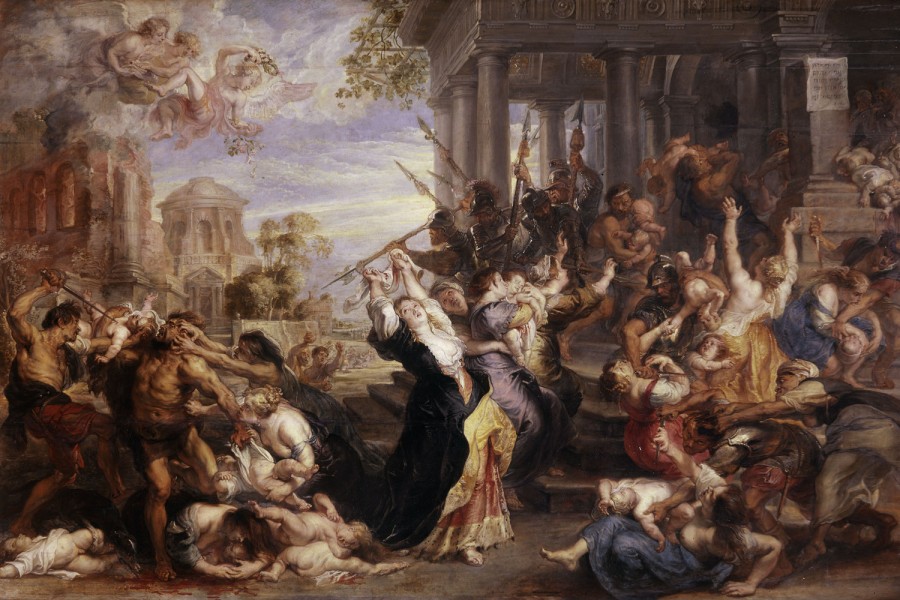
In the 17th century, the Flemish Baroque painter Peter Paul Rubens painted “The Massacre of the Innocents” (see below), an artistic depiction of a very brief Biblical passage in The Gospel of Matthew. The passage recounts the story of how Herod the Great, a Roman client king of Judea, ordered the execution of young male children in Bethlehem, hoping to avoid losing his throne to a newly-born King of the Jews. And it reads like this:
Then Herod, when he saw that he was deceived by the wise men, was exceedingly angry; and he sent forth and put to death all the male children who were in Bethlehem and in all its districts, from two years old and under, according to the time which he had determined from the wise men. Then was fulfilled what was spoken by Jeremiah the prophet, saying:
“A voice was heard in Ramah,
Lamentation, weeping, and great mourning,
Rachel weeping for her children,
Refusing to be comforted,
Because they are no more.”
In the 21st century, Sebastian Burdon and Mat Collishaw have now come along and created “All Things Fall,” a 3d zoetrope that brings the “Massacre of the Innocents” to life. Using a 19th century optical technique that produces the illusion of motion, the zoetrope virtually animates the gruesome Biblical scene. You can watch it play out, eerily, above.
According to Burdon, it took “6 months to do all the 3d modeling and animations” and involved “creating over 350 character figures, environment elements and architecture. A pretty stunning effort.
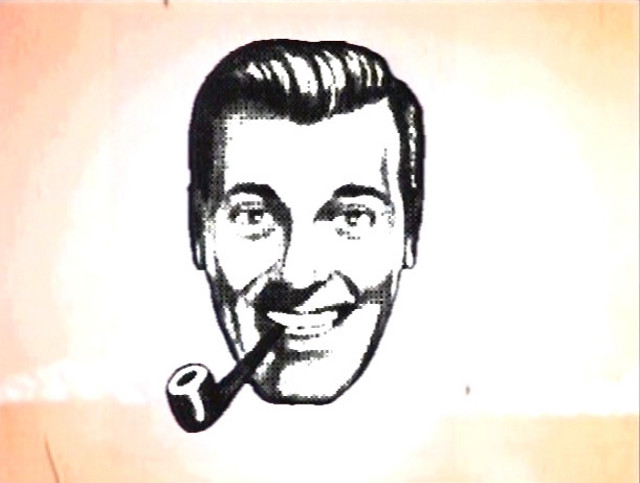
You may not know much about the Church of the SubGenius, but you’ve definitely seen its prophet. The intensively groomed, Ward Cleaveresque J. R. “Bob” Dobbs (below) began as a humble piece of 1950s clip art and went on to become “a way of life to millions… yet half of them don’t even know it.” Or so claims the sweeping, absurdity-laced, sonically (and perhaps intellectually) twisted narration of Arise! The SubGenius, an “instructional barrage video” put out by the Church in 1992 as the most potent distillation of its religion-satirizing sensibility.
The obsession with worldwide conspiracies, the importance granted to voracious consumption and “remixing” of pop culture (visible everywhere in Arise!), the hardline opposition to work, the all-important and never-defined quality of “Slack,” the askew eschatology: how much of the Church of the Subgenius’ doctrine has remained mere parody religion, and how much, since its founding in the late 1970s, have its “followers”—a group that includes such alt-icons as David Byrne, Robert Crumb, and Mark Mothersbaugh—come to consider as good as the real thing?
But whatever legitimacy this surprisingly long-running postmodern joke has attained, we can also view it, like all religions, as a cultural movement. This approach raises its own questions: how, exactly, did Dobbs’ pipe-clenching, fatherly yet sinister visage become one of the most recognizable subcultural emblems of the 1980s and 1990s? You may never learn the answer, just as you may never get a handle on the entirety of the Church’s ever more labyrinthine and aggressively preposterous mythology, but you’ll certainly find it all strangely compelling in the attempt.
And even if Arise! The SubGenius doesn’t recruit you into the Church of the SubGenius’ ranks, you’ve got to respect what they’ve predicted: not the end of the world, as much as they talk about it, but our currently thriving 21st-century culture of media appropriation, recontextualization, and absurdification. If ever there were a religion for the Youtube era, here it is. And if you find nothing novel in its characteristic ambivalence about what counts as serious and what doesn’t, maybe the Church of the SubGenius’ teachings have penetrated even deeper into the zeitgeist than all those “Bob” stickers made us suspect.
A quick note: Kristoffer Seland Hellesmark was looking for a documentary on Christopher Hitchens to watch, but could never find one. So, after waiting a while, he said to himself, “Why don’t I just make one?” The result is the 80-minute documentary about Hitchens, lovingly entitled The Hitch, which features clips from his speeches and interviews. We’ve added it to our collection of 200+ Free Documentaries, a subset of our larger collection, 4,000+ Free Movies Online: Great Classics, Indies, Noir, Westerns, Documentaries & More.
If you would like to support the mission of Open Culture, consider making a donation to our site. It’s hard to rely 100% on ads, and your contributions will help us continue providing the best free cultural and educational materials to learners everywhere. You can contribute through PayPal, Patreon, and Venmo (@openculture). Thanks!
We're hoping to rely on loyal readers, rather than erratic ads. Please click the Donate button and support Open Culture. You can use Paypal, Venmo, Patreon, even Crypto! We thank you!
Open Culture scours the web for the best educational media. We find the free courses and audio books you need, the language lessons & educational videos you want, and plenty of enlightenment in between.