The Unbelievers, A New Film Starring Richard Dawkins, Lawrence Krauss, Werner Herzog, Woody Allen, & Cormac McCarthy

The so-called New (or “Gnu”) Athe­ism arrived at a time when fear, anger, and con­fu­sion over extrem­ist reli­gion had hit a fever pitch. Sud­den­ly, peo­ple who didn’t pay much atten­tion to religion—their own or any­one else’s—became intense­ly inter­est­ed in reli­gious crit­i­cism and debate; it was the per­fect cli­mate for a pub­lish­ing storm, and that’s essen­tial­ly how the move­ment began. It was also, of course, pre­dat­ed by thou­sands of years of philo­soph­i­cal athe­ism of some vari­ety or anoth­er, but “new” athe­ism had some­thing dif­fer­ent to offer: while its pro­po­nents large­ly hailed from the same worlds as their intel­lec­tu­al predecessors—the arts, polit­i­cal jour­nal­ism and activism, the sci­ences and aca­d­e­m­ic philosophy—after Sep­tem­ber 11, these same peo­ple took the dis­cus­sion to the pop­u­lar press and a pro­lif­er­a­tion of inter­net out­lets and well-orga­nized con­fer­ences, debates, and meet­ings. And their expres­sions were uncom­pro­mis­ing and polem­i­cal (though not “militant”—no shots were fired nor bombs det­o­nat­ed).

In the wake of over a decade of con­tro­ver­sy unleashed by “new athe­ism,” a new film The Unbe­liev­ers (trail­er above) fol­lows two promi­nent sci­en­tists and stars of the movement–evolutionary biol­o­gist Richard Dawkins and the­o­ret­i­cal physi­cist Lawrence Krauss—as they trek across the globe and explain their views. Dawkins and Krauss receive sup­port from a cast of celebri­ty inter­vie­wees includ­ing Ricky Ger­vais, Wern­er Her­zog, Woody Allen, Cor­mac McCarthy, Sarah Sil­ver­man, Ayaan Hir­si-Ali, and sev­er­al more. The film’s web­site has no offi­cial release date (oth­er than “2013”), but it does fea­ture links to online buzz, both glib—Krankie snarks that the trail­er makes it look like Dawkins and Krauss have packed in the sci­ence and start­ed a band—and sub­dued; the evan­gel­i­cal Chris­t­ian Post does lit­tle but quote from the press pack­age.

These cham­pi­ons of rea­son-over-reli­gion have always had pow­er­ful crit­ics, even among those who might oth­er­wise seem sym­pa­thet­ic (take Marx­ist lit­er­ary crit­ic Ter­ry Eagleton’s charge that new athe­ism is noth­ing but counter-fun­da­men­tal­ism). Then there is the host of reli­gious detrac­tors, many of them respect­ed sci­en­tists and philoso­phers them­selves. One notable name in this camp is famed geneti­cist Fran­cis Collins, who head­ed the Human Genome Project. Obvi­ous­ly no denier of the explana­to­ry pow­er of sci­ence, Collins nonethe­less argues for faith as a dis­tinct kind of knowl­edge, as he does in the inter­view excerpt below from an appear­ance on The Char­lie Rose Show.

The debates seem like they could rage on inter­minably, and prob­a­bly will. I, for one, am grate­ful they can hap­pen open­ly and in rel­a­tive peace in so many places. But as the same sets of issues arise, some of the ques­tions become just a bit more nuanced. British pre­sen­ter Nicky Camp­bell, for exam­ple, recent­ly presided over a large debate among sev­er­al promi­nent sci­en­tists and cler­gy about whether or not all reli­gions should accept evo­lu­tion (below). While Dawkins and Krauss ulti­mate­ly advo­cate a world with­out reli­gion, the par­tic­i­pants of this debate try to shift the terms to how sci­en­tif­ic dis­cov­ery and reli­gious iden­ti­ty can coex­ist with min­i­mal fric­tion.

Relat­ed Con­tent:

Richard Dawkins Explains Why There Was Nev­er a First Human Being

Some­thing from Noth­ing? Richard Dawkins and Lawrence Krauss Dis­cuss Cos­mol­o­gy, Ori­gins of Life & Reli­gion Before a Packed Crowd

Alain de Bot­ton Wants a Reli­gion for Athe­ists: Intro­duc­ing Athe­ism 2.0

Josh Jones is a writer, edi­tor, and musi­cian based in Wash­ing­ton, DC. Fol­low him @jdmagness

William Shatner Puts in a Long Distance Call to Astronaut Aboard the International Space Station

If his goal is to be tak­en seri­ous­ly, William Shat­ner hasn’t always been his own best friend. His cov­ers of pop hits launched a whole mini-genre of unin­ten­tion­al­ly bad celebri­ty record­ings.

To his cred­it, he made fun of him­self to great effect on Boston Legal but fol­lowed that series up with a Broad­way show It’s Shatner’s World, We Just Live In It, to mixed reviews.

But the man nev­er quits. Ear­li­er this month the Cana­di­an Space Agency orga­nized a Tweet­up with Cana­di­an astro­naut Chris Had­field, who is aboard the Inter­na­tion­al Space Sta­tion orbit­ing the Earth. One space lover who par­tic­i­pat­ed was Shat­ner, who tweet­ed:

@Cmdr_Hadfield: “Are you tweet­ing from space? MBB”

A few hours lat­er Had­field, respond­ed: “Yes, Stan­dard Orbit, Cap­tain. And we’re detect­ing signs of life on the sur­face.”

Shat­ner and Had­field planned a longer con­ver­sa­tion and it was hard to say who was more thrilled by the event: Trekkies the world over, Shat­ner, or Had­field.

For about fif­teen min­utes today, with Hous­ton Mis­sion Con­trol act­ing as galac­tic switch­board oper­a­tor, the two chat­ted about the space pro­gram, the risks of liv­ing in space, and even some exis­ten­tial mat­ters.

Right off the bat, Shat­ner asked Had­field whether the fact that he had used a Russ­ian vehi­cle to get up to the space sta­tion means that Amer­i­ca is “falling behind” in its space pro­gram. The answer—long and upbeat—was, in a word, no.

Then Shat­ner asked Had­field why he’d vol­un­teered for the as-yet unsched­uled mis­sion to Mars.

“Isn’t that a fear­ful endeav­or, fraught with enor­mous dif­fi­cul­ty and dan­ger?”

“Well you’ve tak­en a lot of risks in your life as well,” Had­field replied.

He lat­er went on to say that pro­grams like Star Trek inspired him to study to become an astro­naut.

“Going to Mars is inevitable,” Had­field said, speak­ing into a float­ing, hand-held micro­phone, “just as sail­ing across the Atlantic or going to the moon. We take those visu­al­ized fan­tasies and turn them into real­i­ties.”

The view of Earth from his win­dow on the Space Sta­tion, he added, is just like the view that Sulu and Chekhov had from the Star­ship Enter­prise.

“It’s an enor­mous won­der­ful rolling Earth but all you have to do is flip your­self upside-down and the rest of the uni­verse is under you.”

By the end of their chat, Had­field had invit­ed Shat­ner to vis­it him at his cab­in and watch the satel­lites fly through the sky.

“You know those scenes in Boston Legal at the end of an episode when you were on the veran­da drink­ing a whiskey and smok­ing a cig­ar, you ought to vis­it me in North­ern Ontario. It’s a great place to talk about life.”

Relat­ed Con­tent: 

Nichelle Nichols Tells Neil deGrasse Tyson How Mar­tin Luther King Con­vinced Her to Stay on Star Trek

Leonard Nimoy Nar­rates Short Film About NASA’s Dawn: A Voy­age to the Ori­gins of the Solar Sys­tem

William Shat­ner Nar­rates Space Shut­tle Doc­u­men­tary

Star Trek Celebri­ties, William Shat­ner and Wil Wheaton, Nar­rate Mars Land­ing Videos for NASA

Kate Rix writes about dig­i­tal media and edu­ca­tion. Vis­it her at .

Join Cartoonist Lynda Barry for a University-Level Course on Doodling and Neuroscience

lyndabarry

Car­toon­ist Lyn­da Bar­ry, who has helped legions of adults grope their way back to the unself­con­scious cre­ativ­i­ty of child­hood, is teach­ing at the uni­ver­si­ty lev­el. Bar­ry’s Unthink­able Mind course is designed to appeal to stu­dents of the human­i­ties.  Also hard­core sci­ence majors, the sort of lab-coat­ed spec­i­mens the first group might refer to as “brains.” The instruc­tor describes her Uni­ver­si­ty of Wis­con­sin spring semes­ter offer­ing thus:

A writ­ing and pic­ture-mak­ing class with focus on the basic phys­i­cal struc­ture of the brain with empha­sis on hemi­spher­ic dif­fer­ences and a par­tic­u­lar sort of insight and cre­ative con­cen­tra­tion that seems to come about when we are using our hands (the orig­i­nal dig­i­tal devices) —to help us fig­ure out a prob­lem.

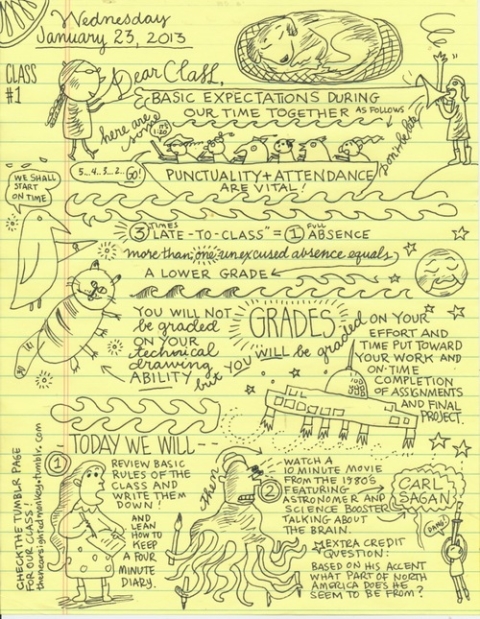
The twen­ty-one grads and under­grads accept­ed into Pro­fes­sor Bar­ry’s course have been warned, via the illus­trat­ed let­ter above,  hand­writ­ten on legal paper, that the work­load will be heavy.

lyndabarry2

You should be warned as well, if you elect to audit this course from home. Enroll­ment is not nec­es­sary. Pro­fes­sor Bar­ry will be post­ing her week­ly assign­ments and cur­ricu­lum mate­ri­als on her tum­blr, a forum where her abid­ing inter­est in sci­ence is as appar­ent as her devo­tion to undi­rect­ed doo­dling. Your first assign­ment, post­ed above, requires a box of crayons, the col­or­ing pages of your choice, down­loaded to four types of paper, and a sig­nif­i­cant chunk of time set aside for brain-relat­ed arti­cles and vin­tage videos star­ring Cog­ni­tive Neu­ro­sci­en­tist Michael Gaz­zani­ga and astronomer Carl Sagan. You should also be com­mit­ted to keep­ing a four-minute diary and serv­ing as your own guinea pig.

Who’s in?

A big H/T @kirstinbutler

Relat­ed Con­tent

Car­toon­ist Kate Beat­on Plays on Lit­er­ary Clas­sics — The Great Gats­by, Julius Cae­sar & More

Steven Pinker Explains the Neu­ro­science of Swear­ing (NSFW)

Carl Sagan’s Under­grad Read­ing List: From Pla­to and Shake­speare, to Hux­ley and Gide

- Ayun Hal­l­i­day ‘s most recent book is Peanut.

NASA Sends Image of the Mona Lisa to the Moon and Back

The same super-fast laser tech­nol­o­gy that sent clear images of Mars back to Earth just cleared anoth­er hur­dle clos­er to home by send­ing an image of the Mona Lisa to the sur­face of the moon and back again.

Sci­en­tists at NASA want­ed to know whether they could use laser puls­es to “com­mu­ni­cate” with the lunar sur­face using the same tool that tracks the posi­tion of the Lunar Recon­nais­sance Orbiter.

The team sent a dig­i­tized ver­sion of Leonardo’s famous­ly inscrutable sig­no­ra from the God­dard Space Cen­ter in Mary­land 240,000 miles up to a laser trans­mit­ter aboard the orbit­ing space­craft. Pix­els trav­eled one at a time and were adjust­ed for bright­ness by con­trolled delays in their arrival time. The team cor­rect­ed errors in the image using com­mon DVD and CD tech­niques.

Pret­ty much every­body knows what the Mona Lisa looks like, so maybe that’s why they picked her face, instead of, well, mine. Maybe NASA is hop­ing her name will be changed to Moona Lisa.

The Lunar Recon­nais­sance Orbiter (explained above) began its lunar orbit near­ly four years ago. Laser puls­es beam down to the moon and then bounce back to form images of the sur­face. Like those star­tling pic­tures of Mars, laser tech­nol­o­gy is help­ing devel­op a crys­tal clear topo­graph­i­cal map of the moon, includ­ing the tracks of two astro­nauts’ unsuc­cess­ful trek to the top of a crater and the site of a lost Russ­ian rover.

The Mona Lisa’s trip to the moon is impor­tant because the image was sent at the same time as laser puls­es that track the craft’s position—the first out­er space con­fer­ence call—and it sets the stage for future high-data trans­mis­sions between Earth and its satel­lite explor­ers.

via The Atlantic

Relat­ed Con­tent

NASA Presents “The Earth as Art” in a Free eBook and Free iPad App

Leonard Nimoy Nar­rates Short Film About NASA’s Dawn: A Voy­age to the Ori­gins of the Solar Sys­tem

NASA’s “Spot the Sta­tion” Will Text or Email You When the Space Sta­tion Pass­es Over Your Home

Kate Rix writes about dig­i­tal media and edu­ca­tion. Vis­it her at .

Cornell Launches Archive of 150,000 Bird Calls and Animal Sounds, with Recordings Going Back to 1929

Ornithol­o­gists and bird watch­ers rejoice. After a dozen years, The Cor­nell Lab of Ornithology’s Macaulay Library has ful­ly dig­i­tized its near­ly 150,000 audio record­ings (a total run­ning time of 7,513 hours), rep­re­sent­ing close to 9,000 dif­fer­ent species, such as the very unset­tling-sound­ing Barred Owl (above). While the col­lec­tion also includes the sounds of whales, ele­phants, frogs, pri­mates, and oth­er ani­mals, the pri­ma­ry empha­sis here is on birds (it is a Lab of Ornithol­o­gy, after all), and there is an incred­i­ble range of calls. Cor­nell rec­om­mends some of the high­lights below:

Ear­li­est record­ing: Cor­nell Lab founder Arthur Allen was a pio­neer in sound record­ing. On a spring day in 1929 he record­ed this Song Spar­row sound­ing much as they do today

Youngest bird: This clip from 1966 records the sounds of an Ostrich chick while it is still inside the egg – and the researchers as they watch

Liveli­est wake-up call: A dawn cho­rus in trop­i­cal Queens­land, Aus­tralia is burst­ing at the seams with war­bles, squeals, whis­tles, booms and hoots

Best can­di­date to appear on a John Coltrane record: The indri, a lemur with a voice that is part moan, part jazz clar­inet

Most spines tin­gled: The incom­pa­ra­ble voice of a Com­mon Loon on an Adiron­dacks lake in 1992

Most errat­ic con­struc­tion project: the stac­ca­to ham­mer­ing sounds of a wal­rus under water

Most like­ly to be mis­tak­en for aliens arriv­ing: Birds-of-par­adise make some amaz­ing sounds – here’s the UFO-sound of a Curl-crest­ed Manu­code in New Guinea

Whether you’re an enthu­si­as­tic bird­er, prac­tic­ing sci­en­tist, or sound-sam­ple hunter, you’ll find some­thing to blow your mind at the exten­sive col­lec­tions of the Macaulay Library. Both ama­teur and pro­fes­sion­al nat­u­ral­ists, for exam­ple, can acquire, visu­al­ize, mea­sure, and ana­lyze ani­mal sounds with a free ver­sion of the Cor­nell Lab’s pro­pri­etary inter­ac­tive sound analy­sis soft­ware, Raven.

And admir­ers of the aston­ish­ing vari­ety and beau­ty of the bird-of-par­adise should stay tuned for the Bird-of-Par­adise Project web­site, launch­ing this month. Sign up to receive an email when the full site launch­es. Mean­while, watch the project’s spell­bind­ing trail­er below.

Vis­it the Cor­nell Lab of Ornithol­o­gy’s YouTube page for more fas­ci­nat­ing bird videos.

Relat­ed Con­tent

Para­Hawk­ing in Nepal: What It’s Real­ly Like to Fly with Birds

The Wild King­dom: Brought to You by Mutu­al of Oma­ha (and YouTube)

Josh Jones is a free­lance writer, edi­tor, and musi­cian based in Wash­ing­ton, DC. Fol­low him @jdmagness

Lux Aeterna: A Journey of Light, From Distant Galaxies to Small Drops of Water

In years past, we’ve shared with you two ani­ma­tions by Cristóbal Vila — first Nature by Num­bers, which cap­tured the ways in which math­e­mat­i­cal con­cepts (Fibonac­ci Sequence, Gold­en Num­ber, etc.) reveal them­selves in nature. And then Inspi­ra­tions, a short film cel­e­brat­ing the math­e­mat­i­cal art of M.C. Esch­er. Now Vila returns with Lux Aeter­na, a 3D study of light. On his web site, Vila describes the essence of the film.

[It’s] a look at light from sev­er­al points of view. On one side it’s a pow­er­ful radi­a­tion emit­ted by the most dis­tant stars in the uni­verse, and also by our Sun; light floods every­where in nature, from the largest things to the small­est, cre­at­ing inter­est­ing and beau­ti­ful effects; humans always used light as a sym­bol­ic and spir­i­tu­al ele­ment; and it’s an intrigu­ing phys­i­cal phe­nom­e­non deeply stud­ied by sci­ence too.

Vila’s site also hosts a series of screen­shots that take you into the mak­ing of the film. Down the line, the Span­ish artist plans to record a series of video tuto­ri­als in Span­ish ful­ly demon­strat­ing the cre­ative process. If you fol­low him on Twit­ter or Face­book, he’ll let you know when they’re ready for view­ing. Inci­den­tal­ly, you can catch Open Cul­ture on Twit­ter and Face­book too. Hope to see you there.

152 Big Thinkers Answer the Question “What Should We Be Worried About?”

Edge_2013_Flower

It’s a new year, which means it’s time for the Edge.org to pose its annu­al ques­tion to some of the world’s finest minds. The 2013 edi­tion asks the ques­tion, “What Should We Be Wor­ried About?”. And the replies — 152 in total — fea­ture thoughts by Nas­sim Nicholas Taleb, Daniel Den­nettSher­ry Turkle, Lawrence Krauss, and Esther Dyson, plus the ones excerpt­ed below. If you’re will­ing to go down the rab­bit hole, you can access the com­plete col­lec­tion of respons­es here.

What I fear most is that we will lack the will and the fore­sight to face the world’s prob­lems square­ly, but will instead retreat from them into super­sti­tion and igno­rance. Con­sid­er how in 375 AD, after a dream in which he was whipped for being “a Ciceron­ian” rather than a Chris­t­ian, Saint Jerome resolved no more to read the clas­si­cal authors and to restrict him­self only to Chris­t­ian texts, how the Chris­tians of Alexan­dria mur­dered the philoso­pher and math­e­mati­cian Hypa­tia in 415, and real­ize that, at least in part, the so-called dark ages were not some­thing imposed from with­out, a break­down of civ­i­liza­tion due to bar­bar­ian inva­sions, but a choice, a turn­ing away from knowl­edge and dis­cov­ery into a kind of reli­gious fun­da­men­tal­ism. [Read the rest here.]

Tim O’Reil­ly, Founder and CEO of O’Reil­ly Media, Inc.

Death is what makes this cycli­cal renew­al and steady advance in organ­isms pos­si­ble. Dis­cov­ered by liv­ing things mil­lions of years ago, aging and death per­mit a species to grow and flour­ish. Because nat­ur­al selec­tion ensures that the child-who-sur­vives-to-repro­duce is bet­ter than the par­ent (albeit infin­i­tes­i­mal­ly so, for that is how evo­lu­tion works), it is bet­ter for many species that the par­ent step out of the way and allow its (supe­ri­or) child to suc­ceed in its place.… So impor­tant is death that we have, wired into our genes, a self-destruct senes­cence pro­gram that shuts down oper­a­tions once we have suc­cess­ful­ly repro­duced, so that we even­tu­al­ly die, leav­ing our children—the fresh­er, new­er, shinier ver­sions of ourselves—to car­ry on with the best of what we have giv­en them: the best genes, the best art, and the best ideas. Four bil­lion years of death has served us well. Now, all this may be com­ing to an end, for one of the things we humans, with our evolved intel­li­gence, are work­ing hard at is try­ing to erad­i­cate death.[Read the rest here.]

–Kate Jef­fery, Head, Dept. of Cog­ni­tive, Per­cep­tu­al and Brain Sci­ences, Uni­ver­si­ty Col­lege, Lon­don

Most of the smart peo­ple I know want noth­ing to do with pol­i­tics. We avoid it like the plague… Is this because we feel that pol­i­tics isn’t where any­thing sig­nif­i­cant hap­pens? Or because we’re too tak­en up with what we’re doing, be it Quan­tum Physics or Sta­tis­ti­cal Genomics or Gen­er­a­tive Music? Or because we’re too polite to get into argu­ments with peo­ple? …  It’s pol­i­tics that’s bleed­ing the poor­er nations for the debts of their for­mer dic­ta­tors. It’s pol­i­tics that allows spe­cial inter­ests to run the coun­try. It’s pol­i­tics that helped the banks wreck the econ­o­my. It’s pol­i­tics that pro­hibits gay mar­riage and stem cell research but nur­tures Gaza and Guan­tanamo.… What wor­ries me is that while we’re lais­sez-ing, some­one else is faire-ing. [Read the rest here]

–Bri­an Eno, Artist, Com­pos­er, Pro­duc­er

You can dive into the full col­lec­tion at Edge.org. The pho­to above was tak­en by Katin­ka Mat­son.

by | Permalink | Make a Comment ( 8 ) |

The Many Ways to Mars: A Reality Show, a New Martian City, and Mapping Mars from Home

Real­i­ty tele­vi­sion has been around since at least the late ’40s. First we had Can­did Cam­era, where hap­less, but real, peo­ple became the unwit­ting butt of Allen Funt’s jokes. But it wasn’t until fifty years lat­er that the genre explod­ed, bring­ing us Big Broth­er and, of course, Sur­vivor.

Now, make way for the unbe­liev­able and ultra-expen­sive mar­riage of real­i­ty tele­vi­sion and sci­ence fic­tion. Mars One, the brain­child of Dutch entre­pre­neur Bas Lans­dorp, plans to estab­lish a per­ma­nent human set­tle­ment on the red plan­et in 2023. First, four peo­ple would land on Mars. Every two years, anoth­er group of peo­ple would arrive. The trips would be one-way and all the set­tlers would live out the rest of their lives on Mars. Fund­ing for the first phase is esti­mat­ed at $6 bil­lion.

Mars One back­ers say rais­ing $6 bil­lion will be easy. Every four years the Sum­mer and Win­ter Olympics gen­er­ate mil­lions of dol­lars in rev­enue because peo­ple all over the world want to watch. The Olympics held in 2005 and 2008 togeth­er made near­ly $5.5 bil­lion from pro­gram­ming and spon­sor­ship.

So, what if there were an event so fas­ci­nat­ing, so unprece­dent­ed and amaz­ing, that lit­er­al­ly every tele­vi­sion, com­put­er, and smart device would be tuned in to watch? What if the entire Mars mis­sion was an inter­na­tion­al real­i­ty tele­vi­sion show? That’s the plan. Every­thing from the selec­tion of the first group of astro­nauts to the launch, land­ing, and dai­ly life on the red plan­et would be tele­vised. The audi­ence even gets to vote on the final four space trav­el­ers.

Inter­est­ed? Mars One has issued its require­ments for astro­naut selec­tion. No mil­i­tary, flight, or sci­ence expe­ri­ence required. Appli­cants must be at least 18, in good men­tal and phys­i­cal health, and will­ing to devote eight years to train­ing before begin­ning the jour­ney to their new home plan­et. Find­ing this hard to believe? The first ques­tion in Mars One’s FAQ page sort of says it all. Is this for real? Yes, the plans are for real. Whether any or every­thing Mars One imag­ines actu­al­ly takes place is anybody’s guess.

What’s cer­tain is that Mars is a hot des­ti­na­tion at the moment, and not just for aspir­ing real­i­ty stars. SpaceX fun­der and bil­lion­aire Elon Musk wants to build a city for 80,000 on Mars. While accept­ing an award from the Roy­al Aero­nau­ti­cal Soci­ety, Musk out­lined his vision to charge $500,000 per per­son to trans­port peo­ple to the new Mar­t­ian city. He’s men­tioned want­i­ng to retire on Mars and is using SpaceX as a lab to devel­op new inter­plan­e­tary rock­et tech­nol­o­gy.

But you don’t need to be rich or pop­u­lar to see some of the red plan­et. There’s also plen­ty of explor­ing to do on the sur­face of Mars from home. Cit­i­zen sci­en­tists can help Plan­et Four iden­ti­fy fans and blotch­es in images of the Mar­t­ian sur­face. The pic­tures come from a cam­era aboard the Mars Recon­nais­sance Orbiter, a NASA mis­sion to orbit Mars and trans­mit images and data to Earth using a pow­er­ful radio fre­quen­cy called the “Ka-band,” which works like an inter­plan­e­tary Inter­net.

Using sim­ple mark­ing tools, users can mark the sur­face col­orations and spots that help sci­en­tists study changes in the planet’s weath­er. So-called “spi­ders” of dry ice form on the planet’s poles in the win­ter and then lead to fan-shaped mois­ture foot­prints.

It’s fun to imag­ine that the data you cre­ate could bring us clos­er to our dis­tant neigh­bor plan­et. Unless of course you’d rather suit up and start train­ing to go there your­self. In that case, good luck and start sav­ing.

Kate Rix writes about dig­i­tal tech­nol­o­gy and edu­ca­tion. Read more of her work at .

« Go BackMore in this category... »
Quantcast