We have free will. We make our own decisions. We have long taken these basic assumptions for granted. But what does neuroscience make of this? In this excerpt from the BBC Horizon special, “The Secret You,” Marcus Du Sautoy (Oxford University) participates in a brain imaging experiment conducted by John-Dylan Haynes, a neuroscientist based in Berlin. And the results? Well, they force us to rethink things a bit. Goodbye Descartes. Goodbye mind before matter. Goodbye to consciousness and free will, as we traditionally like to think about them. And welcome to the world of neurons, to brain activity that makes your decisions before your conscious self is even aware of them. To delve deeper into all of this, you can watch Haynes give a 90 minute lecture here called “Unconscious determinants of free decisions in the human brain.”
Five Minutes with Richard Dawkins
You’ll get the schtick pretty quickly. The BBC’s Matthew Stadlen spends five quick minutes with celebrities, thinkers and newsmakers. And, above, he gets down to business with Richard Dawkins, with the conversation touching on religion, the afterlife, spirituality, morality, happiness, and the whole point of life. Other thinkers featured in the series include Martin Amis, AC Grayling, Alain de Botton, Brian Cox, Sir Terry Pratchett and others.
via Metafilter
Do Physicists Believe in God?
Every day, physicists and astronomers confront the wonders of the universe. But does staring into the sublime abyss incline them toward a belief in God? Not if you ask the physicists at The University of Nottingham School of Physics and Astronomy, who answer big questions on YouTube and Sixty Symbols, including “What happens if you stick your hand inside the Large Hadron Collider, the world’s largest particle accelerator?
The Nottingham physicists are in some good company. According to a well-known 1997 study published in Nature, biologists within the National Academy of Sciences rejected God and immortality at rates of 65.2% and 69.0%. Meanwhile, when physical scientists were polled, the numbers rose to 79.0% and 76.3%. The summary originally published by Nature now appears here.
via PourMeCoffee
The Milky Way over Texas
This 45 second timelapse video of the “Galactic Center of the Milky Way” rising over Texas Star Party (2009) just gets more spectacular as it rolls along. William Castleman created this sequence using a Canon EOS-5D, with exposures at 20 and 40 second intervals. This complements nicely Stéphane Guisard’s panoramic view of the Milky Way taken from the Atacama desert in Chile. See the The Milky Way in 360 Degrees here.
Find us on Facebook and Twitter!
The Best American Science Writing 2010: Free Essays
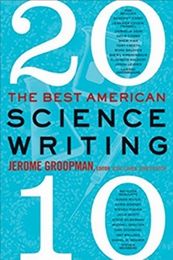 Jerome Groopman, the New Yorker staff writer and Harvard med school prof, has edited The Best American Science Writing 2010 - a new collection that brings together “the most crucial, thought-provoking, and engaging science writing” during the past 12 months. The 368 page book runs $10.19 online. But before you run out and buy it, let me say this: you can read many of the collected essays online for free. The Truth About Grit by Jonah Lehrer; My Genome, My Self by Steven Pinker; Are We Still Evolving? by Kathleen McAuliffe – they’re among 16 essays available online, and they’re all included in a handy list pulled together by Metafilter. Meanwhile, if you want to read these essays later on (when you have some time to delve into longer articles) give Instapaper a try. As I’ve mentioned before, it’s a great way to read texts in a clean format on the iPad, iPhone, and Kindle.
The Milky Way in 360 Degrees
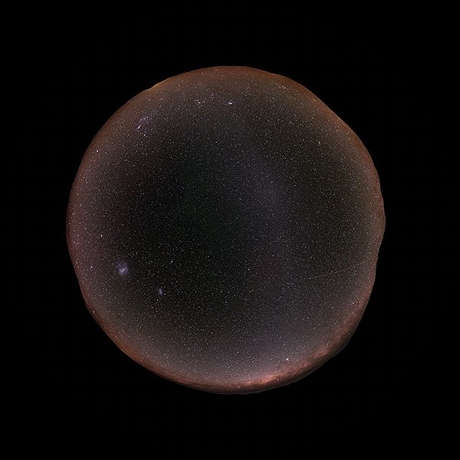
Stéphane Guisard traveled to the Paranal observatory, situated in Chile’s remote Atacama desert, in search of the “darkest sky.” The result? Some amazing zoomable, fisheye images that reveal the darkest of dark skies (including a glimpse of the Gegenschein). And then also this “byproduct”: a 360 degree panoramic view of the Milky Way that lies on the dark sky horizon. You can view Los Cielos de Chile here.
Please note that the page can take a little time to load. But once you’re there, you can toggle around the images and control the views.
The Dalai Lama on the Neuroscience of Compassion
Last week, the Dalai Lama spent several days at Stanford University, where he made compassion his focus. He laid the foundation with a large public address before an audience of 7,000. (Watch an excerpt above or the full talk below.) Then things got more focused when the spiritual leader of Tibet participated in a daylong conference about the neurobiological underpinnings of compassion. Hosted by Stanford’s Center for Compassion and Altruism Research and Education, the conference brought together important scientists from many disciplines – psychology, neuroscience, medicine, and economics. You can watch a recording of the conference here. It’s all in video and ready to go.
If you would like to support the mission of Open Culture, consider making a donation to our site. It’s hard to rely 100% on ads, and your contributions will help us continue providing the best free cultural and educational materials to learners everywhere. You can contribute through PayPal, Patreon, and Venmo (@openculture). Thanks!
The Smallest Stop-Motion Animation Ever
From the makers of Wallace and Gromit comes the smallest stop-motion animation ever. The lilliputian main character, aptly named Dot, stands a mere 0.35-inch-tall. According to Popular Science, the animators “used a 3D printer to make 50 different versions of Dot, because she is too small to manipulate or bend like they would other stop-motion animation characters.” Then each print-up was hand-painted by artists looking through a microscope. Once the set and characters were ready to go, the directors attached a CellScope (a cellphone camera with a 50x magnification microscope) to a Nokia N8 and let the cameras roll. You can watch the final cut above.
Support Us
We're hoping to rely on loyal readers, rather than erratic ads. Please click the Donate button and support Open Culture. You can use Paypal, Venmo, Patreon, even Crypto! We thank you!

Receive our Daily Email
About Us

Open Culture scours the web for the best educational media. We find the free courses and audio books you need, the language lessons & educational videos you want, and plenty of enlightenment in between.
Advertise With Us

