You have received those odd text messages from a stranger. (“Hi, This is Anita. Have you received the Panamera parts yet?”) You know the messages are spam, but you don’t quite understand the angle of the scam. Above, the Search Engine podcast works with Bloomberg reporter Zeke Faux to break down the con operation. The story turns out to be more complicated than it first appears. It involves crypto, but also human trafficking and forced labor compounds in Cambodia and Myanmar. We’ll just leave it at that and suggest you listen to this unnerving podcast episode. You can hopefully stream it above or find it on your favorite podcast platform—e.g., Apple and Spotify.
How Photos Were Transmitted by Wire in 1937: The Innovative Technology of a Century Ago
When did you last send someone a photo? That question may sound odd, owing to the sheer commonness of the act in question; in the twenty-twenties, we take photographs and share them worldwide without giving it a second thought. But in the nineteen-thirties, almost everyone who sent a photo did so through the mail, if they did it at all. Not that there weren’t more efficient means of transmission, at least to professionals in the cutting-edge newspaper industry: as dramatized in the short 1937 documentary above, the visual accompaniment to a sufficiently important scoop could also be sent in mere minutes through the miracle of wire.
“Traveling almost as fast as the telephone story, wired photos now go across the continent with the speed of light,” declares the narrator in breathless newsreel-announcer style. “It’s not a matter of sending the whole picture at once, but of separating the picture into fine lines, sending those lines over a wire, and assembling them at the other end.”
Illustrating this process is a clever mechanical prop involving two spindles on a hand crank, and a length of rope printed with the image of a car that unwinds from one spindle onto the other. To ensure the viewer’s complete understanding, animated diagrams also reveal the inner workings of the actual scanning, sending, and receiving apparatus.
This process may now seem impossibly cumbersome, but at the time it represented a leap forward for mass visual media. In the decades after the Second World War, the same basic principle — that of disassembling an image into lines at one point in order to reassemble it at another — would be employed in the homes and offices of ordinary Americans by devices such as the television set and fax machine. We know, as the viewers of 1937 didn’t, just how those analog technologies would change the character of life and work in the twentieth century. As for what their digital descendants will do to the twenty-first century, as they continue to break down all existence into not lines but bits, we’ve only just begun to find out.
Related content:
The History of Photography in Five Animated Minutes: From Camera Obscura to Camera Phone
Watch a Local TV Station Switch From Black & White to Color for First Time (1967)
Creative Uses of the Fax Machine: From Iggy Pop’s Bile to Stephen Hawking’s Snark
From the Annals of Optimism: The Newspaper Industry in 1981 Imagines its Digital Future
Based in Seoul, Colin Marshall writes and broadcasts on cities, language, and culture. His projects include the Substack newsletter Books on Cities, the book The Stateless City: a Walk through 21st-Century Los Angeles and the video series The City in Cinema. Follow him on Twitter at @colinmarshall or on Facebook.
An Introduction to the Astrolabe, the Medieval Smartphone

Image by Anders Sandberg, via Wikimedia Commons
Asked to imagine the character of everyday life in the Middle Ages, a young student in the twenty-twenties might well reply, before getting around to any other details, that it involved no smartphones. But even the flashiest new technologies have long evolutionary histories, and, in certain notable respects, even the smartphone has a medieval ancestor. That would be the astrolabe, an especially fascinating eleventh-century example of which was recently discovered at the Fondazione Museo Miniscalchi-Erizzo in Verona. It was identified by University of Cambridge historian Federica Gigante, who’s been making the media rounds to explain the context and function of this striking and historic device.
“It’s basically the world’s earliest smartphone,” Gigante says in an NPR All Things Considered segment. “With one simple calculation, you can tell the time, but you can also do all sorts of other things.” In a visual New York Times feature, Franz Lidz and Clara Vannucci add that astrolabes, which resembled “large, old-fashioned vest pocket watches,” also allowed their users to determine “distances, heights, latitudes and even (with a horoscope) the future.”
Gigante tells them that, when she got the chance to pay the Miniscalchi-Erizzo astrolabe closer scrutiny, she could identify Arabic inscriptions, “faint Hebrew markings,” and Western numerals, which made this particular artifact “a powerful record of scientific exchange between Muslims, Jews and Christians over nearly a millennium.”
In the video above, Seb Falk, author of The Light Ages: The Surprising Story of Medieval Science, demonstrates how to use an astrolabe to calculate the time. It is, admittedly, a more complicated affair than glancing at the screen of your phone, analogies to which have become irresistible in these discussions. “Like the smartphone, the astrolabe came into being during times of economic prosperity — in that case, likely during the height of the Roman Empire,” writes Smithsonian ‘s Laura Poppick. Though functional astrolabes were made of ordinary wood or metals, the surviving examples tend to be ornately engraved brass, which provided status value to the high-end market. In that respect, too, the astrolabe resembles the “conceptual ancestor to the iPhone 7” — a device that, in the eyes of technophiles here in 2024, now looks fairly medieval itself.
Related content:
The Ancient Astronomy of Stonehenge Decoded
The World’s First Mobile Phone Shown in 1922 Vintage Film
Based in Seoul, Colin Marshall writes and broadcasts on cities, language, and culture. His projects include the Substack newsletter Books on Cities, the book The Stateless City: a Walk through 21st-Century Los Angeles and the video series The City in Cinema. Follow him on Twitter at @colinmarshall or on Facebook.
The Armored-Knight “Robot” Designed by Leonardo da Vinci (circa 1495)
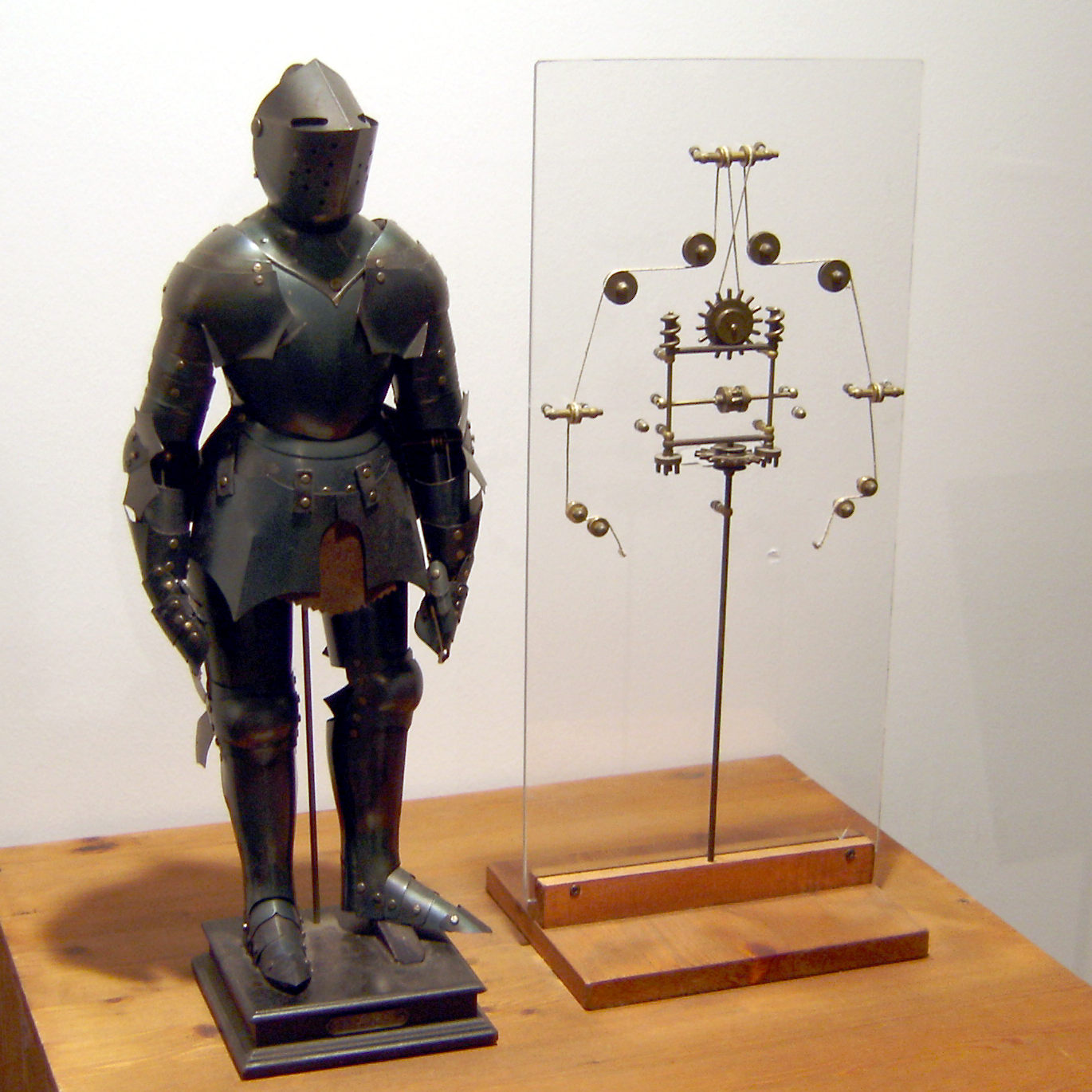
Image by Erik Möller, via Wikimedia Commons
Those of us who were playing video games in the nineteen-nineties may remember a fun little platformer, not technically unimpressive for its time, called Clockwork Knight. The concept of a clockwork knight turns out to have had some historical validity, or at least it could potentially have been justified by the then-current state of Leonardo da Vinci studies. Back in the fifties, writes Royal Montgomery at Unchained Robotics, “a team of scholars at the University of California were poring over a number of Leonardo da Vinci’s notebooks, specifically the Codices Atlanticus and Madrid.” There they found plans for what turned out to be “a life-size mechanical knight inside a fifteenth-century German suit of armor.”
More than one generation of enthusiasts and robotics specialists have since set about re-creating Leonardo’s “automaton.” Before 2007, writes Montgomery, “most reconstructed plans included a mechanical device in the belly of the knight. It was later determined that this device had nothing to do with the knight at all — it was actually part of a clock!”
Even if it didn’t run on literal clockwork, Leonardo’s knight would’ve made quite a spectacle. It “appears to have been assembled and displayed for the first time at a ceremony held by the Prince of Milan, Ludovico Sforza in 1495,” and in this sole appearance “could sit and stand, lift its own visor, and move its arms. It was stiff, sure, but you try moving gracefully in 15th century armor.”
However much it amused its aristocratic audience, Leonardo’s surreptitiously pulley-and-cable-operated “robot” would also have offered working, integrated proof of the kind of mechanical systems to which he’d long put his formidable engineering mind. And today, as pointed out at the site of the Robotic Online Short Film Festival, “we are fascinated and terrified in equal parts by humanoid robots for military purposes like Atlas, created by the company Boston Dynamics for DARPA (Defense Advanced Research Projects Agency of the United States). They are all heirs, with twenty-first century technology, to the robotic soldier designed by Leonardo.” The question of whether he also did any pioneering work on robot animals who could dance remains a matter of inquiry for future Leonardo scholars.
Related content:
Explore the Largest Online Archive Exploring the Genius of Leonard da Vinci
Leonardo da Vinci’s Elegant Design for a Perpetual Motion Machine
The Ingenious Inventions of Leonardo da Vinci Recreated with 3D Animation
The Amazing Engineering of Gauntlets (Armored Gloves) from the 16th Century
200-Year-Old Robots That Play Music, Shoot Arrows & Even Write Poems: Watch Automatons in Action
Based in Seoul, Colin Marshall writes and broadcasts on cities, language, and culture. His projects include the Substack newsletter Books on Cities, the book The Stateless City: a Walk through 21st-Century Los Angeles and the video series The City in Cinema. Follow him on Twitter at @colinmarshall or on Facebook.
A Preview of Sora, the New OpenAI Tool That Creates Remarkable AI-Generated Videos
A little over four years ago, we featured here on Open Culture a set of realistic images of people who don’t actually exist. They were, as we would now assume, wholly generated by an artificial-intelligence system, but back in 2018, there were still those who doubted that such a thing could be done without furtive human intervention. Now, after the release of tools like OpenAI’s ChatGPT and DALL‑E, few such doubters remain. In recent weeks, another OpenAI product has caused quite a stir despite having yet to be properly released: Sora, which can use text prompts to create not just replies in kind or still images, but minute-long video clips.
“This is simultaneously really impressive and really frightening,” says Youtuber Marques Brownlee in his introduction to Sora above. He examines some of the demo videos released so far by OpenAI, highlighting both their strengths and weaknesses.
It would be difficult not to feel at least a little astonishment at the result Sora has produced from the following prompt: “A stylish woman walks down a Tokyo street filled with warm glowing neon and animated city signage. She wears a black leather jacket, a long red dress, and black boots, and carries a black purse. She wears sunglasses and red lipstick. She walks confidently and casually. The street is damp and reflective, creating a mirror effect of the colorful lights. Many pedestrians walk about.”
There’s something Blade Runner going on here, in more senses than one. The not-quite-human qualities about this “footage” do stand out on closer inspection, and in any case make the whole thing feel, as Bownlee puts it, “a little bit… off.” But as he also emphasizes, repeatedly, it was just a year ago that the bizarre AI-generated Will Smith eating spaghetti made the social-media rounds as a representation of the state of the art. The underlying technology has clearly come a long, long way since then, and though the material so far released by OpenAI may feel faintly awkward and “video-gamey,” they clearly show Sora’s capability to create videos plausible at first and even second glance.
This may spell trouble not just for those currently in the stock-footage business, but also for those who happen to believe everything they watch. Brownlee calls the implications “insanely sketchy during an election year in the US,” but he may take some comfort in the fact that Sora is not, at the moment, available to the general public. There are also explainers, like the one from the Wall Street Journal video above, in which AI-industry professional Stephen Messer points out the telltale glitches of AI-generated video, many of which have to do with the finer details of physics and anatomy. And if you find yourself paying unusual attention to the consistency of the number digits on Messner’s hands, just tell yourself that this is how it feels to live in the future.
Related content:
Artificial Intelligence Creates Realistic Photos of People, None of Whom Actually Exist
A New Course Teaches You How to Tap the Powers of ChatGPT and Put It to Work for You
DALL‑E, the New AI Art Generator, Is Now Open for Everyone to Use
Based in Seoul, Colin Marshall writes and broadcasts on cities, language, and culture. His projects include the Substack newsletter Books on Cities, the book The Stateless City: a Walk through 21st-Century Los Angeles and the video series The City in Cinema. Follow him on Twitter at @colinmarshall or on Facebook.
“Hello Vincent”: A Generative AI Project Brings Vincent Van Gogh to Life at the Musée D’Orsay
?si=aoRK422gthc62UZE
If you attend the “Van Gogh in Auvers-sur-Oise” exhibition at the Musée D’Orsay, in Paris, you can spend time with “Hello Vincent,” a generative Artificial Intelligence project that allows visitors to have “a unique, personalized encounter” with Vincent van Gogh. According to CBS Sunday Morning, whose report we’ve included above, “Hello Vincent” allows museum visitors to converse with Van Gogh and ask him questions. His responses draw on a corpus of 900 letters where Van Gogh talks about his life and work. And apparently “the more questions you ask, the more the AI learns and improves.”
The “Hello Vincent” project was developed by Jumbo Mana, a startup specializing in generative AI that brings characters to life.
If you would like to support the mission of Open Culture, consider making a donation to our site. It’s hard to rely 100% on ads, and your contributions will help us continue providing the best free cultural and educational materials to learners everywhere. You can contribute through PayPal, Patreon, and Venmo (@openculture). Thanks!
Related Content
Download Hundreds of Van Gogh Paintings, Sketches & Letters in High Resolution
Martin Scorsese Plays Vincent Van Gogh in a Short, Surreal Film by Akira Kurosawa
Isaac Asimov Predicts the Future in 1982: Computers Will Be “at the Center of Everything;” Robots Will Take Human Jobs
Four decades ago, our civilization seemed to stand on the brink of a great transformation. The Cold War had stoked around 35 years of every-intensifying developments, including but not limited to the Space Race. The personal computer had been on the market just long enough for most Americans to, if not actually own one, then at least to wonder if they might soon find themselves in need of one. On New Year’s Eve of 1982, The MacNeil-Lehrer News Hour offered its viewers a glimpse of the shape of things to come by inviting a trio of forward-looking guests, Wasn’t the Future Wonderful author Tim Onosko; Omni magazine editor Dick Teresi; and, most distinguished of all, Isaac Asimov.
As the “author of more than 250 books, light and heavy, fiction and non-fiction, some of the most notable being about the future,” Asimov had long been a go-to interviewee for media outlets in need of long-range predictions about technology, society, and the dynamic relationship between the two. (Here on Open Culture, we’ve previously featured his speculations from 1983, 1980, 1978, 1967, and 1964.) Robert MacNeil opens with a natural subject for any science-fiction writer: mankind’s forays into outer space, and whether Asimov sees “anything left out there.” Asimov’s response: “Oh, everything.”
In the early eighties, the man who wrote the Foundation series saw humanity as “still in the Christopher Columbus stage as far as space is concerned,” foreseeing not just space stations but “solar power stations,” “laboratories and factories that can do things in space that are difficult or impossible to do on Earth,” and even “space settlements in which thousands of people can be housed more or less permanently.” In the fullness of time, the goal would be to “build a larger and more elaborate civilization and one which does not depend upon the resources of one world.”
As for “the computer age,” asks Jim Lehrer; “have we crested on that one as well”? Asimov knew full well that the computer would be “at the center of everything.” Just as had happened with television over the previous generation, “computers are going to be necessary in the house to do a great many things, some in the way of entertainment, some in the way of making life a little easier, and everyone will want it.” There were many, even then, who could feel real excitement at the prospect of such a future. But what of robots, which, as even Asimov knew, would come to “replace human beings?”
“It’s not that they kill them, but they kill their jobs,” he explains, and those who lose the old jobs may not be equipped to take on any of the new ones. “We are going to have to accept an important role — society as a whole — in making sure that the transition period from the pre-robotic technology to the post-robotic technology is as painless as possible. We have to make sure that people aren’t treated as though they’re used up dishrags, that they have to be allowed to live and retain their self-respect.” Today, the technology of the moment is artificial intelligence, which the news media haven’t hesitated to pay near-obsessive attention to. (I’m traveling in Japan at the moment, and saw just such a broadcast on my hotel TV this morning.) Would that they still had an Asimov to discuss it with a level-headed, far-sighted perspective.
Related content:
Isaac Asimov Predicts the Future on The David Letterman Show (1980)
Based in Seoul, Colin Marshall writes and broadcasts on cities, language, and culture. His projects include the Substack newsletter Books on Cities, the book The Stateless City: a Walk through 21st-Century Los Angeles and the video series The City in Cinema. Follow him on Twitter at @colinmarshall or on Facebook.
Before ChatGPT, There Was ELIZA: Watch the 1960s Chatbot in Action
In 1966, the sociologist and critic Philip Rieff published The Triumph of the Therapeutic, which diagnosed how thoroughly the culture of psychotherapy had come to influence ways of life and thought in the modern West. That same year, in the journal Communications of the Association for Computing Machinery, the computer scientist Joseph Weizenbaum published “ELIZA — A Computer Program For the Study of Natural Language Communication Between Man and Machine.” Could it be a coincidence that the program Weizenbaum explained in that paper — the earliest “chatbot,” as we would now call it — is best known for responding to its user’s input in the nonjudgmental manner of a therapist?
ELIZA was still drawing interest in the nineteen-eighties, as evidenced by the television clip above. “The computer’s replies seem very understanding,” says its narrator, “but this program is merely triggered by certain phrases to come out with stock responses.” Yet even though its users knew full well that “ELIZA didn’t understand a single word that was being typed into it,” that didn’t stop some of their interactions with it from becoming emotionally charged. Weizenbaum’s program thus passes a kind of “Turing test,” which was first proposed by pioneering computer scientist Alan Turing to determine whether a computer can generate output indistinguishable from communication with a human being.
In fact, 60 years after Weizenbaum first began developing it, ELIZA — which you can try online here — seems to be holding its own in that arena. “In a preprint research paper titled ‘Does GPT‑4 Pass the Turing Test?,’ two researchers from UC San Diego pitted OpenAI’s GPT‑4 AI language model against human participants, GPT‑3.5, and ELIZA to see which could trick participants into thinking it was human with the greatest success,” reports Ars Technica’s Benj Edwards. This study found that “human participants correctly identified other humans in only 63 percent of the interactions,” and that ELIZA, with its tricks of reflecting users’ input back at them, “surpassed the AI model that powers the free version of ChatGPT.”
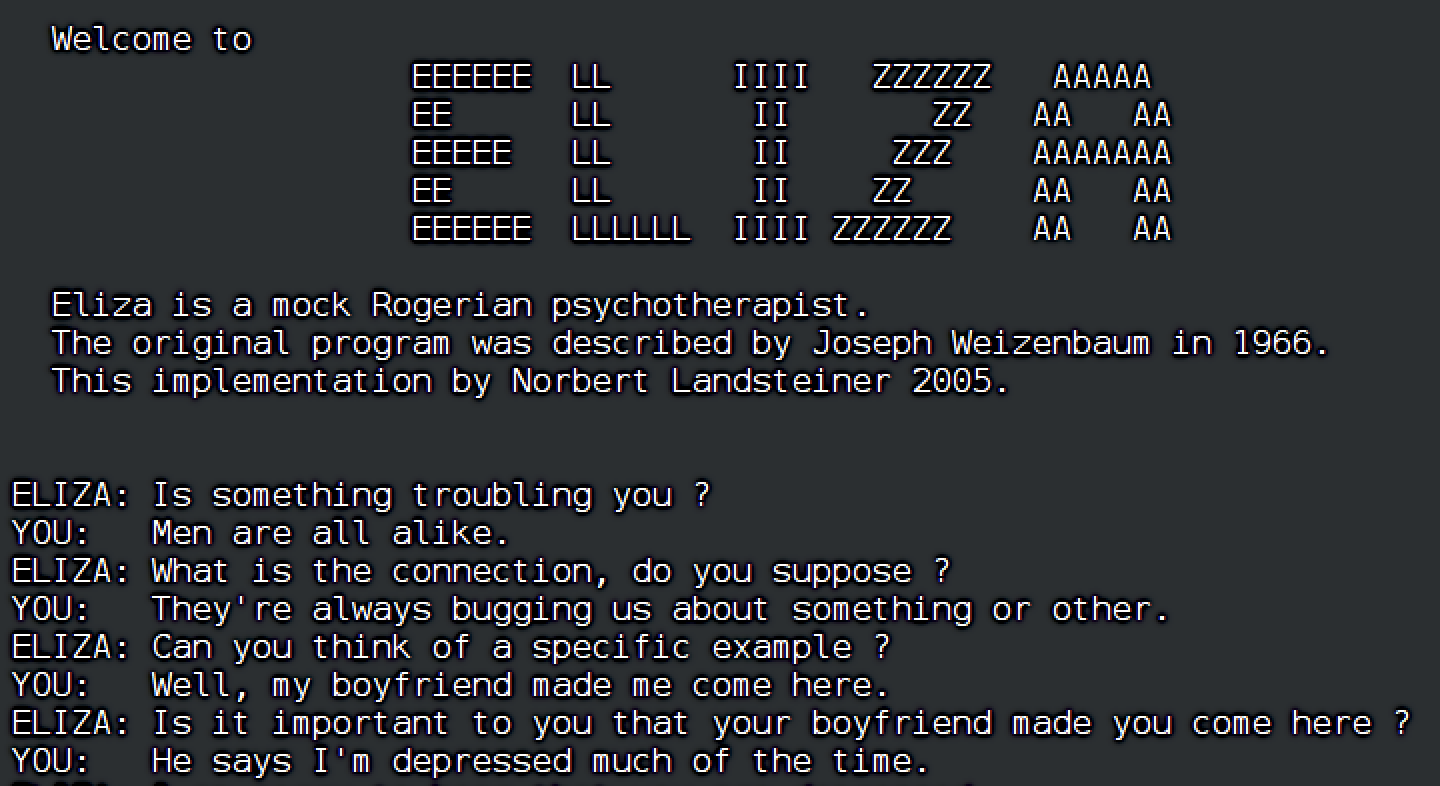
This isn’t to imply that ChatGPT’s users might as well go back to Weizenbaum’s simple novelty program. Still, we’d surely do well to revisit his subsequent thinking on the subject of artificial intelligence. Later in his career, writes Ben Tarnoff in the Guardian, Weizenbaum published “articles and books that condemned the worldview of his colleagues and warned of the dangers posed by their work. Artificial intelligence, he came to believe, was an ‘index of the insanity of our world.’ ” Even in 1967, he was arguing that “no computer could ever fully understand a human being. Then he went one step further: no human being could ever fully understand another human being” — a proposition arguably supported by nearly a century and a half of psychotherapy.
Related content:
A New Course Teaches You How to Tap the Powers of ChatGPT and Put It to Work for You
What Happens When Someone Crochets Stuffed Animals Using Instructions from ChatGPT
Noam Chomsky Explains Where Artificial Intelligence Went Wrong
Based in Seoul, Colin Marshall writes and broadcasts on cities, language, and culture. His projects include the Substack newsletter Books on Cities, the book The Stateless City: a Walk through 21st-Century Los Angeles and the video series The City in Cinema. Follow him on Twitter at @colinmarshall or on Facebook.
Support Us
We're hoping to rely on loyal readers, rather than erratic ads. Please click the Donate button and support Open Culture. You can use Paypal, Venmo, Patreon, even Crypto! We thank you!

About Us

Open Culture scours the web for the best educational media. We find the free courses and audio books you need, the language lessons & educational videos you want, and plenty of enlightenment in between.
Advertise With Us



