Once reserved for rebels and outliers, tattoos have gone mainstream in the United States. According to recent surveys, 21% of all Americans now have at least one tattoo. And, among the 18–29 demographic, the number rises to 40%. If that number sounds high, just wait until tattoos go from being aesthetic statements to biomedical devices.
At Harvard and MIT, researchers have developed “smart tattoo ink” that can monitor changes in biological and health conditions, measuring, for example, when the blood sugar of a diabetic rises too high, or the hydration of an athlete falls too low. Pairing biosensitive inks with traditional tattoo designs, these smart tattoos could conceivably provide real-time feedback on a range of medical conditions. And also raise a number of ethical questions: what happens when your health information gets essentially worn on your sleeve, available for all to see?
To learn more about smart tattoos, watch the Harvard video above, and read the corresponding article in the Harvard Gazette.
If you would like to support the mission of Open Culture, consider making a donation to our site. It’s hard to rely 100% on ads, and your contributions will help us continue providing the best free cultural and educational materials to learners everywhere. You can contribute through PayPal, Patreon, and Venmo (@openculture). Thanks!
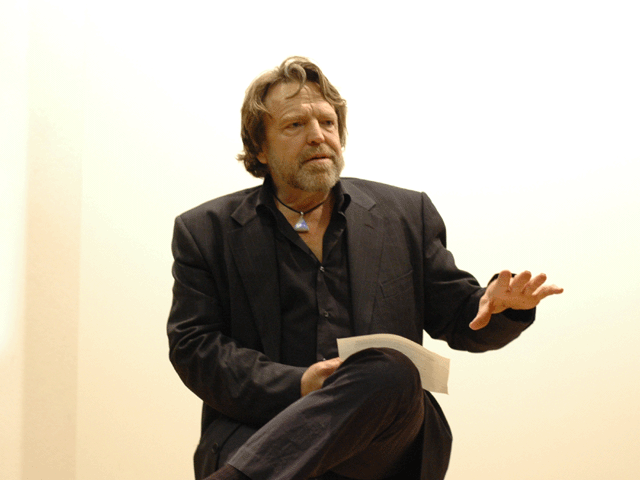
The most successful outlaws live by a code, and in many ways John Perry Barlow, founder of the Electronic Freedom Foundation, Wyoming rancher, and erstwhile songwriter for the Grateful Dead—who diedon Wednesday at the age of 70—was an archetypal American outlaw all of his life. He might have worn a white hat, so to speak, but he had no use for the government telling him what to do. And his charismatic defense of unfettered internet liberty inspired a new generation of hackers and activists, including a 12-year-old Aaron Swartz, who saw Barlow speak at his middle school and left the classroom changed.
Few people get to leave as lasting a legacy as Barlow, even had he not pioneered early cyberculture, penning the “Declaration of Independence of the Internet,” a techo-utopian document that continues to influence proponents of open access and free information. He introduced the Grateful Dead to Dr. Timothy Leary, under whose guidance Barlow began experimenting with LSD in college. His creative and personal relationship with the Dead’s Bob Weir stretches back to their high school days in Colorado, and he became an unofficial member of the band and its “junior lyricist,” as he put it (after Robert Hunter).
“John had a way of taking life’s most difficult things and framing them as challenges, therefore adventures,” wrote Weir in a succinctly poignant Twitter eulogy for his friend. We might think of Barlow’s code, which he laid out in a list he called the “25 Principles of Adult Behavior,” as a series of instructions for turning life’s difficulties into challenges, an adventurous reframing of what it means to grow up. For Barlow, that meant defying authority when it imposed arbitrary barriers and proprietary rules on the once-wild-open spaces of the internet.
But being a grown-up also meant accepting full responsibility for one’s behavior, life’s purpose, and the ethical treatment of oneself and others. See his list below, notable not so much for its originality but for its plainspoken reminder of the simple, shared wisdom that gets drowned in the assaultive noise of modern life. Such uncomplicated idealism was at the center of Perry’s life and work.
1. Be patient. No matter what. 2. Don’t badmouth: Assign responsibility, not blame. Say nothing of another you wouldn’t say to him. 3. Never assume the motives of others are, to them, less noble than yours are to you. 4. Expand your sense of the possible. 5. Don’t trouble yourself with matters you truly cannot change. 6. Expect no more of anyone than you can deliver yourself. 7. Tolerate ambiguity. 8. Laugh at yourself frequently. 9. Concern yourself with what is right rather than who is right. 10. Never forget that, no matter how certain, you might be wrong. 11. Give up blood sports. 12. Remember that your life belongs to others as well. Don’t risk it frivolously. 13. Never lie to anyone for any reason. (Lies of omission are sometimes exempt.) 14. Learn the needs of those around you and respect them. 15. Avoid the pursuit of happiness. Seek to define your mission and pursue that. 16. Reduce your use of the first personal pronoun. 17. Praise at least as often as you disparage. 18. Admit your errors freely and soon. 19. Become less suspicious of joy. 20. Understand humility. 21. Remember that love forgives everything. 22. Foster dignity. 23. Live memorably. 24. Love yourself. 25. Endure.
Barlow the “cowboy, poet, romantic, family man, philosopher, and ultimately, the bard of the digital revolution”—as Stephen Levy describes him at Wired—“became a great explainer” of the possibilities inherent in new media. He watched the internet become a far darker place than it had ever been in the 90s, a place where governments conduct cyberwars and impose censorship and barriers to access; where bad actors of all kinds manipulate, threaten, and intimidate.
But Barlow stood by his vision, of “a world that all may enter without privilege or prejudice accorded by race, economic power, military force, or station of birth… a world where anyone, anywhere may express his or her beliefs, no matter how singular, without fear of being coerced into silence or conformity.”
This may sound naïve, yet as Cindy Cohn writes in EFF’s obituary for its founder, Barlow “knew that new technology could create and empower evil as much as it could create and empower good. He made a conscious decision to move toward the latter.” His 25-point code urges us to do the same.
“Video,” as we now say on the internet, “or it didn’t happen,” articulating a principle to which the ever-forward-thinking National Aeronautics and Space Administration (NASA) has adhered for about 70 years now, starting with film in the time before the invention of video itself. Even setting aside the wonders of voyaging into outer space, NASA has done a few things right here on Earth that you wouldn’t believe unless you saw them with your own eyes. And now you easily can, thanks to the agency’s commitment to making the fruits of its research available to all on its YouTube Channel. Take for example this recently-uploaded collection of 400 historic flight videos.
Here we have just a sampling of the hundreds of videos available to all: the M2-F1, a prototype wingless aircraft, towed across a lakebed by a modified 1963 Pontiac Catalina convertible; a mid-1960s test of the Lunar Lander Research Vehicle, also known as the “flying bedstead,” that will surely remind long-memoried gamers of their many quarters lost to Atari’s Lunar Lander; a spin taken in the Mojave Desert, forty years later, by the Mars Exploration Rover; and, most explosively of all, a “controlled impact demonstration” of a Boeing 720 airliner full of crash-test dummies meant to test out a new type of “anti-misting kerosene” as well as a variety of other innovations designed to increase crash survivability.
These historic test videos were all shot back when the Armstrong Flight Research Center (re-named in 2014 for Neil Armstrong, whose legacy stands as a testament to the cumulative effectiveness of all these NASA tests) was known as the Hugh L. Dryden Flight Research Center: you can watch the 418 clips just from that era on this playlist.
Rest assured that the experimentation continues and that NASA still pushes the boundaries of aviation right here on Earth, a project continuously documented in the channel’s newest videos. As astonishing as we may find mankind’s forays up into the sky and beyond so far, the aviation engineer’s imagination, it seems, has only just gotten started.
Based in Seoul, Colin Marshall writes and broadcasts on cities and culture. His projects include the book The Stateless City: a Walk through 21st-Century Los Angeles and the video series The City in Cinema. Follow him on Twitter at @colinmarshall or on Facebook.
This week, the artificial intelligence community Botnik published a 2018 Coachella Lineup poster composed entirely of performer names generated by neural networks. It does get one wondering what the music of “Lil Hack,” “House of the Gavins,” or “Paper Cop” might sound like — or, given the direction of technology these days, how long it will take before another neural network can actually compose it. But why use AI to create yet another millennial-minded Coachella act, you might ask, when it could create another Johann Sebastian Bach?
“One form of music that Bach excelled in was a type of polyphonic hymn known as a chorale cantata,” says the MIT Technology Review. “The composer starts with a well-known tune which is sung by the soprano and then composes three harmonies sung by the alto, tenor, and bass voices.” Such compositions “have attracted computer scientists because the process of producing them is step-like and algorithmic. But doing this well is also hard because of the delicate interplay between harmony and melody.” Hence the fascination of the question of whether a computer could ever compose a truly Bach-like chorale.
The video at the top of the post offers a listening experience that points toward an answer. The minute-long piece you hear, and whose score you see, comes not from Bach himself, nor from any human Bach imitator, but from a neural network called DeepBach, a system developed by Gaetan Hadjeres and Francois Pachet at the Sony Computer Science Laboratories in Paris.
Like any such deep learning system, the more existing material it has to “learn” from, the more convincing a product it can produce on its own: just as Botnik’s network could learn from all the band names featured on Coachella posters since 1999, DeepBach could learn from the more than 300 short chorale compositions the real Bach wrote in his lifetime.
“About half the time,” says the MIT Technology Review, “these compositions fool human experts into thinking they were actually written by Bach.” But of course, this sort of artificial intelligence has a greater and more diverse potential than tricking its listeners, as other experiments at Sony CSL-Paris suggest: the AI-composed “Beatles” song “Daddy’s Car,” for instance, or the “Flow Machine” that re-interprets Beethoven’s “Ode to Joy” in the style of the Beatles, Take 6, and even electronic lounge music. But we won’t know the technology has matured until the day we find ourselves booking tickets for artificial intelligence-composed music festivals.
Based in Seoul, Colin Marshall writes and broadcasts on cities and culture. His projects include the book The Stateless City: a Walk through 21st-Century Los Angeles and the video series The City in Cinema. Follow him on Twitter at @colinmarshall or on Facebook.
In 2016, Reinhold Hanning, a former SS guard at the Auschwitz concentration camp, was tried and convicted for being an accessory to at least 170,000 deaths. In making their case, prosecutors did something novel–they relied on a virtual reality version of the Auschwitz concentration camp, which helped undermine Hanning’s claim that he wasn’t aware of what happened inside the camp. The virtual reality headset let viewers see the camp from almost any angle, and established that “Hanning would have seen the atrocities taking place all around him.”
The high-tech prosecution of Hanning gets well documented in “Nazi VR,” the short documentary above. It comes from MEL Films, and will be added to our collection of online documentaries.
If you would like to support the mission of Open Culture, consider making a donation to our site. It’s hard to rely 100% on ads, and your contributions will help us continue providing the best free cultural and educational materials to learners everywhere. You can contribute through PayPal, Patreon, and Venmo (@openculture). Thanks!
If you’ve so much as set foot in the realm of massive online open courses (MOOCs) — a list of which we offer right here on Open Culture — you’ve no doubt heard of Coursera, which, since it started up in 2012, has become one of the biggest MOOC providers around. Like most growing Silicon Valley companies, Coursera has branched out in several different directions, bringing in courses from universities from all over the world as well as offering certificate and Master’s programs. Now, in partnership with Google, it has launched a program to train information-technology professionals for jobs in the industry.
Techcrunch’s Ingrid Lunden describes Coursera’s Google IT Support Professional Certificate program as “a course written by Googlers for the Coursera platform to teach and then test across six fundamental areas of customer support: troubleshooting and customer service, networking, operating systems, system administration, automation, and security. No prior IT experience is necessary.” The global, English-language program “has 64 hours of coursework in all, and students are expected to complete it in eight to 12 months, at a cost of $49/month.” This means “the typical cost of the course for full-paying students will be between $392 and $588 depending on how long it takes,” which Lunden calls “a pretty good deal” compared to other IT training programs.
Amid talk of vanishing jobs across so many sectors of the economy, Coursera and Google are marketing the IT Support Professional Certificate as a promising path to gainful employment: “There’s no better example of a dynamic, fast-growing field than IT support,” writes Google Product Lead Natalie Van Kleef Conley, citing statistics showing 150,000 IT support jobs currently open in the United states and an average starting salary of $52,000. Coursera notes that “upon completion of the certificate, you can share your information with top employers, like Bank of America, Walmart, Sprint, GE Digital, PNC Bank, Infosys, TEKSystems, UPMC, and, of course, Google.”
If you suspect that you might share professional aspirations with young Edgar Barragan of Queens, whose testimonial video shows how he became a Google IT support specialist after participating in the program that evolved into the IT Support Professional Certificate, visit the official page on Coursera. There you can read up on the details of the six courses that make up the program and read answers to the questions frequently asked about it. Do you think you’d excel in a career amid the nuts and bolts of computers? With Google and Coursera’s program officially opening next Wednesday, January 24th, now’s a good time indeed to figure out whether it could get you where you want to be. Get more information and/or enroll here.
Note: Open Culture has a partnership with Coursera. If readers enroll in certain Coursera courses, it helps support Open Culture.
Based in Seoul, Colin Marshall writes and broadcasts on cities and culture. His projects include the book The Stateless City: a Walk through 21st-Century Los Angeles and the video series The City in Cinema. Follow him on Twitter at @colinmarshall or on Facebook.
Quick fyi: Earlier this month, we tried to make sense of the Bitcoin frenzy in the only we know how–by pointing you toward a free course. Specifically, we highlighted a Princeton course called Bitcoin and Currency Technologies that’s being offered on the online platform Coursera. The course is based on a successful course taught on Princeton’s campus.
And it’s worth mentioning that you can find the actual video lectures from that original campus course on Youtube. (See them embedded above, or access them directly here.) Pair the 12 lectures with the freePrinceton Bitcoin textbook and you should be ready to make sense of Bitcoin … and maybe even some of the Bitcoin hype.
If you would like to support the mission of Open Culture, consider making a donation to our site. It’s hard to rely 100% on ads, and your contributions will help us continue providing the best free cultural and educational materials to learners everywhere. You can contribute through PayPal, Patreon, and Venmo (@openculture). Thanks!
We’ve all had the experience, growing up, of using notepads for something other than their intended purpose: running our thumbs down their stacked-up pages and savoring the buzzing sound, turning them into flipbooks by painstakingly drawing a frame on each page, and even — in times of truly dire boredom — cutting them down into unusual sizes and shapes. Now, Japanese architectural model maker Triad has elevated that youthful impulse to great heights of aesthetic refinement with their lineup of Omoshiroi Blocks.
The Japanese word omoshiroi (面白い) can translate to “interesting,” “fun,” “amusing,” or a whole host of other such descriptors that might come to the mind of someone who runs across an Omoshiroi Block in person, or even on the internet.
According to Spoon & Tamago, Triad uses “laser-cutting technology to create what is, at first, just a seemingly normal square cube of paper note cards. But as the note cards get used, an object begins to appear. And you’ll have to exhaust the entire deck of cards to fully excavate the hidden object.
These objects include “various notable architectural sites in Japan like Kyoto’s Kiyomizudera Temple, Tokyo’s Asakusa Temple and Tokyo Tower. The blocks are composed of over 100 sheets of paper and each sheet is different from the next in the same way that individual moments stack up together to form a memory.” Other three-dimensional entities excavatable from Omoshiroi Blocks include trains, cameras, and even the streetscape of Detroit, which includes the late John C. Portman Jr.‘s Renaissance Center — the Tokyo Tower, you might say, of the Motor City.
You can see most of these Omoshiroi Blocks, and others, on Triad’s Instagram account. You may have no other option at the moment, since Triad’s official site has recently been overwhelmed by visitors, presumably seeking a few of these recently-gone-viral blocks for themselves. Besides, notes their most recent Instagram post, “all items are out of stock. So, overseas shipping is not possible at this moment. Please wait for our online shop announcements to be updated.”
If you can’t make it out there, rest assured that Triad will probably have their online shop up and running before this year’s holiday season, thus providing you with an impressive gift option for the enthusiasts in your life of architecture, stationery, unconventional uses of technology, small-scale intricate craftsmanship, and the artifacts of Japanese culture — all fields in which Japan has spent hundreds, if not thousands of years excelling.
Based in Seoul, Colin Marshall writes and broadcasts on cities and culture. His projects include the book The Stateless City: a Walk through 21st-Century Los Angeles and the video series The City in Cinema. Follow him on Twitter at @colinmarshall or on Facebook.
We're hoping to rely on loyal readers, rather than erratic ads. Please click the Donate button and support Open Culture. You can use Paypal, Venmo, Patreon, even Crypto! We thank you!
Open Culture scours the web for the best educational media. We find the free courses and audio books you need, the language lessons & educational videos you want, and plenty of enlightenment in between.