Like many famous episodes in the lives of famous people, Andy Warhol’s 15 minutes quote turns out to be a garbling of what happened. Warhol simply said that everybody wants to be famous (and by implication, famous forever). To which the Factory’s “court photographer” Nat Finkelstein replied, “yeah, for 15 minutes.” Given the way the idea has come down to us, we’ve missed the ambiguity in this exchange. Do we all want to be famous for 15 minutes (and only 15 minutes), or do we only spend 15 minutes wanting to be famous before we move on and accept it as a sucker’s game?
Finkelstein himself might have felt the latter as he watched “pop die and punk being born” (he said in a 2001 interview). It was the death of Warhol’s fame ideal, and the birth of something new: music that loudly declared open hostilities against the gatekeepers of popular culture. Not every punk band reserved its punches for those above them. California hardcore legends Fear — led by confrontational satirist Lee Ving — swing wildly in every direction, hitting their audience as often as the powers that be.
When their first taste of Warholian fame came around — in Penelope Spheeris’ 1981 documentary The Decline of Western Civilization — Ving used the moment in front of the cameras to taunt and abuse audience members until a few of them rushed the stage to fight him. Had NBC executives seen this footage casual violence, profanity, and worrisome ebullience, it’s unlikely they would have let returning guest John Belushi book Fear on Halloween night of that same year.
The SNL appearance — for which Fear proudly earned a permanent ban — became the stuff of legend. Not only did Ving and band get up to their usual antics onstage, but the show brought in a crew of about 80 DC punks (including Dischord Records/Fugazi founder Ian MacKaye), who smashed up the set and joined the band in solidarity against New York and its saxophones. The network cut the broadcast short when one punk (identified as either MacKaye or John Brannon of the band Negative Approach) yelled “F*ck New York!” into an open mic during the last song, “Let’s Start a War.” NBC shelved the footage for years.
Although well-known in fan communities, the appearance might have faded from memory were it not for the internet, which not only has the Warholian power to make anyone famous (or “internet famous”) for no reason, but also routinely resurrects lost moments of fame and makes them last forever. Just so, the legend of Fear on SNL has grown over time on YouTube. It now warrants a short documentary — one made, no less, by Jeff Krulik, a filmmaker who, five years after the Fear appearance, documented another burgeoning Fear-like fandom in his cult short, “Heavy Metal Parking Lot.”
“Fear on SNL,” above, includes several interview clips from firsthand witnesses. DC “punk superfan” Bill MacKenzie listens to an old interview he gave about the show, in which he says the band asked him to come to the taping. As Ian MacKaye tells it, Lorne Michaels himself placed the call. (He must mean producer Dick Ebersol, as Michaels left the show in 1980 and wouldn’t return until 1985.) But both MacKaye and Ving remember that it was Belushi who really rounded up the audience of authentic punks, leveraging his own hard-won celebrity to stick it to the factory that made his fame.
While there are many close-ups of their fresh young faces, the control room wisely chose to zoom out much of the time, in appreciation of the brothers’ precision choreography.
The brightest star was the youngest, eleven-year-old Michael, taking lead vocals in purple fedora and fringed vest on a cover of Sly and the Family Stone’s “Stand.”
Jackie, Tito, Jermaine, and Marlon provide support for a bit of hokum that positions Michael at the center of an elementary school romance, by way of introduction to a full throated cover of Smokey Robinson’s “Who’s Loving You”:
We toasted our love during milk break. I gave her my cookies! We fell out during fingerpainting.
Halfway through, he forgets his lines and freezes, looking back at his older brothers for help. It’s an alarmingly vulnerable moment, one only possible in the era of live television. You feel bad for him. It suddenly doesn’t seem right that a kid should be made to perform live in front of an entire country. Yet he somehow finds his way back and stumbles through.
When the music starts, we see something else entirely. The first note he sings is as confident, sure, and purposeful as any adult could ever be. He transforms from nervous child at a talent show into timeless embodiment of longing. Not only does he sing exactly on key but he appears to sing from the very bottom of his heart. He stares into the camera, shakes his head, and blinks back tears in perfect imitation of a sixties soul man. And it feels, for a moment, as though there are two different beings here. One is a child—a smart kid, to be sure, and cute, but not more special than any other child. He is subject to the same laws of life—pain, age, confusion, fear—as we all are. The other being seems to be a spirit of sorts, one who knows only the truest expression of human feeling. And this spirit appears to have randomly inhabited the body of this particular mortal kid. In so doing, it has sentenced him to a lifetime of indescribable enchantment and consummate suffering.
Michael’s explosive performance of the Jackson 5’s first national single, “I Want You Back,” released just two months before their Sullivan Show appearance, gives us that “spirit” in full force.
It’s also not hard to imagine that the brothers’ thrillingly executed choreography is the result of a literally punishing rehearsal regimen, a factor of the King of Pop’s troubled legacy.
The Sullivan Show appearance ensured that there would be no stopping this train. Five months later, when the Jacksons returned to the Sullivan Show, “I Want You Back” had sold over a million copies, as had “ABC,” which they performed as a medley.
Boyhood is fleeting, making Jacksonmania a carpe diem type situation.
The period from 1969 to 1972 saw an onslaught of Jackson 5‑related merch and a funky Saturday morning cartoon whose pilot tarted up the Diana Ross origin story with an escaped pet snake.
Ayun Halliday is the Chief Primaologist of the East Village Inky zine and author, most recently, of Creative, Not Famous: The Small Potato Manifesto. Follow her @AyunHalliday.
Oh, to be in the studio audience of CBS’ Television City in Hollywood on September 9th, 1956, to see Elvis Presley’s gyrating pelvis rocket him to superstardom on The Ed Sullivan Show.
His appearance made television history, but 60 million home viewers were left to fill in some major blanks, as the rising heartthrob was filmed from the waist up whenever he was in motion.
Sullivan had been hesitant to book Elvis, not wanting to court the outrage the magnetic young singer had sparked in two “suggestive” appearances on The Milton Berle Show earlier that year. Elvis, he told the press, was “not my cup of tea” and “wasn’t fit for family entertainment.”
Elvis was displeased by this jokey spin, but submitted, and newcomer Allen’s ratings clobbered Sullivan’s that week.
Sullivan sent Steve Allen a telegram:
Steven Presley Allen, NBC TV, New York City. Stinker. Love and kisses. Ed Sullivan.
Whether Sullivan was throwing down a gauntlet, or delivering congratulations with a side of poor sportsmanship is somewhat unclear, but Sullivan was now ready to claim his stake, at ten times the price.
The $5,000 appearance fee that had been floated prior to Elvis’ appearance on The Milton Berle Show, had ballooned to the jaw dropping sum of $50,000 for 3 episodes.
Sullivan and Presley’s names are forever linked for that historic first appearance, but injuries from a car crash knocked the host out of commission. Actor Charles Laughton subbed in as host from Sullivan’s New York studio, and was charged with ushering in Elvis’s remote appearance in a very particular way.
Presley was the headliner, and a Sullivan headliner normally opened the show, but Sullivan was burying him. Laughton had to make the moment invisible: to act as if nobody was actually waiting for anything. He did it instantly, with complete command, with the sort of television presence that some have and some — Steve Allen, or Ed Sullivan himself — don’t. It’s a sense of ease, a querulous interrogation of the medium itself, affirming one’s own odd, irreducible subjectivity against the objectivity enforced by any system of representations: that is, getting it across that at any moment that you might forget where you are and say whatever comes into your head, which was exactly what half the country hoped and half the country feared might be the case with Elvis Presley.
Laughton, who elsewhere in the show used a reading of James Thurber’s Red Riding Hood parody, “The Little Girl and the Wolf” to insinuate that “it’s not so easy to fool little girls nowadays as it used to be,” settled on a non-committal “and now, away to Hollywood to meet Elvis Presley!”
Elvis, clad in a non-threatening plaid jacket on a set trimmed with guitar-shaped cut outs, thanked Laughton, and wiped his brow:
Wow. This is probably the greatest honor I’ve ever had in my life. Ah. There’s not much I can say except, it really makes you feel good. We want to thank you from the bottom of our heart.
His first number, “Don’t Be Cruel,” had an immediate effect on the teenage girls in attendance, who knew what they were seeing.
“Thank you, ladies,” he said, coyly acknowledging what all knew to be true, before going on to debut the title song of the motion picture he was in town to film, Love Me Tender, his first of 31 such vehicles.
Disc jockeys tuned in to tape the unreleased song for play on their radio shows, shooting pre-sales up to nearly a million.
As a great philosopher once said…’You ain’t nothin’ but a hound dog!’
Cue screams.
A week later, The New York Times’ Jack Gould alleged that in booking Elvis, Sullivan had failed to “exercise good sense and display responsibility,” moralizing that “in some ways it was perhaps the most unpleasant of (the singer’s) recent three performances:
Mr. Presley initially disturbed adult viewers — and instantly became a martyr in the eyes of his teen- age following — for his striptease behavior on last spring’s Milton Berle program. Then with Steve Allen he was much more sedate. On the Sullivan program he injected movements of the tongue and indulged in wordless singing that were singularly distasteful.
At least some parents are puzzled or confused by Presley’s almost hypnotic power; others are concerned; perhaps most are a shade disgusted and content to permit the Presley fad to play itself out.
Neither criticism of Presley nor of the teen-agers who admire him is particularly to the point. Presley has fallen into a fortune with a routine that in one form or another has always existed on the fringe of show business; in his gyrating figure and suggestive gestures the teen-agers have found something that for the moment seems exciting or important.
Cue more screams.
A month and a half after his first Sullivan Show booking, Elvis and Sullivan met in the New York studio for a follow up, along with a chaste youth choir, the Little Gaelic Singers, and ventriloquist Señor Wences. (S’alright? S’alright.)
“Don’t Be Cruel,” “Love Me Tender,” and “Hound Dog” were on the menu again, along with a brand new release — “Love Me,” above.
Señor Wences was not the tough act to follow here.
The appearance resulted in more wildly high ratings for Sullivan, and a growing awareness of the perils of rock n’ roll, as embodied by Elvis’ well lubricated nether regions, which the camera, fooling no one, again shied from at crucial moments.
Cue another million teenage fan club enrollments, as well as parents, clergy and other concerned citizens who came together to burn the singer in effigy in Nashville and St. Louis.
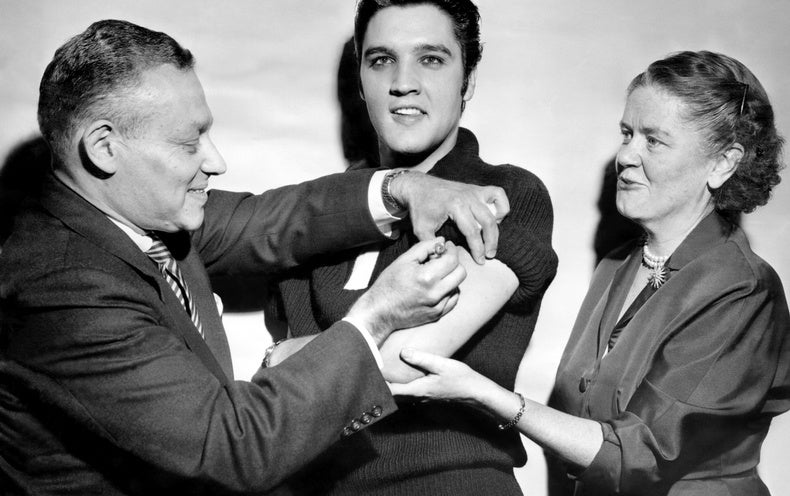
Nearly as notable, from the perspective of 2021, was the public service Elvis performed backstage, allowing himself to be photographed receiving the polio vaccine, in hopes his legions of admirers would follow suit.
Elvis’ third visit to Sullivan’s show, January 6th, 1957, would prove to be his last, owing to the astronomical fee his manager Colonel Tom Parker set for future television appearances: $300,000 with the promise of two guest spots and an hour-long special. An attempt to book Elvis for Sullivan’s 10th anniversary celebration, was thwarted by the fact that Elvis was abroad, serving in the Army.
Another massive audience tuned in for another helping of hits — “Hound Dog,” “Love Me Tender,” “Heartbreak Hotel,” and “Don’t Be Cruel,” as well as newer material — “Too Much” and “When My Blue Moon Turns To Gold Again.”
Between songs, Sullivan advised the swooning teenagers to rest their larynxes and introduced Elvis’ performance of the gospel standard, “Peace in the Valley,” by urging viewers to contribute to a Hungarian refugee relief fund Elvis supported.
While many fans persist in the belief that the gospel number was included as an affectionate nod to the singer’s beloved mother, Gladys, a letter from Colonel Parker’s assistant to Elvis suggests that the choice had more to do with his host:
Mr. Sullivan thought it might be very appropriate for you to sing a hymn or a semi-religious song on the show. You certainly can sing a hymn very effectively and I think it would make a very strong impression on all the viewers. It has been suggested that a song like ‘Peace in the Valley’ might be held in readiness. We have obtained the music on this song and are forwarding it to you.”
This time, home viewers really were left to guess what was going on below the star’s sequined vest and open collared blouse, described by Marcus as “the outlandish costume of a pasha, if not a harem girl:”
From the make-up over his eyes, the hair falling in his face, the overwhelmingly sexual cast of his mouth, he was playing Rudolph Valentino in The Sheik, with all stops out. That he did so in front of the Jordanaires, who this night appeared as the four squarest-looking men on the planet, made the performance even more potent.
Sullivan’s first co-producer, Marlo Lewis, intimated that the decision to formalize a waist-up policy for Elvis’ third visit was sparked by a rumor that had dogged his prior appearances. To wit:
Elvis has been hanging a small soft-drink bottle from his groin underneath his pants, and when he wiggles his leg it looks as though his pecker reaches down to his knee!
Meanwhile, it appeared Sullivan was no longer willing to be lumped in with Elvis’ detractors, closing the show by saying:
I wanted to say to Elvis Presley and the country that this is a real decent, fine boy, and wherever you go, Elvis, we want to say we’ve never had a pleasanter experience on our show with a big name than we’ve had with you. So now let’s have a tremendous hand for a very nice person!
Had Elvis won him over, or was it, as cultural critic Tim Parrish asserts, that Colonel Parker, “had threatened to remove Elvis from the show if Sullivan did not apologize for telling the press that Elvis’s ‘gyrations’ were immoral.”
Watch all of Elvis Presley’s performances on The Ed Sullivan Show in HD here.
For a glimpse of the 1956 Gibson J‑200 Elvis played in that final appearance, and speculation as to whether he crossed paths with fellow guests Carol Burnett and Lena Horne, watch Graceland archivist Angie Marchese’s show and tell of ephemera related to his stints on the Ed Sullivan Show.
To lysergic acid diethylamide, better known as LSD, we owe much of what has endured from Western popular culture of the mid-20th century: consider, for instance, the latter half of the Beatles’ oeuvre. In Revolution in the Head: The Beatles’ Records and the Sixties, Ian MacDonald describes LSD as “a powerful hallucinogen whose function is temporarily to dismiss the brain’s neural concierge, leaving the mind to cope as it can with sensory information which meanwhile enters without prior arrangement — an uncensored experience of reality which profoundly alters one’s outlook on it.”
So profound is that alteration that some came to believe in a utopia achievable through universal ingestion of the drug: “If there be necessary revolution in America,” declared Allen Ginsberg, “it will come this way.” But most Americans didn’t see it quite the same way. It was for them that CBS made its broadcast “The Hippie Temptation.” Aired in August 1967, three months after the release of Sgt. Pepper’s Lonely Heart’s Club Band, it constitutes an exposé of LSD-fueled youth culture as it effervesced at the time in and around San Francisco’s countercultural mecca of Haight-Ashbury.
“The hippies present a strange problem,” says correspondent Harry Reasoner, later known as the host of 60 Minutes. “Our society has produced them. There they are, in rapidly increasing numbers. And yet there seem to be very few definite ideas behind the superficial glitter of their dress and behavior.” In search of the core of the hippie ideology, which seems outwardly to involve “standing apart from society by means of mutual help and love,” Reasoner and his collaborators delve into the nature of LSD, whose users “may see a wild complexity of images, hear a multiplicity of sounds. This is called ‘taking an acid trip.’ ”
Alas, “for many, the price of taking the shortcut to discovery the hippies put forward turns out to be very high.” A young doctor from UCLA’s neuropsychiatric institute named Duke Fisher argues that most LSD users “talk about loving humanity in general, an all-encompassing love of the world, but they have a great deal of difficulty loving one other person, or loving that specific thing.” Also included in “The Hippie Temptation” are interviews with young people (albeit ones cleaner-cut than the average denizen of late-60s Haight-Ashbury) placed into medical facilities due to hallucinogen-related mishaps, including suicide attempts.
“There is the real danger that more and more young people may follow the call to turn on, tune in, drop out,” Reasoner declares, in keeping with the broadcast’s portentous tone. Even then there were signs of what MacDonald calls “the hippie counterculture’s incipient commercialization and impending decline into hard drugs.” But to this day, “that there was indeed something unusual in the air can still be heard from many of the records of the period: a light, joyous optimism with a tangible spiritual aura and a thrillingly fresh informality” — a quality MacDonald finds concentrated in the work of not just The Beatles but the Grateful Dead, who sit for an interview in “The Hippie Temptation.” LSD may no longer be as tempting as it was half a century ago, but many of the creations it inspired then still have us hooked today.
Based in Seoul, Colin Marshall writes and broadcasts on cities, language, and culture. His projects include the Substack newsletterBooks on Cities, the book The Stateless City: a Walk through 21st-Century Los Angeles and the video series The City in Cinema. Follow him on Twitter at @colinmarshall or on Facebook.
In the mid-50s, Maya Angelou accepted a role as a chorus member in an international touring production of the opera, Porgy and Bess:
I wanted to travel, to try to speak other languages, to see the cities I had read about all my life, but most important, I wanted to be with a large, friendly group of Black people who sang so gloriously and lived with such passion.
On a stopover in Paris, she met James Baldwin, who she remembered as “small and hot (with) the movements of a dancer.”
The two shared a love of poetry and the arts, a deep curiosity about life, and a passionate commitment to Black rights and culture. They forged a connection that would last the rest of their lives.
In 1968, when Angelou despaired over the assassination of Martin Luther King Jr., Baldwin did what he could to lift her spirits, including escorting her to a dinner party where she captivated the other guests with her anecdotal storytelling, paving a path to her celebrated first memoir, I Know Why the Caged Bird Sings.
The book wouldn’t have been written, however, without some discreet behind-the-scenes meddling by Baldwin.
Angelou considered herself a poet and a playwright, and resisted repeated attempts by fellow dinner party guest, Random House editor Robert Loomis, to secure her autobiography.
As Angelou later discovered, Baldwin counseled Loomis that a different strategy would produce the desired result. His dear friend might not conceive of herself as a memoirist, but would almost assuredly respond to reverse psychology, for instance, a statement that no autobiography could compete as literature.
I said, ‘Well, hmmm, maybe I’ll try it.’ The truth is that (Loomis) had talked to James Baldwin, my brother friend, and Jimmy told him that ‘if you want Maya Angelou to do something, tell her she can’t do it.’
“This testimony from a Black sister marks the beginning of a new era in the minds and hearts and lives of all Black men and women,” Baldwin enthused upon its publication.
They became siblings of affinity. Witness their easy rapport on the 1975 episode of Assignment America, above.
Every episode centered on someone who had made an important contribution to the ideas and issues of America, and Angelou, who alternated hosting duties with psycho-historian Doris Kearns Goodwin, columnist George Will, and oral historian Studs Terkel, landed an extremely worthy subject in Baldwin.
Their friendship made good on the promise of her hopes for that European tour of Porgy and Bess.
Their candid discussion covers a lot of overlapping ground: love, death, race, aging, sexual identity, success, writing, and the closeness of Baldwin’s family — whom Angelou adored.
Those of us in the generations who came after, who became acquainted with Angelou, the commanding, supremely dignified elder stateswoman, commanding more authority and respect than any official Poet Laureate, may be surprised to see her MO as interviewer, giggling and teasing, functioning as the chorus in a room where code switching is most definitely not a thing:
Baldwin: I think…the only way to live is knowing you’re going to die. If you’re afraid to die, you’ll never be able to live.
Angelou: Hey, hey!
Baldwin: You know.
Angelou: Hey, hey.
Baldwin: And nobody knows anything about that.
Angelou: Yes, yes, yes.
She poses great questions, and listens without interrupting to her friend’s thoughtfully composed answers, for instance, his description of his family’s response to his decision to base himself in France, far from their Harlem home:
Sweetheart, you have to understand, um, you have to understand what happens to my mother’s telephone when I’m in town. People will call up and say what they will do to me. It doesn’t make me shut up. You, you also gotta remember that I’ve been writing, after all, between assassinations. If you were my mother or my brother, you would think, who’s next?
There’s a lot of food for thought in that reply. The familiar connection between interviewer and subject, both towering figures of American literature, brings a truly rare dimension, as when Angelou shares how Baldwin’s older brothers would reserve a part of the proceeds from selling coal in the winter and ice in the summer to send to Baldwin:
In France! I mean to think of a Black American family in Harlem, who had no pretensions to great literature… and to have the oldest boy leave home and go to Paris, France, and then for them to save up enough pennies and nickels and dimes to send a check of $150 to him, in Paris, France!
Baldwin: That’s what people, that’s what people don’t really know about us.
Angelou: One of the things I think, I mean I believe that we are America. It is true.
Please watch out for each other and love and forgive everybody. It’s a good life, enjoy it. — Jim Henson
Born in Greenville, Mississippi, Jim Henson spent his youth practicing the tenets of Christian Science, a faith he would officially renounce in 1975. But the power of positive thinking his early religion years instilled would persist, romanticized by his alter-ego, Kermit the Frog, and tempered by foils like the earthy, irascible Ms. Piggy. For every foul-mouthed Oscar the Grouch, there was always a lovable Big Bird, “Jim taught us many things: to save the planet, be kind to each other, praise God, and be silly,” said Muppet writer Jerry Juhl at Henson’s 1990 New York City memorial service. “That’s how I’ll remember him — as a man who was balanced effortlessly and gracefully between the sacred and the silly.”
Henson’s first memorial, held at the cavernous Cathedral of St. John the Divine bore witness to Juhl’s portrait of the late, brilliant creator’s legacy. In true Henson fashion, the puppeteer directed the event himself from beyond the grave, a final lighthearted joke, as he had written in a letter to his family four years earlier: “It feels strange writing this while I am still alive, but it wouldn’t be easy after I go …. This all may seem silly to you guys, but what the hell, I’m gone and who can argue with me?”
To the sounds of jazz, his friends and family added — of course — the songs that defined Henson’s career, including “Sunny Day,” the Sesame Street theme song, Muppets anthem “The Rainbow Connection,” and — in a second memorial service held two months later at St. Paul’s in London — Kermit the Frog’s anthem, “It’s Not Easy Being Green” (above) sung by Big Bird and Oscar puppeteer Caroll Spinney. (Spinney passed away in 2019.) Both Henson memorials were solemn (unavoidable given the occasion and the venues) but also decidedly silly, as story after story about the man poured forth from those who knew him best.
In the Defunctland video at the top, you can see Henson’s friend and frequent collaborator Juhl take the pulpit at St. John the Divine to tell his favorite Henson story of working on their first show in 1955, Sam and Friends, a local Washington, D.C. live-action/puppet program that gave birth to Kermit. Doubting the joke at the heart of a sketch, Juhl went to Henson with his misgivings; and Henson replied, “It’s a terrible joke, but it’s worthy of us.” The laughter that rumbles through the crowd is characteristic of both funeral services, which feel far more intimate than they are. Or as Henson’s son Brian says in his tribute, “Sorry Dad. Little service, big place.” See the full New York funeral service for Henson just below.
Writers Sarahlyn Bruck and Kayla Dreysse join your host Mark Linsenmayer to discuss how this once very popular TV show type has simultaneously become niche, yet has had a tremendous influence on current prestige TV as well as reality shows. We talk about soaps’ story and structure conventions, the demands on soap actors and writers, and how changing market forces and technology have affected the genre. How much of a role does sexism play in the critical dismissal of soaps?
In addition to the daytime soaps like General Hospital and The Bold and the Beautiful, we touch on nighttime soaps like Dallas, teen soaps like Beverly Hills 90210, Downton Abbey, White Orchid, Breaking Bad, 24, Gray’s Anatomy, and more.
No one living has experienced a viral event the size and scope of COVID-19. Maybe the unprecedented nature of the pandemic explains some of the vaccine resistance. Diseases of such virulence became rare in places with ready access to vaccines, and thus, ironically, over time, have come to seem less dangerous. But there are still many people in wealthy nations who remember polio, an epidemic that dragged on through the first half of the 20th century before Jonas Salk perfected his vaccine in the mid-fifties.
Polio’s devastation has been summed up visually in textbooks and documentaries by the terrifying iron lung, an early ventilator. “At the height of the outbreaks in the late 1940s,” Meilan Solly writes at Smithsonian, “polio paralyzed an average of more than 35,000 people each year,” particularly affecting children, with 3,000 deaths in 1952 alone. “Spread virally, it proved fatal for two out of ten victims afflicted with paralysis. Though millions of parents rushed to inoculate their children following the introduction of Jonas Salk’s vaccine in 1955, teenagers and young adults had proven more reluctant to get the shot.”
At the time, there were no violent, organized protests against the vaccine, nor was resistance framed as a patriotic act of political loyalty. But “cost, apathy and ignorance became serious setbacks to the eradication effort,” says historian Stephen Mawdsley. And, then as now, irresponsible media personalities with large platforms and little knowledge could do a lot of harm to the public’s confidence in life-saving public health measures, as when influential gossip columnist Walter Winchell wrote that the vaccine “may be a killer,” discouraging countless readers from getting a shot.
When Elvis Presley made his first appearance on Ed Sullivan’s show in 1956, “immunization levels among American teens were at an abysmal 0.6 percent,” note Hal Hershfield and Ilana Brody at Scientific American. To counter impressions that the polio vaccine was dangerous, public health officials did not solely rely on getting more and better information to the public; they also took seriously what Hershfield and Brody call the “crucial ingredients inherent to many of the most effective behavioral change campaigns: social influence, social norms and vivid examples.” Satisfying all three, Elvis stepped up and agreed to get vaccinated “in front of millions” backstage before his second appearance on the Sullivan show.
Elvis could not have been more famous, and the campaign was a success for its target audience, establishing a new social norm through influence and example: “Vaccination rates among American youth skyrocketed to 80 percent after just six months.” Despite the threat he supposedly posed to the establishment, Elvis himself was ready to serve the public. “I certainly never wanna do anything,” he said, “that would be a wrong influence.” See in the short video at the top how American public health officials stopped millions of preventable deaths and disabilities by admitting a fact propagandists and advertisers never shy from — humans, on the whole, are easily persuaded by celebrities. Sometimes they can even be persuaded for the good.
We're hoping to rely on loyal readers, rather than erratic ads. Please click the Donate button and support Open Culture. You can use Paypal, Venmo, Patreon, even Crypto! We thank you!
Open Culture scours the web for the best educational media. We find the free courses and audio books you need, the language lessons & educational videos you want, and plenty of enlightenment in between.