Is Opera Part of Pop Culture? Pretty Much Pop #15 with Sean Spyres

This image has an empty alt attribute; its file name is PMP-Opera-as-Pop-400-x-800.jpg

Opera used to be a cen­tral part of Euro­pean pop cul­ture, Pavarot­ti was as big a pop star as they come. But still, it’s now the quin­tes­sen­tial art-form of the wealthy and snob­bish. What gives?

Guest Sean Spyres from Spring­field Region­al Opera joins his sis­ter Eri­ca along with Mark and Bri­an to dis­cuss oper­a’s place in cul­ture (includ­ing its film appear­ances), how it’s dif­fer­ent from music the­ater, the chal­lenges it faces and how it might become more rel­e­vant.

Some arti­cles:

Watch the Shaw­shank Redemp­tion opera scene or per­haps the Pret­ty Woman scene. What Is pop opera? Here’s Ranker’s list of artists. Paul Potts sings that famous song on Britain’s Got Tal­ent. Plus, check out albums from broth­er Michael Spyres. Yes, you can hear an opera-singer sing “Take Me Out to the Ball­game,” but you prob­a­bly should­n’t.

This episode includes bonus dis­cus­sion that you can only hear by sup­port­ing the pod­cast at patreon.com/prettymuchpop. This pod­cast is part of the Par­tial­ly Exam­ined Life pod­cast net­work.

Pret­ty Much Pop is the first pod­cast curat­ed by Open Cul­ture. Browse all Pret­ty Much Pop posts or start with the first episode.

Patti Smith Sings “People Have the Power” with a Choir of 250 Fellow Singers

…peo­ple have the pow­er

To redeem the work of fools

—Pat­ti Smith

As protest songs go, “Peo­ple Have the Pow­er” by God­moth­er of Punk Pat­ti Smith and her late hus­band Fred Son­ic Smith is a true upper.

The goal was to recap­ture some of the ener­gy they’d felt as youth activists, com­ing togeth­er to protest the Viet­nam War. As Pat­ti declared in an NME Song Sto­ries seg­ment:

… what we want­ed to do was remind the lis­ten­er of their indi­vid­ual pow­er but also of the col­lec­tive pow­er of the peo­ple, how we can do any­thing. That’s why at the end it goes, “I believe every­thing we dream can come to pass, through our union we can turn the world around, we can turn the earth’s rev­o­lu­tion.” We wrote it con­scious­ly togeth­er to inspire peo­ple, to inspire peo­ple to come togeth­er.

Sad­ly, Fred Smith, who died in 1994, nev­er saw it per­formed live. But his wid­ow has car­ried it around the world, and wit­nessed its joy­ful trans­for­ma­tive pow­er.

Wit­ness the glow­ing faces of 250 vol­un­teer singers who gath­ered in New York City’s Pub­lic The­ater lob­by to per­form the song as part of the Onas­sis Fes­ti­val 2019: Democ­ra­cy Is Com­ing last spring.

The event was staged by Choir! Choir! Choir!, a Cana­di­an orga­ni­za­tion whose com­mit­ment to com­mu­ni­ty build­ing vis-à-vis week­ly drop-in singing ses­sions at a Toron­to tav­ern has grown to include some star­ry names and world-renowned venues, rais­ing major char­i­ta­ble funds along the way.

As per Choir! Choir! Choir!’s oper­at­ing instruc­tions, there were no audi­tions. The singers didn’t need to know how to read music, or even sing par­tic­u­lar­ly well, as par­tic­i­pant Elyse Orec­chio described in a blog post:

The man behind me exu­ber­ant­ly deliv­ered his off-pitch notes loud­ly into my ear. But to whine about that sort of thing goes against the spir­it of the night. This was a democ­ra­cy: the people’s cho­rus.

Direc­tor Sarah Hugh­es had been hav­ing “one of those the­ater nerd Sat­ur­days,” and was grab­bing a post-Pub­lic-mati­nee sal­ad pri­or to an evening show uptown, when she bumped into friends who asked if she want­ed to sing with Pat­ti Smith and a com­mu­ni­ty choir:

I’m work­ing on play­wright Chana Porter and com­pos­er Deepali Gupta’s Dear­ly Beloved, a med­i­ta­tion on pro­duc­tive despair for com­mu­ni­ty choir, and have been hav­ing beau­ti­ful, enlight­en­ing expe­ri­ences mak­ing music with large groups of non-singers, so I was curi­ous about what this might be like. 

And it was love­ly. Just singing at all is always very great, even though I am not “good at it.” Singing along with all the oth­er peo­ple in the room felt espe­cial­ly good. 

The Choir! Choir! Choir! lead­ers were gen­er­ous, had a sense of humor, and weren’t afraid to tell us when we sound­ed ter­ri­ble, which was refresh­ing. 

We learned our parts and then I ate my sal­ad stand­ing in the Pub­lic lob­by while we wait­ed for Pat­ti. She took a longer time to arrive than they’d planned for, I think, but it was because she was at a cli­mate cri­sis ral­ly so we weren’t mad. And she was just very ful­ly her­self. 

I’m not like a die-hard Pat­ti Smith fan, but I sort of fell in love with her after read­ing her beau­ti­ful recount­ing of mess­ing up while singing “A Hard Rain’s Gonna Fall” at Dylan’s Nobel Prize cer­e­mo­ny. This expe­ri­ence made me appre­ci­ate her even more—her human­i­ty, her vul­ner­a­bil­i­ty, the strange­ness of being famous or rec­og­nized or hero­ic to many many peo­ple. And she real­ly did lead us, in this very spe­cial, sim­ple, real way. It remind­ed me of how lit­tle we real­ly need in the way of mon­ey or pro­duc­tion val­ues or even tal­ent for a per­for­mance or pub­lic event to feel worth our time.

The film reflects that sense of the extra­or­di­nary co-exist­ing glo­ri­ous­ly with the ordi­nary:

An unim­pressed lit­tle girl eats a peach.

Two young staffers in Pub­lic The­ater t‑shirts seem both sheep­ish and thrilled when the film crew zeroes in on them singing along.

Gui­tarist and Choir! Choir! Choir! co-founder Dav­eed Gold­man near­ly bonks Pat­ti in the head with the neck of his instru­ment.

Also? That’s the Police’s Stew­art Copeland play­ing the fry­ing pan.

Next up on Choir! Choir! Choir!’s agen­da is an Octo­ber 13th con­cert at California’s Board­er Field State Park, with some 300 peo­ple on the Tijua­na side and 500 on the San Diego side rais­ing their voic­es togeth­er on Lennon and McCartney’s “With a Lit­tle Help from My Friends.” More infor­ma­tion on that, and oth­er stops on their fall tour, here.

Sign up to be noti­fied next time Choir! Choir! Choir! is look­ing for singers in your area here.

Relat­ed Con­tent:

Pat­ti Smith, The God­moth­er of Punk, Is Now Putting Her Pic­tures on Insta­gram

Hear a 4 Hour Playlist of Great Protest Songs: Bob Dylan, Nina Simone, Bob Mar­ley, Pub­lic Ene­my, Bil­ly Bragg & More

Pat­ti Smith’s 40 Favorite Books

Ayun Hal­l­i­day is an author, illus­tra­tor, the­ater mak­er and Chief Pri­ma­tol­o­gist of the East Vil­lage Inkyzine.  Join her in NYC on Mon­day, Octo­ber 7 when her month­ly book-based vari­ety show, Necro­mancers of the Pub­lic Domaincel­e­brates the art of Aubrey Beard­s­ley. Fol­low her @AyunHalliday.

Sir Ian McKellen Reads Kurt Vonnegut’s Letter to High School Students: Make Art and “Make Your Soul Grow”

Author Kurt Von­negut was pos­sessed of a droll, unsen­ti­men­tal pub­lic speak­ing style. A son of Indi­anapo­lis, he nev­er lost his Hoosier accent, despite lengthy stints in Cape Cod and New York City.

Actor Ian McK­ellen, on the oth­er hand, exudes warmth. He’s a charmer who tells a sto­ry with a twin­kle in his eye, alter­ing his voice and facial expres­sions to height­en the effect. (Check out his Mag­gie Smith.) Vocal train­ing has only enhanced his beau­ti­ful instru­ment. (He can make a tire repair man­u­al sound like Shake­speare.)

These two lions may have come at their respec­tive crafts from dif­fer­ent angles, but Sir Ian did Von­negut proud, above, as part of Let­ters Live, an ongo­ing cel­e­bra­tion of the endur­ing pow­er of lit­er­ary cor­re­spon­dence.

The let­ter in ques­tion was penned the year before Vonnegut’s death, in reply to five stu­dents at a Jesuit high school in New York City, regret­ful­ly declin­ing their invi­ta­tion to vis­it.

Instead, he gave them two assign­ments.

One was fair­ly uni­ver­sal, the sort of thing one might encounter in a com­mence­ment address: make art and in so doing, learn about life, and your­self.

The oth­er was more con­crete:

Write a 6 line rhyming poem

Don’t show it or recite it to any­one.

Tear it up into lit­tle pieces

Dis­card the pieces in wide­ly sep­a­rat­ed trash recep­ta­cles

Why?

A chance for Xavier High School’s all male stu­dent body to air roman­tic feel­ings with­out fear of  dis­cov­ery or rejec­tion?

May­haps, but the true pur­pose of the sec­ond assign­ment is encap­su­lat­ed in the first—to “expe­ri­ence becom­ing” through a cre­ative act.

This notion clear­ly strikes a chord with Sir Ian, 17 years younger than Von­negut but by the time of the  2016 per­for­mance, clos­ing in on the igua­na-like age Von­negut had been when he wrote the let­ter.

Should we attribute the quiver on the clos­ing line to act­ing or gen­uine emo­tion on Sir Ian’s part?

Either way, it’s a love­ly ren­di­tion.

Novem­ber 5, 2006

Dear Xavier High School, and Ms. Lock­wood, and Messrs Perin, McFeely, Bat­ten, Mau­r­er and Con­gius­ta:

I thank you for your friend­ly let­ters. You sure know how to cheer up a real­ly old geezer (84) in his sun­set years. I don’t make pub­lic appear­ances any more because I now resem­ble noth­ing so much as an igua­na. 

What I had to say to you, more­over, would not take long, to wit: Prac­tice any art, music, singing, danc­ing, act­ing, draw­ing, paint­ing, sculpt­ing, poet­ry, fic­tion, essays, reportage, no mat­ter how well or bad­ly, not to get mon­ey and fame, but to expe­ri­ence becom­ing, to find out what’s inside you, to make your soul grow.

Seri­ous­ly! I mean start­ing right now, do art and do it for the rest of your lives. Draw a fun­ny or nice pic­ture of Ms. Lock­wood, and give it to her. Dance home after school, and sing in the show­er and on and on. Make a face in your mashed pota­toes. Pre­tend you’re Count Drac­u­la.

Here’s an assign­ment for tonight, and I hope Ms. Lock­wood will flunk you if you don’t do it: Write a six line poem, about any­thing, but rhymed. No fair ten­nis with­out a net. Make it as good as you pos­si­bly can. But don’t tell any­body what you’re doing. Don’t show it or recite it to any­body, not even your girl­friend or par­ents or what­ev­er, or Ms. Lock­wood. OK?

Tear it up into tee­ny-wee­ny pieces, and dis­card them into wide­ly sep­a­rat­ed trash recep­ti­cals. You will find that you have already been glo­ri­ous­ly reward­ed for your poem. You have expe­ri­enced becom­ing, learned a lot more about what’s inside you, and you have made your soul grow.

God bless you all!

Kurt Von­negut

(Ian McKellen’s oth­er Let­ters Live per­for­mance is a fic­tion­al com­ing out let­ter from Armis­tead Maupin’s Tales of the City, from a gay char­ac­ter to his Ani­ta Bryant-sup­port­ing par­ents.)

Relat­ed Con­tent:

In 1988, Kurt Von­negut Writes a Let­ter to Peo­ple Liv­ing in 2088, Giv­ing 7 Pieces of Advice

Why Should We Read Kurt Von­negut? An Ani­mat­ed Video Makes the Case

Kurt Von­negut Offers 8 Tips on How to Write Good Short Sto­ries (and Amus­ing­ly Graphs the Shapes Those Sto­ries Can Take)

Ayun Hal­l­i­day is an author, illus­tra­tor, the­ater mak­er and Chief Pri­ma­tol­o­gist of the East Vil­lage Inkyzine.  Join her in NYC on Mon­day, Sep­tem­ber 9 for anoth­er sea­son of her book-based vari­ety show, Necro­mancers of the Pub­lic Domain. Fol­low her @AyunHalliday.

High School Kids Stage Alien: The Play and You Can Now Watch It Online

Sev­er­al weeks back, Col­in Mar­shall told you about an enter­pris­ing group of high school stu­dents in North Bergen, New Jer­sey who staged a dra­mat­ic pro­duc­tion of Rid­ley Scot­t’s 1979 film Alien. And they did it on the cheap, cre­at­ing cos­tumes and props with donat­ed and recy­cled mate­ri­als. The pro­duc­tion was praised by Rid­ley Scott and Sigour­ney Weaver alike. Now, above, you can watch a com­plete encore per­for­mance made pos­si­ble by a $5,000 dona­tion by Scott, and attend­ed by Weaver her­self. Have fun.

If you would like to sign up for Open Culture’s free email newslet­ter, please find it here. It’s a great way to see our new posts, all bun­dled in one email, each day.

If you would like to sup­port the mis­sion of Open Cul­ture, con­sid­er mak­ing a dona­tion to our site. It’s hard to rely 100% on ads, and your con­tri­bu­tions will help us con­tin­ue pro­vid­ing the best free cul­tur­al and edu­ca­tion­al mate­ri­als to learn­ers every­where. You can con­tribute through Pay­Pal, Patre­on, and Ven­mo (@openculture). Thanks!

h/t aztecla­dy

Relat­ed Con­tent:

High School Kids Stage Alien: The Play, Get Kudos from Rid­ley Scott and Sigour­ney Weaver

Sigour­ney Weaver Stars in a New Exper­i­men­tal Sci-Fi Film: Watch “Rak­ka” Free Online

Rid­ley Scott Demys­ti­fies the Art of Sto­ry­board­ing (and How to Jump­start Your Cre­ative Project)

Rid­ley Scott Walks You Through His Favorite Scene from Blade Run­ner

Ele­men­tary School Stu­dents Per­form in a Play Inspired by David Lynch’s Twin Peaks

Orson Welles Presents Thorn­ton Wilder’s Our Town, the Most Pop­u­lar High School Play of All Time (1939)

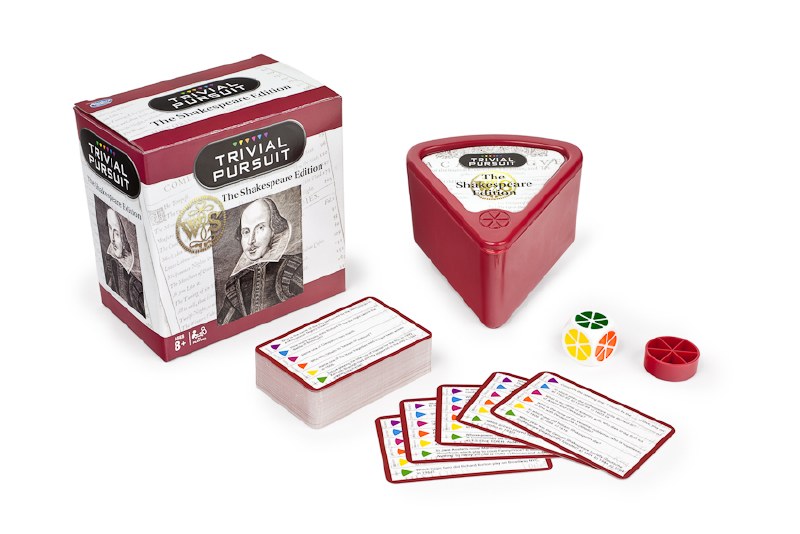
Trivial Pursuit: The Shakespeare Edition Has Just Been Released: Answer 600 Questions Based on the Life & Works of William Shakespeare

“The stan­dard thing to say is that each age makes a Shake­speare in its own image,” wrote The New York­er’s Adam Gop­nik on the the Bard’s 440th birth­day. But over the cen­turies, the bio­graph­i­cal and crit­i­cal por­tray­al of the play­wright of Ham­letRomeo and Juli­etOth­el­lo, and King Lear has remained remark­ably con­sis­tent: “He was a genius at com­e­dy, a free-flow­ing nat­ur­al who would do any­thing for a joke or a pun, and whom life and abil­i­ty bent toward tragedy.” He evolved “a match­less all-sid­ed­ness and neg­a­tive capa­bil­i­ty, which could probe two ideas at once and nev­er quite come down on the ‘side’ of either: he was a man in whom a tem­pera­men­tal timid­i­ty and cau­tion blos­somed artis­ti­cal­ly into the near­est thing we have to uni­ver­sal­i­ty.”

But today, on Shake­speare’s 455th birth­day, we might still won­der how uni­ver­sal his work real­ly is. As luck would have it, the Shake­speare Birth­day Trust has just come up with a kind of test of that propo­si­tion: an all-Shake­speare edi­tion of the pop­u­lar board game Triv­ial Pur­suit.

“Devised by the Shake­speare Birth­place Trust, the inde­pen­dent and self-sus­tain­ing char­i­ty that cares for the world’s great­est Shake­speare her­itage sites in his home town of Strat­ford-upon-Avon, in part­ner­ship with games com­pa­ny, Win­ning Moves,” Triv­ial Pur­suit: The Shake­speare Edi­tion (which you can buy on the Shake­speare Birth­day Trust’s online shop) offers “600 ques­tions across six cat­e­gories — Come­dies, His­to­ries, Tragedies, Char­ac­ters, Biog­ra­phy and Lega­cy,” all “care­ful­ly craft­ed by Shake­speare schol­ars Dr Nick Wal­ton and Dr Anj­na Chouhan.”

One might assume that Shake­speare buffs and schol­ars will dom­i­nate this game. No doubt they will, but per­haps not as often as expect­ed, since its ques­tions give any­one with gen­er­al cul­tur­al aware­ness a fight­ing chance: “As well as ques­tions about Shakespeare’s life and works, there are oth­ers that link him to pop­u­lar cul­ture such as the Har­ry Pot­ter film series, TV shows Dr. Who and Upstart Crow, as well as actors Sir Patrick Stew­art, Sir Lau­rence Olivi­er, and Keanu Reeves, and the Bard’s less­er known influ­ence on the likes of Elvis Pres­ley and even the clas­sic car­toon Pop­eye.” As Wal­ton puts it, “there are all sorts of paths to Shake­speare,” not least because of his work’s still-unchal­lenged place as the most drawn-upon texts, delib­er­ate­ly or inad­ver­tent­ly, in the whole of the Eng­lish lan­guage. As for Shake­speare him­self, he remains “the reign­ing poet of the lan­guage,” in Gop­nik’s words, as well as “the ordi­nary poet of our com­pa­ny” — and now we have a game to play to keep him in our com­pa­ny.

Pick up your copy of the game here.

via Men­tal Floss

Relat­ed Con­tent:

Hear 55 Hours of Shakespeare’s Plays: The Tragedies, Come­dies & His­to­ries Per­formed by Vanes­sa Red­grave, Sir John Giel­gud, Ralph Fiennes & Many More

30 Days of Shake­speare: One Read­ing of the Bard Per Day, by The New York Pub­lic Library, on the 400th Anniver­sary of His Death

Free Online Shake­speare Cours­es: Primers on the Bard from Oxford, Har­vard, Berke­ley & More

Read All of Shakespeare’s Plays Free Online, Cour­tesy of the Fol­ger Shake­speare Library

What Shake­speare Sound­ed Like to Shake­speare: Recon­struct­ing the Bard’s Orig­i­nal Pro­nun­ci­a­tion

Take a Vir­tu­al Tour of Shakespeare’s Globe The­atre

Based in Seoul, Col­in Mar­shall writes and broad­casts on cities, lan­guage, and cul­ture. His projects include the book The State­less City: a Walk through 21st-Cen­tu­ry Los Ange­les and the video series The City in Cin­e­ma. Fol­low him on Twit­ter at @colinmarshall or on Face­book.

High School Kids Stage Alien: The Play, Get Kudos from Ridley Scott and Sigourney Weaver

High school dra­ma depart­ments tend to work from a pret­ty stan­dard­ized reper­toire, which makes sense giv­en the strict lim­i­ta­tions they work under: short time frames, school-sized bud­gets, teenage actors. The elab­o­rate, Hol­ly­wood film-like pro­duc­tions staged by Max Fis­ch­er in Wes Ander­son­’s Rush­more speak to frus­trat­ed high-school the­ater direc­tors and their fan­tasies about what they could put on stage with a bit more in the way of resources. But just this month, a real high-school dra­ma club put on a show that out-Max Fis­chered Max Fis­ch­er, draw­ing not just the aston­ish­ment of the inter­net but the respect of one of the most emi­nent film­mak­ers alive.

“A New Jer­sey high school has found itself the unex­pect­ed recip­i­ent of online acclaim and viral atten­tion for its recent stage pro­duc­tion of Alien, the 1979 sci­ence-fic­tion thriller,” writes the New York Times’ Dave Itzkoff. “Alien: The Play, pre­sent­ed last week­end by the dra­ma club of North Bergen High School, starred a cast of eight stu­dents in the film roles orig­i­nal­ly played by Sigour­ney Weaver, Tom Sker­ritt, John Hurt and Ian Holm. Where­as the movie had a bud­get in the range of about $10 mil­lion, Alien: The Play had cos­tumes, props and set designs made most­ly from donat­ed and recy­cled mate­ri­als.” Or as North Bergen stu­dent Justin Pier­son put it in NJ.com’s video on the sur­prise hit: “This is going to sound real­ly fun­ny but (the set crew) used garbage essen­tial­ly.”

With that “garbage” — “just any­thing that was lying around, like card­board and met­al” — they built not only a set that con­vinc­ing­ly evokes the dark claus­tro­pho­bia of the space ship Nos­tro­mo, but a shock­ing­ly accu­rate-look­ing alien, the ter­ri­fy­ing crea­ture orig­i­nal­ly born from the mind of Swiss illus­tra­tor H.R. Giger.

The young cast and crew get into detail about how they did it on Syfy’s Fan­dom File pod­cast: “Much of the atten­tion has high­light­ed and embraced their DIY approach,” writes host Jor­dan Zakarin, and “they were end­less­ly cre­ative in build­ing the sets, with hand-pup­pet aliens, egg crate walls, a stuffed cat (the stand-in for Jones was a par­tic­u­lar­ly inge­nious idea), and oth­er swed­ed props.”

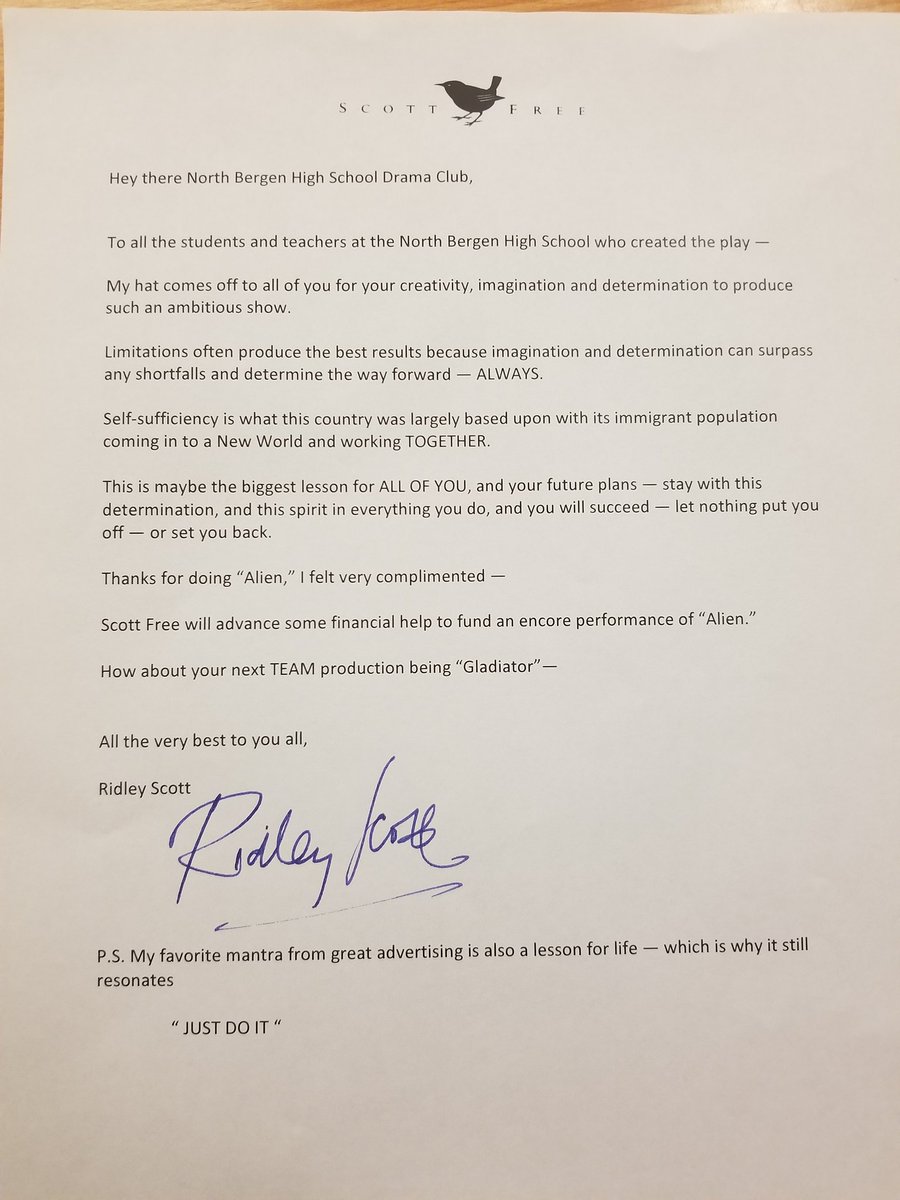
Respons­es to the video clips of Alien: The Play that have cir­cu­lat­ed on the inter­net include a per­son­al con­grat­u­la­to­ry mes­sage from the orig­i­nal film’s star Sigour­ney Weaver as well as a let­ter from its direc­tor Rid­ley Scott, which Alien: The Play’s direc­tor, North Bergen Eng­lish-teacher-by-day Per­fec­to Cuer­vo, post­ed on Twit­ter. “Lim­i­ta­tions often pro­duce the best results because imag­i­na­tion and deter­mi­na­tion can sur­pass any short­falls and deter­mine the way for­ward — ALWAYS,” writes Scott, who has built his rep­u­ta­tion in the film indus­try on tak­ing firm and deci­sive action in the face of any and all pro­duc­tion dif­fi­cul­ties. He also offers both the funds for an encore pro­duc­tion as well as a sug­ges­tion: “How about your next TEAM pro­duc­tion being Glad­i­a­tor.” No doubt Cuer­vo and his enter­pris­ing play­ers are feel­ing pret­ty vin­di­cat­ed in their deci­sion not to do Our Town right about now.

Relat­ed Con­tent:

Rid­ley Scott Demys­ti­fies the Art of Sto­ry­board­ing (and How to Jump­start Your Cre­ative Project)

Rid­ley Scott Walks You Through His Favorite Scene from Blade Run­ner

Ele­men­tary School Stu­dents Per­form in a Play Inspired by David Lynch’s Twin Peaks

Orson Welles Presents Thorn­ton Wilder’s Our Town, the Most Pop­u­lar High School Play of All Time (1939)

Based in Seoul, Col­in Mar­shall writes and broad­casts on cities, lan­guage, and cul­ture. His projects include the book The State­less City: a Walk through 21st-Cen­tu­ry Los Ange­les and the video series The City in Cin­e­ma. Fol­low him on Twit­ter at @colinmarshall or on Face­book.

Leonard Bernstein Awkwardly Turns the Screws on Tenor Jose Carreras While Recording West Side Story (1984)

What have we here?

Evi­dence that the Mae­stro is a mon­ster?

Or a behind the scenes reminder that Arrest­ed Devel­op­ment’s wannabe actor Tobias Fünke is not too far off base when he says that to make it in “this busi­ness of show, you have to have the heart of an angel and the hide… of an ele­phant.”

Both? Nei­ther? Any way you slice it, the record­ing ses­sion above is not for your typ­i­cal cast album.

West Side Sto­ry, with a book by Arthur Lau­rents, music by Leonard Bern­stein, and lyrics by Stephen Sond­heim, opened on Broad­way in 1957.

The film, star­ring Natal­ie Wood and Richard Beymer as star-crossed lovers Maria and Tony, came along four years lat­er.

After which it’s been an end­less round of com­mu­ni­ty, col­lege, and high school pro­duc­tions.

Are you a Jet or a Shark?

The cel­e­brat­ed tenor José Car­reras does not make a par­tic­u­lar­ly believ­able Jet.

While untold num­bers of white kids have attempt­ed Puer­to Rican accents to play Maria, Bernar­do, Ani­ta, and Chi­no, that knife has sel­dom cut the oth­er way.

Per­haps a dialect coach could have trans­formed Car­reras’ thick Span­ish accent into Tony’s New York street punk ver­nac­u­lar, but the prep time for these Sep­tem­ber 1984 record­ing ses­sions was min­i­mal, and not tied to any actu­al pro­duc­tion.

Car­reras was also, at 38, a bit long in the tooth to be tack­ling the part.

But what might have been deal break­ers for a Broad­way revival were per­mis­si­ble for this week­long spe­cial event in which world-cal­iber artists, “whose main rea­son for exist­ing,” accord­ing to Bern­stein, was their singing, would be lay­ing down the score in the stu­dio, backed by a full orches­tra.

As he told his asso­ciate and even­tu­al biog­ra­ph­er, clas­si­cal music tele­vi­sion pre­sen­ter Humphrey Bur­ton:

l’d always thought of West Side Sto­ry in terms of teenagers and there are no teenage opera singers, it’s just a con­tra­dic­tion in terms. But this is a record­ing and peo­ple don’t have to look 16, they don’t have to be able to dance or act a rather dif­fi­cult play eight times a week. And there­fore we took this rather unortho­dox step of cast­ing num­ber-one world-class opera singers. I sup­pose the only fore­see­able prob­lem was that they might sound too old—but they don’t, they just sound mar­velous!

Bernstein’s approv­ing mood is nowhere in evi­dence in the above clip, in which he hec­tors Car­reras for screw­ing up the tem­po, as the instru­men­tal­ists and sound engi­neers squirm.

Car­reras’ dis­com­fort and cha­grin is so pal­pa­ble that you can find the sequence on YouTube under the title “Tenor Keeps Screw­ing Up while Bern­stein Con­ductsAwk­ward Sequence,” as if he were some weedy upstart, still wet behind the ears, when in fact, he had just flown in from Verona, where he’d been appear­ing as Don José in Car­men.

Dame Kiri Te Kanawa, Car­reras’ Maria, sup­plied a taste of what it was like to sing for the com­pos­er:

He’s a man of many emo­tions. You can see his moods, his frus­tra­tions, his hap­pi­ness, his want­i­ng to per­form to peo­ple. That’s the thing that makes the man inter­est­ing. One is con­stant­ly try­ing to read him, but he’s on anoth­er plan­et!

In the end, Bern­stein declared him­self pleased with what had been accom­plished, or at least with the endur­ing pow­er of the mate­r­i­al.

But read­ers with an anti-author­i­tar­i­an streak may not feel sat­is­fied until they’ve seen the clip below, in which a rogue BBC Orches­tra trum­pet isn’t quite so def­er­en­tial in the face of the Maestro’s crit­i­cism.

Lis­ten to the 1984 record­ing of West Side Sto­ry for free on Spo­ti­fy.

Relat­ed Con­tent:

Leonard Bern­stein Intro­duces the Moog Syn­the­siz­er to the World in 1969, Play­ing an Elec­tri­fied Ver­sion of Bach’s “Lit­tle Fugue in G”

Watch Leonard Bern­stein Con­duct the Vien­na Phil­har­mon­ic Using Only His Eye­brows

Leonard Bern­stein Presents “The Great­est 5 Min­utes in Music Edu­ca­tion”

Ayun Hal­l­i­day is an author, illus­tra­tor, the­ater mak­er and Chief Pri­ma­tol­o­gist of the East Vil­lage Inky zine.  Join her for the next install­ment of her book-based vari­ety show, Necro­mancers of the Pub­lic Domain in New York City this April. Fol­low her @AyunHalliday.

Watch Lin-Manuel Miranda Perform the Earliest Version of Hamilton at the White House, Six Years Before the Play Hit the Broadway Stage (2009)

Anoth­er immi­grant comin’ up from the bot­tom

His ene­mies destroyed his rep, Amer­i­ca for­got him… 

Holler if you can remem­ber a time when few Amer­i­cans were well-versed enough in found­ing father Alexan­der Hamil­ton’s ori­gin sto­ry to recite it in rhyme at the drop of a hat.

Believe it or not, as recent­ly as the sum­mer of 2015, when Lin-Manuel Miran­da’s Pulitzer Prize-win­ning Hamil­ton: An Amer­i­can Musi­cal explod­ed on Broad­way, Hamil­ton the man was, as the Tony award win­ning lyrics above sug­gest, large­ly for­got­ten, a rel­ic whose por­trait on the $10 bill aroused lit­tle curios­i­ty.

Back then, Hamil­ton was per­haps best known as the hap­less soul embod­ied by Michael Cera in the web series Drunk His­to­ry.

Ron Chernow’s 2005 biog­ra­phy served up a more nuanced por­trait to read­ers with the sta­mi­na to make it through his mas­sive tome.

That’s the book Miran­da famous­ly took along on vaca­tion in the peri­od between his musi­cal In the Heights’ Broad­way and Off-Broad­way runs.

The rest, as they say, is his­to­ry.

As is the above video, in which a 29-year-old Miran­da per­forms The Hamil­ton Mix­tape for Pres­i­dent Oba­ma, the First Lady, and oth­er lumi­nar­ies as part of a White House evening of poet­ry, music, and spo­ken word.

There’s your Hamil­ton (the musi­cal) ori­gin sto­ry.

Its cre­ator ini­tial­ly con­ceived of it as a hip hop con­cept album in which cel­e­brat­ed rap­pers would give voice to dif­fer­ent his­tor­i­cal char­ac­ters.

Music direc­tor Alex Lacamoire’s jubi­lant expres­sion at the White House piano con­firms that they had some inkling that they were on to some­thing very big.

A few months lat­er, Miran­da reflect­ed on the expe­ri­ence in an inter­view with Play­bill:

The whole day was a day that will exist out­side any oth­er day in my life. Any day that starts with you shar­ing a van to the White House with James Earl Jones is going to be a crazy day! I was the clos­ing act of the show and I had nev­er done this project in pub­lic before so I was already ner­vous. I looked at the Pres­i­dent and the First Lady only once and when I looked at him he was whis­per­ing some­thing to her and I couldn’t let that get to me. After­wards, George Stephanopou­los came up to me and said, “The Pres­i­dent is back there talk­ing about your song, he’s say­ing ‘Where is (Sec­re­tary of the Trea­sury) Tim­o­thy Geit­ner? We need him to hear the Hamil­ton rap!’” To hear that the Pres­i­dent enjoyed the song was a real dream come true. 

The Oba­mas enjoy­ment was such that they appeared in a pre-taped seg­ment to intro­duce the Hamil­ton cast at the 2016 Tony awards (a tough year for any oth­er musi­cal unlucky enough to have debuted in the same peri­od as this jug­ger­naut).

They also host­ed a Hamil­ton work­shop for DC-area youth, for which the Broad­way cast trav­eled down on their day off, per­form­ing the open­ing num­ber out of cos­tume. Biog­ra­ph­er Ron Cher­now was in the front row for that one, as Oba­ma remarked that “Hamil­ton is the only thing Dick Cheney and I agree on.”

(“Dick Cheney attend­ed the show tonight,” Miran­da tweet­ed after Cheney’s vis­it. “He’s the OTHER vice-pres­i­dent who shot a friend while in office.” Cur­rent Vice Pres­i­dent Mike Pence also took in a per­for­mance short­ly before his swear­ing in, though his appear­ance was met with a much less pithy response.)

As for The Hamil­ton Mix­tape, many of Miran­da’s dream rap­pers turned out for its record­ing, though the tracks they laid down diverge from the one per­formed live for the Oba­mas in 2009, which legions of ador­ing fans can chant along to thanks to the musi­cal’s over­whelm­ing pop­u­lar­i­ty. Instead, this mixtape’s con­tribut­ing artists were invit­ed to reimag­ine and expand upon the themes of the play—immigration, ambi­tion, and stubble—placing them in an explic­it­ly 21st-cen­tu­ry con­text.

Lis­ten to The Hamil­ton Mix­tape and the orig­i­nal cast record­ing of Hamil­ton for free on Spo­ti­fy.

Relat­ed Con­tent:

Lin-Manuel Miran­da & Emi­ly Blunt Take You Through 22 Clas­sic Musi­cals in 12 Min­utes

A Whiskey-Fueled Lin-Manuel Miran­da Reimag­ines Hamil­ton as a Girl on Drunk His­to­ry

Hamilton’s Lin-Manuel Miran­da Cre­ates a 19-Song Playlist to Help You Get Over Writer’s Block

Ayun Hal­l­i­day is an author, illus­tra­tor, the­ater mak­er and Chief Pri­ma­tol­o­gist of the East Vil­lage Inky zine. She has yet to win the Hamil­ton lot­tery. Join her in New York City for the next install­ment of her book-based vari­ety show, Necro­mancers of the Pub­lic Domain, this March. Fol­low her @AyunHalliday.

« Go BackMore in this category... »
Quantcast