See The Iliad Performed as a One-Woman Show in a Montreal Bar by McGill University Classics Professor Lynn Kozak

Homer’s Ili­ad staged as a one-woman show? IN A BAR! It’s an out­rage. A des­e­cra­tion of a found­ing work of West­ern Civ­i­liza­tion™. A sure sign of cul­tur­al decline.

But wait…. What if McGill Uni­ver­si­ty clas­sics pro­fes­sor Lynn Kozak’s per­for­mance returns the epic Greek poem to its ori­gins, as a dra­mat­ic oral pre­sen­ta­tion for small audi­ences who were, quite pos­si­bly, ine­bri­at­ed, or at least a lit­tle tip­sy? Kozak’s Pre­vi­ous­ly on… The Ili­ad, described as “Hap­py Hour Homer,” presents its inti­mate audi­ence with “a new, par­tial­ly impro­vised Eng­lish trans­la­tion of a bit of The Ili­ad, all the way through the epic.”

The per­for­mances take place every Mon­day at 6 at Montreal’s Bar des Pins. Like the sto­ry itself, Kozak begins in medias res—in the mid­dle, that is, of a chat­ter­ing crowd of stu­dents, who qui­et down right away and give the sto­ry their full atten­tion.

Ancient Greek poet­ry was per­formed, not stud­ied in schol­ar­ly edi­tions in aca­d­e­m­ic depart­ments. It was sung, with musi­cal accom­pa­ni­ment, and prob­a­bly adapt­ed, impro­vised, and embell­ished by ancient bards to suit their audi­ences. Grant­ed, Kozak doesn’t sing (though some per­for­mances involve music); she recites in a man­ner both casu­al and dra­mat­i­cal­ly grip­ping. She reminds us that the sto­ries we find in the text are dis­tant kin to the bloody seri­al­ized TV soap operas that occu­py so much of our day-to-day con­ver­sa­tion, at home, on social media, and at hap­py hour.

The lib­er­ties Kozak takes recre­ate the poem in the present as a liv­ing work. This is clas­sics edu­ca­tion at its most engag­ing and acces­si­ble. Like any poet­ic per­former, Kozak knows her audi­ence. The Ili­ad  is a lot like Game of Thrones, “because of the num­ber of char­ac­ters that you have to keep up with,” Kozak tells the CBC’s As It Hap­pens, “and also because of the fact that there’s not always clean-cut kind of vil­lains or who you’re sup­posed to be root­ing for in any major scene—especially in bat­tle scenes.”

The per­for­mance of the “anger of Achilles” (top, with beer pong) con­veys the moral com­plex­i­ty of the Greek hero. “He must be bru­tal and ready to risk bru­tal­i­ty,” as UNC pro­fes­sor of phi­los­o­phy CDC Reeve writes. “At the same time, he must be gen­tle to his friends and allies, and able to join with them in group activ­i­ties both mil­i­tary and peace­ful.” Is Achilles a tool of the gods or a man dri­ven to extremes by rage? Homer sug­gests both, but the action is set in motion by divine agency. “Apol­lo was pissed at King Agamem­non,” Kozak para­phras­es, then sum­ma­rizes the nature of the insult and checks in with the young lis­ten­ers: “every­one still with me?”

The sto­ry of The Ili­ad, many schol­ars believe, exist­ed as an oral per­for­mance for per­haps 1,000 years before it was com­mit­ted to writ­ing by the scribe or scribes iden­ti­fied as Homer. But the poem “isn’t real­ly a the­atre piece,” says Kozak, despite its musi­cal nature. “It’s real­ly a sto­ry. It’s real­ly a one-per­son show. And for me it’s just impor­tant to be in a place that’s casu­al and where I’m with the audi­ence.” It’s doubt­ful that the poem was per­formed in its entire­ly in one sit­ting, though the notion of “seri­al­iza­tion” as we know it from 19th cen­tu­ry nov­els and mod­ern-day tele­vi­sion shows was not part of the cul­ture of antiq­ui­ty.

“We’re not real­ly sure how The Ili­ad was bro­ken up orig­i­nal­ly,” Kozak admits. Adapt­ing the poem to con­tem­po­rary audi­ence sen­si­bil­i­ties has meant “think­ing about where or if episodes exist in the epic,” in the way of Game of Thrones. Each per­for­mance is styled dif­fer­ent­ly, with Kozak hold­ing court as var­i­ous char­ac­ters. “Some­times there are cliffhang­ers. Some­times they have res­o­lu­tions. It’s been an inter­est­ing mix so far.” That “so far” extends on YouTube from Week 1 (Book 1, lines 1–487) to Week 14 (Book 11, line 461 to Book 12, line 205). Check back each week for new “episodes” to come online, and watch Weeks One through Four above and the oth­er ten at the Pre­vi­ous­ly on… The Ili­ad YouTube chan­nel.

Relat­ed Con­tent:

Hear What Homer’s Odyssey Sound­ed Like When Sung in the Orig­i­nal Ancient Greek

Hear Homer’s Ili­ad Read in the Orig­i­nal Ancient Greek

One of the Best Pre­served Ancient Man­u­scripts of The Ili­ad Is Now Dig­i­tized: See the “Bankes Homer” Man­u­script in High Res­o­lu­tion (Cir­ca 150 C.E.)

Josh Jones is a writer and musi­cian based in Durham, NC. Fol­low him at @jdmagness

The 1,700+ Words Invented by Shakespeare*

One of the favorite ref­er­ence books on my shelves isn’t a style guide or dic­tio­nary but a col­lec­tion of insults. And not just any col­lec­tion of insults, but Shakespeare’s Insults for Teach­ers, an illus­trat­ed guide through the playwright’s barbs and put-downs, designed to offer com­ic relief to the belea­guered edu­ca­tor. (Books and web­sites about Shakespeare’s insults almost con­sti­tute a genre in them­selves.) I refer to this slim, humor­ous hard­back every time dis­cus­sions of Shake­speare get too pon­der­ous, to remind myself at a glance that what read­ers and audi­ences have always val­ued in his work is its light­ning-fast wit and inven­tive­ness.

While perus­ing any curat­ed selec­tion of Shakespeare’s insults, one can’t help but notice that, amidst the puns and bawdy ref­er­ences to body parts, so many of his wise­cracks are about lan­guage itself—about cer­tain char­ac­ters’ lack of clar­i­ty or odd ways of speak­ing. From Much Ado About Noth­ing there’s the col­or­ful, “His words are a very fan­tas­ti­cal ban­quet, just so many strange dish­es.” From The Mer­chant of Venice, the sar­cas­tic, “Good­ly Lord, what a wit-snap­per you are!” From Troilus and Cres­si­da, the deri­sive, “There’s a stewed phrase indeed!” And from Ham­let the sub­tle shade of “This is the very coinage of your brain.”

Indeed, it can often seem that Shakespeare—if we grant his his­toric­i­ty and authorship—is often writ­ing self-dep­re­cat­ing notes about him­self. “It is often said,” writes Fras­er McAlpine at BBC Amer­i­ca, that Shake­speare “invent­ed a lot of what we cur­rent­ly call the Eng­lish lan­guage…. Some­thing like 1700 [words], all told,” which would mean that “out of every ten words,” in his plays, “one will either have been new to his audi­ence, new to his actors, or will have been pass­ing­ly famil­iar, but nev­er writ­ten down before.” It’s no won­der so much of his dia­logue seems to car­ry on a meta-com­men­tary about the strange­ness of its lan­guage.

We have enough trou­ble under­stand­ing Shake­speare today. The ques­tion McAlpine asks is how his con­tem­po­rary audi­ences could under­stand him, giv­en that so much of his dic­tion was “the very coinage” of his brain. Lists of words first used by Shake­speare can be found aplent­ly. There’s this cat­a­log from the exhaus­tive mul­ti-vol­ume lit­er­ary ref­er­ence The Oxford Eng­lish Dic­tio­nary, which lists such now-every­day words as “acces­si­ble,” “accom­mo­da­tion,” and “addic­tion” as mak­ing their first appear­ance in the plays. These “were not all invent­ed by Shake­speare,” the list dis­claims, “but the ear­li­est cita­tions for them in the OED” are from his work, mean­ing that the dictionary’s edi­tors could find no ear­li­er appear­ance in his­tor­i­cal writ­ten sources in Eng­lish.

Anoth­er short­er list links to an excerpt from Charles and Mary Cow­den Clarke’s The Shake­speare Key, show­ing how the author, “with the right and might of a true poet… mint­ed sev­er­al words” that are now cur­rent, or “deserve” to be, such as the verb “artic­u­late,” which we do use, and the noun “co-mart”—meaning “joint bargains”—which we could and maybe should. At ELLO, or Eng­lish Lan­guage and Lin­guis­tics Online, we find a short tuto­r­i­al on how Shake­speare formed new words, by bor­row­ing them from oth­er lan­guages, or adapt­ing them from oth­er parts of speech, turn­ing verbs into nouns, for exam­ple, or vice ver­sa, and adding new end­ings to exist­ing words.

“Whether you are ‘fash­ion­able’ or ‘sanc­ti­mo­nious,’” writes Nation­al Geo­graph­ic, “thank Shake­speare, who like­ly coined the terms.” He also appar­ent­ly invent­ed sev­er­al phras­es we now use in com­mon speech, like “full cir­cle,” “one fell swoop,” “strange bed­fel­lows,” and “method in the mad­ness.” (In anoth­er BBC Amer­i­ca arti­cle, McAlpine lists 45 such phras­es.) The online sources for Shakespeare’s orig­i­nal vocab­u­lary are mul­ti­tude, but we should note that many of them do not meet schol­ar­ly stan­dards. As lin­guists and Shake­speare experts David and Ben Crys­tal write in Shakespeare’s Words, “we found very lit­tle that might be classed as ‘high-qual­i­ty Shake­speare­an lex­i­cog­ra­phy’” online.

So, there are rea­sons to be skep­ti­cal about claims that Shake­speare is respon­si­ble for the 1700 or more words for which he’s giv­en sole cred­it. (Hence the aster­isk in our title.) As not­ed, a great many of those words already exist­ed in dif­fer­ent forms, and many of them may have exist­ed as non-lit­er­ary col­lo­qui­alisms before he raised their pro­file to the Eliz­a­bethan stage. Nonethe­less, it is cer­tain­ly the case that the Bard coined or first used hun­dreds of words, writes McAlpine, “with no obvi­ous prece­dent to the lis­ten­er, unless you were schooled in Latin or Greek.” The ques­tion, then, remains: “what on Earth did Shakespeare’s [most­ly] une­d­u­cat­ed audi­ence make of this influx of new­ly-mint­ed lan­guage into their enter­tain­ment?”

McAlpine brings those poten­tial­ly stu­pe­fied Eliz­a­bethans into the present by com­par­ing watch­ing a Shake­speare play to watch­ing “a three-hour long, open air rap bat­tle. One in which you have no idea what any of the slang means.” A good deal would go over your head, “you’d maybe get the gist, but not the full impact,” but all the same, “it would all seem ter­ri­bly impor­tant and dra­mat­ic.” (Cos­tum­ing, props, and stag­ing, of course, helped a lot, and still do.) The anal­o­gy works not only because of the amount of slang deployed in the plays, but also because of the inten­si­ty and reg­u­lar­i­ty of the boasts and put-downs, which makes even more inter­est­ing one data scientist’s attempt to com­pare Shakespeare’s vocab­u­lary with that of mod­ern rap­pers, whose lan­guage is, just as often, the very coinage of their brains.

Relat­ed Con­tent:

Do Rap­pers Have a Big­ger Vocab­u­lary Than Shake­speare?: A Data Sci­en­tist Maps Out the Answer

Hear 55 Hours of Shakespeare’s Plays: The Tragedies, Come­dies & His­to­ries Per­formed by Vanes­sa Red­grave, Sir John Giel­gud, Ralph Fiennes & Many More

What Shakespeare’s Eng­lish Sound­ed Like, and How We Know It

Josh Jones is a writer and musi­cian based in Durham, NC. Fol­low him at @jdmagness.

When Ira Aldridge Became the First Black Actor to Perform Shakespeare in England (1824)

The ways that Oth­el­lo, Aaron the Moor from Titus Andron­i­cus, and Shy­lock from The Mer­chant of Venice—Shakespeare’s “explic­it­ly racial­ized char­ac­ters,” as George Wash­ing­ton University’s Ayan­na Thomp­son puts it—have been inter­pret­ed over the cen­turies may have less to do with the author’s inten­tions and more with con­tem­po­rary ideas about race, the actors cast in the roles, and the direc­to­r­i­al choic­es made in a pro­duc­tion. To a great degree, these char­ac­ters have been played as though their iden­ti­ties were like the cos­tumes put on by actors who dark­ened their faces or wore stereo­typ­i­cal mark­ers of eth­nic or reli­gious Judaism (includ­ing “an obnox­ious­ly large nose”).

Such por­tray­als risk turn­ing com­plex char­ac­ters into car­i­ca­tures, val­i­dat­ing much of what we might see as overt and implic­it racism in the text. But there are those, Thomp­son says, who think such roles are actu­al­ly “about racial imper­son­ation.” Oth­el­lo, for exam­ple, is “a role writ­ten by a white man, intend­ed for a white actor in black make­up.”

For cen­turies, that is what most audi­ences ful­ly expect­ed to see. The tra­di­tion con­tin­ued in Britain until the 19th cen­tu­ry, when the Shake­speare­an col­or line, so to speak, was first crossed by Ira Aldridge, an Amer­i­can actor born in New York City in 1807.

“Edu­cat­ed at the African Free School,” notes the Fol­ger Shake­speare Library, Aldridge “was able to see Shake­speare plays at the Park The­atre and the African Grove The­atre.” He took on roles like Romeo with the African Com­pa­ny, but “New York was gen­er­al­ly not a wel­com­ing place for black actors… some white the­ater­go­ers even attempt­ed to pre­vent black com­pa­nies from per­form­ing Shake­speare at all.” As Tony Howard, an Eng­lish pro­fes­sor at the Uni­ver­si­ty of War­wick, tells PRI, “he was beat­en up in the streets.” And so Aldridge left for Eng­land in 1824, where he played Oth­el­lo at the The­atre Roy­al, Covent-Gar­den, at only 17 years old, the first black actor to play a Shake­speare­an role in Britain.

He lat­er began per­form­ing under the name Keene, “a homonym,” notes the site Black His­to­ry 365, “for the then pop­u­lar British actor, Edmund Kean.” Aldridge’s big break came after he met Kean and his son Charles, also an actor, in 1831, and both became sup­port­ers of his career. When the elder Kean col­lapsed onstage in 1833, then died, Aldridge took over his role as Oth­el­lo at Lon­don’s Roy­al­ty The­atre in two per­for­mances. “Crit­ics object­ed,” the Fol­ger writes, “to his race, his youth, and his inex­pe­ri­ence.” As Howard tells it, this char­ac­ter­i­za­tion is a gross under­state­ment:

There were those who said this is a very inter­est­ing and extra­or­di­nary young actor. And the fact that he’s a black actor makes it more inter­est­ing and fas­ci­nat­ing. But for many peo­ple, it was an insult because this is still a soci­ety where there is a great deal of slav­ery in the British Empire. And in order to com­bat the idea of increas­ing abo­li­tion, per­form­ers like Ira had to be stopped. And so there was a great deal of vio­lent aggres­sion. Not phys­i­cal vio­lence this time, but vio­lence in the press.

Some of that ver­bal vio­lence includ­ed com­par­ing Aldridge to “per­form­ing hors­es” and “per­form­ing dogs.” Many Lon­don crit­ics saw his entry on the Shake­speare­an stage as an affront to Eng­lish lit­er­ary tra­di­tion. Per­form­ing the bard’s works was “a kind of vio­la­tion,” Howard sum­ma­rizes, “he has no right to do that, not even to play Oth­el­lo.”

Pho­to via the Fol­ger Library

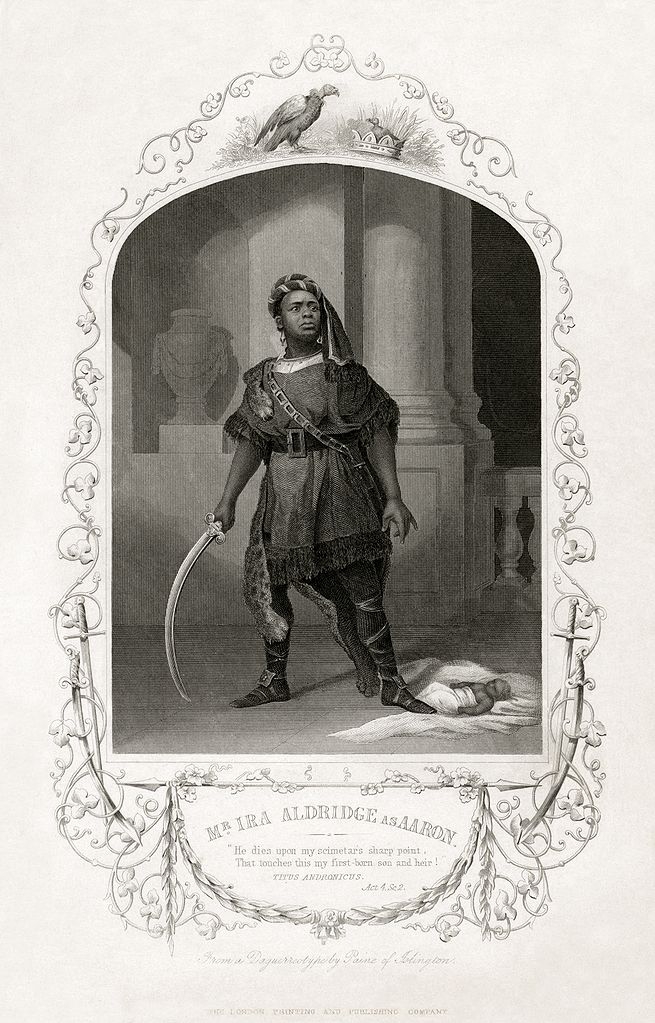
From his begin­nings in Coven­try to his expe­ri­ence in Lon­don, Aldridge made the once-black­face role his own, per­haps increas­ing­ly draw­ing “on his own expe­ri­ence and his own feel­ing.” He also por­trayed Aaron in Titus, and as he per­se­vered through neg­a­tive press and prej­u­dice, he took on oth­er star­ring roles, includ­ing Richard III, Shy­lock, Iago, King Lear, and Mac­beth. He “toured the Eng­lish provinces exten­sive­ly,” the BBC writes, “and stayed in Coven­try for a few months, dur­ing which time he gave a num­ber of speech­es on the evils of slav­ery. When he left, peo­ple inspired by his speech­es went to the coun­ty hall and peti­tioned for its abo­li­tion.”

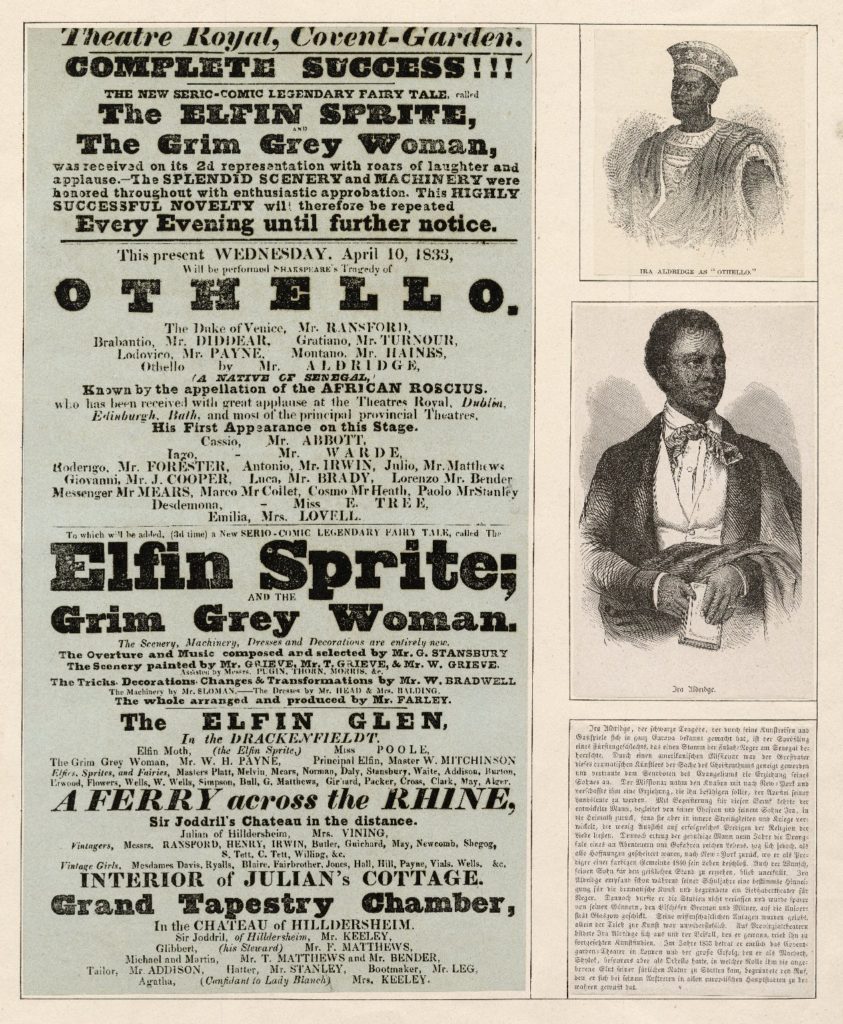
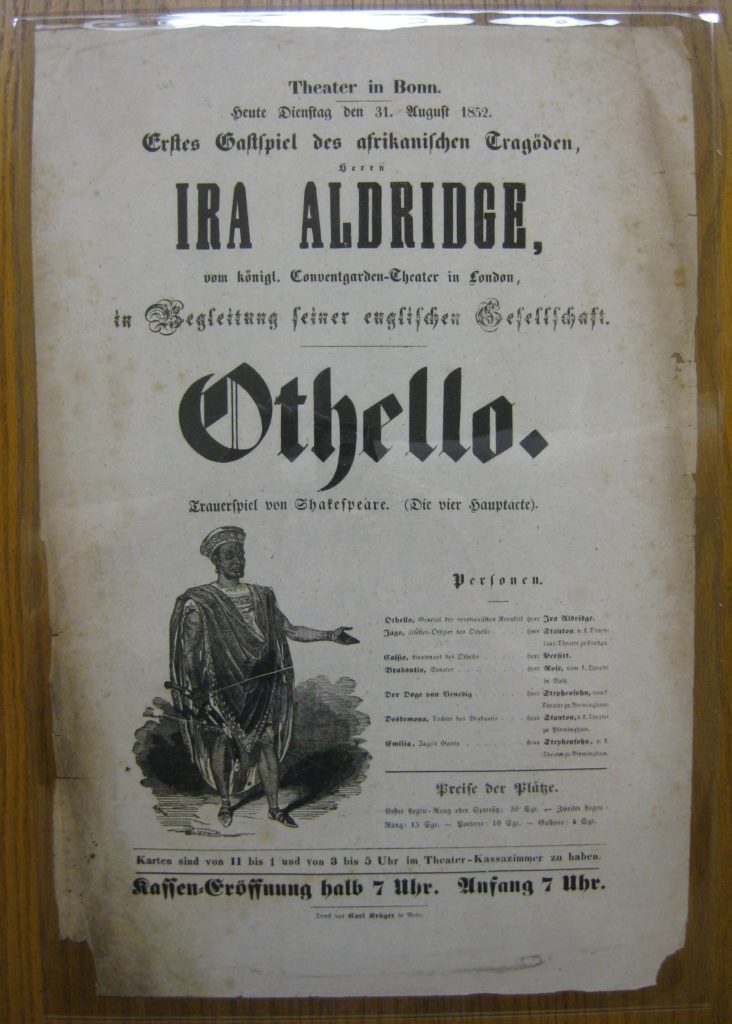
By the end of the 1840s, how­ev­er, Aldridge felt he had gone as far as he could go in Eng­land and left to tour the Con­ti­nent in what had become his sig­na­ture role, Oth­el­lo. While first tour­ing with an Eng­lish com­pa­ny, he “lat­er began to work with local the­ater troupes,” the Fol­ger writes, “per­form­ing in Eng­lish while the rest of the cast would per­form in Ger­man, Swedish, etc. Despite the lan­guage bar­ri­er, Aldridge’s per­for­mances in Europe were high­ly acclaimed, a tes­ta­ment to his act­ing skills.” (See a play­bill fur­ther up from a Bonn per­for­mance.) After win­ning great fame in Europe and Rus­sia, the actor returned in tri­umph to Lon­don in 1855, and this time was very well-received.

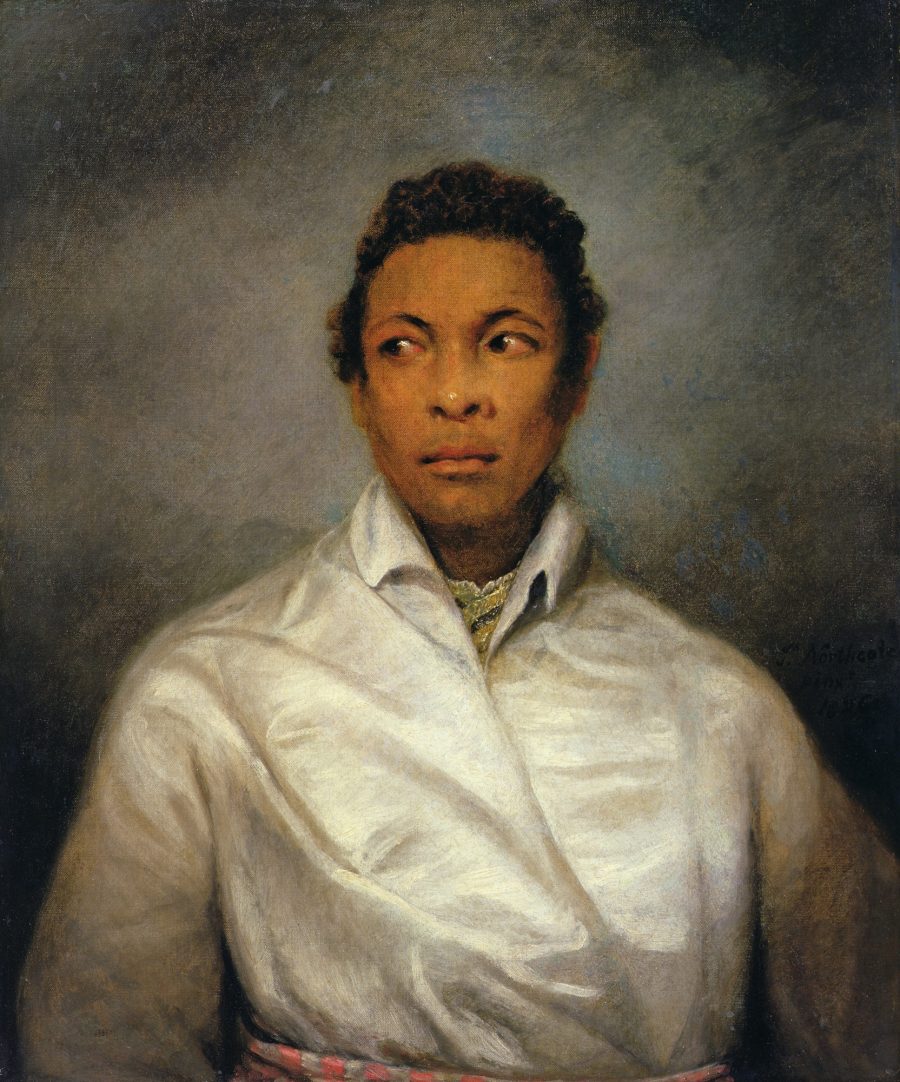
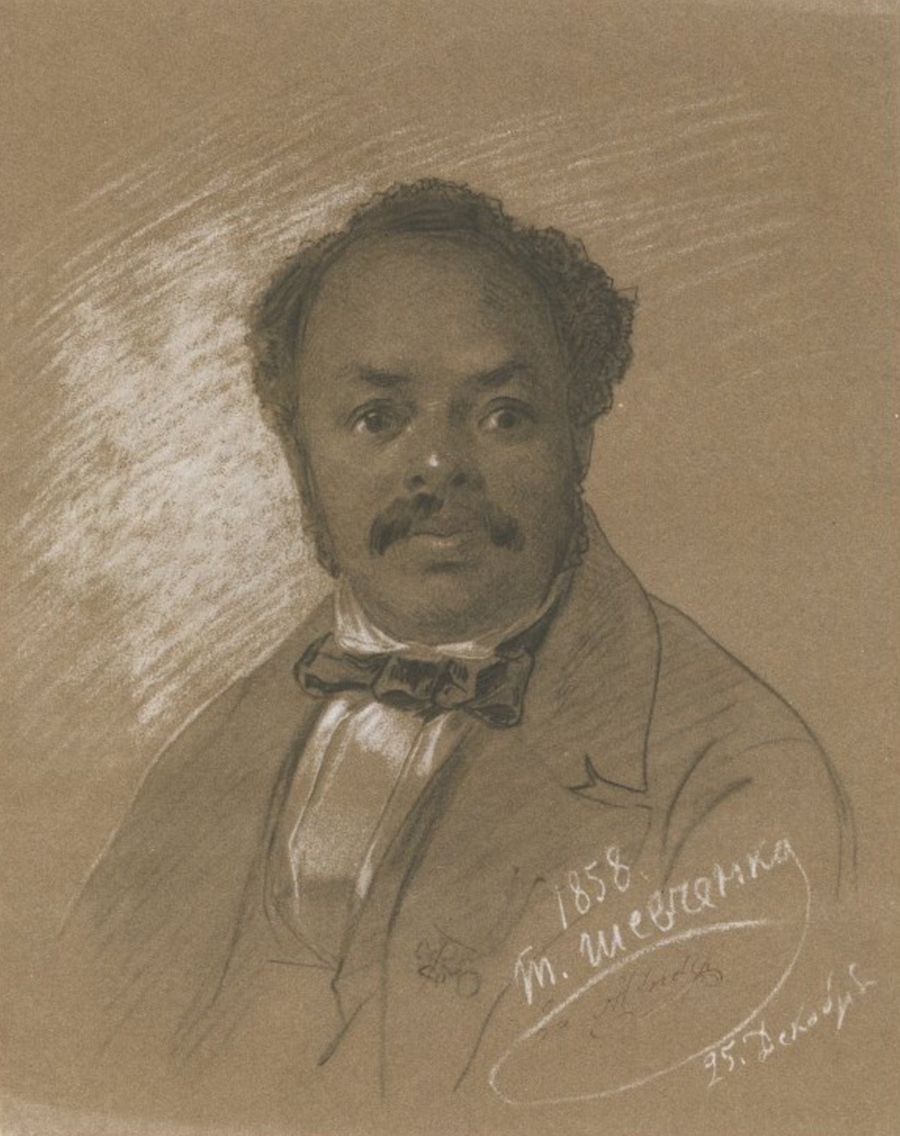
Aldridge died in 1867. And though he was the sub­ject of many por­traits of the period—like that by James North­cote at the top of the post, por­tray­ing the 19-year-old Aldridge as Oth­el­lo, and this 1830 paint­ing by Hen­ry Per­ronet Brig­gs—he was “large­ly for­got­ten by the­ater his­to­ri­ans.” (See him above in an 1858 draw­ing by Ukran­ian artist Taras Shevchenko.) But his lega­cy has been revived in recent years. Aldridge was the sub­ject of two recent plays, Black Oth­el­lo, by Cecil­ia Siden­bladh, and Red Vel­vet by Loli­ta Chakrabar­ti. And last year, he was hon­ored in Coven­try by a plaque on the site of the the­ater where he first achieved fame.

While he suc­ceed­ed in becom­ing an all-around great Shake­speare­an actor, Aldridge’s lega­cy rests espe­cial­ly in the way he helped trans­form roles per­formed as “racial imper­son­ation” for a few hun­dred years into the prove­nance of tal­ent­ed black actors who bring new depth, com­plex­i­ty, and authen­tic­i­ty to char­ac­ters often played as stock eth­nic vil­lains. While white actors like Orson Welles and Lawrence Olivi­er con­tin­ued to play Oth­el­lo well into the 20th cen­tu­ry, these days such cast­ing can be seen as “ridicu­lous,” as Hugh Muir writes at The Guardian, espe­cial­ly if that actor “blacks up” for the role.

via the British Library

Relat­ed Con­tent:

What Shakespeare’s Eng­lish Sound­ed Like, and How We Know It

3,000 Illus­tra­tions of Shakespeare’s Com­plete Works from Vic­to­ri­an Eng­land, Neat­ly Pre­sent­ed in a New Dig­i­tal Archive

Young Orson Welles Directs “Voodoo Mac­beth,” the First Shake­speare Pro­duc­tion With An All-Black Cast: Footage from 1936

Josh Jones is a writer and musi­cian based in Durham, NC. Fol­low him at @jdmagness

Hear 55 Hours of Shakespeare’s Plays: The Tragedies, Comedies & Histories Performed by Vanessa Redgrave, Sir John Gielgud, Ralph Fiennes & Many More

The so-called “Great Vow­el Shift” was a very unusu­al occur­rence. Dur­ing the peri­od between around 1500 to around 1700, the Eng­lish lan­guage “lost the pur­er vow­el sounds of most Euro­pean lan­guages, as well as the pho­net­ic pair­ing between long and short vow­el sounds,” writes the site The His­to­ry of Eng­lish. Such rad­i­cal lin­guis­tic change seems a “sud­den and dra­mat­ic shift” his­tor­i­cal­ly, and “a pecu­liar­ly Eng­lish phe­nom­e­non…. con­tem­po­rary and neigh­bor­ing lan­guages like French, Ger­man and Span­ish were entire­ly unaf­fect­ed.” Over a peri­od of around 200 years, in oth­er words, Eng­lish com­plete­ly mor­phed from Chaucer’s melod­ic, near­ly incom­pre­hen­si­ble Mid­dle Eng­lish into the sounds we hear in Dami­an Lewis’s speech as Antony in Julius Cae­sar, above.

Shakespeare’s Eng­lish sound­ed like nei­ther of these, but some­what like both. Eng­lish became more dis­tinc­tive pre­cise­ly dur­ing the time it became more cos­mopoli­tan, philo­soph­i­cal, and, even­tu­al­ly, glob­al.

It was a peri­od of “a large intake of loan­words from the Romance lan­guages of Europe…, which required a dif­fer­ent kind of pronunciation”—and of a great flood of Lati­nate words from sci­en­tif­ic, legal, and med­ical dis­course. “Latin loan­words in Old and Mid­dle Eng­lish are a mere trick­le,” writes Charles Bar­ber in The Eng­lish Lan­guage, “but in Ear­ly Mod­ern Eng­lish,” Shakespeare’s Eliz­a­bethan Eng­lish, “the trick­le becomes a riv­er, and by 1600 it is a del­uge.”

The Eng­lish Renais­sance sits smack in the mid­dle of the Great Vow­el Shift, its lit­er­ary pro­duc­tions reflect­ing a riotous and thrilling con­flu­ence of speech, a wild field of lin­guis­tic play and exper­i­men­ta­tion, nov­el­ty, inge­nu­ity, and con­tro­ver­sy. The schol­ars and writ­ers of the time were them­selves very aware of these changes. One “Eliz­a­bethan head­mas­ter,” notes Bar­ber, “com­ment­ed in 1582 on the large num­ber of for­eign words being bor­rowed dai­ly by the Eng­lish lan­guage.” (Empha­sis mine.)

Shakespeare’s lan­guage rev­els in such bor­row­ing, and coin­ing, of words, while often pre­serv­ing the pro­nun­ci­a­tion and the syn­tax, of ear­li­er forms of Eng­lish from all over the UK. All oth­er argu­ments for read­ing and lis­ten­ing to Shake­speare aside—and they are too numerous—the rich­ness of the lan­guage may be the most robust for cen­turies to come. As long as there is some­thing called English—though a thou­sand years hence, our ver­sion may sound as alien as the lan­guage of Beowulf does today—Shake­speare will still rep­re­sent some of the wit­ti­est, most adven­tur­ous expres­sions of the most fer­tile and cre­ative moment in the language’s his­to­ry.

Luck­i­ly for those future Eng­lish speak­ers, writ­ers, and appre­ci­a­tors, Shake­speare has also been the most wide­ly adapt­ed, record­ed, and per­formed writer in the Eng­lish lan­guage, and there will nev­er be a short­age of his work in any for­mat. Orig­i­nal Pro­nun­ci­a­tion Shake­speare has only recent­ly left the acad­e­my and made it to reg­u­lar per­for­mances on the stage, giv­ing us a taste of just how dif­fer­ent the ver­bal music of Ham­let and Romeo and Juli­et sound­ed to their first audi­ences. But what’s remark­able is how Shake­speare seems to work in any accent and any set­ting… almost.

As far as Amer­i­can actors go, Bran­do may have been more up to the task of play­ing Mark Antony than Charl­ton Hes­ton was, but that doesn’t mean we shouldn’t have both, and hun­dreds more besides. I would argue that there’s no such thing as too much Shake­speare in too many dif­fer­ent voic­es. His plays needn’t be the great­est ever writ­ten to nonethe­less con­tain some of the great­est speech­es ever per­formed on any stage. That very much includes the speech­es in less­er-known tragedies like Cori­olanus, which an ensem­ble cast of Ralph Fiennes, Vanes­sa Red­grave, Bri­an Cox, Elan Eshk­eri, and Ger­ard But­ler turned into a 21st-cen­tu­ry polit­i­cal barn­burn­er of a movie.

The music and dia­logue from that 2011 film adap­ta­tion open the playlist of Shakespeare’s tragedies, fur­ther up, which also includes a per­for­mance from Sir John Giel­gud in Ham­let and a record­ed per­for­mance of Amer­i­can com­pos­er Samuel Barber’s Antony and Cleopa­tra, a 1966 opera with a libret­to by Fran­co Zef­firelli based exclu­sive­ly on Shakespeare’s text. This work pre­miered as “one of the great oper­at­ic dis­as­ters of all time,” accord­ing to one crit­ic who was in its first audi­ence, “at one point the sopra­no Leon­tyne Price… found her­self trapped inside a pyra­mid.” The idio­syn­crat­ic deliv­ery in these var­i­ous per­for­mances all stress the flex­i­bil­i­ty of Shakespeare’s lan­guage, which can still mes­mer­ize, even under Spinal Tap-like con­di­tions of per­for­mance anx­i­ety.

After you’ve worked your way through 18 hours of Shakespeare’s tragedies, lis­ten fur­ther up to 19 hours of Come­dies, 13 hours of His­to­ries, and, just above, to some­thing we may not have enough of—5 hours of read­ings of Shakespeare’s poet­ry, by actors like Giel­gud and Sir Antho­ny Quayle, Richard Bur­ton, Emma Top­ping, and many more. Anoth­er great vow­el shift may be com­ing, along with oth­er world his­tor­i­cal changes. These copi­ous record­ings pre­serve for the future the diverse sounds of Late Mod­ern Eng­lish, speak­ing the rich­est lit­er­ary lan­guage of its Ear­ly Mod­ern ances­tor.

If you need Spo­ti­fy’s free soft­ware, down­load it here.

Relat­ed Con­tent:

A 68 Hour Playlist of Shakespeare’s Plays Being Per­formed by Great Actors: Giel­gud, McK­ellen & More

Hear What Shake­speare Sound­ed Like in the Orig­i­nal Pro­nun­ci­a­tion

Pink Floyd’s David Gilmour Sings Shakespeare’s Son­net 18

Hear Beowulf Read In the Orig­i­nal Old Eng­lish: How Many Words Do You Rec­og­nize?

Hear What Shake­speare Sound­ed Like in the Orig­i­nal Pro­nun­ci­a­tion

Josh Jones is a writer and musi­cian based in Durham, NC. Fol­low him at @jdmagness

Elton John Proves He Can Turn any Text into a Song: Watch Him Improvise with Lines from Henrik Ibsen’s Play, Peer Gynt

I’m not a lyric writer. I get all my inspi­ra­tion from look­ing at the writ­ten page. — Elton John

Inspi­ra­tion is one thing. Act­ing on it is anoth­er. Sir Elton’s out­put seems to go beyond his mag­i­cal com­bi­na­tion of tal­ent, work eth­ic, and train­ing. He claims to have tak­en all of 30 min­utes to com­plete “Your Song.” In his 2005 appear­ance on Inside the Actor’s Stu­dio, excerpt­ed above, he passed his genius off as some­thing akin to a par­ty trick, call­ing on the audi­ence to pass up a book—any book—as source mate­r­i­al for an ins­ta-song.

Giv­en the num­ber of stu­dent actors in the audi­ence, it’s real­ly not so sur­pris­ing that the first vol­ume to hit the stage was Hen­rik Ibsen’s 1867 verse play Peer Gynt.

Magi­cians height­en the dra­ma by demand­ing absolute silence pri­or to a dif­fi­cult trick.

John swings the oth­er way. The result­ing impro­vised tune is all the more impres­sive for his off the cuff, raunchy text-based pat­ter. It’s hard to imag­ine Ibsen play­ing so fast and loose with lines like:

Every­thing spites me with a vengeance

Sky and water and those wicked moun­tains

Fog pour­ing out of the sky to con­found him

The water hurl­ing in to drown him

The moun­tains point­ing their rocks to fall-

And those peo­ple, all of them out for the kill!

Oh no, not to die!

I mustn’t lose him. The lout!

Why’s the dev­il have to tease him?

What might Metal­li­ca or Iron Maid­en have con­jured from such mate­r­i­al? In John’s hands, it becomes a lush, emo­tion­al­ly charged bal­lad, the moun­tains and fog apt metaphors.

In his book Inside Inside, host James Lip­ton names this as one of “the two most astound­ing impro­vi­sa­tions in the his­to­ry of Inside the Actors Stu­dio.” The oth­er was Robin Williams mak­ing mer­ry with a pink pash­mi­na shawl.

In a 2012 inter­view with NPR, John went into the nature of his col­lab­o­ra­tion with his long­time word man, Bernie Taupin. Unlike oth­er lyri­cists, Taupin does not think in terms of verse and cho­rus, leav­ing it to John to free the song from a wall of text:

It’s just a blank—well, not a blank, but it’s a piece of paper. In the old days, it was hand­writ­ten. Then it got typed. Then it got faxed. Now it gets emailed. And it’s no sug­ges­tions, noth­ing. And we’ve nev­er writ­ten in the same room. I don’t know if peo­ple know that. But he gives me the lyric, and I go away and write the song, and then come back and play it to him. And I’ve nev­er lost the enjoy­ment or the thrill of play­ing him the song that I’ve just writ­ten to his lyric.

If you’d like to fin­ish what John start­ed by fur­ther musi­cal­iz­ing Ibsen’s Peer Gynt, the com­plete script can be read here. Or lis­ten to the 1946 radio adap­ta­tion star­ring Ralph Richard­son as Peer Gynt and Lau­rence Olivi­er as the Troll King and a but­ton-moul­der, below. Also above, you can watch John turn instruc­tions for using an oven (yes, that dai­ly appli­ance) into song.

via metafil­ter

Relat­ed Con­tent:

Elton John Sings His Clas­sic Hit ‘Your Song’ Through the Years

Tom Pet­ty Takes You Inside His Song­writ­ing Craft

Enjoy a Blue­grass Per­for­mance of Elton John’s 1972 Hit, “Rock­et Man”

Ayun Hal­l­i­day is an author, illus­tra­tor, the­ater mak­er and Chief Pri­ma­tol­o­gist of the East Vil­lage Inky zine.  Join her in NYC on March 20 for the sec­ond install­ment of Necro­mancers of the Pub­lic Domain at The Tank. Fol­low her @AyunHalliday.

An Innocent Christmas Typo Causes Sir Patrick Stewart to Star as Satan In This Animated Holiday Short

In cer­tain sec­tors, over-the-top ad agency greet­ings are as much a part of the hol­i­day sea­son as A Christ­mas Car­ol and How the Grinch Stole Christ­mas!.

Anom­aly Lon­don put in their thumb and pulled out a plum when Sir Patrick Stew­art agreed to voice their lat­est effort, above.

And what bet­ter way to top his cel­e­brat­ed turn as Ebe­neez­er Scrooge than by tack­ling the most Christmas‑y role of them all?

San­ta, is that you?

No, dear child, ’tis Satan, sum­moned by an inno­cent mis-spelling on the part of a young girl eager for a Christ­mas pup­py.

When the post office deliv­ers her sim­i­lar­ly mis­ad­dressed enve­lope to hell by Decem­ber 25, the buff and tat­tooed Lord of Dark­ness’ heart grows three sizes. Every­one likes to be told they’re spe­cial.

Next thing you know, he’s trad­ed the fiery fur­nace for a gluten-free bak­ery in Shored­itch, where he’s a hap­py team play­er, mak­ing lat­te art and wear­ing a goofy cap.

The end­ing is a sweet mix of “I hate you, you ruined Christ­mas, go to hell!” and “God bless us every­one.” San­ta doesn’t sur­vive, but the child­like capac­i­ty for won­der does.

Those with sen­si­tive stom­achs may want to go easy on the eggnog while watch­ing this soon-to-be-hol­i­day clas­sic. The pro­jec­tile vom­it­ing rivals the Exor­cist’s.

And hap­py hol­i­days from all of us at Open Cul­ture!

Relat­ed Con­tent:

Hear The Cin­na­mon Bear, the Clas­sic Hol­i­day Radio Series That Has Aired Between Thanks­giv­ing and Christ­mas for 80 Years

Hear Paul McCartney’s Exper­i­men­tal Christ­mas Mix­tape: A Rare & For­got­ten Record­ing from 1965

Sir Patrick Stew­art & Sir Ian McK­ellen Play The New­ly­wed Game

Ayun Hal­l­i­day is an author, illus­tra­tor, the­ater mak­er and Chief Pri­ma­tol­o­gist of the East Vil­lage Inky zine.  Fol­low her @AyunHalliday.

Hamilton Mania Inspires the Library of Congress to Put 12,000 Alexander Hamilton Documents Online

Remem­ber when bloody, bloody Andrew Jack­son seemed like a shoe in for Best Sepul­chral His­tor­i­cal Fig­ure Brought Back to Life by an Amer­i­can Musi­cal?

Alas for the 7th Pres­i­dent, a lit­tle jug­ger­naut called Hamil­ton came along, and just like that, it was the first Trea­sury Sec­re­tary and author of the Fed­er­al­ist Papers who had a fan base on the order of Beat­le­ma­nia.

Teach­ers, his­to­ri­ans, and librar­i­ans thrilled to reports of kids singing along with the Hamil­ton sound­track. Play­wright and orig­i­nal star Lin-Manuel Miran­da’s clever rap lyrics ensured that young Hamil­fans (and their par­ents, who report­ed­ly were nev­er allowed to lis­ten to any­thing else in the car) would become well versed in their favorite found­ing father’s per­son­al and pro­fes­sion­al his­to­ry.

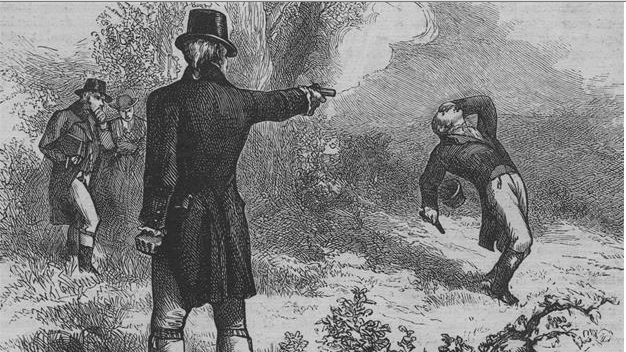
Out of town vis­i­tors who spend upwards of a month’s gro­cery bud­get for Broad­way tick­ets vol­un­tar­i­ly side trip way uptown to tour Hamil­ton Grange. The insa­tiable self­ie imper­a­tive dri­ves them to Cen­tral Park and Muse­um of the City of New York in search of larg­er than life sculp­tures. They take the PATH train to Wee­hawken to pay their respects in the spot where Hamil­ton was felled by Aaron Burr

Hamil­ton mer­chan­dise, need­less to say, is sell­ing briskly. Books, t‑shirts, jew­el­ry, bob­ble heads com­mem­o­ra­tive mugs…

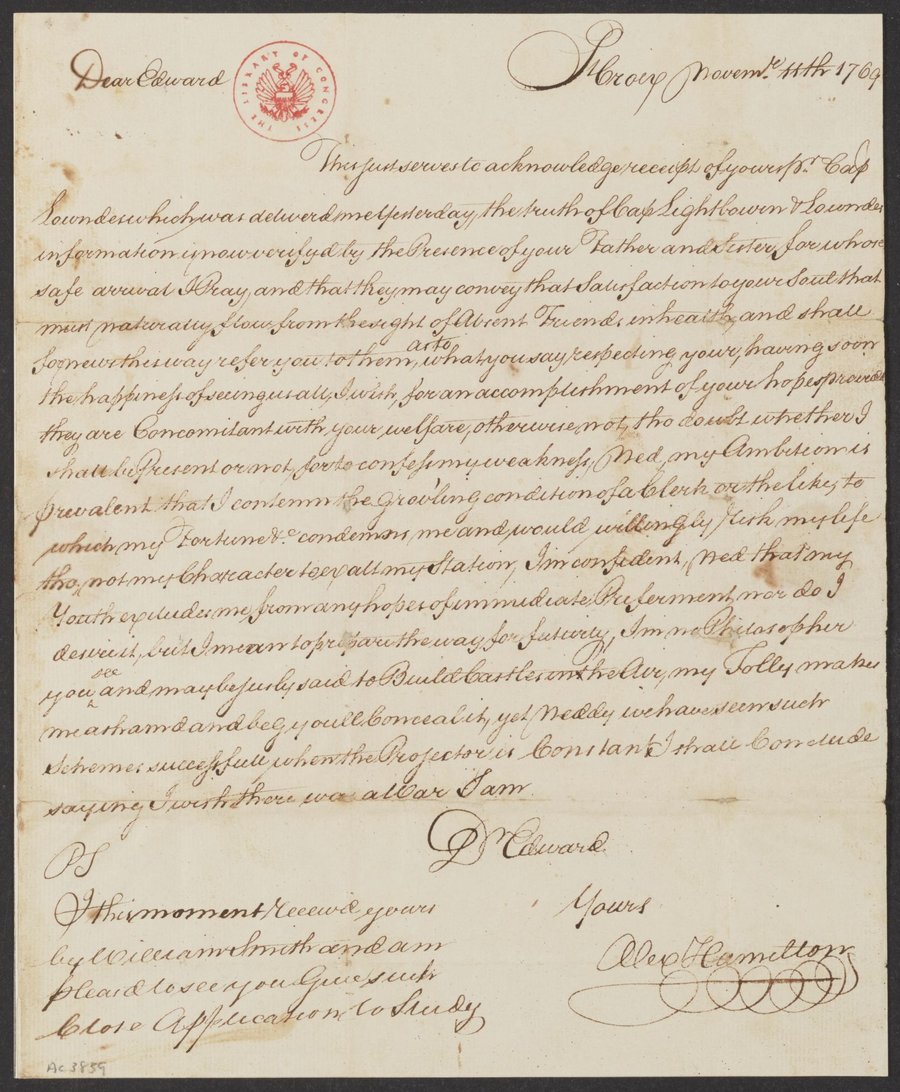
The Library of Con­gress is not out to cash in on this cul­tur­al moment in the mon­e­tary sense. But “giv­en the increased inter­est in Hamil­ton,” says Julie Miller, a cura­tor of ear­ly Amer­i­can man­u­scripts, it’s no acci­dent that the Library has tak­en pains to dig­i­tize 12,000 Hamil­ton doc­u­ments and make them avail­able on the web. The col­lec­tion includes speech­es, a draft of the Reynolds Pam­phlet, finan­cial accounts, school exer­cis­es and cor­re­spon­dence, both per­son­al and pub­lic, encom­pass­ing such mar­quee names as John Adams, Thomas Jef­fer­son, the Mar­quis de Lafayette, and George Wash­ing­ton.

One need not be a musi­cal the­ater fan to appre­ci­ate the emo­tion of the let­ter he wrote to his wife, Eliz­a­beth Schuyler, on the eve of his fate­ful duel with Aaron Burr:

I need not tell you of the pangs I feel, from the idea of quit­ting you and expos­ing you to the anguish which I know you would feel.… Adieu best of wives and best of Women. Embrace all my dar­ling Chil­dren for me.

Explore the Library of Con­gress’ Hamil­ton col­lec­tion here.

And enter the online lot­tery for $10 Hamil­ton tick­ets because, hey, somebody’s got to win.

via The­ater Mania

Relat­ed Con­tent:

Dis­cov­er Thomas Jefferson’s Cut-and-Paste Ver­sion of the Bible, and Read the Curi­ous Edi­tion Online

Watch a Wit­ty, Grit­ty, Hard­boiled Retelling of the Famous Aaron Burr-Alexan­der Hamil­ton Duel

“Alexan­der Hamil­ton” Per­formed with Amer­i­can Sign Lan­guage

Ayun Hal­l­i­day is an author, illus­tra­tor, the­ater mak­er and Chief Pri­ma­tol­o­gist of the East Vil­lage Inky zine.  Fol­low her @AyunHalliday.

Brooklyn Academy of Music Puts Online 70,000 Objects Documenting the History of the Performing Arts: Download Playbills, Posters & More

Yes­ter­day the sad news broke that The Vil­lage Voice will dis­con­tin­ue its print edi­tion. Co-found­ed by Nor­man Mail­er in 1955 and pro­vid­ing New York­ers with savvy music writ­ing, raunchy advice columns, juicy exposés, reviews, enter­tain­ment list­ings, apart­ments, jobs, band mem­bers, ter­ri­ble room­mates, and pret­ty much any­thing else one might desire every week for over half a cen­tu­ry, the paper will be missed. Though it won’t dis­ap­pear online, the loss of the street-lev­el copy in its com­fort­ing­ly famil­iar red plas­tic box marks the abrupt end of an era. Those of us inclined to mourn its pass­ing can take some solace in the fact that so many of the city’s key cul­tur­al insti­tu­tions still per­sist.

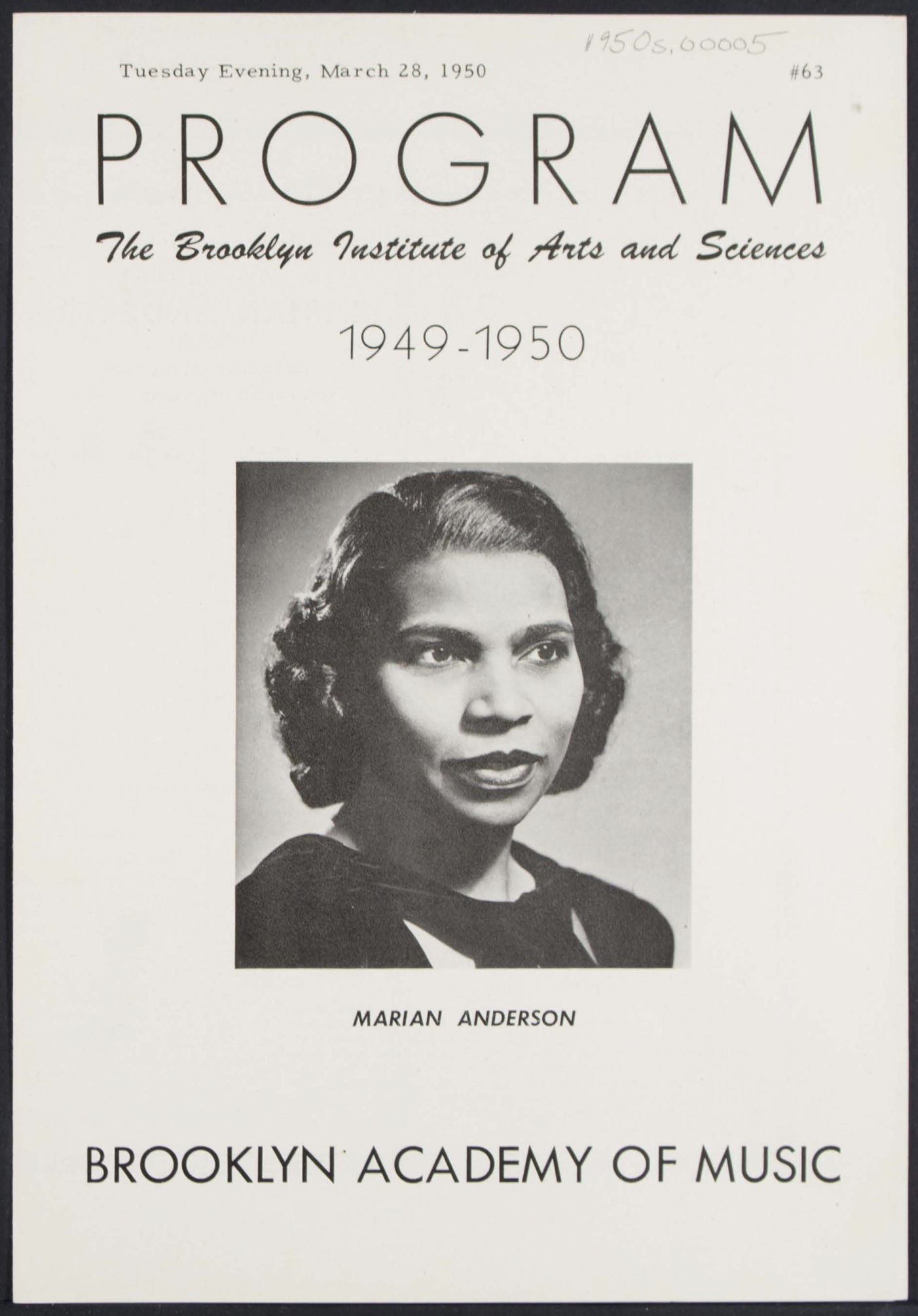
Promi­nent among them, Brooklyn’s Acad­e­my of Music, or BAM, has been at it since 1861, when it began as the home of the Phil­har­mon­ic Soci­ety of Brook­lyn. It has inhab­it­ed its present Beaux Arts build­ing in Fort Greene since 1908. In its 150 years as a per­for­mance space for opera, clas­si­cal, avant-garde the­ater, dance, and music, and film, BAM has amassed quite a col­lec­tion of mem­o­ra­bil­ia. This year, on its cen­tu­ry-and-a-half anniver­sary, it has made 70,000 of those arti­facts avail­able to the pub­lic in its Leon Levy Dig­i­tal Archive. Like future issues of the Voice, you can­not hold these in your hand, unless you hap­pen to be one of the museum’s cura­tors. But “researchers—or any­one else inter­est­ed,” writes The New York Times, “can cre­ate per­son­al­ized col­lec­tions based on spe­cif­ic artists, com­pa­nies or eras.”

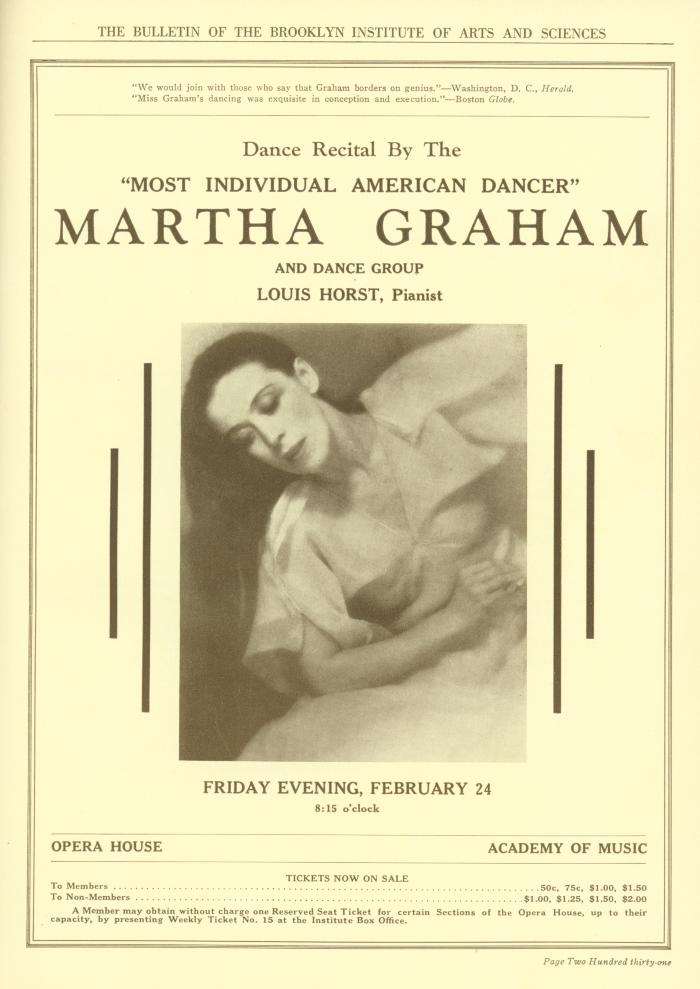
The his­to­ry rep­re­sent­ed here is vast and deep, by a young country’s stan­dards. “Every pres­i­den­tial can­di­date made cam­paign stops there before there was tele­vi­sion,” says for­mer BAM pres­i­dent Karen Brooks Hop­kins. “Mary Todd Lin­coln was in the audi­ence dur­ing the open­ing week of fes­tiv­i­ties. Then you have [Rudolph] Nuryev mak­ing his first per­for­mance in the West just after he defects, [Martha] Gra­ham per­form­ing her last per­for­mance on stage….” These land­mark moments notwith­stand­ing, BAM has earned a rep­u­ta­tion as a home for avant-garde per­for­mance art, and the col­lec­tion cer­tain­ly reflects that dimen­sion among the 40,000 artists rep­re­sent­ed.

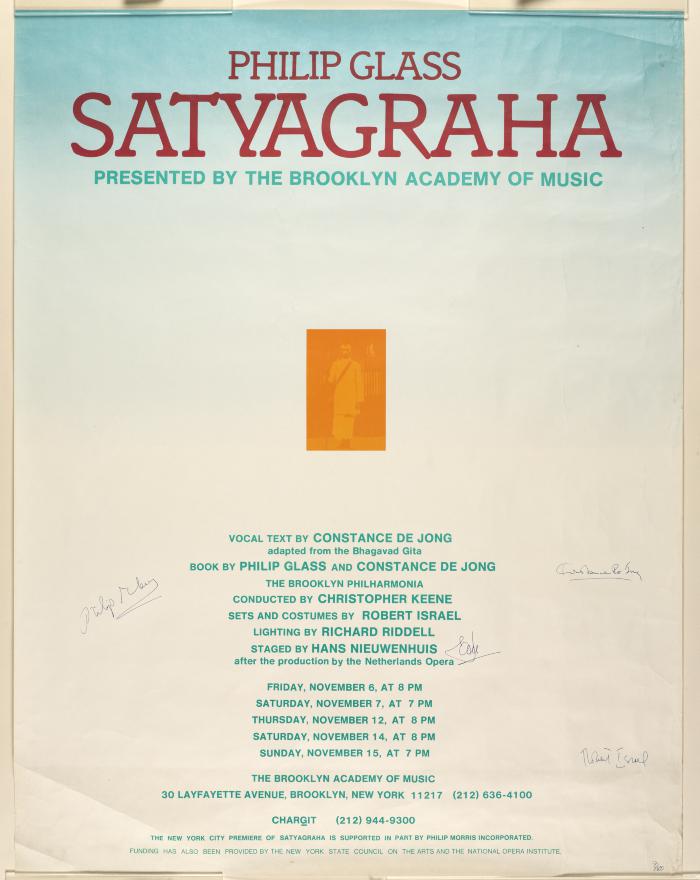
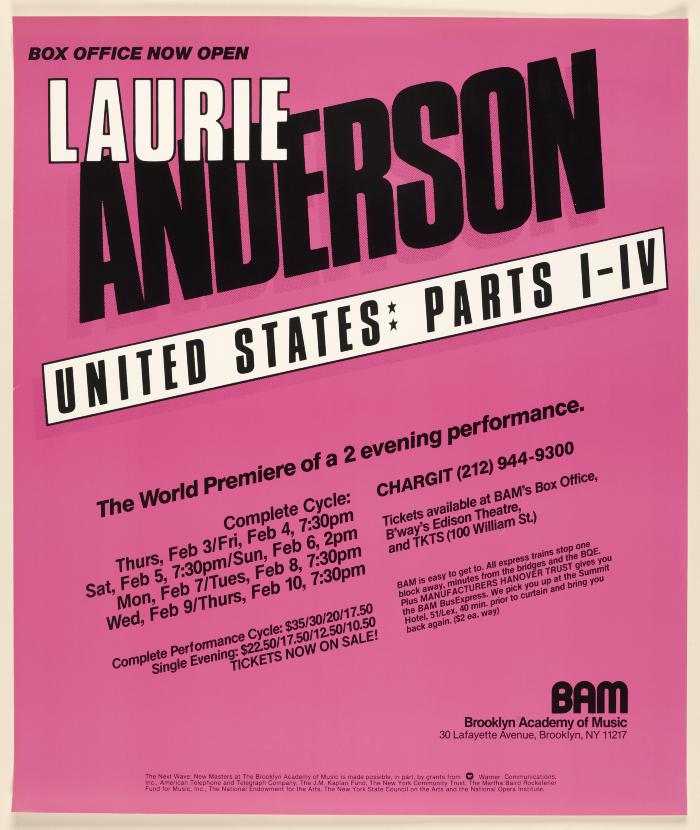
We have fur­ther up the post­card Kei­th Har­ing designed for a 1984 Bill T. Jones and Arnie Zane piece called Secret Pas­tures (Har­ing also designed the sets). We have the poster above for a 1981 per­for­mance of Philip Glass’ Satya­gra­ha, his opera based on the life of Gand­hi. And below, a poster for the 1983 world pre­mier of Lau­rie Anderson’s Unit­ed States: Parts I‑IV. These objects come from BAM’s Next Wave Fes­ti­val col­lec­tion, which con­tains many thou­sands of pho­tographs, play­bills, and posters from the space’s more exper­i­men­tal side, many, though not all of them, down­load­able.

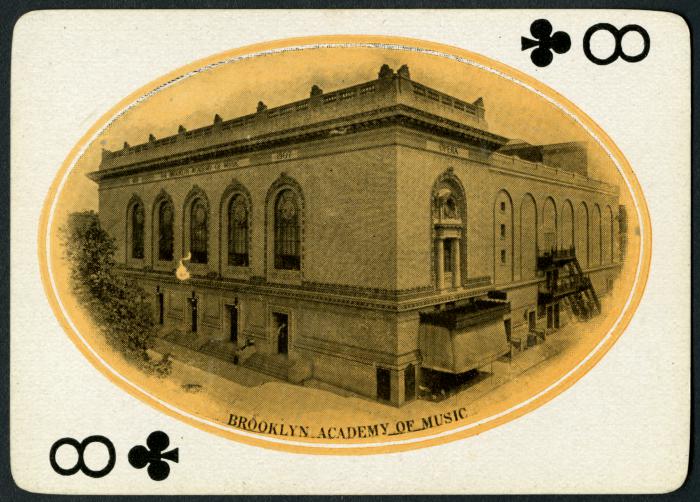
Between the Civ­il War mem­o­ra­bil­ia and mod­ernist doc­u­ments, you’ll find all sorts of fas­ci­nat­ing ephemera: pho­tos of a very young Meryl Streep and Christo­pher Lloyd in a 1977 pro­duc­tion of Hap­py End at the Chelsea The­ater dur­ing a BAM Spring Series, or of an old­er Patrick Stew­art in a 2008 Mac­beth. Just below, we have a charm­ing play­ing card fea­tur­ing the Brook­lyn Acad­e­my of Music’s Peter Jay Sharp build­ing in 1909, the year after it was built. It’s an impos­ing struc­ture that seems like it might last for­ev­er, though much of the vibrant cre­ative work fea­tured year after year at BAM may some­day also move entire­ly into dig­i­tal spaces. Enter the com­plete BAM dig­i­tal archive here.

via The New York Times/Hyper­al­ler­gic

Relat­ed Con­tent:

The The­ater Dic­tio­nary: A Free Video Guide to The­atre Lin­go

A Min­i­mal Glimpse of Philip Glass

Google Gives You a 360° View of the Per­form­ing Arts, From the Roy­al Shake­speare Com­pa­ny to the Paris Opera Bal­let

Josh Jones is a writer and musi­cian based in Durham, NC. Fol­low him at @jdmagness

« Go BackMore in this category... »
Quantcast