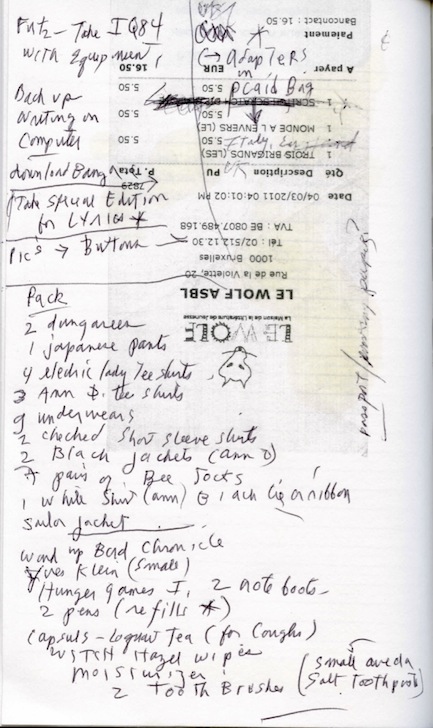
Patti Smith Creates a Detailed Packing List for Going on Tour: Haruki Murakami Books, Loquat Tea & More

Patti Smith Packing List

Pack­ing lists are not inher­ent­ly punk rock.

But the hand­writ­ten pack­ing list God­moth­er of Punk Pat­ti Smith scrawled upside down on a pho­to­copied receipt from a children’s book­store on the eve of a 40-date Euro­pean tour comes close. One can kind of imag­ine her stuff­ing her adap­tors, her Japan­ese pants, and her “9 under­wears” into a shop­ping bag or a dirty day pack, using it as a pil­low in the back of the van…

Behold the real­i­ty, below.

Patti Smith Suitcase

Smith’s hard shell case is kit­ted out with prac­ticed pre­ci­sion, its con­tents pared to the lean­est of  lux­u­ry-brand neces­si­ties to keep her hap­py and healthy on the road.

It’s not often you find a devo­tee of Ann Demeule­meester black jack­ets and $8 tooth­paste who’s will­ing to night­ly wring their socks and undies over a hotel room sink, but accord­ing to her Ban­ga tour diary, Smith is.

Oth­er essen­tials in Smith’s tour bag include loquat tea for her throat and plen­ty of read­ing mate­r­i­al. In addi­tion to the Hunger Games, she elect­ed to take along some old favorites from author Haru­ki Muraka­mi:

I decide this will be essen­tial­ly a Haru­ki Muraka­mi tour. So I will take sev­er­al of his books includ­ing the three vol­ume IQ84 to reread. He is a good writer to reread as he sets your mind to day­dream­ing while you are read­ing him. thus i always miss stuff.

Read­ers, use the com­ments sec­tion to let us know what indis­pens­able items you would pack when embark­ing on a 40-city tour with Pat­ti Smith.

via That Eric Alper

Relat­ed Con­tent:

Pat­ti Smith’s List of Favorite Books: From Rim­baud to Susan Son­tag

Pat­ti Smith Reviews Haru­ki Murakami’s New Nov­el, Col­or­less Tsuku­ru Taza­ki and His Years of Pil­grim­age

Pat­ti Smith Doc­u­men­tary Dream of Life Beau­ti­ful­ly Cap­tures the Author’s Life and Long Career (2008)

Ayun Hal­l­i­day is an author, illus­tra­tor, and Chief Pri­ma­tol­o­gist of the East Vil­lage Inky zine. Her play, Fawn­book, opens in New York City lat­er this fall. Fol­low her @AyunHalliday

Human: The Movie Features Interviews with 2,020 People from 60 Countries on What It Means to Be Human

What is it that makes us human? And how best to ensure that we all get our fair say?

For direc­tor, pho­tog­ra­ph­er, and envi­ron­men­tal activist Yann Arthus-Bertrand, the answers lay in fram­ing all of his inter­view sub­jects using the same sin­gle image lay­out. The for­mal sim­plic­i­ty and unwa­ver­ing gaze of his new doc­u­men­tary, Human, encour­age view­ers to per­ceive his 2,020 sub­jects as equals in the sto­ry­telling realm.

There’s a deep diver­si­ty of expe­ri­ences on dis­play here, arranged for max­i­mum res­o­nance.

The qui­et­ly con­tent first wife of a polyg­a­mist mar­riage is fol­lowed by a polyamorous fel­low, whose uncon­ven­tion­al lifestyle is a source of both tor­ment and joy.

There’s a death row inmate. A lady so con­fi­dent she appears with her hair in curlers.

Where on earth did he find them?

His sub­jects hail from 60 coun­tries. Arthus-Bertrand obvi­ous­ly went out of his way to be inclu­sive, result­ing in a wide spec­trum of gen­der and sex­u­al ori­en­ta­tions, and sub­jects with dis­abil­i­ties, one a Hiroshi­ma sur­vivor.

Tears, laugh­ter, con­flict­ing emo­tions… stu­dents of the­ater and psy­chi­a­try would do well to book­mark this page. There’s a lot one can glean from observ­ing these sub­jects’ unguard­ed faces.

The project was inspired by an impromp­tu chat with a Malian farmer. The direc­tor was impressed by the frank­ness with which this stranger spoke of his life and dreams:

I dreamed of a film in which the pow­er of words would res­onate with the beau­ty of the world. Putting the ills of human­i­ty at the heart of my work—poverty, war, immi­gra­tion, homophobia—I made cer­tain choic­es. Com­mit­ted, polit­i­cal choic­es. But the men talked to me about every­thing: their dif­fi­cul­ty in grow­ing as well as their love and hap­pi­ness. This rich­ness of the human word lies at the heart of Human. 

In Vol­ume I, above, the inter­vie­wees con­sid­er love, women, work, and pover­ty. Vol­ume II deals with war, for­give­ness, homo­sex­u­al­i­ty, fam­i­ly, and the after­life. Hap­pi­ness, edu­ca­tion, dis­abil­i­ty, immi­gra­tion, cor­rup­tion, and the mean­ing of life are the con­cerns of the third vol­ume .

The inter­view seg­ments are bro­ken up by aer­i­al sequences, rem­i­nis­cent of the images in Arthus-Bertrand’s book, The Earth from Above. It’s a good reminder of how small we all are in the grand scheme of things.

Appro­pri­ate­ly, giv­en the sub­ject mat­ter, and the director’s long­time inter­est in envi­ron­men­tal issues, the film­ing and pro­mo­tion were accom­plished in the most sus­tain­able way, with the sup­port of the Good­Plan­et Foun­da­tion and the Unit­ed Car­bon Action pro­gram. It would be love­ly for all human­i­ty if this is a fea­ture of film­mak­ing going for­ward.

The Google Cul­tur­al Insti­tute has a col­lec­tion of relat­ed mate­r­i­al, from the mak­ing of the sound­track to behind-the-scenes rem­i­nis­cences of the inter­view team.

Human will be added to our col­lec­tion, 4,000+ Free Movies Online: Great Clas­sics, Indies, Noir, West­erns, Doc­u­men­taries & More.

Relat­ed Con­tent:

What Makes Us Human?: Chom­sky, Locke & Marx Intro­duced by New Ani­mat­ed Videos from the BBC

Richard Dawkins Explains Why There Was Nev­er a First Human Being

Biol­o­gy That Makes Us Tick: Free Stan­ford Course by Robert Sapol­sky

Ayun Hal­l­i­day is an author, illus­tra­tor, and Chief Pri­ma­tol­o­gist of the East Vil­lage Inky zine. Her new play, Fawn­book, opens in New York City lat­er this fall. Fol­low her @AyunHalliday.

Support “Where Is the City of the Future?”: A Journey Across the Pacific Rim Using a Brand New Model of Journalism

Apart from from writ­ing here on Open Cul­ture, I write about cities. Hav­ing men­tioned my city-relat­ed projects here from time to time (the pod­cast Note­book on Cities and Cul­ture, the City in Cin­e­ma video essays), I’d like to sub­mit for your approval my newest and most ambi­tious one yet: Where Is the City of the Future?, an in-depth search across the Pacif­ic Rim for the best city to lead us into the urban cen­tu­ry ahead — using a brand new mod­el of jour­nal­ism.

Not long after the turn of the 21st cen­tu­ry, the world’s urban pop­u­la­tion sur­passed its non-urban pop­u­la­tion for the first time ever. And the deep­er human­i­ty gets into the this cen­tu­ry, the more urban­ized our world becomes: devel­op­ing cities devel­op, neglect­ed cities revi­tal­ize them­selves, and the long-stand­ing great cities of the world con­tin­ue to find (or strug­gle to find) new ways of accom­mo­dat­ing all those who’ve nev­er stopped com­ing to live in them. How can the ever-grow­ing urban world pre­pare itself for things to come?

colin cities

This series of reports, com­bin­ing both text and pho­tographs, and informed by both exten­sive on-the-ground explo­ration and in-depth con­ver­sa­tions with those who know these fas­ci­nat­ing urban places best, aims to find out by tak­ing as close as pos­si­ble a look at cities all across the Pacif­ic Rim. These include 20th-cen­tu­ry metrop­o­lis­es look­ing toward the future like Los Ange­les, Seat­tle and Van­cou­ver, com­pact city-states like Sin­ga­pore and Hong Kong, fast-devel­op­ing cap­i­tals like Jakar­ta and Bangkok, low­er-pro­file but nev­er­the­less inven­tive “sleep­er” cities like Welling­ton and San­ti­a­go, and east Asian megac­i­ties like Seoul, Tokyo, and Shang­hai.

I’ve launched “Where Is the City of the Future?” as one of the flag­ship projects on Byline, a new plat­form for crowd­fund­ed jour­nal­ism. For every $2000 raised there, I’ll go report on one Pacif­ic Rim city, seek­ing out the impor­tant lessons it has to teach every oth­er, from the urban­is­tic to the archi­tec­tur­al to the cul­tur­al and beyond. This will begin with reports on Los Ange­les and Seoul, and will con­tin­ue on indef­i­nite­ly to poten­tial cities of the future in an order vot­ed on the back­ers. (The­o­ret­i­cal­ly, you could keep me at this for quite a long time!) If you like, you can get involved at the project’s Byline page. Thanks very much indeed — and I look for­ward to find­ing the city of the future togeth­er.

Relat­ed con­tent:

The City in Cin­e­ma Mini-Doc­u­men­taries Reveal the Los Ange­les of Blade Run­ner, Her, Dri­ve, Repo Man, and More

Col­in Mar­shall writes else­where on cities, lan­guage, Asia, and men’s style. He’s at work on a book about Los Ange­les, A Los Ange­les Primer, the video series The City in Cin­e­ma, and the crowd­fund­ed jour­nal­ism project Where Is the City of the Future? Fol­low him on Twit­ter at @colinmarshall or on Face­book.

A Wealth of Free Documentaries on All Things Japanese: From Bento Boxes to Tea Gardens, Ramen & Bullet Trains

“I used to be OBSESSED with Japan­ese cul­ture,” wrote an uncom­mon­ly thought­ful Youtube com­menter. “I miss that part of me. Try­ing to search for it again. That’s when I was the hap­pi­est.” Many of us west­ern­ers — or real­ly, many of us non-Japan­ese — go through sim­i­lar peri­ods of affin­i­ty and avid­i­ty for all things Japan­ese. Some of us put it away with our child­ish things; some of us make Japan­ese cul­ture a life­long inter­est, or even the stuff of our pro­fes­sions. I myself got into Japan ear­ly, at some point found myself put off by the just slight­ly too obses­sive Japan­ese pop-cul­ture fan com­mu­ni­ty in the West (though I admit­ted­ly read that com­ment below a music video with four mil­lion views), and lat­er returned with a much more seri­ous intent to under­stand.

But to under­stand what? The Japan­ese lan­guage, cer­tain­ly, and Japan­ese film, Japan­ese cities, Japan­ese aes­thet­ics, Japan­ese tech­nol­o­gy — all the fruits of the cul­ture that stoke in the rest of the world both deep envy and, some­times, faint sus­pi­cion. Why do they per­sist in using writ­ing sys­tems that, despite their con­sid­er­able beau­ty, come with such aggra­vat­ing dif­fi­cul­ty? The com­pre­hen­sive sub­way net­works in metrop­o­lis­es like Tokyo and Osa­ka func­tion day in and day out with aston­ish­ing reach and reli­a­bil­i­ty, but why do their rid­ers tol­er­ate crowd­ed­ness even to the point of get­ting uncom­plain­ing­ly crammed inside the cars by white-gloved atten­dants? And why, despite the Japan­ese love for ele­gant design and advanced con­sumer tech­nol­o­gy, do their web sites look so jum­bled and con­fus­ing?

NHK World can put you on the road to under­stand­ing these and oth­er ques­tions with Japanol­o­gy, their series of Eng­lish-lan­guage doc­u­men­taries explor­ing the things large and small, all sur­pris­ing to the for­eign­er, that make up the fab­ric of Japan­ese life. BEGIN Japanol­o­gy, their series for the Japan-intrigued but not nec­es­sar­i­ly Japan-expe­ri­enced, has come to six sea­sons so far.

At the top of the post, you can see its episode on ben­to, those painstak­ing­ly pre­pared lunch box­es, sim­pli­fied ver­sions of which even those who know noth­ing of Japan have seen at gro­cery stores the world over. To learn more about ben­to’s place in Japan­ese cul­ture, pro­ceed on to the rel­e­vant episode of Japanol­o­gy Plus, NHK’s series for the even more insa­tiably curi­ous Japanophile. And cou­ple with an episode on Ramen above.

Japanol­o­gy Plus also ded­i­cates one of its half-hour pro­grams to the Shinkansen, com­mon­ly known as the “bul­let train,” that quin­tes­sen­tial­ly Japan­ese mode of trans­porta­tion that, with its impec­ca­ble half-cen­tu­ry record of speed, safe­ty, and punc­tu­al­i­ty, has become the pride of the land. (I, for one, hold out hope that Oba­ma will make The Onion’s “Ambi­tious Plan to Fly Amer­i­cans to Japan to Use Their Trains” a real­i­ty.) But if you don’t feel quite ready yet to board a Shinkansen, much less learn about its inner work­ings, try the Begin Japanol­o­gy Spe­cial Mini series, which offers five-minute dis­tilled doc­u­men­taries on such icons of Japan as tea gar­dens, hot springs, and Mount Fuji. Watch­ing all these, I feel glad indeed that I’ve already got the tick­ets booked for my next flight over there. Do you have yours?

You can find Japanol­o­gy added to our list of 200+ Free Doc­u­men­taries, a sub­set of our col­lec­tion 4,000+ Free Movies Online: Great Clas­sics, Indies, Noir, West­erns, Doc­u­men­taries & More

Relat­ed Con­tent:

Dis­cov­er Japan’s Earth­quake Proof Under­ground Bike Stor­age Sys­tem: The Future is Now

“Tsun­doku,” the Japan­ese Word for the New Books That Pile Up on Our Shelves, Should Enter the Eng­lish Lan­guage

Watch a Japan­ese Crafts­man Lov­ing­ly Bring a Tat­tered Old Book Back to Near Mint Con­di­tion

A Pho­to­graph­ic Tour of Haru­ki Murakami’s Tokyo, Where Dream, Mem­o­ry, and Real­i­ty Meet

Ear­ly Japan­ese Ani­ma­tions: The Ori­gins of Ani­me (1917–1931)

Cook­pad, the Largest Recipe Site in Japan, Launch­es New Site in Eng­lish

Let’s Learn Japan­ese: Two Clas­sic Video Series to Get You Start­ed in the Lan­guage

Col­in Mar­shall writes else­where on cities, lan­guage, Asia, and men’s style. He’s at work on a book about Los Ange­les, A Los Ange­les Primer, the video series The City in Cin­e­maand the crowd­fund­ed jour­nal­ism project Where Is the City of the Future? Fol­low him on Twit­ter at @colinmarshall or on Face­book.

Vintage 1930s Japanese Posters Artistically Market the Wonders of Travel

Vintage-Japanese-Tourism-Posters

Ear­li­er this year, we fea­tured vin­tage Japan­ese print adver­tise­ments from the gold­en age of Art Deco and for such prod­ucts as beer, sake, and cig­a­rettes. If you like that sort of thing, you might con­sid­er pay­ing atten­tion to the recent­ly launched Brand­ing in Asia, a site detect­ed to cov­er­ing “the art of brand­ing” as expressed in “the excit­ing new ideas and con­cepts explod­ing from the mind of Asia” — or the excit­ing old ideas and con­cepts which, aes­thet­i­cal­ly speak­ing, remain pret­ty explo­sive still.

Vintage-Japanese-Travel13

Take, for instance, their col­lec­tion of clas­sic Japan­ese steamship ads. “In the ear­ly part of the 20th cen­tu­ry,” writes Steph Aromdee, “Japan’s increas­ing­ly pros­per­ous mid­dle class was tak­ing to the high seas for trav­el. One com­pa­ny, the Japan Mail Steamship, adver­tised heav­i­ly, hop­ing to attract would-be tourists to their lux­u­ry ships. What were like­ly at the time regard­ed as sim­ple adver­tise­ments and brochures that sim­ply showed depar­tures and des­ti­na­tions, have today become viewed as stun­ning works of art.”

Vintage-Japanese-Travel4

Here we’ve excerpt­ed a few such adver­tise­ments from their impres­sive selec­tion which, as you can see, ranges artis­ti­cal­ly from the styl­ized to the real­is­tic, and con­cep­tu­al­ly from the prac­ti­cal to the pure­ly evoca­tive. They might entice read­ers onto a steamship voy­age with an Art Deco bathing beau­ty, a con­trast of human trav­el­er against moun­tain’s majesty, a detailed map enu­mer­at­ing a vari­ety of pos­si­ble des­ti­na­tions, or, as in the case of deer-filled Nara, a scat­ter­ing of local icons.

Vintage-Japanese-Travel11

The age of the steamship has, of course, long since dis­solved into the roman­tic past, even in Japan. Or per­haps I should say espe­cial­ly in Japan, whose shinkansen bul­let train not only put every oth­er mode of trans­port straight into obso­les­cence, but — at least to my mind — also boasts a cut­ting-edge romance of its own.

Vintage-Japanese-Travel-posters7

And so these adver­tise­ments, more than 70 years after their print­ings, still get me plan­ning my next trip to Japan, a coun­try that knows a thing or two about desire and place. “Even in Kyoto,” wrote 17th-cen­tu­ry poet Mat­suo Bashō, “I long for Kyoto.”
Vintage-Japanese-Travel-posters12

via Brand­ing in Asia

Relat­ed Con­tent:

Adver­tise­ments from Japan’s Gold­en Age of Art Deco

Glo­ri­ous Ear­ly 20th-Cen­tu­ry Japan­ese Ads for Beer, Smokes & Sake (1902–1954)

Hand-Col­ored Pho­tographs of 19th Cen­tu­ry Japan

Col­in Mar­shall writes on cities, lan­guage, Asia, and men’s style. He’s at work on a book about Los Ange­les, A Los Ange­les Primer, and the video series The City in Cin­e­ma. Fol­low him on Twit­ter at @colinmarshall or on Face­book.

Pico Iyer on “the Art of Stillness”: How to Enrich Your Busy, Distracted Life by Unplugging and Staying Put

Hav­ing known Pico Iyer for quite some time, on paper and in per­son, as a per­pet­u­al exam­ple and occa­sion­al men­tor in the writ­ing of place, it delights me to watch him attract more lis­ten­ers than ever with the talks he’s giv­en in recent years, the most pop­u­lar of which advo­cate some­thing called “still­ness.” But at first I won­dered: did this shift in sub­ject mean that Iyer—a Cal­i­for­nia-grown Brit from an Indi­an fam­i­ly who most­ly lives in Japan (“a glob­al vil­lage on two legs,” as he once called him­self), known for books like Video Night in Kath­man­duFalling off the Map, and The Glob­al Soulhad put his sig­na­ture hard-trav­el­ing ways behind him?

Hard­ly. But he did start telling the world more about his long-stand­ing habit of rou­tine­ly seek­ing out the most qui­et, least “con­nect­ed” places he can—the sea­side no-speech-allowed Catholic her­mitage, the rur­al vil­lage out­side Kyoto—in order to reflect upon the time he has spent cir­cling the globe, trans­pos­ing him­self from cul­ture to alien cul­ture. “24 years ago, I took the most mind-bend­ing trip across North Korea,” he tells us, “but the trip last­ed a few days. What I’ve done with it sit­ting still—going back to it in my head, try­ing to under­stand it, find­ing a place for it in my thinking—that’s last­ed 24 years already, and will prob­a­bly last a life­time.”

If we want to fol­low Pico’s exam­ple, we must strike a bal­ance: we must process the time we spend doing some­thing intensely—traveling, writ­ing, pro­gram­ming, lift­ing weights, what have you—with time spent not doing that some­thing, a pur­suit in its own way as intense. He con­nects all this with the 21st-cen­tu­ry tech­nol­o­gy cul­ture in which we find our­selves, cit­ing the exam­ple of folks like Wired co-founder Kevin Kel­ly and even cer­tain enlight­en­ment-mind­ed Googlers who reg­u­lar­ly and rig­or­ous­ly detach them­selves from cer­tain kinds of mod­ern devices, going “com­plete­ly offline in order to gath­er the sense of direc­tion and pro­por­tion they’ll need when they go online again.”

Achiev­ing such a prop­er intel­lec­tu­al, psy­cho­log­i­cal, social, and tech­no­log­i­cal com­part­men­tal­iza­tion in life may seem like a rare trick to pull off. But if you ever doubt its pos­si­bil­i­ty, just revis­it the last talk from Pico we fea­tured, in which he describes his encounter with Leonard Cohen, the only man alive who has suc­cess­ful­ly com­bined the lifestyles of rock star and Zen monk.

Relat­ed Con­tent:

The Best Writ­ing Advice Pico Iyer Ever Received

Pico Iyer on “The Joy of Less”

How Leonard Cohen’s Stint As a Bud­dhist Monk Can Help You Live an Enlight­ened Life

Col­in Mar­shall writes on cities, lan­guage, Asia, and men’s style. He’s at work on a book about Los Ange­les, A Los Ange­les Primer, and the video series The City in Cin­e­ma. Fol­low him on Twit­ter at @colinmarshall or on Face­book.

Climb Virtually Up “El Capitan,” Yosemite’s Iconic Rock Wall, With Google Street View

Google has used its Street View tech­nol­o­gy to let you take vir­tu­al tours of some far-flung places — places like Shackleton’s Antarc­tic, Mt. Ever­est and oth­er high moun­tain peaks, The Ama­zon Riv­er, and The Grand Canyon. Now you can add to the list, El Cap­i­tan, the icon­ic rock wall in the mid­dle of Yosemite Nation­al Park.

Yes­ter­day, Google’s offi­cial blog declared, “Today we’re launch­ing our first-ever ver­ti­cal Street View col­lec­tion, giv­ing you the oppor­tu­ni­ty to climb 3,000 feet up the world’s most famous rock wall: Yosemite’s El Cap­i­tan. To bring you this new imagery, we part­nered with leg­endary climbers Lynn Hill, Alex Hon­nold and Tom­my Cald­well.” Above, you can see this trio in action, talk­ing about what makes El Cap a mec­ca for rock climbers every­where.

To cre­ate this Street View of El Cap­i­tan, Hill, Hon­nold and Cald­well worked with Google engi­neers to fig­ure out how to haul a cam­era up this sheer rock face. And what you ulti­mate­ly get are some amaz­ing 360-degree panoram­ic images. Accord­ing to Cald­well, these “are the clos­est thing I’ve ever wit­nessed to actu­al­ly being thou­sands of feet up a ver­ti­cal rock face—better than any video or pho­to.” Which, hat­ing heights, is good enough for me.

via Google Blog

If you would like to sign up for Open Culture’s free email newslet­ter, please find it here. It’s a great way to see our new posts, all bun­dled in one email, each day.

If you would like to sup­port the mis­sion of Open Cul­ture, con­sid­er mak­ing a dona­tion to our site. It’s hard to rely 100% on ads, and your con­tri­bu­tions will help us con­tin­ue pro­vid­ing the best free cul­tur­al and edu­ca­tion­al mate­ri­als to learn­ers every­where. You can con­tribute through Pay­Pal, Patre­on, and Ven­mo (@openculture). Thanks!

Take a Visual Walking Tour of Franz Kafka’s Prague with Will Self (Then Read His Digital Essay, “Kafka’s Wound”)

“There is noth­ing intrin­si­cal­ly imag­i­na­tive about the idea of ‘gold,’ nor the idea of ‘moun­tain,’” writes Will Self, cit­ing an idea of the philoso­pher David Hume, “but join them togeth­er and you have a fan­tas­ti­cal­ly gleam­ing ‘gold moun­tain.’ And might not that gold moun­tain be the Lau­ren­z­iberg in Prague? After all, it looms over con­tem­po­rary Prague just as it loomed in the con­scious­ness of Franz Kaf­ka, whose ear­li­est sur­viv­ing nar­ra­tive frag­ment, ‘Descrip­tion of a Strug­gle,’ is in part an account of a phan­tas­magor­i­cal ascent of its slopes.”

This asso­ci­a­tion comes from “Kafka’s Wound,” Will Self­’s new essay in the Lon­don Review of Books — or rather, a new “dig­i­tal essay” from the LRB on the BBC and Arts Coun­cil Eng­land’s new site The Space, one which takes full advan­tage of the mul­ti­me­dia future, much enthused over back in the 1990s, in which we now find our­selves. For some read­ers, myself includ­ed, the asso­ci­a­tion of the author of The Meta­mor­pho­sis and The Tri­al with Hume, the author of so many vol­umes fic­tion­al, non­fic­tion­al, and psy­cho­geo­graph­i­cal (find some in our col­lec­tion of Free Phi­los­o­phy eBooks), con­sti­tutes rea­son enough to min­i­mize all oth­er win­dows and get read­ing.

But Self has tak­en on an even more ambi­tious project than that: the mind-map­pish inter­face of “Kafka’s Wound” offers a wealth of audio, video, and oth­er tex­tu­al mate­r­i­al to sup­ple­ment the expe­ri­ence of the main text, all of which con­nects in some way to the essay’s sub­ject: Will Self­’s “per­son­al rela­tion­ship to Kafka’s work through the lens of the short sto­ry ‘A Coun­try Doc­tor’ (1919), and in par­tic­u­lar through the aper­ture of the wound described in that sto­ry.” Self­’s own site describes the essay as “ ‘through com­posed’ with Will’s own thoughts, as he works, being respond­ed to by dig­i­tal-con­tent providers,” with more of that con­tent to come through July.

The envi­ron­ment inter­net, which facil­i­tates our nat­ur­al ten­den­cy to drift from sub­ject to at least semi-relat­ed sub­ject with an addic­tive vengeance, encour­ages asso­ci­a­tion­al think­ing. But so do cities, as a psy­cho­geo­g­ra­ph­er like Will Self knows full well. And so part of this rich lit­er­ary inves­ti­ga­tion takes the form of an hour­long doc­u­men­tary (click here or the image above to view), in which Self takes a walk­ing tour of Kafka’s Prague, seek­ing out the writer’s “genius loci,” the sites that gave set­tings to the mile­stones of his life and shape to his artis­tic and intel­lec­tu­al sen­si­bil­i­ties. He also takes the oppor­tu­ni­ty to do a Kaf­ka read­ing right there in Kafka’s home­town. It’s one thing to read Kaf­ka with the Lau­ren­z­iberg in mind, but still quite anoth­er to do it with the Lau­ren­z­iberg in sight.

Relat­ed Con­tent:

Kafka’s Night­mare Tale, ‘A Coun­try Doc­tor,’ Told in Award-Win­ning Japan­ese Ani­ma­tion

Franz Kafka’s Kafkaesque Love Let­ters

Vladimir Nabokov Makes Edi­to­r­i­al Tweaks to Franz Kafka’s Novel­la The Meta­mor­pho­sis

The Art of Franz Kaf­ka: Draw­ings from 1907–1917

Four Franz Kaf­ka Ani­ma­tions: Enjoy Cre­ative Ani­mat­ed Shorts from Poland, Japan, Rus­sia & Cana­da

Col­in Mar­shall writes on cities, lan­guage, Asia, and men’s style. He’s at work on a book about Los Ange­les, A Los Ange­les Primer, and the video series The City in Cin­e­ma. Fol­low him on Twit­ter at @colinmarshall or on Face­book.

« Go BackMore in this category... »
Quantcast