Click image once to enlarge, and yet again to enlarge further.
The assignment was impossible: a subject that refused to be interviewed, research that took over three months, and expenses that reached nearly $5,000 (in mid 1960s money). The result: one of the greatest celebrity profiles ever written.
Recently hired by Esquire after spending the first ten years of his career at TheNew York Times, Gay Talese’s first assignment from editor Harold Hayes was to write a profile of the already iconic Frank Sinatra.
The legendary singer was approaching fifty, under the weather, out of sorts, and unwilling to be interviewed. So Talese remained in L.A., hoping Sinatra might recover and reconsider, and he began talking to many of the people around Sinatra — his friends, his associates, his family, his countless hangers-on — and observing the man himself wherever he could.
In an interview last month with Nieman Storyboard, Talese explained that he didn’t want to write the story in the first place. “Life magazine just did a piece on Sinatra,” he recalls. “What can you say about Sinatra that hasn’t already been said?” However, for a writer who has written many brilliant pieces, the resulting profile, “Frank Sinatra Has a Cold,” is his most indelible.
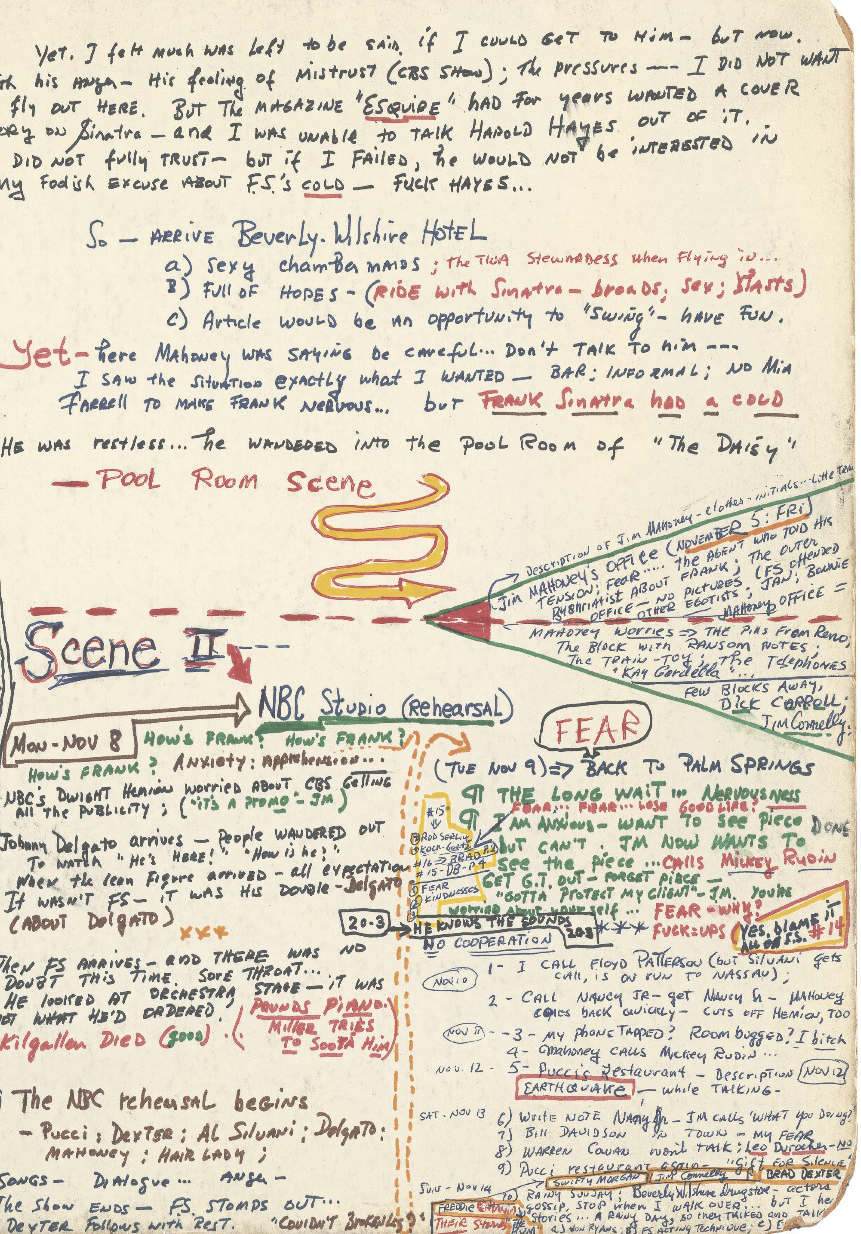
Above is Talese’s outline for the profile. Instead of notebooks, Talese used shirt boards to write down his observations. As he told The Paris Review in 2009, “I cut the shirt board into four parts and I cut the corners into round edges, so that they [could] fit in my pocket. I also use full shirt boards when I’m writing my outlines.”
What is also vital to Talese’s process is his personal observation. If you read Talese’s outline (click on the image above to enlarge), you will uncover more of what Talese thought and felt during that day than facts about Sinatra. “What I’m doing as a researching writer is always mixed up with what I’m feeling while doing it,” Talese notes, “and I keep a record of this. I’m always part of the assignment.”
This style goes to the heart of what became known as New Journalism, which, among other things, established the right for a writer to use his or her imagination to make a scene come alive. While the style was adopted by Talese, along with Tom Wolfe, Joan Didion, and others, it was first born out of necessity to complete the Sinatra profile. “The creativity in journalism is in what you do with what you have,” Talese says.
Despite being the paragon of imperturbable masculinity of his time, Ernest Hemingway had a highly sensitive artistic temperament. Nowhere did he exhibit this more than when discussing his writing. Papa did not suffer fools gladly, and literary critics tended to fare even worse. After Max Eastman dared to write, “Come out from behind that false hair on your chest, Ernest. We all know you,” Hemingway was reported to have slapped him with a book. When Orson Welles—a cinematic firebrand in his own right—decided to chide Hemingway about his script, the author took a swing.
In this YouTube clip, the critic seems to have gotten away with merely a verbal wallop. Although there is no video, the audio is clear, and we hear Hemingway’s measured baritone reading, then commenting on, an Irish critic’s review that he had received in 1931:
‘Your book lies upon my table. I have finished reading it, and I eye it dubiously.’ You’ve got a nice eye, boy!
‘The pages are cut rather unevenly.’ Nice work, you’re in there.
‘The stiff covers and the binding are normal, I think.’ Who are you, kid?
‘The signature on the cover is stamped in gold, or what looks like gold. There is nothing printed on the back side of the jacket.’ Your own backside.
The reviewer, one Walter H. McKay, fails to probe beyond the book’s binding, and Hemingway, in his typical style, tersely rips him a new one (bonus points if you noticed Hem’s Joycean turn of phrase).
Ilia Blinderman is a Montreal-based culture writer. Follow him at @iliablinderman
Despite some of the stranger circumstances of Philip K. Dick’s life, his reputation as a paranoid guru is far better deserved by other science fiction writers who lost touch with reality. Dick was a serious thinker and writer before pop culture made him a prophet. Jonathan Letham wrote of him, “Dick wasn’t a legend and he wasn’t mad. He lived among us and was a genius.” It’s a fashionable opinion these days, but his genius went mostly unrecognized in his lifetime—at least in his home country—except among a subset of sci-fi readers. But Dick considered himself a literary writer. He left the University of California after less than a semester, but the “consummate autodidact” read widely and deeply, favoring the giants of European philosophy, theology, and literature. For this reason, Dick suspected that his tepid reception in the U.S., by comparison with the warm regard of the French, showed a “flawed” anti-intellectualism in Americans that prevented them from appreciating his work. In the 1977 edited interview above with Dick in France, you can hear him lay out his theory in detail, offering insights along the way into his literary education and influences.
Dick identifies two strains of anti-intellectualism in the U.S. The first, he says, prevents American readers from appreciating “novels of ideas.” Science fiction, he says, “is essentially the field of ideas. And the anti-intellectualism of Americans prohibits their interest in imaginative ideas and interesting concepts.”
I don’t find Dick particularly persuasive here, but I live in a time when he has been fully embraced, if only in adaptation. Dick’s more specific take on what may be a root cause for Americans’ lack of curiosity has to do with the reading habits of Americans.
There’s another facet as regards my particular work say compared to other science fiction writers. I grew up in Berkeley and my education was not limited at all to reading other science fiction novels preceding my own, such as van Vogt, or Heinlein, or people of that kind… Padgett, and so on…. Bradbury. What I read, because it’s a university city, was Flaubert, Stendhal, Balzac… Proust, and the Russian novelists influenced by the French. Turgenev. And I even read Japanese novels, modern Japanese novels, novelists who were influenced by the French realistic writers.
Dick says his “slice of life” novels were well received in France because he based them on 19th French realist novels. His favorite, he tells the interviewer, were Madame Bovary and The Red and the Black, as well as Turgenev’s Fathers and Sons — all found in our collection of Free eBooks and Free Audio Books. Perhaps a little self-importantly, in his particular conception of himself as a literary writer, Dick distances himself from other American science fiction authors, whom he alleges share the American reader’s anti-intellectual propensities. “I think this applies to me more than other American science fiction writers,” says Dick, “In fact, I think that it’s a great flaw in American science fiction writers, and their readers, that they are insulated from the great literature of the world.”
One can work with language all day, I have found—write, teach, blog and tweet incessantly—and still succumb to all the worst habits of lazy writers: indulging strings of clichés and abstractions, making it impossible for a reader to, as they say, “locate herself” in time and space. Travel writer and essayist Pico Iyer found this out on the job. Though he had written his way through graduate school and the pages of Time magazine, he still needed to hear the advice of his editor at Knopf, Charles Elliott. “The reader wants to travel beside you,” said Elliott, “looking over your shoulder.”
Such a simple notion. Essential even. But Elliott’s advice is not limited to the dogma of “show, don’t tell” (maybe a limited way to think of writing). More pointedly he stresses the connection of abstract ideas to concrete, specific descriptions that anchor events to a reality outside the author’s head, one the reader wants see, hear, touch, etc. The “best writing advice” Iyer ever received is a useful precept especially, I think, for people who write all of the time, and who need to be reminded, like Iyer, to keep it fresh. Read his full description at The American Scholar.
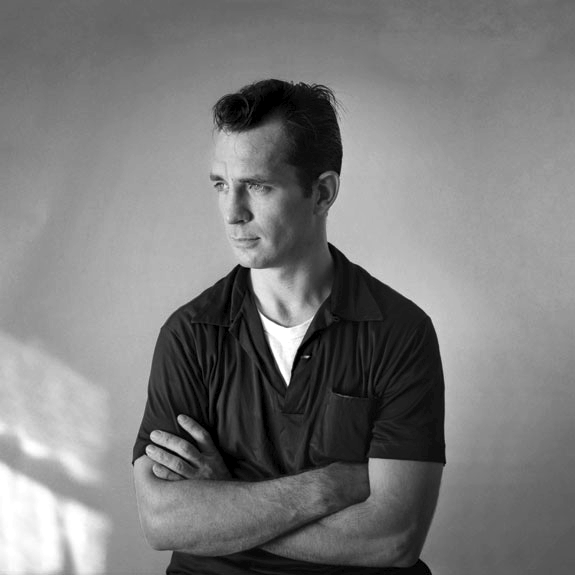
Jack Kerouac wants you to turn writing into “free deviation (association) of mind into limitless blow-on-subject seas of thought, swimming in sea of English with no discipline, other than rhythms of rhetorical exhalation and expostulated statement….” Think you can do that? Find out by following Kerouac’s “Essentials of Spontaneous Prose.” He published this document in Black Mountain Review in 1957 and wrote it in response to a request from Allen Ginsberg and William S. Burroughs that he explain his method for writing The Subterraneansin three days time.
And for a theory of Kerouac’s not quite theory, visit the site of Marissa M. Juarez, professor of Rhetoric, Composition, and the Teaching of English at the University of Arizona. Juarez raises some salient points about why Kerouac’s “Essentials” bemuse the English teacher: His method “discourages revision… chastises grammatical correctness, and encourages writerly flexibility.” Read Kerouac’s full “Essentials of Spontaneous Prose” here or below. [Note: If you see what looks like typos, they are not errors. They are part of Kerouac’s original, spontaneous text.]
SET-UP: The object is set before the mind, either in reality. as in sketching (before a landscape or teacup or old face) or is set in the memory wherein it becomes the sketching from memory of a definite image-object.
PROCEDURE: Time being of the essence in the purity of speech, sketching language is undisturbed flow from the mind of personal secret idea-words, blowing (as per jazz musician) on subject of image.
METHOD: No periods separating sentence-structures already arbitrarily riddled by false colons and timid usually needless commas-but the vigorous space dash separating rhetorical breathing (as jazz musician drawing breath between outblown phrases)– “measured pauses which are the essentials of
our speech”– “divisions of the sounds we hear”- “time and how to note it down.” (William Carlos Williams)
SCOPING: Not “selectivity” of expression but following free deviation (association) of mind into limitless blow-on-subject seas of thought,
swimming in sea of English with no discipline other than rhythms of rhetorical exhalation and expostulated statement, like a fist coming down on a table with each complete utterance, bang! (the space dash)- Blow as deep as you want-write as deeply, fish as far down as you want, satisfy yourself first, then reader cannot fail to receive telepathic shock and meaning-excitement by same laws operating in his own human mind.
LAG IN PROCEDURE: No pause to think of proper word but the infantile pileup of scatological buildup words till satisfaction is gained, which will turn out to be a great appending rhythm to a thought and be in accordance with Great Law of timing.
TIMING: Nothing is muddy that runs in time and to laws of time-Shakespearian stress of dramatic need to speak now in own unalterable way or forever hold tongue-no revisions (except obvious rational mistakes, such as names or calculated insertions in act of not writing but inserting).
CENTER OF INTEREST: Begin not from preconceived idea of what to say about image but from jewel center of interest in subject of image at moment of writing, and write outwards swimming in sea of language to peripheral release and exhaustion-Do not afterthink except for poetic or P. S. reasons. Never afterthink to “improve” or defray impressions, as, the best writing is always the most painful personal wrung-out tossed from cradle warm protective mind-tap from yourself the song of yourself, blow!-now!-your way is your only way- “good”-or “bad”-always honest (“ludi- crous”), spontaneous, “confessionals’ interesting, because not “crafted.” Craft is craft.
STRUCTURE OF WORK: Modern bizarre structures (science fiction, etc.) arise from language being dead, “different” themes give illusion of “new” life. Follow roughly outlines in outfanning movement over subject, as river rock, so mindflow over jewel-center need (run your mind over it, once) arriving at pivot, where what was dim-formed “beginning” becomes sharp-necessitating “ending” and language shortens in race to wire of time-race of work, following laws of Deep Form, to conclusion, last words, last trickle-Night is The End.
MENTAL STATE: If possible write “without consciousness” in semi-trance (as Yeats’ later “trance writing”) allowing subconscious to admit in own uninhibited interesting necessary and so “modern” language what conscious art would censor, and write excitedly, swiftly, with writing-or-typingcramps, in accordance (as from center to periphery) with laws of orgasm, Reich’s “beclouding of consciousness.” Come from within, out-to relaxed and said.
Oh, and for authenticity’s sake, you should try Kerouac’s “Essentials” on a typewriter. It’s all he had when he wrote The Subterraneans. No grammar robots to distract him.
Ricky Gervais, the creator of The Office, rarely gets out of his comic persona. It’s usually laughs, schtick, and more laughs. But when Fast Company pinned him down and asked him about “the single biggest influence on his creative process,” he turned serious (after a few more laughs) and talked about a formative moment with a childhood English teacher. The teacher taught him this: you’re better off writing … Never mind, I’ll let Ricky tell the tale. It’s his story after all.
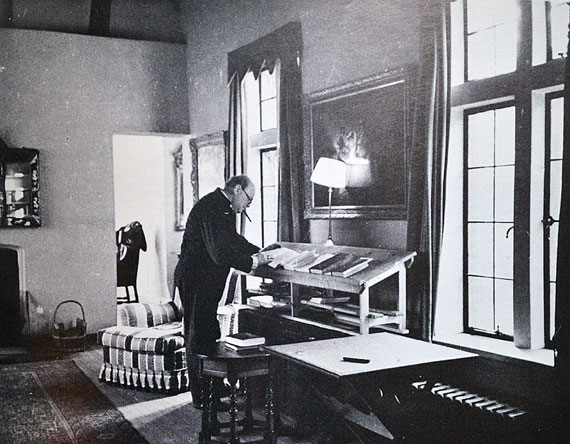
Kierkegaard apparently did his best writing standing up, as did Charles Dickens, Winston Churchill, Vladimir Nabokov and Virginia Woolf. Also put Ernest Hemingway in the standing desk club too.
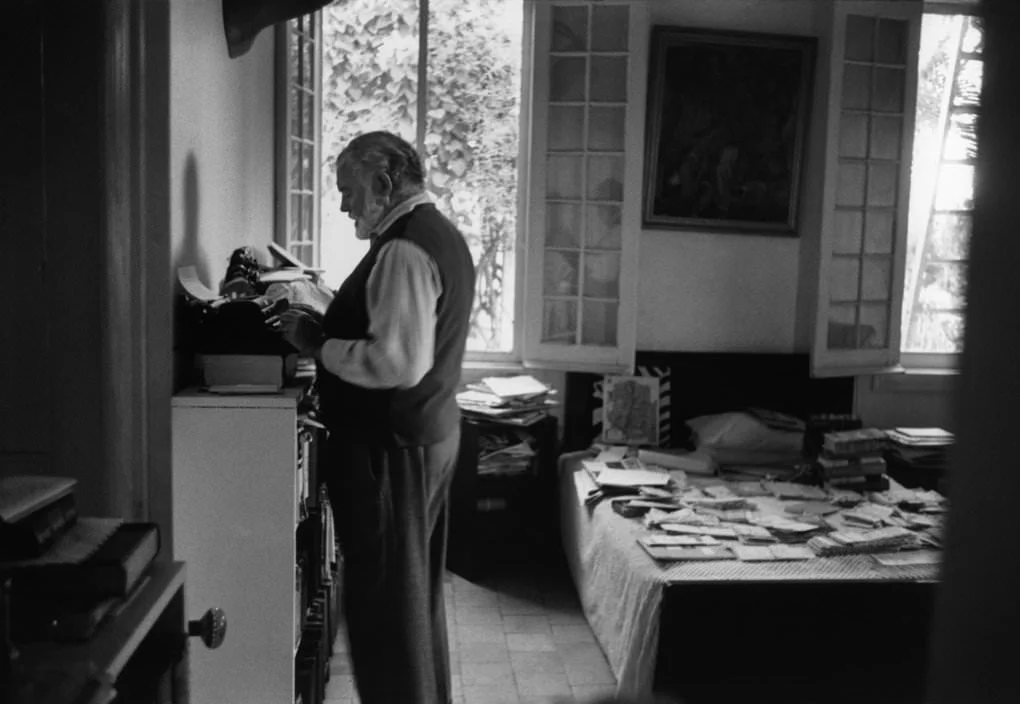
In 1954, George Plimpton interviewed Hemingway for the literary journal he co-founded the year before, The Paris Review. The interview came prefaced with a description of the novelist’s writing studio in Cuba:
Ernest Hemingway writes in the bedroom of his house in the Havana suburb of San Francisco de Paula. He has a special workroom prepared for him in a square tower at the southwest corner of the house, but prefers to work in his bedroom, climbing to the tower room only when “characters” drive him up there…
The room is divided into two alcoves by a pair of chest-high bookcases that stand out into the room at right angles from opposite walls.…
It is on the top of one of these cluttered bookcases—the one against the wall by the east window and three feet or so from his bed—that Hemingway has his “work desk”—a square foot of cramped area hemmed in by books on one side and on the other by a newspaper-covered heap of papers, manuscripts, and pamphlets. There is just enough space left on top of the bookcase for a typewriter, surmounted by a wooden reading board, five or six pencils, and a chunk of copper ore to weight down papers when the wind blows in from the east window.
A working habit he has had from the beginning, Hemingway stands when he writes. He stands in a pair of his oversized loafers on the worn skin of a lesser kudu—the typewriter and the reading board chest-high opposite him.
Popular Science, a magazine with roots much older than the Paris Review, first began writing about the virtues of standing desks for writers back in 1883. By 1967, they were explaining how to fashion a desk with simple supplies instead of forking over $800 for a commercial model — a hefty sum in the 60s, let alone now. Plywood, saw, hammer, nails, glue, varnish — that’s all you need to build a DIY stand-up desk. Or, as Papa Hemingway did, you could simply throw your writing machine on the nearest bookcase and get going. As for how to write the great American novel, I’m not sure that Popular Science offers much help. But maybe some advice from Hemingway himself will steer you in the right direction. See Seven Tips From Ernest Hemingway on How to Write Fiction.
If you would like to support the mission of Open Culture, consider making a donation to our site. It’s hard to rely 100% on ads, and your contributions will help us continue providing the best free cultural and educational materials to learners everywhere. You can contribute through PayPal, Patreon, and Venmo (@openculture). Thanks!
Henry Louis Mencken (1880–1956) was a famous American journalist, essayist, critic of American life and culture, and a scholar of American English. An expert in so many fields, he was called “the Baltimore Sage.” At the age of 22, Mencken became managing editor of the Morning Herald in his hometown of Baltimore. But it was not only through his work as a journalist that he was “as famous in America as George Bernard Shaw was in England.” The influential literary critic helped launch the Southern and Harlem literary renaissances. With his literary journal The Smart Set, Mencken paved the way for writers such as F. Scott Fitzgerald, Eugene O’Neill, Sinclair Lewis, Theodore Dreiser, and James Joyce. He also wrote several books, most notably his monumental study The American Language.
“The two main ideas that run through all of my writing, whether it be literary criticism or political polemic are these: I am strong in favor of liberty and I hate fraud.” (source) His spirited defense of the freedom of speech and of the press almost landed him in jail when he fought against the banning of his second literary journal, The American Mercury.
This interview above was conducted by Mencken’s colleague Donald Howe Kirkley of The Baltimore Sun in a small recording room at the Library of Congress in Washington on June 30, 1948. It gives you a rare chance to hear his voice.
By profession, Matthias Rascher teaches English and History at a High School in northern Bavaria, Germany. In his free time he scours the web for good links and posts the best finds on Twitter.
We're hoping to rely on loyal readers, rather than erratic ads. Please click the Donate button and support Open Culture. You can use Paypal, Venmo, Patreon, even Crypto! We thank you!
Open Culture scours the web for the best educational media. We find the free courses and audio books you need, the language lessons & educational videos you want, and plenty of enlightenment in between.