Carl Sagan — he was an astronomer, astrophysicist, cosmologist and great popularizer of science. He was also, it turns out, a lifelong smoker of cannabis. In 1999, and just three years after Sagan’s death, Keay Davidson published Carl Sagan: A Life, a biography that made headlines for revealing how Sagan wrote an essay in 1969, using the pseudonym “Mr. X,” where he outlined the personal benefits of smoking marijuana. The essay eventually appeared in the 1971 book Reconsidering Marijuana. 35 years old at the time, Sagan explained how the drug heightened his sensory experience, gave him an appreciation for the spiritual realm (“a feeling of communion with my surroundings, both animate and inanimate”), enhanced his enjoyment of sex, and allowed him to achieve some “devastating” insights into scientific, creative and particularly social questions. The drug also gave him a newfound respect for art and music. He wrote:
The cannabis experience has greatly improved my appreciation for art, a subject which I had never much appreciated before. The understanding of the intent of the artist which I can achieve when high sometimes carries over to when I’m down. This is one of many human frontiers which cannabis has helped me traverse.… A very similar improvement in my appreciation of music has occurred with cannabis. For the first time I have been able to hear the separate parts of a three-part harmony and the richness of the counterpoint. I have since discovered that professional musicians can quite easily keep many separate parts going simultaneously in their heads, but this was the first time for me.
Sometimes the old ways work best. That assumption, or at least the assumption that the most centuries-tested techniques can still produce interesting results, underpins many of the Art Institute of Chicago’s Launchpad videos. The series, designed to give visitors context for the artifacts they see there, reveals the process behind the product, and some new products may come out of some very old processes indeed. In the case of the video at the top, we see the creation of an ancient Greek vase — or, rather, a new vase, created as the ancient Greeks did — from the clay purification to the kneading to the shaping to the illustration to the firing.
Just above, you can watch the ancient “free-blown technique” of glassmaking in action. Invented around 40 B.C., glass-blowing gave the glassmakers of the day a faster, cheaper, more controllable way to work, which enabled them to produce for a larger market than ever before. If you’d like to learn more about the method it displaced, the Art Institute also has a video demonstrating the older “core-formed” glassmaking technique. Pottery and glassware have an appealing practicality, and first-rate artisans of those forms could no doubt make a good deal of money, but how did the money itself come into being? The Launchpad video on coin production in Ancient Greece, below, sheds light on minting in antiquity. Serious artistically inclined numismatists will, of course, want to follow it up with its companion piece on coin production in the Roman world.
Long before the printing press, before parchment and papyrus, poetry was a strictly oral form. Many of the features we associate with verse—rhyme, meter, repetition, and extended similes—originated as mnemonic devices for poets and their audiences in times when bards composed extemporaneously from predetermined formulas. And while the image of the Homeric poet, strumming a lyre and narrating the deeds of gods and heroes seems quaint, poetry is still very much an oral art, in cultures traditional and modern. Right this very moment, in cities across the world, poets and audiences gather in bars, cafes, bookstores, temples, and libraries to hear poems spoken, rapped, sung, chanted, etc.
But we no longer assign to the poet god-like power and fame. Those accolades are now reserved for actors and musicians. And while poets are often perfectly good readers of their own work, sometimes there’s nothing so exciting as hearing the utterly distinctive voice of, say, James Earl Jones or Anthony Hopkins, turning over the words of a favorite poem, making them rumble and rustle in ways they never did flat on the page. So today we bring you some modern gods reading the ancient form, beginning with the great, gravel-voiced Tom Waits, who reads the great, gravel-voiced Charles Bukowski’s “The Laughing Heart” (top, full text here). A more perfect union of reader and poet you may never find.
Finally, the unmistakable voice of Sean Connery (backed by the music of Vangelis) beautifully conveys the epic journey of C.P. Cavafy’s “Ithaca” (above, full text here). These are but three examples of the art of actors reading poets. Below, you’ll find several others, along with a couple of writers—Tennessee Williams and Harold Bloom—thrown in for good measure. Hearing poetry read, and read well, creates space in a widening sea of distractions for that most ancient of human crafts.
It turns out that the fleeting pronouncements we post on Twitter are catnip for academics and others eager to find the elusive pulse of American society. Since Twitter launched in 2006, researchers have been hard at work figuring out how to turn those 140-character musings into tea leaves with something meaningful to say about us all.
Here come three new projects that claim to provide a window into the American soul through Twitter. Whether they succeed or not, well, that’s still unclear. (And, by the way, you can start following Open Culture on Twitter here.)
They looked at two things: Hurricane Sandy (top) and the 2012 Presidential Election (above). Using Twitter’s “garden hose feed”—a random sampling of 10 percent of the roughly 500 million tweets sent every day—researchers color-coded tweets red for negative tone and blue for positive and showed the shifting concentrations of Twitter activity across the country. It looks like a map of a talking weather system as occasional dialogue boxes open up to show representative tweets. Researcher Kalev Leetaru argues that tracking Twitter activity gives us the potential to track the heartbeat of society.
Two other projects look in an on-going way at tweet “tone,” or the negativity/positivity of messages. One spin on this research is the Geographic Hate Map (sample map above), a project by Dr. Monica Stephens of Humboldt State University in Northern California. To begin their work, Stephens and her team accessed a massive database of geographically tagged tweets sent between June, 2012 and April, 2013.
They used only tweets that contained any of ten “hate words.” They read each tweet to be sure the words were used in a negative way and built a map based on where the tweets came from. Then they aggregated to the county level and normalized for the amount of twitter traffic in that area so that densely populated areas don’t look more racist or homophobic by default.
Then there’s the glass half full. The Hedonometer measures happiness, or lack thereof, as expressed by tweets, calculating averages based on what the researchers call “word shifts” (watch an explanation above). This research project, put together by the University of Vermont Complex Systems Center, uses the same garden hose feed as the Global Twitter Heartbeat. This project searches for frequently used words to measure how good a day Twitter users are having. Since 2008 the Hedonometer has kept track of how often words like “happy,” “yes,” and “love” pop up in tweets, as opposed to “hate,” “no,” and “unhappy.” The saddest day on Hedonometer record so far is April 15, 2013, the day bombs exploded at the Boston Marathon finish line. Christmas Day tends to rank as the happiest day of the year.
To be sure, any tool that uses tweets for data is measuring a very young and specific subgroup of people. Tweets are not a reliable measure of anything, really, but maybe with some tweaking, these research models will come up with something interesting.
To help celebrate YouTube’s first Comedy Week, Ricky Gervais has revived David Brent, the bumbling “Regional Manager” that ran the Wernham Hogg Paper Company in the UK version of The Office. Although the sitcom presented him as the ‘boss from hell,’ Brent fancied himself “a philosopher to rival Descartes, a musician to rival Texas, a dancer to rival MC Hammer.” And a “brilliant singer-songwriter” too. Perhaps you’ll remember a favorite moment from the show, when Brent led his staff in a sing-a-long to Free Love Freeway? (If not, we have it below, and you can find the chords and lyrics here.) Anyway, Brent is back, and he’s now offering guitar lessons on YouTube — lessons guaranteed to teach you absolutely nothing about playing guitar. If you want real lessons, James Taylor has you covered here.
You can find the first lesson above; the second lesson will hit Ricky Gervais’ YouTube Channel on June 3.
When we think of Kurt Vonnegut, we tend to think of Slaughterhouse-Five. Maybe we also think of the short story “Harrison Bergeron,” which gets assigned in class by slightly alternative-minded English teachers. Now that I think about it, I realize that those two works of Vonnegut’s have both become movies: George Roy Hill’s Slaughterhouse-Five hit theaters in 1972, and Bruce Pittman’s Harrison Bergeron debuted on Showtime in 1995. But the belovedly cynical writer produced fourteen novels, eight story collections, and five books of essays, and even if we just explore further into those adapted for the screen, we find a perhaps under-discussed piece of Vonnegutia: Breakfast of Champions, his 1973 follow-up to Slaughterhouse-Five.
The novel examines Dwayne Hoover, a deeply troubled Pontiac salesman obsessed with the writings of pulp sci-fi author Kilgore Trout. You may remember Trout from his role in Vonnegut’s previous book, whose “unstuck-in-time” protagonist Billy Pilgrim he invites to his wedding anniversary. Breakfast of Champions sets Trout on a collision course with Hoover in the fictional American town of Midland City, bringing in a great variety of characters, themes, and elements from Vonnegut’s other work in so doing. In the clip above, you can hear the author’s very first public reading of the book, recorded on May 4, 1970 at New York’s 92nd Street Y. After it became available to readers three years later, Breakfast of Champions would become a favorite among the Vonnegut faithful. The 1999 Bruce Willis-starring film adaptation… less so.
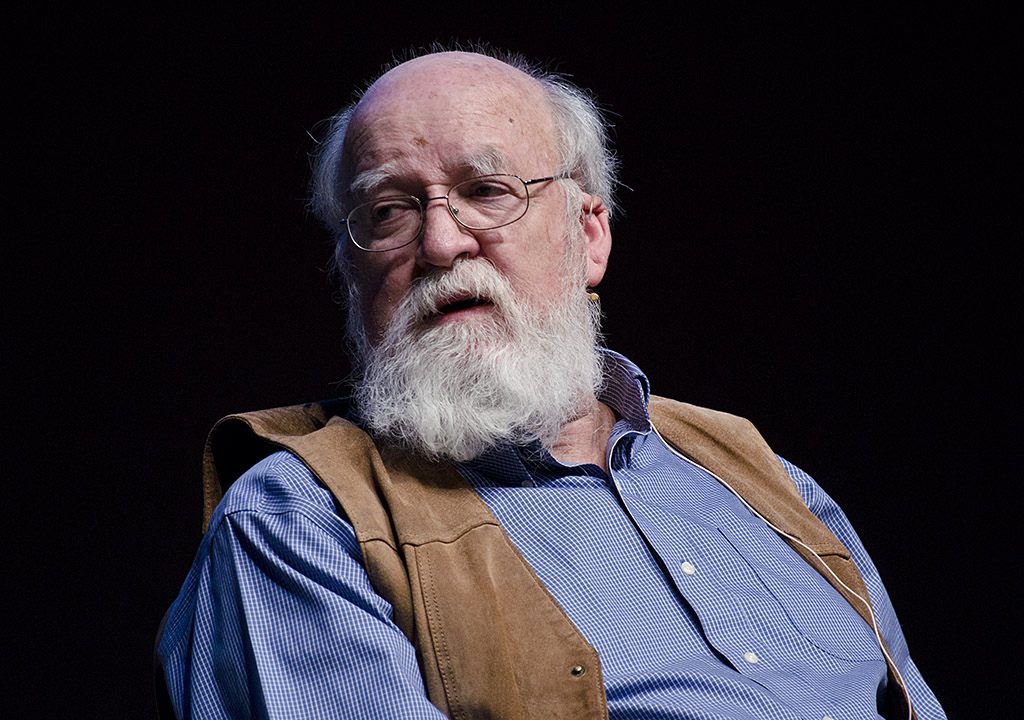
Love him or hate him, many of our readers may know enough about Daniel C. Dennett to have formed some opinion of his work. While Dennett can be a soft-spoken, jovial presence, he doesn’t suffer fuzzy thinking or banal platitudes— what he calls “deepities”—lightly. Whether he’s explaining (or explaining away) consciousness, religion, or free will, Dennett’s materialist philosophy leaves little-to-no room for mystical speculation or sentimentalism. So it should come as no surprise that his latest book, Intuition Pumps And Other Tools for Thinking, is a hard-headed how-to for cutting through common cognitive biases and logical fallacies.
In a recent Guardian article, Dennett excerpts seven tools for thinking from the new book. Having taught critical thinking and argumentation to undergraduates for years, I can say that his advice is pretty much standard fare of critical reasoning. But Dennett’s formulations are uniquely—and bluntly—his own. Below is a brief summary of his seven tools.
1. Use Your Mistakes
Dennett’s first tool recommends rigorous intellectual honesty, self-scrutiny, and trial and error. In typical fashion, he puts it this way: “when you make a mistake, you should learn to take a deep breath, grit your teeth and then examine your own recollections of the mistake as ruthlessly and as dispassionately as you can manage.” This tool is a close relative of the scientific method, in which every error offers an opportunity to learn, rather than a chance to mope and grumble.
2. Respect Your Opponent
Often known as reading in “good faith” or “being charitable,” this second point is as much a rhetorical as a logical tool, since the essence of persuasion involves getting people to actually listen to you. And they won’t if you’re overly nitpicky, pedantic, mean-spirited, hasty, or unfair. As Dennett puts it, “your targets will be a receptive audience for your criticism: you have already shown that you understand their positions as well as they do, and have demonstrated good judgment.”
3. The “Surely” Klaxon
A “Klaxon” is a loud, electric horn—such as a car horn—an urgent warning. In this point, Dennett asks us to treat the word “surely” as a rhetorical warning sign that an author of an argumentative essay has stated an “ill-examined ‘truism’” without offering sufficient reason or evidence, hoping the reader will quickly agree and move on. While this is not always the case, writes Dennett, such verbiage often signals a weak point in an argument, since these words would not be necessary if the author, and reader, really could be “sure.”
4. Answer Rhetorical Questions
Like the use of “surely,” a rhetorical question can be a substitute for thinking. While rhetorical questions depend on the sense that “the answer is so obvious that you’d be embarrassed to answer it,” Dennett recommends doing so anyway. He illustrates the point with a Peanuts cartoon: “Charlie Brown had just asked, rhetorically: ‘Who’s to say what is right and wrong here?’ and Lucy responded, in the next panel: ‘I will.’” Lucy’s answer “surely” caught Charlie Brown off-guard. And if he were engaged in genuine philosophical debate, it would force him to re-examine his assumptions.
5. Employ Occam’s Razor
The 14th-century English philosopher William of Occam lent his name to this principle, which previously went by the name of lex parsimonious, or the law of parsimony. Dennett summarizes it this way: “The idea is straightforward: don’t concoct a complicated, extravagant theory if you’ve got a simpler one (containing fewer ingredients, fewer entities) that handles the phenomenon just as well.”
6. Don’t Waste Your Time on Rubbish
Displaying characteristic gruffness in his summary, Dennett’s sixth point expounds “Sturgeon’s law,” which states that roughly “90% of everything is crap.” While he concedes this may be an exaggeration, the point is that there’s no point in wasting your time on arguments that simply aren’t any good, even, or especially, for the sake of ideological axe-grinding.
7. Beware of Deepities
Dennett saves for last one of his favorite boogeymen, the “deepity,” a term he takes from computer scientist Joseph Weizenbaum. A deepity is “a proposition that seems both important and true—and profound—but that achieves this effect by being ambiguous.” Here is where Dennett’s devotion to clarity at all costs tends to split his readers into two camps. Some think his drive for precision is an admirable analytic ethic; some think he manifests an unfair bias against the language of metaphysicians, mystics, theologians, continental and post-modern philosophers, and maybe even poets. Who am I to decide? (Don’t answer that).
You’ll have to make up your own mind about whether Dennett’s last rule applies in all cases, but his first six can’t be beat when it comes to critically vetting the myriad claims routinely vying for our attention and agreement.
Ray Manzarek of the Doors died Monday of cancer. He was 74. Manzarek’s jazz-inflected, classically influenced keyboard playing, woven together with Jim Morrison’s baritone vocals, helped define the sound of the 1960s.
Manzarek and Morrison were both recent graduates of the UCLA film school in 1965 when they had a chance encounter on Venice Beach. Morrison sang a few songs for Manzarek, and the two decided right then and there to start a band. Drummer John Densmore and guitarist Robby Krieger soon joined, and the Doors were born.
From the beginning, the classically trained Manzarek played musical foil to Morrison’s poetic wildman persona. “We just combined the Apollonian and the Dionysian,” Manzarek said of the band in 1997. “The Dionysian side is the blues, and the Apollonian side is classical music. The proper artist combines Apollonian rigor and correctness with Dionysian frenzy, passion and excitement. You blend those two together, and you have the complete, whole artist.”
For a fascinating look at just how beautifully things blended together with the Doors, watch above as Manzarek tells the story of the band’s classic 1971 single, “Riders on the Storm.” The scene is from the 2011 documentary Mr. Mojo Risin’: The Story of L.A. Woman, which chronicles the making of the Doors’ sixth and final studio album. The band recorded “Riders on the Storm” in December of 1970. By the time L.A. Woman was released in April of 1971, Morrison had already moved to Paris, where he died a few months later. “Riders on the Storm” reached number 14 on the Billboard charts in America. You can hear the finished recording below.
Every year, right before Labor Day, 50,000 people travel to Black Rock City, Nevada to take part in Burning Man — an experimental community dedicated to radical self reliance, radical self-expression and art. As Burning Man’s own web site will tell you, “Trying to explain what Burning Man is to someone who has never been to the event is a bit like trying to explain what a particular color looks like to someone who is blind.” Nonetheless, the Burning Man organizers offer a short, introductory essay and a First-Timer’s Guide to get you started, plus some photo galleries to help fill out the picture. And then above, we have a newly-made short film that offers a glimpse into the art and culture of the Burning Man experience. It highlights some wondrous artistic creations and the artists, designers, builders and sundry minds behind them. The documentary, Dream: Art & Culture of Burning Man,premiered at the Sonoma International Film Festival.
If you would like to support the mission of Open Culture, consider making a donation to our site. It’s hard to rely 100% on ads, and your contributions will help us continue providing the best free cultural and educational materials to learners everywhere. You can contribute through PayPal, Patreon, and Venmo (@openculture). Thanks!
How did Pablo Picasso do it? Art historians have spent much time and many words answering that question, but in the video above, you can watch the painter in the act of creation — or, rather, you can watch a series of his paintings as they come into being, evolving from spare but evocative collections of marker strokes into complete images, alive with color. We see Picasso’s visual ideas emerge, and then we see him refine and revise them, sometimes toward a surprising result. All of this happens in under two minutes, since filmmaker Henri-Georges Clouzot shot the artist working with time-lapse photography, compressing each creative process into mere seconds.
This particular sequence became the trailer of Clouzot’s 1956 documentary The Mystery of Picasso. The paintings in it, we read at the end, “cannot be seen anywhere else. They were destroyed upon completion of the film.” Though word on the street has it that one or two of them may actually survive somewhere today, the idea of Picasso paintings existing only on film does capture the imagination, and it moved the French government to officially declare The Mystery of Picasso a national treasure. Picasso had, of course, painted on film before, as you might recall from seeing us feature Paul Haesaerts’ 1950 Visite à Picasso.
If you would like to support the mission of Open Culture, consider making a donation to our site. It’s hard to rely 100% on ads, and your contributions will help us continue providing the best free cultural and educational materials to learners everywhere. You can contribute through PayPal, Patreon, and Venmo (@openculture). Thanks!
We're hoping to rely on loyal readers, rather than erratic ads. Please click the Donate button and support Open Culture. You can use Paypal, Venmo, Patreon, even Crypto! We thank you!
Open Culture scours the web for the best educational media. We find the free courses and audio books you need, the language lessons & educational videos you want, and plenty of enlightenment in between.