In the preface of The Swerve: How the World Became Modern, Stephen Greenblatt recalls the day he encountered a translation of Lucretius’ 2000 year old poem, On the Nature of Things. He was a grad student back at Yale, living on modest means, when he ambled into a bookstore and found a copy marked down to ten cents. He picked it up, not having much to lose and not knowing what he’d find. Soon enough he was reading one of the most scandalous and groundbreaking texts from antiquity, a book that eventually traveled a long and winding road and changed our entire modern world. That story Greenblatt tells in The Swerve.
The ten cents Greenblatt spent in the 1960s may be roughly equivalent to the deal you can get today. Right now, The Swerve, the winner of the 2012 Pulitzer Prize for general nonfiction, can be downloaded as an audio book for $5.95 via iTunes. Yes, we know, $5.95 is not free, and iTunes is not open, but it’s certainly a deal worth mentioning nonetheless.
But if you’re really hankering for something free, then don’t miss our meta lists of Free Audio Books and Free eBooks, which include a copy of Lucretius’ famous work. Or definitely check out Audible.com’s Free Trial offer, which lets you download pretty much any audio book you want (classic or modern) for free. Get details here.
“I suppose you’re wondering why I’ve called you all here,” says Ray Bradbury above, in a lengthy interview with the The Big Read project sponsored by the National Endowment for the Arts. Breaking the ice with this stock phrase, Bradbury–author of Fahrenheit 451, The Illustrated Man, The Martian Chronicles, and several dozen more fantasy and sci-fi novels and short story collections (and some truly chilling horror)–begins to talk about… Love. Specifically a love of books. “Love,” he says, “is at the center of your life. The things that you do should be things that you love, and the things that you love, should be things that you do.” That’s what books teach us, he says, and it becomes his mantra.
Bradbury, who passed away in June, was certainly an early inspiration for me, and several million other bookish kids whose warmest memories involve discovering some strange, life-altering book on the shelf of a library. As he recounts his childhood experiences with books, he’s such an enthusiastic booster for public libraries that you may find yourself writing a check to your local branch in the first ten minutes of his talk. And it’s easy to see why his most famous novel sprang from what must have been a very pressing fear of the loss of books. Bradbury was largely self-taught. Unable to afford college, he pursued his fierce ambition to become a writer immediately out of high school and published his first short story, “Hollerbochen’s Dilemma,” at the age of nineteen. As he says above, he became a writer because, “I discovered that I was alive.” But I’m not doing it justice. You have to watch him tell it to really feel the thrill of this epiphany.
The Big Read’s mission is to create a “Nation of Readers,” and to do so, it posts free audio guides for classics such as Bradbury’s Fahrenheit 451, Hemingway’s A Farewell to Arms, and Fitzgerald’s The Great Gatsby. They also feature video interviews with other authors, like Amy Tan, Ernest J. Gaines, and Tobias Wolff. Each of the interviews is fantastic, and the readers’ guides are superb as well. Bradbury’s, for example, narrated by poet and author Dana Gioia, also features sci-fi giants Orson Scott Card and Ursula K. Le Guin, as well as several other writers who were inspired by his work.
Josh Jones is a doctoral candidate in English at Fordham University and a co-founder and former managing editor of Guernica / A Magazine of Arts and Politics.
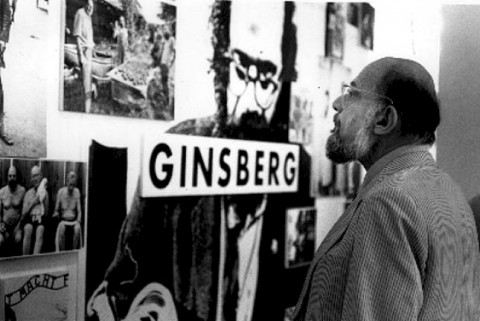
In April of 1959 the British philosopher and mathematician Bertrand Russell sat down with John Freeman of the BBC program Face to Face for a brief but wide-ranging and candid interview. Russell reminisced about his early attraction to mathematics. “I got the sort of satisfaction that Plato says you can get out of mathematics,” he said. “It was an eternal world. It was a timeless world. It was a world where there was a possibility of a certain kind of perfection.”
Russell, of course, distinguished himself in that rarified world as one of the founders of analytic philosophy and a co-author of Principia Mathematica, a landmark work that sought to derive all of mathematics from a set of logical axioms. Although the Principia fell short of its goal, it made an enormous mark on the course of 20th century thought. When World War I came along, though, Russell felt it was time to come down from the ivory tower of abstract thinking. “This world is too bad,” Russell told Freeman. “We must notice it.”
The half-hour conversation, shown above in its entirety, is of a quality rarely seen on television today. The interviewer Freeman was at that time a former Member of Parliament and a future Ambassador to the United States. Russell talks with him about his childhood, his views on religion, his political and social activism, even his amusing conviction that smoking extended his life. But perhaps the most famous moment comes at the end, when Freeman asks the old philosopher what message he would offer to people living a thousand years hence. In answering the question, Russell balances the two great spheres that occupied his life:
I should like to say two things, one intellectual and one moral:
The intellectual thing I should want to say to them is this: When you are studying any matter or considering any philosophy, ask yourself only what are the facts and what is the truth that the facts bear out. Never let yourself be diverted either by what you wish to believe or by what you think would have beneficent social effects if it were believed, but look only and solely at what are the facts. That is the intellectual thing that I should wish to say.
The moral thing I should wish to say to them is very simple. I should say: Love is wise, hatred is foolish. In this world, which is getting more and more closely interconnected, we have to learn to tolerate each other. We have to learn to put up with the fact that some people say things that we don’t like. We can only live together in that way, and if we are to live together and not die together we must learn a kind of charity and a kind of tolerance which is absolutely vital to the continuation of human life on this planet.
“Truman Capote didn’t study to become expert in capital crime and its punishment,” says William F. Buckley on the Firing Line broadcast of September 3, 1968, “but his five and one half year engagement of the slaughter of the Clutter family, which went into the writing of In Cold Blood, left him with highly settled impressions in the matter.” You can hear Buckley elicit and Capote concisely lay out the position to which these impressions brought him in the clip above. Though remembered for his own conservative views, Buckley seemed ever eager to invite onto his show, frequently and without hesitation, public figures who strongly disagreed with him. This sense of controversy generated a stream of classically compelling televisual moments over Firing Line’s 33-year run, but for my money, all the direct conflicts have less to offer than the times a guest — or even the host — broke from standard ideological positions, as Capote does here.
Buckley opens by asking whether “systematic execution of killers over the preceding generation might have stayed the hand of the murderers of the Cutter family.” Capote replies that “capital punishment — which I’m opposed to, but for quite different reasons than are usually advanced — would in itself be a singularly effective deterrent, if it were, in fact, systematically applied. But because public sentiment is very much opposed to it and the courts have allowed this endless policy of appeal — to such a degree that a person can be eleven, twelve, thirteen, fourteen years under a sentence of capital punishment — it becomes, in effect, an extreme, unusual, and cruel punishment. If people really were sentenced to be executed and were within a reasonable period of time, the professional murderer knew the absolute, positive end of their actions would be their own death, I think it would certainly give them second thoughts.” This perhaps lends itself poorly to a sound bite, but Firing Line at its best never dealt in those.
When Mad Men kicked off its fifth season earlier this year, we encountered Don Draper and Peggy Olson brainstorming an advertising campaign for Heinz baked beans. The goal? To make this staple of the American diet sexier to a younger generation. It’s a perennial problem for many traditional brands, something that real-world companies contend with day in, day out. Take Campbell’s Soup for example. As part of a broader effort to make its products “more ethnic, more hip,” the company founded in 1869 plans to sell 1.2 million cans with artwork inspired by Andy Warhol.
Of course, Warhol is the artist who famously began producing silkscreens of Campbell’s soup cans back in 1962. When Andy first created these iconic pieces of pop art, Campbell’s was none too pleased. In fact, the company considered hitting him with a lawsuit. But, by 1964, they were sending him nice letters and free cases of soup, and they also commissioned him to make a painting for the firm’s retiring chairman. Now 50 years later, they’re hoping that Warhol’s pop art can get their sagging sales going again.
The soup cans will go on sale at Target, starting this Sunday, for 75 cents a pop. In the meantime, we’ll leave you with this — Sal Khan (Khan Academy) and Steven Zucker (Smarthistory) explaining what makes Warhol’s art, art. And, by the way, I spotted Sal at the local grocery store tonight. Should have said hi. It’s a small world.
Kurt Vonnegut never did things the conventional way. He didn’t write particularly conventional novels. He certainly didn’t make very conventional speeches at universities. But he did make semi-conventional domestic agreements. Take, for example, this contract written on January 26, 1947. Posted on the Harper’s website in full, this odd little document, dubbed “The Chore List of Champions,” finds Vonnegut outlining all of the tasks he promised to do around the house — this while his young wife, Jane, prepared to give birth to their first child. The contract (the content is conventional, the form is not) will be published in Kurt Vonnegut: Letters next month. And it begins:
I, Kurt Vonnegut, Jr., that is, do hereby swear that I will be faithful to the commitments hereunder listed:
I. With the agreement that my wife will not nag, heckle, or otherwise disturb me on the subject, I promise to scrub the bathroom and kitchen floors once a week, on a day and hour of my own choosing. Not only that, but I will do a good and thorough job, and by that she means that I will get under the bathtub, behind the toilet, under the sink, under the icebox, into the corners; and I will pick up and put in some other location whatever movable objects happen to be on said floors at the time so as to get under them too, and not just around them. Furthermore, while I am undertaking these tasks I will refrain from indulging in such remarks as “Shit,” “Goddamn sonofabitch,” and similar vulgarities, as such language is nerve-wracking to have around the house when nothing more drastic is taking place than the facing of Necessity. If I do not live up to this agreement, my wife is to feel free to nag, heckle, and otherwise disturb me until I am driven to scrub the floors anyway—no matter how busy I am.
And then later continues:
g. When smoking I will make every effort to keep the ashtray I am using at the time upon a surface that does not slant, sag, slope, dip, wrinkle, or give way upon the slightest provocation; such surfaces may be understood to include stacks of books precariously mounted on the edge of a chair, the arms of the chair that has arms, and my own knees;
h. I will not put out cigarettes upon the sides of, or throw ashes into, either the red leather wastebasket or the stamp wastebasket that my loving wife made me for Christmas, 1945, as such practice noticeably impairs the beauty and ultimate practicability of said wastebaskets;
j. An exception to the above three-day time limit is the taking out of the garbage, which, as any fool knows, had better not wait that long; I will take out the garbage within three hours after the need for disposal has been pointed out to me by my wife. It would be nice, however, if, upon observing the need for disposal with my own two eyes, I should perform this particular task upon my own initiative, and thus not make it necessary for my wife to bring up a subject that is moderately distasteful to her;
l. The terms of this contract are understood to be binding up until that time after the arrival of our child (to be specified by the doctor) when my wife will once again be in full possession of all her faculties, and able to undertake more arduous pursuits than are now advisable.
Peter Sellers was a compulsive home movie maker. His house was cluttered with cameras, cables and tape recorders, according to his first wife Anne Howe, and he liked to bring a camera along with him wherever he went, sometimes handing it to a companion and clowning around in front of the lens.
In 1995, fifteen years after Sellers’s death, producers from BBC Arena sorted through his extensive archive and assembled some of the best footage for a film called The Peter Sellers Story. In 2002 they shortened it into The Peter Sellers Story: As He Filmed It (above), which tells the story of the comedian’s life almost exclusively with footage from his own camera.
There are glimpses of some notable people from the actor’s circle, including Stanley Kubrick, Sophia Loren, Lord Snowdon, Princess Margaret, Britt Ekland, Blake Edwards, Spike Milligan and Orson Welles. The audio is pieced together from vintage performances and interviews, along with commentary by Sellers’s friends, family and colleagues. It’s a unique film, offering a personal look at the enigmatic and emotionally troubled genius who was able to slip confidently into an amazing range of personas–often in the same film–but was never sure of his own. As Sellers once told an interviewer:
I have no personality of my own, you see. I could never be a star because of this. I’m a character actor. I couldn’t play Peter Sellers the way Cary Grant plays Cary Grant, say–because I have no concrete image of myself. I look in the mirror and what I see is someone who has never grown up–a crashing sentimentalist who alternates between great heights and black depths. You know, it’s a funny thing, but when I’m doing a role I feel it’s the role doing the role, if you know what I mean. When someone tells me “You were great as so-and-so,” I feel they should be telling this to so-and-so, and when I finish a picture I feel a horrible sudden loss of identity.
The Peter Sellers Story: As He Filmed It will be added to our collection of 500 Free Movies Online.
“This movie is going to be pretty obvious.” That’s not the best way to get the viewer’s attention. And the rest of the script, read by Bob Crane, is not much better: “Hey Kitty, look … Kitty, you didn’t look hard enough … See the thing that looks like a building? That’s a building!” Nor is the premise of the film very good: Kitty is a novice actress, and, before appearing in her first movie, she gets an aerial tour of Hollywood and its landmarks.
But from a historical perspective, this 1950s footage of the Los Angeles movie industry has its intriguing moments. It’s particularly interesting to see how much space there still was around some of the studios and movie theaters. Just compare the image of Grauman’s Chinese Theater on Hollywood Boulevard taken from the film with a Google Earth shot from today:
By profession, Matthias Rascher teaches English and History at a High School in northern Bavaria, Germany. In his free time he scours the web for good links and posts the best finds on Twitter.
“It’s turtles all the way down,” a possibly apocryphal old lady once said as a way of fully explaining her concept of the world supported on the back of a giant tortoise. But according to City University of New York’s Michio Kaku, it’s physics all the way down. He shares this highly educated assumption with, presumably, everyone in his field of theoretical physics, and if you’ve got 42 minutes, he’ll tell you why the subject’s explanatory power has compelled him and so many others to dedicate their lives to it. In “The Universe in a Nutshell,” the lecture embedded above, Kaku tells of the origins of modern physics, breaks down how it has clarified to humanity so many of the mechanisms of existence, and reminds us of both the countless technological advances it has already made possible and the infinitude of them it will in the future. To our fellow humans just a few generations back, he says, we, with our advanced communication devices and our ability to watch slickly produced, high-resolution lectures on demand, would look like wizards; our grandchildren, enjoying yet more benefits from physics, would look like gods.
This video comes to you free from Big Think, though as a production it originates from the associated venture Floating University, which sells access to lectures on a variety of subjects, from physics to demography to linguistics to aesthetics. Given all the useful information technology now so widely available — thanks in part to discoveries in, yes, physics — a particularly fruitful time has come for projects meant to reinvent education. Floating University considers itself to be “democratizing education,” and the demand certainly seems fervent. “Why can’t school be like this?” writes one YouTube commenter. “I don’t want homework, I don’t want a binder with dividers, I don’t want to be bored to death with worksheets. I just want to LEARN.” This, of course, started arguments. But that’s democracy for you.
Albert Einstein endeavored to express his view of God as forthrightly as possible to a public eager to know where he stood in the popular conflict between science and religion. In 1936, a sixth-grade girl named Phyllis wrote him a letter on behalf of her Sunday School class. “We have brought up the question,” she wrote, “Do scientists pray? It began by asking whether we could believe in both science and religion.” Einstein’s reply is somewhat equivocal. He is clear enough in stating that a scientific fidelity to the “laws of nature” means that “a scientist cannot be inclined to believe that the course of events can be influenced by prayer, that is, by a supernaturally manifested wish.” This would seem to settle the question. However, he goes on to invoke the philosopher Spinoza’s god and distinguish between intellectual humility and wonder, on the one hand, and a more popular, supernatural faith on the other.
However, we must concede that our actual knowledge of these forces is imperfect, so that in the end the belief in the existence of a final, ultimate spirit rests on a kind of faith. Such belief remains widespread even with the current achievements in science.
But also, everyone who is seriously involved in the pursuit of science becomes convinced that some spirit is manifest in the laws of the universe, one that is vastly superior to that of man. In this way the pursuit of science leads to a religious feeling of a special sort, which is surely quite different from the religiosity of someone more naive.
This is probably not the response that Phyllis and her class had hoped for, and they (or their teacher) may have taken offense at the description of their faith as “naïve.” But Einstein’s careful reply also expresses a kind of scientific awe that acknowledges the limits of reason and leads to a kind of sublime feeling that can legitimately be called “religious” (much as Carl Sagan would do decades later). This, I believe, is not a casual or callous dismissal of Phyllis’s faith, something that so-called “New Atheists” are often accused of (justly or not). Instead it’s a considered response in which the great physicist shares his own version of “faith”–his faith in Nature, or the “laws of the universe,” which he concedes are “vastly superior to man.” I think it’s a moving exchange between two people who couldn’t be further apart in their understanding of the world, but who just may have found some small common ground in considering each other’s positions for a moment.
Einstein’s correspondence comes to us via the always illuminating Letters of Note
Josh Jones is a doctoral candidate in English at Fordham University and a co-founder and former managing editor of Guernica / A Magazine of Arts and Politics.
When Dylan Thomas was a little boy his father would read Shakespeare to him at bedtime. The boy loved the sound of the words, even if he was too young to understand the meaning. His father, David John Thomas, taught English at a grammar school in southern Wales but wanted to be a poet. He was bitterly disappointed with his station in life.
Many years later when the father lay on his deathbed, Dylan Thomas wrote a poem that captures the profound sense of empathy he felt for the dying old man. The poem, “Do Not Go Gentle into That Good Night,” was written in 1951, only two years before the poet’s own untimely death at the age of 39. Despite the impossibility of escaping death, the anguished son implores his father to “Rage, rage against the dying of the light.”
The poem is a beautiful example of the villanelle form, which features two rhymes and two alternating refrains in verse arranged into five tercets, or three-lined stanzas, and a concluding quatrain in which the two refrains are brought together as a couplet at the very end. You can hear Thomas’s famous 1952 recital of the poem above. To see the poem’s structure and read along as you listen, click here to open the text in a new window.
And to hear more of Thomas reciting his own works you can visit HarperAudio, where you will find a treasure trove of recordings from a number of writers, including these from Thomas:
Part 1: “No Sun Shines,” “The Hand that Signed the Paper,” “Should Lanterns Shine,” “And Death Shall Have No Dominion,” and the first verse of “Alterwise by Owl Light.”
Part 2: “Poem in October,” “This Side of the Truth,” Love in the Asylum,” and “The Hunchback in the Park.”
Part 3: “Do Not Go Gentle into That Good Night,” “On the Marriage of a Virgin,” “In My Craft or Sullen Art,” and “Ceremony After a Fire Raid.”
All poems have been added to our collection of Free Audio Books.
We're hoping to rely on loyal readers, rather than erratic ads. Please click the Donate button and support Open Culture. You can use Paypal, Venmo, Patreon, even Crypto! We thank you!
Open Culture scours the web for the best educational media. We find the free courses and audio books you need, the language lessons & educational videos you want, and plenty of enlightenment in between.