From Aeon Video comes a short, vividly-animated tribute to Grete Hermann (1901–1984), the German mathematician and philosopher who made important, but often forgotten, contributions to quantum mechanics. Aeon introduces the video with these words:
In the early 20th century, Newtonian physics was upended by experiments that revealed a bizarre subatomic universe riddled with peculiarities and inconsistencies. Why do photons and electrons behave as both particles and waves? Why should the act of observation affect the behaviour of physical systems? More than just a puzzle for scientists to sort out, this quantum strangeness had unsettling implications for our understanding of reality, including the very concept of truth.
The German mathematician and philosopher Grete Hermann offered some intriguing and original answers to these puzzles. In a quantum universe, she argued, the notion of absolute truth must be abandoned in favour of a fragmented view – one in which the way we measure the world affects the slice of it that we can see. She referred to this idea as the ‘splitting of truth’, and believed it extended far beyond the laboratory walls and into everyday life. With a striking visual style inspired by the modern art of Hermann’s era, this Aeon Original video explores one of Hermann’s profound but undervalued contributions to quantum theory – as well as her own split life as an anti-Nazi activist, social justice reformer and educator.
The short was directed and animated by Julie Gratz and Ivo Stoop, and produced by Kellen Quinn.
If you would like to support the mission of Open Culture, consider making a donation to our site. It’s hard to rely 100% on ads, and your contributions will help us continue providing the best free cultural and educational materials to learners everywhere. You can contribute through PayPal, Patreon, and Venmo (@openculture). Thanks!
Ansel Adams captured many an American landscape as no photographer had before or has since, but in his large catalog you’ll find few pictures as immediately striking as — and none more famous than — Moonrise, Hernandez, New Mexico. Originally taken from the shoulder of a highway passing through the community of Hernandez in 1941, the shot captures the moon rising above a cluster of houses, a church with a graveyard, and a mountain range in the background. All of those might seem like pretty standard elements of a remote part of America in that era, but the sheer visual impact Adams draws from them shows what separates a road-trip snapshot from the work of a dedicated photographer.
Few photographers in the history of the medium have been quite as dedicated as Adams, whose techniques we’ve previously featured here on Open Culture. But as much as his deliberateness and patience have become the stuff of photographic legend, Moonrise was very much a seat-of-the-pants achievement.
Adams was driving around the west with his son Michael and friend Cedric Wright at the behest of Secretary of the Interior Harold Ickes, who had commissioned Adams to produce large-format photographs for the Department of the Interior’s new museum. Toward the end of one not particularly productive day on the job came the big moment. As Adams himself tells it in Examples: The Making of Forty Photographs:
We were sailing southward along the highway not far from Espanola when I glanced to the left and saw an extraordinary situation — an inevitable photograph! I almost ditched the car and rushed to set up my 8×10 camera. I was yelling to my companions to bring me things from the car as I struggled to change components on my Cooke Triple-Convertible lens. I had a clear visualization of the image I wanted, but when the Wratten No. 15 (G) filter and the film holder were in place, I could not find my Weston exposure meter! The situation was desperate: the low sun was trailing the edge of the clouds in the west, and shadow would soon dim the white crosses.
While an experienced photographer today probably won’t have used the same gear as Adams, they’ll certainly recognize the dreadful feeling of being about to lose a precious image. What came to the rescue of Moonrise wasn’t any piece of Adams’ equipment — he never did find that light meter — but the fact that he’d already spent so much time immersed so deeply in the practice of photography that he could set up and load his camera as if by pure instinct. Then, when he remembered that he knew the luminosity of the moon (250 foot candles, for the record), he could calculate the proper exposure for the image he’d already visualized in his head: one with a bright moon and just enough light on the ground to make the crosses in the churchyard glow.
You can learn more about the making and nature of Adams’ best-known photograph, prints of which command high prices at auction to this day, in the three videos here: first Adams’ own description of his process making it, then a short by the Ansel Adams Gallery examining a rare “mural-sized” print from the early 1970s, then a look into the picture’s backstory by Swann Auction Galleries. The tale of the picture’s taking, dramatic though it is, doesn’t quite convey the full extent of the photographic work it took to create the image known to everyone familiar with Adams’ work (and many who aren’t familiar with it): he also had to go through quite a bit of trial and error in the development process to imbue the sky with just the right darkness. If any photographer could produce Moonrise, Hernandez, New Mexico, Ansel Adams could. But we might reflect on the fact that even a master like Ansel Adams only had one Moonrise, Hernandez, New Mexico in his career — and even he almost missed it.
Based in Seoul, Colin Marshall writes and broadcasts on cities, language, and culture. His projects include the book The Stateless City: a Walk through 21st-Century Los Angeles and the video series The City in Cinema. Follow him on Twitter at @colinmarshall or on Facebook.
In his Critique of JudgmentImmanuel Kant made every attempt to separate the Sublime—the phenomenon that inspires reverence, awe, and imagination—from terror, horror, and monstrosity. But as Barbara Freeman argues, the distinctions fall apart. Nowhere do we see this better dramatized, Freeman writes, than in Mary Shelley’s Frankenstein, which “can be read almost as a parody of the Critique of Judgment, for in it everything Kant identifies with or as sublime… yield precisely what Kant prohibits: terror, monstrosity, passion, and fanaticism.”
Reason, even that as careful as Kant’s, begets monsters, Shelley suggests. It’s a theme that has become so commonplace in writing about Frankensteinand its numerous progeny that it seems hardly worth repeating. And yet, Shelley’s dark vision, like that of her contemporary Francisco Goya, came at a time when electricity was a new force in the world (one that her husband Percy used to conduct experiments on himself)… a time when Kant’s philosophy had seemingly validated empirical realism and the primacy of abstract reason.
Steeped in the latest science and philosophy, and living on the other side of the French Revolution, Shelley saw the return of what Kant had sought to banish. The monster arrives as an ominous portent of atrocity. As Steven J. Kraftchick points out in a recent anthology of Frankenstein essays published for the novel’s 200th anniversary, “the English term ‘monster’ (by way of French) likely derives from the Latin words montrare ‘to demonstrate’ and monere ‘to warn.’” The monster comes to show “the limits of the ordinary… expanding or contracting.”
As a being intended to show us something, it seems apt that Victor Frankenstein’s creation became ubiquitous in film and television, first arriving on screen in 1910 at the dawning of film as a popular medium. The first Frankenstein adaptation predates the technological horrors of the 20th century (themselves, of course, well documented on film). Rather than taking technology to task directly, this original cinematic adaptation, directed by J. Searle Dawley for Thomas Edison’s studios, vaguely illustrates, as Rich Drees writes, “the dangers of tampering in God’s realm.”
It was a trite message tailored for censorious moral reformers who had taken aim at the moving image’s supposedly corrupting effect on impressionable minds. And yet the film does more than inaugurate a cinematic tradition of better Frankenstein adaptations, both faithful and liberally modernized. The creation of the monster in the 13-minute short is somewhat terrifying—and certainly would have unsettled audiences at the time. Significantly, it takes place in giant black box, with a small window through which Victor peers as the special effects unfold.
The scene is not unlike a film director looking through a colossal camera’s lens, further suggesting the dangerous influence of film, its ability to produce and capture monstrosities. The Library of Congress’s Mike Mashon describes the Edison production of Frankenstein as not “all that revelatory.” Maybe with the benefit of 108 years of hindsight, it is not. But as a critique of the very technology that produced it, we can see it updating Shelley’s anxieties, anticipating the ways in which Frankenstein-like stories have come to telegraph fears of computer intelligence, in films increasingly created by intelligent machines.
This 1910 Frankenstein film has been restored by the Library of Congress, and Mashon’s story of how the only nitrate print was acquired by the library’s Packard Campus for Audio Visual Conservation may be, he writes, “more interesting than the film itself.” Or it may not, depending on your level of interest in the twists and turns of library acquisitions. But the film, which you can see in its restored glory at the top, rewards viewing as more than a cinema-historical artifact. Its effects are crude, its simplified story moralistic, but this truncated version cannily recognizes the horrific creature not as the excluded other but as the monstrous mirror image of its creator.
And yes, there’s a soon-to-be released biopic, Rocketman.
On the other hand, there’s the ridiculously pneumatic two-minute television commercial above, upscale department store John Lewis’s attempt to best rivals Sainsbury’s and Marks & Spencer in the unofficial British holiday advert bowl.
These annual productions are as hotly anticipated as Superbowl ads, but this year’s entry, in which viewers travel backwards in time nearly 70 years to the three-year-old Elton (née Reginald Dwight) receiving a (SPOILER!) piano from his granny, has proved a bit of a misfire.
Viewers are flocking to social media to lambast the ad for inadvertently suggesting that Elton John is the reason for the season. (Popular subjects from Christmases past include Paddington Bear, penguins, and boxer dogs.)
There’s also a bit of cynicism surrounding the fact that John Lewis hustled to add digital keyboards to its inventory prior to the release of “The Boy And The Piano”…
And then there’s the rumor that Sir Elton took home £5 million for his participation in the four day shoot.
Several of the star’s most outré looks have been faithfully recreated, but, Christmas aside, it’s hard not to feel that this portrait is rather too sanitized. You won’t find any friends rolling ‘round the basement floor here. His dad, an RAF officer with whom he had a thorny relationship is similarly stricken from the record. There’s nary a whisper of drugs or diva-esque behavior.
Elton John isn’t a great pop star because he sings songs about little dancers, crocodiles that rock, and being able to stand up. No, Elton John is a great pop star because he is knotty and complicated and, well, a bit of a dick sometimes.
A number of spoofs have already cropped up, and naturally there’s a Making Of, below—also set to “Your Song”—wherein the young actors who embodied Sir Elton at various stages of his life and career, sometimes with the help of prosthetics, hold forth.
Also… while we don’t dismiss out of hand the possibility that sentimental attachment could have caused Sir Elton to hold on to his childhood piano, we’ll eat our platform boots if that’s what constitutes his Christmas tree.
We tend to take a very special interest in archives and maps on this site—and especially in archives of maps. Yet it is rare, if not unheard of, to discover a map archive in which every single entry repays attention. The PJ Mode Persuasive Cartography Collection at Cornell University Library is such an archive. Each map in the collection, from the most simplified to the most elaborate, tells not only one story, but several, overlapping ones about its creators, their intended audience, their antagonists, the conscious and unconscious processes at work in their political psyches, the geo-political view from where they stood.
Maps drawn as propaganda must be broad and bold, casting aside precision for the pressing matter at hand. Even when finely detailed or laden with statistics, such maps press their meaning upon us with unsubtle force.
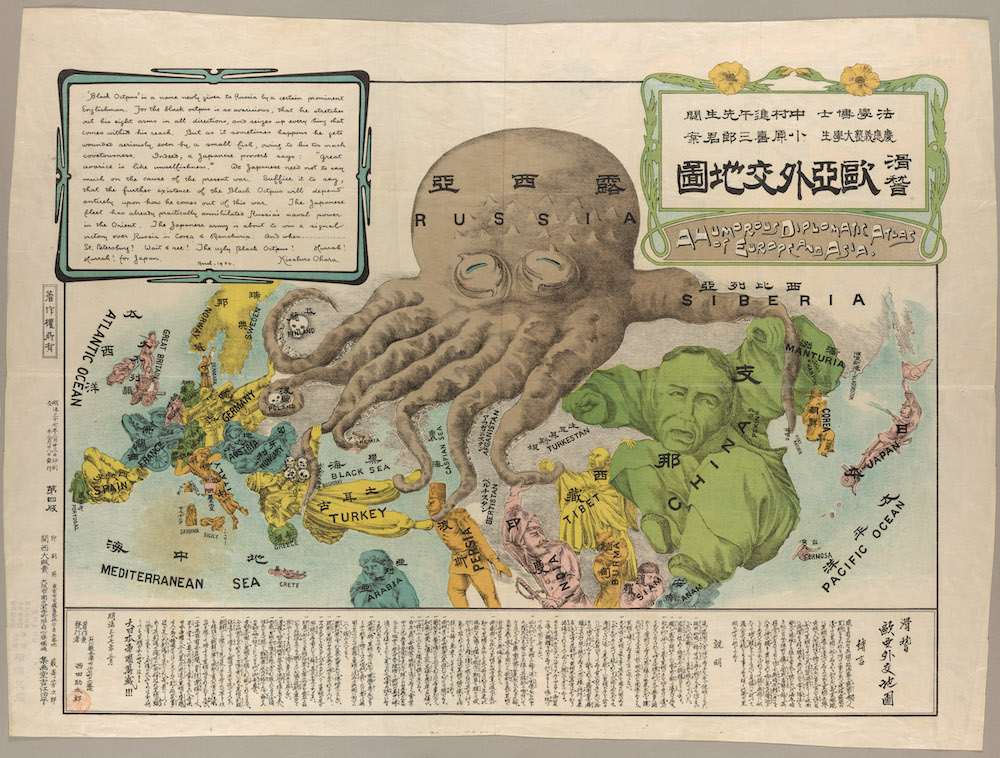
One especially resonant example of persuasive cartography, for example, at the top shows us an early version of a widely-used motif—the “Cartographic Land Octopus,” or CLO, as Frank Jacobs dubs it at Big Think. The CLO has never gone out of style since its likely origin in J.J. van Brederode’s “Humorous War Map” of 1870, which depicts Russia as a monstrous mollusk. Later, Caricaturist Fred W. Rose printed a reprise, the “Serio-Comic War Map for the Year 1877.”
A full twenty-seven years later, a Japanese student used the very same design for his satirical map of Russia-as-Octopus, the occasion this time the Russo-Japanese War. Titled “A Humorous Diplomatic Atlas of Europe and Asia,” the Japanese map cites Rose, or “a certain prominent Englishman,” as its inspiration. Its text reads, in part:
The black octopus is so avaricious, that he stretches out his eight arms in all directions, and seizes up every thing that comes within his reach. But as it sometimes happens he gets wounded seriously even by a small fish, owing to his too much covetousness.
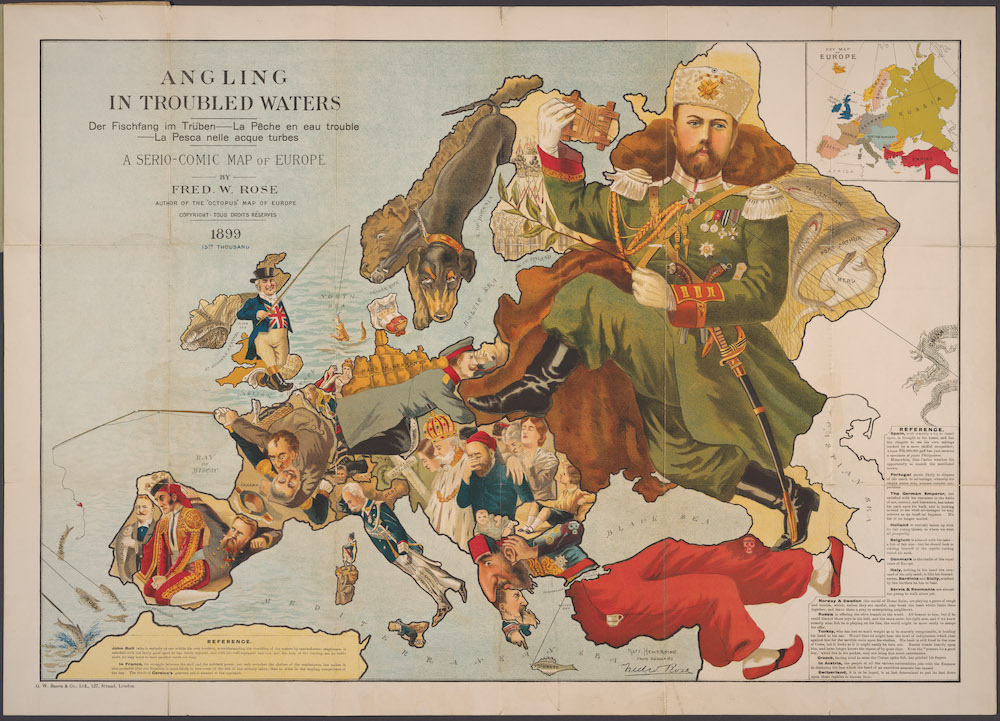
No doubt Russian persuasive cartographers had a different view of who was or wasn’t an octopus. Many years after his octopus map, Fred Rose dropped sea creatures for fishing in another of his serio-comic maps, “Angling in Troubled Waters,” above, this one from 1899, and showing Russia as a massive incarnation of the tsar, his boots posed to walk all over Europe. After the revolution, the Russian octopus returned, bearing different names but no less menacing a beast.
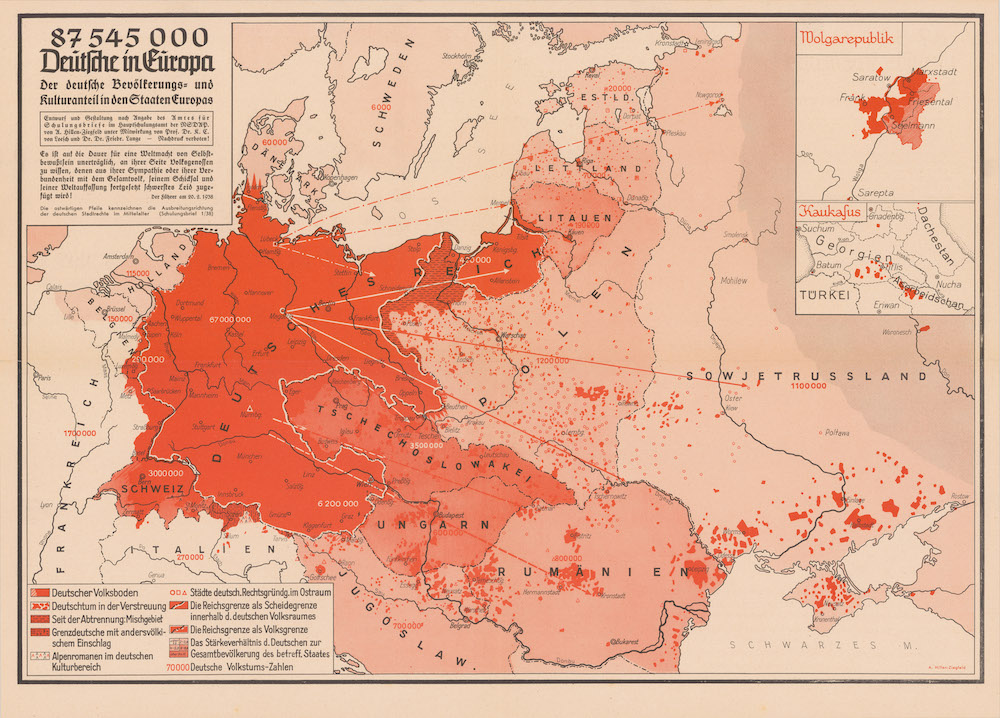
Many maps in the collection show contradictory views of Russia, or Great Britain, or whatever world power at the time threatened to overrun everyone else. It’s interesting to see the continuity of such depictions over decades, and centuries (Jacobs shows examples of Russian octopi from 1938 and 2008). The map above from 1938 reflects “Nazi expansionist goals,” notes Cornell’s digital collections, by showing the supposed “German” populations scattered all over Europe and the need, as Hitler argued in the quoted speech, to protect and liberate “national comrades” by means of annexation, bombing, and invasion.
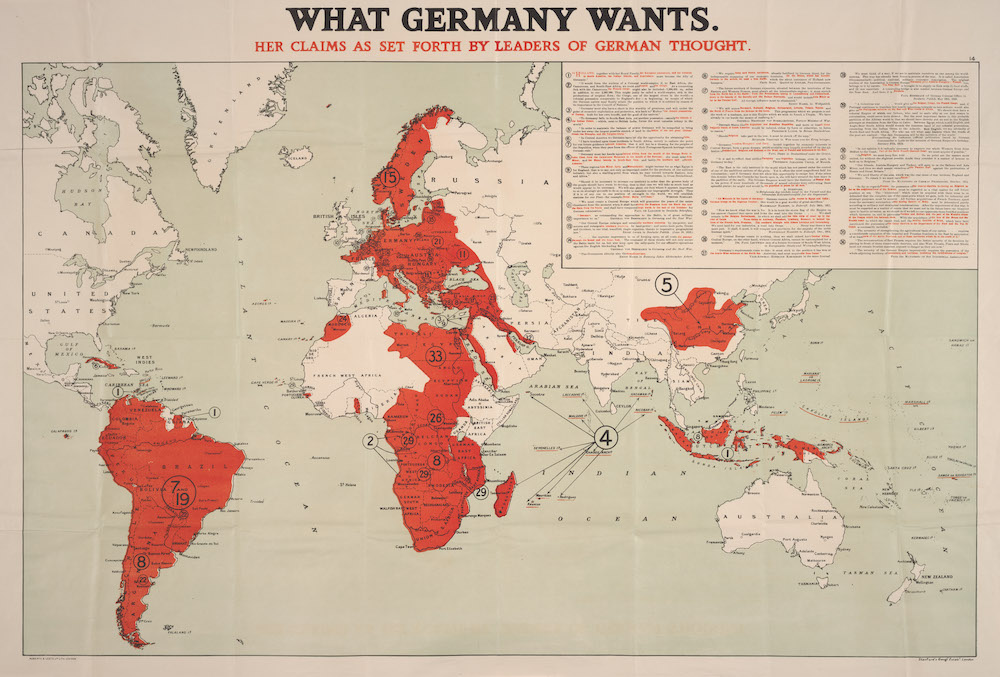
Where the blood red of the German map represents the “blood” of the volk, in the map above, from 1917, it stands in for the blood of everyone else if the “leaders of German thought” get what they want. Where the Reich map took aim at Europe, the quoted “former generals,” notes Cornell, “and well-known Pangermanists” in the WWI-era map above wanted to colonize most of the world, a particular affront to the British, who were well on their way to doing so, and to a lesser degree, the French, who wanted to. These two world powers had been at it far longer, however, and not without fierce opposition at home as well as in the colonies.
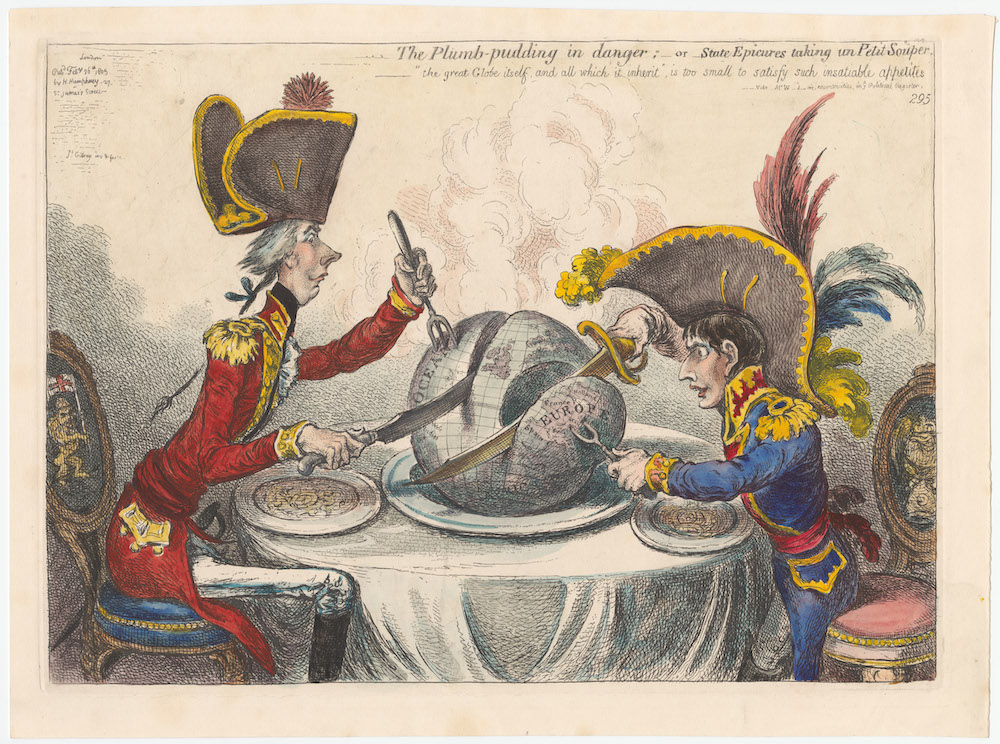
The famous eighteenth century British caricaturist James Gillray’s most famous print, from 1805, shows William Pitt and Napoleon seated at table, carving up the world between them to consume it.
A steaming ‘plum-pudding’ globe, both intent on carving themselves a substantial portion…. Pitt appears calm, meticulous and confident, spearing the pudding with a trident indicative of British naval supremacy. He lays claim to the oceans and the West Indies. In contrast Napoleon Bonaparte reaches from this chair with covetous, twitching eyes fixed on the prize of Europe and cuts away France, Holland, Spain, Switzerland, Italy and the Mediterranean.
Gillray’s cartoon hardly counts as a “map” but it deserves inclusion in this fine collection. Other notable maps featured include the 1904 “Distribution of Crime & Drunkenness in England and Wales,”a study in the persuasive use of correlation; the 1856 “Reynold’s Political Map of the United States,” illustrating the “stakes involved in the potential spread of slavery to the Western States” in support of the Republican Presidential candidate John Fremont; and the French Communist Party’s 1951 “Who is the Aggressor?” which shows American military bases around the world, their guns—or big black arrows—pointed at China and the U.S.S.R.
There are hundreds more persuasive maps, illustrating views theological, political, social, mechanical, and otherwise, dating from the 15th century to the 2000s. You can browse the whole collection or by date, creator, subject, repository, and format. All of the maps are annotated with catalog information and collector’s notes explaining their context. And all of them, from the frivolous to the world-historical, tell us far more than they intended with their peculiar ways of spatializing prejudices, fears, desires, beliefs, obsessions, and overt biases.
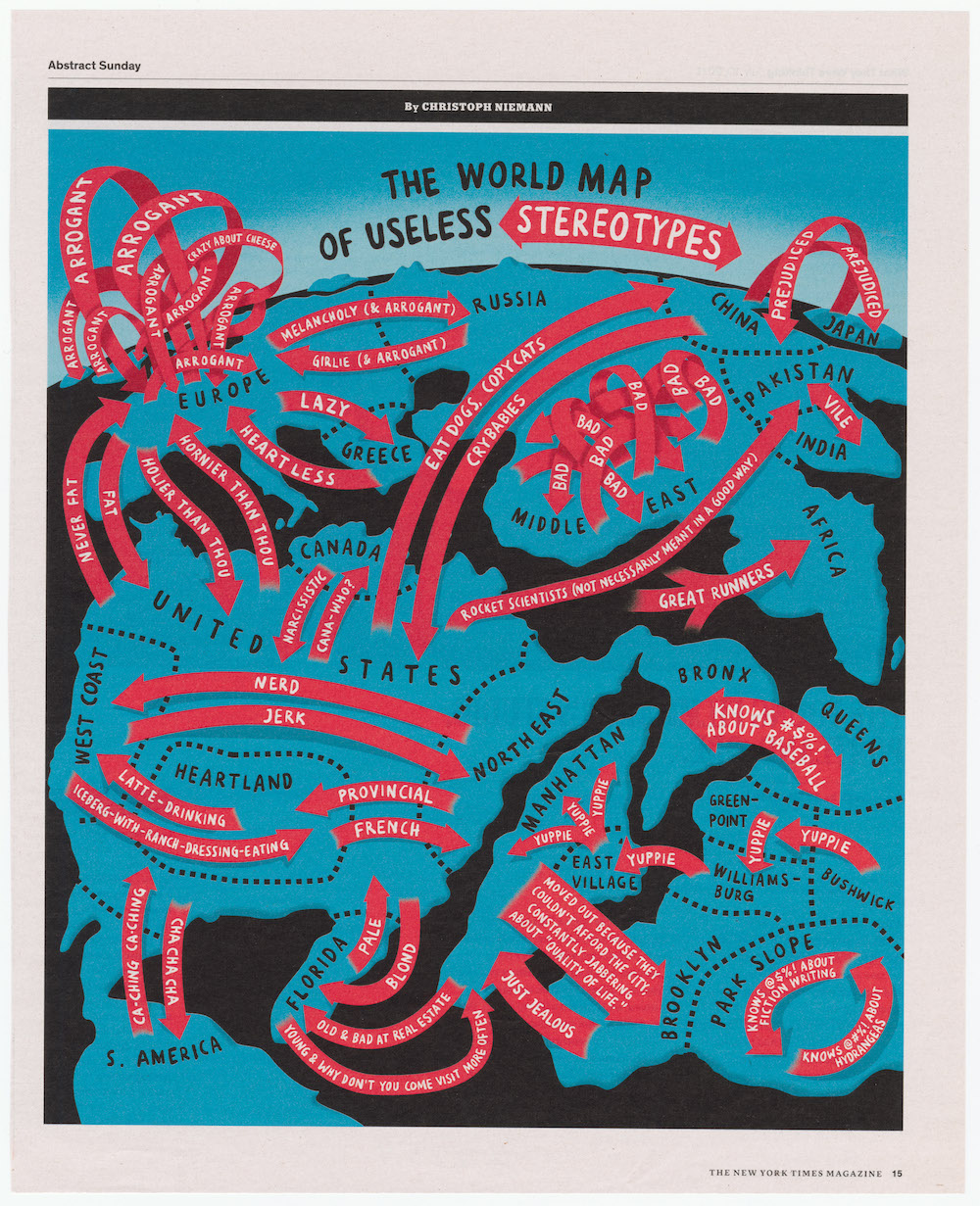
“Every map has a Who, What, Where and When about it,” as collector PJ Mode writes on the Cornell site. “But these maps had another element: Why? Since they were primarily ‘about’ something other than geography, understanding the map required finding the reasoning behind it.” The most recent entry in the archive, Christopher Neiman’s 2011 “World Map of Useless Stereotypes” from The New York Times Magazine turns the persuasive map in on itself, using its satirical devices to poke fun at propaganda’s reductive effects.
Late last month, Turner and Warner Bros. Digital Networks announced–much to the chagrin of cinephiles–that it planned to close Filmstruck, a streaming service that specialized in arthouse and classic films. Fans and celebrities–from Christopher Nolan to Guillermo del Toro–quickly got behind a petition to save the streaming service. And today their wish came true, more or less.
The Criterion Collection and WarnerMedia just issued a press release, declaring that “the Criterion Channel will launch as a free-standing streaming service” in the spring of 2019. This will effectively allow the Criterion Channel to “pick up where FilmStruck left off, with thematic programming, regular filmmaker spotlights, and actor retrospectives, featuring major classics and hard-to-find discoveries from Hollywood and around the world, complete with special features like commentaries, behind-the-scenes footage and original documentaries.”
If you want to demonstrate your appreciation and support, you can become a Charter Subscriber and gain the following benefits:
A 30-day free trial.
A reduced subscription fee for as long as you keep your subscription active. The regular fee will be $10.99 a month or $100 a year, but as a Charter Subscriber you’ll pay $9.99 a month or $89.99 a year.
Concierge customer service from the Criterion Collection, including a customer ID and a special e‑mail address.
A holiday gift-certificate present, for use on the Criterion Collection website.
A Charter Subscriber membership card.
The satisfaction of knowing you’re keeping the best of film alive and available.
Hope this helps you have a great weekend.
If you would like to support the mission of Open Culture, consider making a donation to our site. It’s hard to rely 100% on ads, and your contributions will help us continue providing the best free cultural and educational materials to learners everywhere. You can contribute through PayPal, Patreon, and Venmo (@openculture). Thanks!
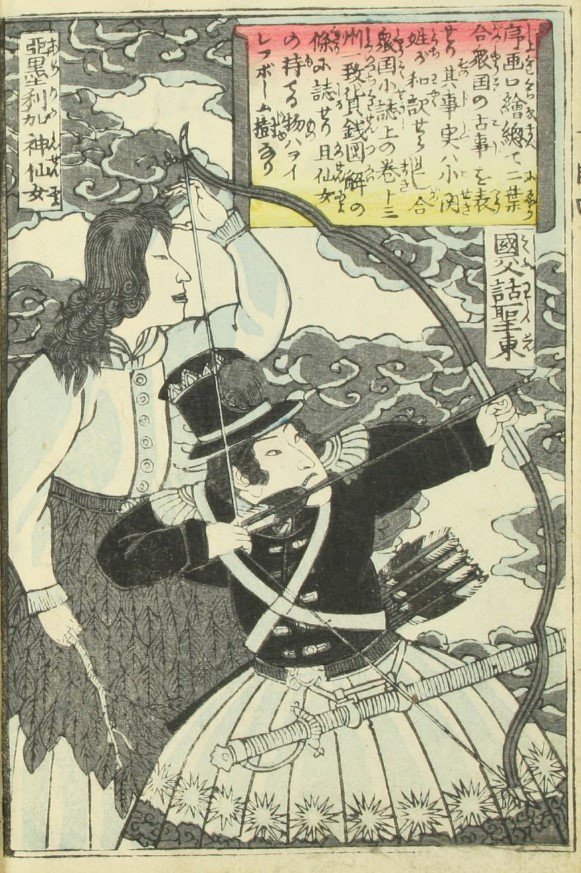
“George Washington (with bow and arrow) pictured alongside the Goddess of America”
Though I’m American myself, I always learn the most about America when I look outside it. When I want to hear my homeland described or see it reflected, I seek out the perspective of anyone other than my fellow Americans. Given that I live in Korea, such perspectives aren’t hard to come by, and every day here I learn something new — real or imagined — about the United States. But Japan, the next country over to the east, has a longer and arguably richer tradition of America-describing. And judging by Osanaetoki Bankokubanashi (童絵解万国噺), an 1861 book by writer Kanagaki Robun and artist Utagawa Yoshitora, it certainly has a more fantastical one. “Here is George Washington (with bow and arrow) pictured alongside the Goddess of America,” writes historian of Japan Nick Kapur in a Twitter thread featuring selections from the book.
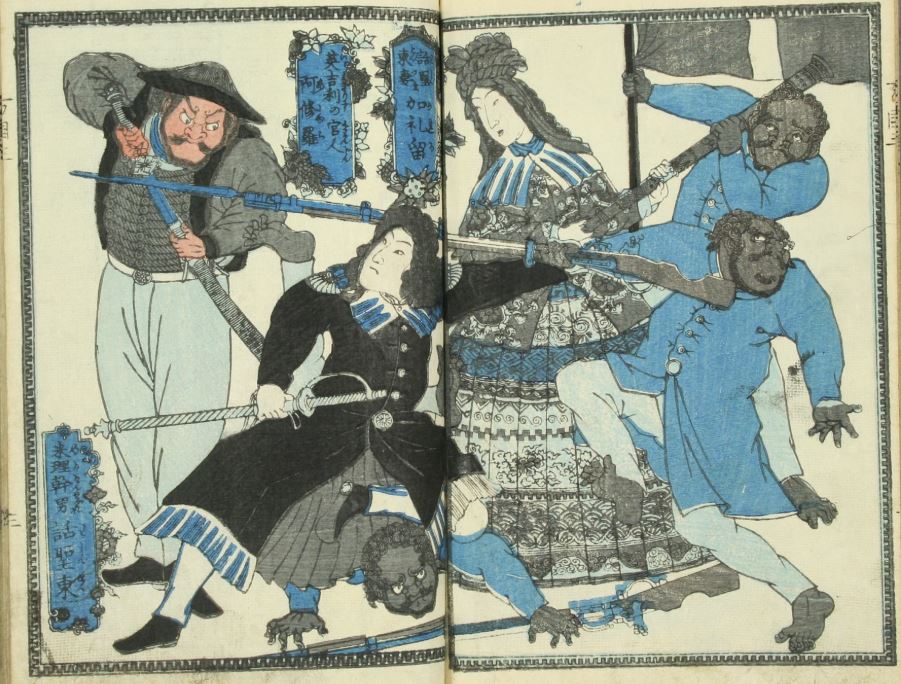
“George Washington defending his wife ‘Carol’ from a British official”
History does record Washington having practiced archery in his youth, among other popular sports of the day, and the image of the Goddess of America does look like a faintly Japanese version of Columbia, the historical female personification of the United States.
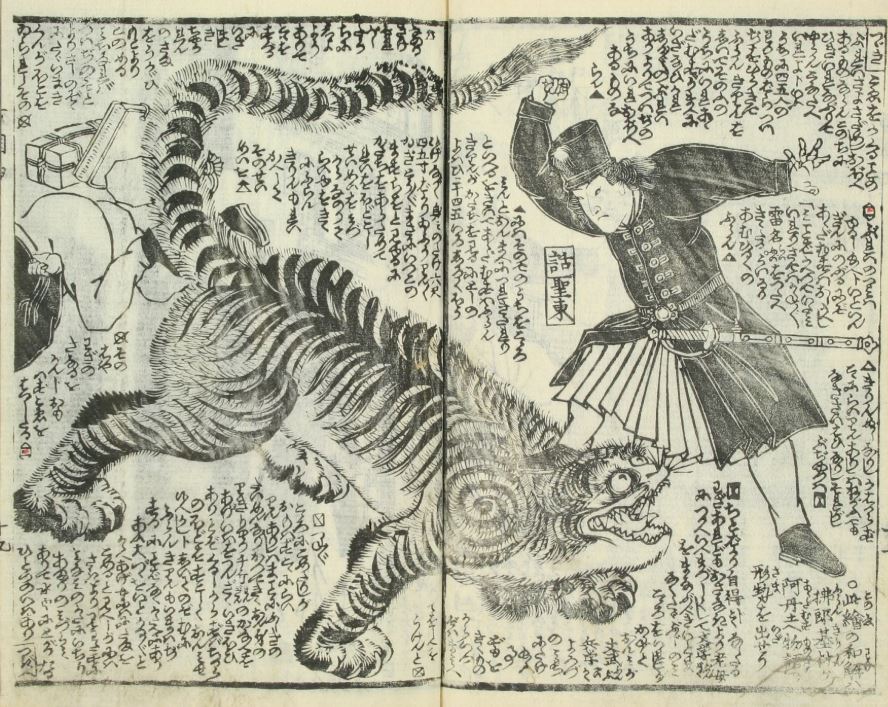
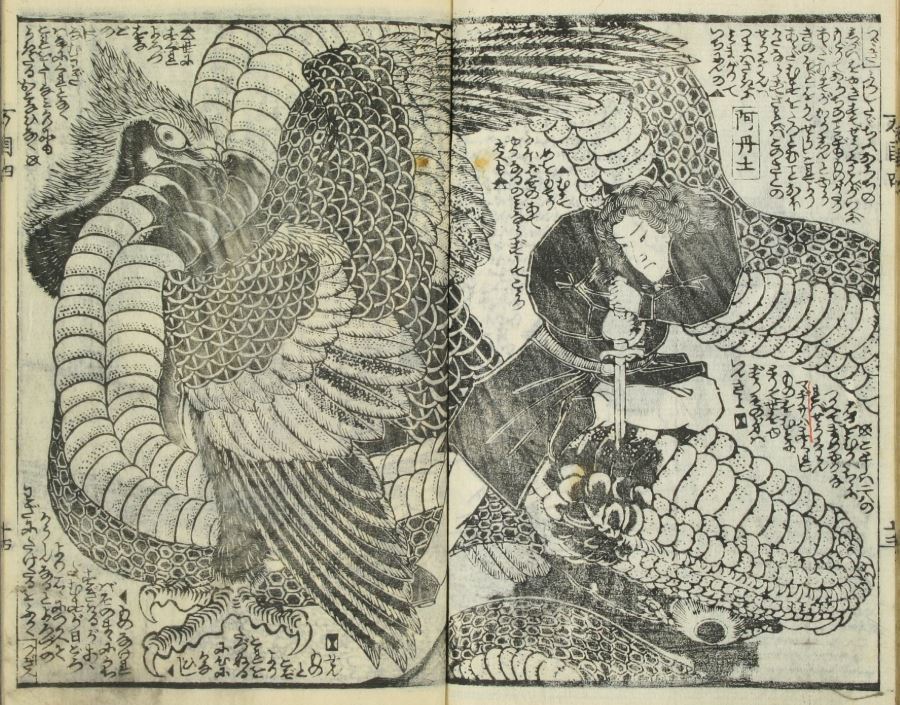
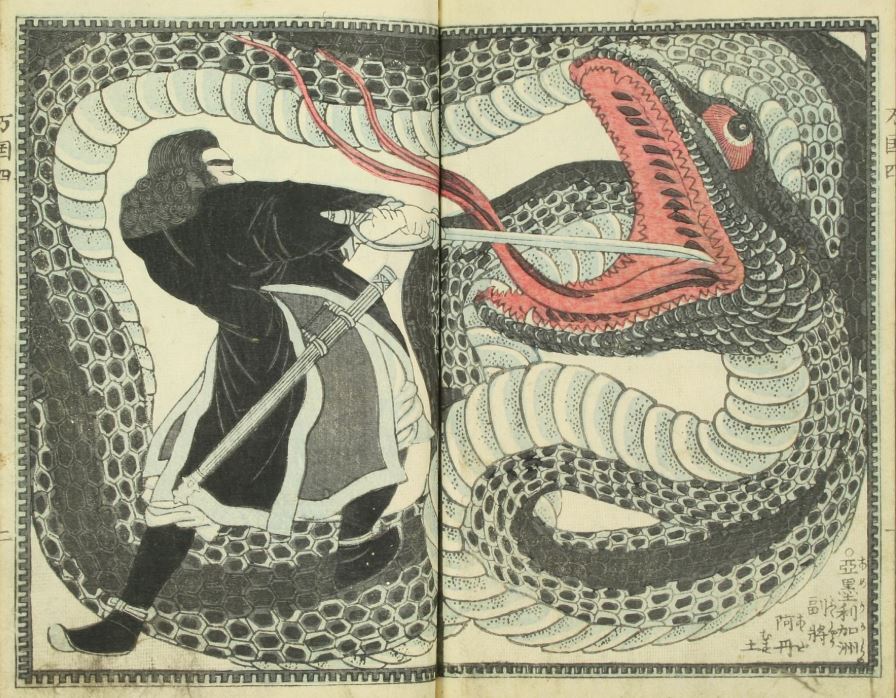
The next image Kaur posts shows Christopher Columbus reporting his discovery of America to Queen Isabella of Spain. “So far, kinda normal,” but then comes a bit of artistic license: a scene from the American Revolution in which we see “George Washington defending his wife ‘Carol’ from a British official named ‘Asura’ (same characters as the Buddhist deity).” Other illustrated events from early American history include “Washington’s “second-in-command” John Adams battling an enormous snake,” “the incredibly jacked Benjamin Franklin firing a cannon that he holds in his bare hands, while John Adams directs him where to fire,” and “George Washington straight-up punching a tiger.”
“George Washington straight-up punching a tiger”
The founding of the United States, as Kanagaki and Utagawa saw it, seems to have required the defeat of many a fearsome beast, including a giant snake that eats Adams’ mother and against which Adams must then team up with an eagle to slay. What truth we can find here may be metaphorical in nature: even in the mid-19th century, the world still saw America as a vast, wild continent just waiting to enrich those brave and strong enough to subdue it. Global interest in the still-new republic also ran particularly high at that time, as evidenced by the popularity of publications like Alexis de Tocqueville’s Democracy in America (which still offers an insightful outsider’s perspective on America), first published in 1835 and 1840.
“Together, John Adams and the eagle kill the enormous snake that ate his Mom. The power of teamwork!!!”
Japan, long a closed country, had also begun to take a keen interest in the outside world: American Commodore Matthew Perry and his warships, filled with technology then unimaginable to the Japanese, had arrived in 1853 with an intent to open Japan’s ports to trade. In 1868 the Meiji Restoration would consolidate imperial rule in the country and open it to the world, but Osanaetoki Bankokubanashi, which you can read in its entirety in digitized form at Waseda Unversity’s web site, came out seven years before that. At that time, the likes of Kanagaki and Utagawa, relying on second-hand sources, could still thrill their countrymen — none of whom had any more direct experience of America than they did — with tales of the grotesque creatures, vile oppressors, heroic rebels, and guiding goddesses to be found just on the other side of the Pacific Ocean.
Based in Seoul, Colin Marshall writes and broadcasts on cities, language, and culture. His projects include the book The Stateless City: a Walk through 21st-Century Los Angeles and the video series The City in Cinema. Follow him on Twitter at @colinmarshall or on Facebook.
Music lovers bracing against the annual onslaught of the Singing Dogs’ “Jingle Bells” may find their savage beasts soothed somewhat by Eddy Chen’s performance of Pachelbel’s Canon, above.
It retains its relaxing musicality. Chen, one half of Australian duo TwoSetViolin, plays that bird like the disciplined, classically-trained pro he is.
The duo describes its mission as “upholding the integrity of classical music” while making it “relevant to the modern generation through fun, humour and simplicity,” noting, in a joint interview with Violinist.com:
There are people out there who are ready to love classical music, and we have to actively find them. It is the way classical music has been presented so far that makes it so austere. We were lucky that we learned the instrument for 20 years; if we were not musicians, it would be very hard to get into.
Everyone has the potential to like it, but sometimes musicians alienate and scare potential listeners with our pride.
Back when classical music was new, it was not ‘classical’; it was just music.
Today our (classical music audience) is very small, but there are many great musicians
Granted, the standards for classical music are there for a good reason: people want the best art, and that is a standard we should uphold. At the same time, sometimes we see people breaking down and freaking out because of those standards. It is sad to think of all that lost potential and love for music. We feel we are losing audiences; we are losing people who used to love music.
The chicken definitely appeals to young listeners, though surely there’s no age limit for enjoying its take on Erik Satie’s Gymnopédie No.1…
It was the opposite of superstar rock concerts, or even a sweaty, dark stage like that at CBGB’s in New York. But the dining hall at Folsom Prison was the setting for a concert that would give Johnny Cash, on the verge of a career collapse, a second chance on life. And it would become one of the unlikeliest venues in the history of country music.
Nothing was the same after this unlikeliest of turnarounds. After the album recorded at this gig, Cash would be hurtled into superstardom. He’d get his own national TV show. And instead of being a drug and alcohol casualty, he’d take on the mantel of elder statesman with a hint of danger. No, he’d never killed a man in Reno just to watch him die, but when he sang it in that long drawl, you could believe so. None of the original artists that played on Sun Records had a second act quite like Cash.
And that’s all down to the decision to play a concert at California’s Folsom Prison, in which he had set one of his most famous songs from 1953.
In Polyphonic’s nine minute mini-doc above on the making of this classic album, he tries to piece together what makes the Folsom Prison album so special.
You might not think of the album as a radical piece of late ‘60s music similar to The White Album or Beggar’s Banquet, but it is. For it was birthed with the help of producer Bob Johnston, who had a try-anything attitude that was very much in the air in 1968. The recording is raw and very, very live sounding. The audience of prisoners is a part of the mix. Cash’s voice is similarly raw and flubs and mistakes were kept in. (But as the video points out, some of the audience noises were edited for greater impact, like a ‘whoop’ after Cash’s infamous “Reno” line.) June Carter’s sweet voice contrasts with Cash’s, but there’s an air of tension to the duets, as these men probably haven’t seen a young woman in the flesh for a very long time.
There’s also the empathy of the entire project. Cash sings like he’s one of them, and his songs are of isolation and loneliness. He even sings a song written by an inmate called “Greystone Chapel.” While so many acts at this time were stripping away artifice–think of Bob Dylan’s turn away from his psychedelic mid-‘60s height–Cash beat them all to it with unadorned honesty, humor, and in the middle of a prison, a sense of joy.
This year marks the 50th anniversary of the album, and the racial make-up of Folsom has changed–it’s gone from a majority white prison to one populated by African-Americans, Latinos, and Asians.
And while country music would not get the same reception now as it did then, the biggest change is that prisoners make the music themselves. In a Los Angeles Times article about the prison, “the musicians at Folsom have formed hip-hop, hard rock/heavy metal, Latin rock, alt-rock, smooth jazz and progressive rock ensembles within Folsom’s walls.” One recent artist to visit and perform was hip-hop musician Common.
But none of that would have happened without Cash’s historic visit. As he told the Times’ Robert Hilburn about that moment, “I knew this was it. My chance to make up for all the times when I had messed up. I kept hoping my voice wouldn’t give out again. Then I suddenly felt calm. I could see the men looking over at me. There was something in their eyes that made me realize everything was going to be okay. I felt I had something they needed.”
Ted Mills is a freelance writer on the arts who currently hosts the artist interview-based FunkZone Podcast and is the producer of KCRW’s Curious Coast. You can also follow him on Twitter at @tedmills, read his other arts writing at tedmills.com and/or watch his films here.
It’s a perverse irony or an apt metaphor: Leonard Cohen is best known for a song that took him five years to write, and that went almost unheard on its debut, in part because the head of Columbia’s music division, Walter Yetnikoff, refused to release Cohen’s 1985 album Various Positions in the U.S. “Leonard, we know you’re great,” said Yetnikoff, “We just don’t know if you’re any good.” It might have been Cohen’s summation of life itself.
It wasn’t until Jeff Buckley’s electric gospel cover in 1994 (itself a take on John Cale’s version) that “Hallelujah” became the massive hit it is, having now been covered by over 300 artists. Canadian magazine Maclean’s has called the song “pop music’s closest thing to a sacred text.” One can imagine Cohen looking deep into the eyes of those who think that “Hallelujah” is a hymn of praise and saying, “you don’t really care for music, do ya?”
With the trappings and imagery of gospel, and a sleazy synth-driven groove, it tells a story of being tied to a chair and overpowered, kept at an emotional distance, learning how to “shoot somebody who outdrew ya.” Love, sings Cohen sings in his lounge-lizard voice, “is not a victory march… It’s not somebody who’s seen the light.” If you’re looking to Leonard Cohen for redemption, best look elsewhere.
Used in film and television for moments of epiphany, triumph, grief, and relief, “Hallelujah,” like all of Cohen’s work, makes profane and prophetic utterances in which beauty and ugliness always coexist, in a painful arrangement no one gets clear of. Cohen will not let us choose between darkness and light. We must take both.
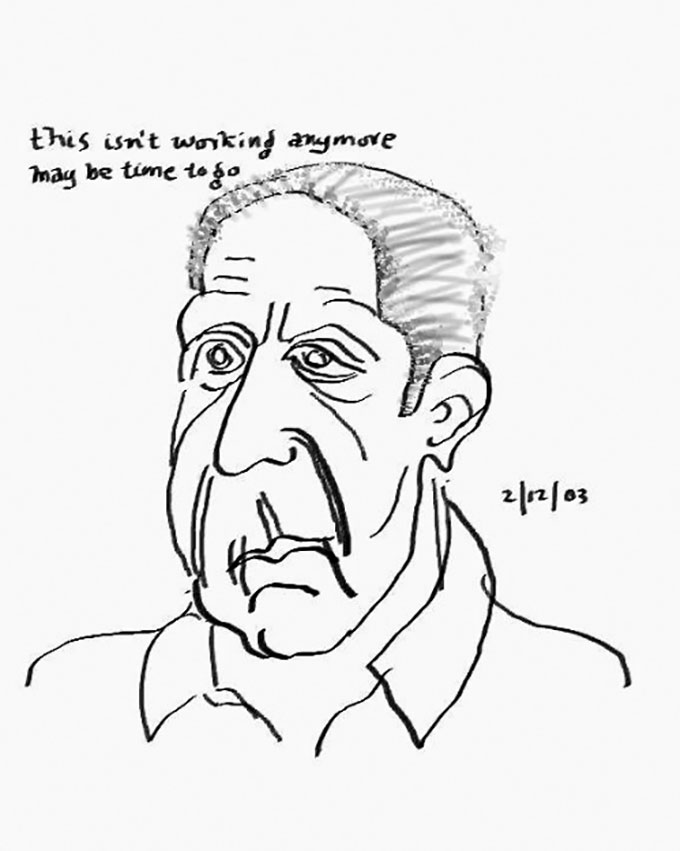
In the last years of his life, he brought his tragic vision to a remarkable climax in his final, 2016 album, You Want it Darker. Last month, the final act in his magisterial career premiered in the form of The Flame. The book is “a collection of poems, lyrics, drawings, and pages from his notebooks,” writes The Paris Review, who quote from Cohen’s son Adam’s forward: “This volume contains my father’s final efforts as a poet…. It was what he was staying alive to do, his sole breathing purpose at the end.”
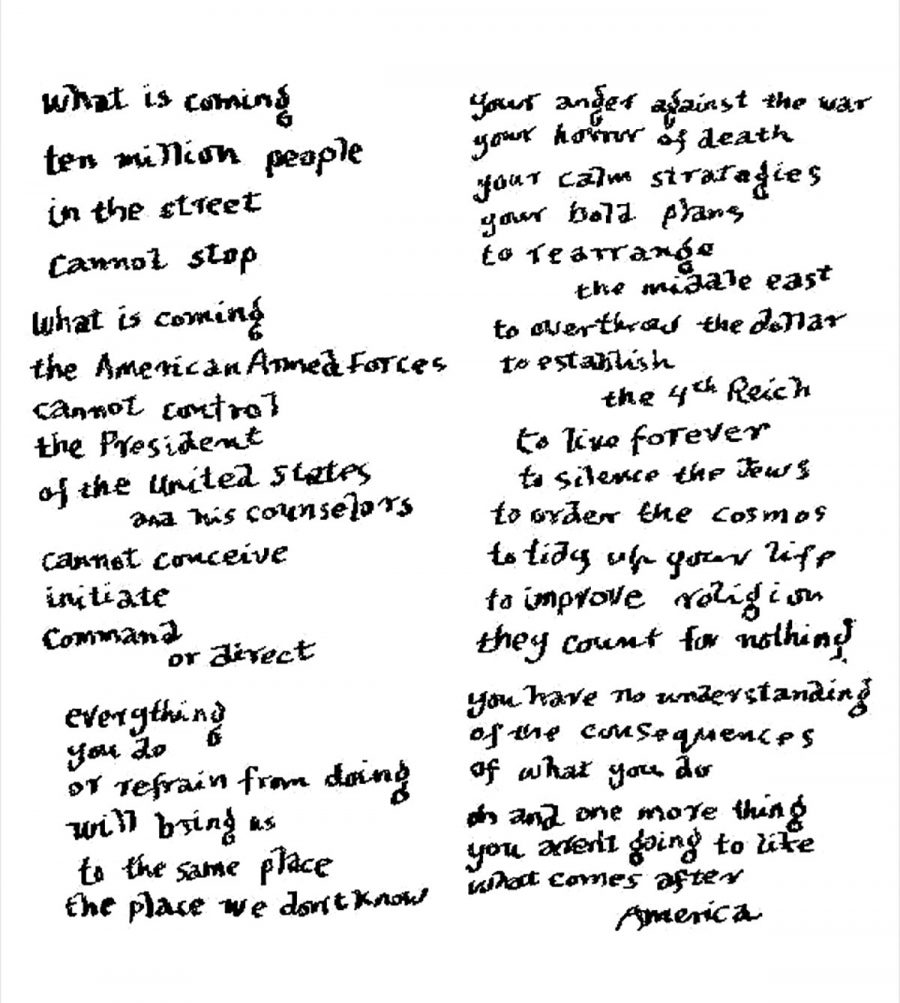
Cohen did not leave words of hope behind. One of his last poems issues forth an enigmatic and terrifying prophecy, hammering away at the conceits of human power.
What is coming
ten million people
in the street cannot stop
What is coming
the American Armed Forces
cannot control
the President
of the United States
and his counselors
cannot conceive
initiate
command
or direct
everything
you do
or refrain from doing
will bring us
to the same place
the place we don’t know
your anger against the war
your horror of death
your calm strategies
your bold plans
to rearrange
the middle east
to overthrow the dollar
to establish
the 4th Reich
to live forever
to silence the Jews
to order the cosmos
to tidy up your life
to improve religion
they count for nothing
you have no understanding
of the consequences
of what you do
oh and one more thing
you aren’t going to like
what comes after
America
But The Flame is not all jeremiad. In some ways it’s a turn from the grim, oracular voice of “You Want it Darker” and to a more intimate, at times quotidian and confessional, Cohen. “All sides of the man are present” in this book of poems and sketches writes Scott Timberg at The Guardian. “Was he, in the end, a musician or a poet? A grave philosopher or a grim sort of comedian? A cosmopolitan lady’s man or a profound, ascetic seeker? Jew or Buddhist? Hedonist or hermit?” Yes.
Cohen’s work, his son says, “was a mandate from God.” The writing of his final poems “was all private.” “My father was very interested in preserving the magic of his process. And moreover, not demystifying it. Speaking of any of this is a transgression.”
However else we interpret Leonard Cohen’s theo-mythic-philosophical incantations, he made a few things clear. What he meant by “God” was deeper and darker than what most people do. And to trivialize the mysteries of life and love and death and song, to pretend we understand them, he suggests, is a grave and tragic, but perhaps inevitable, mistake. “You want it darker,” he sang at the end. “We kill the flame.”
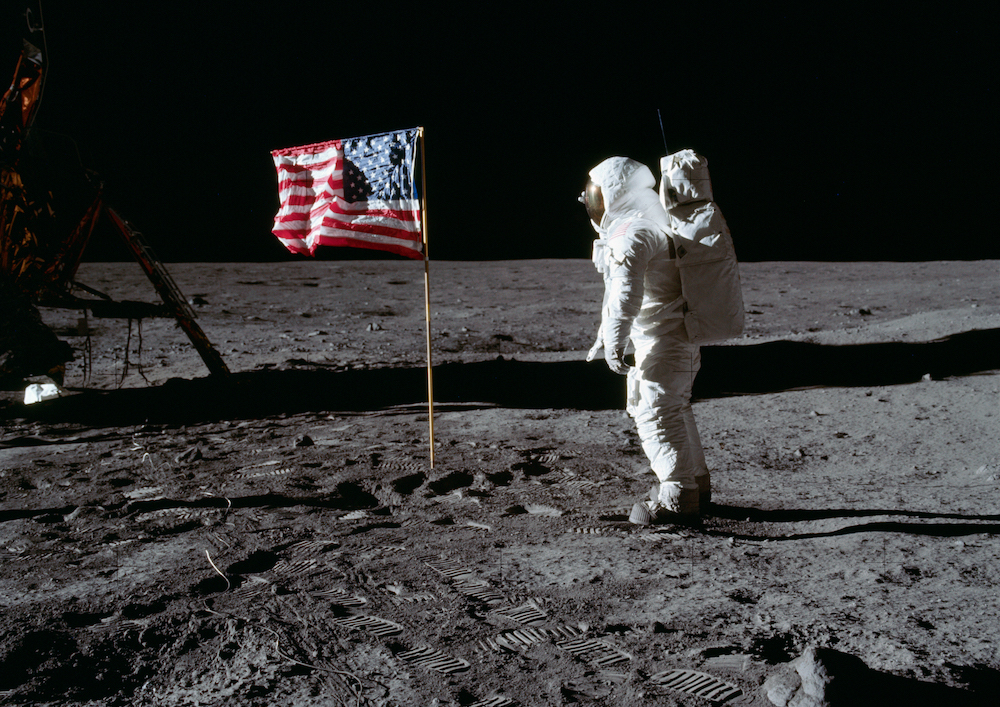
When we think of the Apollo missions, we tend to think of images, especially those broadcast on television during the Apollo 11 moon landing in 1969. And if we think of the sounds of Apollo, what comes more quickly to mind — indeed, what sound in human history could come more quickly to mind — than Neil Armstrong’s “one small step for a man, one giant leap for mankind” line spoken on that same mission? But that’s just one small piece of the total amount of audio recordings made during the Apollo program, which ran from the mid-1960s to the early 1970s. Now, with nearly 20,000 hours of them digitized, they’ve begun to be made available for listening and downloading at the Internet Archive.
“After the Apollo missions ended, most of the audio tapes eventually made their way to the National Archives and Records Administration building in College Park, Maryland,” writes Astronomy’s Catherine Meyers. But even after getting all the recordings in one place (easier said than done given the vast size of the archives in which they resided), a much larger challenge loomed.
“The existing tapes could be played only on a machine called a SoundScriber, a big beige and green contraption complete with vacuum tubes. NASA had two machines, but the first was cannibalized for parts to make the second one run.”
Refurbishing the very last SoundScriber to play these 30-track tapes required the help of a retired technician, and then the research team needed to “play all 30 tracks at once to minimize the time required to digitize them, as well as to avoid damaging the almost 50-year-old tapes by playing them over and over.” What with the 50th anniversary of the Apollo 11 moon landing approaching next summer — and with First Man, Damien Chazelle’s biopic of Neil Armstrong currently in theaters — NASA has cleared that mission’s audio recordings for public release.
You can listen to the Apollo 11 tapes directly at the Internet Archive, or you can make your way through them at Explore Apollo, a site designed by students at the University of Texas at Dallas that highlights the most historically significant of the thousands of hours of audio recorded during Apollo 11: not just Armstrong’s first step, but the launch from Kennedy Space Center, the lunar landing itself, and the astronauts’ walk on the moon’s surface. But space exploration is about much more than astronauts, as you’ll soon find out if you spend much time at the Internet Archive’s collection of Apollo 11 recordings, on which appear not just Neil Armstrong, Buzz Aldrin, and Michael Collins, but the hundreds and hundreds of other NASA personnel who made the moon landing possible. We may never have heard their names before, but now we can finally hear their voices.
Based in Seoul, Colin Marshall writes and broadcasts on cities, language, and culture. His projects include the book The Stateless City: a Walk through 21st-Century Los Angeles and the video series The City in Cinema. Follow him on Twitter at @colinmarshall or on Facebook.
We're hoping to rely on loyal readers, rather than erratic ads. Please click the Donate button and support Open Culture. You can use Paypal, Venmo, Patreon, even Crypto! We thank you!
Open Culture scours the web for the best educational media. We find the free courses and audio books you need, the language lessons & educational videos you want, and plenty of enlightenment in between.