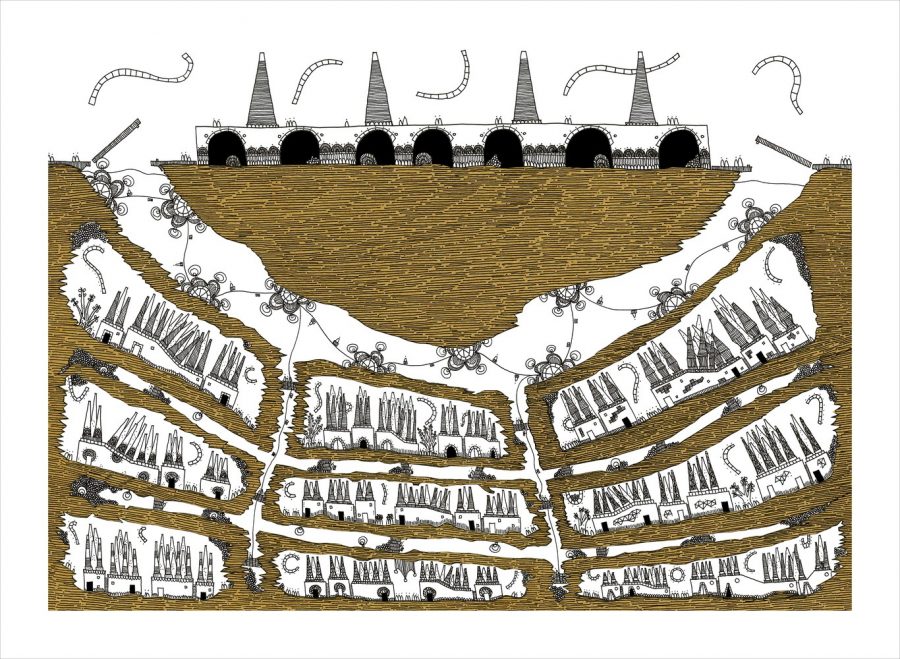
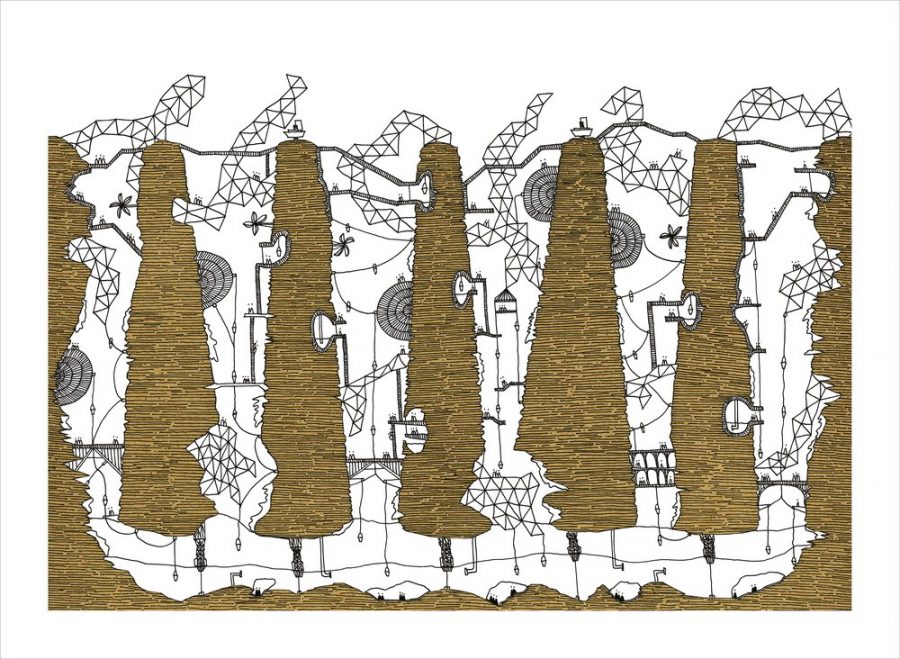
Above, watch ‘Adam,’ a short claymation made by Evelyn Jane Ross while attending the Rhode Island School of Design. As she points out in a recent interview, ‘Adam’ is “nothing like Wallace and Gromit; it’s neither a children’s story nor does it have a distinct character. Instead, it’s a poetic narrative depicting love and emotional sincerity. It uses the malleable nature of clay to emphasize the main idea, creation. ‘Adam’ also defies the perception that animation is a children’s medium. The film could easily be rated “R” for “MATURE” audiences only.” She then adds:
I read a quote by Stanley Kubrick, ‘A film is — or should be — more like music than like fiction. It should be a progression of moods and feelings. The theme, what’s behind the emotion, the meaning, all that comes later’. This quote really guided my progression. It seemed like a wonderful way to think of structure and timing. The meaning, yes, came later.
Although Ross made the film mainly to fulfill some senior year requirements at RISD, she got some extra mileage out of the claymation. Among other awards, it won Best Animated Film at the Yale Student Film Festival, the Berlin Flash Film Festival, and Santa Fe Independent Film Festival. And it was a BAFTA Student Awards Finalist. Enjoy.
Stephen F. Steinbach, a resident of Vienna and a “cartography, language and travel enthusiast, with an engineering background,” is not a linguist. Steinbach, who runs the site Alternative Transport, seems much more interested in mapping and transportation than morphology and etymology. But he has made a contribution to a linguistic concept called “lexical difference” with the map you see above, a colorful 2015 visualization of European languages, grouped together in clusters according to their subfamilies (Italic-Romance, Baltic, Slavic, Germanic, etc.—see a much larger version here).
Straight and arcing lines span the relative distance these languages have presumably traveled from each other. Solid lines between languages represent a very close proximity, dashed lines of different thicknesses show more distance, and thin dotted lines traverse the greatest expanses.
Hungarian and Ukrainian, for example, have a lexical distance score of 90, where Polish and Ukrainian, both Slavic languages, are only 30 degrees from each other. “The map shows the language families that cover the continent,” writes Big Think, “large, familiar ones like Germanic, Italic-Romance and Slavic, smaller ones like Celtic, Baltic and Uralic; outliers like Semitic and Turkic; and isolates—orphan languages, without a family: Albanian and Greek.” (Technically, modern Greek does have a family—Hellenic—though it is the only surviving member.)
As we might expect from this subset of the durable Indo-European schema, the languages within each clustered group occupy the shortest distance from each other, with some exceptions. Romanian, for example, is slightly closer to Albanian than it is to French, its Romance cousin. The Slavic languages Russian and Polish seem to have traveled a bit further apart than Polish has from the Baltic language of Lithuanian. What does this mean, exactly? According to the measure of “lexical distance” proposed by Ukrainian linguist Konstantin Tishchenko, it means that closer languages might be more mutually intelligible, at least from a lexical standpoint, since they may share more cognates (similar-sounding and meaning words) and borrowings.
The idea received a much more trenchant critique more recently. Steinbach clarified that the theory, and the map, only compare written words and not syntax or speech. “It has nothing to do with grammar, syntax, rhythm or other important features that are important for intelligibility,” he writes. “It also compares a small list of words and not the entire vocabulary of one language to another.” This explanation does cast doubt on whether “lexical distance” is a meaningful concept. I’ll leave it to the linguists to decide. (Steinbach reached out to Tischchenko but has yet to receive a reply.)
Tischchenko’s original “lexical distance” map, further up, drawn in 1997, gets the idea across with minimal fuss, but it leaves much to be desired graphically. (A large, hand-drawn color version improves upon the printed map.) Steinbach took his version from a 2008 English-language adaptation made by Teresa Elms in 2008 (above). In his blog post here, he explains all of the changes he made to Elms and Tischchenko’s designs. These include adjusting the size of the “bubbles” to proportionally represent the number of speakers of each language. Steinbach also added several languages, as well as “gravestones” for the dead Anatolian and Tocharian branches. In all, his map shows “54 languages, representing 670 million people.” He adds, vaguely, that “it checks out.”
After posting his Lexical Distance Map, Steinbach proposed a “3D” version, with the added dimension of time. (See his preliminary sketch above.) The maps are intriguing, the theory of “lexical distance” an interesting one, but we should bear in mind, as Steinbach writes, that he is “no linguist,” and that this idea is hardly an orthodox one within the discipline.
The problem is there are no Nixons around at the moment. That’s what we need — we need a real good Nixon to give something for other people to get their teeth into, to really … loathe him, to become themselves more effective as opposition leaders.
Alas, his prayers have been answered.
Steadman, who has brought his inky sensibilities to bear on such works as Animal Farm andAlice in Wonderland, has a new American president to add to the collection he discussed several years ago, in the video above.
Steadman’s pen was the sword that rendered Gerald Ford as a scarecrow, Ronald Reagan as a vampire, and George W. Bush as a monkey in a cage of his own making.
Barack Obama, one of the candidates in that comparatively bland 2012 election, is depicted as a tenacious, slender vine, straining ever upward.
Jimmy Carter, somewhat less benignly, is a puppy eagerly fetching a stick with which to pardon Nixon, the Welsh cartoonist’s dark muse, first encountered when he accompanied Thompson on the road trip that yielded Fear and Loathing: On the Campaign Trail ’72.
And now…
Donald Trump has given Steadman reason to come out fighting. With luck, he’ll stay out as long as his services are required. The above portrait, titled “Porky Pie,” was sent, unsolicited, to Gerry Brakus, an editor of the New Statesman, who published it on December 17, 2015.
At the time, Steadman had no reason to believe the man he’d anthropomorphized as a human pig hybrid, squeezed into bloody flag-print underpants, would become the 45th president:
Trump is unthinkable. A thug and a molester. Who wants him?
The portrait’s hideousness speaks volumes, but it’s also worth looking beyond the obvious-seeming inspiration for the title to a reference few Americans would get. “Pork pie”—or porky—is Cockney rhyming slang for “a lie.”
See a gallery of Steadman’s portraits of American presidents on his website.
After TheVillage Voiceannounced this week that it was folding its print operation, a couple people compared the venerable NYC rag’s demise to the end of Gawker, the snarky online tabloid taken down by Hulk Hogan and his shadowy financier Peter Thiel. For too many reasons to list, this comparison seems to my mind hardly apt. There’s a gesture toward the Voice’s profane unruliness, but the alternative weekly, founded in 1955, transcended the blog age’s sophomoric nihilism. The hermetic container of its newsprint sealed out frothing comment sections; no links ferried readers through rivers of personalized algorithms.
The Voice published hard journalism that many, including Voice writers themselves, have ruefully revisited of late. Its music and culture writers like Nat Hentoff, Lester Bangs, Sasha Frere-Jones, Robert Christgau and so many others are some of the smartest in the business. Its columnists, editors, and reviewers—Andrew Sarris, J. Hoberman, Robert Sietsema, Tom Robbins, Greg Tate, Michael Musto, Thulani Davis, Ta-Nehisi Coates—equally so.
In its over sixty-year run, Voice writers sat in the front rows for the birth for hard bop, free jazz, punk, no wave, and hip-hop, and all manner of downtown experimentalism in-between and after.
Amongst the many remembrances from current and former Voice staff in a recent Esquire oral history, one from editor and writer Camille Dodero stands out: “The alt-weekly’s purpose was, in theory, speaking truth to power and the ability to be irreverent, and print the word ‘fuck’ while doing so.’” Mission accomplished many times over, as you can see yourself in Google’s Village Voice archive, featuring 1,000 scanned issues going all the back to 1955, when Norman Mailer founded the paper with Ed Fancher, Dan Wolf, and John Wilcock. There are “blind spots” in Google’s archive of the Voice, noted John Cook at the erstwhile Gawker. In 2009, his “searches didn’t turn up any coverage of Norman Mailer’s 1969 campaign or the Stonewall riots… and there’s not much on Rudy Giuliani’s mayoral bid.” Many years later, months and years in the Google archive remain blank, “no editions available.”
The Voice has had its own blind spots. Writer Walter Troy Spencer referred to Stonewall, for example, as “The Great Faggot Rebellion” and used a phrase that has perhaps become the most wearisome in American English: “there was mostly ugliness on both sides.” This anti-gay prejudice was a regular feature of the paper’s first few years, but by 1982, just as the AIDS crisis began to filter into public consciousness, the Voice was the second organization in the US to offer extended benefits to domestic partners. It became a prominent voice for New York’s LGBTQ culture and politics, through all the buyouts, cutbacks, and unbeatable competition that brought it to its current pass.
The paper also became a voice for the most interesting things happening in the city at any given time, such as the goings on at a Bowery dive called CBGB in 1975. Character studies have long been a Voice staple. Lester Bangs’ write-up of Iggy Pop two years later cut to the heart of the matter: “It’s as if someone writhing in torment has made that writhing into a kind of poetry.” Back in ’75, Andrew Sarris wrote a rather jaw-dropping profile of Hervé Villechaize (in which he begins a sentence, “The problem of midgets….”). …. the more I look through Voice back issues, the more I think it might have been a Gawker of its time, but as onetime columnist Harry Siegel tells Esquire, “what made it unique depends a lot on the age of who you’re asking. It was a very different paper in different decades. It was valuable enough for a long time that people paid money to read it.”
Indeed its first issue cost 5 cents, though by the nondescript cover, above, you wouldn’t guess it would amuse or titillate in the ways the Village Voice became well-known for—in its columns, photos, cartoons, and libertine advertising and classifieds. But most people these days remember it as “free every Wednesday,” to proffer dance, film, theater, music, restaurants, to line subway cars and birdcages, and to open up the city to its readers. The Voice is dead, long live the Voice.
Although Neil deGrasse Tyson is somewhat hesitant to go in on plans to terraform and colonize Mars, that doesn’t mean he doesn’t like a good ol’–yet science-based–video game. Several outlets announced recently that the videogame Space Odyssey, spearheaded by deGrasse Tyson–one of America’s main defenders of logic and Enlightenment–has surpassed its Kickstarter funding goal. The game promises to send players on “real science-based missions to explore space, colonize planets, create and mod in real time.”
In the game, according to deGrasse Tyson, “you control the formation of planets, of comets, of life, civilization. You could maybe tweak the force of gravity and see what effect that might have.” It will be, he says, “an exploration into the laws of physics and how they shape the world in which we live.”
The game has been forming for several years now, and most importantly to our readers, has called in several sci-fi and fantasy writers to help create the various worlds in the game, as they have aptly demonstrated their skills in doing so on the printed page. That includes George R.R. Martin, currently ignoring whatever HBO is doing to his creation Game of Thrones; Neil Gaiman, who creates a new universe every time he drops a new novel; and Len Wein, who has had a hand in creating both DC’s Swamp Thing and Marvel’s Wolverine. Also on board: deGrasse Tyson’s buddy Bill Nye, former NASA astronaut Mike Massimino, and astrophysicist Charles Liu.
The idea of world/galaxy-building is not new in video games, especially recently. No Man’s Sky (2015) features “eighteen quintillion full-featured planets” and Minecraft seems limitless. But Space Odyssey (still a temporary title!) is the first to have deGrasse Tyson and friends working the controls in the background. And a game is as good as the visionaries behind it.
According to the Kickstarter page, the raised funds will go into “the ability to have this community play the game and engage with it while the final build is underway. As the Kickstarter gaming community begins to beta test game-play and provide feedback, we can begin to use the funds raised via Kickstarter to incorporate your modding, mapping and building suggestions, together building the awesome gaming experience you helped to create.”
DeGrasse Tyson will be in the game himself, urging players onward. There’s no indication whether Mr. Martin will be popping up, though.
Ted Mills is a freelance writer on the arts who currently hosts the artist interview-based FunkZone Podcast and is the producer of KCRW’s Curious Coast. You can also follow him on Twitter at @tedmills, read his other arts writing at tedmills.com and/or watch his films here.
Think of the artists you know who, especially in the 1960s and 70s, portrayed an often sordid reality in detail, just as they saw it, garnering acclaim from enthusiasts, who perceived a high artistry in their seemingly rough-hewn work, and cries from countless detractors who objected to what they saw as the artists’ lazy crudity. In the realm of poetry and prose, Charles Bukowski should come to mind sooner or later; in that of comic art, who fits the bill better than Robert Crumb? It makes only good sense that the work of both men should intersect, and they did in the 1980s when Crumb illustrated two short books by Bukowski, Bring Me Your Love and There’s No Business.
“Crumb’s signature underground comix aesthetic and Bukowski’s commentary on contemporary culture and the human condition by way of his familiar tropes — sex, alcohol, the drudgery of work — coalesce into the kind of fit that makes you wonder why it hadn’t happened sooner,” writes Brain Pickings’ Maria Popova.
“In 1998, a final posthumous collaboration was released under the title The Captain Is Out to Lunch and the Sailors Have Taken Over the Ship— an illustrated selection from Buk’s previously unpublished diaries, capturing a year in his life shortly before his death in 1994.” As one student of the graphic novel summarizes Bring Me Your Love, “the main character is a man whose personality resembles the main character of most Bukowski stories. He goes through life rather aimlessly, killing time by drinking and having sex. His wife is in a mental hospital.”
“Crumb’s illustrations give the already gritty storylines a visual context — such as a man who looks much like Buk wrestling on the floor with his ‘wife’ after a dispute involving answering the phone or various barroom skirmishes depicting a Bukowski-looking character running amok,” says Dangerous Minds. “He was a very difficult guy to hang out with in person, but on paper he was great,” Crumb once said of Bukowski, and his illustrations also reveal that he understands Bukowski’s own awareness of the difference between his page self and his real one. “Old writer puts on sweater, sits down, leers into computer screen, and writes about life,” Bukowski writes, in their third and final collaboration, above a Crumb illustration of just such a scene. “How holy can we get?”
Oh sure, they look festive, but seriously, think twice before arming a blindfolded child (or a beer guzzling adult guest) with a sturdy stick and encouraging him to swing wildly.
There’s no need to worry, however, about anyone taking a bat to the intricate Hieronymus Bosch-inspired piñatas of Roberto Benavidez, a self-described half-breed, South Texan, queer figurative sculptor.
Even if you filled them with candy, the exteriors would be far more valuable than any treasures contained within.
Bosch, of course, excelled at scenarios far more nightmarish than anything one might encounter in a backyard party. Benavidez seems less drawn to that aspect than the beauty of the fantastical creatures populating The Garden of Earthly Delights.
In fact, the majority of his papier-mâché homages are drawn from the paradisiacal left panel of the famous triptych.
Not so the first in the series, 2013’s superbly titled Piñata of Earthly Delights #1, above
In the original, a misshapen waterbird uses its long beak to spear a cherry with which it tempts a passel of weak-willed mortals, crowded together inside a spiky pink blossom.
In Benavidez’s version the lack of naked humans allows us to focus on the creature, whose beak now pierces a simple star-shaped piñata of its own.
Those with a fascination for the antics of Bosch’s party people are invited to play a variation of Where’s Waldo, scouring the painting for the inspiration behind Candy Ass Bottom, above.
While little is known about Bosch’s artistic training, Benavidez majored in acting, before returning to his childhood fascination for sculpting, taking classes in drawing, painting, and bronze casting at Pasadena City College. Thrift and portability led him to begin exploring paper as his primary medium.
As he remarked on the blog of the crepe paper manufacturer Cartotecnica Rossi:
I was intrigued by the idea of taking the piñata form, something seen as cheap and disposable, and moving it into the arena of fine art. I feel that my sculptural forms and fringing techniques set my work apart from what most people think of as a typical piñata and the themes are more complex than is typical.
Definitely.
View more of Roberto Benavidez’ fine art piñatas, including those inspired by Hieronymus Bosch on his website or Instagram feed.
The rattleback–it’s been intriguing us since prehistoric times. Seeming to defy the laws of physics, it spins in one direction, “rattles” to a stop, and then changes direction, as Neil deGrasse Tyson demonstrates above. How does the rattleback work? To get into that, watch this technical video from William Case, a professor at Grinnell College. Or review the resources on this web page. In either case, you will need to wear your thinking cap.
If you would like to sign up for Open Culture’s free email newsletter, please find it here. It’s a great way to see our new posts, all bundled in one email, each day.
If you would like to support the mission of Open Culture, consider making a donation to our site. It’s hard to rely 100% on ads, and your contributions will help us continue providing the best free cultural and educational materials to learners everywhere. You can contribute through PayPal, Patreon, and Venmo (@openculture). Thanks!
The vibrations of the Metropolitan Elevated Railroad in Manhattan, a recitation of “Mary Had a Little Lamb,” the announcements issuing forth from an inventor’s attempt at a talking clock — hardly a mix with which to get the party started, but one that provides the closest experience we can get to traveling in a sonic time machine. With Centuries of Sound, James Errington has assembled those recordings and a few others into its 1878–1885 mix, an early chapter in his project of creating one listening experience for each year in the history of recorded sound.
“Things get a little more listenable in 1887 with a recording of ‘Twinkle Twinkle Little Star,’ ” writes The A.V. Club’s Matt Gerardi. “It’s also with this third mix that we start to get a sense for Centuries Of Sound’s editing style, as speeches start to be layered over musical performances, creating a listening experience that’s as pleasurable as it is educational.”
In so doing, “Errington calls attention to the issue of representation, as one of his primary goals is to paint a global, multi-cultural picture of recording history,” digging past all the “marching bands, sentimental ballads, novelty instrumentals and nothing much else” in the historical archives while putting out the call for expert help sourcing and evaluating “Rembetika, early microtonal recordings, French political speeches, Tagore songs or anything else.”
Putting up another year’s mix each month, Centuries of Sound has so far made it up to 1893, the year of the World’s Columbian Exposition in Chicago which “set the tone for the next twenty-five years of architecture, arts, culture and the electrification of the world,” and also the first age of “ ‘hits’ – music produced with an eye to selling, even if only as a souvenir or a fun novelty.” With a decade remaining until Centuries of Sound catches up with the present moment, Errington has put together a taste of what its sonic dose of the almost-present will sound like with a 2016 preview mix featuring the likes of the final album by A Tribe Called Quest and Lazarus, the musical by David Bowie, both of whom took their final bows last year. We’re definitely a long way from the time of “Mary Had a Little Lamb.” But how will it all sound to the ears of 2027?
A native of West Palm Beach, Florida, Derek Black grew up in one of the most prominent white nationalist families in the United States. He’s the son of Don Black, a former grand wizard of the Ku Klux Klan. And he’s the godson of David Duke, “the most recognizable figure of the American radical right, a neo-Nazi, longtime Klan leader and now international spokesman for Holocaust denial” (per the Southern Poverty Law Center). In short, Derek Black had every reason to grow up a racist, and remain a racist from cradle to grave. But things didn’t turn out that way.
Below, you can hear Black explain how, as a young adult, he broke with white nationalism, leaving behind his family, friends and community. What laid the groundwork for that break? Going to a small liberal arts college, encountering new ideas, and meeting different people. In this recorded interview, he tells Michael Barbaro of The New York Times:
In 2010, I moved across the state and started college at this little liberal arts college in Florida, which was about three and a half hours from home and it was the first time that I had lived away from home. Nobody knew who I was and I did not volunteer who I was or anything about my background, I made friends, hung out with people and played my guitar on my balcony in my dorm. It was nice to come back from class and be able to talk about history or philosophy or whatever other subject and be around other people.…
I had a friend on campus who I had gotten to know during my first semester when nobody knew who I was, he was an observant Jew who had Shabbat dinners pretty regularly whenever he was in town on Friday night and he would invite people of atheists and all sorts of different religions. It was just a nice dinner. And so he actually invited me to one of the Shabbats, and I knew him, and so I brought wine…
He had read my posts on Stormfront [a white nationalist website created by Don Black] going back years — even the stuff when I was a teenager — and he doubted that he was going to convince me of anything, he just wanted to let me see a Jewish community thing so that if I was going to keep saying these anti-Semitic things that at least I had seen real Jews.
It was ultimately in private conversations with a person I met at the Shabbat dinners … we would talk about things. Not only white nationalism, but eventually white nationalism. And I would say, “This is what I believe about I.Q. differences, I have 12 different studies that have been published over the years, here’s the journal that’s put this stuff together, I believe that this is true, that race predicts I.Q. and that there were I.Q. differences in races.” And they would come back with 150 more recent, more well researched studies and explain to me how statistics works and we would go back and forth until I would come to the end of that argument and I’d say, Yes that makes sense, that does not hold together and I’ll remove that from my ideological toolbox but everything else is still there. And we did that over a year or two on one thing after another until I got to a point where I didn’t believe it anymore.
As you stream the interview below, spend some time thinking about the transformative power of a liberal arts education. Yes, more than an expedient business degree, it can change hearts and save lives.
Also pay attention to Black’s final thoughts on what Trump’s response to the Charlottesville drama did for the White nationalist movement: “I think Tuesday was the most important moment in the history of the modern white nationalist movement.” Trump “said there were good people in the white nationalist rally and he salvaged their message.”
If you would like to sign up for Open Culture’s free email newsletter, please find it here. It’s a great way to see our new posts, all bundled in one email, each day.
If you would like to support the mission of Open Culture, consider making a donation to our site. It’s hard to rely 100% on ads, and your contributions will help us continue providing the best free cultural and educational materials to learners everywhere. You can contribute through PayPal, Patreon, and Venmo (@openculture). Thanks!
Sylvia Plath was a study in contrasts. Her popularization as a confessional poet, feminist literary icon, and tragic casualty of major depression; her middle-class Boston background and tortured marriage to poet Ted Hughes—these are the highlights of her biography, and, in many cases, all many people get to know about her. But “she was much more than that,” Dorothy Moss tells Mental Floss. As Vanessa Willoughby puts it in a stunning essay about her own encounters with Plath’s work, “this woman was not the sum of a gas oven and two sleeping children nestled in their beds.”
Moss, a curator at the Smithsonian National Portrait Gallery has organized an exhibit featuring many more sides of the poet’s divided, yet purposeful self, including her work as a visual artist. Readers of Plath’s poetry may not be surprised to learn she first intended to become an artist. Her visual sense is so keen that fully-formed images seem to leap out of poems like “Blackberrying,” and into the reader’s hands; like the “high green meadows” she describes, her lines are “lit from within” by a deep appreciation for color, texture, and perspective.
Blackberries / Big as the ball of my thumb, and dumb as eyes / Ebon in the hedges, fat / With blue-red juices. These they squander on my fingers.
The blackberries come alive not only in their personification but through the kind of vivid language that could only come from someone with a painterly way of looking at things. Plath “drew and painted and sketched constantly as a child,” says Moss, and first enrolled at Smith College as an art major.
The exhibition, the National Portrait Gallery writes, “reveals how Plath shaped her identity visually as she came of age as a writer in the 1950s.” Unsurprisingly, her most frequent subject is herself. Her visual art, like her poetry, notes Mental Floss, “is often preoccupied with themes of self-identity.” But as in her eloquently-written letters and journals, as well as her published literary work, she is never one self, but many—and not all of them variations on the sly, yet brooding intellectual we see staring out at us from the well-known photographs.
Look at that ugly dead mask here and do not forget it. It is a chalk mask with dead dry poison behind it, like the death angel. It is what I was this fall, and what I never want to be again.
The hands thrown up in defense or surrender, the black lifeless eyes… Plath emerges from the ring of dead trees behind her like a suffering saint. Another portrait, further up also resembles a mask, calling to mind the ancient origins of the word persona. But the style has totally changed, the tumult of brushstrokes smoothed out into clean geometric lines and uniform patches of color. Three masks combine into one face, a trinity of Plaths. The poet always had a sense of herself as divided, referring to two distinct personalities as her “brown-haired” and “platinum” selves. The brown-haired young girl made several charming sketches of her family, with humorous commentary. (Her troubling father is tellingly, perhaps, absent.)
Hers was an epitome of standard-issue 50s white, middle class American childhood, the kind of supposedly idyllic upbringing which no small number of people still remember today in a glowing, nostalgic haze. In Plath’s excavations of the identities that she cultivated herself and those she had pushed upon her, she gazed with radical intensity at America’s patriarchal social fictions, and the violence and entitlement that lay beneath them. The collage above from 1960 presents us with the kind of layered, cut-up, hybrid text that William Burroughs had begun experimenting with not long before. You can see more highlights from the Plath exhibit, “One Life: Sylvia Plath,” at the National Portrait Gallery. Also featured are Plath’s family photos, books, letters, her typewriter—and, in general, several more dimensions of her life than most of us know.
We're hoping to rely on loyal readers, rather than erratic ads. Please click the Donate button and support Open Culture. You can use Paypal, Venmo, Patreon, even Crypto! We thank you!
Open Culture scours the web for the best educational media. We find the free courses and audio books you need, the language lessons & educational videos you want, and plenty of enlightenment in between.