Many religious leaders would like to liven up their services to attract a younger, hipper flock, but few have the necessary background to pull it off in a truly impressive way. Not so for the Japanese Buddhist priest Gyōsen Asakura, who answered the higher calling after a career as a DJ but evidently never lost his feel for the unstoppable pulse of electronic music. Getting behind his decks and donning his headphones once again, he has begun using sound, light, and the original splendor of Fukui City’s Shō-onji temple to hold “techno memorial services.” You can see and hear a bit of one such audiovisual spiritual spectacle in the video just above, shot at a memorial service last fall.
“Buddhism may be approaching something of a crisis point in Japan,” reports Buddhistdoor’s Craig Lewis, “with 27,000 of the country’s 77,000 Buddhist temples forecast to close over the next 25 years, reflecting shrinking populations in small rural communities and a loss of faith in organized religion among the country’s population as a whole.”
He also sites an Asahi Shimbun survey that found 434 temples closed over the past decade and 12,065 Japanese Buddhist temples currently without resident monks. Can this temple in a small city, itself known for its phoenix-like rise from the ashes of the Second World War, do its part to reverse the trend?
Gyōsen Asakura frames his techno memorial services, however incongruous they might at first seem, as in keeping with the traditions of his branch of Pure Land Buddhism. “Originally, golden decorations in the temple are expressions of paradise light,” he told THUMP. “However, the light of a traditional temple has not changed its form from 1000 years ago to use candlelight, even after electricity was invented. I felt doubtful about that, and then I thought about expressing paradise with the latest stage lighting such as 3D mapping.”
After all, as he said to Japankyo, “people used to use the most advanced technologies available to them at the time in order to ornament temples with gold leaf,” so why not harness today’s technology to evoke the Buddhist “world of light” as well? And in any case, ecstatic sensory experiences are nothing new in the realm of faith, though ecstatic sensory experiences of Gyōsen Asakura’s kind do cost money to put together. And so he, in the way of most religious projects the world over, has asked for donations to fund them, using not a bowl but the crowdfunding site Readyfor. Judging by 383,000 yen (more than $3300 U.S. dollars) he’s already raised, quite a few techno-heads have seen the light.
If you would like to support the mission of Open Culture, consider making a donation to our site. It’s hard to rely 100% on ads, and your contributions will help us continue providing the best free cultural and educational materials to learners everywhere. You can contribute through PayPal, Patreon, and Venmo (@openculture). Thanks!
Musician Rufus Harley did the people of Scotland a great favor when he took up the bagpipes. Like the Loch Ness Monster and haggis, outside its country of origin, the national instrument has evolved into a hackneyed punchline.
What better, more unexpected ambassador for its expanded possibilities than a certified American jazz cat?
He certainly stumped the all-white celebrity panel when he appeared on Steve Allen’s popular TV game show, “I’ve Got a Secret” in 1966.
Politician and former Miss America Bess Myerson’s opening question feels a bit impolitic from a 50 year remove:
Is it how well you play it that’s unusual?
“Yes, definitely,” Harley agrees.
Having quickly sussed out that the instrument in question is a woodwind, the panel cycles through a list of candidates — flute?
Oboe?
Clarinet?
No?
A…sweet potato?
Once they start batting around saxophones, Allen issues a brisk corrective:
He wouldn’t be here tonight if he, you know, just played the saxophone and that was his secret because that wouldn’t be too good a secret.
Point taken.
Something tells me a white guy in a suit and a tie would have elicited less wonder from the panel upon the revelation that the instrument they failed to guess was the bagpipes.
Harley had had professional training in the saxophone, oboe, trumpet and flute, but as a bagpiper he was self-taught. As the comments on the video above demonstrate, his unorthodox handling of the instrument continues to confound more traditional pipers. No matter. The sounds he coaxed out of that thing are unlike anything you’re likely to hear on the bonny, bonny banks of Loch Lomond.
At the end of the segment, Harley joined his back up musicians onstage for a live, Latin-inflected cover of “Feeling Good.”
And just for fun, check out this list of bagpipe terms.There’s more to this instrument than its association with Groundskeeper Willy might suggest.
From art director Zach Schläppi comes Pasta for War, an animation that satirizes propaganda newsreels from the 1930s. The plot is simple:
It begins with fresh pasta marching towards the podium. There, the Great Dictator orates. A young recruit envisions formations of dive bombing bow-ties flying above columns of ravioli tanks, while he wades through marinara sauce to battle against utensils at the bottom of the sink. The realisation that he may die ends his fantasy, but his comrades march ever forward, to their impending doom — a towering pot of boiling water.
As Jon Hofferman notes at Animation World Network, Schläppi does a pretty fine job of “re-creating the look and feel of 1930s-era wartime filmmaking, using sepia tones, triumphalist camera angles and slightly stilted editing and narration to good advantage.” Created in 2000, Pasta for War was screened at various animation film festivals and took home a few awards. Hope you enjoy.
If you would like to support the mission of Open Culture, consider making a donation to our site. It’s hard to rely 100% on ads, and your contributions will help us continue providing the best free cultural and educational materials to learners everywhere. You can contribute through PayPal, Patreon, and Venmo (@openculture). Thanks!
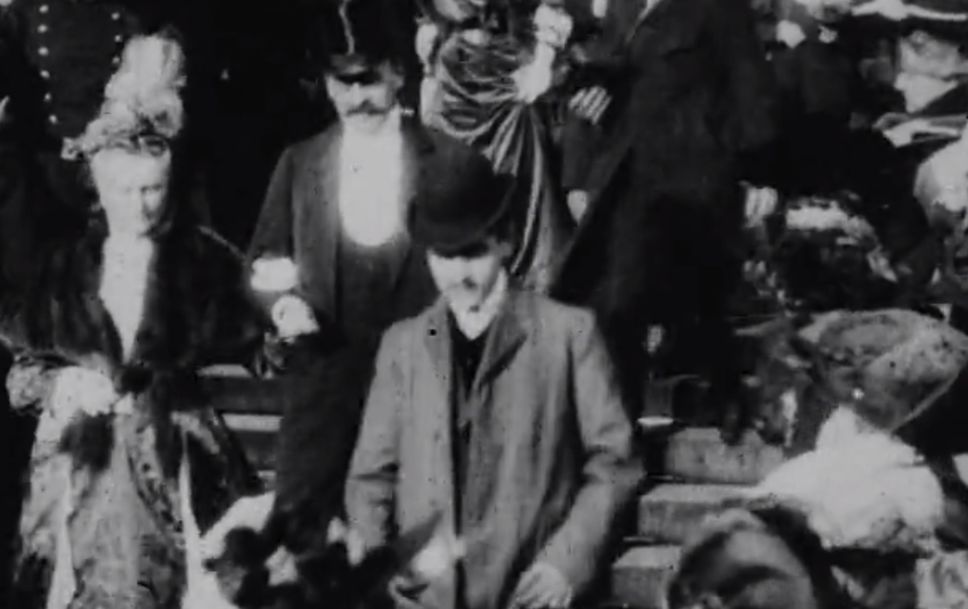
Ladies and gentlemen, we present the first known footage of the French author Marcel Proust.
Announced by ProfessorJean-Pierre Sirois-Trahan in the latest edition of the French journal, Revue d’études proustiennes, the footage was recorded on November 14, 1904 (nine years before Proust published the first volume in his classic work, À la recherche du temps perdu/Remembrance of Things Past). And it shows Proust descending a stairway at the wedding of his close friend, Armand de Guiche. Look for him at the 37 second mark. He’s dressed less formally (in grey, not black) than the aristocrats joining him at the celebration. I’ve added a close up picture below.
If you would like to support the mission of Open Culture, consider making a donation to our site. It’s hard to rely 100% on ads, and your contributions will help us continue providing the best free cultural and educational materials to learners everywhere. You can contribute through PayPal, Patreon, and Venmo (@openculture). Thanks!
By the end of the 1960s, Alan Watts had become one of the gurus of the counterculture. Though he was not really a Zen Buddhist, he was many a person’s gateway into the religion due to The Way of Zen published in 1958. His was a philosophical and populist approach to Eastern religion, an antecedent to the Eckhart Tolles of our time.
This short film, Now and Zen, was directed by Elda and Irving Hartley, shot in the gardens at their residence, and features Watts encouraging the viewer to go beyond the material world, especially as we understand it through language and our cultural viewpoint. Instead, he says, “This world is a multidimensional network of all kinds of vibrations” which infants understand better than us adults. The film then transitions into a guided sitting meditation of sorts, and ends with the sounds of nature. (Plus, there’s ducks.)
“Hence the importance of meditation in zen,” he continues, “which is, from time to time, to stop thinking altogether, and simply be aware of what is. This may be done very, very simply. By becoming aware of the play of light and color upon your eyes. Don’t name anything you see. Just let the light and the shadow, the shape and the color, play with your eyes, and allow the sound to play with your ears.”
Elda Hartley, working with her husband Irving, used this film to launch the Hartley Film Foundation, its mission to produce documentaries on world religions and spirituality. (It still exists as a non-profit). Zen as a subject came first, because Elda had been on a trip to Japan with Alan Watts, and when she proposed the film, he agreed to narrate. She would later make films with Margaret Mead, Joseph Campbell, Ram Dass, Huston Smith and others.
There are several other films on archive.org’s Hartley Productions page, and another Watts-narrated one: The Flow of Zen. (Warning: this is the opposite of meditative, and its harsh atonal electronic sounds very far removed from any mediation CD you might have kicking around.)
Finally, as someone who spent many an undergrad night listening to his late-night lectures on KPFK and at the time not understanding a whit, it was edifying to hear Watts say in the above film:
As you listen to my voice, don’t try to make any sense of what I am saying. Just be aware of the tones and your brain will automatically take care of the sense.
I can vouch that he was right about that…eventually. But only after reading many, many books on Buddhism.
Ted Mills is a freelance writer on the arts who currently hosts the FunkZone Podcast. You can also follow him on Twitter at @tedmills, read his other arts writing at tedmills.com and/or watch his films here.
One of Akira Kurosawa’s last films, 1990’s Dreams, saw the Japanese master stretching out into more personal territory. A collection of short pieces based on the director’s dreams, one of these episodes, “Crows,” shows us a young Kurosawa surrogate who wanders from a gallery of Van Gogh’s paintings and into the French countryside Van Gogh painted. The addition of Martin Scorsese as a voluble, Brooklyn-accented Van Gogh adds a quirky touch, but there’s something a little disappointing about the move from the paintings to their referent. When people ask, after all, “what must it have been like to have seen the world through Vincent van Gogh’s eyes?” they seem to assume the painter saw reality in same the swirling, writhing, riotously-colored motion as his paintings.
It’s true the beleaguered Dutch artist had problems with his vision, due to lead poisoning and temporal lobe epilepsy. But what we really want to experience is seeing the world not as Van Gogh saw it but as he painted it. And as we shared last year, we’ll soon have a chance thanks to an incredible animated feature film project called Loving Vincent by Dorota Kobiela and High Welchman. “Every frame of Loving Vincent will be an oil painting on canvas, created with the same techniques Van Gogh used over a century ago.” The filmmakers have since released an official trailer for the film, which you can see at the top of the post, and a making-of short, which you can watch just above. The artists we see hard at work in studios in Greece made a total of 65,000 individual oil paintings for the film, in color and black-and-white, many of which you can see—and purchase—at the Loving Vincent website.
The painters drew their inspiration from live action performances by actors like Douglas Booth, Saoirse Ronan, and Aidan Turner, which were then digitally enhanced with computer animated “elements such as birds, horses, clouds and blowing leaves.” The 125 “painting animators,” as the film’s site calls them, transformed “this reference material into Vincent van Gogh’s painting style,” then re-created “the movement of the shot through animating each brushstroke.” It’s a phenomenal achievement that painter Piotr Dominiak above says gave him “goosebumps” when he saw it. The handful of painters interviewed above—from all over Europe—are passionate about Van Gogh. Few of them are professional artists. Dominiak worked as a cook before joining the project. Sarah Campos worked as a Spanish teacher, and Waldek Wesolowski restored old cars.
From start to finish, Loving Vincent has—like its subject’s body of work—been a labor of love (watch a behind-the-scenes short above). But this one came together on the internet. The filmmakers began funding with a Kickstarter campaign several years ago, and most of the artists were recruited through their website. Given the incredible results in what we’ve seen so far, we can expect to enter Van Gogh’s creative vision in a way we could only dream about before. Learn much more about the project at the impressive Loving Vincent website.
Note: Please scroll to the 6:52 mark where the conversation begins.
The name Miyazaki defines Japanese animation not just in its own country, but across the world. The name Kurosawa does the same for the rest of Japanese cinema. But given their differences of not just specific art form but of generation (Akira Kurosawa was born in 1910, Hayao Miyazaki in 1941), one might wonder whether the men themselves, were they to meet, would have much to talk about. Nippon TV put the idea to the test in 1993 by airing Miyazaki Meets Kurosawa, which sends the already renowned animator, whose sixth film Porco Rosso had come out the previous year, to the home of the long-reigning “Emperor” of Japanese film, whose thirtieth and final film Madadayo (a title translatable as Not Yet!) had come out the previous month. Their conversation starts at the 6:52 mark above.
After a bit of small talk, mostly about the magnificent view of Mount Fuji from Kurosawa’s front porch, the masters get down to shop talk. Kurosawa and Miyazaki discuss the difficulty of speaking about one’s own work, the sweet taste of sake at the end of a long shoot, the pain of sitting at a desk drawing day in and day out, what it took to build a sloping street for Madadayo or an entire castle for Ran (just to burn it down), how to visually and sonically evoke the various different eras of Japanese history, Miyazaki’s appreciation for Kurosawa’s storyboards, and Kurosawa’s appreciation for the cat bus in Miyazaki’s My Neighbor Totoro — at which point the translated transcript at fan site nausicaa.net indicates that “Miyazaki seems to be at a loss for words.” (You can read the transcript at the bottom of the post.)
Though Japanese tradition, to say nothing of the customs of one dedicated artist speaking to another, dictates that Miyazaki display a certain deference to Kurosawa (an attitude certainly visible in the segments of the broadcast available on Youtube), the two have plenty of insight to offer one another. And however different their films, they all emerged from the same spirit of painstaking dedication. “If you let things slide thinking ‘well, this won’t be in view of the camera,’ ” Kurosawa warns, “then there’s no end to how lazy you can get. You either give it your all, or don’t even bother.”
Miyazaki, who has since risen to a Kurosawa-like prominence of his own, offers this closing reflection on his first meeting with the director of the likes of Rashomon, Seven Samurai, and Ikiru: “Whether a work is a masterpiece or… something more modest, I realized that they all originate at the same place — an environment where people are constantly thinking and rethinking their own ideas,” rather than waiting around for inspiration. Instead, they adopt the attitude of, “ ‘Regardless of what they think… or whether or not they like the way I do things, I’m gonna do what has to be done!’ That’s what’s important.”
A big hat tip goes to Adrian.
Transcript, translated by Yuto Shinagawa.
KUROSAWA — One of the settings for our movie — the “Oichini [ah one two]” drug salesman scene — if you recall, is a rectangular room. What we’d do is use three cameras, all on one side of the room to film everything from start to finish… after which we’d move the them to another side of the room, switch out the lenses, and film the scene over. We’d do this three times…from all four directions. So in the end, there’d be 36 cuts that we had to look through during editing…just for one scene.
MIYAZAKI — That’s what boggles my mind. How do you pick which cuts to use?
KUROSAWA — Pretty much on a first come first serve basis for me.
MIYAZAKI — Is that so?
KUROSAWA — You just skim through them really quick…“toss…keep…toss,” so that all you have to do in the end is just string together what’s left. That’s all there is to it.
MIYAZAKI — Well yes, but…[Laughs]
KUROSAWA — So we might have one segment that seems like it’s going to be a big hassle…perhaps take days to film…but ends up taking only half a day — from morning to 3 o’clock later that day. The same goes with editing — we’d be expecting a big mess, when in fact, we’d be finished by 3 o’clock the same day, only to have everyone go, “what?!”
[Shows clip from Maadadayo]
KUROSAWA — Battle scenes too. When the cavalry makes a charge or something…we film it three times with three different cameras, each time with different lenses. So in the end, we’ll have 9 cuts, and all you have to do is string together the good ones. It’s not that hard. Aside from that…when someone falls off a horse…gets shot and falls of a horse… we’ll do a special take afterwards for those types of scenes. And all you have to do is throw that clip in at the right moment, and that’s it. [Pause] And…if you run out of cuts, just flip the film over…
[Takes a while to get it; Big Laugh]
KUROSAWA — Yeah, just flip it over and now the guy is running from that side to this side. Hey, you’ll never notice the difference.
MIYAZAKI — [Laughing] Even if they’re carrying their swords on the wrong side? [Usually, the left so they can draw it with their right hand]
KUROSAWA — No you won’t notice…because…it’s only when the guy falls off the horse. It’s really absurd if you’re paying close attention…with the sword on the wrong side and all. You should notice it, but…well…[Pause] you just don’t.
MIYAZAKI — [Laughs]
KUROSAWA — You know how Mifune’s fight scenes are really intense. Well one time, we were editing one of those scenes and had to stop the reel because someone came in to ask a question. And that’s when I happened to look down at the film and notice that… he’s not visible on the film itself.
MIYAZAKI — Huh…
KUROSAWA — He’s nothing but a blur on each of those frames…and you can’t really see his face either. Only when you play back the film do you actually see Mifune in combat. That’s how fast he’s moving. That’s why those fight scenes are so intense. Also, when you spend a lot of time editing those scenes, you get the impression that it’s going to be very lengthy, but no…it’s really really short. I’d say the film itself is about 20 feet…no more than 20 feet. Even then, I feel as though I’ve seen plenty, and that’s because I’m so nervously focused onto the screen.
MIYAZAKI — [Say’s something about the audience’s perception, but I’m not sure what he meant]
KUROSAWA — Right, right.
[Shows clip from Tsubaki Sanjuro (1962)]
MIYAZAKI — Do you make these [storyboard] drawings after you finish writing the script?
KUROSAWA — Most of them, yes…but there are a few that I draw while I’m still writing the script. I’ll sometimes come across old sketches on the back of an envelope or something.
MIYAZAKI — [Looking at the drawings] Really good.
KUROSAWA — Huh?
MIYAZAKI — You’re really good
KUROSAWA — Huh?
MIYAZAKI — You are really good [Laughs]
KUROSAWA — Nawww, I really don’t think…
MIYAZAKI — You don’t think so? I…
KUROSAWA — Well the funny thing is… I was supposed to be an artist when I was young. My dream was Paris — to open my own art shop. Mr. Umehara would always walk up and compliment my drawings whenever I’d be painting outside. It was with his and Mr. Cardin’s support that I eventually got the chance to put some of my drawings on display at an art exhibition overseas. And to my surprise, I was later invited to give a talk at the Louvre Museum. “But sir, I’m not an artist!” was my response. So oddly enough…my dreams did come true.
MIYAZAKI — It sure did!
KUROSAWA — “Your style is really interesting,” is what Mr. Umehara used to always say, and we wondered why. Well, after much discussion, we figured out it’s because they [the paintings] aren’t intended to be very high quality paintings when I draw them. They’re just meant to give my staff a feeling for the scene, and nothing more, so they tend to be a little reckless in style. There might be some that are draw sensibly. It depends; I’ll draw with whatever I have on me at that moment.
MIYAZAKI — [Flipping through more drawings] From the sound of your stories, the live-action business sounds like a lot of fun.
KUROSAWA — Huh?
MIYAZAKI — Live-action sounds like a lot of fun. [Laughs]
KUROSAWA — It sure is. For example, if there’s going to be a film shoot the next day, I want to get out there as early as possible. Though, my assistants probably don’t like it when I come in early because they’d rather not have to deal with me. For them, a good day is one where I take my time coming into work. So a lot of the time, you’ll find me waiting impatiently at home.
MIYAZAKI — [Laughs]
KUROSAWA — Everyone has a lot of fun, really. I always tell my people, “no matter how grueling things may be at first, you’ll eventually start to enjoy it if you just keep at it. Once you reach that state, you’ll be putting in a lot of effort without evening knowing it.” And it’s true. I might say “ok, that’s good enough,” but their response will be “just a second…one more thing” They’re that immersed in their work. Conversely, if you let things slide thinking “well, this won’t be in view of the camera,” then there’s no end to how lazy you can get. You either give it your all, or don’t even bother.
MIYAZAKI — [Laughs]
KUROSAWA — And sometimes, ridiculous things happen because of it. If you recall Hachi-gatsu no Rapusodi [Rhapsody in August, 1991], there’s a field across the house. Well, long before any filming takes place, the first thing we do is ask the local farmers to plant the appropriate crops in each of the fields. You know, “pumpkin fields here…” and so forth. All this so that by the time we come back, all the crops will be fully grown. You just can’t plant these things at the last moment and expect them to look natural. Well one time, I look down on what was supposed to be a pumpkin patch and “wait a minute, these are gourds!”
MIYAZAKI — [Laughs] Mixed up the seeds did they?
KUROSAWA — “I told you, the gourd goes here on this shelf in the kitchen. The field out there is supposed to be pumpkin!” But in the end, we figured that it would all get covered with leaves, and that you wouldn’t be able to tell the difference anyway. People got the idea to claim their own gourd by writing their name on it, so they could take one home afterwards, and make them into ornaments or whatever. They all grew up to be pretty big. So yeah, we had a big laugh over that — “what kind of fool plants gourds in a field?”
MIYAZAKI — When you’re recruiting your staff for a movie, do you just announce it and have people flock to you?
KUROSAWA — No… in my case, most of my staff members are people that I’ve worked with for a very long time. When I announce a new movie, it’s the usual gang that rushes in to help. Otherwise, I don’t think it would go so smoothly. “Man, have you lost a lot of hair.” That’s how long I’ve known some of the people. Like Takao Saito, our cameraman who I just refer to as Taka-bou (little Taka)…he’s already sixty. It’s just that I’ve known him from when he was that little, and the name stuck through all these years.
MIYAZAKI — And the cameraman’s assistant…Taka-bou-san gets to pick?
KUROSAWA — Yes, he makes those decisions. So everyone works their way up the ranks. In that sense, people will gather around if I holler. You know, “we’re gonna start filming in however many hours so have everything ready to go by then.” I’m pretty meticulous when it comes to planning and preparation, so I tend to spend more time than most. If the filming doesn’t go smoothly, it’s usually because you didn’t spend enough time getting everything ready. You do your homework, and everything goes smoothly.
MIYAZAKI — In the old days when movie studios were in much better shape, we could afford to put up a fight against movie companies. That is, even if we went over-budget…even if we didn’t get along at all, we could still manage to squeeze the funding out of them to make movies.
KUROSAWA — That was exactly what happened when we were working on Seven Samurai. It was taking a whole lot longer than it was supposed to. So much so that we were expecting them to cut us off at any moment. In fact, we hadn’t filmed a single scene from the last battle because of it. And just as we expected, we had a few visitors come in from Toho: “We’d like to see what you have so far.” “But sir, we haven’t filmed the most important part of the movie.” “I don’t care; just show us what you have.” “Sir, it’s already February. If it starts snowing now, we’ll be in big trouble when it comes to filming the rest of the movie. Are you sure about this?” “Yes, let’s see it.” So we spent an entire week editing what we had of the film so far. And we showed it to them, up towards the end, where Kikuchiyo runs up the roof where the flag is…you know, “ta ta ta tee ta ta ta…[flutter] [flutter]” right? “[Points] There they come there they come!” and then…blank, goes the screen.
MIYAZAKI — [Laughing]
KUROSAWA — “[With a confused and impatient look] so what happens next…?” “We told you, we don’t have a single scene filmed for the rest of the movie.” So they all gathered around…mumbled something and then came back to us and said “Go ahead, film whatever you need…please.”
MIYAZAKI — [Laughs]
KUROSAWA — And that’s when it started snowing. We all yelled, “Told you so! That’s what you get!” and then proceeded to have big binge back at my place later that night.
MIYAZAKI — [Laughs]
KUROSAWA — As luck would have it, it snowed pretty heavily that night. We had to bring in the fire department and spend an entire week melting all that snow. Melting the snow over an area that used to be rice paddies to begin with… the muck was unbelievable. That might be part of the reason why those scenes were so dynamic.
MIYAZAKI — Indeed! [Laughs]
[Shows clip from Seven Samurai]
KUROSAWA — You know, I really liked that bus in Totoro.
MIYAZAKI — [Gleefully] Thank you.
[Miyazaki seems to be at a loss for words here]
KUROSAWA — Those are the kinds of things that people like me in this business can’t do, and that’s something I’m really envious about.
MIYAZAKI — The thing is, I grew up in the city… in a time right after the war…when my only perception of Japan was that it was an impoverished and pitifully hopeless country. [Laughs]. At least that’s what we were always told. It was only after I went overseas for the first time that I started appreciating Japan’s natural environment. That being the case, it’s funny that I keep wanting to make movies with a foreign [western/European] setting. I made Totoro because I felt the need to make a movie that takes place in Japan.
[Shows the Mei-bound Catbus scene from Tonari no Totoro (1988)]
MIYAZAKI — Lately, I’ve been wanting to make a Jidai-geki [period dramas]. Man is it hard! I don’t even know what to do!
KUROSAWA — What I think is really interesting about the Sengoku-era [1467–1567] is that…it’s perceived to be a time when, for example, one had to be loyal to his lord and obey similar moral and ethical codes. But in actuality, those only came into existence during the Tokugawa Shogunate [Edo-era; approximately 1603–1867] as an attempt to maintain some degree of order [and peace for the Tokugawa family]. The Sengoku-era, on the other hand, was quite the opposite — people had a lot of freedom then.
[The word KUROSAWA — uses next is ambiguous; “shujin” can either mean man of the house (husband) or landlord; below are two plausible translations based on these two different definitions]
KUROSAWA — (first translation): “This husband of mine…he’s no good.” If that’s what she thought, then she would’ve, you know… [walked out on him]…without so much as a second thought.
KUROSAWA — (second translation): “Our landlord…he’s no good.” If that’s what they thought, then they would’ve, you know…[revolted]…without so much as a second thought.
MIYAZAKI — [Laughs]
KUROSAWA — And that’s the kind of environment that spawned people like Hideyoshi [1536–1598]. They’re free-thinkers. “You must be loyal to your husband” — that wasn’t the case then. If he wasn’t worthy, then you could just abandon him. That’s what it was like. I think it would be really interesting if you could portray that.
MIYAZAKI — Hmm…
KUROSAWA — Shakespeare might be uniquely British, but actually…Japan did have people like Macbeth during that era. You’d be surprised how easily you could make a Japanese story that parallels something out of Shakespeare. Yeah, why don’t you do a Japanese Shakespearean Jidai-geki? There are a lot of good stories.
MIYAZAKI — [Pause, perplexed laugh]
KUROSAWA — Yeah?
MIYAZAKI — Well, let’s start with what they ate…what they wore.
KUROSAWA — We do have records of those…like menus
MIYAZAKI — What about the Muromachi-era [encompasses the Sengoku-era, also known as the Ashikaga-era; 1333–1573]
KUROSAWA — Muromachi is…a good period.
MIYAZAKI — It gets a little fuzzy in the Nanboku-cho [early years; 1336–1392]. That and the Taiheiki [collection of war tales]…everything becomes a big mess.
KUROSAWA — Yeah, it gets more difficult the further back you go. If it’s the Tale of the Heike [Part of the Taiheiki], then we have good records of those.
MIYAZAKI — The utter devastation of Kyoto towards the end of the Heian-era [794‑1185], as depicted in the Houjouki [Tale of the Ten-Foot Square Hut] — earthquakes, great fires, dead bodies everywhere…rushing back from Fukuhara [modern day Kobe area] only to find your estate in complete ruins…
KUROSAWA — You mean Rashomon’s time period. That’s interesting too.
MIYAZAKI — Watching it as a kid, I remember it being a really scary movie! [Laughs]. For me, the movies that stay on my mind aren’t the uplifting ones, but rather the ones that depict the realities of survival.
KUROSAWA — Akutagawa-san has a lot of novels [aside from Rashomon] that depict that time period. Remember that the Rashomon written by him is completely different from Yabu no Naka [from which the movie was originally adapted] — remember the old lady upstairs who’s stealing the hair from the corpse?
MIYAZAKI — Right, right.
MIYAZAKI — It seems as if movies these days don’t deal with as wide of a time frame as they used to.
KUROSAWA — Yes, and that’s because…well first of all, even if you wanted to make a movie of that era, you’d have a lot of trouble finding a good filming location.
MIYAZAKI — That’s very true. Power lines everywhere! [Laughs].
KUROSAWA — Places like the Ikaruga no Miya Palace [7th century] were built in the middle of a cedar forest. Those trees were huge [Gestures] and that’s why they could manage to build such a wooden structure. Nowadays, there’s not a single one left! That’s how much things have changed.
MIYAZAKI — [Nodding] Yes…yes.
KUROSAWA — For Maadadayo (1993), we had access to many of the clothes from that era [1940s]…like suites. But if you and I try to wear them, they won’t fit at all; we’ve gotten bigger.
MIYAZAKI — Oh I see.
KUROSAWA — But if you look at the armor from the Battle of Okehazama [1560], or something, they’re noticeably bigger. Clothes from the Sengoku-era are big.
MIYAZAKI — [Laughs] Are you saying that we got smaller during the Edo-era [1603–1867]?
KUROSAWA — [Nod] Our physique undoubtedly deteriorated during the 300 years under Tokugawa. At first, I didn’t think such a drastic change was reasonable, or even possible. But when you look at the clothes from the early Showa-era [pre WWII] and compare it to those of today…in just 40 years, look at how much we’ve changed. They just don’t fit!
MIYAZAKI — [Laughs]
KUROSAWA — So we had to find fabric that matched the original and tailor new ones based on that. It was a big hassle.
MIYAZAKI — When it comes to making a Jidai-geki, I just keep running in circles…and never actually come close to realizing that goal. People ask, “so what’s your next project?” to which I’ll respond, “Jidai-geki!” I’ve been saying that for the past 10 years! [Laughs]
KUROSAWA — In Seven Samurai, we were originally going to chronicle the everyday life of a particular samurai. And as you mentioned earlier…he’ll wake up in the morning, eat something for breakfast, perhaps go to the Edo Castle…but what exactly would he do there, and what would he do for lunch? We don’t know any of the details. There’s no way we can write a script like that.
MIYAZAKI — Right…right.
KUROSAWA — It’s actually easier to find earlier written records than it is to find those of the Edo-era. We did a lot of research, and that’s when we came across an account of a village hiring samurais to become the only village spared from rebel attacks. “Hey, let’s do this.” And that’s how it started. Of course, once we got to work on it, we just let our imagination run wild. Our producer asked, “what about the title?” and I said, “well, it’s about seven samurai…hey, that’s perfect!” “We’re going with this, no matter what!”
MIYAZAKI — That’s true! Movies that don’t have a fitting title are no good. [Laughs]
KUROSAWA — That’s very true. Although… we had a lot of trouble naming this one [Maadadayo].
MIYAZAKI — Oh really? [Laughs]
KUROSAWA — They were all too awkward sounding. Every day, I’d rack my brain over a title to the point where one day, I just blurted out “Maadadayo! [Not yet!]” My son said “hey, that works!” so we knew it was a keeper.
The word “Wagnerian” as a synonym for operatic bombast may have fallen out of favor in recent years, as has the reputation of German composer Richard Wagner. He has been regarded as “the most repugnant of musical nationalists,” writes David P. Goldman at Tablet—a sentiment widely shared given Wagner’s permanent association with Nazism. His music has long been banned in Israel, though “every so often a prominent musician makes a point of sneaking Wagner into a public concert.” And just as philosophy departments across the world have struggled with Martin Heidegger’s Nazism, so the classical music and opera worlds have wrestled with Wagner.
What’s odd, however, in this case, is that Wagner died in 1883. He towered over 19th-century German culture, a contemporary of Nietzsche rather than Hitler, who claimed him after the composer’s death.
Yet those who know the story of Wagner’s turbulent friendship with Nietzsche know that the philosopher violently rejected his former idol and father figure in part because, as Robert Holub argues, Nietzsche “was unequivocally antagonistic toward what he understood as anti-Semitism and anti-Semites.” Nietzsche saw the writing on the wall in views Wagner expressed in essays like 1850’s “Judaism in Music.”
Wagner—musicologists and historians would say—also saw the future, and helped design it through his unwitting posthumous influence on Hitler. The composer’s famed theory and practice of what he called Gesamtkunstwerk, the “total work of art,” anticipate the massive spectacles of 20th century totalitarian aesthetics and the mythological dimensions of 20th century fascism. Wagner called his work the “Music of the Future,” happily appropriating a term critics used to deride his Romantic nationalism. But Wagner’s cultural influence is much, much broader than its most damning association, including his formative influence on Nietzsche.
Wagner’s greatest achievement, Der Ring des Nibelungen—referred to as the Ring Cycle—inspired J.R.R. Tolkien’s Lord of the Rings and scored the “Ride of the Valkyries” scene in Apocalypse Now. Loony Tunes’ “Kill the Wabbit” spoofed the Ring Cycle, and became an entire generation’s “first, and often only exposure to opera,” as Ayun Halliday noted here recently. The Ring Cycle’s overwhelming demonstration of the Gesamtkunstwerk is a thing to behold, and you can see it here performed in full, all four parts, “15 hours of epic opera” courtesy of BBC Arts and The Space. The film here, by Opera North, comes from live performances in Leeds in 2016. At the top, see Das Rheingold, below it Die Walküre, just above Siegfried, and below Götterdämmerung (“Twilight of the Gods”).
So what should we make of Wagner’s music, given its unavoidable relationship to wars of domination (against even “Wabbits”)? If we are to heed some of his critics, we might think of him as a 19th century Michael Bay. Mark Twain is rumored to have called Wagner’s music “better than it sounds”—though it turns out the quote actually comes from humorist Edgar Wilson. Twain did write that he enjoyed “the first act of everything Wagner created,” but “after two acts I have gone away physically exhausted.” Samuel Beckett, in a gem of a paragraph, called Wagner’s work “clouds on wheels.” But Wagner is also incredibly powerful and often sublime, and his music does inspire the kind of awe that Tolkien and Francis Ford Coppola drew on for their own awe-inspiring work.
< Appreciating Wagner may indeed be an endurance exercise. His booming tales of dwarfs and giants, gods and river-maidens, heroes and, yes, Valkyries, can seem to rumble along several miles above us. The exercise is not for the faint of heart. However, the technology of streaming video can save us from Twain’s fate—you can return here, or to the BBC’s site—as many times as you like without having to take in the massive Der Ring des Nibelungen all in one sitting. And as is always helpful in opera of any length, you can peruse summaries—like this one—when you feel a bit lost in the clouds. Or, for a truly surreal condensed Wagnerian experience, watch the video above of “four and a half hours of opera in one minute.”
Pretty clever. Even more better is the comment left by one YouTube user, “I wonder if he’s first chair?” Ha!!
If you would like to support the mission of Open Culture, consider making a donation to our site. It’s hard to rely 100% on ads, and your contributions will help us continue providing the best free cultural and educational materials to learners everywhere. You can contribute through PayPal, Patreon, and Venmo (@openculture). Thanks!
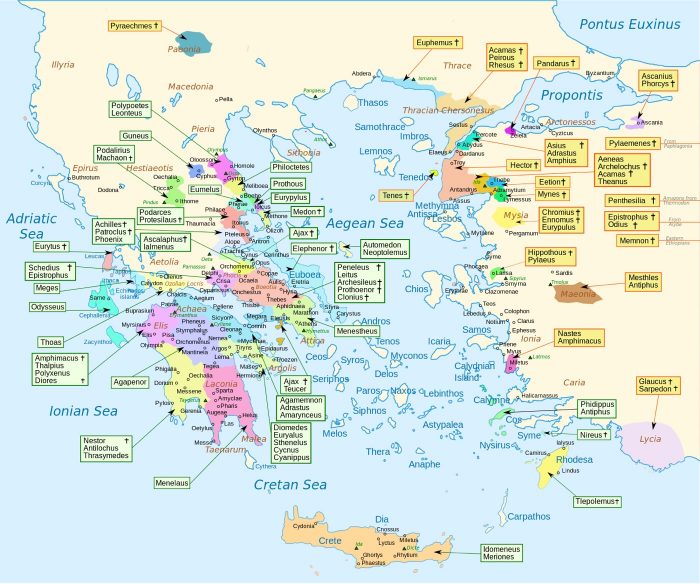
You’ve adjusted to the strangeness of names like Ascalaphus and Phidippus. You’ve more or less figured out who’s on which side in the ancient war between Greece and Troy. But as literary epics will do—from the ancient Greeks and Indians to the 19th century Russians—Homer’s Iliad also presents you with several logistical puzzles you must either ignore or spend countless hours trying to solve: you are given the names of major and minor characters’ hometowns, ranging all over the Adriatic, Ionian, Cretan, and Aegean Seas. Doubtless you have no idea where most of these places were.
Again and again, place names occur in rapid succession, and you’re told not only who hails from where, but who commands and conquers which city. Just a smattering of examples from Book II (in Samuel Butler’s translation):
Ulysses led the brave Cephallenians, who held Ithaca, Neritum with its forests, Crocylea, rugged Aegilips, Samos and Zacynthus, with the mainland also that was over against the islands.
Thoas, son of Andraemon, commanded the Aetolians, who dwelt in Pleuron, Olenus, Pylene, Chalcis by the sea, and rocky Calydon,
And those that held Pherae by the Boebean lake, with Boebe, Glaphyrae, and the populous city of Iolcus
“Huh,” you say, “Okay, Homer, I’ll take your word for it.” Questions of historicity aside, we can at least say that the hundreds of cities and towns mentioned in this culturally formative text did exist, or continue to do so, though it’s debatable, as Jason Kottke writes, whether “that level of mobility was accurate for the time [somewhere in the 11th or 12th century BC] or if Homer simply populated his poem with folks from all over Greece as a way of making listeners from many areas feel connected to the story.”
In any case, you need not despair of ever making sense of Homer’s bewildering geographical lists. The map above (click here to see it in a larger format) handily illustrates the world of the Iliad, showing the places of origins of a few dozen characters, with Greeks in green and Trojans in yellow. Kottke notes in an addendum to his post that “not every character is represented… (particularly the women) and… some of the locations and hometowns are incorrect.” We would welcome corrections—as would Wikipedia—if an enterprising classics scholar has the time and energy to devote to such an effort.
But for the lay reader of Homer’s epic, the map more than suffices as helpful visual context for a very complicated narrative. One defining feature of a war epic well-told, most critics would say, is that the human drama does not get lost in the scale and scope of the action. More than any other form, the epic illustrates what Tolstoy described in War and Peace as the “historical sense” that our conflicts are “bound up with the whole course of history and preordained from all eternity.” But against this kind of determinism, the great poets particularize, making their characters seem not like props in a cosmic drama but like actual people from actual places on earth. Seeing the Iliad mapped above reinforces our sense of the Greek epics as genuine—if fantastical—accounts of meaningful human action in the world.
You can find free versions of the Iliad and the Odyssey in our collection of Free eBooks and Free Audio Books.
Nice guys, so they say, finish last. Many of us might instinctively label such a worldview “Machiavellian,” partially for good reason and partially not. It stands as a testament to the insights of the Renaissance-era Florentine political philosopher Niccolò Machiavelli, expressed with great clarity and succinctness in his books The Prince and the Discourses on Livy, not just that his name became an adjective, but that it became one that remains in wide use nearly 500 years after his death. But like other such terms — “Kafkaesque” and “Orwellian” come to mind — its modern usage tends to come detached from its namesake writer’s original ideas.
So what did Machiavelli actually have to say to humanity? “Machiavelli’s Advice for Nice Guys,” a new animated video from Alain de Botton’s School of Life, highlights the core insight of his work: “that the wicked tend to win. And they do so because they have a huge advantage over the good: they are willing to act with the darkest ingenuity and cunning to further their cause. They are not held back by those rigid opponents of change: principles.
They will be prepared to outright lie, twist facts, threaten or get violent. They will also – when the situation demands it – know how to seductively deceive, use charm and honeyed words, bedazzle and distract. And in this way, they conquer the world.”
This line of thinking, put in such stark terms, can make Machiavelli seem like an offputtingly harsh (if quite intelligent) character. But his writing is more nuanced: he advocates not using flat-out lies and violence to achieve one’s ends, but indeed to be nice — just “never to be overly devoted to acting nicely,” an attitude he thought the West’s popular readings of the story of Jesus of Nazareth too often advocated — while always knowing “how to borrow – when need be – every single trick employed by the most cynical, dastardly, unscrupulous and nastiest people who have ever lived.” Nice guys, in short, have no choice but to learn from their enemies.
You can learn more about the sometimes harrowing experiences that taught Machiavelli all this in the School of Life’s introduction to his political theory just above. He reckoned, more memorably than any other, “the price of dealing with the world as it is, and not as we feel it should be. The world has continued to love and hate Machiavelli in equal measure for insisting on this uncomfortable truth.” Machiavelli, as Salman Rushdie put it in a clip we featured a few years ago, lived in a time when Italy’s ruling families behaved “in the most ruthless way, and he wrote this little treatise about not what he would like things to be like, but how power actually works, which he observed.” Rushdie calls the negative associations with the philosopher’s name “a classic case of shooting the messenger” — something, alas, even the most good-intentioned ruler may find himself forced to do once in a while.
We're hoping to rely on loyal readers, rather than erratic ads. Please click the Donate button and support Open Culture. You can use Paypal, Venmo, Patreon, even Crypto! We thank you!
Open Culture scours the web for the best educational media. We find the free courses and audio books you need, the language lessons & educational videos you want, and plenty of enlightenment in between.