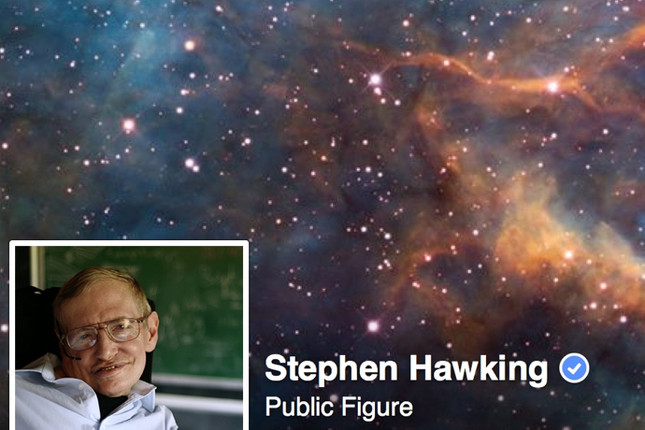
I have no idea whether there’s intelligent life out there in the universe. But we can at least confirm that there’s a little intelligent life on Facebook, seeing that Stephen Hawking, the world’s best known theoretical physicist, began posting there yesterday. His first status update reads:
I have always wondered what makes the universe exist. Time and space may forever be a mystery, but that has not stopped my pursuit. Our connections to one another have grown infinitely and now that I have the chance, I’m eager to share this journey with you. Be curious, I know I will forever be.
Welcome, and thank you for visiting my Facebook Page. ‑SH
The New York Times writes: “Ever since [we] published the Scientific 7‑Minute Workout in May last year, readers have been writing and tweeting their requests for an updated, more advanced version. For them, the workout became too easy or humdrum, as tends to happen when exercises are repeated without variation. So here it is: a new, more technically demanding regimen, one that requires a couple of dumbbells but still takes only seven minutes.”
According to the Times, these short, intense, efficient workouts strengthen muscle groups throughout the upper body, lower body and torso. And they may well “produce greater gains than an hour or more of gentler exercise.” So if you don’t have a lot of free time.…
The Times has notably made the workout available as a free web app that you can access on your phone, tablet or other mobile devices. The app “offers a step-by-step guide to both 7‑minute workouts [the old and new ones], offering animated illustrations of the exercises, as well as a timer and audio cues to help you get the most out of your seven minutes.” Click here to access it.
When Stanley Kubrick was a mere high school student in April 1945, just after FDR died, he snapped a picture of a news vendor framed on either side by posters announcing the president’s death. He was so excited by the picture that he skipped school to develop it and then marched right into the office of Look magazine. Photo editor Helen O’Brian offered to buy the photo for $25. Displaying his trademark cockiness, Kubrick told her that he wanted to see what price he could get from The New York DailyNews. They only offered $10, so Kubrick went with Look. Within a few months, at the age of 17, Kubrick became a staff photographer for the publication.
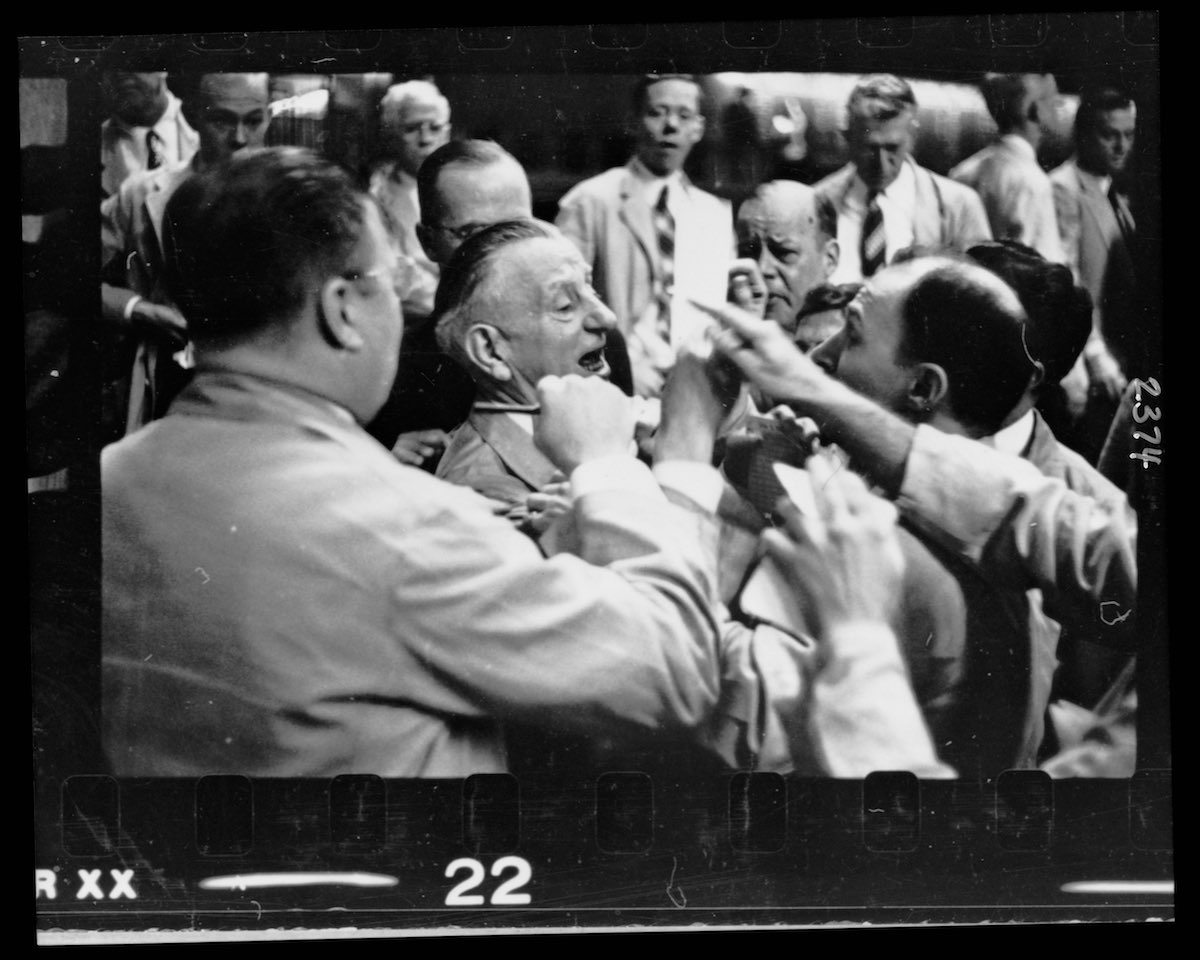
Below you can see some photographs that Kubrick took in 1949 while on assignment in Chicago. Using the same noirish high-contrast, low-light look that marked his first three movies, he documented all different strata of society from floor traders, to lingerie models, to meat packers to impoverished African-American families. Click on the images to view them in a larger format. Find a more extensive gallery of images here. To take a closer look at Kubrick’s photography, see the 2018 Taschen book Stanley Kubrick Photographs: Through a Different Lens and also Stanley Kubrick: Drama & Shadows.
Men working the floor at the Chicago Board of Trade
Lingerie model, wearing a girdle and strapless bra, smoking in an office; in the background a woman sits at a desk
Butcher holding slab of beef in a meat locker
African American mother and her four children in their tenement apartment
Jonathan Crow is a Los Angeles-based writer and filmmaker whose work has appeared in Yahoo!, The Hollywood Reporter, and other publications. You can follow him at @jonccrow. And check out his blog Veeptopus, featuring lots of pictures of vice presidents with octopuses on their heads. The Veeptopus store is here.
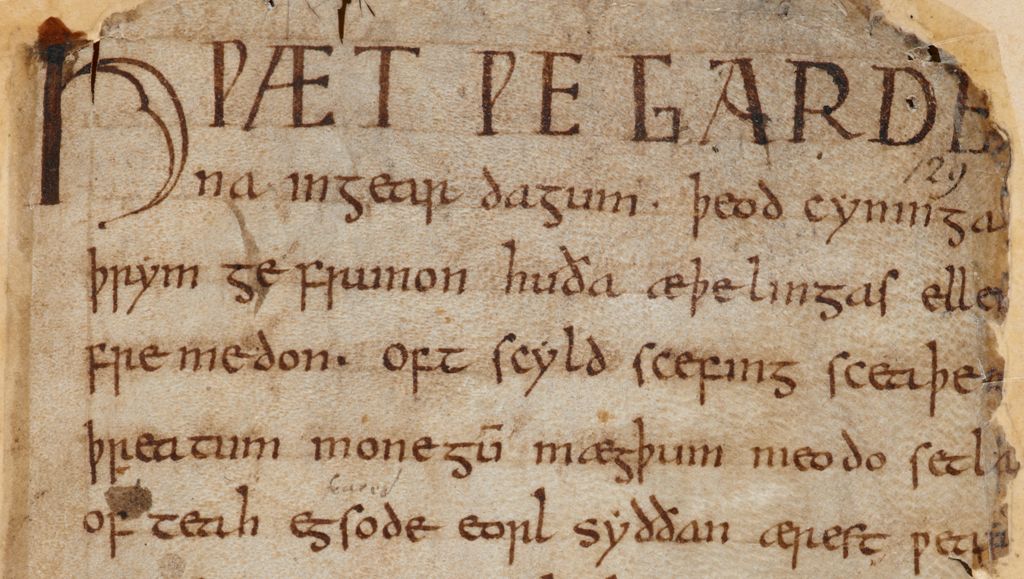
I was as surprised as most people are when I first heard the ancient language known as Old English. It’s nothing like Shakespeare, nor even Chaucer, who wrote in a late Middle English that sounds strange enough to modern ears. Old English, the English of Beowulf, is almost a foreign tongue; close kin to German, with Latin, Norse, and Celtic influence.
As you can hear in the Beowulf reading above from The Telegraph, it’s a thick, consonant-rich language that may put you in mind of J.R.R. Tolkien’s elvish. The language arrived in Briton—previously inhabited by Celtic speakers—sometime in the fifth century, though whether the Anglo-Saxon invasion was a hostile takeover by Germanic mercenaries or a slow population drift that introduced a new ethnicity is a matter of some dispute. Nevertheless it’s obvious from the reading above—and from texts in the language like this online edition of Beowulf in its original tongue—that we would no more be able to speak to the Anglo-Saxons than we would to the Picts and Scots they conquered.
So how is it that both the language we speak and its distant ancestor can both be called “English”? Well, that is what its speakers called it. As the author of this excellent Old English introductory textbook writes, speakers of “Old English,” “Middle English,” and “Modern English” are “themselves modern”; They “would have said, if asked, that the language they spoke was English.” The changes in the language “took place gradually, over the centuries, and there never was a time when people perceived their language as having broken radically with the language spoken a generation before.” And while “relatively few Modern English words come from Old English […] the words that do survive are some of the most common in the language, including almost all the ‘grammar words’ (articles, pronouns, prepositions) and a great many words for everyday concepts.” You may notice a few of those distant linguistic ancestors in the Beowulf passage accompanying the reading above.
Beowulf is, of course, the oldest epic poem in English, written sometime between the 8th and early 11th century. It draws, however, not from British sources but from Danish myth, and is in fact set in Scandinavia. The title character, a hero of the Geats—or ancient Swedes—travels to Denmark to offer his services to the king and defeat the monster Grendel (and his mother). The product of a warrior culture, the poem shares much in common with the epics of Homer with its code of honor and praise of fighting prowess. And here see vocalist, harpist, and medieval scholar Benjamin Bagby perform the opening lines of the poem as its contemporary audience would have experienced it—intoned by a bard with an Anglo-Saxon harp. The modern English subtitles are a boon, but close your eyes for a moment and just listen to the speech—see if you can pick out any words you recognize. Then, perhaps, you may wish to turn to Fordham University’s online translation and find out what all that big talk in the prologue is about.
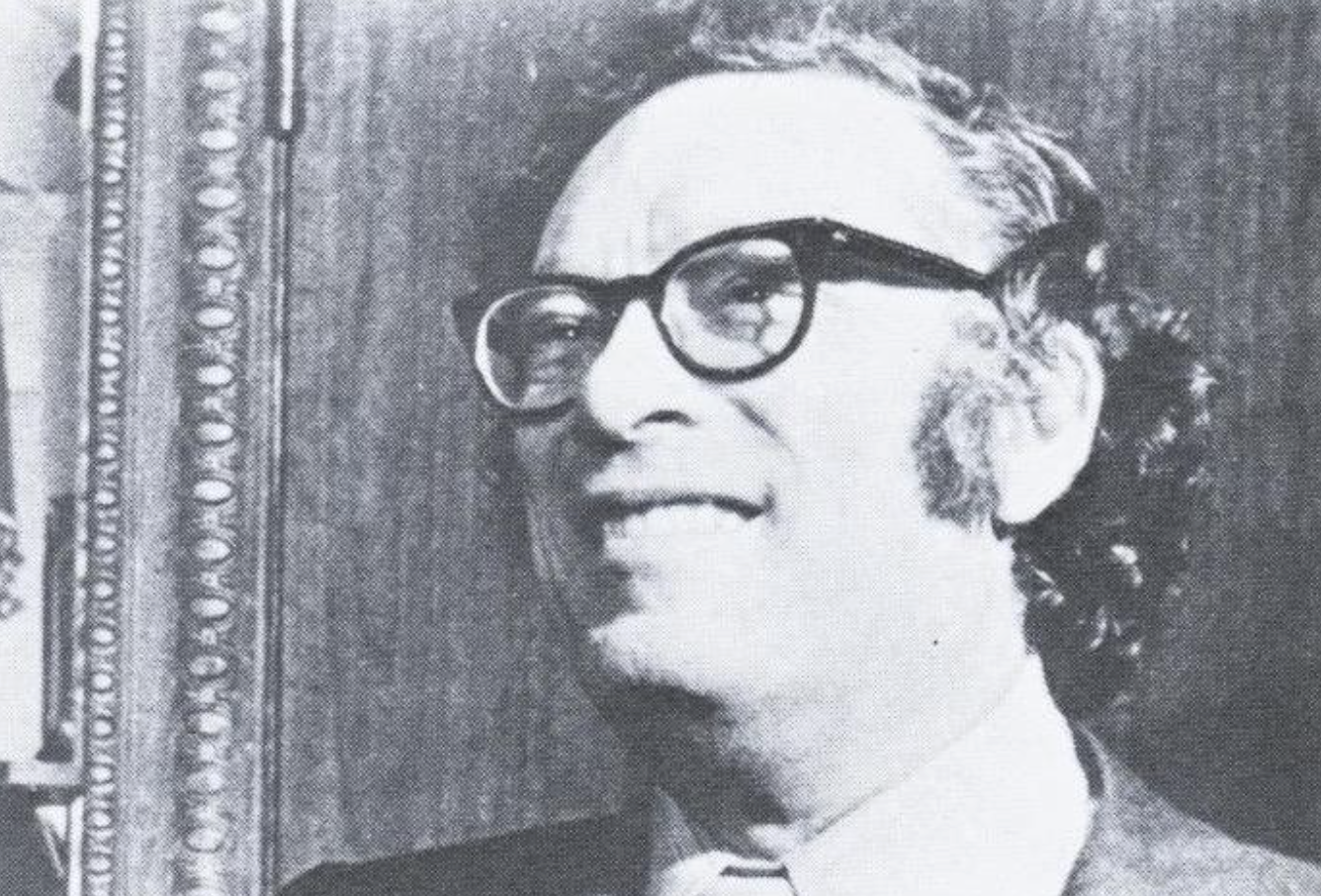
Where do ideas come from? The question has always had the potential to plague anyone trying to do anything worthwhile at any time in human history. But Isaac Asimov, the massively prolific and even more massively influential writer of science fiction and science fact, had an answer. He even, in one 1959 essay, laid out a method, though we, the general public, haven’t had the chance to read it until now. The MIT Technology Review has just published his essay on creativity in full, while providing a few contextualizing remarks from the author’s friend Arthur Obermayer, a scientist who invited Asimov on board an “out of the box” missile-defense research project at an MIT spinoff called Allied Research Associates.
“He expressed his willingness and came to a few meetings,” remembers Obermayer, but “he eventually decided not to continue, because he did not want to have access to any secret classified information; it would limit his freedom of expression. Before he left, however, he wrote this essay on creativity as his single formal input.” When Obermayer found it among his old files, he “recognized that its contents are as broadly relevant today as when [Asimov] wrote it” in 1959, describing as they do “not only the creative process and the nature of creative people but also the kind of environment that promotes creativity.” Whether you write sci-fi novels or do military research, make a web series, or work on curing Ebola, you can put Asimov’s methods to use.
Asimov first investigates the origin of ideas by looking to The Origin of Species. Or rather, he looks to what you find within it, “the theory of evolution by natural selection, independently created by Charles Darwin and Alfred Wallace,” two men who “both traveled to far places, observing strange species of plants and animals and the manner in which they varied from place to place,” both “keenly interested in finding an explanation for this,” and both of whom “failed until each happened to read Malthus’s ‘Essay on Population.’ ” He finds that “what is needed is not only people with a good background in a particular field, but also people capable of making a connection between item 1 and item 2 which might not ordinarily seem connected.” Evolutionary theory seems obvious only in retrospect, he continues, as
The history of human thought would make it seem that there is difficulty in thinking of an idea even when all the facts are on the table. Making the cross-connection requires a certain daring. It must, for any cross-connection that does not require daring is performed at once by many and develops not as a “new idea,” but as a mere “corollary of an old idea.”
It is only afterward that a new idea seems reasonable. To begin with, it usually seems unreasonable. It seems the height of unreason to suppose the earth was round instead of flat, or that it moved instead of the sun, or that objects required a force to stop them when in motion, instead of a force to keep them moving, and so on.
A person willing to fly in the face of reason, authority, and common sense must be a person of considerable self-assurance. Since he occurs only rarely, he must seem eccentric (in at least that respect) to the rest of us. A person eccentric in one respect is often eccentric in others.
Consequently, the person who is most likely to get new ideas is a person of good background in the field of interest and one who is unconventional in his habits. (To be a crackpot is not, however, enough in itself.)
Once you have the people you want, the next question is: Do you want to bring them together so that they may discuss the problem mutually, or should you inform each of the problem and allow them to work in isolation?
The essay puts forth an argument for isolation (“Creation is embarrassing. For every new good idea you have, there are a hundred, ten thousand foolish ones, which you naturally do not care to display”) and a set of best practices for group idea generation, as implementable in the Allied Research Associates of the 1950s as in any organization today. If you can’t trust Asimov on this subject, I don’t know who you can trust, but consider supplementing this newfound essay with Ze Frank’s thematically related video “Brain Crack” (linguistically NSFW, though you can watch the PG version instead), which deals, in an entirely different sensibility, with the question of where ideas come from:
Apparently, the bad part about scoring an interview with the President is it kind of makes you blasé for sitting down with anybody else. Not that Zach Galifianakis of Between Two Ferns deserved his tete-a-tete with Obama, or for that matter Bart Pit … Bradley Pitts … Brad Pitt, star of 2013’s 12 Years a Salve(sic).
Yes, this interviewer is petty, combative, and utterly lacking in grace, but his interviewee, the celebrity who turns stone-faced and sullen almost immediately is no prize either.
Everyone’s miserable, even comedian Louis CK, whom Galifianakis summons with a few bars of his popular sitcom’s theme song. Moods seem on the verge of lifting when Galifianakis brings up Pitts’ starring role in “Benjamin Buttons,” but it doesn’t last. Inevitably, there are references to Pitt’s famous wife, as well as his ex, an earlier Between Two Ferns guest. (She’s no Tila Tequila…)
This is a different dynamic than the one Borat shared with certain incredulous, intelligent subjects. It’s a given that Pitt’s in on the joke. And it would seem that both gentlemen have something they’d like to get across regarding the dirty business of celebrity interviews.
The game is you listen politely while they plug their film, bang on about their ‘method’, the brilliance of their co-stars and directors etc. Then in return you hope they will offer up — without you having to prod and pester like some celebrity stalker — the tiniest nugget of anecdote, a shard of light upon their real selves.
Because they hate the game too, and particularly since it is mainly conducted in hotel suites, you feel as if you’re engaged in an odd form of prostitution, one where it remains unclear who is the hooker and who the john.
Her perspective brings a certain purity to the Galifianakis-Pitt Ferns stand-off. Certainly, neither of them is playing the game.
If you want to learn how to conduct a horrible interview, watch Galifianakis.
If you want tips on how to make it worse, watch Pitt.
And if you want to be a movie star, seek ways to laugh at yourself without breaking character.
When it comes to matters of broad scientific consensus, I’m generally inclined to offer provisional assent. Like everyone else, I have to rely on the expertise of others in matters outside my ken, and in many cases, this rational appeal to authority is the best one can do without acquiring the relevant qualifications and years of experience in highly specialized scientific fields. In the case of evolution, I happen to find the evidence and explanations nearly all biologists proffer much more persuasive than the claims—and accusations—of their mostly unscientific critics. But as we know from recent survey data, a very large percentage of Americans reject the theory of evolution, at least when it comes to humans, though it’s likely a great many of them—like myself—do not know very much about it.
But as a layperson with an admittedly rudimentary science education, I’m always grateful for clear, simple explanations of complex ideas. This is precisely what we get in the video series Stated Clearly, which harnesses the power of web animation as an instructional tool to define what the theory of evolution is, and why it explains the observable facts better than anything else. Stated Clearly’s tagline is “science is for everyone,” and indeed, their mission “is simple”: “to promote the art of critical thinking by exposing people from all walks of life, to the simple beauty of science.” The video at the top gives us a broad overview of the theory of evolution. The animation just above presents the evidence for evolution, or some of it anyway, in clear, compelling terms, drawing from at least two of the many independent lines of evidence. And below, we have a Stated Clearly take on natural selection, an absolutely key concept of evolutionary biology, and one regularly misunderstood.
After watching these three shorts, you might agree that what is “often considered a complex and controversial topic” is “actually a very simple concept to understand.” In layman’s terms, at least. In fact, artist, narrator, and creator of the series, Jon Perry, admits that he himself has no formal scientific training. “He believed,” his bio states, “that if he could create just one good animation on his own, scientists and educators would realize the potential of this project and help him create more.” And indeed they have. Stated Clearly has a distinguished panel of science advisers and partners that include the Center for Chemical Evolution, Emory University, Georgia Tech, NASA, and the National Science Foundation. Learn much more about Stated Clearly’s goals and affiliations, or lack thereof, at their website. And below, see the fourth video of the series, “Does the Theory of Evolution Really Matter?,” which addresses the practical, real world implications of evolutionary theory, and scientific literacy.
We cannot properly speak of horror fiction without mentioning the name H.P. Lovecraft, any more than we could do so without speaking of Edgar Allan Poe, whose complete works we featured in a post yesterday. Even now, as some of Lovecraft’s really vicious attitudes have come in for much critical reappraisal, the Lovecraftian is still a dominant form. Winners of the World Fantasy Award receive a bust of the author, and dark modern masters like Stephen King and Joyce Carol Oates admit that Lovecraft was “the twentieth century’s greatest practitioner of the classic horror tale” and “an incalculable influence on succeeding generations of writers of horror fiction.” His work, writesSalon, has influenced “everyone from the Argentinian metafictionist Jorge Luis Borges to the film director Guillermo del Toro, as well as untold number of rock bands and game designers.”
The early twentieth century author spent almost his entire life in the New England of his birth, drawing on its many oddities in obscure stories published in pulp magazines—notably the influential Weird Tales. Hypochondriac, hyper-sensitive, and reclusive in later life, Lovecraft survived on a dwindling inheritance and never achieved much recognition. But in death, he has spawned a formidable cult who immerse themselves in a universe created from references to the occult, demonology, and various mythological archetypes. However overwrought his prose, Lovecraft’s work can be situated in a long literary tradition of influence, and a Lovecraft circle continued to expand his vision of scientific and supernatural horror after his death.
Central to the Lovecraft cosmos are “The Old Ones,” a collection of powerful primordial beings, and their cult worshipers, first introduced in “The Call of Cthulhu” in 1926. At the top of the post, you can hear a dramatic reading of the story by Garrick Hagon. Just above hear a radio dramatization of “The Colour Out of Space,” which was collected in The Best American Short Stories in 1928, one of the few of Lovecraft’s works to receive such an honor in his lifetime. You’ll find much more Lovecraft read aloud on YouTube, including classic stories like “The Dunwich Horror,” “At The Mountains of Madness,” and “The Horror at Red Hook.”
Listening to Lovecraft is an excellent, as well as convenient, way to experience his work. His florid, often archaic, and melodramatic descriptions lend themselves perfectly to aural interpretations. Luckily for us, we have not one, but two audio book collections of nearly everything Lovecraft ever wrote. Just above, stream his complete public domain works, and see the Internet Archive for another audiobook set of his collected works. One of the reasons audio of Lovecraft is so plentiful is that most of his work is in the commons. SFF Audio has yet another huge collection of Lovecraft stories read aloud, downloadable as MP3s. Finally, if you somehow can’t find what you’re looking for at any of those links, you’re bound to at The World’s Largest H.P. Lovecraft Audio Links Gateway.
Should listening to Lovecraft whet your appetite for more, you may just be ready to start reading. Although Lovecraft’s fiction features what may be some of modern literature’s most dreadful monsters, the horror in his work is mostly existential, as characters confront a vast, malevolent and thoroughly alien universe that has no regard for human life whatsoever. But the persistent bleakness and doom of his vision is countered by an inexhaustibly rich imagination. In one of the opening sentences of “The Call of Cthulu,” Lovecraft writes, “the most merciful thing in the world, I think, is the inability of the human mind to correlate all its contents,” perhaps the truest description of his own fictional cosmos. Lovecraft scholars and fans spend lifetimes sifting through his massive storehouse of weirdness. Whether you’re inclined to join them in the deep end, or just dip in a toe, you can find all of Lovecraft’s published work in various forms at the locations below.
Given these resources, you should have no trouble becoming a Lovecraft expert by Halloween. Or, at the very least, picking out a few of his scariest stories to listen to and read aloud around a flickering jack o’ lantern or your collection of Cthulhu figurines.
Morgan Spurlock is a filmmaker who has long found catchy ways of getting his point across. For his breakout movie, Super Size Me(available on Hulu), he sought to illustrate just how truly awful fast food is for you by subsisting solely on McDonald’s for a month. His diet literally almost killed him. Not long after the movie came out, McDonald’s started adding more healthy options to its menu. In POM Wonderful Presents: The Greatest Movie Ever Sold, Spurlock looked to make a documentary about product placement in movies by financing the doc entirely through product placement. (That movie gets pretty meta fast.)
And most recently, Spurlock has launched We The Economy: 20 Short Films You Can’t Afford To Miss. As you might surmise, the series tries to explain economics to the masses by releasing 20 short films made by a host of different stars and filmmakers, including Amy Poehler, Tony Hale, Sarah Silverman and Maya. The whole project will be released in theaters and on VOD but the shorts have also been released in advance on Youtube. You can watch Spurlock’s segment, called “Cave-o-nomics,” above. Seeking to answer the question “What is an economy?” Spurlock dresses up as a caveman struggling to increase his material wealth by swapping spears for meat.
The clear stand out of the bunch, however, is Ramin Bahrani’s “Lemonade War.” Bahami tackles the potentially dreary issue of business regulation by telling a tale of two rival lemonade stands. One is run by a corrupt slob – played by Patton Oswalt — and the other is run by a whip smart ten-year-old girl. Though the girl doesn’t have the money or connections that her rival has, she more than makes up for it with moxie and business acumen. This, sadly, proves to be not enough. When she calls the government regulator about some of her rival’s truly unhygienic practices, she discovers the regulator is in her competition’s pocket and soon she’s driven out of business. Things look hopeless for her until a neighborhood hero, played by none other than Werner Herzog (!), comes to her rescue. With the little girl in tow, he confronts the slob and regulator with his trademark malevolent Teutonic lilt. “If Mr. Smith could go to Washington today,” he declares, “he would filibuster you back into your big bang wormhole you have slithered out of.” The two simply cower in the face of Herzog’s Old Testament wrath. If only Herzog could deliver similar fusillades against the board of Goldman Sachs.
Jonathan Crow is a Los Angeles-based writer and filmmaker whose work has appeared in Yahoo!, The Hollywood Reporter, and other publications. You can follow him at @jonccrow. And check out his blog Veeptopus, featuring lots of pictures of vice presidents with octopuses on their heads. The Veeptopus store is here.
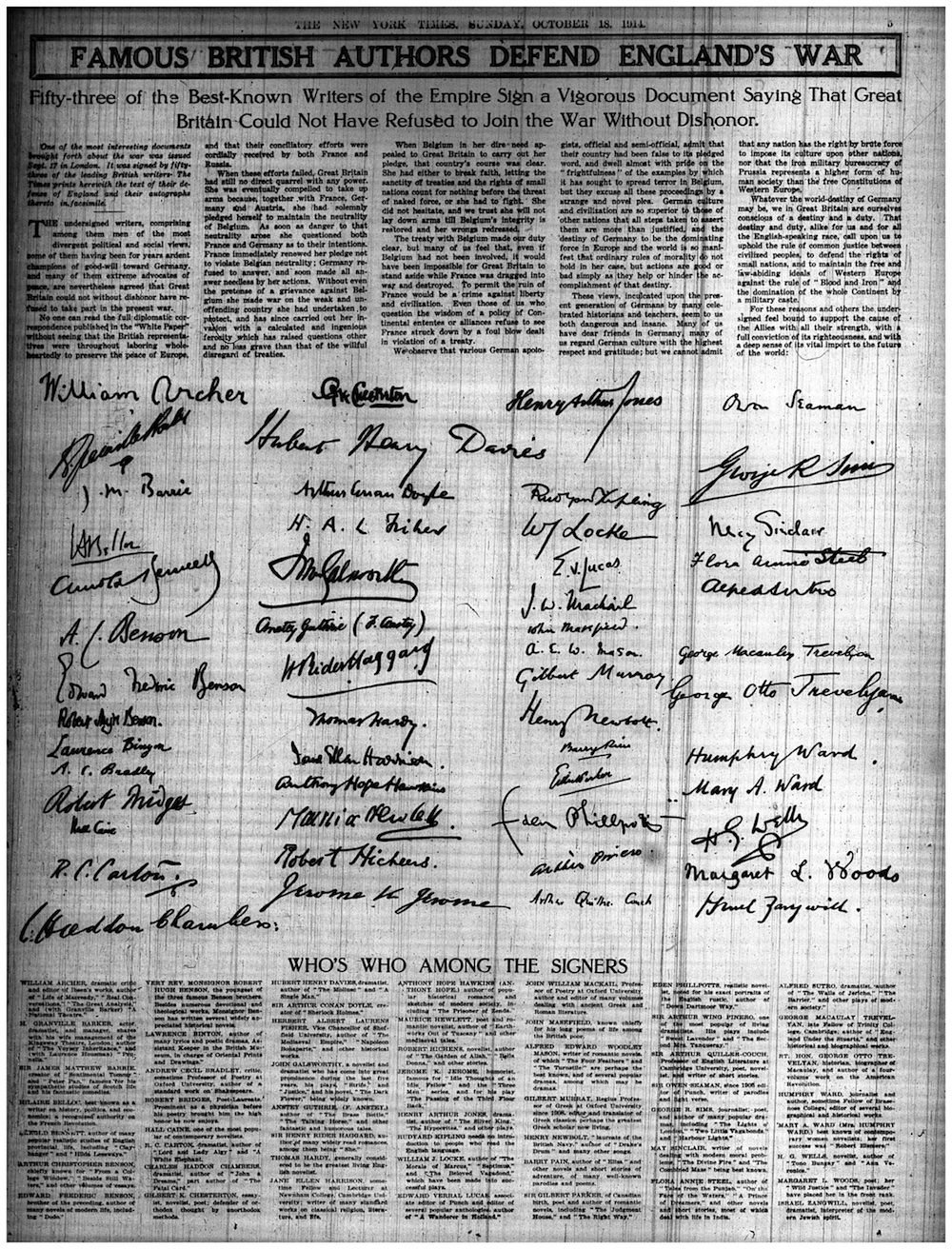
Thinkers have said a great deal about the relative might of the pen and the sword—often one well-known phrase in particular—but still, the subject of intellect versus might remains a matter of active inquiry. But what if might harnesses intellect? What if those who live by the pen pick up their writing tool of choice to endorse the national use of weaponry infinitely more powerful than all the swords ever forged? This very thing happened in the Britain of 1914: “FAMOUS AUTHORS DEFEND ENGLAND’S WAR,” read the headlines, and University of Ottawa English professor Nick Milne has more historical analysis of the event in the first post of “Pen and Sword,” a series focusing on British Propaganda at the open educational resource World War I Centenary: Continuations and Beginnings.
“In September of 1914,” writes Milne in a version of the post up at Slate, “as the armies of Europe were engaged in the Race to the Sea and the stalemate of the trenches loomed, Rudyard Kipling, Sir Arthur Conan Doyle, and other British authors collaborated on a remarkable piece of war propaganda. Fifty-three of the leading authors in Britain — a number that included Thomas Hardy and H.G. Wells — appended their names to the ‘Authors’ Declaration.’ This manifesto declared that the German invasion of Belgium had been a brutal crime, and that Britain ‘could not without dishonour have refused to take part in the present war.’ ” Other men of letters the War Propaganda Bureau could convince to sign on, in addition to Kipling, a fellow rarely called insufficiently patriotic, included “defender of unorthodox thought by unorthodox methods” G.K. Chesterton.
You can take a close-up look at the complete list of signatories with their brief bios, as well as the signatures themselves, by clicking at the image of the New York Times page up above. (Then click again to zoom in.) England may not, in the event, have lost the First World War, but the buoyancy its writers provided its fighting spirit had little to do with it. Germany “responded to the declaration by bringing together an even larger assortment of artists, authors, and scientists to sign the Manifesto of the Ninety-Three, an astounding document which denied any German wrongdoing in Belgium and bewilderingly accused the Allies of ‘inciting Mongolians and negroes against the white race.’ ”
Several of the British writers involved, most notably H.G. Wells, eventually developed a public cynicism toward the war. “The unity of vision and purpose the declaration so strongly implied,” as Milne mildly puts it, “did not endure.”
If you’re in the UK, get ready for Kubrick’s 2001: A Space Odyssey. 46 years after its original release, it’s returning to theatres near you in a digitally-restored format, starting on November 18. (Find dates and locations here.) To celebrate the re-release of this “philosophically ambitious, technically innovative and visually stunning cinematic milestone,” the British Film Institute has created a new trailer (above). Down below, we have the original 1968 trailer (which I prefer) and some good background items on the film itself.
We're hoping to rely on loyal readers, rather than erratic ads. Please click the Donate button and support Open Culture. You can use Paypal, Venmo, Patreon, even Crypto! We thank you!
Open Culture scours the web for the best educational media. We find the free courses and audio books you need, the language lessons & educational videos you want, and plenty of enlightenment in between.