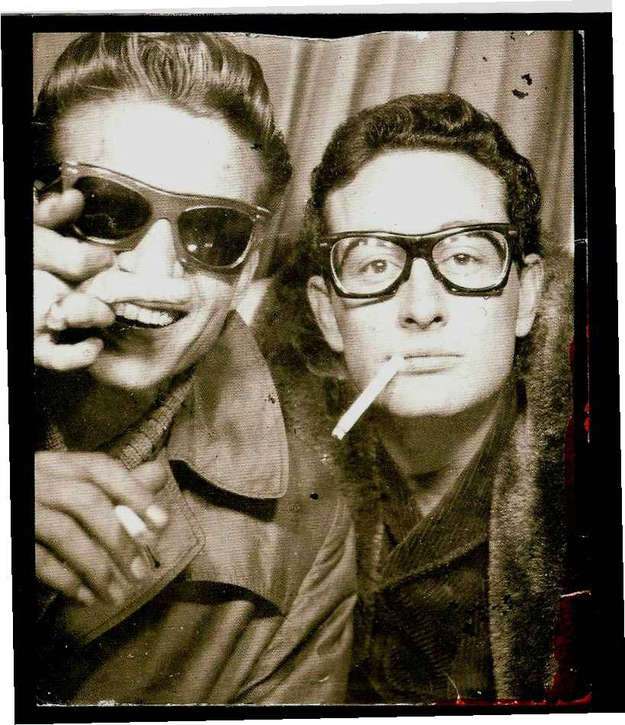
Two Texans, Buddy Holly and Waylon Jennings, met in a restaurant in Lubbock when they were teenagers. Holly took the younger Jennings under his wing: He played guitar on Jenning’s first recording session in 1958. That same year, they collaborated on the song, “You’re the One.” And, in late January 1959, Holly began a three-week tour across the Midwest — dubbed the “Winter Dance Party” — and had Jennings play bass in his band. Before they left, the two posed for a picture in a photo booth at Grand Central Station in New York City.
The “Winter Dance Party” would end in tragedy when Holly climbed aboard a charter plane that crashed near Clear Lake, Iowa on February 3, 1959. Jennings got bumped from the flight, getting a chance to live beyond the Day the Music Died.
If you would like to support the mission of Open Culture, consider making a donation to our site. It’s hard to rely 100% on ads, and your contributions will help us continue providing the best free cultural and educational materials to learners everywhere. You can contribute through PayPal, Patreon, and Venmo (@openculture). Thanks!
A mild-looking barber slices into his morning loaf of bread to find a human nose embedded within. You might imagine this image opening the next David Lynch movie, but it actually sets up a more lighthearted, much older, and much more Russian story: Nikolai Gogol’s “The Nose.” (Find it in our Free eBooks and Free Audio Books collections.) The story soon introduces us to the man to whom the nose belongs, a government official who wakes to find nothing but a smooth patch of flesh in the middle of his face. The quest to reclaim his nose takes him to the architecturally imposing, column-intensive hall in which he works, where he finds that the organ through which he once breathed has not only grown a body of its own, but already risen above him in the ranks of the civil service. To find out how this increasingly bizarre, dreamlike scenario resolves itself, you can either read Gogol’s story in the English translation free in Project Gutenberg’s copy of the Gogol Collection The Mantle and Other Stories, or you can watch Alexander Alexeieff and Claire Parker’s 1963 short above, which adapts “The Nose” by means of something called pinscreen animation.
Ian Lumsden at Animation Blog describes Alexeieff and Parker’s particular method as a form of “shadow animation in effect whereby Alexander works on the positive side of a large black canvas full of pins and Claire on the negative side; the more the flat headed pins are pushed in the lighter is the effect, creating the look of mezzotint with its textured shades of grey.” Lumsden adds that he “can scarcely conceive of a more labour intensive form of animation particularly given that pins numbered in their hundreds of thousands are used.” Just try to pay close attention to some of the effects The Nose achieves and try not to wince at how demanding and painstaking an effort the animators, pushing these tiny pins in and out to adjust the visual textures just so, must have put forth to achieve them. Russian literary historian D.S. Mirsky calls the original story “a piece of sheer play, almost sheer nonsense,” where “more than anywhere else Gogol displays his extraordinary magic power of making great comic art out of nothing.” In these funny and dazzling but no doubt hard-won eleven minutes Alexeieff and Parker express that sheer play with the most intensive animating work possible.
In 2002, the elusive novelist Thomas Pynchon made two cameo appearances on The Simpsons. Of course, we didn’t actually get to see Pynchon. His cartoon depiction wore, rather humorously, a bag over his head. But, we did get to hear Pynchon’s voice. And apparently that, alone, was a first.
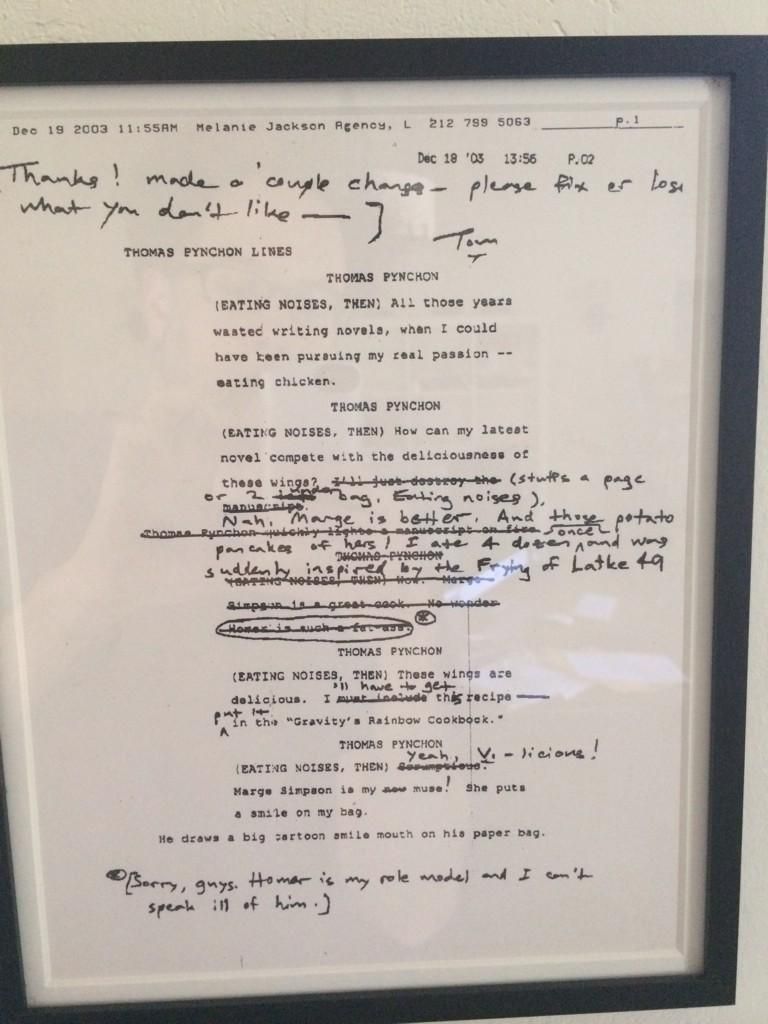
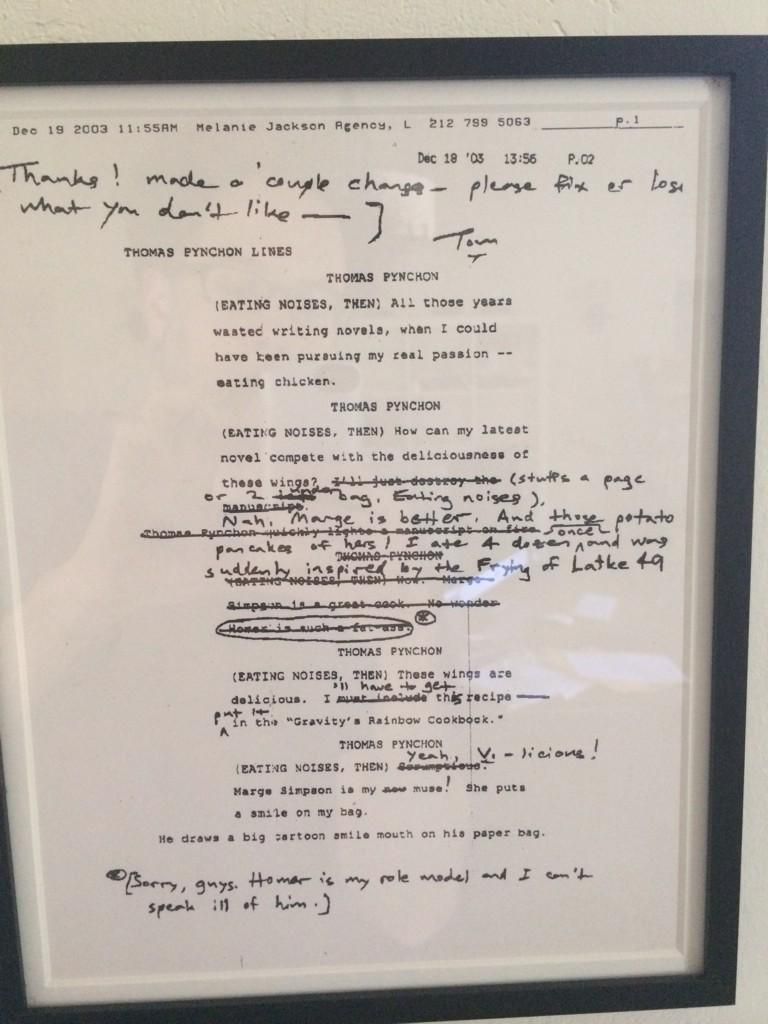
This past week, Matt Selman, an executive producer for The Simpsons, shed some more light on those playful cameos. On Twitter, he posted a copy of the script Pynchon edited and faxed back to the show’s writers. (Click on the image above to see it in a larger format.) In some cases, Pynchon, always the writer, tweaked the language to make it flow as he liked. In other cases, he added his own material to the script — new sound effects, jokes, and puns. (The word “Scrumptious” gets turned into Vi-licious.) And, in one case, he removed a joke. Deleting the words “No wonder Homer is such a fat ass,” Pynchon scrawled the comment: “Sorry, guys. Homer is my role model and I can’t speak ill of him.” Finally, Homer gets some respect.
Currently, 210 backers have pledged $13,419 towards the $20,000 he’s trying to raise. Above, Baba explains how the money will be spent. To move forward, the campaign needs to be fully funded by . We hope you’ll help push Baba over the top. You can make a contribution here.
1979 was a strange year in music. A year of endings, in a way. Sid Vicious died, Ozzy Osbourne left Black Sabbath… an old guard faded away. On the other hand, U2 went into the studio for their debut, Kate Bush went on her first tour, and new wave emerged from punk’s end. It was also the year, notably or not, that Berlin/New York cabaret performer Klaus Nomi broke, sort of. Nomi had been performing Wagner and Vaudeville in New York, and David Bowie, always on the make for unusual traveling companions, invited him to appear as a backup singer on Saturday Night Live. Bowie himself was in transition, leaving behind his high concept work with Brian Eno on his Berlin Trilogy (Low, ”Heroes,” and Lodger) and entering another high pop phase. It was an abrupt, but natural, shift for Bowie; tapping into Nomi’s art-pop affectations may have seemed a perfect way to bridge the two.
Bowie, Nomi, and flamboyant New York performance artist Joey Arias do three songs, reaching back to Bowie’s folkier times for “The Man Who Sold the World.” Bowie launches next into Station to Station’s “TVC 15” in a skirt and heels, while Nomi and Arias drag around a pink plastic poodle. For the last number, Lodger’s “When You’re a Boy,” Bowie perhaps invents the look of 80s new wave videos to come—from Peter Gabriel to the Pet Shop Boys—while wearing a life-size marionette costume. Some amazing mechanism, puppeteers offstage or Bowie himself, operates the oversized arms, and the whole thing takes SNL musical performances to a place they’d never been. Nomi was so impressed with the costuming that he adopted the huge plastic tuxedo Bowie wears during the first song as his own, wearing one on the cover of his first album and performing in it until his death from AIDS in 1983. The broadcast above took place on December 15, 1979.
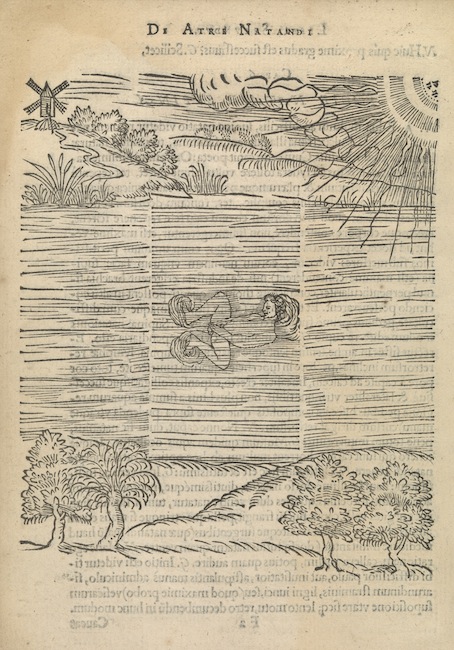
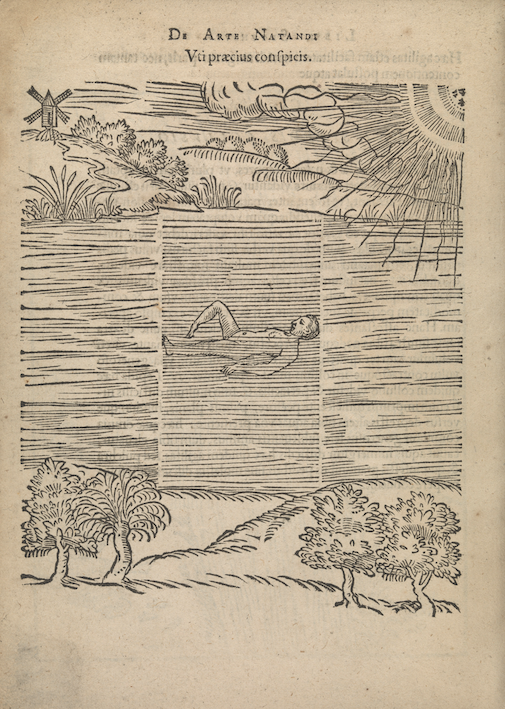
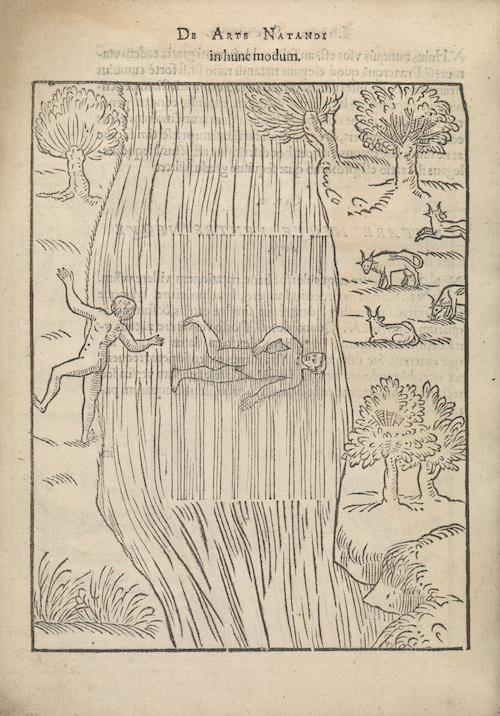
Or failing that, an extremely bow-legged man, as featured in Sir Everard Digby’s 1587 treatise-cum-manual, De Arte Natandi (The Art of Swimming). Hubba hubba, who needs trunks?
There were no pools at the time. The male bathers populating Digby’s 40 plus woodcut illustrations are river swimmers, like Ben Franklin, the inventor of swim fins and the only Founding Father to be inducted (posthumously) into the International Swimming Hall of Fame.
As Franklin would two centuries later, Digby sought to bring both water safety and proper form to the masses. According to the BBC’s History Magazine, the Cambridge Don’s goal was “to turn swimming from a disregarded skill of bargees and boatmen into an accomplishment for gentlemen, to make them more like the Romans.”
To get closer to his goal, Digby breaks it down as deftly as an online swim instructor in the era of youtube. When not delivering the how to’s on back stroke, side stroke, and doggy paddle, he’s advising absolute beginners on how to enter the water and steer clear of animal-befouled holes, and helping more seasoned students embellish their game with nifty tricks, (dancing, toenail cutting).
Ayun Halliday is an author, homeschooler, Chief Primatologist of the East Village Inky zine, and extremely enthusiastic swimmer. Follow her @AyunHalliday
She didn’t earn the posthumous sobriquet “Comedic Stiletto” from The New York Times for nothing. “Raspy loudmouth” comedian Joan Rivers inspired strong emotions and reliable bursts of controversy with her abrasive, take-no-prisoners style. Mastering insult comedy was a survival skill for the comic who took as much as she dished out while coming up in the aggressive, mostly male stand-up world. Before the late-night, fashion, and reality shows, autobiography and documentary, and stints on QVC, Rivers carved paths, paved ways, blazed trails, and left other pioneering marks for such masters of the put-down as Roseanne Barr, Sarah Silverman, and others who—as a 1965 NYT review painfully put it—overcame “the handicap of a woman comic.” Ham-fisted jabs from the press aside, Rivers said many times she never thought of herself particularly as a “woman comic,” and if that designation ever signified a “handicap” or some sort of gimmick it’s no wonder. She deserved better than to be patronized. Rivers was true to the craft, as every comic currently eulogizing her will tell you, and as she would tell us herself, at every opportunity, but perhaps never more earnestly than to Louis C.K. above in a clip from his show. C.K. is moved enough to put one of his signature moves on her. Rivers’ response? “Nobody likes necrophiliacs.” She will haunt us from the grave with her morbid, scalpel-like one-liners, may she rest in peace.
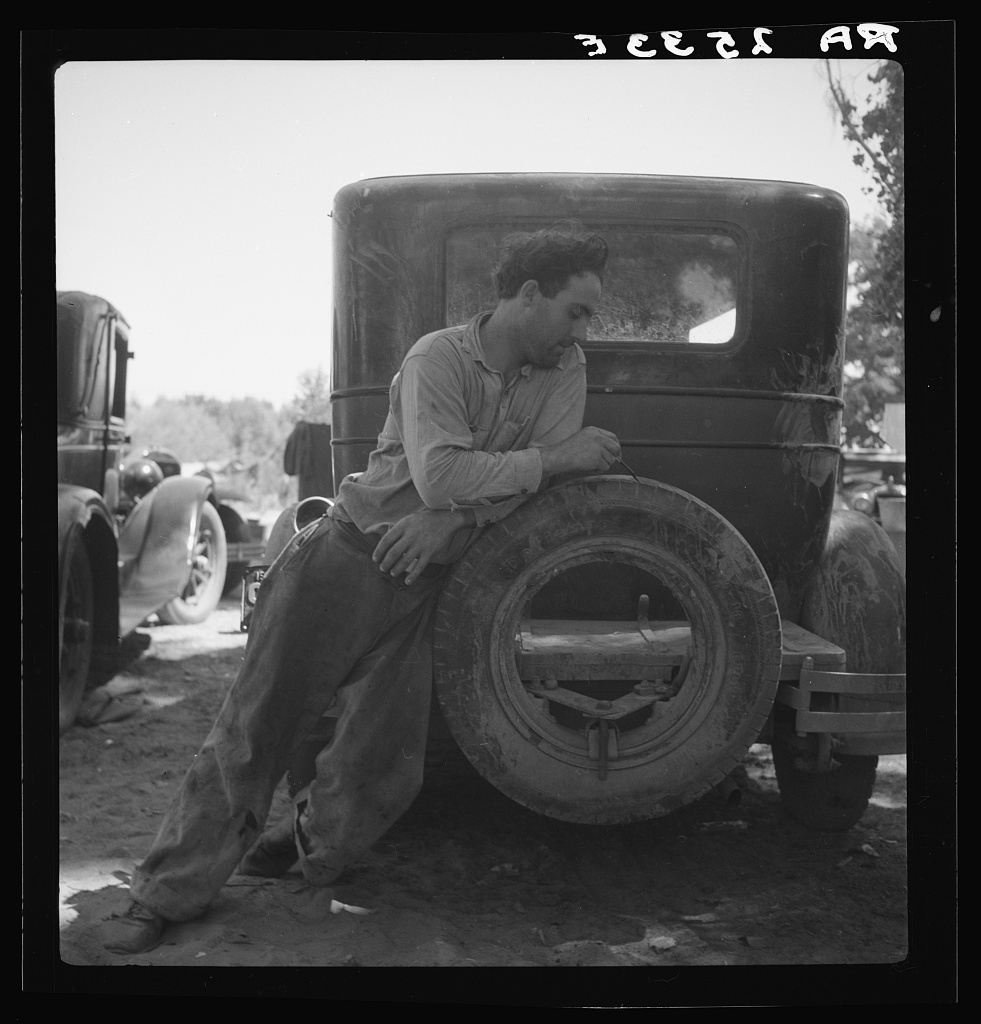
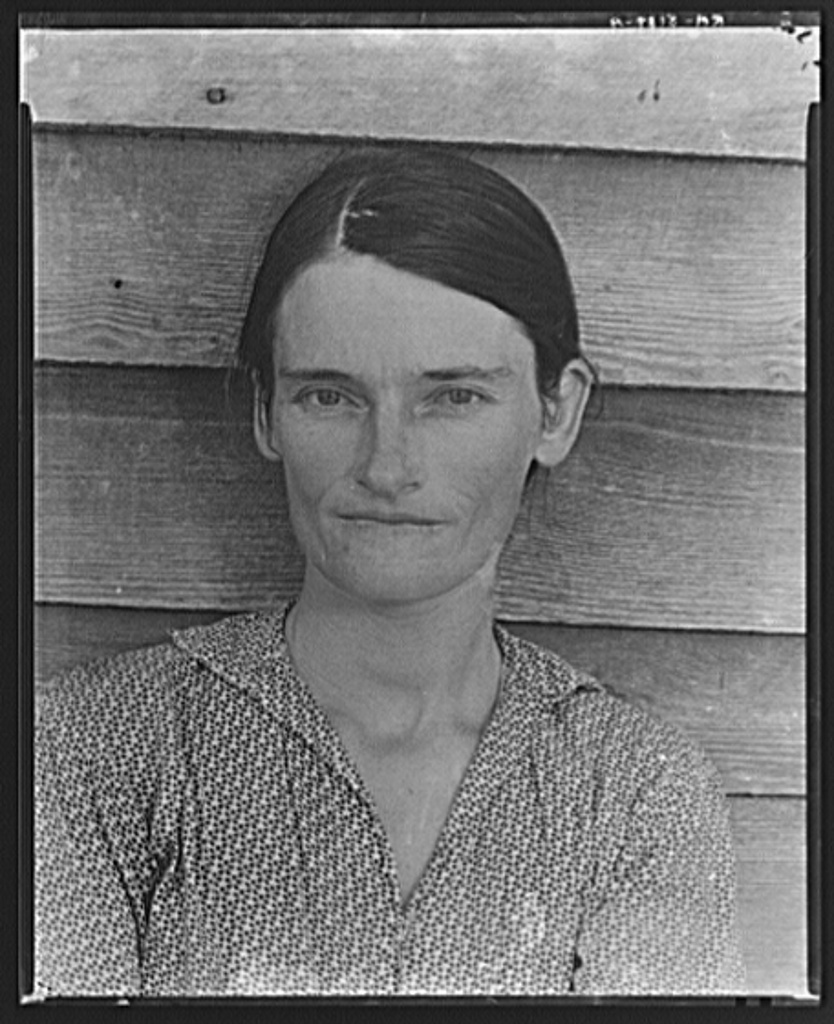
During the Great Depression, The Farm Security Administration—Office of War Information (FSA-OWI) hired photographers to travel across America to document the poverty that gripped the nation, hoping to build support for New Deal programs being championed by F.D.R.‘s administration.
Legendary photographers like Dorothea Lange, Walker Evans, and Arthur Rothstein took part in what amounted to the largest photography project ever sponsored by the federal government. All told, 170,000 photographs were taken, then catalogued back in Washington DC. The Library of Congress became their eventual resting place.
Yale University has launched Photogrammar, a sophisticated web-based platform for organizing, searching, and visualizing these 170,000 historic photographs.
Photogrammar also offers a handy interactive map that lets you gather geographical information about 90,000 photographs in the collection.
And then there’s a section called Photogrammar Labs where innovative visualization techniques and data experiments will gradually shed new light on the image archive.
Top image: A migrant agricultural worker in Marysville migrant camp, trying to figure out his year’s earnings. Taken in California in 1935 by Dorothea Lange.
Second image: Allie Mae Burroughs, wife of cotton sharecropper. Photo taken in Hale County, Alabama in 1935 by Walker Evans.
Third image: Wife and children of sharecropper in Washington County, Arkansas. By Arthur Rothstein. 1935.
Fourth image: Wife of Negro sharecropper, Lee County, Mississippi. Again taken by Arthur Rothstein in 1935.
Bottom image: Destitute pea pickers in California. Mother of seven children. Age thirty-two. Taken by Dorothea Lange in Nipomo, California, 1936.
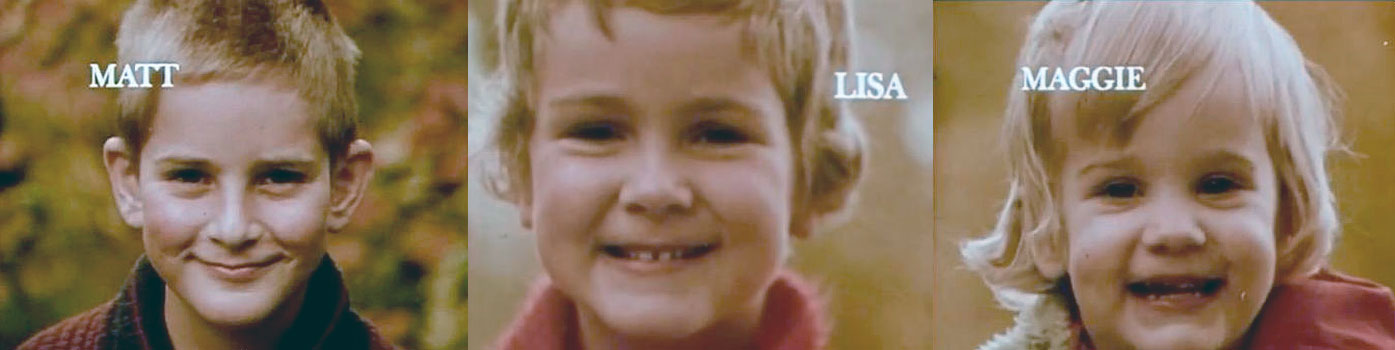
The Story (1969) is a cute short film about two kids, Matt and Lisa, telling their younger sister Maggie a bedtime story about meeting some animals, and an alien, in the woods. You can watch it above. The Matt in this film is none other than Matt Groening, who would go on to create The Simpsons. Their dad, Homer, made the movie. The Simpsons, as Groening admitted in an interview with Smithsonian magazine, is more than a little autobiographical.
I had been drawing my weekly comic strip, “Life in Hell,” for about five years when I got a call from Jim Brooks, who was developing “The Tracey Ullman Show” for the brand-new Fox network. He wanted me to come in and pitch an idea for doing little cartoons on that show. I soon realized that whatever I pitched would not be owned by me, but would be owned by Fox, so I decided to keep my rabbits in “Life in Hell” and come up with something new.
While I was waiting—I believe they kept me waiting for over an hour—I very quickly drew the Simpsons family. I basically drew my own family. My father’s name is Homer. My mother’s name is Margaret. I have a sister Lisa and another sister Maggie, so I drew all of them. I was going to name the main character Matt, but I didn’t think it would go over well in a pitch meeting, so I changed the name to Bart.
Groening incorporated other autobiographical elements into The Simpsons too. For instance, the Groening family, like Bart and company, lived on Evergreen Terrace. In that same interview with Smithsonian, he all but admitted that the show is set in his native Oregon. And he even hinted that the names of a couple despised schoolyard bullies made their way into the show.
The real Homer, however, was very different from the donut-obsessed rube in the cartoon. “My father was a real man’s man, you know. He was a B17 bomber pilot in the War, stationed in England. So I grew up with this very intimidating, tough act to follow,” Groening told the Telegraph. “The nice thing was that he would leave his pens out for me to play with. But then he was not particularly approving of what I came up with.”
And while the early episodes of the Simpsons, which show Homer being perpetually irritated by his smart aleck son, hints at the complicated relationship Groening had with his father, he also credits him – and the movie above in particular – for inspiring his hugely successful show.
He used to tape-record the family surreptitiously, either while we were driving around or at dinner, and, in 1963, he and I made up a story about a brother and a sister, Lisa and Matt, having an adventure out in the woods with animals. I told it to my sister Lisa, and she in turn told it to my sister Maggie. My father recorded the telling of the story by Lisa to Maggie, and then he used it as the soundtrack to a movie. So the idea of dramatizing the family—Lisa, Maggie, Matt—I think was the inspiration for doing something kind of autobiographical with “The Simpsons.” There is an aspect of the psychodynamics of my family in which it makes sense that one of us grew up and made a cartoon out of the family and had it shown all over the world.
Jonathan Crow is a Los Angeles-based writer and filmmaker whose work has appeared in Yahoo!, The Hollywood Reporter, and other publications. You can follow him at @jonccrow. And check out his blog Veeptopus, featuring one new drawing of a vice president with an octopus on his head daily.
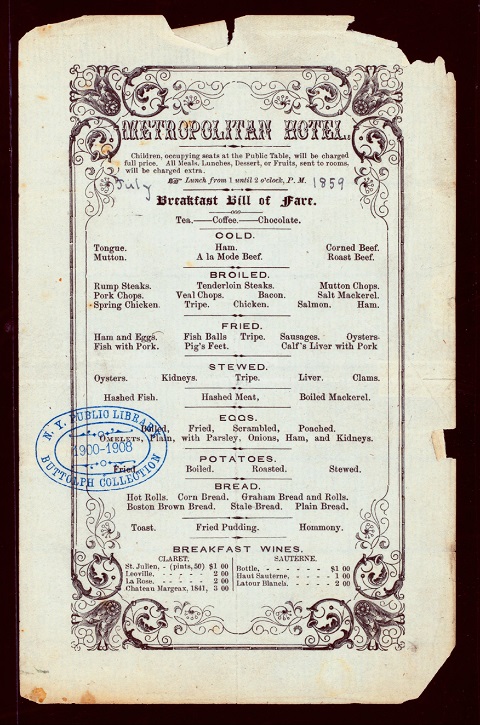
To be a New Yorker is to be a gourmand—of food carts, local diners, supermarkets, outer borough mercados, whatever latest upscale restaurant surfaces in a given season.… It is to be as likely to have a menu in hand as a newspaper, er… smartphone…, and it is to notice the design of said menus. Well, some of us have done that. Often the added attention goes unrewarded, but then sometimes it does. Now you, dear reader, can experience well over one-hundred years of staring at menus, thanks to the New York Public Library’s enormous digitized collection. Fancy a time warp through dining halls abroad? You’ll not only find several hundred New York restaurants represented here, but hundreds more from all over the world. With a collection of 17,000 menus and counting, a person could easily get lost.
You may notice I used the word “gourmand,” and not “foodie” above. While it might be a gross anachronism to call someone a “foodie” in 1859, the year the menu for the Metropolitan Hotel (above) was printed, it might also import a cosmopolitan concept of dining that didn’t seem to exist, at least at this establishment. More than anything, the menu resembles the various descriptions of pub food that populate Joyce’s Ulysses. Though much of it was delicious, I’m sure, for heavy eaters of meat, eggs, potatoes, and bread, you won’t find a vegetable so much as mentioned in passing. The fare does include such hearty staples as “Hashed Fish,” “Stale Bread,” and “Breakfast Wine.” The design marries flowery Victorian elements with the kind of font found in Old West typesets.
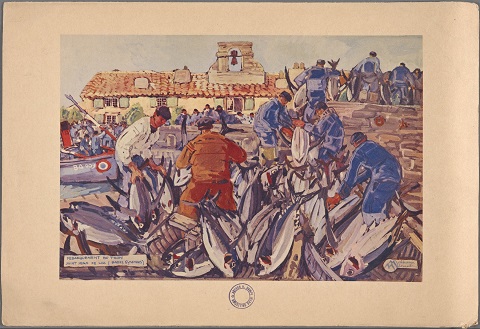
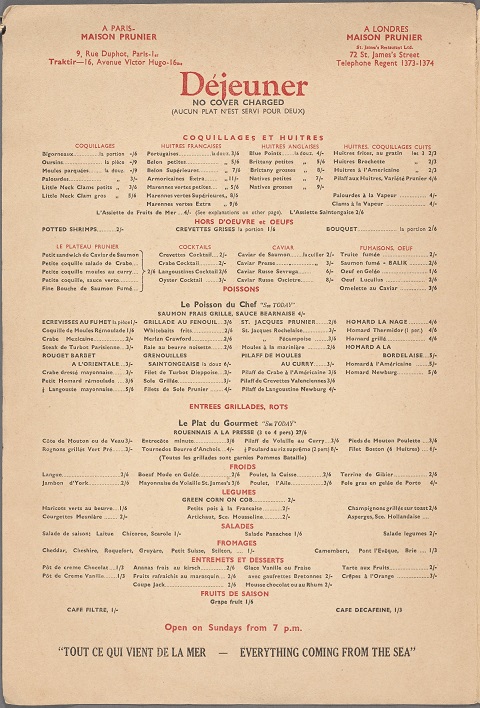
1939 was a good year for menus, at least in Europe. While New York institutions like the Waldorf Astoria practiced certain design austerities, the Maison Prunier, with locations in Paris and London, spared no expense in the printing of their full-color fishermans’ slice of life painting on the menu cover above and the elegant typography of its extensive contents below. A version was printed in English—though The New York Public Library (NYPL) doesn’t seem to have a copy of it digitized. One English phrase stands out at the bottom, however: the translation of “Tout Ce Qui Vient De La Mer–Everything From the Sea.” Other menus for this restaurant show the same kind of careful attention to design. Clicking on the pages of many of the NYPL menus—like this one from a 1938 Maison Prunier menu—brings up an interactive feature that links each dish to close-up views.
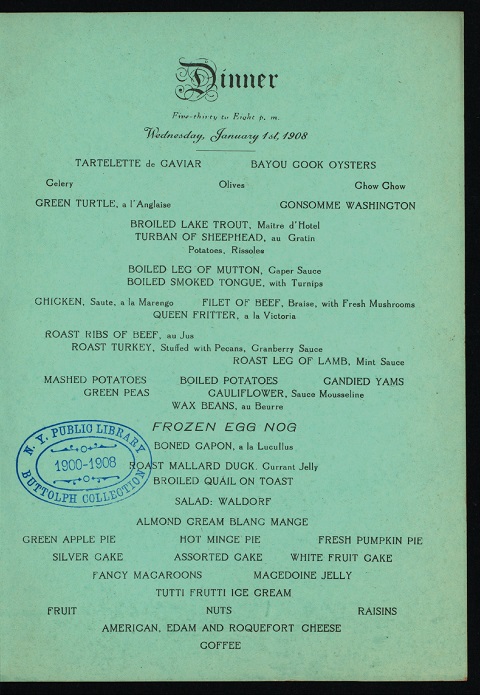
In a post on the NYPL menu collection, Buzzfeed specifically compares New York menus of today with those of 100 years ago, noting that prices quoted signify cents, not dollars. A 1914 Delmonico “Rib of Roast” would run you .75 cents, for example, while a 2014 rib eye there sells for 58 big ones. Of course then, as now, many restaurants considered it gauche to print prices at all. See, for example, the dinner menu at New Orleans’ St. Charles Hotel from 1908 below. We may have an all-inclusive feast here since this comes from a New Years Eve bill, which also includes a “Musical Program” in two parts and a list of local “Amusements” at such places as Blaney’s Lyric Theatre, Tulane, Dauphine, “French Orera” (sic), and the 2:00 pm races at City Park. Matinees and 8 o’clock shows every day except Sunday.
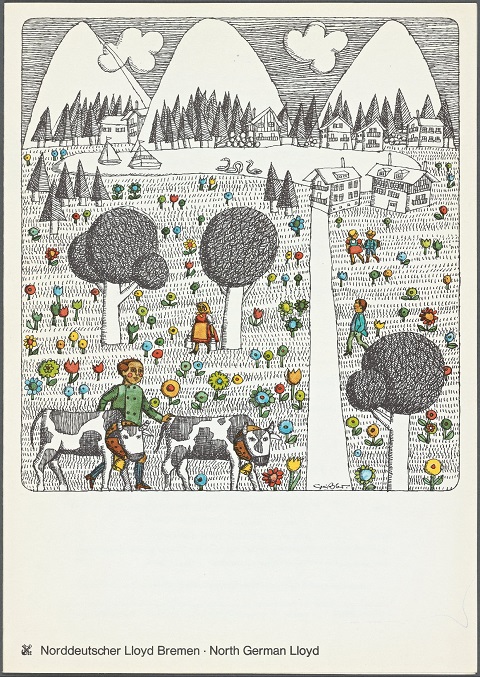
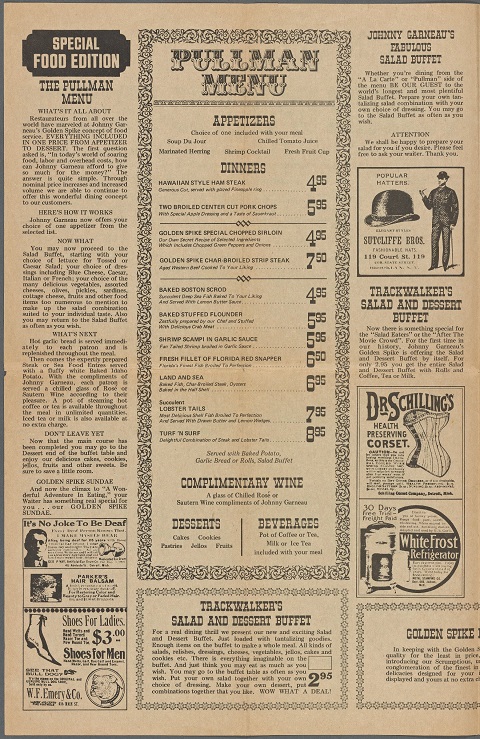
The sixties gave us an explosion of menus that parallel in many cases the breakout designs of magazine and album covers. See two standouts below. The North German Lloyd, just below, went with a funky children’s book-cover illustration for its 1969 menu cover, though its interior maintains a minimalist clarity. Below it, see the striking first page of a menu for Johnny Garneau’s Golden Spike from that same year. The cover boasts a nostalgic headline story for Promontory News: “Golden Spike is Driven: The last rail is laid! East meets West in Utah!” Put it on the cover of a Band or CSNY album and no one bats an eye.
See many, many, many more menus at the NYPL site. With the steady growth of food scholarship, this collection is certainly a boon to researchers, as well as curious gourmands, foodies, and rabid diners of all stripes.
Today we think of music videos, perhaps quaintly and not always correctly, as the cradle of modern Hollywood’s sense-overloading, logic-sacrificing, teen-targeting, “quick-cut” style. But the medium, especially in its formative years, offered a wide-open canvas not just to hacks, but to auteurs as well. Case in point: the British director, artist, and writer Derek Jarman, well known for features like Caravaggio, The Last of England, and Blue, but maybe even better-known, depending on which circles you run in, for his short films meant to promote songs from a variety of musical-cultural figures: The Smiths, Marianne Faithfull, the Pet Shop Boys, Patti Smith, the Sex Pistols, Bryan Ferry. At the top of the post, we see Jarman pushing the boundaries of the music video, intentionally or unintentionally, as early as 1979, with a 12-minute visual suite interpreting not one but three of Faithfull’s songs.
Jarman goes a minute longer just above for another, 1986 three-parter: The Smiths’ “The Queen is Dead,” “Panic,” and “There is a Light that Never Goes Out,” songs which allow him to fully exercise his penchant for nostalgia-saturated styles of footage and acid criticism of the direction of England. He would also collaborate with his equally satirical countrymen the Pet Shop Boys in the late 1980s and early 1990s on no fewer than four separate videos, two of which, both from 1987, appear below: “Rent” and “It’s a Sin.” What’s more, he directed their 1989 live tour, which featured not only elaborate costumes but whole new short films projected onstage. With his combination of theatrical sense and interest in abstract visual expression, Jarman must have seemed a perfect fit for such an aesthetically minded outfit as the Pet Shop Boys. Those qualities also placed him well to define the nature of the music video itself — in which, at its best, we can still detect his influence today.
We're hoping to rely on loyal readers, rather than erratic ads. Please click the Donate button and support Open Culture. You can use Paypal, Venmo, Patreon, even Crypto! We thank you!
Open Culture scours the web for the best educational media. We find the free courses and audio books you need, the language lessons & educational videos you want, and plenty of enlightenment in between.